Known Information
Susan and Isaac Johnson are the parents of Cassandra Johnson, the first wife of Bruce Dent.
Sources
Brown, L. W. (1972). Free Negroes in the District of Columbia, 1790-1846. New York: Oxford University Press.
Provine, D. S. (1996). District of Columbia free Negro registers, 1821-1861. Bowie, Md: Heritage Books.
City Directories for Washington, DC | Fold3
1820 U S Census; Census Place: Washington Ward 4, Washington, District of Columbia; Page: 103; NARA Roll: M33_5; Image: 110 | ancestry.com
Tanner, Henry Schenck. City of Washington. [Philadelphia: H.S. Tanner, 1836] | loc.gov
Susan and Isaac Johnson registered the free status of her two sons, Jacob and Charles Johnson, on 15 September 1827 in the District of Columbia. In this registration, Thomas Hurdle “swears that Isaac, [Sr.] and his wife, Susan, are by reputation free and that Jacob Johnson, aged about five, and Charles Johnson, aged about three, were born in his neighborhood and are the children of Isaac and Susan. They were born free.”
This affadavit, sworn on 13 Sept 1827, provides clues into the lives of the Johnson family in the District of Columbia.
Thomas Hurdle is listed in the 1822 and 1827 City Directory for Washington, District of Columbia. In the 1822 City Directory, he is listed as a foreman carpenter at the Capitol. The 1827 directory lists him as a carpenter living on 2e street near St. Joseph’s Church. In the 1820 Census, he is enumerated as living in Ward 4, which was around Capitol Square. Isaac Johnson is listed immediately prior to Thomas in the census.
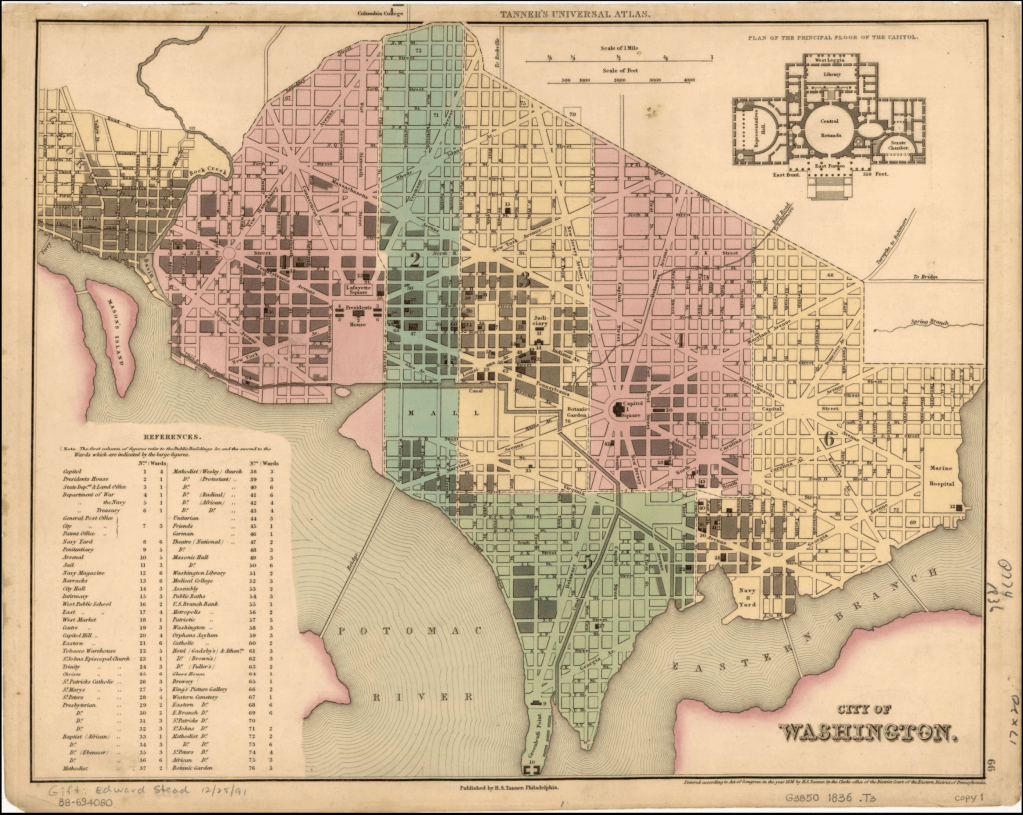
The neighborhood around the Capitol had two types of residents: congressmen and aides living in boarding houses, and the skilled laborers who were building the city after it was burned by the British in the War of 1812. The labor forced used by the city was a mix of Irish labor and Black labor, both free and enslaved.

Thomas Hurdle was listed as living near St. Joseph’s in the 1827 directory. The use of St. as part of the name suggests a Catholic Church, and the early maps of the City of Washington do not list a St. Joseph’s. Instead, I propose that the church referenced is St. Peter’s Church on 2nd and C street. This church was newly established in the 1820s, and both Black and white residents attended the church. St. Joseph’s, which is on 2nd Street in NE was not built until 1868. That the church was mislabeled in the Directory is strengthened by the 1830 Tax Lists.
The DC Tax Books record Archibald Johnson with property on block 734 and Isaac Johnson with property on block 733 in 1830. Between 1830 and 1845, Isaac’s taxes on the property went from $0.31 to $3.45 which suggests he made considerable improvements on his lot.

De Krafft, F. C, W. I Stone, and William M Morrison. Map of the city of Washington. [Washington, D.C.?: Wm. M. Morrison, 1840]
Tanner, Henry Schenck, and S. Augustus Mitchell. City of Washington. [Philadelphia: S. Augustus Mitchell, 1846]
Library of Congress
During this time, the City of Washington was only 20 years old and transitioning from farmland to a city. Large parts of the city remained rural, and the homes of the residents were likely smaller ramshackle buildings.

 stories of Then