Abraham Henry | USCT

Abraham (Abram) Henry enlisted in the 1st Regiment of the US Colored Infantry in June 1863, when the regiment was being organized in the District.

His service records indicate that he was a free man and as such could receive $100 bounty for enlisting.

US Colored Troops Military Service Records “Abram Henry” | ancestry.com

Alexander Hawkins was another free man who joined the same regiment and same company, who was also from Upper Marlboro. Neither man is found in the 1860 census for Prince George’s County.

Both men enlisted a year after the abolition of slavery in DC, and in that year, many enslaved people in neighboring jurisdictions fled their enslavers and the estates where they were held captive, escaping to DC where they could claim freedom. This flight came at the risk of encountering slave patrols and constables who preyed on Black people (regardless of official status), capturing them, confiscating their property and (re)enslaving them.

Chandra Manning wrote in her book Troubled Refuge: Struggling for Freedom in the Civil War, that “despite the chronic threat of kidnapping, refugees from Maryland could at least hope to blend in among the capital city’s free black community.” With the abolition of slavery in DC, it is likely that Abram Henry claimed free status in an attempt to avoid recapture and a return to an enslaver. This theory is supported by documentary evidence both in Henry’s service record and in the registrations kept by the Freedmen’s Bureau. Henry’s wife, Celia, was living in a refugee camp.

Celia Henry

Freedmen and refugees gathered in the presence of the Union troops. Manning wrote, “Wherever the Union army went, tens of thousands of enslaved men, women, and children made their way to its blue lines, braving almost unimaginable risks to get there. They gambled against dogs, heavily armed search parties, jittery Confederate and Union pickets who might shoot at the very sound of an unexpected footstep…Still they came. Still they found work where they could. Still they aided the Union army when and where they were able.” Celia Henry and her two younger children are listed in the registration for the Freedmen’s Village, situated on the bluffs on the confiscated lands of the Lee family, where the federal government was creating a series of forts and entrenchments to protect the capital city.

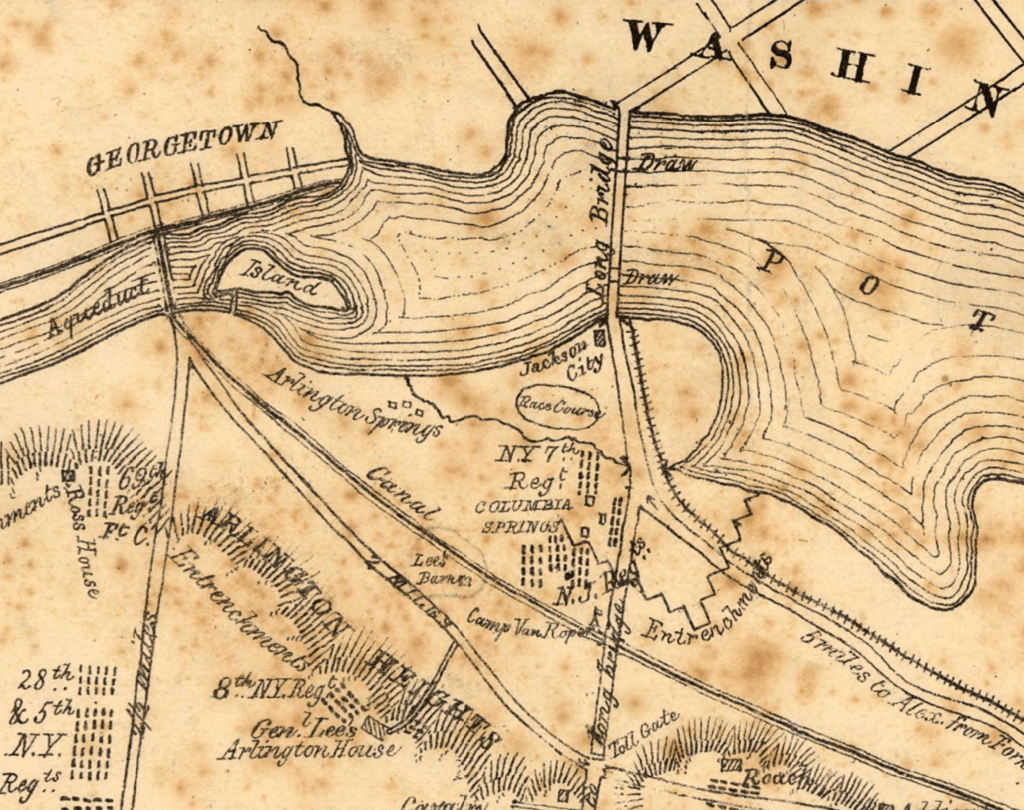
Another record has her registering at Camp Wadsworth, one of the camps set up in Arlington to house the refugees and provide opportunities for employment. Camp Wadsworth was established on the land of Cooke, who had rebelled against the federal government and crossed to the confederacy. The Union army seized his land near Langley and converted it to Camp Wadsworth. There about 200 refugees grew winter wheat, corn, oat, potatoes, cabbage, turnips, buckwheat, melons, tomatoes and garden vegetables. Men are paid from $8 to $10 a month with rations and quarters. (Birmingham Daily Post, 02 Jun 1864) The Buffalo Morning Express reported that some of the crops grown were used as rations in the hospitals (04 Aug 1863)

Family Names

In addition to the record of Celia Henry finding refuge at Arlington Heights and at Camp Wadsworth, there is a pattern of family names that suggest that Abram Henry and his family escaped from Charles Hill.

Charles Hill, and his son, Charles C. Hill were among the largest slaveholders in Prince George’s County. They owned substantial estates in both Marlboro and Queen Anne District. In the 1860 census, Charles Hill’s real estate was valued at $300,000 and his personal estate (which included the value of commodified enslaved people) was $215,000. His son had real estate at $83,000 and a personal estate of $71,720. They enslaved around 280 people according to the 1860 US Slave Schedule.

In 1867, Charles C. Hill submitted compensation lists for himself and on behalf of his father’s estate, listing the given and family names of those he enslaved. Among the lists are the family names, Henry and Hawkins, the same family name as Abram Henry and Alexander Hawkins who enlisted as free men. In fact, the Hill family was the only family to submit the name Henry as a family name.

A review of the Freedmen’s Bureau registration lists shows other family names connected with the Hills’ compensation lists: Holland and Diggs. The Hill family claimed 35 people with the family name Diggs, and a Holland family. The Holland family was smaller: four people, one of whom was named Martha and her two children, who were the same approximate age of those in the Registration list.

The evidence is circumstantial and indirect — and it is possible that documentary evidence exists that counters this hypothesis. And yet, the evidence that has been found suggests the possibility that Abram and his wife Celia escaped to DC with their children, and Abram signed up to fight in the newly created regiment of the Colored Troops while Celia sought refuge at the freemen’s camps.

After the war, they returned to Prince George’s County where they raised a family, having many of their children baptized by the priests of White Marsh a Jesuit Plantation with connection to Charles Hill and other wealthy Catholic landowners.

Eleanor (Nelly) Crawford

Nelly Crawford was listed in the Benjamin Lee inventory as 33 years old with four living children: Caroline, Louisa, Dennis, and Jerry.

The names of the children with their ages allowed for the identification of Eleanor (Nelly) Crawford’s family in the 1870 Census. The family was living with their father, Dennis Green, near the small mercantile community of Woodmoor. Eleanor is not listed with the family, suggesting she died within the past two years.

John and Harriet Crawford

This is one post in a series on the children of David and Kizzy Crawford.

John was listed as Kizzy’s son in the 1832 Inventory of James Belt‘s estate. He was four years old when Belt died. Kizzy, his mother, was 27 and she was listed with an unnamed child and John, her son.

PC 2:20 James Belt’s Inventory | familysearch.org

In 1863, John (as Jack) and Kizzy were listed in the Inventory of Benjamin Lee’s estate. Lee was the son-in-law of Belt and administered his estate.

WAJ 3:127 Benjamin Lee’s Inventory | Maryland State Archives

In 1870, after emancipation, John was enumerated as living in Queen Anne District along Church Road south of Collington. He is living with his wife, Harriet and four children.

White Marsh Records

The Jesuit priests of White Marsh, located near Priest’s Bridge in Queen Anne District, left baptismal records, including parent’s names, sponsors and at times, the mother’s enslaver. These help recreate kin groups.

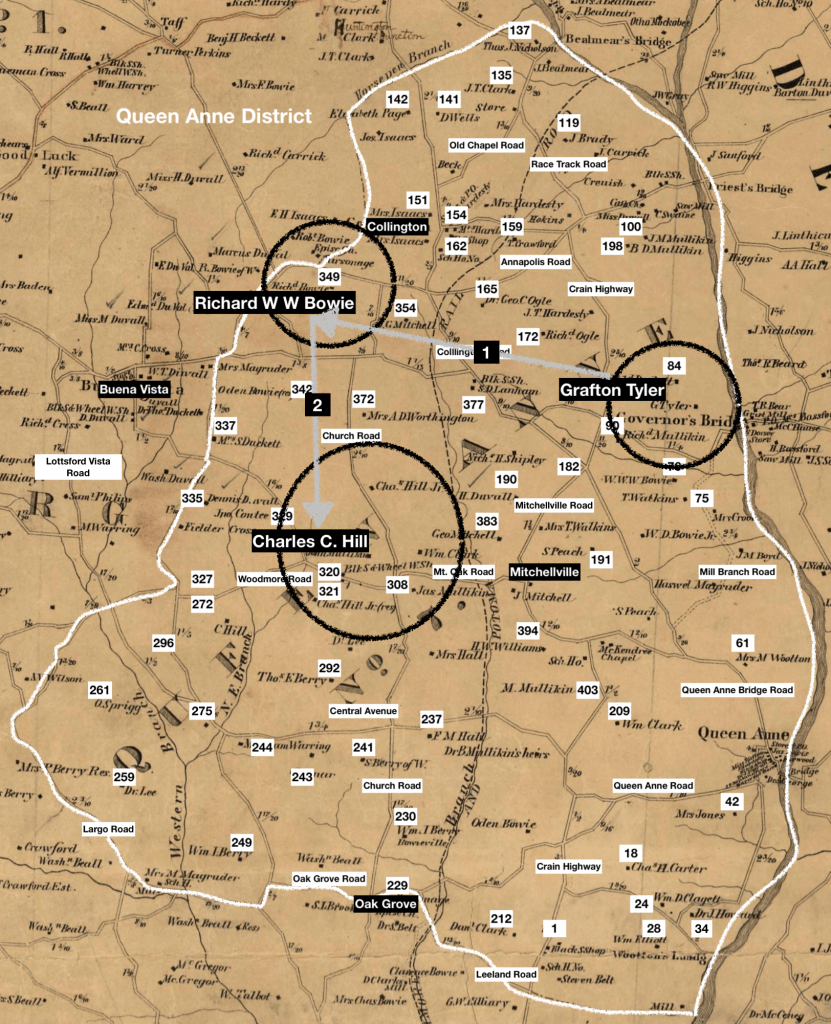
In 1853, the priests of White Marsh recorded the baptism of Louisa Crowford, daughter of John Crowford and Hariot Harrison, his wife, property of Dr. Tayler. Dr. Tayler is likely Dr. Grafton Tyler who owned a large estate near Governor’s Bridge. Her birthday is noted as July 1 1853.

In 1856, Amelia [Amilia] Crawford, daughter of John Crawford and Harriet [Hariot] Harrison was baptized. The mother was marked as property of Richard Bowie. Johanna Harrison sponsored the baptism. As Harriet and Johanna have the same last name, it is likely they are kin, cousins or sisters. Her birthday is marked as April 1856.

In 1859, William H Crawford, son of John and Harriette Crawford, “servants of Charles Hill, Jr.” was baptized.

In each baptism, Harriet Harrison is recorded as the property of three different enslavers: Dr. Grafton Tyler, Richard W. W. Bowie, and Charles C. Hill, all large estate owners in Queen Anne District.

In 1867, Charles C Hill enumerated names on the compensation lists he submitted to the Prince George’s County Commission on Slave Statistics. Harriet and five children were named by Hill:

  • Harriet, age 37
  • John, age 17
  • Thomas, age 15
  • Lucy, age 12 ⛪️
  • James Washigton, age 3 ⛪️
  • Edward, age 1

Amelia & Lucy Crawford

Amelia Crawford, baptized in 1857, was not named in the 1867 compensation list submitted by Charles C. Hill. It is unclear if she was separated from her family as they were sold to Bowie and Hill, or if she did not survive to adulthood, though she may be the second wife of Henry Tyler.

In 1870, Lucy Crawford married Henry Tyler. Their marriage was performed by “Begue”, i.e., Charles Bague, one of the Jesuit Priests of White Marsh. This shows the marriage was Catholic, in line with the other White Marsh baptisms.

In the 1870 Census, John and Harriet Crawford are enumerated at dwelling number 366. They are listed with four sons: Thomas, James, Edward, Charles. Enumerated immediately after the Crawfords is the household of Henry Tyler at dwelling number 367. He is 21 years old.

1870 Census | ancestry.com

Henry Tyler’s Household

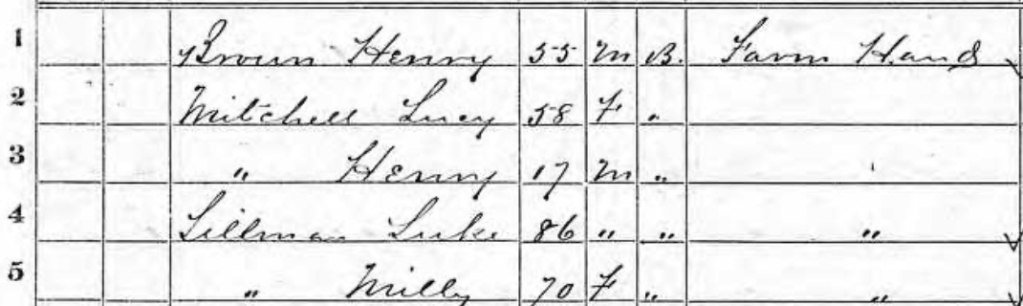
Henry’s household does not list Lucy or another female of comparable age. There is Henry Brown, age 55, Lucy Mitchell, age 58 with Henry, age 17, as well as Luke and Milly Tilghman (Tillman).

1870 Census | ancestry.com

Lucy Mitchell and Henry were names submitted by Charles C. Hill; Luke and Milly were not submitted. However, the 1826 will of Francis Magruder Hall conveyed “Luke and Milly, his wife and their six children” to Hall’s grandson, Benjamin Young, the son of Notley and Eleanor Young.

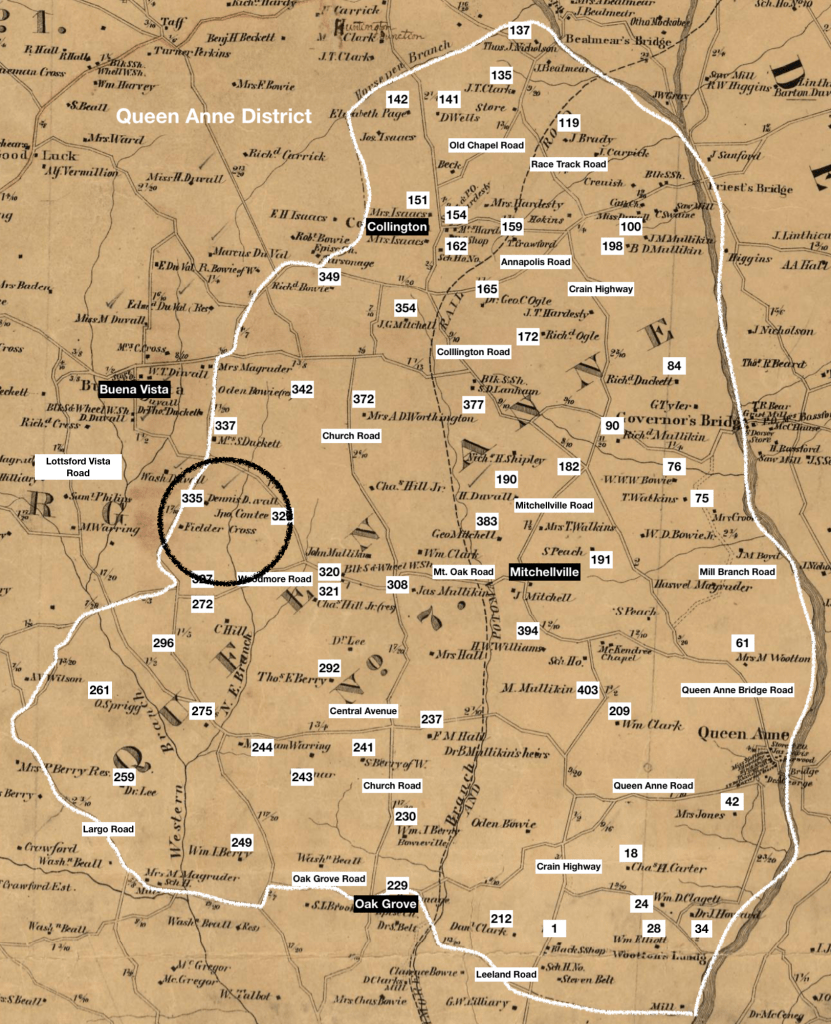
In 1880, Henry Tyler is living in Queen Anne District near “T. C. Slingluff”, a landowner who is living near Woodmore along the edge of Queen Anne District. Slingluff had acquired the estate of Fielder Cross.

1880 Census | ancestry.com

Henry Tyler is living with “Emma Tyler”. Emma and Amelia are similar sounding names. They are both listed as 30 providing a rough estimated year of 1850.

In 1900, Emma Tyler appears in the census, living in Kent, the neighboring district. She is living with John Tyler, her nephew. Her birthmonth is given as April.

James Stewart | Wife

In 1870, a partnerless James Stewart is living with his grown children in Queen Anne District of Prince George’s County. The census allows us to identify George, Mary (Polly), Sarah (Sallie) and Notley. The death certificate for George Stewart in 1904 lists James Stewart and marks his mother as unknown.

James Stewart was enslaved by Marsham Waring and his children were enslaved by Dr. Benjamin Lee. Both slaveholders owned extensive property in Queen Anne District and were brother-in-laws. They also both died during the Civil War, and the inventories of their estate help to identify the family groups.

The 1863 Inventory of Lee’s estate (WAJ 3:127) allows for the identification of other children of James Stewart. As explored in another post, Jim was identified as James Stewart, Jr.

In 1832, James Stewart and Suky had their son, James, baptized by the priests of White Marsh. James (Sr.) was identified as enslaved by Marsham Waring and Suky was identified as enslaved by Dr. Lee.

In the inventory excerpt, there is a child, Susan, 2 months old, that is likely the daughter of Betty, age 18, and grandchild of James Stewart as they are listed between other children of James Stewart also identified in the 1870 census. The name Susan is also used by Sarah Stewart, the daughter of James Stewart. This repetition suggests that the name is significant to the family and is consistent with what was learned from the 1832 White Marsh Record, namely that James Stewart partnered with Suky, or Susan. Sukey (and numerous variations) was a diminutive of Susan.

In 1854, Susana Steward sponsored the baptism of Christina Johns [Jones], the daughter of Joseph and Barbara Jones, who were enslaved by Marsham Waring.

The names in the inventory give hint to Susana Stewart’s age. The ages range from 29 to 3; though the baptism of James in 1832 suggests that the ages are slightly off. If we estimate that Susana began having children around 1830 and that Notley was her last child in 1860, this would suggest a typical child-bearing range of 30 years when women were approximately 15 to 45 years old, allowing us to estimate that Susana was born around 1815.

James and Martha Wedge

Martha Wedge died in August 1908; her death certificate lists her as a widow and child of C. Briscoe and Olivia Briscoe. Daniel Webster, her brother, served as the informant.

Maryland State Archives

In 1900, Martha Wedge is enumerated in the census as an employee in the household of William Underwood in Piscataway District of Prince George’s County. Underwood is a merchant. The 1878 Hopkins Atlas of Prince George’s County Map, Piscataway District, shows the Underwood family living in the vicinity of the Accokeek Post Office along with the Manning Family.

In 1870, three decades earlier, Martha Briscoe and James Wedge are living in the Underwood household, William, a merchant in 1900, is a five-year old living with his parents, John and Mary Underwood, yeoman farmers, who had two domestic servants and a laborer in their household, including James Wedge and Martha Briscoe.

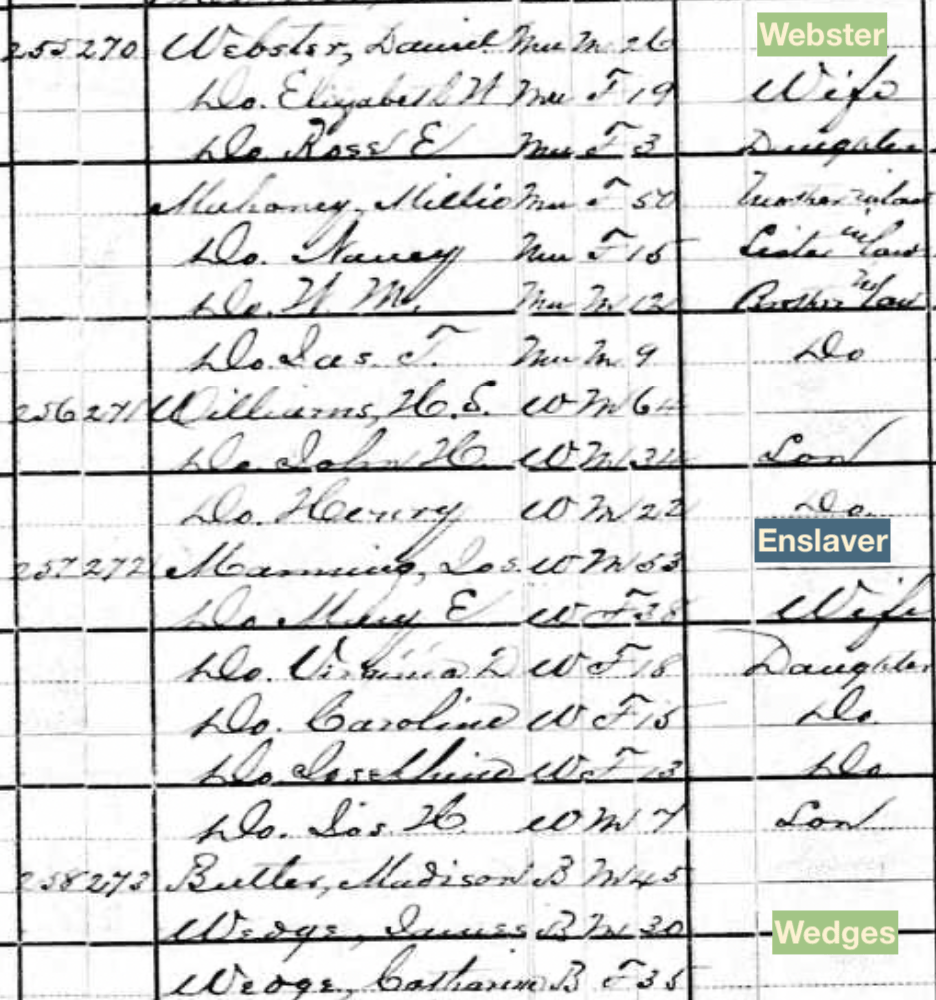
In 1880, they appear in the census as James and Catherine Wedge, still living Piscataway, but not with the Underwoods. They are living with Madison Butler, a Black carpenter.

Living nearby, enumerated three households before, is Daniel Webster and his wife Elizabeth Mahoney, her mother and siblings.. The families were living near the Mannings, who were near the Underwoods along Piscataway Creek. Joseph Manning claimed Matthew Mahoney, Elizabeth’s father in his compensation list that was submitted to the Prince George’s County Commission on Slave Statistics in 1867.

In 1900, Daniel is working as a Carpenter and living in Piscataway near his in-laws.

1880 Census | ancestry.com

Rachel Weldon

Collateral

A series of financial transactions between Richard W. W. Bowie and others in the 1850s shows Bowie in debt and using Rachel and her children, whom he enslaved, as collateral for his debt. 

Richard W. W. Bowie’s father had died in 1839, and his inheritance was controlled by his mother until her death in 1852.  Bowie married the same year; joining in matrimony to Elizabeth L Waring, the daughter of Marsham Waring. 

In 1852, Richard W. W. Bowie signed an indenture on account of having borrowed $500 from Septimus I Cook.  To secure the loan, he sold the legal authority to enslave Rachel (about 30 years old) and her four children: Elizabeth, 10 years old, Mary, 8 years old, John, 6 six years old, and Sophy about three years old to William Holtzman, who secured the loan.  (ON 1:157)  Holtzman was a merchant living in Vansville District. 

In 1854, Richard W. W. Bowie signed another indenture on account of having borrowed $1200 dollars from James T. Perkins.  He secured the loan through the conveyance of Rachel (32 years old), Catherine (12), Sophy, (6) and Edward (4).  and a “boy” by the name of Isaiah (18) to Richard D Hall, a planter, also residing in Vansville.  (ON 2:148)

NameAge in 1852 IndentureAge in 1854 Indenture
Rachel3032
Catherine/Elizabeth1012
Mary8
John6
Sophy36
Edward4

Baptismal Records

The same year that Bowie mortgaged the family to Hall, Rachel had a child baptized by the priests of White Marsh.  Baptismal records for White Marsh prior to 1853 perished in the fire, and the baptism in 1854 is the first after the fire. 

In August 1854, the priests of White Marsh baptized Philomena, the daughter of Eduard Weldon and Rachel Galloway.  Rachel was recorded as property of Richard Bowie.  

In May 1856, the priests baptized Ann. Elis Welden, the daughter of Eduard Welden and Rachel GallowayRachel was again marked as property of R. Bowie. 

In July 1859, the priests baptized Anne Maria, daughter of Edward and Rachael Weldon, at Mr. Bowie’s residence.

In April 1863, the priests baptized Mary, daughter of Rachel and Edward Weldon at Rob. Bowie’s residence.

Waring’s Purchases

In March 1857, Richard W. W. Bowie sold the family to Marsham Waring, his father-in-law for $2000, most likely allowing him to maintain possession of the family at his estate for the use of Waring’s daughter, Elizabeth L. Bowie.  (CSM 1:538)  This transaction was not secure a debt, rather was a bill of sale, in which he sold the legal authority to enslave Rachel, age 35, Catherine, age 13, Sophia, age 7, Edward, age 5, Philla, age 3, and Elizabeth age 1.  The Bill of Sale does not mention her husband Edward Welden; it is unclear who enslaved him, as priests did not consistently record the father’s slaveholder. 

NameAge in 1852 IndentureAge in 1854 IndentureAge in 1857
Bill of Sale
Rachel303235
Catherine/Elizabeth101213
Mary8
John6
Sophy367
Edward45
Philla (Philomena)3
Ann Elizabeth1

In February 1859, Richard W. W. Bowie was paid $3000 by his brother Walter W. W. Bowie to relinquish claim to land described in the 1839 will of his father, Walter Bowie, particularly “Locust Grove”.  (CSM 3:117)

Then, in the same month, Marsham Waring purchased the lot and parcel of land “known as part of Darnall’s Grove” and called “Locust Grove”, for $15,190 from Walter W. W. Bowie.  (CSM 3:538) The Daily Exchange, a paper out of Baltimore, reported the sale.  

In Waring’s 1860 will, he directed that the farm “Locust Grove” go to his son James Waring, “for the use and benefit of my beloved daughter Elizaebth L Bowie [Richard W. W. Bowie’s wife], the plantation which I purchased of Walter W. W. Bowie”  In his inventory, the people enslaved by Waring were organized by estate and 9 people were named as laboring on Locust Grove:  Anna, 22, George, 4, Mary 15, Sam, 35, and Rachel 28, Catherine, 16, Edward, 8, Eliza, 8, and Maria, infant.  Rachel and her children made up the bulk of the people named on the estate.  

After Waring’s Death

In May 1862, Catherine Weldon, the daughter of Edward and Rachel, fled to the District with other people from the Waring estates.  She is named in the affidavit that James Waring took out.  The month prior, in April 1862, the District had abolished slavery and those enslaved in the neighboring jurisdictions fled to the freedom it promised along with the Federal Troops who offered a modicum of protection against slave patrols and slave catchers.  Many named in affidavit and their extended family are found in the records of the freedmen’s camps (see Jones Family Group and Stewart Family Group posts).  Records connected to Catherine have yet to be located.  Though in February 1867, Rachel Weldon is recorded as receiving a nominal amount from a Freedmen Bureau’s agent in the District. 

In April 1867, the priests of White Marsh baptized Edward, the son of William Franklin and Catherine, his wife.  Martha Sprigg, a woman formerly enslaved by the Warings, sponsored the baptism.  Martha’s son, Daniel, was baptized the same day.   Edward was likely named for her brother and father.  

In 1870, Edward and Rachel Weldon were living in the District of Columbia, in Ward 6 with their son Edward.  Both Edward’s are working as laborers.  City Directories place them near Lincoln Park.  In 1880. the census records Edward and Rachel  at 328 Ninth Street SE with their grandchildren.   Rachel died in October 1884 and was buried at Mt. Olivet Cemetery.  Edward died in 1889 and is also buried at Mt. Olivet.  


In 1870, Catherine and William were living in Queen Anne District in the vicinity of Collington with three children and in 1880 they were living in the vicinity of Bowie.  FrankWeldon, age 48, is living in their household.  He is perhaps an older brother or uncle of Catherine.

Rachel’s Family Group

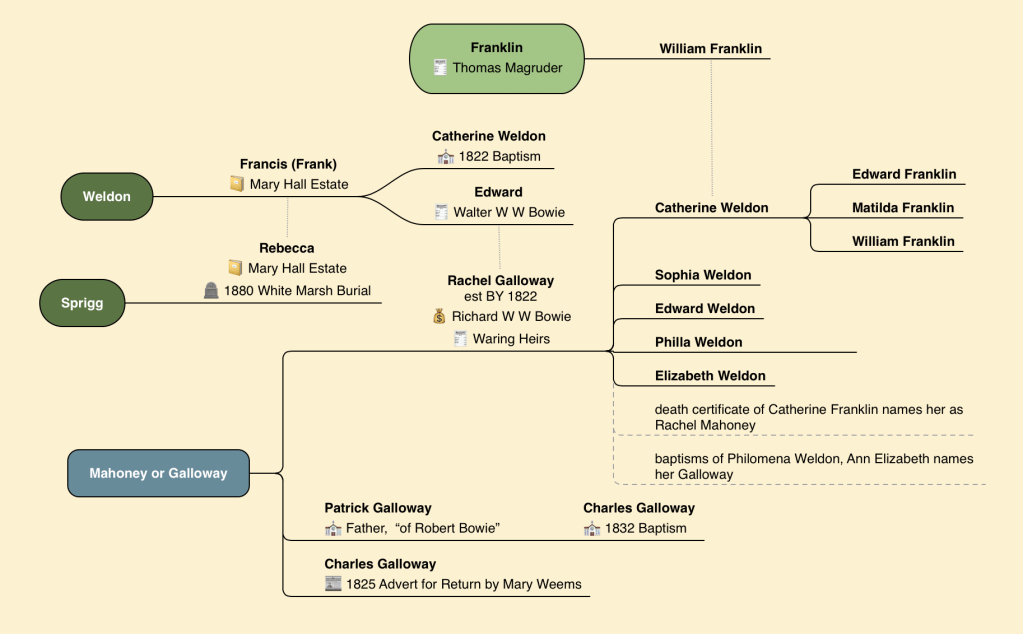
Rachel partnered with Edward Weldon. The extended Weldon family had multiple baptisms recorded in the surviving White Marsh Baptismal records and many were connected with the Mary Hall estate. In the 1861 Inventory of Mary Hall’s estate, two elderly people are named: Frank and Becky. Based on their age in the inventory, they were born around 1790. In 1822, a priest of White Marsh baptized Catherine, daughter of FrancisWelden” and Becca Sprig. The name Catherine would also be used by Edward and Rachel suggesting a relationship between the Weldons enslaved by the Bowies (Edward Welden and his children) and the Weldons enslaved by the Hall family (Francis Weldon and his children)

Two direct sources provide two possible names for Rachel’s family: Galloway and Mahoney. The Baptismal Records lists Rachel as Rachel Galloway in 1854 and 1856 baptisms of her children. This source most likely had either Rachel or her enslaver providing the name for her family, and therefore directly knowledgeable about her family connections. The second source is a death record for Catherine Franklin, who died in Dec 1911, almost thirty years after Rachel. Her son listed his grandparents, and Catherine’s parents as Edward Weldon and her mother as Rachel Mahoney.

Mahoney is connected with a family with direct ties to White Marsh, as Charles Mahoney had sued John Ashton, manager of White Marsh for his freedom in the 1790s. William G. Thomas wrote a fascinating book about this suit and others, called A Question of Freedom: The Families Who Challenged Slavery from the Nation’s Founding to the Civil War. The Hall Family was descended from Benjamin Hall who is said to have taken possession of Ann Joice after she was illegally denied freedom at the end of her indenture. The Mahoney family was descended from Ann, and three Mahoney’s were named in the will of Francis Magruder Hall in 1826. Francis Weldon and Becca Sprigg were named by Hall as well in his will. The death record that connects Rachel to this family group is from a less reliable informant than the informant of the baptism records due to the nature of memory. Based on depositions given by the members of the Mahoney family during their freedom suits, their family passed on an oral tradition of how they were related to Ann Joice, which may have continued after the end of the freedom suits.

The family name Galloway has fewer baptisms than Mahoney or Weldon. In 1832, the priests baptized Charles, the son of Patrick and Henrietta Galloway who was enslaved by Robert Bowie. The sponsor was Kitty from White Marsh. Seven years earlier, a Charles Galloway escaped the captivity of Mary Weems living in Prince George’s County. He was described as a mulatto man about 21 years of age with relations in the city of Washington. Mary Weems, who advertised for Galloway’s return, may be Mary Margaret Hall who married James William Loch Weems and the grandmother of Walter W. W. Bowie and Richard W. W. Bowie. Mary Margaret Hall and Francis Magruder Hall were siblings, and therefore likely to partner their enslaved young adults.

The two diagrams below show the relationships visually. The first shows the connections between the slaveholders. The second diagram shows the family connections of Edward and Rachel Weldon as constructed from direct and indirect evidence, and the estates they were were associated with.

Mary Weems died in 1849, and the 1850 inventory of her estate shows a family group that may be Rachel and children born prior to the surviving baptismal records of White Marsh. (PC 1:384) Rachel, age 30, would have an estimated birth year of 1820, similar to Rachel Galloway’s age given in the multiple Bowie transactions. Additionally, she had a daughter, Catherine, age 5, would would have an estimated birth year of 1845. The 1857 Bill of Sale between Bowie and Waring had an age of 13 for Catherine which would result in an 1844 estimated birth year. Additionally, the oldest daughter, Henny, may have been named for Henrietta Galloway, the mother named in the 1832 baptism, an inferred relative of Rachel.

William Crawford | Civil War Drafts

In 1863, the US Federal Government began to actively recruit Black men for the Union Army. In the fall of 1863, the War Department authorized the systematic enlistment of enslaved men in the Border States, including Maryland. General Order 329 promised freedom to the soldier and compensation to slaveholders loyal to the Union. The slaveholders were resistant to the enlistment of what they perceived as their “property”, despite promised compensation.

Barbara Jean Fields wrote in her book Slavery and Freedom on the Middle Ground that “Full-scale recruitment put an end to slavery in Maryland. Before the war was over some ten thousand Black men served in the Union army and navy. If only half of them were slaves, they would represent well over a third of the slave men aged eighteen to forty-five.”

In October 1864, the War Department organized a round of the Draft and the names were published in the Baltimore Sun. Among those pulled for the Seventh District of Prince George’s County (Queen Anne District) were Samuel and William Crawford, “slave of the estate of Benjamin Lee”.

Oct 21, 1864, Baltimore Sun, page 1 | newspapers.com

Not every name was called into service and of the two brothers, William Crawford served. A service record for the 6th regiment of the USCT Infantry, Company H shows that he was born in Prince George’s County, Maryland and was drafted from the 5th Election District (Prince George’s County).. He was enlisted for one year.

The service record describes William Crawford as 28 years old [1836] and of average height at 5 feet 8 1/2 inches. His eyes, hair, and complexion was described as Black. By April 1865, he was ill and marked as “absent sick” in the muster rolls. He was mustered out in Sept 1865 in Wilmington, NC.

For the time that Crawford was enlisted in the 6th regiment, it appears to have been fighting in North Carolina as part of the attacks on Fort Fisher, North Carolina and at Sugar Loaf Hill. In February it took part in the Battle of Wilmington and in March took part in Sherman’s Carolinas Campaign.

In 1870, William Crawford filed for a pension as an invalid. It does not provide a place of residence and Crawford has yet to be identified in the 1870 census.

Samuel and Sophia Crawford

In the 1863 Inventory of Benjamin Lee‘s estate, Sam, age 24, is listed two names below the name of Davy and Kizzy. No other details are recorded for him. The estate’s appraisers noted that “Owning to the unsafe conditions …. produced by the war” that raged on, they could not provide a market value for the people they commodified, marking only each person as $100, giving no other indication of health or skill. In October 1864, the Civil War Draft called the name of Samuel Crawford, “slave of the estate of Benj Lee”; based on the birth years of his children, he likely did not get called up.

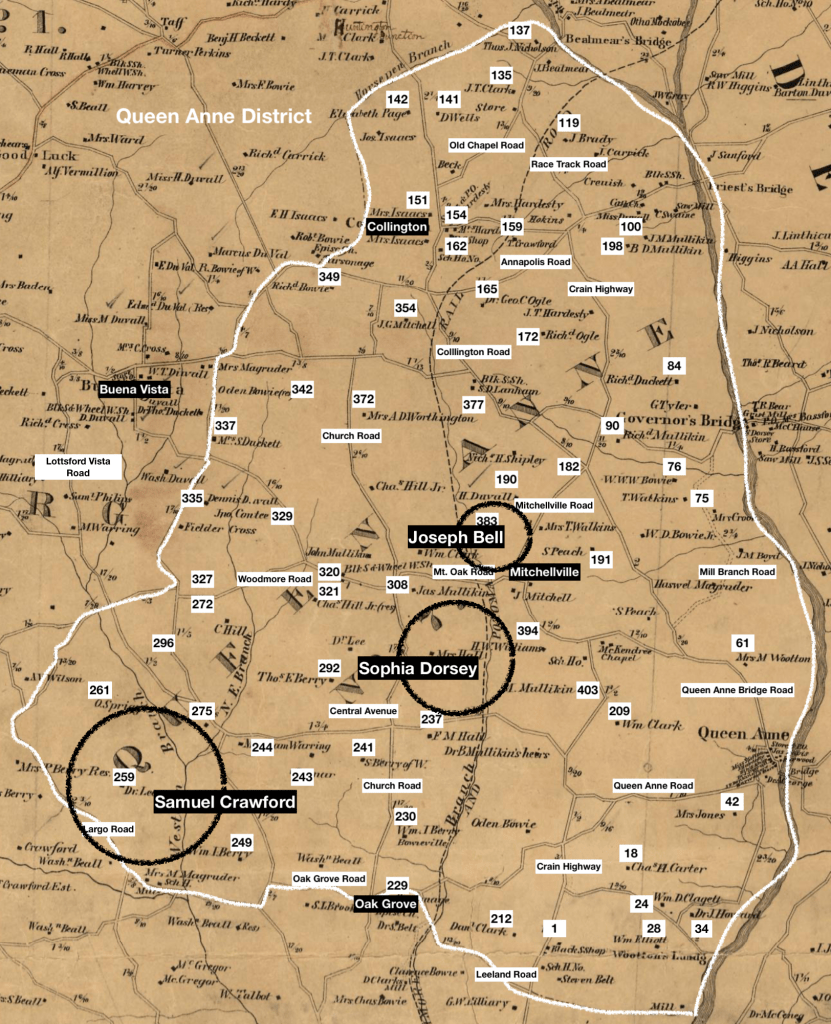
And in 1870, after the Civil War ended and the nation began the slow arduous work of reconstructing an economy based on a strict social hierarchy, Samuel Crawford, age 35, was living between Buena Vista and Mitchellville, two small mercantile communities among the plantations of the “Forest of Prince George’s County.”

Crawford lived near the convergence of Woodmore Road with Mt. Oak Road at Church Road near the estates of Mary Hall and James Mullikin, white landowners who had connections with some of the richest men in Prince George’s County, that derived their wealth from the labor of the enslaved and near Lee’s newly purchased Stewart Farm.

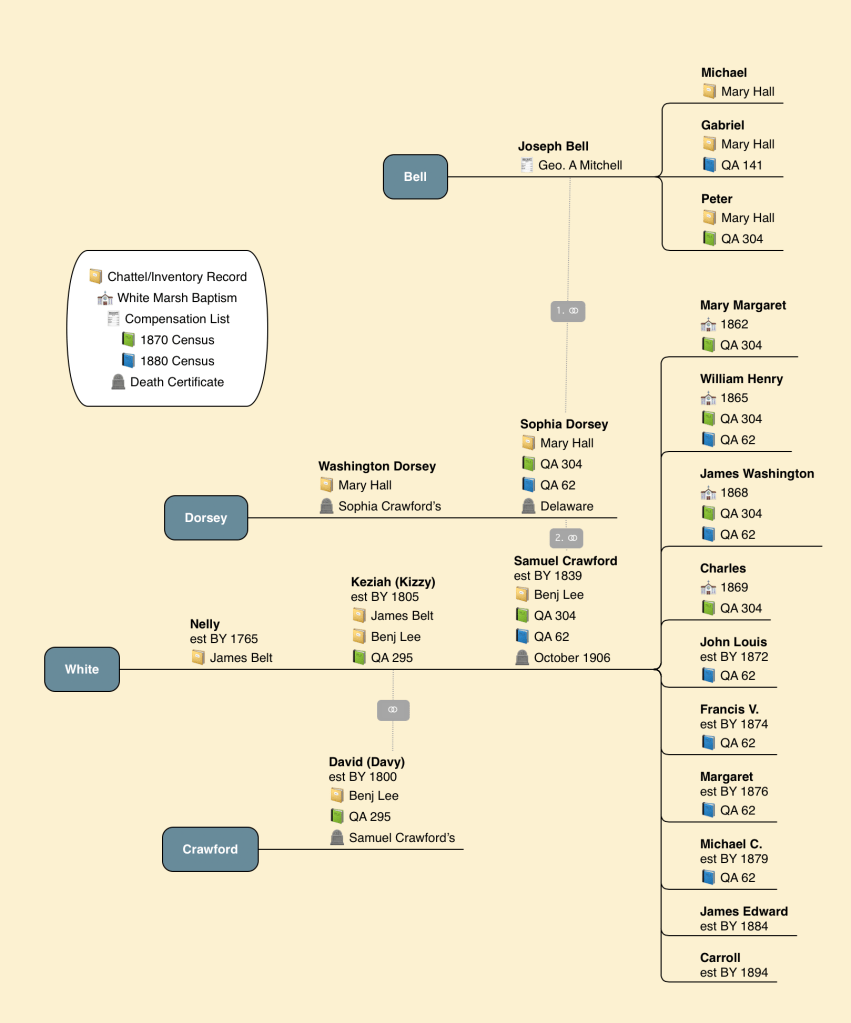
Samuel Crawford is living with his wife, Sophia Crawford, age 30 and their four children, Mary, age 8, William, age 5, Washington, age 3, and Charles age 1. Also living with them is Peter, age 10, not listed chronologically with the other children, suggesting a different relationship than biological.

Through the next three decades, Samuel would labor in the fields of Queen Anne District, renting his farm and providing for his family. He died in October 1906 from chronic gastritis. His son provided the information for the Certificate of Death, naming Sophia as his wife and David Crawford as his father. After his death, Sophia and many of their children migrated north away from Queen Anne District and Prince George’s County to Delaware.

Maryland State Archives

White Marsh Baptisms

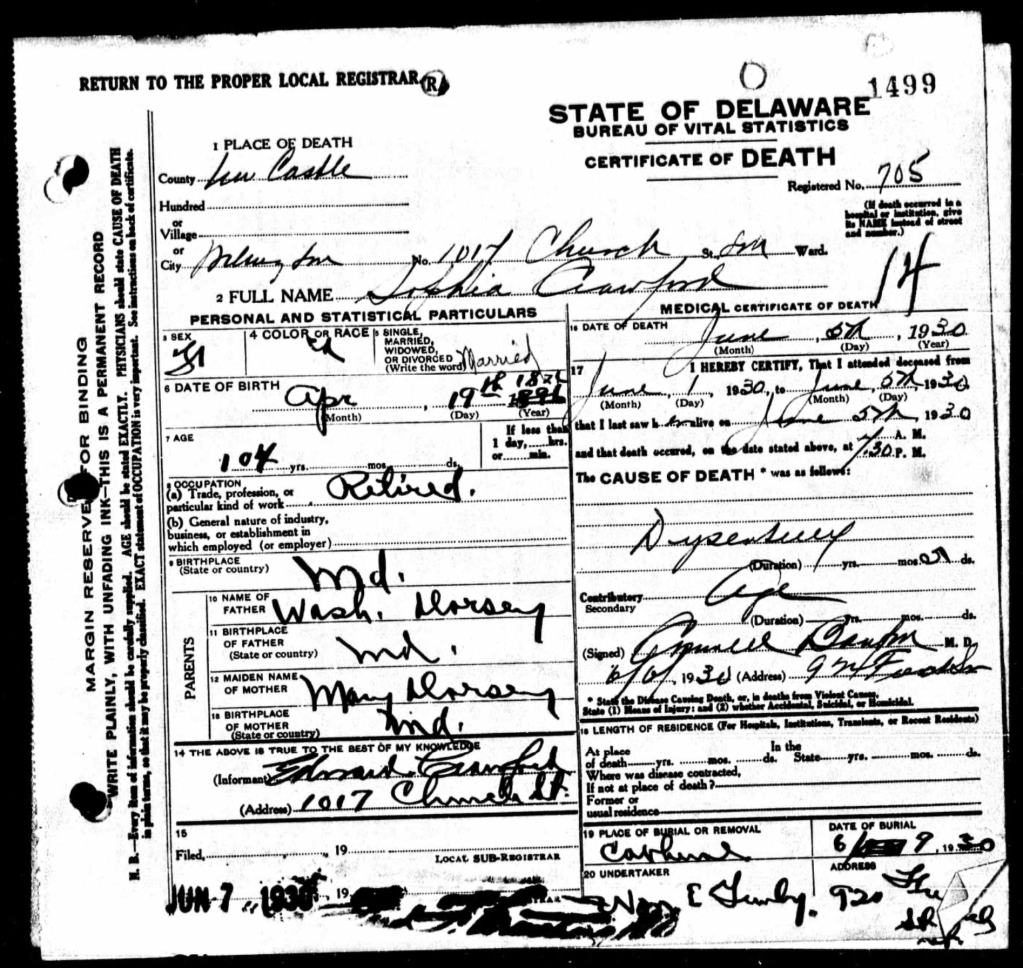
Sophia died a few decades later in 1930. At the beginning of the Great Depression, Sophia Crawford lived in New Castle, Delaware, where she was living with her son, Edward. He gave the name of her parents as Wash. Dorsey and Mary Dorsey of Maryland for the death certificate.

ancestry.com

The Evening Journal ran an obituary for her: “Former Slave Dead at Age of 104”

Life as a slave in Maryland, the Civil War and freedom which followed it, were vivid memories of Mrs. Sophie Crawford, who died last evening, at the age of 104 years, at the home of her son, James E. Crawford, 1017 Church Street. She had not been ill, but gradually weakened until she died.

She was born on April 19, 1826 on the estate of the late Mr. and Mrs. F. M. Hall in Prince George county, MD., and spent her life as a slave there. Sophie Dorsey married Joseph Bell when she was eighteen years old. Two sons that marriage, Gabriel Bell of Uniontown, PA., and Peter Bell of Baltimore, still survive her. Joseph Bell was killed in the Civil War. In 1865, she married Samuel Crawford. Eleven children were born to them, six boys and five girls. Of these children, John L. Crawford, Michael C. Crawford, and James E Crawford, all of this city, survive her.

The old colored woman had been reared a Catholic and since coming to Wilmington in 1911, was a member of St. Joseph’s parish. She was very devout and counseled her children to be temperate in all things.

Funeral Services will be held on Monday from her home. Solemn requiem mass will be said in St. Joseph’s Church and internment will be in Cathedral cemetery.

The News Journal, Wilmington, Delaware, 6 Jun 1930, page 39

The article notes her former enslaver. Mrs. F. M. Hall, or Mary Hall, was part of the Hill family, descendant from the Darnalls and other Catholics connected with the Calvert family, who had shaped much of Maryland’s culture and economy. Mary Hall, the widow of Francis Magruder Hall, had inherited a vast estate not only from her husband, but both of her parents, Clement and Eleanor Hill.

Connected as she was to the wealthy Catholic landowners, she also had connections to the White Marsh Jesuit Plantation near Priest’s Bridge in Queen Anne District along the Patuxent River. The priests of White Marsh baptized many of the Catholics living in Queen Anne District, both the white landowners and those they enslaved. The Jesuits kept records of their baptisms, noting often who enslaved the mother of the baptized child. Due to a fire in 1853, earlier records are incomplete with mostly only those from around 1820 preserved. “White Marsh Book 3” kept the records of the baptisms after 1853 and the fire. Among them, Samuel and Sophia Crawford had four children baptized and their sacrament recorded in the records of the Jesuit Priests.

  • In 1862, one year after the death of Mary Hall, Sophy Dorsey and Samuel Crawford had their daughter Marg. baptized. Sophy’s sister, Rosanna, sponsored the child. No enslaver is noted.
  • In 1865, as the Civil War drew to an end and after Maryland ended slavery, Saml. and Sophia Crawford had their son, William Henry, baptized. Harrietta Mitchell sponsored the child.
  • In 1868, Jas. Washington, the son of Sam. Crawford & Sophy, his wife, is baptized. Harriette Hall is the sponsor. The baptism occurred at Dr. Belt’s, a relative of Benjamin Lee. The same day, Sophy Crawford sponsored the baptism of Jas. Henry, the son of Philip Hall and Harriette, his wife, who had stood as sponsor for their children.
  • In 1869, Charles, the son of Samuel Crawford & Sophia Dorsey, his lawfull wife was baptized. Lowis [sic] Wood sponsored the baptism.

No record of their marriage has been found.

The four children baptized at White Marsh are the same four children listed in the 1870 census. Another White Marsh record provides clarity for the relationship of Peter, age 10 in the census.

1870 Census | ancestry.com

Her obituary notes eleven children for Samuel and Sophia, six boys and five girls. Reviewing the 1870, 1880, 1900, and 1910 census, this does not seem to be accurate.

  • 1870 Census: 1 girl and 3 boys
  • 1880 Census: 2 additional girls and 2 additional boys, for 3 girls and 5 boys total
  • 1900 Census: 2 additional boys, for 3 girls and 7 boys, for 10 total.

The 1900 census also marked 13 children total which would account for the 3 boys with Joseph Bell (see below) and 10 children from Samuel, with seven children living. The 1910 census also marked 13 children total with 10 children living.

Peter Dorsey Bell

In 1859, three years before the death of Mary Hall, Peter was baptized, the son of Joseph Bell and Sophia Dorsey, illeg.; the baptism was sponsored by William Weldon and the baptism occurred “at Mrs. Hall’s.”

Peter is the step-son of Samuel Crawford and the son of Joseph Bell and Sophia Dorsey. While marriage was not legally recognized by the state between enslaved people, and while slaveholders did not often recognize the rights of those partnered, the records of White Marsh show that Mrs. Hall had permitted and perhaps even encouraged a Catholic blessing for the unions of those enslaved by herself and her neighboring Catholic slaveholders. This suggests that the union between Joseph and Sophia Dorsey was not one sanctioned by Mary Hall or the other white slaveholders, though Sophia viewed it as a legitimate partnership.

Another record, in 1858, records the baptism of Gabriel, son of Sophey “of Mrs. Hall’s”. No father was listed. In 1880, there is a Gabriel Beall living in Queen Anne District who was estimated to have been born in 1858.

In Mary Hall’s 1861 Inventory, Sophy, age 24, is listed with her parents, Dorsey, 45, and Mary 40, and their family group is listed with Peter, age 1, and Gabriel, age 3. There is also a Michael age 5, suggesting that Sophy may have had another son, named Michael. She would later name another of her sons with Samuel Crawford, Michael.

Joseph Bell was enumerated by Geo. A. Mitchell in the 1867 Compensation Lists submitted to the Prince George’s Commission on Slave Statistics. Mitchell owned land on the east side of Collington Branch near the Mullikin’s and Halls. In the 1870 census, Mitchell was marked as a Merchant and Farmer and it is his name that was given to the community that grew after the war with the establishment of the railroad nearby. The article notes he was killed in the Civil War; a service record has yet to be located for him.

Davy and Kizzy Crawford

Davy and Kizzy were listed about two-thirds of the way through the 1863 Inventory of Benjamin Lee’s estate. Davy, age 63, and Kizzy, age 58, were among the oldest listed in the inventory. Listed with them were several adults: Jack, age 36, Sam, age 24, Billy, age 21, and Nelly, age 33 and then what appears to be Nelly’s children, and likely Davy and Kizzy’s grandchildren.

In 1870, “DanlCrawford and Kizzie Crawford were enumerated in Queen Anne District of Prince George’s County, living in the household of Delaney and Lucy Brown. They are living in close proximity to the white landowner Jeremiah Duckett, who lived outside the village of Woodmore, and near the estates of Northhampton (Sprigg) and Oak Hill (Lee). They do not appear to be living during the 1880 census.

Benjamin Lee, their enslaver prior to Lee’s death in 1863 and emancipation in 1864, was from Anne Arundel County, the son of Stephen Lee who owned land in and around South River. His father had remarried and the bulk of his father’s estate had gone to Lee’s half-siblings upon his father’s death in 1833. In the previous decade, Lee had married Eleanor Lansdale Belt, the daughter of Captain James Belt, a merchant in Prince George’s County, in 1824.

James Belt died in 1832, and Benjamin Lee and his brother-in-law, Marsham Waring served as administrators of the estate. On the 1832 Inventory of Belt’s estate, the name Kizzy, age 27, is listed along with John, Kizzy’s son, age 4. Davy Crawford does not appear on the inventory list with any variation of the name David, suggesting that Lee acquired the legal authority to enslave Davy from a different person than James Belt.

John, listed on the James Belt 1832 Inventory, is likely Jack of the Benjamin Lee 1863 Inventory. Young John, on the Belt Inventory, was 4 years old, allowing an estimated birth year of 1829. Jack, of the Lee Inventory was 36, giving him an estimated birth year of 1831, only two years later. Jack is a diminutive form of John.

Update

The death certificate of Mary Anna Stewart was located. Mary Anna Stewart, Robert Stewart’s wife died in 1903 and her death certificate was informed by her sister, Lucy Brown. Lucy reported their parents as David Crawford and Ida Jackson.

Both Anna and Lucy are listed in the 1863 Benjamin Lee Inventory below David (Davy) Crawford and Keziah (Kizzy). Anna was twenty and Lucy were 18. They were not immediately identified as children of David and Keziah as there were other children and grand-children listed between them and David. However, it also allows for the identification of other possible children.

It also shows the connection between the Crawfords and the 1870 household of Delaney Brown, whose wife was Lucy Brown.

John and Patsy Hamilton

The eruption of the Civil War and the subsequent abolition of slavery in the District of Columbia disrupted social hierarchy of Prince George’s County The Cecil Whig estimated in March 1864 that over 30,000 enslaved people escaped their captivity across the state and found freedom from their enslavers. Census records show the same for Prince George’s County.

In the decades prior to the Civil War, the enslaved population of Prince George’s County grew from 10,636 in 1840 to 12,479 in 1860. In these decades, the birth rate of the enslaved population was likely offset by high mortality rates among children, a short life expectancy for adults, and sales to the Deep South. The Evening Star in October 1863 called it “the late very large exodus from [Maryland] of free [Black] and slave labor”

In 1860, at the start of the Civil War, the combined total for the free and enslaved population was 13,677. After the war ended and a new economic relationship between White employers and Black employees was being established, the Black population of Prince George’s County had dropped to 9,780, a total comparable to the enslaved population in 1810. About thirty percent of the population had disappeared during and after the war, either having fled their estates or having died from starvation and disease inevitable during times of war.

While John and Patsy Hamilton survived the war, their family group did not and their children had disappeared.


In 1863, as the war raged on, Dr. Benjamin Lee died. A large landowner in Queen Anne District of Prince George’s County, his inventory named seventy-six people he enslaved. He resided at “Oak Hill” near the Sprigg Northhampton estate and near the Western Branch. His inventory also indicated his “Chelsea Farm” and his “Stewart Farm”. Benjamin Lee’s nephew, James Waring, was one of the appraisers for the inventory, who notated at the end of the inventory:

Owing to he unsafe condition of the above property consistent of seventy-six [Black people] produced by the war, we can value them at but an average of one hundred dollars per head.”

WAJ 3:132 Inventory of Benjamin Lee

In his inventory are included the names John and Patsy. They are listed near the beginning of the inventory suggesting they were more likely to be house servants rather than farm laborers. With them are the names of four people who are likely their children and grandchild:

  • Pink, age 24
  • Frank, age 15 months
  • Egbert, age 17
  • Letty, age 14

The children/grandchild have yet to be located in the 1870 census, suggesting they fled or died during the War and the ensuing chaos. Barbara Jeanne Fields, in her book Slavery and Freedom on the Middle Ground: Maryland During the Nineteenth Century, wrote that after the abolition of slavery in the District, “families packed up such of their possessions as could be compactly assembled and departed, sometimes appropriating means of transportation from their owners”. The escape to DC was often along roads lined with slave patrols and local constables. James Waring, Lee’s nephew, had gone to DC in May 1862 to return a group of enslaved people who had fled from Waring’s estates. Because fleeing to DC meant the possibility of physical punishment resulting from exposure to elements and torture from patrols, it was often the “vigorous young men and women” who took their chances with the intention to come back for the rest of their family.

In June 1863, the Evening Star in the District of Columbia ran the headline:

EXTENSIVE STAMPEDE OF SLAVES

A FIGHT BETWEEN THEM AND AN INDEPENDENT PATROL

On Sunday night, some seventy-five slaves, belonging in the neighborhood of South River, Anne Arundel count and Queen Anne’s Prince George’s county, MD, stampeded, taking with them a wagon and cart, with horses and brining with them a portion of their effects. The party left the first named neighborhood about 11 o’clock at night, and travelled all night, at various points on the road being reinforced, until the number reached about seventy-five.

Yesterday morning, they were stopped near the “Long Old Fields” by a number of men styling themselves “patrols” armed with shot guns and pistols, but the party of slaves massed themselves and pushed on, the patrollers attempting to stop their profess and to drive them from the teams, and when about one mile from Fort Meigs, they fired into the fugitives, when it is said, one of the slaves returned the fire and selves other shots were fired. The party of fugitives separated and led and the patrollers also made off.

Among the fugitives there was two men an one woman killed and five wounded as far as known. The wounded persons were taken in charge and brough to the city, and th company in different bands arrived here yesterday afternoon and during the night– fifty having reported at Contraband Camp up to the his morning. Some of the wounded are not expected to live. One man received four balls in his head, face, shoulder and hip.”

Evening Star, 16 Jun 1862, page 3

Letitia Hamilton shows up in the White Marsh Records in 1868. In October, “Letitia, daughter of John and Betsy Hamilton, 18 years old” had converted to Catholicism and was baptized. The same day, she stood as a sponsor for the baptism of Eliza, the daughter of John Cameron and his wife, Matilda. The priests of White Marsh were inconsistent spellers, often from non-English spelling countries and using phonetic spelling. Hence, Betsy for Patsy. This record helps support the belief that the four names after John and Patsy in the Inventory are their children/grandchild.


In 1870, John and Patsy Hamilton are living in household of Violetta Harding, the daughter of Benjamin Lee, and heir of the estates. Patsy is given an estimated age of 50, while John is given an estimated age of 60. Despite their age, which for the formerly enslaved is quite elderly, they are working. Patsy is listed as a servant. John is listed as a farm hand. The next household listed is James Duvall, an overseer, who likely oversaw the tenant farmers, who were formerly enslaved.

By 1880, they are no longer listed in the census.


Prior to the war, John Hamilton had attempted an escape of his own from the estates of Benjamin Lee. In 1841, the Washington Daily Globe ran an advertisement for the return of John Hamilton.  He was described as “about 21 years of age, five feet seven or eight inches high, dark complexion, large head and short neck”.   Benjamin Lee offered a $100 reward for his return.

His clothing was described as “a dark kersey roundabout, white kersey pantaloons, blue and red striped home-spun waistcoat with metal buttons, and an old furred hat; he has other clothing and the probability is that he will change them”.

Kersey is a kind of coarse woolen cloth. Lee’s inventory showed he had about hundred sheep across his three estates with over 500 lbs of wool. Despite the wool production from the labor of the people he enslaved, there was no mention of a spinning wheel among his inventory. The kersey and the “home-spun” waistcoat was probably purchased from a local merchant or artisan rather than produced on the estate. Along with the world, was listed a small trunk with 16 pairs of stockings, 26 servant shirts, cloth for 12 coats and 6 servant frocks.

The color and the metal buttons of the homespun waistcoat suggests a more extravagant waistcoat than typically worn by a field laborer. The expense of the waistcoat suggested by the dye and metal buttons opens the possibility that John Hamilton is wearing a waistcoat handed down from Benjamin Lee; or that John Hamilton worked in the house and as such was dressed in his livery. Patricia Hunt-Hurst writes in her article about the clothing of the enslaved: “Unlike other items of clothing, vests [or waistcoats] were likely optional apparel, more decorative than functional, and thus rarely worn by slaves. They may have been a winter allotment for some plantations, perhaps as a hand-me-down or gift.”


During the war, on 12 July 1864, the Baltimore Sun ran a list of draftees for the Civil War.  Listed in the Seventh District for Prince George’s County is the name Jno. Hamilton, slave of the estate of Benj. Lee. Due to his age, it is unlikely he enlisted; no record has been found.

Sources:

Fields Barbara Jeanne. Slavery and Freedom on the Middle Ground : Maryland during the Nineteenth Century. Yale University Press 1985.

Hunt-Hurst, Patricia. “‘Round Homespun Coat & Pantaloons of the Same’: Slave Clothing as Reflected in Fugitive Slave Advertisements in Antebellum Georgia.” The Georgia Historical Quarterly, vol. 83, no. 4, 1999, pp. 727–40. JSTOR, http://www.jstor.org/stable/40584195. Accessed 21 May 2023.