Jane Reeder

Question

What information can I find out about Jane’s life prior to her arrival in Washington DC?

Known Information

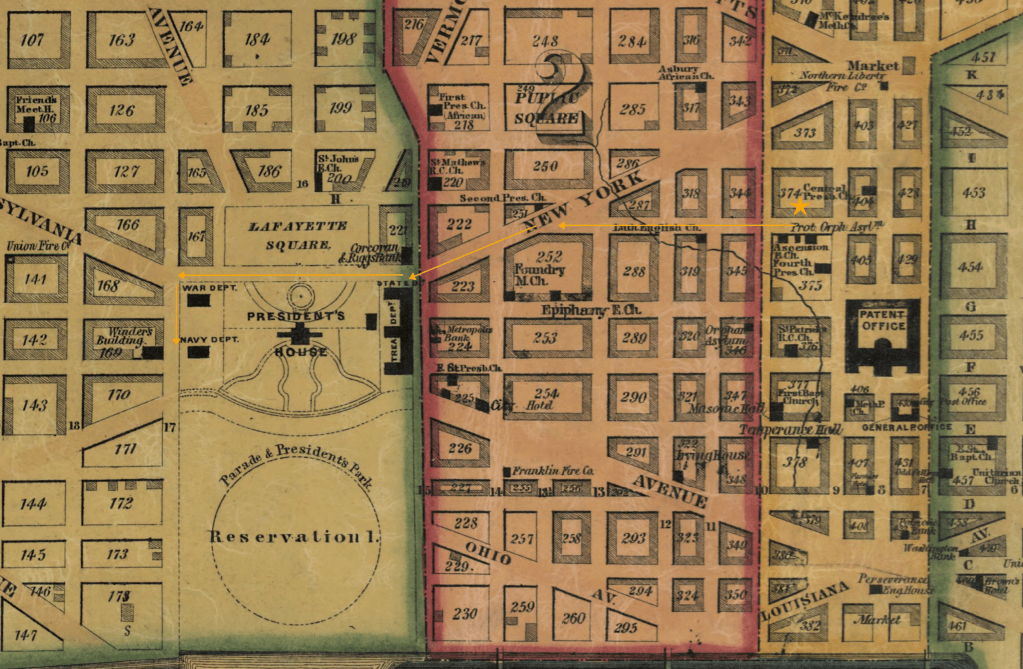
  • Jane Reeder is listed in the 1873 City Directory for DC at 17 14th NE. This is a couple of blocks east of Lincoln Park.
  • Jane is listed as the widow of Thomas.
  • Jane is also listed in the Freedmen’s Bank Records for James Reeder and Mary Fountain.
DetailJames Reeder’s
Bank Records
Mary Fountain’s
Bank Records
BirthplaceSt. Mary’s Countynot listed
Jane Reedermothermother
John Reederbrother
Thomas Reederbrother
James Reederborther
Walter Reederbrother
Mary Ellen Fountainsister

Source 1: St. Mary’s Slave Statistics

“The Slave Statistics consist of lists of slaves owned as of 1 November 1864, the date when the Constitution of 1864, which abolished slavery in Maryland, took effect. In the hope that the federal government would compensate former slaveholders, the General Assembly in 1867 authorized the compilation of records to establish slave ownership and the value of slave property. The governor appointed a commissioner of slave statistics for each county with a term in office of two years. Former slaveowners furnished the commissioner with descriptive information on each slave for whom they claimed ownership. The commissioner then recorded the lists and filed the records with the clerk of the circuit court of his county. (Ch. 189, Acts of 1867; Ch. 385, Acts of 1868). Entries give date of registration, name of the owner, and, if applicable, name of person acting for the owner. For each enslaved person, the records show his or her name, sex, age, physical condition, term of servitude, date of emancipation, and, if applicable, information on and compensation for military service.”

Source: Maryland State Archives

Agnes Kane Callum indexed the slave statistics for St Mary’s County and her index can be found on the Maryland State Archives website.

Her index includes the Reeder family on page 170.

Jane102
John121, 124
Thomas121, 124, 136
James121, 124
Mary Ellen121, 124
Walternot listed
Jane Reeder

Jane Reeder is listed as the sole enslaved individual by Ann Chiveral. Ms. Callum indicates that she is unsure of the spelling for Chiveral with a question mark. The entry also indicates that Jane escaped Ms. Chiveral enslavement in February 1863.

Excerpt from Slave Statistics, page 233
Jane’s Children

John, James, Mary Ellen, and Thomas are listed in the index for Edward Abell as owner, and for Edward Abell as guardians of George L Smith and Sarah C Smith.

Excerpt from Slave Statistics, page 283

Source 2: Ann E. Chiveral Documentation

The intent here is to track Ann E Chiveral through the available documentation: marriage records, census records, slave schedules and probate records in order to identify how Ann enslaved Jane and what labor Jane may have performed.

Marriage to William Chiveral

Ann E Tarlton married William Chiveral on 17 Sept 1861 (ancestry.com) and they share a household in the 1870 census (Roll: M593_594; Page: 546B). William is listed as an oysterman and she has three children, including Virginia and Mary Tarlton. The household is listed in District 2, near the Great Mills post office with no personal estate or real estate.

In the 1860 Census (Roll: M653_479; Page: 14), Ann E Tarlton is listed with three children, including A. Virginia and Mary Tarlton. No adult male is listed in her 1860 household. She is living in District 1, St. Mary’s, near the St. Inigoes Post Office. She has personal estate worth $500. In comparison, her neighbors have personal estates worth thousands. In 1860, the personal estate included value of property, possession, or wealth and included estimated values of enslaved individuals.

Ann Tarlton is not listed in the 1860 Slave Schedule which would list her name and the gender and age of the individuals she enslaved. This suggests that either Ann E. Tarleton/Chiveral enslaved Jane after 1860, or failed to report her in the 1860 slave schedule. However, as William is not listed as the owner in the Slave Statistics, despite being alive, it suggests that Ann E Chiveral was the enslaver, not William, and that she brought Jane with her to her new household when Ann and William married in 1861.

William Chiveral is listed in the 1860 and 1850 Census with his mother, Ann Maria Chiveral in District 2, near Great Mills. His mother was a seamstress and William was a sailor. When Ann married William, she moved away from her residence to join William near his family.

Virginia Tarlton is indicated as an invalid in the 1870 Census and has the comment “idiotic” written on her record in the 1860 Census. This raises the possibility that Ann needed help taking care of Virginia and that Ann enslaved Jane to assume the role of caretaker.

Marriage to Basil Tarlton

Prior to her marriage to Chiveral, Ann E Wheatley married Basil Tarlton in 1853, who died by 1857, when his inventory and account of sales were listed in the probate records of St. Mary’s County (familysearch.org). Among his probate records is the distribution of the estate to his family: Ann as his widow got 1/3 of the estate, around $980, and his 9 children received an equal sum, around $220. Ann V(irginia) Tarlton and Mary E Tarlton are among the children listed.

His estate records named four enslaved individuals who were sold: two men, Lewis and John, and an unnamed woman and child. Records indicate that William M. Moore paid to enslave the unnamed woman as part of the estate sales. (St. Mary’s County, Account of sales 1851-1857 vol GC3, p 517 | familysearch.org). William W. Moore is the son of John T Moore, Ann’s neighbor in the 1860 Census.

Sister-in-law to John T. Moore

Ann Tarleton’s dwelling number is 86 in the 1860 census. Dwelling number 85 contains individuals with the last name of Moore and Tarlton. John Moore heads the household with a personal estate worth $4000. He employs and/or houses several young adult/children with the surname Tarlton. Their given names are similar to the list of children on Basil’s estate distribution record: William, James P, and George. Both John T Moore and William W Moore had an account of sales for their estate recorded in spring of 1865 (Account of sales 1857-1865 vol GC4), suggesting they died near the end of the Civil War.

In the 1850 census, Ann E Wheatley is living in the household of John T. Moore. He is 43 and his wife, Mary, is 28. Ann is 25. Marriage records show that John Moore married Mary Wheatley in 1843 in St. Mary’s County (ancestry.com).

Initial Conclusions

Ann was living with her sister in her brother-in-law’s household until her marriage to Basil Tarlton, a widower with several children. Ann Virginia Tarlton was born the same year he married Ann and had some sort of condition that resulted in the census taker indicating her status as invalid. The year of her birth, 1853, was the same year he married Ann. It is a possibility that his previous wife had had a difficulty delivery and died while giving birth to Ann Virginia, and that she became an invalid due to the complications during birth. Ann Wheatley/Tarlton continued to care for her step-daughter while the older step-children lived with her sister. This proposed one possibility for the labor that Ann expected from Jane, especially as Ann had no real estate and limited personal estate.

Ann enslaved Jane prior to 1862, possibly when William W Moore purchased the unnamed woman from the Tarlton estate in 1857. Ann remarried again, this time to a modest sailor who did not have property. Shortly after Ann’s marriage and move out of District 2, Jane escaped, making her way to DC.

This conclusion does not account for Jane’s children and how they came to be enslaved on the Abell estate. Additionally, this theory does not demonstrate with any documentary evidence that the enslaved woman was transferred from William W Moore to the Tarlton/Chiveral household.

Charles Graham


1852-1902

In 1862, the District of Columbia emancipated the individuals enslaved within its borders; it also offered reparations to the enslavers, who could no longer force labor from the freed.

George Washington Young submitted a list of the people he enslaved so as to be compensated. Among the names is the family group of Grahams: Peter and Charity Graham and their children, including Charley Graham, age 9. His height was listed as 4 foot 8 inches. He was of average height for his age.


Young owned a considerable amount of land in Anacostia. He managed two plantations: Nonesuch and Giesborough Manor, both across the river in the area considered Anacostia today. Nonesuch was located north of Good Hope, in a neighborhood now called Hillcrest. His grandfather, Notley Young, had owned plantations in what became the city of Washington, particularly Duddington Pasture, which was located on the southwest waterfront.

View, probably 1833, from Anacostia, showing Navy Yard and Capitol in center | painted by G. Cooke ; engd. by W.J. Bennett. | loc.gov

G. W. Young purchased Giesborough Manor in 1833 and inherited Nonesuch from his father in 1826. In addition to inheriting the land, his father also named several enslaved individuals, among them, Peter and Charity, Charley’s parents in the 1862 emancipation records, in his bequest for George Washington Young.

Peter worked both as field hand and blacksmith. Charity was a field hand. Likely, Charles worked beside his parents in the fields.


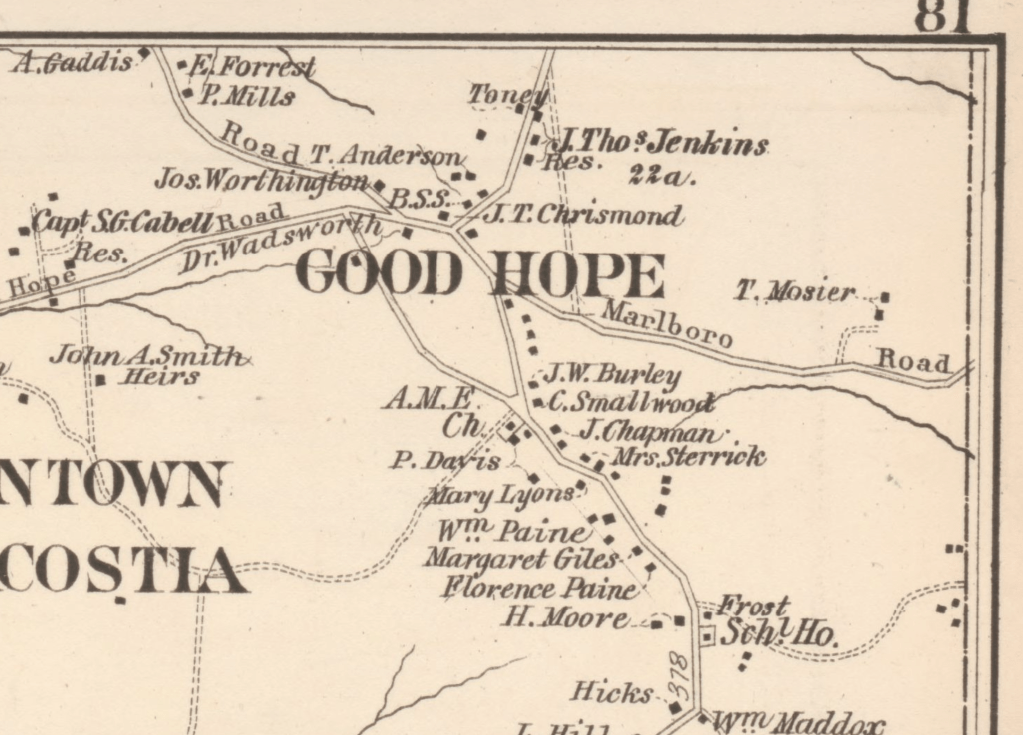
In 1870, the Grahams are living near Good Hope (DN 910). The Census records Charity, as a white washer, with her children and Johanna Chase. Charles is working as a farm laborer. Their neighbors are the Paine and Giles household visible on the Hopkins Map, south of Good Hope.

His brother, Robert Graham, is living nearby with his own household, also working as a farm laborer (DN 929). Robert is a neighbor of Jos. Worthington who is shown on the Hopkins 1878 map of Good Hope. GWJ Hatton, a blacksmith, lives in the Robert Graham household. Thomas Anderson (1792-1882) was a blacksmith as well, and grew produce he sold at Center Market. (East of the River) Anderson’s daughter married Jerome Hutton in 1871.

Excerpt from Hopkins Map | loc.gov

In 1875, Charles Graham and Johanna Chase applied for a marriage license. Two death records: one for an infant girl and one for Johanna Graham show that she died giving birth in Mar 1877.

Johanna Chase is listed in the 1870 Household of Charles’ mother, Charity. She may be the same Johanna Graham that is listed in the family group of Peter and Charity in the emancipation records of George Washington Young. She is listed in the census as 25 with an estimated birth year of 1845.

Her birthplace, unlike the Graham’s, is listed as Maryland. There are Chase households in Hyattsville, Collington and Upper Marlboro in Prince George’s County in the 1870 Census. It is possible that she connected to these.

In the 1880 Census, Charles is still living with Charity and several of her grandchildren: Mary, Sally, Robert and Edward. It is unclear if the four children listed in Charity’s household are the children of Charles and Johanna. Edward, the youngest, if age 4, suggesting that they were all born prior to 1877.


In 1881, Charles married Alice Dent, a widow with three children, Charles, Georgiana, and William.

Alice’s first father-in-law, Bruce Dent had been a huckster at Centre Market, and was able to purchase land on Bowen Road, near the plantation of Nonesuch. Dent’s second wife continued to be a huckster, while he was a gardener. The map excerpt shows Good Hope on the left, and Bowen road leading northeast to the lands of Nonesuch. (Mary B Denham and Washington A Young were heirs of G. W. Young.). To the right of the Denham and Young land are small parcels. Dent owned 5 acres on the MD border; in 1875, he was delinquent on his taxes and the land description was included in the National Republican: “Beginning at the intersection of the DC Lin with the boundary of IF Young’s part of ‘Nonesuch’ and the Trimble tract…”

Excerpt from Plate 44 of Hopkins Plat Book of DC } Washingtoniana Map Collection

Alice’s children, Charles, Georgiana and William list Anacostia and/or Oxon Hill as their birth place on records, suggesting that she had been living near Dent and therefore near the Grahams.


Charles’ brother, Robert Graham, moved to the City of Washington in the early 1870s, moving to B st se, near where Alice was working as a domestic servant in 1880.

In 1882, Charles is recorded living in Pleasant Alley, which is behind G street SW, two blocks south of where Bruce Dent had owned property on 3d Street between E and F. I

By 1886, the family had moved to southeast DC and Capitol Hill. Charles and his step-children are listed living at 301 G Street SE. In 1887, Georgiana married Frank Winters and moves to 427 2d SE. They are close to Eastern Market.

By 1900, Charles is living with his step-son, William Henry Graham at 303 7th St SE. He dies in 1902.

Maria Dent | Domestic

Known Information

In 1840, Susan Dent had two younger Free Black individuals living in her household. One was a female whose age is consistent with Maria Dent’s in the 1850 & 1860 Census.
Sources

Year: 1850; Census Place: Washington Ward 3, Washington, District of Columbia;Roll: 56; Page: 170a | ancestry.com

Year: 1860; Census Place: Washington Ward 3, Washington, District of Columbia; Page: 717 | ancestry.com

Evening Star | Washington, District of Columbia | 07 Jan 1862, Tue  •  Page 3

1853 City Directory of Washington DC | fold3.com

Maria Dent is listed in the household of J. S. Williams in both the 1850 and 1860 Census. No occupation is listed for her in either census.

1850 Census
1860 Census

J. S. Williams was a clerk with the Naval Department who lived on H Street between 9th and 10th. Born and married in Connecticut, he moved to DC in 1848 and died during the Civil War from Small Pox. His wife moved back to Connecticut after her husband’s death.

Though no occupation is listed for her, it is likely that Maria served as a domestic servant in the home. Williams’ property was valued at $3000 with personal property valued at $1000, suggesting means to hire Maria, a free Black. While the Williams and therefore Maria lived in Ward 3, “by 1860, one-eighth of the most prosperous families in the First Ward employed live-in servants, either white or black.” (Civil War Washington)

As a domestic in the household, it is possible that Maria’s work ranged across the spectrum of “women’s work”. Taking care of the Williams’ clothing alone would require sewing, washing, and ironing. Preparing meals may have meant cooking and serving.

In 1850, Maria is listed with a child, E., who is 7 years old. By the 1860 census, the child is no longer listed in the household. It is possible that the child by 1860 had either died, or had left the Williams household, apprenticed to another. The 1860 census does not enumerate an E Dent in other households, raising the likelihood of death. The Williams had a child, Thomas, who died in 1859 from consumption. It is possible that they both caught the same disease and passed away.
The 1870, 1873 and 1876 City Directories list a Maria Dent. In 1870, she was working as a cook in a nearby household, at 815 6th Street NW

Susan and Isaac Johnson | Freedom

Known Information

Susan and Isaac Johnson are the parents of Cassandra Johnson who married Bruce Dent in 1830.

Sources

Provine, D. S. (1996). District of Columbia free Negro registers, 1821-1861. Bowie, Md: Heritage Books.

Rogers, H. H., & District of Columbia. (2007). Freedom & slavery documents in the District of Columbia. Baltimore, MD: Gateway Press..

Land Record, Elizabeth Stump to Margeret Robertson, HD R 547 | mdlandrecs.net

A Biographical Dictionary of the Maryland Legislature 1635-1789 by Edward C. Papenfuse, et. al., pg 483 | Maryland Sate Archives

 Maryland Genealogical and Memorial Encyclopedia, pg. 644-645 | ancestry.com

Maryland Historical Trust | Stafford Farm | John Stump House

Race & Slavery Petition Project, Petition 20981106 | Digital Library on American Slavery

National Register of Historic Places Registration Form, Swansbury

The Baltimore directory and register, for the year 1816 | archive.org

Susan and Isaac Johnson registered their children, Jacob and Charles Johnson, as free in the District of Columbia on 15 September 1827. In Provine’s Book, she indicates that the Susan (Suckey) Johnson was manumitted in 1804 by Elizabeth Stamp [sic] of Harford County, MD, and that she is the wife of Isaac Johnson who was manumitted in 1818, two years after Archibald Johnson purchased him from Samuel Jay. The record also lists her children: Archibald (1810), Isaac (1812), Cassandra (1817), Mary Ann (1819).

Susan Johnson

Susan Johnson was enslaved by the Stump family, a large commercial family in Harford County, Maryland. The patriarch of the family had come from Prussia in the early 1700s and purchased land in Cecil County, Maryland (across the Susquehanna River) and his sons came to Harford County, MD.

Elizabeth Stump of Harford County, Maryland

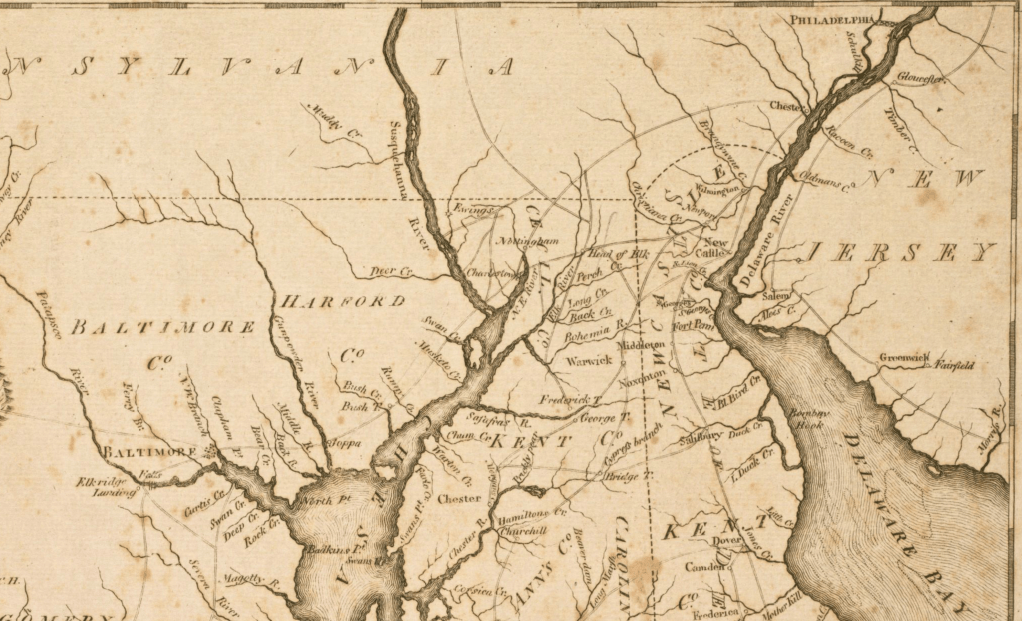
Harford County is located 25 miles northeast of Baltimore along the Susquehanna River and the Chesapeake Bay. It is between Philadelphia and Baltimore, both port cities during the Colonial and Federal period. Originally, the European Colonists created tobacco plantations, similar to southern plantations, however, the crops shifted so that by the end of the 18th century, the farms had shifted to growing wheat and corn, which was shipped to Europe and the West Indies from Baltimore and Philadelphia.

Excerpt from The states of Maryland and Delaware, from the latest surveys [1796] | Norman B. Leventhal Map Center Collection

In the 1790s, Elizabeth, the daughter of Josiah William Dallam, a wealthy landowner who enslaved people, married Herman Stump, one of the grandsons of the original patriarch. Her husband, Herman, was engaged in trade with his brothers, including John Stump, and they shipped flour produced at Stump Mills in Harford and across the mid-Atlantic to England and the West Indies. The map shows the location of one of these mills on Deer Creek along the Susquehanna, upstream from Havre de Grace.

Excerpt from Havre De Grace 1799 Susquehanna River and Chesapeake Bay, Maryland 1799 | historicmapworks.com

Herman Stump died in 1801, leaving Elizabeth Stump a wealthy widow. By 1804, she married again, to Abraham Jarrett. Prior to her marriage, she put her land and wealth into a trust held by her friend Margaret Robertson/Robinson. At the same time, she legally freed the people she enslaved, including Susan (Suckey) Johnson. In the petition, she that did so “believing freedom to be the inalienable right of all human beings”. While she stated this, her husband continued to enslave people. Despite her stated lofty ideals, it is possible to have a more cynical view of her actions. Prior to her second marriage, she placed her own wealth into a trust, suggesting that she was financially savvy, as her soon-to-be husband had debts that she wanted to protect her fortunes from. It could be, with the shift in economy, it was not longer economically viable for her to enslave people, as she would be taxed and she no longer had the lands on which to compel their labor.

William Taylor, of Havre de Grace

Havre de Grace was situated on the mouth of the Susquehanna. Built in the late 1780s, it came very close to be chosen as the national capitol. Built to be a booming trade town, it never grew to compete with either Baltimore nor Philadelphia. William Taylor lived in Havre de Grace, where he engaged in manufacturing. A 1818 court case names William Taylor as a blacksmith.

In 1820, he vouched for Susan’s freedom, saying that he knew her “from his first knowledge of things”. The 1810 Census lists Wm Taylor living on page 826 where many of the names on this and the following pages indicates that he lived in a neighborhood with a large population of Black families with free status. Susan (Suckey) is not listed among the heads of households. However, his testimony suggests that she lived in Havre de Grace for a period of time before moving to DC.

Isaac Johnson

In the meantime, while Susan was released from captivity in 1804, Isaac Johnson was enslaved until 1818. In 1818, Archibald Johnson, in consideration of one dollar, manumitted Isaac Johnson, whose he purchased from Samuel Jay about two years ago (1816).

Samuel Jay

Samuel Jay, like the Stumps, was engaged in commerce in Harford County. He owned 1000 acres near Swan Creek and in addition to a nail factory and other property. He married into the prominent Griffith family of Harford and served on the Board of Commissioners in the early 1800s with a Roger Boyce.

Jay and Boyce were also business partners; in 1799, Boyce and Jay entered into a partnership that revolved around a nail and anchor manufacturing factory in Havre de Grace. This partnership resulted in Boyce taking on a $3000 debt, and Jay controlled the promissory note. When Boyce died intestate without having repaid the debt, Jay asked the courts to compel Boyce’s widow to sell property to cover the debt.

The Chancery Court documents for this case name the people Boyce enslaved and whose captivity was transferred to Jay. The list not only includes an Isaac who is roughly the right age to be the Isaac Johnson married to Susan, but also the some of the names of the other individual slaves are names used by Isaac and Susan to name their children: Abraham, Charles, Jacob. This suggests a familial relationship between the people enslaved by Boyce and Isaac Johnson.

The Chancery Case was settled around 1815-1816 which is consistent with the timeline that Archibald Johnson purchased Isaac from Samuel Jay two years prior to 1818, when he manumitted him.

The Bill of Sale is documented in the Freedom and Slavery Records of DC:

Isaac Johnson (half brother to Archibald Johnson) Bill of Sale was recorded 16 January 1816, Samuel Jay sells to Archibald Johnson a free Mulatto of Baltimore, Harford County, Maryland, for $200 a slave and half brother of Archibald Johnson, named Isaac Johnson age about 45 years, Signed on 30 Dec 1815 by Samuel Jay

NameAge
Abram/Abraham*14
Charles*16
Denbugh45
Dick35
Frank15
Harry15
Isaac*15
Isaac*35
Jack*22
Jacob/Big Jacob*35
Jacob*17
Thomas
Will45
William

Archibald Johnson

In the late 1700s, two Archibald Johnsons lived in Harford County. Yet, by 1810, while an Archibald isn’t enumerated in the Harford County census, there is a Archd Johnson living in Baltimore Ward 1. The Baltimore directory and register, for the year 1816 lists Archibald C. Johnson living as a tailor at the corner of St. Paul’s Lane and Chatham street.

In the 1820 census, two years after Archibald purchased Isaac’s freedom, both an Archibald Johnson and an Isaac Johnson are enumerated in Washington DC, in Ward 4. Archibald Johnson is over 45 years old and lived with a free Black male 14-25, a free Black female age 14-25, 1 female under 14 and 2 enslaved females; living nearby, is Isaac Johnson.

Johnson Family | Thomas Hurdle, witness

Known Information

Susan and Isaac Johnson are the parents of Cassandra Johnson, the first wife of Bruce Dent.

Sources

Brown, L. W. (1972). Free Negroes in the District of Columbia, 1790-1846. New York: Oxford University Press.

Provine, D. S. (1996). District of Columbia free Negro registers, 1821-1861. Bowie, Md: Heritage Books.

City Directories for Washington, DC | Fold3

1820 U S Census; Census Place: Washington Ward 4, Washington, District of Columbia; Page: 103; NARA Roll: M33_5; Image: 110 | ancestry.com

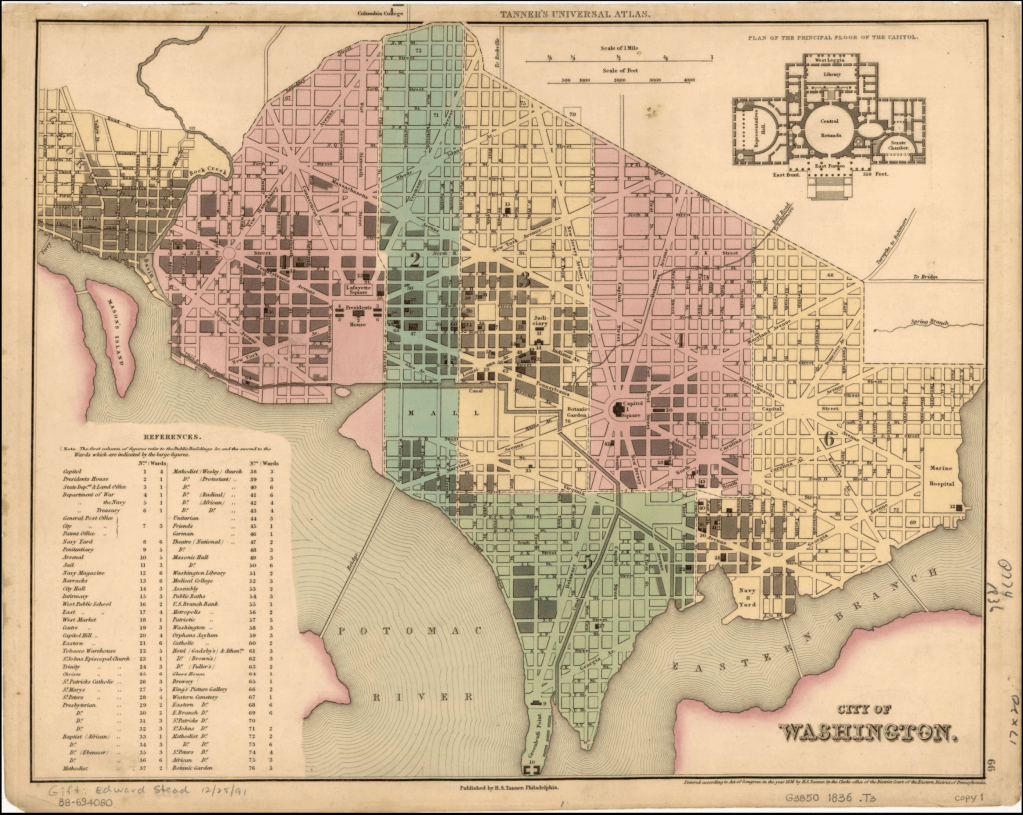
Tanner, Henry Schenck. City of Washington. [Philadelphia: H.S. Tanner, 1836] | loc.gov

Susan and Isaac Johnson registered the free status of her two sons, Jacob and Charles Johnson, on 15 September 1827 in the District of Columbia. In this registration, Thomas Hurdle “swears that Isaac, [Sr.] and his wife, Susan, are by reputation free and that Jacob Johnson, aged about five, and Charles Johnson, aged about three, were born in his neighborhood and are the children of Isaac and Susan. They were born free.”

This affadavit, sworn on 13 Sept 1827, provides clues into the lives of the Johnson family in the District of Columbia.

Thomas Hurdle is listed in the 1822 and 1827 City Directory for Washington, District of Columbia. In the 1822 City Directory, he is listed as a foreman carpenter at the Capitol. The 1827 directory lists him as a carpenter living on 2e street near St. Joseph’s Church. In the 1820 Census, he is enumerated as living in Ward 4, which was around Capitol Square. Isaac Johnson is listed immediately prior to Thomas in the census.

Tanner, Henry Schenck. City of Washington. [Philadelphia: H.S. Tanner, 1836] | loc.gov

The neighborhood around the Capitol had two types of residents: congressmen and aides living in boarding houses, and the skilled laborers who were building the city after it was burned by the British in the War of 1812. The labor forced used by the city was a mix of Irish labor and Black labor, both free and enslaved.

1820 Census showing the neighborhood with a mix of free Black and white residents

Thomas Hurdle was listed as living near St. Joseph’s in the 1827 directory. The use of St. as part of the name suggests a Catholic Church, and the early maps of the City of Washington do not list a St. Joseph’s. Instead, I propose that the church referenced is St. Peter’s Church on 2nd and C street. This church was newly established in the 1820s, and both Black and white residents attended the church. St. Joseph’s, which is on 2nd Street in NE was not built until 1868. That the church was mislabeled in the Directory is strengthened by the 1830 Tax Lists.

The DC Tax Books record Archibald Johnson with property on block 734 and Isaac Johnson with property on block 733 in 1830. Between 1830 and 1845, Isaac’s taxes on the property went from $0.31 to $3.45 which suggests he made considerable improvements on his lot.

The small map overlay is a 1846 map showing blocks with buildings. #28 represents St. Peter’s Church. It is overlaid onto a 1840 map showing square numbers.
De Krafft, F. C, W. I Stone, and William M Morrison. Map of the city of Washington. [Washington, D.C.?: Wm. M. Morrison, 1840] 
Tanner, Henry Schenck, and S. Augustus Mitchell. City of Washington. [Philadelphia: S. Augustus Mitchell, 1846]
Library of Congress

During this time, the City of Washington was only 20 years old and transitioning from farmland to a city. Large parts of the city remained rural, and the homes of the residents were likely smaller ramshackle buildings.

Steel, James W., Engraver, and Thomas Doughty. The capitol Washington / drawn by T. Doughty ; eng. by J.W. Steel. Washington D.C, 1826. [Philadelphia: Published by A.R. Poole] | loc.gov

related posts

Louis B Graham | Stable Boss for the Coal Yard

Known Information

Louis B Graham was the son of William Henry Graham and Mary “Mollie” Thomas. He was born in 1896 and died in 1927. He was 29 years old.

Sources

Draft Card

In 1917, the Selective Service Act allowed the government to raise a national army to fight in World War I. Registration began for men between 21 and 30 years old on June 5, 1917. Louis Bernard Graham was one of the men who registered.

His registration card lists his occupation as “Stable Boss” and that he was employed by “W. H. Marlowe.

U.S., World War I Draft Registration Cards, 1917-1918 | ancestry.com

Washington, District of Columbia, City Directory, 1917

Given Graham’s listed address, there are two possible branches that he worked at:

  • 216 A NE
  • 1237 1st NE

Close to Home

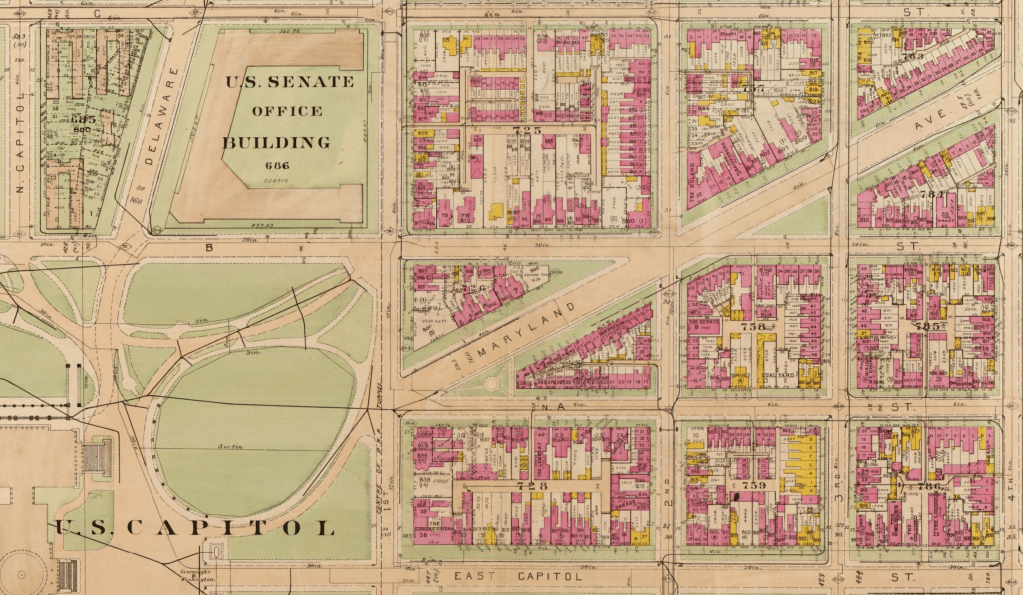
The 216 A NE branch is a smaller branch, in the same neighborhood as Graham. Graham lived in square 786, in the lower right of the map excerpt below. The Marlowe Branch (yellow building) located on A street is northwest diagonal from his home, in square 758.

Baist’s real estate atlas of surveys of Washington, District of Columbia: complete in four volumes, 1919 | loc.gov

As a Stable Boss, he would have been responsible for the care of horses, mules, and ponies, and assigning the animals to workers during the shift. This location would have needed the animals to make home deliveries. Marlow advertised in the Evening Star, a DC newspapers, prompt deliveries, and as evidenced by the for sale ad, he kept stable of work horses at the 216 A NE location.

Coal Dump near Union Station

It’s also possible that Graham worked a little farther from home, and closer to Union Station. Marlow had a Coal Yard Dump north of Union Station. Unlike the local coal yard near the Capitol Building, this is where Marlow brought his imported coal before distributing it to the local yards. Union Station had been built a decade earlier, and with it the landscape north of it changed from housing into warehouses and ice pants. The railway lines leading into Union Station had spurs that allowed for the offloading of coal from Cumberland and Pennsylvania.

Baist’s real estate atlas of surveys of Washington, District of Columbia: complete in four volumes, 1919 | loc.gov

Further Research Needed:

related posts

Doradie Stewart and Rebecca Caroline Deville

This blog post is one of a series that explores the lives of the people enslaved by the Sasscer family, who lived south of Upper Marlboro in Prince George’s County, MD. The primary estate for the family was named Pleasant Hills and additional posts about the people can be found under the category “Pleasant Hills”.

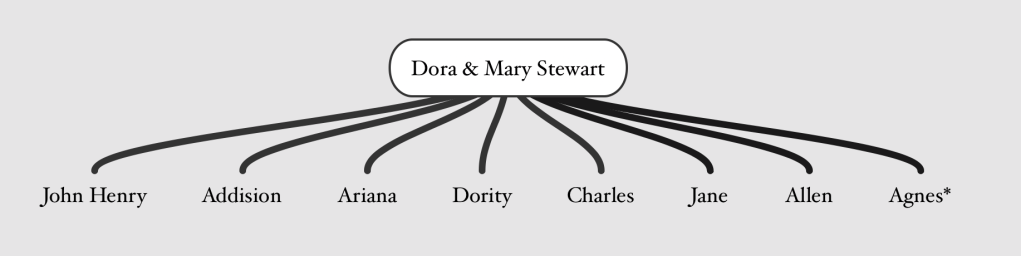
Identified children of Dora and Mary Stewart from the 1867 Slave Statistics, 1870 & 1880 Census, and Index of Marriage Licenses, Prince George’s County, Maryland 1777-1886

The third son of Dora Stewart has an unusual name. In some documents its recorded as Dorothy, others Dortha, some Doradie, and others yet Dougherty. None of the documents are consistent with their spelling, leaving the imagination to consider the possibilities.

In the 1867 Slave Statistics, Sasscer submitted the name Dorothy and listed the gender as female. The 1870 census listed the name as Dorothy, and again, the gender as female. In the 1870 marriage license, it records Dorothy Stewart marrying Caroline Deville. The 1880 census lists him as a male named Dority.

“District of Columbia, Freedmen’s Bureau Field Office Records, 1863-1872,” database with images, FamilySearch (https://familysearch.org/ark:/61903/3:1:3QS7-8937-FTL4?cc=2333782&wc=9J3J-829%3A1069293202%2C1069293101 : 3 August 2016), Local superintendent for Washington and Georgetown (correspondence) > Roll 16, Letters received entered in vol 1-3, Apr 17, 1867-Aug 20, 1868 > image 1341 of 1408; citing NARA microfilm publication M1902 (Washington, D.C.: National Archives and Records Administration, n.d.).

In 1868, his name is recorded as Doradie in a correspondence between the Marlboro Field Office and the District of Columbia Headquarters of the Freedmen’s Bureau. In this letter, “sundry names of Freedmen” were submitted as informants about a man posing as a agent and demanding money from them. The men, Doradie Stewart, John Galloway, John Henry Stewart, and Washington Galloway, are brothers and brothers-in-law. The letter lists their residence as on Zed. Sasscer’s farm two miles northwest of Marlboro. It can be inferred from the letter that one of them or an acquaintance of theirs sold their hogs to meet the demand of the spurious agent. “My informers threatened him with me, that they would inform me immediately” suggests that the family were aware of the Bureau and its work in the community.

In 1880, Doradie and his family are still living near his brothers and brothers-in-law, next door to Washington Galloway, and working as a tenant farmer on the Sasscer land.

additional families from Pleasant Hills

Doradie Stewart and Rebecca Caroline Deville

This blog post is one of a series that explores the lives of the people enslaved by the Sasscer family, who lived south of Upper Marlboro in Prince George’s County, MD. The primary estate for the family was named Pleasant Hills and additional posts about the people can be found under the category “Pleasant Hills”.…

Ariana Stewart and Pinkney Brown

This blog post is one of a series that explores the lives of the people enslaved by the Sasscer family, who lived south of Upper Marlboro in Prince George’s County, MD. The primary estate for the family was named Pleasant Hills and additional posts about the people can be found under the category “Pleasant Hills”.

Addison Stewart and Caroline Stewart

This blog post is one of a series that explores the lives of the people enslaved by the Sasscer family, who lived south of Upper Marlboro in Prince George’s County, MD. The primary estate for the family was named Pleasant Hills and additional posts about the people can be found under the category “Pleasant Hills”.

Something went wrong. Please refresh the page and/or try again.

Ariana Stewart and Pinkney Brown

This blog post is one of a series that explores the lives of the people enslaved by the Sasscer family, who lived south of Upper Marlboro in Prince George’s County, MD. The primary estate for the family was named Pleasant Hills and additional posts about the people can be found under the category “Pleasant Hills”.

Identified children of Dora and Mary Stewart from the 1867 Slave Statistics, 1870 & 1880 Census, and Index of Marriage Licenses, Prince George’s County, Maryland 1777-1886

Addison Stewart is the second oldest son of Dora and Mary Stewart. Addison was enslaved by the Sasscers, while his wife and son were living elsewhere. Their marriage was recognized in 1870; the marriage license lists his wife as Caroline Stewart, leaving ambiguity as to what her maiden name was. The PG Slave statistics do not list a Caroline Stewart nor a Nathan Stewart

Birth years calculated from the 1870 Census

In 1870, Addison and his family are living with the other Stewarts, working the Sasscer land. Addison is a farm hand while Caroline, his wife, is listed as “keeping house”. Unlike the other wives of the Stewart family, who are listed as servants. This suggests the possibility that Caroline provided child care while the others worked in the fields and the house. In 1880, Addison is still working the land, though it appears he moved away from the Sasscer lands to an estate closer to the Patuxent River. He is listed in the census as living near Richard B. B. Chew who held lands along the river. Addison is neighbored with another person identified as being enslaved by the Sasscers, Tom Beall.

By 1880, Addison has become injured, though the extents of his injuries are unclear. The census taker marked that he was “maimed, crippled or bedridden” while also marking his occupation as “farm hand”. This suggests that despite the injury, Addison still worked the fields; his wife Caroline, is still listed as “keeping house”. In the 1890s, Addison is listed as an “out-pensioner” in the Prince George’s Enquirer and Marlboro Advertiser; an “out-pensioner” received direct payment support from the County, as opposed to being housed in the county poor-house. They were typically granted to individuals deemed “too old, crippled or young to work”. More information about this can be found on the Maryland State Archives page. This suggests that Addison’s injury prevented him from working over time. He died in 1904 from a cerebral hemorrhage, his occupation still listed as a “Farm Hand”.

additional families from Pleasant Hills

Dora Stewart and John Henry Stewart

This blog post is one of a series that explores the lives of the people enslaved by the Sasscer family, who lived south of Upper Marlboro in Prince George’s County, MD. The primary estate for the family was named Pleasant Hills and additional posts about the people can be found under the category “Pleasant Hills”.…

Addison Stewart and Caroline Stewart

This blog post is one of a series that explores the lives of the people enslaved by the Sasscer family, who lived south of Upper Marlboro in Prince George’s County, MD. The primary estate for the family was named Pleasant Hills and additional posts about the people can be found under the category “Pleasant Hills”.

Identified children of Dora and Mary Stewart from the 1867 Slave Statistics, 1870 & 1880 Census, and Index of Marriage Licenses, Prince George’s County, Maryland 1777-1886

Addison Stewart is the second oldest son of Dora and Mary Stewart. Addison was enslaved by the Sasscers, while his wife and son were living elsewhere. Their marriage was recognized in 1870; the marriage license lists his wife as Caroline Stewart, leaving ambiguity as to what her maiden name was. The PG Slave statistics do not list a Caroline Stewart nor a Nathan Stewart

Birth years calculated from the 1870 Census

In 1870, Addison and his family are living with the other Stewarts, working the Sasscer land. Addison is a farm hand while Caroline, his wife, is listed as “keeping house”. Unlike the other wives of the Stewart family, who are listed as servants. This suggests the possibility that Caroline provided child care while the others worked in the fields and the house. In 1880, Addison is still working the land, though it appears he moved away from the Sasscer lands to an estate closer to the Patuxent River. He is listed in the census as living near Richard B. B. Chew who held lands along the river. Addison is neighbored with another person identified as being enslaved by the Sasscers, Tom Beall.

By 1880, Addison has become injured, though the extents of his injuries are unclear. The census taker marked that he was “maimed, crippled or bedridden” while also marking his occupation as “farm hand”. This suggests that despite the injury, Addison still worked the fields; his wife Caroline, is still listed as “keeping house”. In the 1890s, Addison is listed as an “out-pensioner” in the Prince George’s Enquirer and Marlboro Advertiser; an “out-pensioner” received direct payment support from the County, as opposed to being housed in the county poor-house. They were typically granted to individuals deemed “too old, crippled or young to work”. More information about this can be found on the Maryland State Archives page. This suggests that Addison’s injury prevented him from working over time. He died in 1904 from a cerebral hemorrhage, his occupation still listed as a “Farm Hand”.

Dora Stewart and John Henry Stewart

This blog post is one of a series that explores the lives of the people enslaved by the Sasscer family, who lived south of Upper Marlboro in Prince George’s County, MD. The primary estate for the family was named Pleasant Hills and additional posts about the people can be found under the category “Pleasant Hills”.

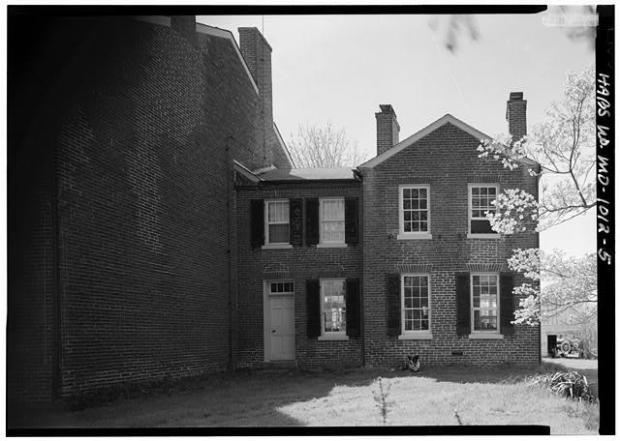
Historic American Buildings Survey, Creator, and Catherine C Lavoie, Boucher, Jack E, photographer. Pleasant Hills,Croom Station Road, Upper Marlboro, Prince George’s County, MD. Prince George’s County Maryland Upper Marlboro, 1933. Documentation Compiled After. Photograph. https://www.loc.gov/item/md1231/.

Dora Stewart was 70 years old when he was emancipated in 1864 by the Maryland Constitution. He had been enslaved by the Sasscer family since at least 1821 when he was listed in the inventory for William Sasscer’s estate, where he was valued at $500. His inferred wife, Mary and his children were also enslaved by the Sasscer family. In the 1870 census, Dora and many of his family and those enslaved by the Sasscer’s were still living on the lands of Pleasant Hills. Dora’s occupation was recorded as a servant, suggesting that he continued to work for the Sasscer family, cleaning and repairing their dwelling plantation. His wife, Mary, is not listed in the census records, which suggests she died before 1870 and Dora is not listed in the 1880 census which suggests he died between 1870 and 1880.

Identified children of Dora and Mary Stewart from the 1867 Slave Statistics, 1870 & 1880 Census, and Index of Marriage Licenses, Prince George’s County, Maryland 1777-1886

John Henry Stewart & Harriet Ann Thomas

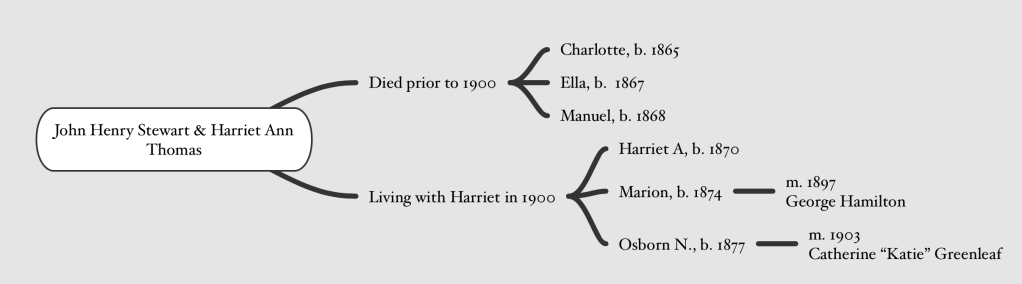
John Henry is the oldest identified son of Dora Stewart. He and his wife, Harriet Ann Thomas, lived with Dora and their two daughters on the Sasscer land after emancipation.

Based on the Slave Statistics, Harriet was most likely enslaved by the estate of Mary M. Warring. Her estate was managed by John H. Waring after her death in the 1850s.

John Henry continued to work the land, while both Ann and Dora worked as servants. In both census, he listed near the residence of Henrietta (Sasscer) Hill, Zadock’ daughter and her husband, William I Hill. By 1900, his wife, Harriet is listed as a widow in the census. Harriet Ann Stewart, Dora’s daughter-in-law, died in 1907 and her death certificate was completed by her son-in-law who listed her father as Stephen Thomas. They had seven children, six of which have been identified in the census records and four of which died prior to the 1900 census.

Family recreated based on information provided in 1900-1910 Census
The 1900 & 1910 census recorded “Number of Years married” and the 1900 Census recorded “Mother of how many children” and “Number of children still living”