Asch, C. M., & Musgrove, G. D. (2019). Chocolate City: A History of Race and Democracy in the Nation’s Capital. Chapel Hill: University of North Carolina Press.
Mary Reeder, age 10, attended school in 1880 while living with her parents in Jackson Alley. She most likely attended School No. 5 in the second division based on its geographic proximity to Jackson Alley.
Education in post Civil War Washington
In 1862, Congress directed ten percent of tax money toward primary schools for Black students, and an independent Board of Trustees was established, which included S. J Bowen, who later became the mayor of DC in 1868. By the 1870s, the Board of Trustees was replaced by a superintendent of schools. Advocates demanded parity between both school systems schools and “the haphazard postwar collection of semiprivate black schools had solidified into a stable system of black public schools run by the Board of Trustees.” (Chocolate City)
Ralph N Dickinson reported the birth of child for Eliza, who he enslaved in Louisa County in 1862.
Sources
Ancestry.com. 1860 U.S. Federal Census – Slave Schedules [database on-line]. Provo, UT, USA: Ancestry.com Operations Inc, 2010. Original data:United States of America, Bureau of the Census. Eighth Census of the United States, 1860. Washington, D.C.: National Archives and Records Administration, 1860. M653, 1,438 rolls.
Virginia, Slave Birth Index, 1853-1866. Database. FamilySearch. https://FamilySearch.org : 6 October 2020. Citing City Court Sheriff, Richmond.
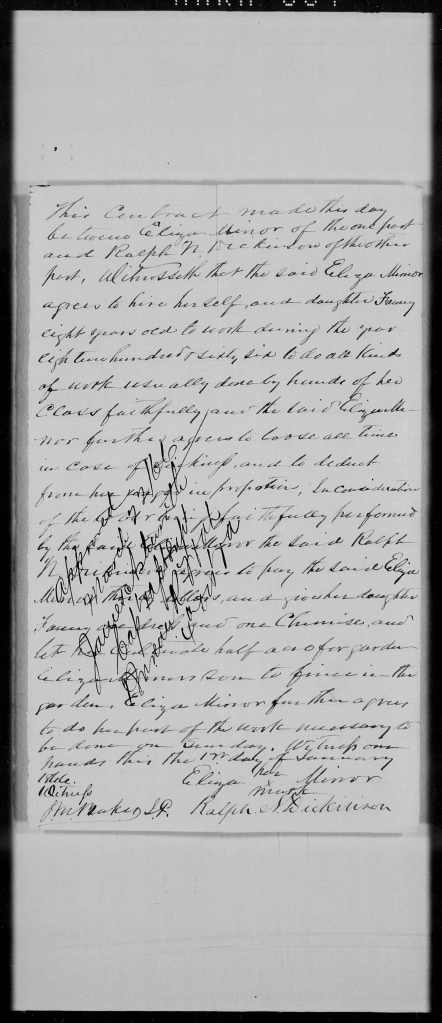
“Virginia, Freedmen’s Bureau Field Office Records, 1865-1872,” database with images, FamilySearch (https://familysearch.org/ark:/61903/3:1:S3HT-6XB7-Z3?cc=1596147&wc=9LML-4WP%3A1078517502%2C1078517501 : 25 June 2014), Louisa Courthouse (assistant subassistant commissioner) > Roll 104, Contracts, May 1865-Sep 1866 > image 205 of 314; citing NARA microfilm publication M1913 (College Park, Maryland: National Archives and Records Administration, n.d.).
In 1860, Ralph N Dickinson reported the enslavement of two people: a 17 year old female and a 35 year old male; he “hired them” from Ann Dillard of Spotsylvania, County.
During the Civil War, an enslaved woman by the name of Eliza gave birth to two children: a daughter in 1862 and a son, named William in Mary 1864. They were reported by a R(alph) N. Dickinson and recorded in what is known as the Virginia Slave Birth Index.
After the Civil War, no longer enslaved, Eliza Minor negotiated a contract with Dickinson with the help of a local agent of the Freedmen’s Bureau, formed by the federal government to aid refugees from the war, especially in the areas of education, employment and health care.
This contract made this day between Eliza Minor of the the one part and Ralph N Dickinson of the other part, witnessed that the said Eliza Minor agrees to hire herself and daughter Fanny, eight years old, to work during the year eighteen hundred + sixty six to do all kinds of work usually done by hands of her class faithfully and the said Eliza Minor further agrees to loose all time in case of sickness and to deduct from her wages in proportion in consideration of the labor being faithfully performed by the said Eliza Minor the said Ralph N Dickinson agrees to pay the said Eliza Minor thirty dollars and give her daughter Fanny one dress and one Chemise and let her cultivate half acre for garden Eliza Minor’s son to fence in the garden. Eliza Minor further agrees to do her part of the work necessary to be done on Sunday.
Labor Contract between Eliza Minor and Ralph N Dickinson
Ralph N Dickinson lived near Duckinghole Creek in Louisa County, Virginia, south of the North Anna River. His property was known as “Woodbine”. He married twice, first to Judith Harris who died of consumption, and then to Evelina Mansfield who outlived him. He was a Justice of the Peace in 1870.
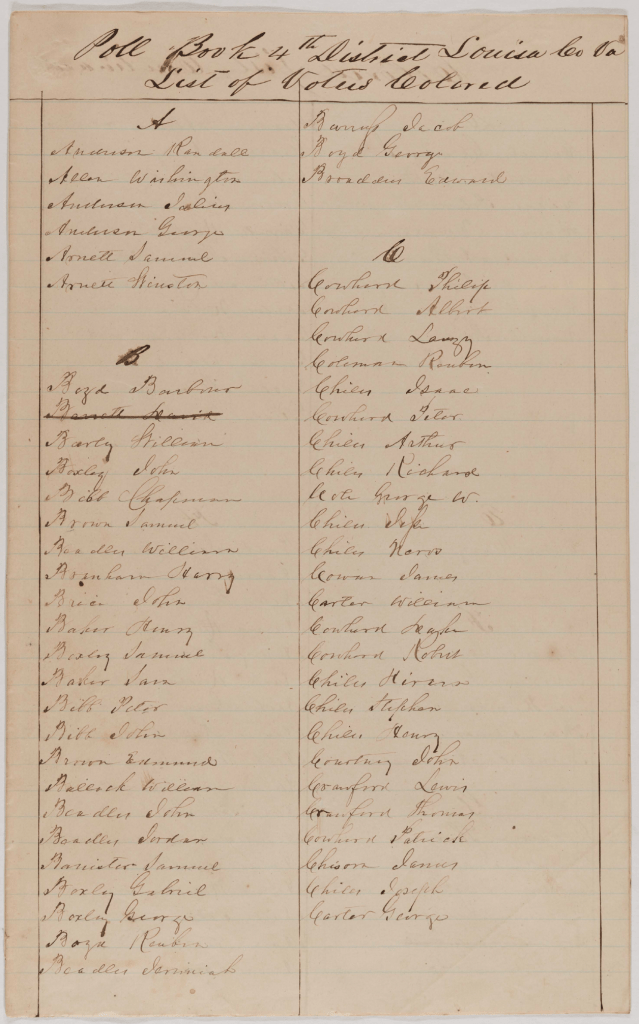
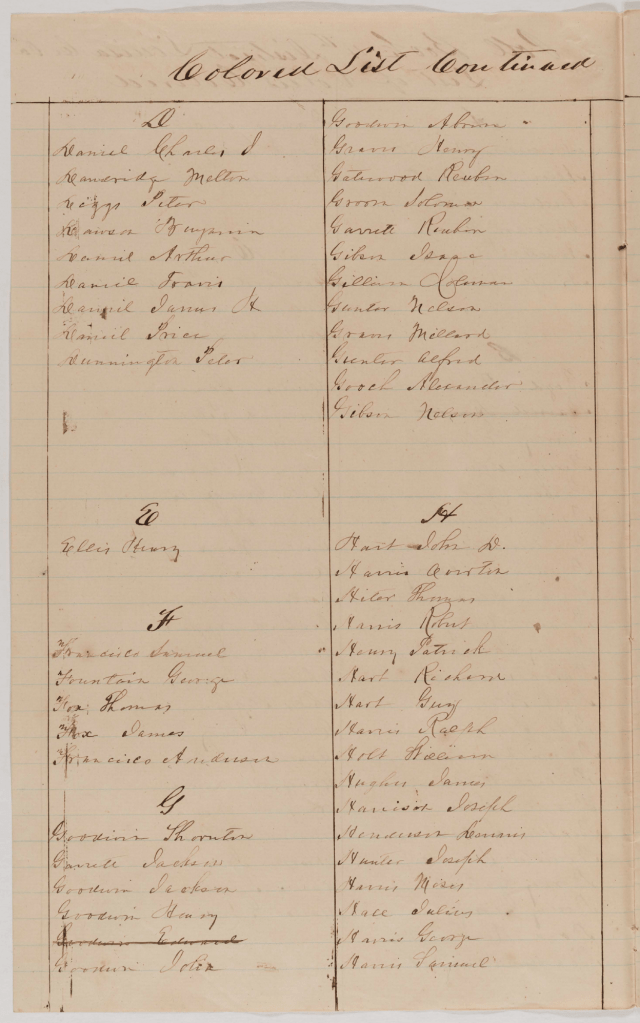
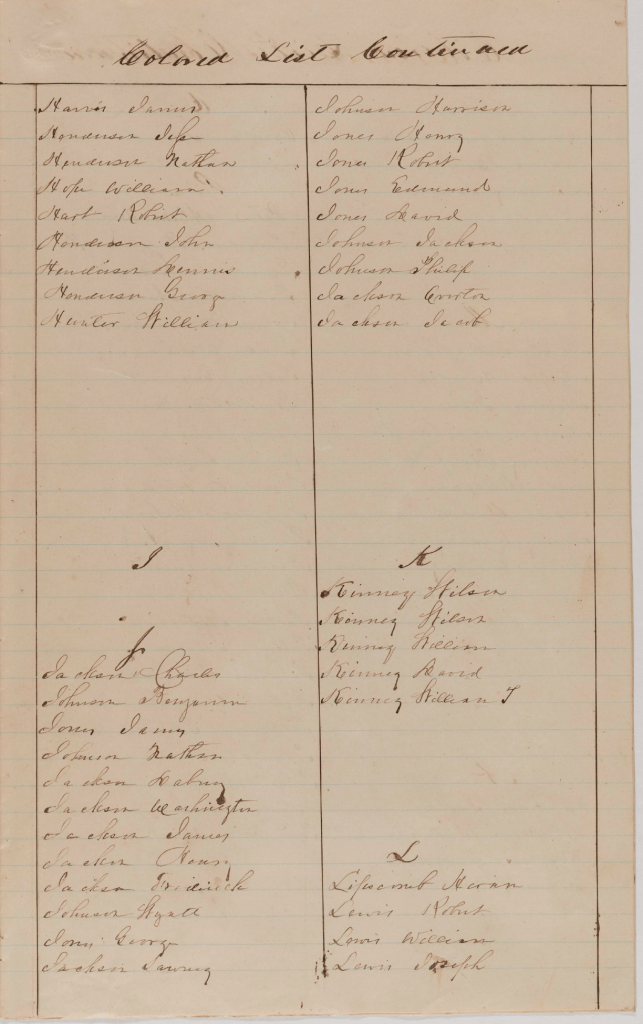
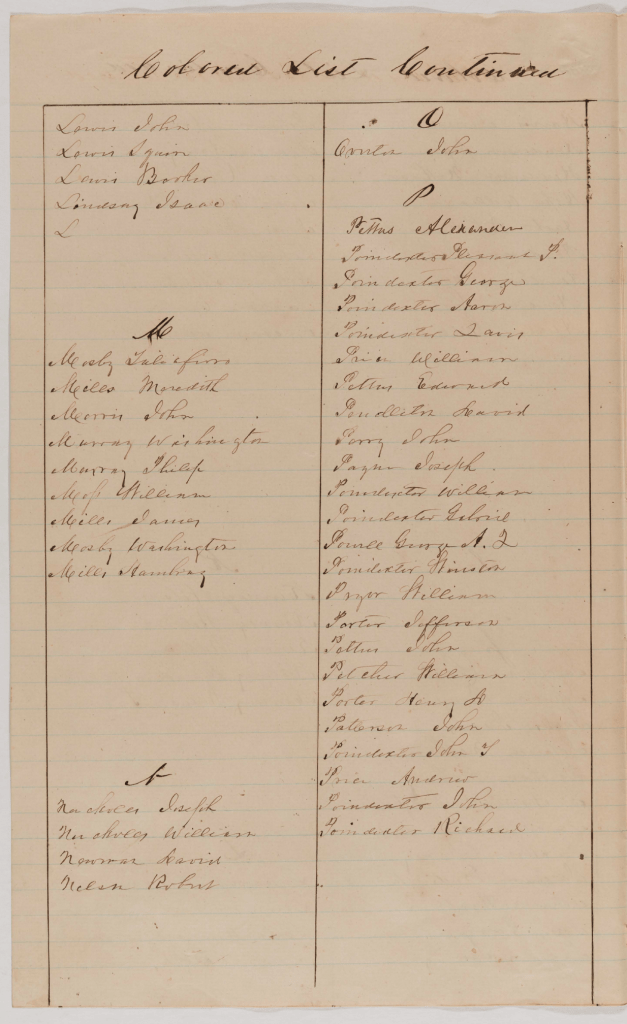
Poll Book, 4th District, Louisa County, Va., List of Voters, Colored, 1867, Virginia Untold: The African American Narrative Digital Collection, Library of Virginia, Richmond, Va.,
Military Rule Election Records of the Virginia Secretary of the Commonwealth, 1867, 1869, Box 21, Folder 3
Census
1870; Census Place: Northern District, Louisa, Virginia; Roll: M593_1660;Page: 331B
In the First Reconstruction Act of 1867, Congress required former confederate states to ratify the Fourteenth Amendment before it allowed their representatives to be seated in Congress. Part of this Act required that each district would register all male citizens of the United States over the age of twenty-one years that were qualified to vote by Sept 1867. Officers of the US Army oversaw the registration of voters, keeping separate poll book for the races. Virginia did not ratify the 14th and 15th Amendments until 1869, keeping in under military law until the ratification. The first elections in which African American males were allowed to vote occurred while Virginia was under military rule in October 22, 1867.
Louisa County, 4th District
Henry Jackson is included among the list of voter for the 4th District of Louisa County. While nothing other than the first and last name is recorded, a comparison of neighbors on the 1870 Census allows the deduction that this Henry Jackson is Alice’s husband and Damon’s father.
Henry Jackson is one of nine Henry Jacksons living in Louisa County in 1870; only two of these nine were over 21 years of age in 1867. Henry, husband of Alice was living in the Northern District of Louisa County and the other in the Southern District.
James H Daniels were listed on the same page as Henry in the census, while Robert Stewart was listed on the next page and Samuel Boxley the previous page. All three are listed in the Poll Book.
Further Research Needed:
Locate relatives of Henry and Alice Jackson in Louisa and surrounding counties
Hotchkiss, Jedediah, Robert E Lee, Washington And Lee University. Trustees, and Worley & Bracher. Map of Augusta County, Virginia. [Lexington, Va.: Trustees of Washington College, 1870] Map. https://www.loc.gov/item/80693004/.
Prints
Rau, Woldemar, Lithographer, and Edward Beyer. Staunton, Va. / drawn from nature by Ed. Beyer ; W. Rau. United States Virginia Staunton, ca. 1857. Photograph. https://www.loc.gov/item/93504429/.
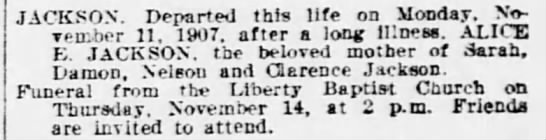
Alice Jackson died on 11 November 1907; she was 53 years old. Her death certificate lists her place of birth as Orange County, Virginia and that she had only been a residence in DC for the past 20 years.
Her son, Clarence died in 1924. Both of his parents were listed on his death certificate: Henry Jackson, born S Carolina and Alice Ternel? in Virginia.
Sarah Hopkins, their daughter, provided the information, and she listed her father’s birthplace as South Carolina, when other records consistently list it as North Carolina, suggesting a close but off memory; the same is possible for Alice’s last name. It might be Ternel, and it might be Terrell, a common last name in Orange County, Virginia.
1880 Census | Staunton, Virginia
In 1880, Henry and Alice Jackson are living in Augusta County, Virginia in the town of Staunton. They are living off on Green Street. Green Street ran south from the City Water Works before curving slightly west. Their house sat on the curve. Immediately to the east, along Federal Street, a brisk 5 block walk would bring you to the Railroad Depot for trains running on the Chesapeake and Ohio Railway, a railway that had connections with Louisa County, as part of the Virginia Central Railway which was originally the Louisa Railroad. The trains east ran to Charlottesville and from there to Gordonsville, where it connected with the line out of Louisa County.
They are living with Thomas Ligins, a RR laborer and Mollie Carr, a housekeeper. They are listed as a separate household, but same address.
SW Quadrant of Staunton | The railroad follows the circle of the river with the depot on the left side of the curve. Green Street is the farthest west and curves around the hill.
Railroads are shown as line with circles
The census enumerator lists Henry and their children: William, Dayman, Joseph, Glance and Sallie with the last name Jackson. For Alice, he listed her as Alice Trimble. There was a large family of Trimble that lived in Staunton, including an Alice V Trimble, married to Joseph.
The census enumerator listed her relationship as “mistress”, a unique term in his records. A keyword search of the 1880 census for the term shows returns only one other record in Albemarle County. Both records lists an older male partner, and a younger female partner. It is unclear whether or not the census enumerators made the independent decision to record the term, or if the family used the term. Enumerators had clear guidelines of what they could and could not use. Given the use of the term, it is unclear if the last name Trimble was also meant in earnest.
Further Research Needed:
Identify possible relatives in Orange and Louisa Counties, Virginia
“CITY NEWS IN A NUTSHELL: A DAY’S STORY OF THE CAPITAL CITY BRIEFLY TOLD BY “POST” REPORTERS.” The Washington Post (1877-1922), May 06 1893, p. 4. ProQuest.
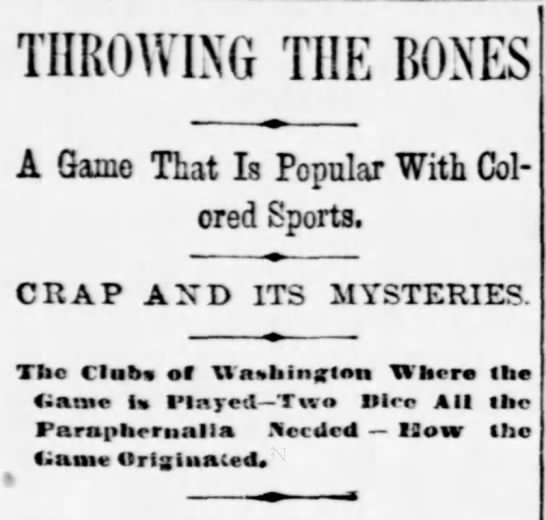
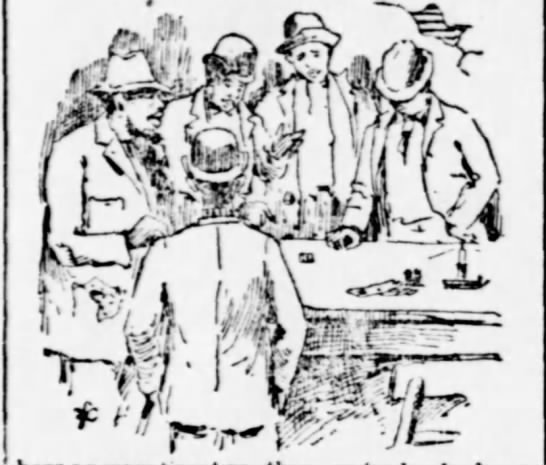
An 1890 article in the Evening Star claims that the game of craps was originated in the “cotton fields of the sunny south”, played by enslaved laborers forced to work in the fields and forbidden to take articles of entertainment with them. A game of craps only requires two “bones” to be thrown from the hand. Throwing a seven or a eleven is a “pass” and he wins the stake. Throwing two, three, or twelve means an automatic loss, while any other number is a “point” and a chance to throw again.
Historically, there are two forms of craps, “Casino Craps” and “Street Craps”. Dice games with any number of variants have been found in many cultures across time. In the 1700s, the French created a form of Hazard that transformed into Craps. French immigrants took it to Arcadia, Nova Scotia and then from there to New Orleans. From New Orleans, the African-Americans picked it up as a game and as with any game, it evolved. Casino Craps was introduced in settings like river boats where there were formal “banks” to bet against, whereas Street Craps were played by people anywhere they could get a smooth setting and placed their bets against each other. The players were referred to as “bone-shooters” and the game “shooting de bones” in newspaper briefs from the 1890s.
In contrast, the Evening Star ran hundreds of articles in the 1890s about the police raiding crap games. The police and the newspapers painted it as a type of robbery as the game “fleeced” young gamblers and allowed large groups of Black men to gather, who were characterized as “boisterous”, using profane language. The Washington Bee, an African-American newspaper from DC, printed a speech in which the speaker lamented “pool and crap games swallowing up their money and monopolizing their thoughts.”
An 1889 article about the “Foggy Bottom” gang, described an alley as “a place where loafers, thieves, crap-shooters, and murderers congregate”, exposing how the newspapers like to paint crap-shooting as a lurid game associated with violence.
Police Take Notice
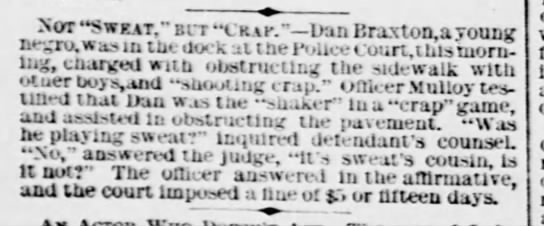
There were only a handful of articles about craps in the Evening Star in the 1880s. In 1887, it ran its first short brief and place the game in quotation marks, “shooting crap” and named the role of “shaker”. The article contrasts Craps with Sweat, a type of card game that resembles poker and considered the “Old Army and Navy game”, and another form of street gambling.
Damon Jackson
In May 1893, Damon Jackson was charged with an assault to kill. Damon had been playing a game of crap with Joseph Plummer which ended by “Damon’s little hatchet which clove the skull oof Joseph Plummer”. Damon had been winning the game, and Joseph requested that he be staked another nickel “to buck gain the fickle goddess once more.” Both Mrs. Jackson and Damon berated him and drove him into the street where he was struck with the hatchet. Witnesses for Damon “with equal zeal asseverated” that Jackson was trying to nail up the door to keep Plummer out. After the flowery and descriptive language of the article, the post article ends simple with “Jackson was acquitted.”
Further Research Needed:
Locate the court records in the National Archives.
Baist, G. Wm, Wm. E Baist, and H. V Baist. Baist’s real estate atlas of surveys of Washington, District of Columbia: complete in four volumes. Philadelphia: G.W. Baist, -<1911 >, 1909. Map. https://www.loc.gov/item/87675120/
1872 | Estimated Birth Year
based on ages given in the 1880 and 1910 Census.
1880 Census
Living with parents, Thomas and Martha (Colbert) Reeder in Jackson Alley, the heart of Swampoodle. He is eight years old living with two sisters, Mary and Georgiana.
1891-97 | 809 N Capitol
The 1891, 1892, and 1897 City Directories list his address as 809 N Capitol street. This address is a block north of the Government Printing Office and within a stone’s throw of Jackson Alley. North Capitol is the N/S road on the right side of the map excerpt. 809 N Capitol is lot 34 on the block opposite DeFrees Street.
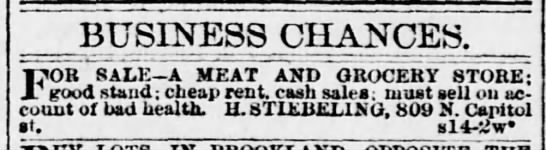
In 1887, the Evening Star ran an advertisement for the sale of the property as a grocery store
In 1889, the Evening star ran an advertisement for a laborer to help in the grocery store.
1900 Census
He is living at 50 Jackson Alley, with his parents and his brother, Charles. Both he and his father are working as day laborers while Charles has a job as a photographer. The census reports that he and his father haven’t been able to work in six months. The census enumerator indicated he had been married for 5 years, but doesn’t list a wife.
The Evening Star lists a marriage between Joseph Reeder and Josephine Lucas in 1895. She is living with parents in the 1900 Census and lists her status as a widow. She is living on Adams Express Alley. There is no death records in the index for a Joseph Reeder between 1895-1900 and a search of the newspapers does not return one either. However, the lack of a death record is inconclusive as one may not have been filed.
1904 Marriage
The Evening Star runs the list of marriage licenses, including Joseph D Reeder and Abbie Nelson. When he applied for the license, he expressed worry for the cake, as he had purchased it from a Seventh Street confectionary and was having it delivered to 809 North Capitol and it had yet to appear.
This article has him living back at the 809 North Capitol address suggesting he works again for the grocery story.
1907-1908 City Directory
He and his wife are living at 54 Pierce Street NW. Pierce Street was undeveloped in the 1887 Plat Book. In the 1907 Baists Real Estate it was block of row houses. It has since be redesigned. It is one block over from where the Hodcarrier’s Association had their building in the 1880s and where James Reeder lived.
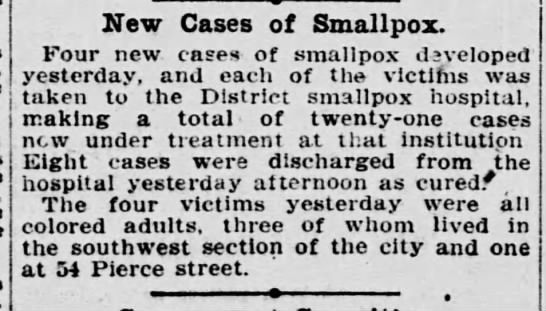
In 1908, there was a reported case of smallpox. No name was provided in the news report. It is unclear if it was in the Reeder household or another household residing in the house.
1910 Census | 1909-1912 City Directories
He is living on 17 Fenton St NE, where his aunts and uncles lived in the 1890s. He is living with his wife and son, Abbie and Frank Reeder. The census enumerator lists this as his first marriage and that they have been for 6 years. Frank is 4 years old.
Joseph is working as a teamster at a grocery store according to the census; the city directories list him as a clerk.
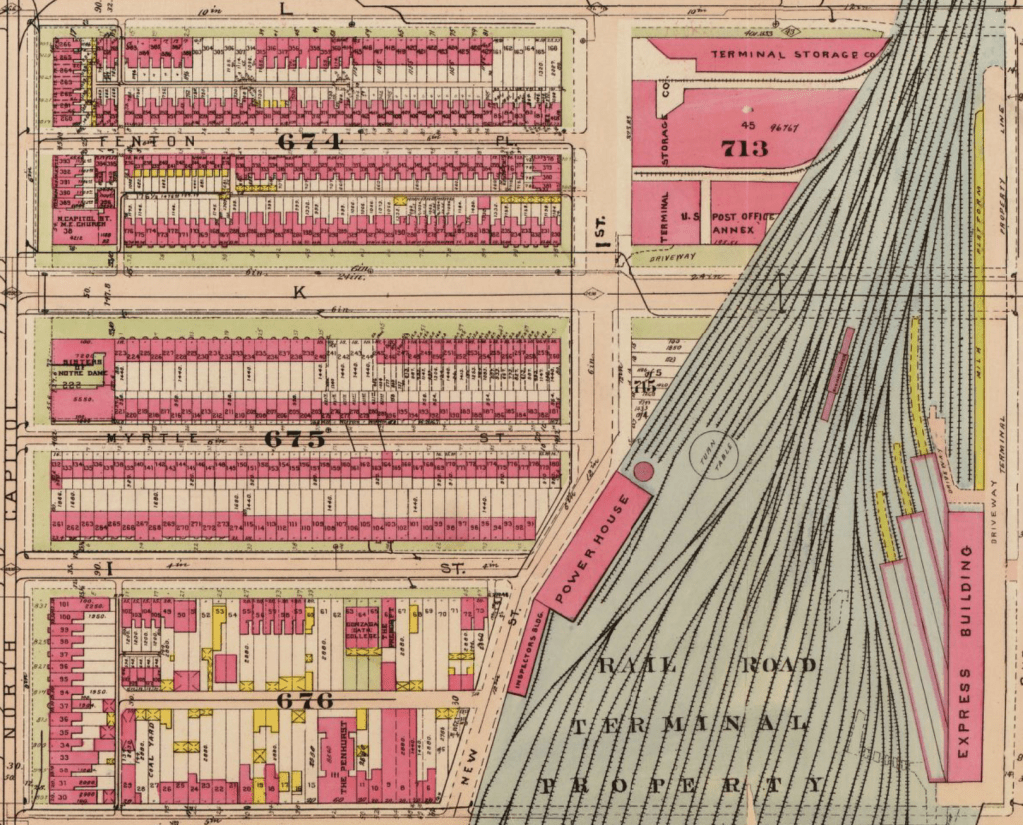
The map excerpt shows the block with the 809 North Capitol Street Grocery store, as the bottom block, with the RR Terminal property on the back side of the block. Two blocks north was Fenton Street, with townhouses packed in tightly.
1914-1915 | 809 N. Capitol
In the 1914 City Directory he is listed as living in rooms above the grocery store. A 1915 Washington Post article that calls him Joseph Reed states his residence as 809 N. Capitol; he was arrested at the rear of 18 L Street northwest and taken to Washington Asylum Hospital, a consolidated hospital, poorhouse and workhouse.
In the 1920 Census, Frank Reeder, Joseph and Abbie’s son, are living in the rear of L Street with Abbie’s parents, Kate and Thomas Simms. Kate died the next year, in 1921 and their address is listed as 13 L Street NW (rear). It lists her daughter and grandson, but not Joseph.
It is likely that Joseph was visiting his in-laws when he was arrested. In October, an Evening Star article states that he was acquitted for his perceived role in a robbery.
Unknown
Joseph and Abbie Reeder have yet to be located in the 1920 or 1930 census. Frank is recorded marrying in Detroit, Michigan in 1935. His parents are listed on the license. He lives there until his death in 1982. It is unclear if Joseph and Abbie also went to Michigan.
Further Research Needed:
Locate a death record for both Abbie and Joseph Reeder
Locate them in the 1920 and 1930 census (if living)
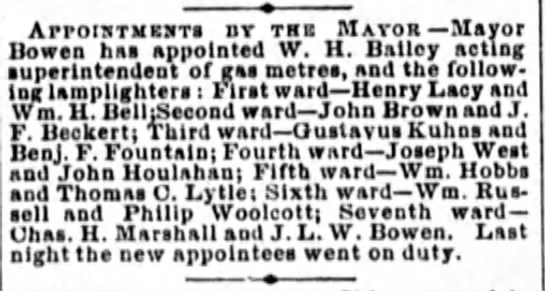
Mary Ellen (Reeder) Fountain lived with her husband on 7th north of Boundary in the 1871 City Directory. Fountain has been appointed lamplighter in 1868 & 1869
Moulton, J. W, and John S Moulton, photographer. Howard University. Washington D.C, None. [Salem, mass.: j. w. & j. s. moulton, publishers between 1867 and 1920] Photograph. https://www.loc.gov/item/2017657067/
Maps
Boschke, A, D McClelland, Hugh B Sweeny, Thos Blagden, and Blanchard & Mohun D. Mcclelland. Topographical map of the District of Columbia. Washington: D. McClelland, Blanchard & Mohun, 1861. Map. https://www.loc.gov/item/88694013/
Hopkins, Griffith Morgan, Jr. Atlas of fifteen miles around Washington, including the County of Prince George, Maryland. Philadelphia: G.M. Hopkins, 1878. Map. https://www.loc.gov/item/76354156/.
Real estate directory of the city of Washington, D.C. suburbs of Washington city, serial number 50, 1874 (25 objects) | DC Public Library
1867 Photograph of Howard University
Howard University was chartered by Congress near the site of a former refugee camp on Seventh Street NW in order to support the educational opportunities of freedmen. Named after its trustee and third residence, O. O. Howard, the university was a comprehensive school providing different types of education for both the newly freed who had been denied access to education under slavery and the free people of color who were seeking higher education. For those who needed basic education, it established the Model School with four classes (A-D) which were organized around skill level. In 1868, B. F. Franklin, living in the Wisewell Barracks, attended the Model School, class C.
Howard University was established just north of Seventh and Boundary, in and around the farmlands of John A Smith.
1861 Topographical Map of the area that would become Howard University1878 Map of the area around Howard University
Fire!
In June of 1871, the Evening Star reported a fire at the home Benj. F. Fountain, on 7th street above Abner Park. The house was destroyed and damage was estimated to be $1000. The fire department “responded promptly, but not in time to save the building”.
Abner Park is the property “situated on Seventh Street, just beyond Boundary street and the terminus of the Seventh Street railway, and is improved by a large commodious hotel with stables, outbuildings, &c.” as described in an 1871 Trustee Sale Ad run in the Evening Star.
Real Estate Transfer
In 1873, the Evening Star listed real estate transfers in the County, and listed the transfer of property between C. C. Caruthers and Mary Fountain in Effingham, is part of the Howard University subdivision of John A Smith’s farm, “Effingham Place”. She sold the south one-third of lot 1 of section 2 of Effingham for $124. This shows her place as being on Seventh Street, and north of the Abner Park Hotel and connected to Howard University.
Based on her Freedmen’s Bank Records, Mary Fountain moved to 13th and O Street NW, immediately south of what was then known as Iowa Cicle. She did not list her husband on her depositor slip. She listed her occupation as sewing. The 1874 City Directory lists Mary E Fountain, dressmaker, living at 818 10th Street NW.
The 1873 City Directory lists Calvin C. Caruthers as living at the corner of Trumbull and Seventh Road which is consistent with the subdivision plat book. In the 1871 City Directory, his residence is listed as the Wisewell Barracks, suggesting that the Fountains and the Caruthers knew each other, as both had passed through Wisewell.
Calvin C. Caruthers was one of the first African-Americans appointed to the DC police force in July 1869.
Wisewell Barracks
The Third Ward Republican Club met frequently at the Wisewell Barracks which was situated near Seventh and O Street. This gave both Caruthers and the Fountains access to the party and allowed them to make connections, providing both with economic opportunities in their appointments. A separate post discusses Fountain’s appointment as lamplighter in 1868 and 1869. It likely that this appointment provided the couple the nest egg they needed to purchase the land near Howard University
Further Research Needed:
Locate death certificate for Benj Fountain who disappears from the records after 1871.
Locate land records for their property in the DC archives
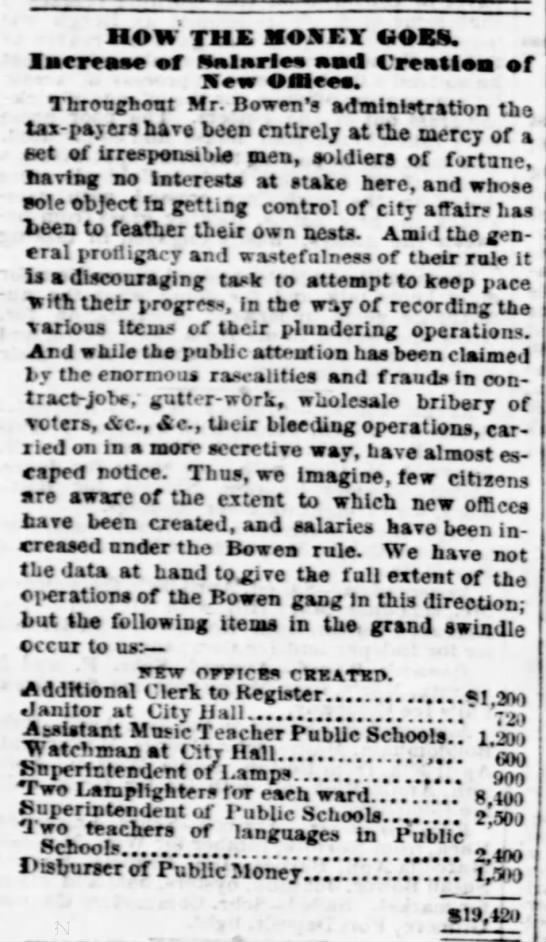
Lamplighters worked at dusk and at dawn, walking the streets of their ward. At the top of the pole, under the lamp, was a bar where they would lean their ladder allowing them to climb to the lamp. In the 1860s, there were two appointed lamplighters for each ward, though bills were proposed that if there were more than 200 lamps, additional lamplighters would be appointed. In 1869, an act was introduced setting the salary of a lamplighter to $600 per annum and separating the appointment of lamplighters from the geographical boundaries of the Wards. They had been receiving a salary of $40 a month ($480/year).
Mayor Sayles J. Bowen, Radical Republican
In 1868, Sayles J. Bowen was elected mayor of DC. He was a Radial Republican who supported educational and economic opportunities for the Black citizens of the District, including the thousands of refugees who had come to the District during and after the Civil War. Bowen Road, in Anacostia, (now Alabama Ave) was named for him. Upon his election in 1868, he filled 30 percent of his administration with Black individuals. Additionally, Bowen inaugurated massive public works projects in the city, building sewers, sidewalks, smoothing roads, etc. This was critical for economic opportunities for working class Washington as there wasn’t an industrial base and unskilled and skilled laborers relied on public works project for employment. His work was criticized by the Democrats and white supremacists who saw his spending and support of Black citizens as wasteful. In actuality, the employment opportunities provided by his administration allowed for a “nest egg” and “modest little homes”.
Among Bowen’s appointees were lamplighters for the wards and he appointed Benj. F. Fountain as lamplighter for the Third Ward in 1868 and again in 1869.
1868
1869
To read more about race and politics in DC, I highly suggest the book Chocolate City by Chris Myers Asch and George Derek Musgrove.
Asch, Chris Myers, and George Derek Musgrove. 2019. Chocolate City A History of Race and Democracy in the Nation’s Capital. Chapel Hill: University of North Carolina Press.
1870 Mayoral Campaign
In 1870, the mayor’s seat was once again up for election, and the Republicans met in May 1870 to determine their candidate. Among the delegates for the Third Ward, was B. F. Fountain.
Further Research Needed:
Identify if the Fountains were able to purchase property
Multiple documents connect the Reeders to St. Mary’s County.
Sources
ST. MARY’S COUNTY COMMISSIONER OF SLAVE STATISTICS (Slave Statistics) 1867-1869 C1698 | Maryland State Archives
The following documents suggest St. Mary’s County as a place of research for the Reeder family:
James Henry Reeder listed St Mary’s County on his service records and the Freedman’s Bank records
John Reeder listed St Mary’s County on his USCT service records and his marriage records in the Freedmen’s Bureau Records
James Henry Reeder and Emeline Dorsey Reeder listed St. Mary’s County on a birth return for two children
John and Cora Key Reeder listed St. Mary’s County on a birth return for two children
Slave Statistics
Emeline Dorsey, wife of James Henry Reeder
John Milburn reported enslaved nineteen people, including a Dorsey family group.
Enslaved Individuals
Age
Mary Dorsey
45
Emeline Dorsey
25
Catherine Dorsey
23
William Dorsey
19
Josiah Dorsey
16
Susan Dorsey
11
Philmore Dorsey
8
Mary Dorsey
4
In 1867, the Maryland General Assembly ordered that enslavers provide lists the individuals they enslaved in 1864. These lists were to be submitted to the federal government in hopes of federal compensation the enlistment of enslaved individuals into the Union Army. No compensation was provided. The records however, include the enslaver’s name, the first and last name of the enslaved as well as their age and gender, allowing the researcher to go past the 1870 census to track family groups and households. Slave statistics survive for Anne Arundel, Dorchester, Frederick, Howard, Kent, Montgomery, Prince George’s and St. Mary’s counties.
Cora Kee/Key, wife of John Reeder
The Freedmen’s Bureau records indicate that Cora and John were married in 1861 by a priest with the last name Moore. This suggests that both Cora Kee and Cora Reeder should be used as search terms in the Slave Statistics. Cora Kee/Key is not listed. Cornore Reeder is.
John A Crane enslaved twenty two individuals, including Cornore Reeder, age 20 and Mary Alice, age 2. John and Cora Reeder listed one child on their marriage report; it is possible that Mary Alice is that child. In the 1880 Census, they list another daughter named Alice who was born in 1877 suggesting that Alice is a family name.
In the 1870 Census, Cora and John Reeder have three individuals with the surname Key living in their household: Mary, Caroline and James. George H. Morgan reported enslaving 24 people, including a family group of Keys.
Enslaved Individual
Age
Cecelia Key
25 (Left, Nov 11, 1863)
Jack Key
6 (Left, Nov 11, 1863)
Elizabeth Key
8 (Left, Nov 11, 1863)
Sarah A Key
23
James Key
5
Mary Key
10
Jane Reeder, mother of the Reeders
Mrs. Ann E Chiveral listed enslaving one individual: Jane Reeder, age 46.
She left with the Union Army on 20 Feb 1863.
the Reeders
Edward L Abell listed 28 enslaved individuals under his own name, and six as guardian for the Smith children. The six individuals appear on both lists, and include James (19), John (30), Thomas (21), and Mary Ellen Reeder (16).
He noted that they left with the Union Army:
Thomas Reeder left first: 14 Sept 1862
James Reeder left: 17 Oct 1863
John and Mary Ellen left: 28 Oct 1863
Thomas Reeder
James L Foxwell reported enslaving thirty individuals, among them Thomas Reeder, age 45. This Thomas is too old to be Thomas Reeder in DC, and is of a similar age as Jane Reeder, suggesting he may be a brother or spouse of Jane.
Further Research Needed:
Identify the land of the enslavers: Milburn, Foxwell, Chiveral, Smith and Abell
Locate inventories related to the enslavers and their family which may contain names of family members and/or the family groups.
Two Thomas Reeders lived in DC after the Civil War.
Sources
Freedmen’s Records
District of Columbia, Freedmen’s Bureau Field Office Records, 1863-1872,” database with images, FamilySearch (https://familysearch.org/ark:/61903/3:1:3QS7-8937-FP18?cc=2333782&wc=9J3J-SPX%3A1069293302%2C1069293906 : 3 August 2016), Assistant inspector general > Roll 1, Letters sent, Mar 21, 1866-Sep 7, 1868 > image 41 of 146; citing NARA microfilm publication M1902 (Washington, D.C.: National Archives and Records Administration, n.d.).
City Directory
Washington, District of Columbia, City Directory, Various
There were two Thomas Reeders who lived in DC after the Civil War. James Thomas Reeder, who alternatively went by James and Thomas, married Clara Woodland and they had one son, John V. Thomas Reeder, married to Martha, lived in Jackson Alley for the bulk of his life in DC.
Freedmen’s Records
Clara Reeder claimed that she and Thomas Reeder had selected two lots in Barry Farm and was inquiring in the case.
James Reeder, from Anne Arundel County, and Clarissa with their son John V, are living in Freedmen’s Village.
Thomas Reeder, with John and Benjamin Fountain, received goods from the Superintendent at the Kendall Green Barracks.
1870 Census
James T. Reeder is listed in the household of Mary Woodland and her daughters, including Clara Woodland. He is listed as Thomas Reeder. John V. Reeder is listed as his son. They are living in Ward 3. Other surnames in the household include Chesley.
Thomas Reeder is living with his wife, Martha and his infant daughter Mary E. Reeder. They are living in Ward 3.
1871 City Directory
James T. Reeder is living at 1214 3d NW.
Thomas Reeder is living at 1417 1st NW.
This address is consistent with the tax records in the newspapers addressed in a different post.
1873 City Directory
Thomas Reeder is living at 813 L NE. He is a porter
Thomas Reeder is living at 811 L NW. So is James Reeder.
1877 City Directory
James T Reeder is living at 1622 2d Street.
Thomas Reeder is living at 1419 1st NW.
1879 City Directory
James T Reeder is living at 43 Pierce.
Thomas Reeder is living at Pierce Street Alley NW
1880 Census
James T. Reeder is listed as head of a household that includes Mary Woodland. His wife is named a Clarissa Reeder and his son, John V is listed. He is also living with his niece, Mary Reeder, age 24. They are living on N Street NW. Other surnames include Chisley
Thomas Reeder is living with his wife, Martha and his three children, Mary, Joseph and Georgiana. They are living on Jackson Alley.
1883-4 City Directory
James T & Thomas Reeder is living at 418 N NW. He is working as a laborer. His son is also listed as living here.
Thomas Reeder is living at 71 Jackson Alley. He is working as a laborer
1885 City Directory
James T Reeder is living at 418 N NW. He is working as a laborer.
Thomas Reeder is living at Jackson Alley. The address is unnumbered. He is working as a laborer
1893 City Directory
J Thomas Reeder is living at 444 Ridge NW. He is working as a laborer. His son is also listed as living here.
Thomas Reeder is living at Jackson Alley. The address is unnumbered. He is working as a laborer
1894 City Directory
J Thomas Reeder is living at 444 Ridge NW. He is working as a laborer. His son is also listed as living here.
Thomas Reeder is living at 34 Jackson Alley. He is working as a laborer
1895 City Directory
J Thomas Reeder is living at 462 Ridge NW. He is working as a laborer. His son is also listed as living here.
Thomas Reeder is living at 36 Jackson Alley. He is working as a laborer
1898 City Directory
James T. Reeder is living at 462 Ridge NW. He is working as a laborer. His son is also listed as living here.
Thomas Reeder is living at 50 Jackson Alley. He is working as a laborer
1900 Census
Thomas Reeder is listed as head of a household with his wife Clara, their son John and his wife. John is a musician. They are living on Ridge NW
Thomas Reeder is living with his wife, Martha and his two children, Joseph and Charles. They are living on Jackson Alley.
1901 City Directory
James T. Reeder is living at 462 Ridge NW. He is working as a laborer. His son is also listed as living here.
Thomas Reeder is living at 50 Jackson Alley. He is working as a laborer
1910 Census
James T and Clara W are living in the household of of John V on Ridge St NW. It indicates that John V is their only child.
Thomas Reeder is the Home for the Aged and Infirm. He is living as a widower.
1920 Census
James T and Clara W are living in the household of of John V on Ridge St NW.
Thomas Reeder is the Home for the Aged and Infirm. He is living as a widower.
Death
The Evening Star ran the obituary of James Thomas Reeder. It names his son, John V, and his daughter in law as well as their home address on Ridge NW. His death record lists his parents: Barnes Reeder and Henrietta Reeder. He was born in St. Mary’s County, MD.
A Thomas Reeder, without identifying information died in 1929. This is consistent with a death in an institution where there is little information about his background.
Another Thomas Reeder is listed with a death in 1924, however, an obituary lists family members not consistent with either Reeder and his age places his birth year in the 1880s. His death records lists his address as 2nd Street SE which is not consistent with City Directories or Census Records.

















 stories of Then