1852-1902
In 1862, the District of Columbia emancipated the individuals enslaved within its borders; it also offered reparations to the enslavers, who could no longer force labor from the freed.
George Washington Young submitted a list of the people he enslaved so as to be compensated. Among the names is the family group of Grahams: Peter and Charity Graham and their children, including Charley Graham, age 9. His height was listed as 4 foot 8 inches. He was of average height for his age.
Young owned a considerable amount of land in Anacostia. He managed two plantations: Nonesuch and Giesborough Manor, both across the river in the area considered Anacostia today. Nonesuch was located north of Good Hope, in a neighborhood now called Hillcrest. His grandfather, Notley Young, had owned plantations in what became the city of Washington, particularly Duddington Pasture, which was located on the southwest waterfront.

G. W. Young purchased Giesborough Manor in 1833 and inherited Nonesuch from his father in 1826. In addition to inheriting the land, his father also named several enslaved individuals, among them, Peter and Charity, Charley’s parents in the 1862 emancipation records, in his bequest for George Washington Young.
Peter worked both as field hand and blacksmith. Charity was a field hand. Likely, Charles worked beside his parents in the fields.
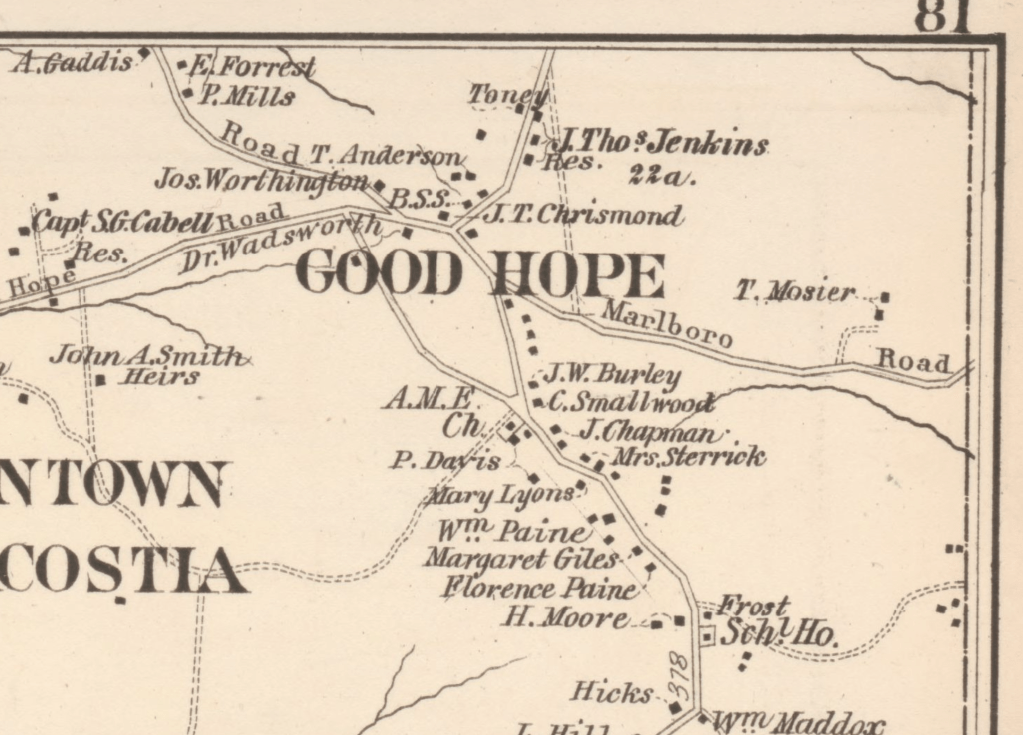
In 1870, the Grahams are living near Good Hope (DN 910). The Census records Charity, as a white washer, with her children and Johanna Chase. Charles is working as a farm laborer. Their neighbors are the Paine and Giles household visible on the Hopkins Map, south of Good Hope.
His brother, Robert Graham, is living nearby with his own household, also working as a farm laborer (DN 929). Robert is a neighbor of Jos. Worthington who is shown on the Hopkins 1878 map of Good Hope. GWJ Hatton, a blacksmith, lives in the Robert Graham household. Thomas Anderson (1792-1882) was a blacksmith as well, and grew produce he sold at Center Market. (East of the River) Anderson’s daughter married Jerome Hutton in 1871.
In 1875, Charles Graham and Johanna Chase applied for a marriage license. Two death records: one for an infant girl and one for Johanna Graham show that she died giving birth in Mar 1877.
Johanna Chase is listed in the 1870 Household of Charles’ mother, Charity. She may be the same Johanna Graham that is listed in the family group of Peter and Charity in the emancipation records of George Washington Young. She is listed in the census as 25 with an estimated birth year of 1845.
Her birthplace, unlike the Graham’s, is listed as Maryland. There are Chase households in Hyattsville, Collington and Upper Marlboro in Prince George’s County in the 1870 Census. It is possible that she connected to these.
In the 1880 Census, Charles is still living with Charity and several of her grandchildren: Mary, Sally, Robert and Edward. It is unclear if the four children listed in Charity’s household are the children of Charles and Johanna. Edward, the youngest, if age 4, suggesting that they were all born prior to 1877.
In 1881, Charles married Alice Dent, a widow with three children, Charles, Georgiana, and William.
Alice’s first father-in-law, Bruce Dent had been a huckster at Centre Market, and was able to purchase land on Bowen Road, near the plantation of Nonesuch. Dent’s second wife continued to be a huckster, while he was a gardener. The map excerpt shows Good Hope on the left, and Bowen road leading northeast to the lands of Nonesuch. (Mary B Denham and Washington A Young were heirs of G. W. Young.). To the right of the Denham and Young land are small parcels. Dent owned 5 acres on the MD border; in 1875, he was delinquent on his taxes and the land description was included in the National Republican: “Beginning at the intersection of the DC Lin with the boundary of IF Young’s part of ‘Nonesuch’ and the Trimble tract…”

Alice’s children, Charles, Georgiana and William list Anacostia and/or Oxon Hill as their birth place on records, suggesting that she had been living near Dent and therefore near the Grahams.
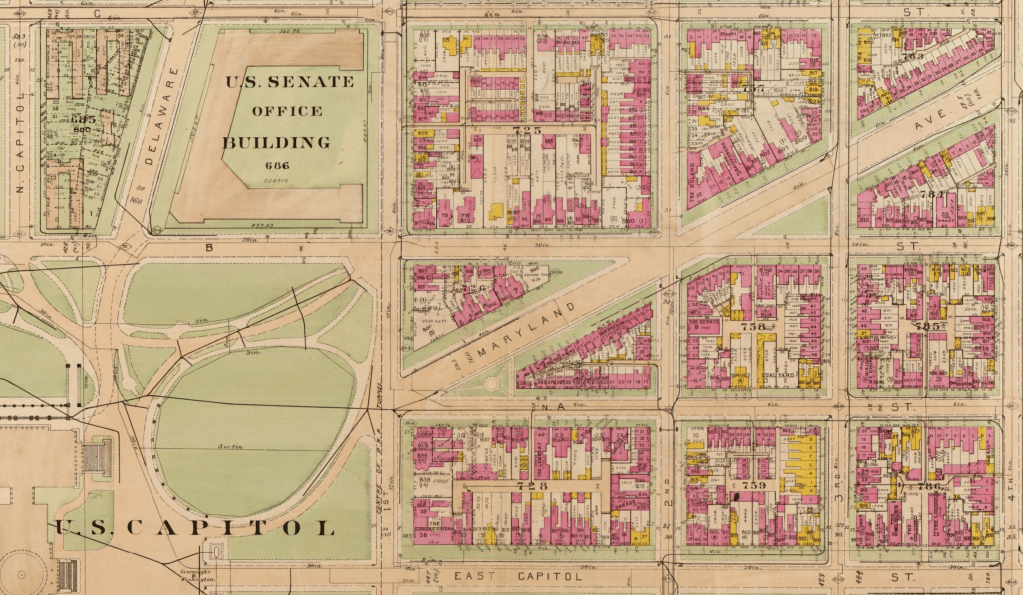
Charles’ brother, Robert Graham, moved to the City of Washington in the early 1870s, moving to B st se, near where Alice was working as a domestic servant in 1880.
In 1882, Charles is recorded living in Pleasant Alley, which is behind G street SW, two blocks south of where Bruce Dent had owned property on 3d Street between E and F. I
By 1886, the family had moved to southeast DC and Capitol Hill. Charles and his step-children are listed living at 301 G Street SE. In 1887, Georgiana married Frank Winters and moves to 427 2d SE. They are close to Eastern Market.
By 1900, Charles is living with his step-son, William Henry Graham at 303 7th St SE. He dies in 1902.





 stories of Then