Henry Jackson | poll book

Known Information

Henry Jackson lived in Louisa County, Virginia in the 1870 Census.

Sources

Prints

Alexander G. McKenney, James H. Terrill, John O’Dwyer, “Notice. The Registration of the Voters,” Remaking Virginia: Transformation Through Emancipation, accessed December 23, 2020, https://www.virginiamemory.com/online-exhibitions/items/show/596.

The Miriam and Ira D. Wallach Division of Art, Prints and Photographs: Picture Collection, The New York Public Library. (1868-07-25).Electioneering at the south. Retrieved from https://digitalcollections.nypl.org/items/510d47e1-3fa3-a3d9-e040-e00a18064a99

Poll Book

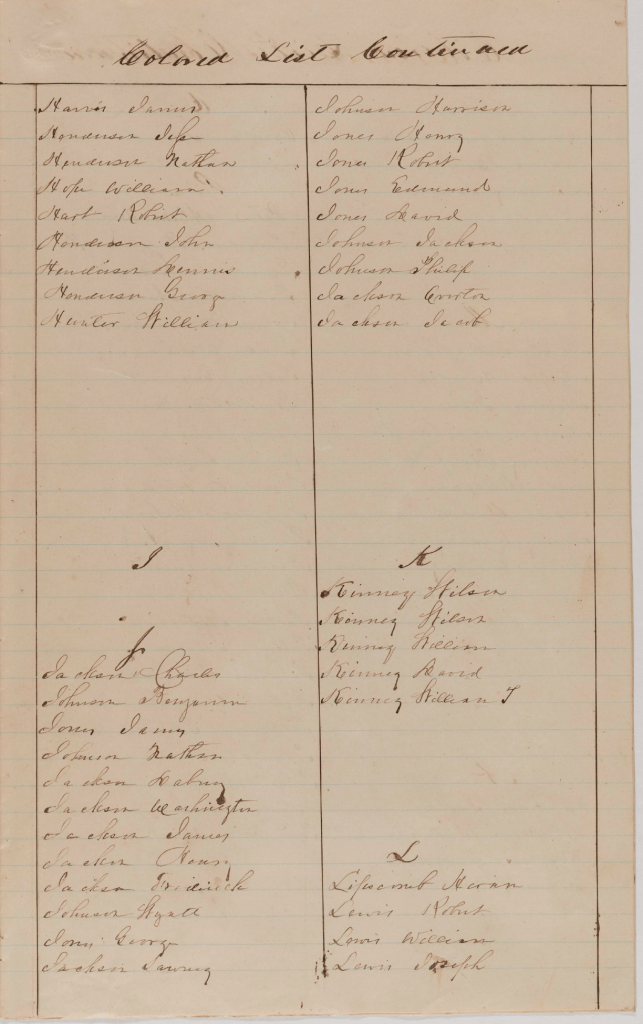
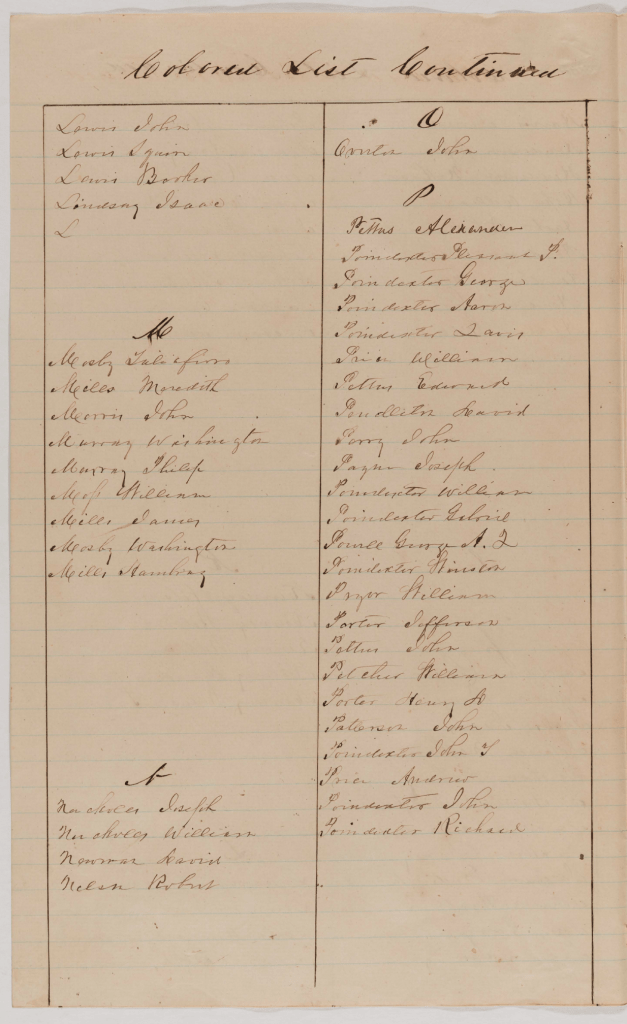
Poll Book, 4th District, Louisa County, Va., List of Voters, Colored, 1867, Virginia Untold: The African American Narrative Digital Collection, Library of Virginia, Richmond, Va.,

Military Rule Election Records of the Virginia Secretary of the Commonwealth, 1867, 1869, Box 21, Folder 3

Census

1870; Census Place: Northern District, Louisa, Virginia; Roll: M593_1660;Page: 331B

In the First Reconstruction Act of 1867, Congress required former confederate states to ratify the Fourteenth Amendment before it allowed their representatives to be seated in Congress. Part of this Act required that each district would register all male citizens of the United States over the age of twenty-one years that were qualified to vote by Sept 1867. Officers of the US Army oversaw the registration of voters, keeping separate poll book for the races. Virginia did not ratify the 14th and 15th Amendments until 1869, keeping in under military law until the ratification. The first elections in which African American males were allowed to vote occurred while Virginia was under military rule in October 22, 1867.

Louisa County, 4th District

Henry Jackson is included among the list of voter for the 4th District of Louisa County. While nothing other than the first and last name is recorded, a comparison of neighbors on the 1870 Census allows the deduction that this Henry Jackson is Alice’s husband and Damon’s father.
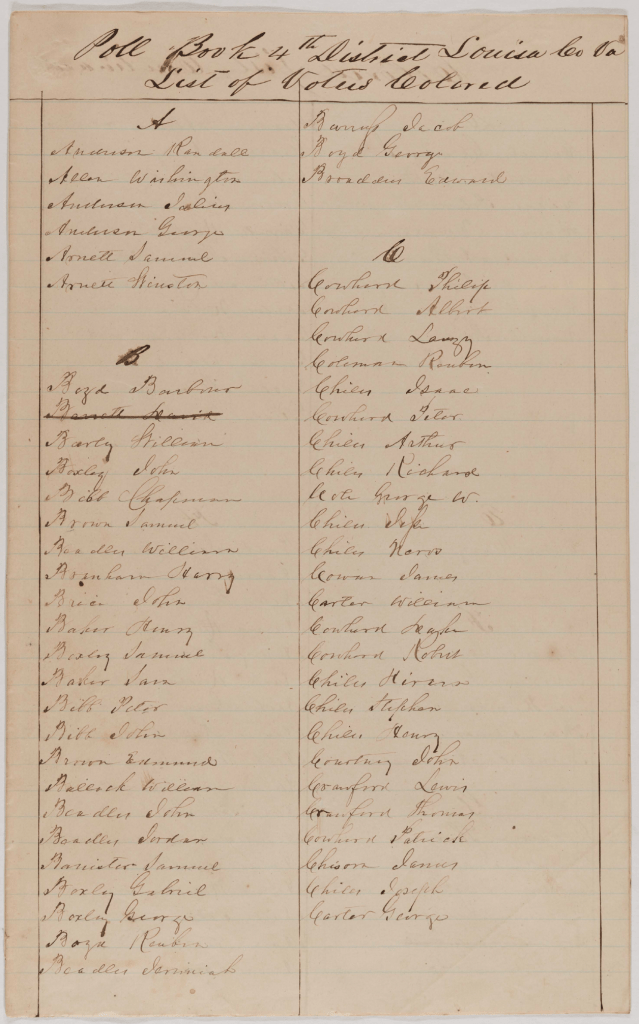
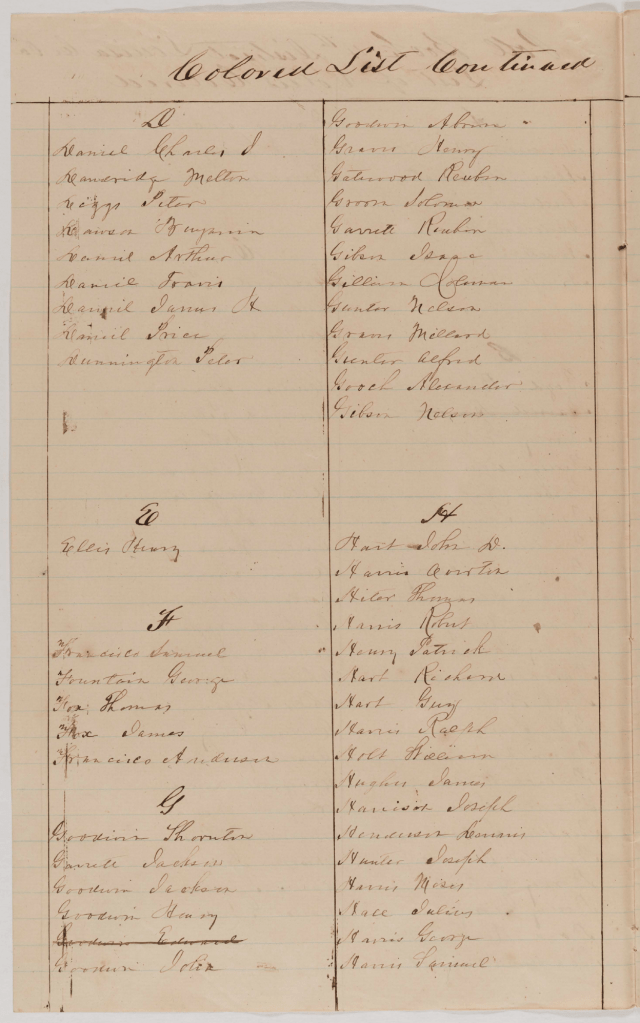
Henry Jackson is one of nine Henry Jacksons living in Louisa County in 1870; only two of these nine were over 21 years of age in 1867. Henry, husband of Alice was living in the Northern District of Louisa County and the other in the Southern District.

James H Daniels were listed on the same page as Henry in the census, while Robert Stewart was listed on the next page and Samuel Boxley the previous page. All three are listed in the Poll Book.

Further Research Needed:

  • Locate relatives of Henry and Alice Jackson in Louisa and surrounding counties
related posts

Alice | maiden name unknown

Known Information

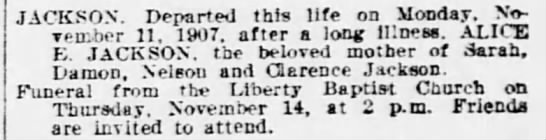
Alice Jackson’s obituary listed her as the beloved mother of Clarence, Sarah and Nelson Jackson.

Sources

Death Certificate

Certificate of Death, Jackson, Alice, 176613, 11,11,1907 | DC Archives

Newspapers

Evening Star 
Washington, District of Columbia
13 Nov 1907, Wed  •  Page 5

Maps

Hotchkiss, Jedediah, and D. C Humphreys. Map of Piedmont Virginia. 1873. Map. https://www.loc.gov/item/2005625117/.

Hotchkiss, Jedediah, Robert E Lee, Washington And Lee University. Trustees, and Worley & Bracher. Map of Augusta County, Virginia. [Lexington, Va.: Trustees of Washington College, 1870] Map. https://www.loc.gov/item/80693004/.

Prints

Rau, Woldemar, Lithographer, and Edward Beyer. Staunton, Va. / drawn from nature by Ed. Beyer ; W. Rau. United States Virginia Staunton, ca. 1857. Photograph. https://www.loc.gov/item/93504429/.

Alice Jackson died on 11 November 1907; she was 53 years old. Her death certificate lists her place of birth as Orange County, Virginia and that she had only been a residence in DC for the past 20 years.

Her son, Clarence died in 1924. Both of his parents were listed on his death certificate: Henry Jackson, born S Carolina and Alice Ternel? in Virginia.

Sarah Hopkins, their daughter, provided the information, and she listed her father’s birthplace as South Carolina, when other records consistently list it as North Carolina, suggesting a close but off memory; the same is possible for Alice’s last name. It might be Ternel, and it might be Terrell, a common last name in Orange County, Virginia.

1880 Census | Staunton, Virginia

In 1880, Henry and Alice Jackson are living in Augusta County, Virginia in the town of Staunton. They are living off on Green Street. Green Street ran south from the City Water Works before curving slightly west. Their house sat on the curve. Immediately to the east, along Federal Street, a brisk 5 block walk would bring you to the Railroad Depot for trains running on the Chesapeake and Ohio Railway, a railway that had connections with Louisa County, as part of the Virginia Central Railway which was originally the Louisa Railroad. The trains east ran to Charlottesville and from there to Gordonsville, where it connected with the line out of Louisa County.

They are living with Thomas Ligins, a RR laborer and Mollie Carr, a housekeeper. They are listed as a separate household, but same address.

SW Quadrant of Staunton | The railroad follows the circle of the river with the depot on the left side of the curve. Green Street is the farthest west and curves around the hill.
Railroads are shown as line with circles

The census enumerator lists Henry and their children: William, Dayman, Joseph, Glance and Sallie with the last name Jackson. For Alice, he listed her as Alice Trimble. There was a large family of Trimble that lived in Staunton, including an Alice V Trimble, married to Joseph.

The census enumerator listed her relationship as “mistress”, a unique term in his records. A keyword search of the 1880 census for the term shows returns only one other record in Albemarle County. Both records lists an older male partner, and a younger female partner. It is unclear whether or not the census enumerators made the independent decision to record the term, or if the family used the term. Enumerators had clear guidelines of what they could and could not use. Given the use of the term, it is unclear if the last name Trimble was also meant in earnest.

Further Research Needed:

  • Identify possible relatives in Orange and Louisa Counties, Virginia

related posts

Damon Jackson | craps game gone wrong

Known Information

Damon Jackson lived in Jackson Alley according to the City Directories. He was married to Mary E Reeder.

Sources

Photos

The Miriam and Ira D. Wallach Division of Art, Prints and Photographs: Picture Collection, The New York Public Library. “Shooting craps.” The New York Public Library Digital Collections. 1890-12-27. https://digitalcollections.nypl.org/items/510d47e2-ee71-a3d9-e040-e00a18064a99

Newspapers

Evening Star 
Washington, District of Columbia
01 Nov 1890, Sat  •  Page 12

The Critic 
Washington, District of Columbia
28 Apr 1890, Mon  •  Page 1

Evening Star 
Washington, District of Columbia
28 Mar 1887, Mon  •  Page 4

Evening Star 
Washington, District of Columbia
11 Feb 1889, Mon  •  Page 3

The Washington Bee 
Washington, District of Columbia
10 Mar 1888, Sat  •  Page 1

Evening Star 
Washington, District of Columbia
06 Feb 1893, Mon  •  Page 9

Evening Star 
Washington, District of Columbia
08 Nov 1889, Fri  •  Page 2

“CITY NEWS IN A NUTSHELL: A DAY’S STORY OF THE CAPITAL CITY BRIEFLY TOLD BY “POST” REPORTERS.” The Washington Post (1877-1922), May 06 1893, p. 4. ProQuest.

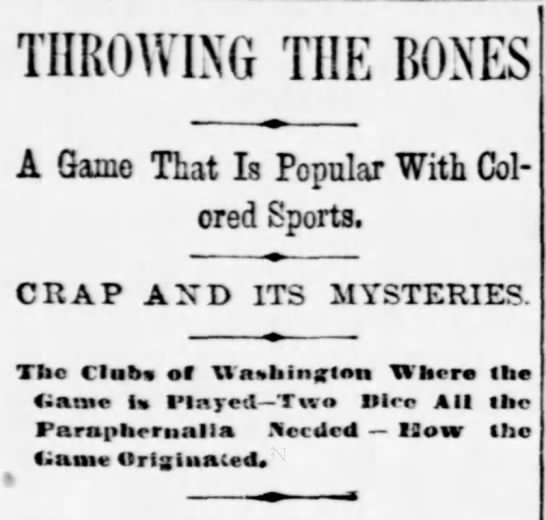
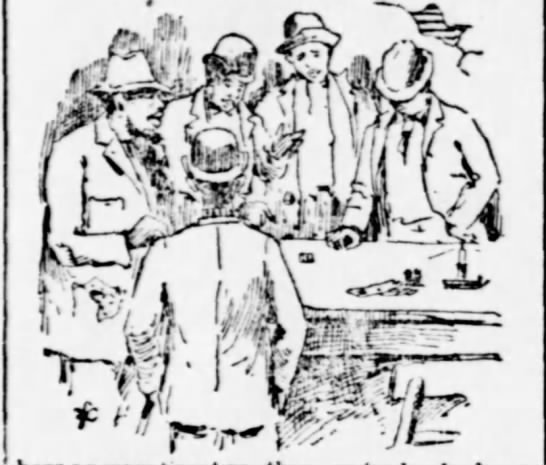
An 1890 article in the Evening Star claims that the game of craps was originated in the “cotton fields of the sunny south”, played by enslaved laborers forced to work in the fields and forbidden to take articles of entertainment with them. A game of craps only requires two “bones” to be thrown from the hand. Throwing a seven or a eleven is a “pass” and he wins the stake. Throwing two, three, or twelve means an automatic loss, while any other number is a “point” and a chance to throw again.

Historically, there are two forms of craps, “Casino Craps” and “Street Craps”. Dice games with any number of variants have been found in many cultures across time. In the 1700s, the French created a form of Hazard that transformed into Craps. French immigrants took it to Arcadia, Nova Scotia and then from there to New Orleans. From New Orleans, the African-Americans picked it up as a game and as with any game, it evolved. Casino Craps was introduced in settings like river boats where there were formal “banks” to bet against, whereas Street Craps were played by people anywhere they could get a smooth setting and placed their bets against each other. The players were referred to as “bone-shooters” and the game “shooting de bones” in newspaper briefs from the 1890s.

In contrast, the Evening Star ran hundreds of articles in the 1890s about the police raiding crap games. The police and the newspapers painted it as a type of robbery as the game “fleeced” young gamblers and allowed large groups of Black men to gather, who were characterized as “boisterous”, using profane language. The Washington Bee, an African-American newspaper from DC, printed a speech in which the speaker lamented “pool and crap games swallowing up their money and monopolizing their thoughts.”

An 1889 article about the “Foggy Bottom” gang, described an alley as “a place where loafers, thieves, crap-shooters, and murderers congregate”, exposing how the newspapers like to paint crap-shooting as a lurid game associated with violence.

Police Take Notice

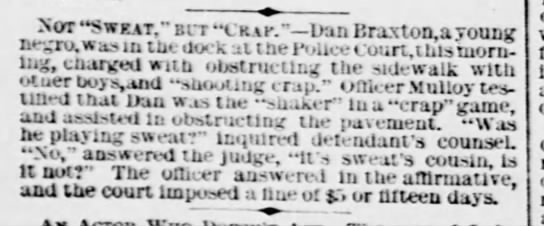
There were only a handful of articles about craps in the Evening Star in the 1880s. In 1887, it ran its first short brief and place the game in quotation marks, “shooting crap” and named the role of “shaker”. The article contrasts Craps with Sweat, a type of card game that resembles poker and considered the “Old Army and Navy game”, and another form of street gambling.

Damon Jackson

In May 1893, Damon Jackson was charged with an assault to kill. Damon had been playing a game of crap with Joseph Plummer which ended by “Damon’s little hatchet which clove the skull oof Joseph Plummer”. Damon had been winning the game, and Joseph requested that he be staked another nickel “to buck gain the fickle goddess once more.” Both Mrs. Jackson and Damon berated him and drove him into the street where he was struck with the hatchet. Witnesses for Damon “with equal zeal asseverated” that Jackson was trying to nail up the door to keep Plummer out. After the flowery and descriptive language of the article, the post article ends simple with “Jackson was acquitted.”

Further Research Needed:

  • Locate the court records in the National Archives.

related posts