A DNA match between descendants initiated an investigation into the probable shared ancestry of two Black individuals living in Prince George’s County after emancipation. Washington Lee, a Civil War veteran, appeared in the Western Branch Neighborhood of Queen Anne District after the Civil War without visible connections to any kinship clusters. In contrast, Maria Matthews, with her husband and children, could be traced to Bel-Air, the Ogle estate situated relatively near Governor’s Bridge. This genetic link between the two individuals suggests a shared ancestry, offering a rare glimpse into the kinship networks formed under chattel slavery in antebellum Maryland.
historical threads: the documentary evidence
Maria Matthews, daughter of Peter Lee
Maria Matthews died in 1903, having lived in Prince George’s County for the majority of her life. Her death certificate identified Peter Lee as her father. This discovery potentially linked Maria Matthews and Peter Lee to Washington Lee, as a shared family name emerged. An elderly Peter (born circa 1800) was listed in the probate records of the Ogle network along with Maria, corroborating the connection between Bel-Air and Maria’s lineal family.
Polly, Wife of Peter
In 1855, Polly, a woman not less than 40 years old, self-liberated herself from William E. Peach. Peach had purchased Polly from the Macgill estate “at her request so that she may enjoy the society of her husband and relatives.” Peach included a certification from Geo. C. Ogle stating that Polly’s husband, Peter, was “anxious that she come home to her master.” Despite Peach’s apparent fulfillment of her request, Polly was not convinced of his purchase and left Prince George’s County, making her way to West River Post Office in Anne Arundel County. Polly had been enslaved on Macgill’s Prince George’s estate, which bordered Bel-Air, where her husband was enslaved. Her journey to West River, in Anne Arundel County, where Macgill’s second estate was situated, suggests the presence of kin in bondage in that location.
Washington Lee, a man of two counties
Washington Lee, a man without readily apparent kinship connections, lived in both Prince George’s County and Anne Arundel County after the Civil War. Marrying Sarah Stewart in Upper Marlboro in 1870, he lived in and around Oak Grove Post Office before moving to Anne Arundel County, near the post offices of Dodon and Harwood, in relative vicinity of West River Post Office. In his waning years, he returned to Prince George’s County to be cared for by his daughter. This combination of Washington Lee’s geographic connections to West River and Queen Anne District, along with the DNA match to Maria Matthews and, presumably, Peter and Polly who also spanned both districts, suggests that Washington Lee was connected with the Lee individuals enslaved on the Macgill estates.
Washington, a boy in the records
A boy named Washington is listed in the probate records of James Macgill. He was held in bondage on Macgill’s Anne Arundel estate near West River, the same area Polly traveled to after her self-liberation from Peach. He was 13 years old in 1844, suggesting a birth year around 1831. His age and location suggest he could be a son or nephew of Polly’s, separated from the Lee individuals who remained in Prince George’s County. Polly’s escape to Anne Arundel County may have been an attempt to reunite with children and kin who had been separated from her in an earlier sale or division of property.
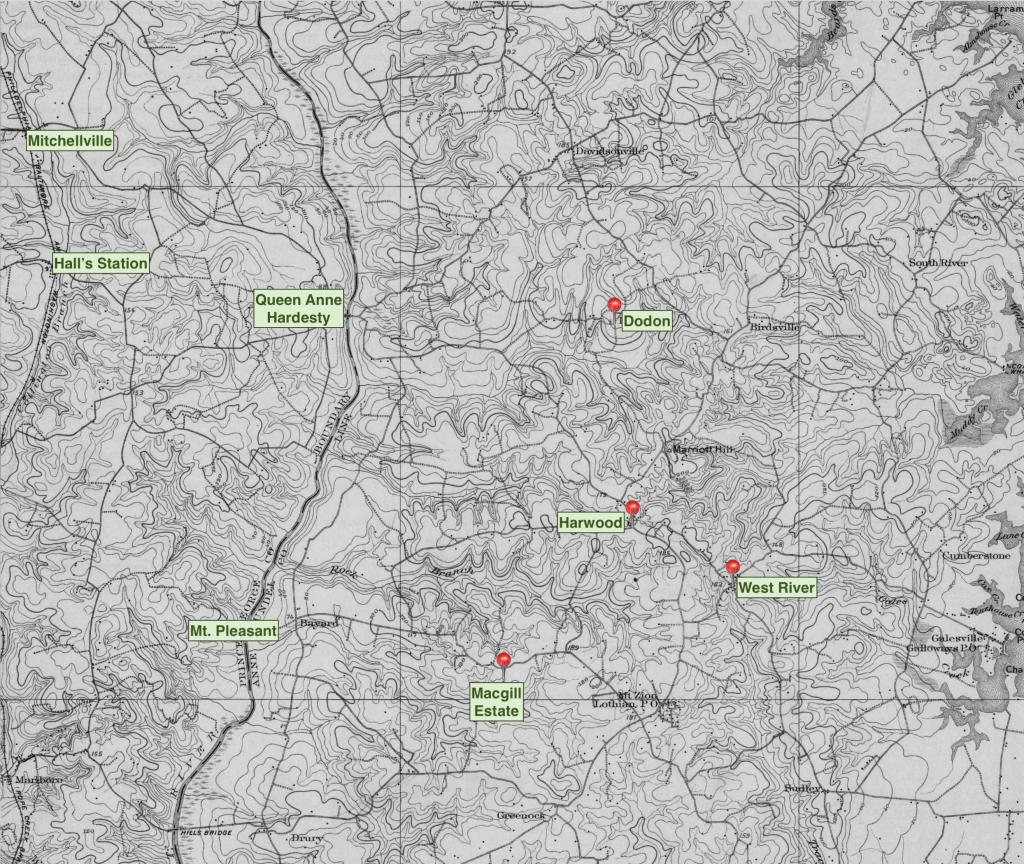
The landscape of southern Anne Arundel County, Maryland, circa 1905. This map illustrates the proximity of key locations in the shared ancestry of Maria Matthews and Washington Lee, including the areas of Dodon, Harwood, and West River. This geographical context is essential for understanding the origins of their kinship connection. Source: U.S. Geological Survey, “Owensville, MD” Quadrangle, 1905, 1918 edition.
weaving the kinship tapestry
The convergence of genetic evidence and meticulously researched historical records allows for the reconstruction of a probable kinship connection linking Maria Matthews and Washington Lee. The shared 62 centimorgans (cM) between their descendants provides a genetic foundation, supporting the documentary trail that places Maria as the daughter of Peter Lee. Given Polly’s documented status as Peter’s wife, her determined self-liberation to be with him, and Washington’s enslavement on a Macgill estate geographically tied to Polly’s post-escape movements, the evidence strongly suggests Washington Lee was a relative of Peter Lee and Polly. This case illustrates how DNA analysis, combined with a deep examination of fragmented historical records, can contribute to understanding kinship networks that were systematically disrupted and obscured by chattel slavery. It underscores the enduring impact of the institution on individuals and their descendants, and the vital role of persistent research in revealing these crucial connections.
The story of Polly is one of resistance against a world designed to commodify her existence. Sold from the estate of her long-time enslaver, she escaped her new owner in a daring attempt to re-stitch the torn fabric of her own kinship community. To understand her actions, one must first examine the complex tapestry of the world that sought to control her.
Dr. James Macgill, heir to his uncle of the same name, presided over a sizable estate in Prince George’s County in the 1830s. His 740+ acre plantation was stitched together from various land tracts along present-day Annapolis Road, a significant crossroads in the Vansville District (later Queen Anne District). The estate was bordered by massive operations: the Jesuit’s 2,000-acre White Marsh plantation, the Ogle family’s 2,000+ acre Bel-air estate, and the Bowie family’s 570+ acre Locust Grove. An 1828 tax list documents the human dimension of this operation, enumerating the 34 people Dr. Macgill enslaved: six elders, eleven adults, four adolescents, and thirteen young children under the age of eight.
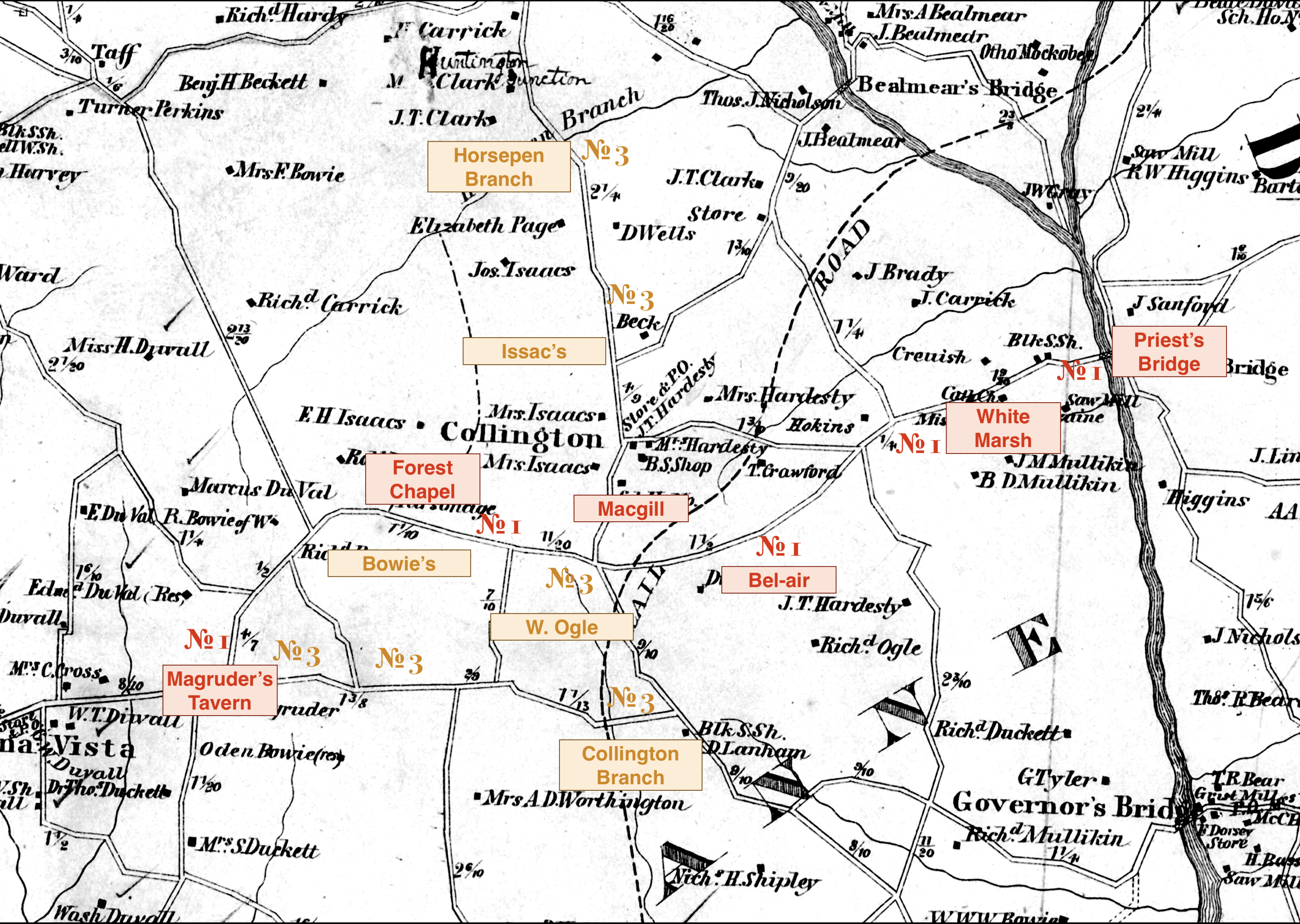
The 1828 Levy Court Road Survey details the estate’s strategic location, providing access to the Patuxent River and placing it in direct proximity to the Ogle’s Bel-air plantation—the community where Polly’s future husband, Peter, was enslaved.
Road No. 1 [now-Annapolis Road]: Commencing at the Priests Bridge on the Patuxent, thence through the White Marsh Plantation; then through Bel-air, thence through the plantation of Dr. James Magill by the Forest Chapel, thence by Magruders Tavern…
Road No. 3: …across Collington Branch, thence with the plantations of William Ogle, James Magill, and Walter Bowie…
Using details from the 1828 Levy Court Road Survey, Martenet’s annotated 1861 map details the route of the area’s primary artery (present-day Annapolis Road), an economic corridor connecting the adjacent plantations of Macgill, Ogle (Bel-air), and the Jesuit’s White Marsh.
Married to Julia Ann Compton in 1829, Macgill also owned property in Anne Arundel County near West River Post Office and Samuel Carr, the husband of Mary Compton. The property was situated in the First District along the road that led to Mount Pleasant Ferry, connecting Anne Arundel to Prince George’s County closer to Upper Marlboro, the county seat. The estates wove together the family’s interests across two counties, creating a broader and more complex tapestry of land and human property.
the Snag: the death of the patriarch (1840)
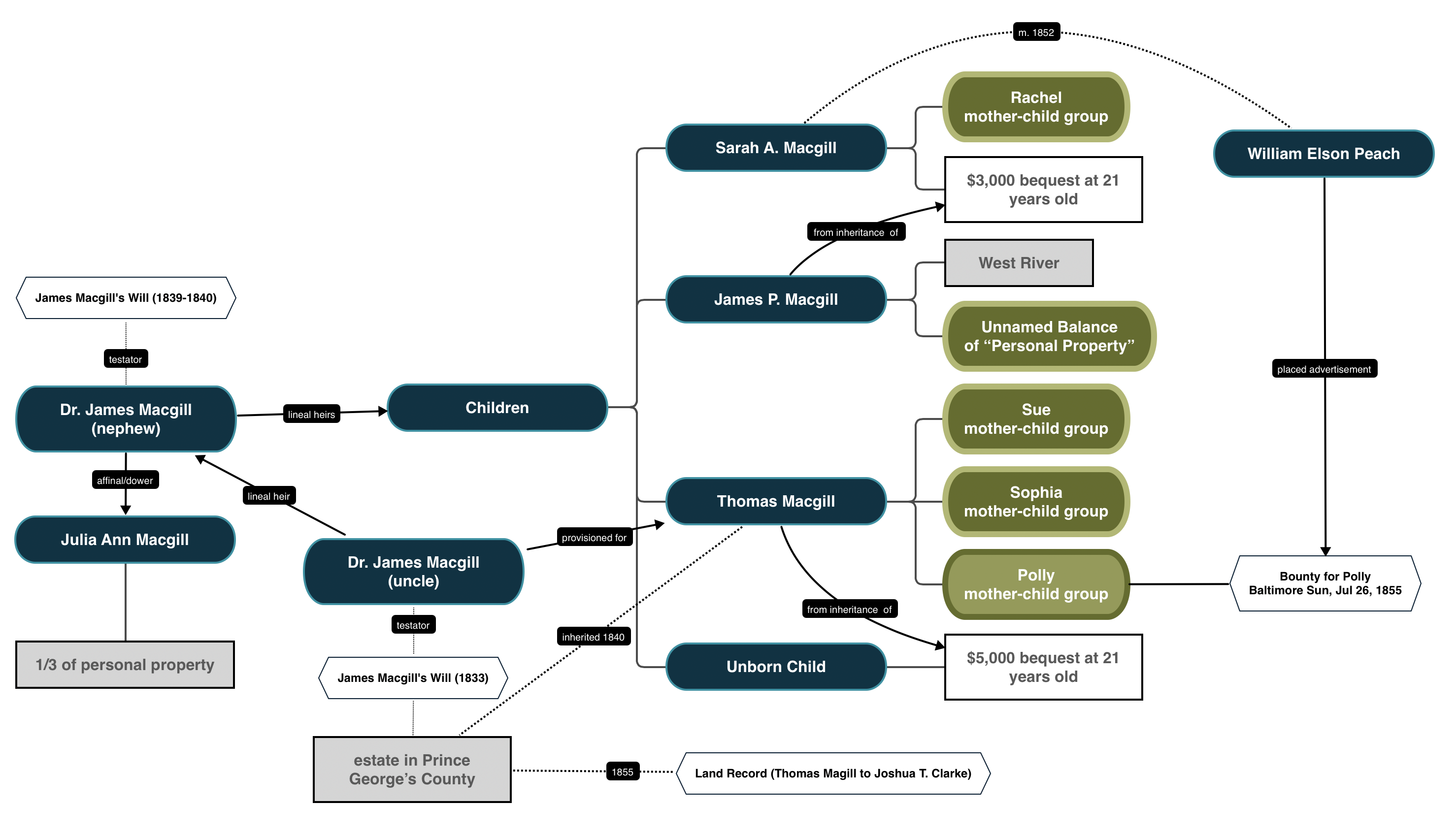
A decade after his marriage, Macgill’s impending death created a snag in the tapestry of his estate, and he composed his last will and testament, dividing his real and personal property among his wife and three born children, while making provisions for his unborn child. Like his uncle, he dictated how the fabric of his estate was to be cut and divided, specifically naming different mother-child family groups and directing the heir who would acquire four family groups, with a third being conveyed to Macgill’s wife as her right of dower, and the unnamed “balance” going to James P. Macgill.
ripped threads of kinship
Macgill’s division in his will ripped the threads of kinship among the community enslaved on his estates. While he nominally kept mother-child groups together, Polly and her children were divided from her larger extended family. As the wife of Peter, she became part of the larger Lee family group, and with Macgill’s will, she was separated from Harriet Lee and her children, Daniel, Oswald [Osborn], Caroline, Ann, and Amelia, who, while unnamed in the will, were named in the inventory and much later in the 1867’s Compensation List of Septimus J. Cook, the second husband of Julia Macgill. Whereas, Polly and her children were conveyed to Thomas Macgill, the oldest son, who would also receive a sizable portion of the Prince George’s estate through provisions of the 1833 will of the older Dr. James Macgill. Polly, Peter, their children, and the family of Harriet Lee were the threads that gave the plantation its texture and life. Macgill’s death subjected these threads to immense strain. They were stretched thin across counties, torn from one another, and tangled with new and unfamiliar threads.
This diagram illustrates the legal fracturing of an enslaved community following the 1840 death of Dr. James Macgill. His will distributed specific mother-child groups, including those of Rachel, Sue, Sophia, and Polly, among his heirs, pulling the kinship network apart and setting the stage for future sales and separations.
threads of inheritance
The will, far from ensuring a smooth transition, pulled the tightly woven kinship community of the enslaved in three distinct directions. Each heir represented a thread pulling part of the tapestry away from the whole. These distinct lines of inheritance did not exist in isolation; they actively pulled the community apart, a process accelerated by the legal and personal entanglements of the heirs.
the dower of the widow: the cook connection
Under Maryland law, Julia Ann Compton Macgill had a dower right to one-third of her husband’s property. This included the enslaved families Macgill designated for her, most notably Harriet Lee and her children. When Julia remarried to Septimus J. Cook in 1845, her dower portion—including Harriet’s family—was legally absorbed into the Cook household. This single act pulled an entire branch of the original enslaved community away, transplanting them into a new network under a new enslaver.
the son’s portion: the line of thomas macgill
Thomas Macgill’s inheritance was anchored in Prince George’s County. As stipulated in two generations of wills, he received a large portion of the home plantation and legal ownership of Polly and her children. While this provision placed Polly in the community where her husband Peter lived, it rested on the financial acumen of the Magill’s guardians to maintain a sizable estate without need to sell off “assets” This thread represented the patriarchal line of succession from uncle to nephew to son.
the balance of the estate: the line of james p. macgill
The younger son, James P. Macgill, inherited the family’s Anne Arundel County property near West River, along with the “balance” of the enslaved people not otherwise assigned. This act created an immediate geographic fracture in the community, moving another group of individuals to a different county and physically separating them from the kinship network on the home plantation. This thread established the West River estate as a distinct, yet connected, Macgill holding—and created the destination Polly would later seek in her flight.
The division of human property among Julia, Thomas, and James P. Macgill set the stage for further disruption. The fifteen years that followed Macgill’s death were marked by a cascade of events—probate, remarriage, and death—that continued to unravel the fabric of the enslaved community.
unraveling in motion: 1840-1855
Multiple events occurred in the years after Macgill’s death that led to self-liberation of Polly in 1855. First, there was the division of the estate as it traveled through probate, followed by the marriage of Julia Macgill to Septimus J. Cook and her subsequent death in 1846, and the re-division of her estate with her children’s. There were sales to settle the debts of the estate. Ultimately in 1855, Thomas Macgill sold his estate that inherited from his uncle to Joshua T. Clark, a neighbor and Justice of the Peace. It is most likely this sale that prompted Polly to seek ways to weave a new beginning for her family.
Polly’s design: weaving against the grain
The impending 1855 sale of the plantation from Thomas Macgill to Joshua T. Clark likely acted as the final catalyst. In response, Polly leveraged her social capital within the enslaver’s network to reach out to William Elson Peach, her late enslaver’s son-in-law. She initiated her own sale, requesting that Peach purchase her to ensure her continued proximity to her husband, Peter. However, while navigating this arrangement with Peach, she almost certainly utilized her own community’s social networks to connect with individuals who offered an alternative path. The “designing person” mentioned in the subsequent bounty notice suggests Polly was not merely seeking a new enslaver but was simultaneously orchestrating an escape. This was her attempt to gather the scattered threads of her own kinship and find lasting liberty beyond the reach of Peach, Clark, and the unraveling Macgill estate.
Sources
1828 Tax List, Prince George’s County
1828 Levy Court Road Survey, Prince George’s County
Marriage Records, for the Macgill-Compton union (1829) and the Macgill-Cook union (1845)
Maryland, U.S., Compiled Marriages, 1655-1850
Maryland, U.S., Compiled Marriages, 1667-1899
Last Will and Testament of Dr. James Macgill (the elder), 1833, PC 1:1
Last Will and Testament of Dr. James Macgill (the nephew), ca. 1840, PC 1:129
Probate Records, Estate of Dr. James Macgill (the nephew), post-1840, which would include:
Inventory and Sales Records of the Estate (PC 4:43, 57, 299; JH 1:20,107,268, 273)
Land Records, for the sale of the Macgill estate to Joshua T. Clark (ca. 1855); EWB 1:137
Newspaper Bounty Notice for the capture of Polly (1855), Baltimore Sun, newspapers.com
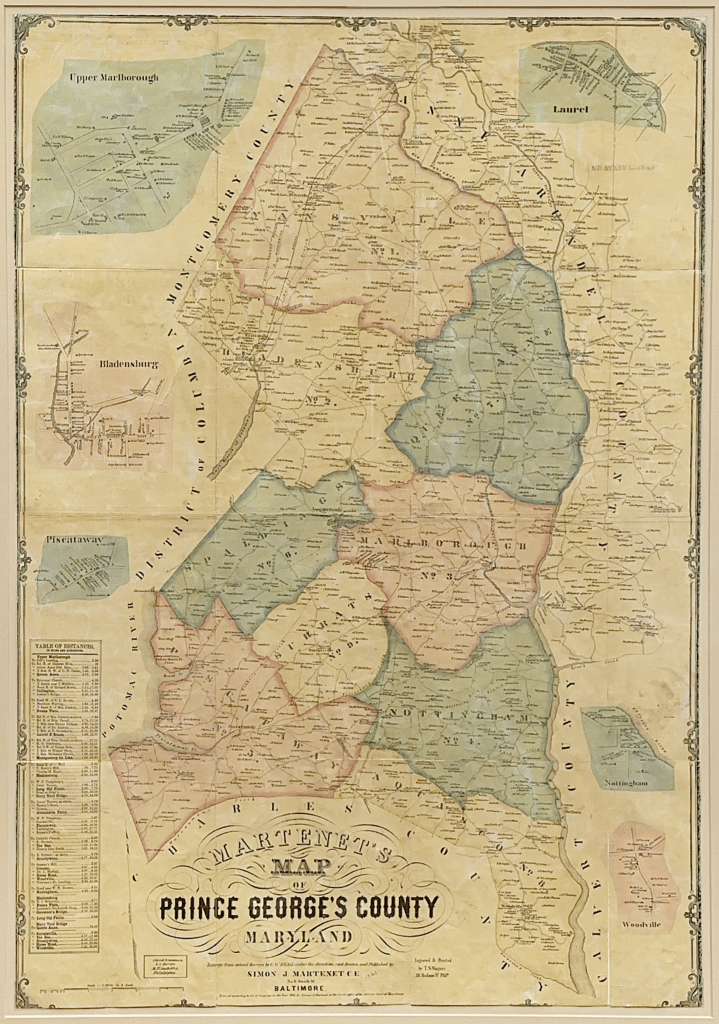
Martenet’s 1861 Map of Prince George’s County (left), with a version modified to show agricultural regions (right). Dark green indicates primary tobacco cultivation; the lighter shade indicates mixed farming. Source: Base map by S. Martenet (1861); overlay data from M-NCPPC (2010).
introduction: a story rooted in place
Antebellum Prince George’s County was a divided world. The world of planters and estates was visible through the creation of Martenet’s Map of Prince George’s County, which documented the landowners and their proximity to seats of power (Upper Marlborough, county seat, as well as the District of Columbia, the nation’s capital) and to transporation routes (the railways, the rivers, the roads). The single black dot on Martenet’s map indicating landowners obscured the outbuildings, quarters, and fields occupied by the enslaved and free Black population of Prince George’s County.
The historical record documents two versions of Alexander (Sandy) Davidge. In one, he is a financial asset, a name on a legal claim filed by his former enslaver six years later. In the other, he is a man of decisive action, self-liberating from a Maryland plantation in the winter of 1861. The gulf between these two records defines not only his story but the divided world of Antebellum Prince George’s County itself, where the landscape of power shown on official maps obscured the complex lives of the enslaved.
the berrys: a multi-district sphere of control
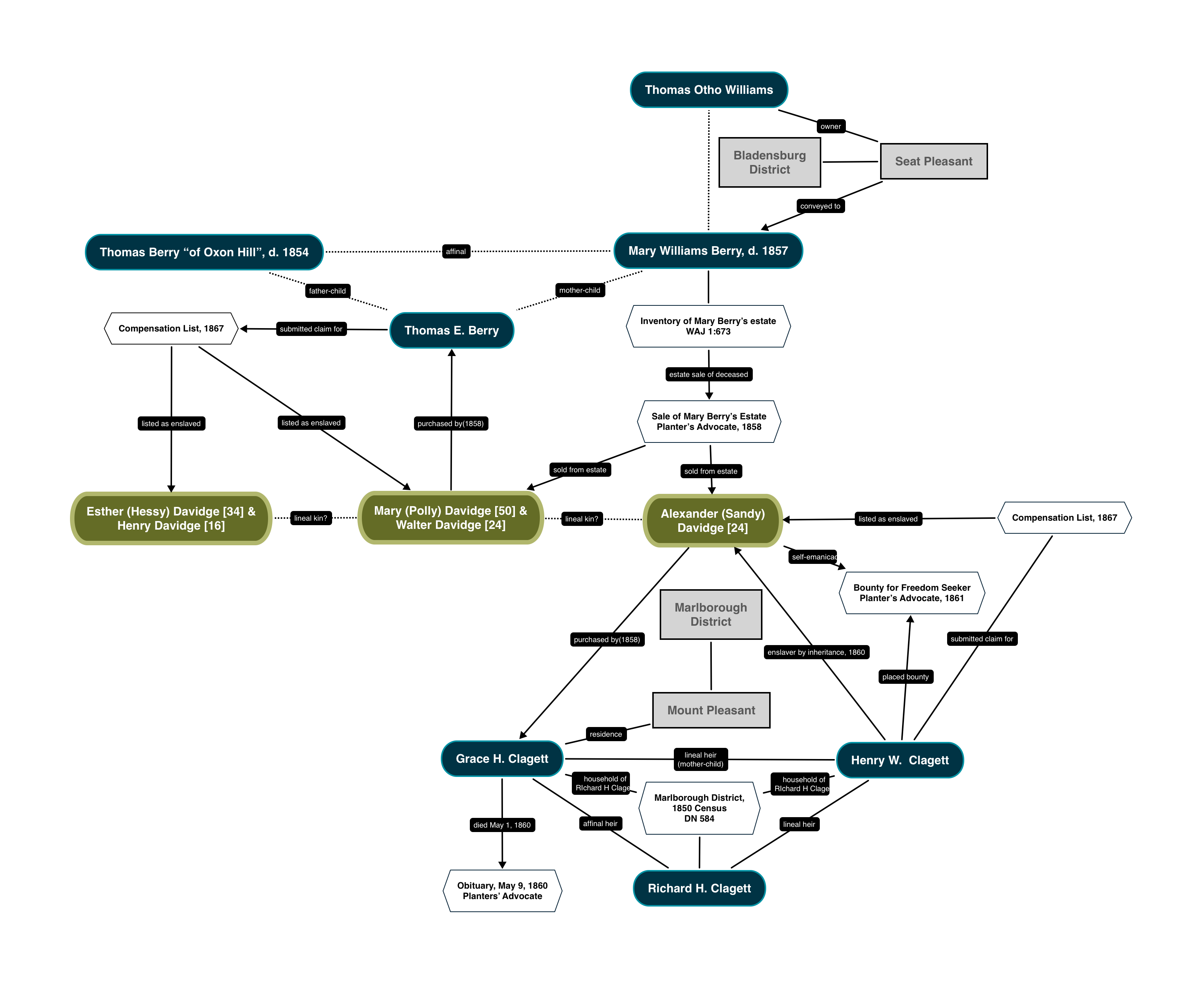
In 1828, Thomas Berry appears in the tax list for Prince George’s county as owning 1300+ acres called Oxon Hill Manor and 650 acres called Seat Pleasant. Berry acquired these acres through a conveyance from his father, Zachariah Berry “of Concord” and through his 1815 marriage to Mary Williams, the would-be heir of Thomas Otho Williams, d. 1818. Their son, Thomas E. Berry would own property in Queen Anne District in the Partnership Neighborhood, in addition to managing his father’s Oxon Hill Manor estate. Other branches of the Berry family would own land in Bladensburg, including the estates of Concord, Graden, and Independence demonstrating the scope of control the Berry network had on the lives of the enslaved people.
Martenet’s 1861 Map of Prince George’s County showing the location of Oxon Hill Manor, Seat Pleasant, and Partnership, properties owned by Thomas Berry, Mary Berry and Thomas E. Berry, their son.
Alexander (Sandy) Davidge labored for Mary Berry at Seat Pleasant. He was first named in an 1847 deed of separation between Mary Berry and her husband, Thomas Berry. Due to “unhappy differences” that have arisen between the husband and wife. In exchange for the property settlement, Mary gives up any future claim to dower rights on Thomas Berry’s separate estate. Thomas and Mary Berry transfer a significant amount of property to the trustee, Elisha W. Williams, for the sole benefit of Mary Berry. This property includes:
Land, specifically part of a tract called “Seat Pleasant,” which is explicitly identified as having “came to the said Mary Berry as one of the heirs of her deceased Father [Thos. O. Williams]”.
Livestock, including hogs, sheep, cows, and horses.
Farm equipment and crops, including “thirty hogsheads of tobacco”.
A community of enslaved people, who are listed by name.
Among them, is “Sandy”.
The list minimally names relationships between members of the community forced to work in the tobacco fields, to care for the livestock and to tend to the farm equipment. From the list, there are some spouses and some children — and other relationships (siblings, cousins, etc.) are ignored and invisible. While the deed explicitly names the wives of Jerry and Sam Butler and the children of Kitty and Caroline, Sandy is listed between Thomas/Tom and Kitty, an individual seemingly untethered to any named kin in that moment.
Prince George’s County, Maryland, Land Records, Deed of Separation, Thomas Berry and Mary Berry to Elisha W. Williams, trustee, November 10, 1847, Liber JBB 5, folio 102, accessed via MDLANDREC, mdlandrec.net.
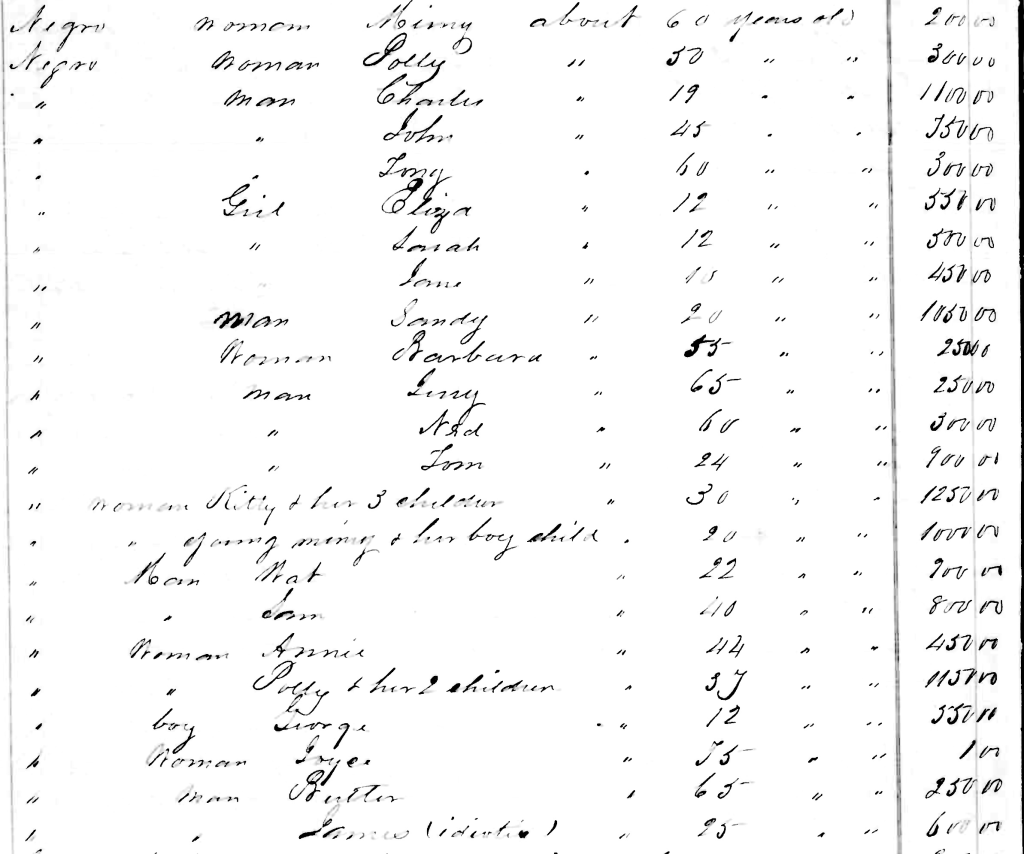
Sandy was also listed in the inventory of Mary Berry’s estate when she died a decade later in 1857. A twenty-year old man, the appraisers assigned him an external market value of $1050. The appraiser’s commodification of Sandy rested on their value of his ability to provide physical labor. Charles was nineteen years old, and externally appraised for $1100 while Walter (Wat) was twenty-two years old, and externally appraised for $900.
Like the deed of separation, Sandy, Walter, and the others are untethered in their relationships. Unlike other other inventories who adhere to one of two organizational patterns ( by gender and chronological age, or by adult males, and mother-child groupings), the list of Mary Berry’s estate includes the names of those she enslaved in a non-recognized order. Mimey and Polly, two elderly woman, head the list, despite the inclusion of other elderly men (Tony and Ned); Eliza, Sarah, Jane, pre-adolescent girls are listed immediately following Tony without a mother, suggesting a possible loss prior to the inventory. Alternatively, the list could be organized by sphere of work, with the first half (headed by elderly woman) representing those who labored in the household, while the second half representing the field hands.
Prince George’s County, Maryland. Register of Wills (Inventories). WAJ 1:673. Maryland State Archives, Annapolis, MD.
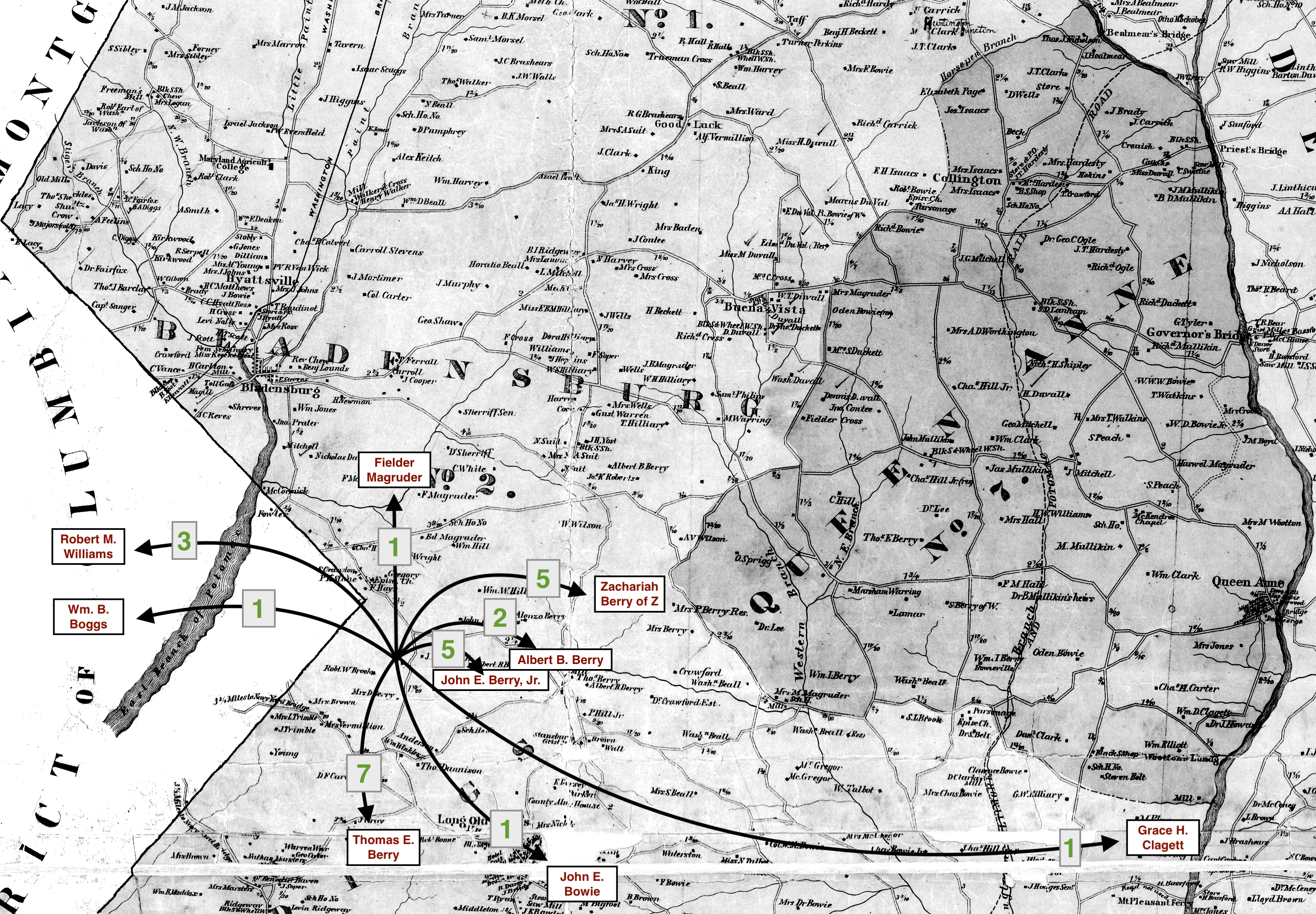
The death of Mary Berry, the mistress of Seat Pleasant, and the appraiser cataloguing her furniture, agricultural implements and enslaved community precipitated precipitated a forceful fragmentation of that community, initiating an unasked-for migration that scattered kin across the distinct agricultural landscapes of Prince George’s County.
Martenet’s 1861 Map of Prince George’s County showing the fragmentation of the community enslaved by Mary Berry
A few months after her death, the Planters’ Advocate advertised the sale of Mary Berry’s estates, both real and personal:
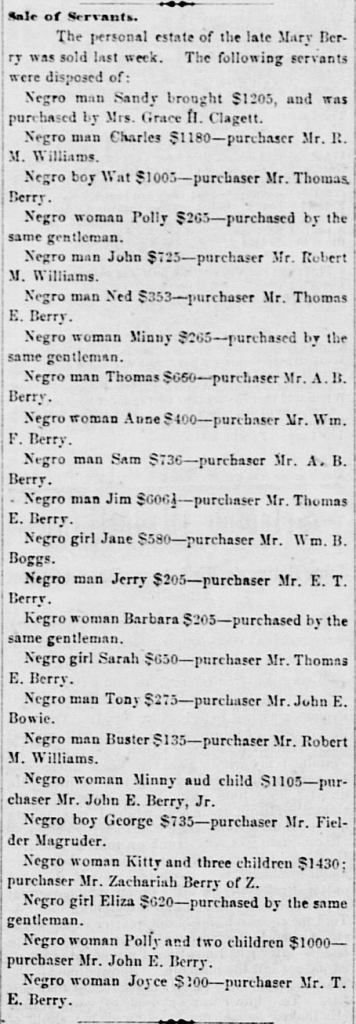
Planters’ Advocate, Feb 23, 1858Sale of Mary Berry’s “Servants”, Feb 3, 1858
Transcription of Estate Sale Advertisement
A VALUABLE ESTATEFOR SALE,Containing Eight Hundred and Twenty-Four and One-Fourth Acres.
BY virtue of a decree of the Circuit Court for Prince George’s county, sitting as a Court of Equity, the subscriber, as Trustee, will offer at public sale, on the premises, ON FRIDAY, the 11th day of March next, if fair, if not, the next fair day thereafter, the VALUABLE REAL ESTATE of the late Mary Berry, containing, by a recent survey, EIGHT HUNDRED AND TWENTY-FOUR ACRES AND ONE-FOURTH OF AN ACRE.
This estate is situated in Prince George’s County, very near the District line, commanding a beautiful view of the Capitol and a portion of Washington City.
The improvements are a good comfortable Dwelling House, KITCHEN, and all the necessary OUT-HOUSES, including STABLES and CARRIAGE HOUSE. The Farm Houses consist of four or five TOBACCO HOUSES, in a good state of repair, and affords room enough to house fifty thousand pounds of tobacco.
This farm consists of a soil well adapted to the growth of the finest quality of Tobacco and all the other staple crops grown in the county. Has a sufficiency of MEADOW LAND, some of it TIMBER, and also an abundance of WOOD and TIMBER.
This land, from its proximity to Washington City, affords a rare chance for speculation and a profitable investment. Portions of it might be profitably cultivated in Fruits and Vegetables, in addition to making a Tobacco Farm.
THE TERMS OF SALE, AS PRESCRIBED BY DECREE, ARE: A cash payment of one thousand dollars to be made on the day of sale, and the balance of the purchase money to be paid in three equal instalments, in twelve, eighteen, and twenty-four months; the whole purchase money to be secured by the bond of the purchaser, with security to be approved by the Trustee, and to bear interest from the day of sale. Upon the payment of the purchase money and interest, the Trustee is authorized by the decree to convey the land to the purchaser in fee simple, and all the right, title, claim and interest of the parties to the cause, and of all those claiming by, through or under them or either of them.
Possession of the property will be delivered as soon as the terms of sale are complied with.
Those wishing to purchase are invited to view the premises, and are referred to A. B. BERRY, Esq., who owns the adjoining farm.
C. C. MAGRUDER, Trustee. Upper Marlboro’, Feb. 16, 1859—ts
Transcription of Sale of “Servants”
Sale of Servants.
The personal estate of the late Mary Berry was sold last week. The following servants were disposed of:
Negro man Sandy brought $1205, and was purchased by Mrs. Grace H. Clagett. Negro man Charles $1180—purchaser Mr. R. M. Williams. Negro boy Wat $1005—purchaser Mr. Thomas. Berry. Negro woman Polly $265—purchased by the same gentleman. Negro man John $725—purchaser Mr. Robert M. Williams. Negro man Ned $355—purchaser Mr. Thomas E. Berry. Negro woman Minny $265—purchased by the same gentleman. Negro man Thomas $650—purchaser Mr. A. B. Berry. Negro woman Anne $400—purchaser Mr. Wm. F. Berry. Negro man Sam $736—purchaser Mr. A. B. Berry. Negro man Jim $606—purchaser Mr. Thomas E. Berry. Negro girl Jane $580—purchaser Mr. Wm. B. Boggs. Negro man Jerry $205—purchaser Mr. E. T. Berry. Negro woman Barbara $205—purchaser by the same gentleman. Negro girl Sarah $650—purchaser Mr. Thomas E. Berry. Negro man Tony $275—purchaser Mr. John E. Bowie. Negro man Buster $135—purchaser Mr. Robert M. Williams. Negro woman Minny and child $1105—purchaser Mr. John E. Berry, Jr. Negro boy George $735—purchaser Mr. Fielder Magruder. Negro woman Kitty and three children $1430; purchaser Mr. Zachariah Berry of Z. Negro girl Eliza $620—purchased by the same gentleman. Negro woman Polly and two children $1000—purchaser Mr. John E. Berry. Negro woman Joyce $100—purchaser Mr. T. E. Berry.
At the 1858 estate sale, the community was fragmented; a twenty-year-old Sandy was sold for $1205, while his peers Charles (19) and Walter (22) brought $1180 and $1005 respectively.
the clagetts: the widow’s residence
Sandy was purchased by Grace H. Clagett, a widow who managed her assets from her parents’ residence of Mount Pleasant. The daughter of Col. Henry Waring and Sarah Harrison, she had married Dr. Richard H. Clagett who died in the early 1850s, leaving her with her son, Henry W. Clagett. She managed at least two farms prior to her own death in 1860.
In the fall and winter of 1857, she advertised in the Planters’ Advocate for the hire of additional field hands before purchasing Sandy at the sale of Mary Berry’s estate.
Despite advertising for two additional men, she only purchased Sandy from Mary Berry’s estate, which meant that Sandy arrived alone and without the comfort of a social network at Mount Pleasant. Any family he had lived with Seat Pleasant had been sent to work at other plantations and estates.
Sandy was taken by the Clagett from a farm near the District, near the roads that led to the bustle of the City of Washington. While working the fields on Seat Pleasant, he would have seen wagons and carts traveling into town filled with produce, with livestock tied to back for butchers. He would have seen stagecoaches and horseback riders traveling with the mail and the guests who would stay at the Hotels on Pennsylvania Ave. When he was forced from Seat Pleasant to Mount Pleasant, the landscape would have changed to a waterfront, where traffic was directed to the steamboats and the small boats that traveled the silting Patuxent. Instead of gentlemen headed to the City of Washington for national politics and markets, he would have seen gentlemen headed to Upper Marlborough, the county seat for estate sales, courthouse dealings, and horse races.
Two years after purchasing Sandy, Grace died on May 1, 1860 after a long illness at her parent’s estate, Mount Pleasant. Without a will and inventory, it is presumed her real and personal estate, including Sandy, was conveyed to Henry W. Clagett, her son. The death of his second enslaver most likely stirred up memories of the last time his enslaver died, with the sale of him and his new community on the auction block. Moreover, his new enslaver, Henry W Clagett, was a young bachelor who had yet to “settle down”. Away at Georgetown for college, his visits home may have been stories of drinking and gambling and other college escapades, which often meant money owed to creditors and debts to be covered by the sale of a “valuable field hand”. This recurring pattern of instability, where his life was subject to the whims of inheritance, now placed his future in the hands of a young, unmarried man, Henry W. Clagett. The prospect of yet another disruption may have been the final catalyst for his decision to escape.
the landscape of Escape
Against this backdop, Alexander (Sandy) Davidge self-liberated himself from Clagett’s estate near Mount Pleasant wearing a brown frock coat and dark hat with black pantaloons the day after Christmas. The week between Christmas and New Years was one of anticipation of separation as enslavers hired out or sold individuals, separating them from the comfort of community within a cold landscape bereft of warmth.
Clagett supposed that Alexander was making his way to family members at Mrs. Thomas E. Berry’s near Long Old Fields, or acquaintances near Bladensburg, suggesting that Sandy was going back to the neighborhood from which he had been extracted, and back to a known community.
Excerpt from the 1861 Martenet Map showing the location of Clagett’s residence and the locations named as possible destinations with their proximity to the District of Columbia.
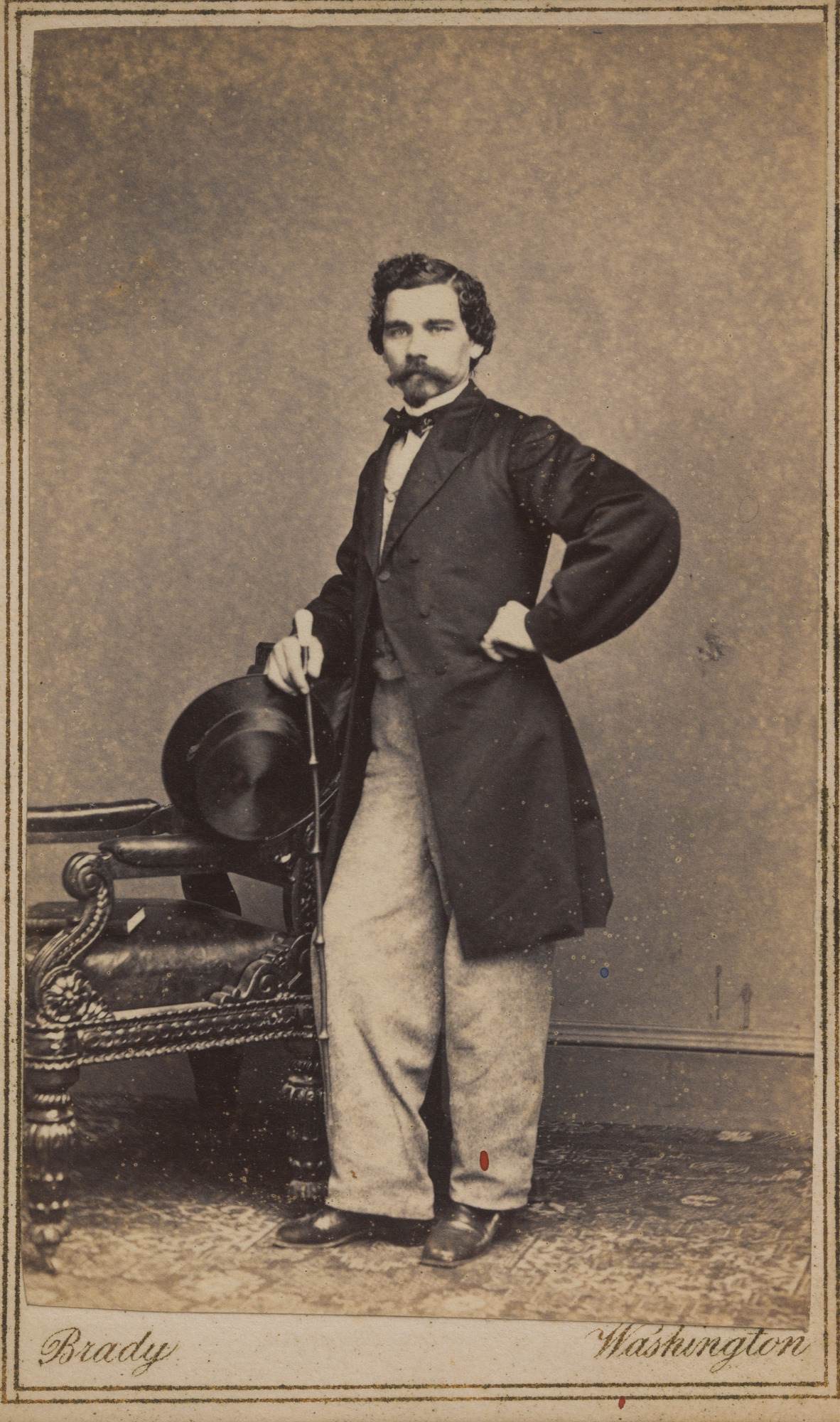
The portrait of John Mulvaney, 1863 provides a visual possibility of what Alexander Davadge wore on his escape to freedom. Choosing a frock coat (more formal than everyday work wear), it would allow Sandy to blend into the crowds moving through the streets of the City. The frock coat would also provide a layer of warmth as he left in the midst of winter.
Transcription of Bounty for Sandy Davadge
$100 Reward. RAN AWAY from the subscriber, living near Upper Marlborough, on Wednesday, the 26th ultimo, a negro man SANDY, who calls himself
SANDY DAVADGE.
Sandy is about five feet nine or ten inches high; is of a dark complexion; has a full suit of hair and a fine set of teeth; is quick when spoken to, and very polite. He had on when he left home a pair of black pantaloons, brown frock coat and a dark hat. He has relations living at Mrs. Thomas E. Berry’s place, near the Long Old Fields, and also acquaintances in Bladensburg.
I will give the above reward for his apprehension, if taken out of the State of Maryland, and Fifty Dollars if taken in the State—in either case he must be brought home or secured in jail, so that I get him again.
HENRY W. CLAGETT. January 2, 1861—tf
As he traveled the roads, turnpikes and trails into the District where he could make for a “Free State”, he would have been wary of slave patrols, set up to control his movement through the landscape of tobacco fields and orchards. Some were more formally organized and others were suspicious planters and planters’ sons, hiding behind bushes to capture the family fleeing for freedom.
“Running Off Negroes,” Port Tobacco Times, and Charles County Advertiser (Port Tobacco, MD), January 3, 1861, p. 3, accessed via Newspapers.com.Transcription of “Running Off Negroes”
RUNNING OFF NEGROES.—The Pr. Georgian of last Friday says:
This day fortnight ago, Messrs. Francis M. Bowie and John E. Bowie, Jr., having some cause for suspicion of some such occurrence, posted themselves in a suitable position and captured a negro who was carrying off, in the dead of night, a negro woman and her two children, the property of the first named gentleman. They were in a covered wagon. The negro is a slave of a lady residing in Montgomery, and the wagon was borrowed from an officer at the Observatory, for another purpose. The prisoner was brought here the day following and indicted by the Grand Jury. He is now in jail.
“Appointment of a Patrol in Alexandria County.” Evening Star (Washington, D.C.), January 4, 1861. From Newspapers.com.“Affairs in St. Mary’s County, MD.—Runaway Slaves—Patrols called out.” Evening Star (Washington, D.C.), June 5, 1861. From Newspapers.com.
Transcription of “Appointment of a Patrol in Alexandria County”
APPOINTMENT OF A PATROL IN ALEXANDRIA COUNTY. The Gazette says: “The County Court of this county at its last term, appointed a patrol for the country portion of this county. The appointment was made under the following provision of the Code of Virginia: “The county court of each county may, when necessary, appoint for a term not exceeding three months, one or more patrols, consisting of an officer either commissioned or non-commissioned, who shall be captain of patrol and so many privates as it may think requisite, to patrol and visit within such bounds as the court may prescribe, as often as it shall require, all negro quarters and other places suspected of having therein unlawful assemblies, or such slaves as may stroll from one plantation to another without permission.”
The following gentlemen were named as the patrol:—Wm. J. Garey, Captain; S. Burch, jr., John Marcey, George Marcey, Elijah Burch, Thos. Thompson, Samuel Marcey and Chas. W. Payne, privates.
It is the duty of this patrol to visit all parts of the county, at least once a week; to break up all unlawful assemblies and arrest negroes violating the law. The members of patrol failing to perform duty, are subject to a fine of five dollars, and when on duty the captain is entitled to one dollar and each private to 75 cents for each twelve hours service.
Transcription of “Affairs in the St. Mary’s County, MD”
AFFAIRS IN ST. MARY’S COUNTY, MD.—Runaway Slaves—Patrols called out—The Leonardtown Beacon of Thursday has the following in relation to affairs in that neighborhood:
Three negro men, representing themselves as runaway slaves from Virginia, were arrested and lodged in our county jail on Tuesday last. They crossed the Potomac in a canoe, and were arrested by private citizens and handed over to the sheriff. They were young, likely negroes, and stated that “they had heard a great deal of talk about Maryland, and came over to see if the truth had been told them.” They represent their masters to have been absent from home at the time they determined upon their tour of investigation. We learned on Tuesday last that there had been many recent cases of runaway in this county. Would it not be well to reorganize the system of patrol that proved so efficient here last winter?
Since the abandonment of the patrol, the negroes have pretty generally fallen into their old night-prowling habits and we hear of several who have ran away from their owners and are now lurking in the county. The patrol force has never been legally disbanded, and are consequently at liberty to go upon duty whenever they may think the public interest requires it. We believe that it requires it now, and we recommend that the force in the different districts proceed at once to make an organization and go upon duty and remain upon duty while the present excitement through the country continues to exist. We hope to hear that the patrol force are in active operation in every district of the county by Saturday next.
During the winter of 1861, Southern Maryland was a region of high tension and strategic importance in the Civil War. As a border state with strong secessionist sympathies, particularly in counties like Prince George’s and Charles, the area was under a heavy Union military occupation designed to secure its loyalty and protect the perimeter of Washington, D.C.
This resulted in a significant and visible presence of Union troops guarding crucial infrastructure, such as railroads and key roads. The Potomac River became an active military frontier due to the “Potomac Blockade,” where Confederate batteries on the Virginia side frequently exchanged fire with Union forces in Maryland, disrupting river traffic. This created a volatile atmosphere for refugees from slavery who sought to navigate both troops and patrols on the road to freedom.
disappearance from the Map
After 1861, Alexander (Sandy) Davidge vanishes from the known map.
In 1867, the former slaveholders submitted claims for compensation for the people emancipated by the November 1864 Constitution of Maryland. Henry W. Clagett was one of the enslavers who submitted a claim. On his list was “Sandy Davidge, age 24”, his name one of 54 people enslaved by Clagett. Clagett, by placing him on the list, is stating on oath Davidge was “in his possession” on Nov 1, 1864, after his escape to freedom. There are no records to clarify if Clagett had recaptured him or if he submitted a fraudulent claim.
Alexander’s family, the ones enslaved by Mrs. Thomas E. Berry near Long Old Fields, appears on a list submitted by “Thomas Berry”: Polly (Mary) Davidge, age 50 and WalterDavidge, age 24, purchased from Mary Berry’s estate and likely Alexander’s mother and brother, as well as Esther (Hessy) Davidge, age 34, and Henry Davidge, age 16.
Clagett’s compensation claim in 1867 is an attempt to place him back on the Marlborough plantation ledger, but his physical body is gone. His final destination, his geography of freedom, remains unknown.
The 1836 schedule for the deed of trust transferring the Goodwood plantation to Rosalie E. Carter from the Calverts lists Eleanor “Nelly” Brown at age 35, establishing her calculated birth year as 1801. Her youth unfolded during the Early Republic Generation (1790-1815), a period of significant economic volatility shaped by the Napoleonic Wars. Trade embargoes depressed agricultural prices, creating economic distress for yeoman farmers who could not afford to store their produce. In contrast, the economic structure enabled elite planters like the Calverts to leverage their substantial capital and storage capacity. They acquired tobacco and other commodities at low rates from distressed sellers and profited when markets rebounded, a cycle that consolidated their wealth and reinforced the system of chattel slavery that held Nelly Brown in bondage.
By the time of the deed of trust, written during the Jacksonian Generation Eleanor Brown was nearing the end of her “prime years” as a laborer and breeder for the Calverts. Despite the commodification of her body by the Calverts and the Carters, Eleanor Brown maintained a soul value in her roles as mother and aunt on the large estate of Goodwood.
Daina Ramey Berry’s book Their The Price for Their Pound of Flesh: The Value of the Enslaved, from Womb to Grave, in the Building of a Nation offers a critical examination of the commodification of enslaved people. Berry meticulously details how enslavers and the slave market assigned an “external appraisal value” or “external market value” to enslaved individuals based on factors such as age, gender, health, and perceived productivity, and contrasts this with “internal spirit value” or “soul value” of enslaved people. While enslavers reduced individuals to mere commodities, Berry highlights the ways in which enslaved people themselves cultivated an intrinsic sense of self-worth and humanity that defied their commodification.
While it is unclear why the Calvert-Carter network designated her family name, she was grouped in the schedule of enslaved people in what appears to be a mother-child lineal grouping, signifying her kinship role to the larger enslaved community. As an adult woman, she was followed by the names of five children — usually this was an organization technique used by clerks to infer kinship.
Nelly Brown
age 35
Emeline
age 14
William
age 11
Dennis
age 8
Maria
age 4
John
an infant
The mother-child lineal grouping raises questions that are not answered in the records. For example, the gap in ages between Maria and Dennis is four years, which is longer than the three year gaps between Emeline-William, William-Dennis. This longer gap suggests three possibilities grounded in the exploitative structure of chattel slavery. The first possibility is an unrecorded infant death. Nelly may have borne a child who did not survive long enough to be recorded, a frequent outcome resulting from the inadequate nutrition, disease, and physical demands of enslavement. Second, the interval may reflect a period of poor maternal health, where a difficult prior birth or illness precluded a subsequent pregnancy. The third possibility is forced separation, a method enslavers used to exert control. The Calverts could have separated Nelly from her partner by selling him, hiring him out to another location, or moving Nelly herself. The archival record does not reveal which of these realities Nelly experienced, and its silence underscores the system’s disregard for the integrity of enslaved families.
liberation of William Brown
Seventeen years later, in an advertisement dated April 20, 1853, Charles H. Carter announced that William Brown, an enslaved man, had self-liberated from Goodwood. Carter described William as “about thirty years of age”. This detail provides a calculated birth year of approximately 1823, which is consistent with the inferred son of Nelly Brown, listed in the 1836 schedule, as William, age 11.
Given that enslavers often provided estimated ages in runaway advertisements, the two-year age difference is minor and the shared family name “Brown” from the 1836 schedule strongly suggests that the man who self-liberated in 1853 was part of this kinship network at Goodwood.
Tracing William Brown beyond the advertisement is difficult as both his given and family name are common, obscuring if he found a temporary freedom or a permanent liberation from slavery.
advertisement
$100 REWARD
WILL be paid for the apprehension of my negro man, William Brown, who left home on the 14th instant. He is a mulatto, about thirty years of age, five feet eight or nine inches high, rather stout make: turns his toes out in walking and limps in consequence of a sprained ankle. He has a wife at Mr. Azell Beall’s, near Buena Vista, and may be there, or in the neighborhood.
I will give fifty dollars for his apprehension, if taken in the District of Columbia, Prince George’s or Anne Arundel Counties—seventy-five dollars, if taken in Baltimore—and one hundred dollars, if taken elsewhere—in either case, he must be secured, so that I get possession of him again.
C. H. CARTER,”Good Wood,”Near Queen Anne,P. G. Co.
April 20, 1853—2w [Planters’ Advocate and Southern Maryland Advertiser; MSA]
post-emancipation life of Emeline
While the fate of William Brown is obscured, Eleanor (Nelly) Brown’s daughter has been tentatively identified in the 1870 Census, living near Queen Anne Towne.
The household of Benjamin “Benny” West and Emily Brown, located in close proximity to Charles H. Carter’s former Goodwood estate was enumerated at dwelling number 48. The presence of this family presents a compelling, though not conclusive, hypothesis for a direct link to the community enslaved at Goodwood three decades prior.
1870 Census
🟢👑 DN 48 | 📮: Mitchellville | 📍 Queen Anne Towne Benny West, age 50 (calc. birth year 1820) Emily Brown, age 45 (calc. birth year 1825) Morris Brown, age 19 (calc. birth year 1851) Maria Brown, age 14 (calc. birth year 1856) Ella Brown, age 12 (calc. birth year 1858) James Brown, age 5 (calc. birth year 1865) Eleanor Brown, age 12 (calc. birth year 1858) Sophia Brown, age 3 (calc. birth year 1867) Louisa Brown, age [1] (calc. birth year 1869)
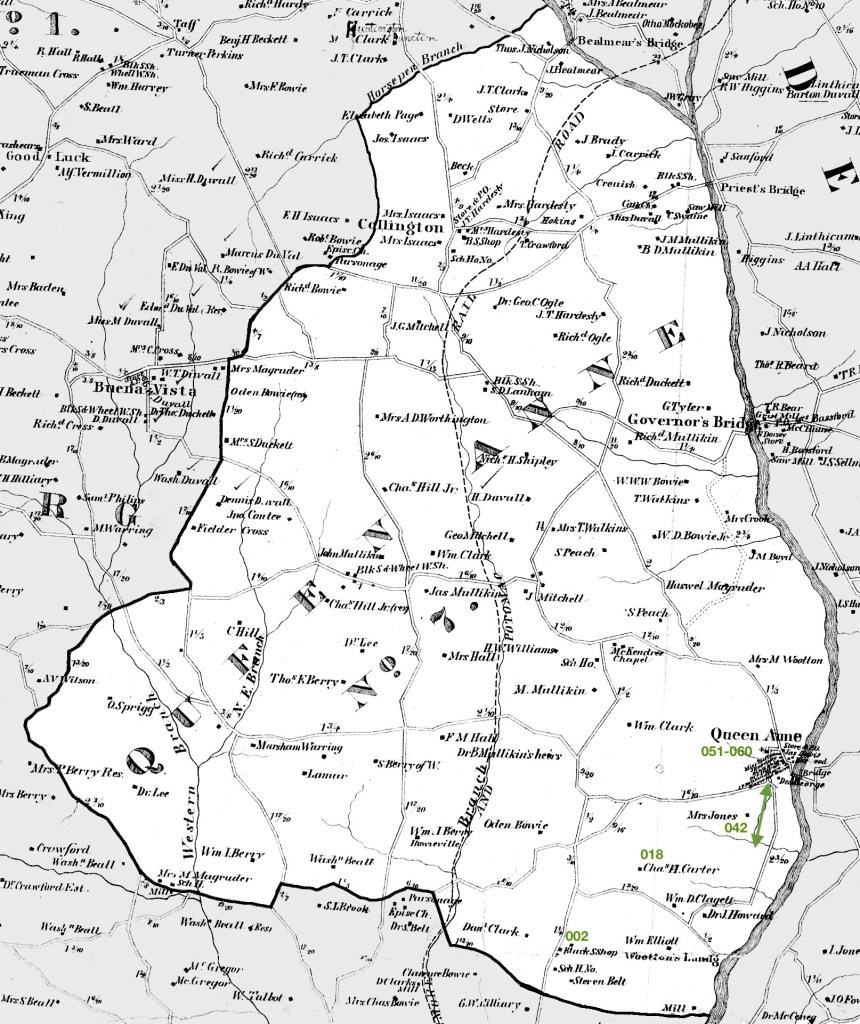
Annotated with Green Numbers which correlate of Head of Households with names from the 1870 Census; the names in both the census were compared against the 1878 Hopkins map and verified where possible by land records.
The primary evidence centers on Emily Brown, listed as 45 years old in 1870, and her potential connection to Emeline, a 14-year-old girl enumerated in the 1836 Deed of Trust schedule for Goodwood. While the calculated birth years (~1825 for Emily vs. ~1822 for Emeline) show a minor three-year discrepancy, such inconsistencies are common in records where ages were often estimated. The link is strengthened through given name analysis. Given this context, “Emeline” and “Emily” are recognized as plausible variations for the same individual, much like other variants such as “Amelia” or “Emilia.”
The most powerful, albeit circumstantial, evidence lies in the naming patterns that suggest a deliberate effort to maintain kinship identity. The 1836 schedule lists Emeline as part of a cohort headed by Nelly Brown, age 35. The discovery of a daughter named Eleanor in Emily Brown’s 1870 household is therefore highly significant. For communities emerging from chattel slavery—an institution that systematically severed familial bonds—the act of naming a child after a parent or grandparent was a potent method of reinforcing lineage. As “Nelly” is a common diminutive for “Eleanor,” it is a strong possibility that Emily Brown named her daughter in honor of her own mother, Nelly Brown. While no single piece of this evidence is definitive, the combination of proximate age, plausible name variation, and the commemorative naming choice makes a strong circumstantial case for the continuity of the Brown family line from enslavement into freedom.











 stories of Then