genetic threads, historical lives: the story of Maria Matthews and Washington Lee

genetic thread: a DNA connection

A DNA match between descendants initiated an investigation into the probable shared ancestry of two Black individuals living in Prince George’s County after emancipation. Washington Lee, a Civil War veteran, appeared in the Western Branch Neighborhood of Queen Anne District after the Civil War without visible connections to any kinship clusters. In contrast, Maria Matthews, with her husband and children, could be traced to Bel-Air, the Ogle estate situated relatively near Governor’s Bridge. This genetic link between the two individuals suggests a shared ancestry, offering a rare glimpse into the kinship networks formed under chattel slavery in antebellum Maryland.

historical threads: the documentary evidence

Maria Matthews, daughter of Peter Lee

Maria Matthews died in 1903, having lived in Prince George’s County for the majority of her life. Her death certificate identified Peter Lee as her father. This discovery potentially linked Maria Matthews and Peter Lee to Washington Lee, as a shared family name emerged. An elderly Peter (born circa 1800) was listed in the probate records of the Ogle network along with Maria, corroborating the connection between Bel-Air and Maria’s lineal family.

Polly, Wife of Peter

In 1855, Polly, a woman not less than 40 years old, self-liberated herself from William E. Peach. Peach had purchased Polly from the Macgill estate “at her request so that she may enjoy the society of her husband and relatives.” Peach included a certification from Geo. C. Ogle stating that Polly’s husband, Peter, was “anxious that she come home to her master.” Despite Peach’s apparent fulfillment of her request, Polly was not convinced of his purchase and left Prince George’s County, making her way to West River Post Office in Anne Arundel County. Polly had been enslaved on Macgill’s Prince George’s estate, which bordered Bel-Air, where her husband was enslaved. Her journey to West River, in Anne Arundel County, where Macgill’s second estate was situated, suggests the presence of kin in bondage in that location.

Washington Lee, a man of two counties

Washington Lee, a man without readily apparent kinship connections, lived in both Prince George’s County and Anne Arundel County after the Civil War. Marrying Sarah Stewart in Upper Marlboro in 1870, he lived in and around Oak Grove Post Office before moving to Anne Arundel County, near the post offices of Dodon and Harwood, in relative vicinity of West River Post Office. In his waning years, he returned to Prince George’s County to be cared for by his daughter. This combination of Washington Lee’s geographic connections to West River and Queen Anne District, along with the DNA match to Maria Matthews and, presumably, Peter and Polly who also spanned both districts, suggests that Washington Lee was connected with the Lee individuals enslaved on the Macgill estates.

Washington, a boy in the records

A boy named Washington is listed in the probate records of James Macgill. He was held in bondage on Macgill’s Anne Arundel estate near West River, the same area Polly traveled to after her self-liberation from Peach. He was 13 years old in 1844, suggesting a birth year around 1831. His age and location suggest he could be a son or nephew of Polly’s, separated from the Lee individuals who remained in Prince George’s County. Polly’s escape to Anne Arundel County may have been an attempt to reunite with children and kin who had been separated from her in an earlier sale or division of property.
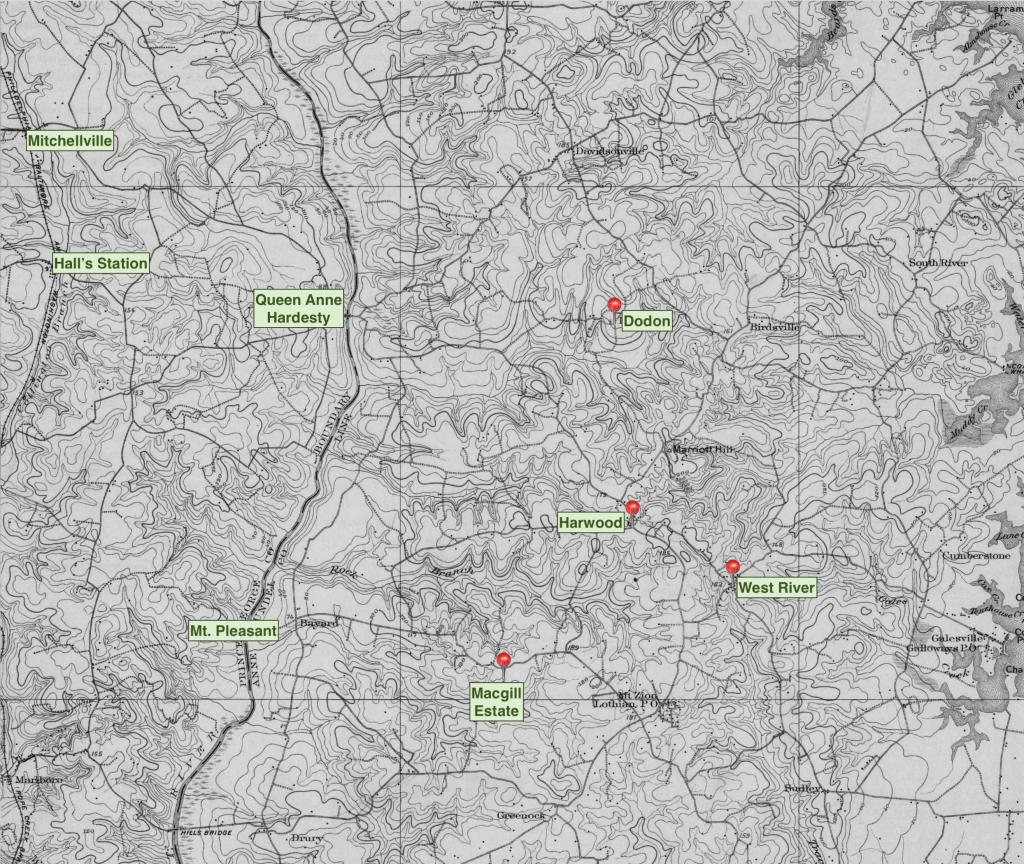
The landscape of southern Anne Arundel County, Maryland, circa 1905. This map illustrates the proximity of key locations in the shared ancestry of Maria Matthews and Washington Lee, including the areas of Dodon, Harwood, and West River. This geographical context is essential for understanding the origins of their kinship connection.
Source: U.S. Geological Survey, “Owensville, MD” Quadrangle, 1905, 1918 edition.

weaving the kinship tapestry

The convergence of genetic evidence and meticulously researched historical records allows for the reconstruction of a probable kinship connection linking Maria Matthews and Washington Lee. The shared 62 centimorgans (cM) between their descendants provides a genetic foundation, supporting the documentary trail that places Maria as the daughter of Peter Lee. Given Polly’s documented status as Peter’s wife, her determined self-liberation to be with him, and Washington’s enslavement on a Macgill estate geographically tied to Polly’s post-escape movements, the evidence strongly suggests Washington Lee was a relative of Peter Lee and Polly. This case illustrates how DNA analysis, combined with a deep examination of fragmented historical records, can contribute to understanding kinship networks that were systematically disrupted and obscured by chattel slavery. It underscores the enduring impact of the institution on individuals and their descendants, and the vital role of persistent research in revealing these crucial connections.

Something went wrong. Please refresh the page and/or try again.

paper trail’s Pulse: dissecting the search for Polly

The Baltimore Sun’s printer placed the ad in the last column of page 2, underneath a bounty for Peter Culver who had absconded with a “free boy, hired by me, named Alexander” and an ad for Ohio Flour.  

A historical advertisement from the 1850s offering a reward for the capture of a woman named Polly, describing her as a mulatto, not less than forty years old, last seen near West River.
“$150 REWARD,” advertisement. The Baltimore Sun (Baltimore, Maryland), July 29, 1855, p. 4. Accessed through Newspapers.com, July 10, 2025. https://www.newspapers.com/article/the-baltimore-sun/176173526/.
Transcription of Bounty

$150 REWARD WILL BE GIVEN FOR THE POSITIVE CONVICTION of any one who shall be guilty of harboring my NEGRO WOMAN POLLY, after a knowledge of this notice, whom I purchased lately of the estate of Dr. Magill.—As I have bought Polly through motives of pure humanity, and at her own request, that she might enjoy the society of her husband and relatives, I feel satisfied that she will come to me unless deceived by some designing person in relation thereto. POLLY is not less than forty years of age, a mulatto of neat and tidy appearance, and was last seen on West River. I will give Twenty Dollars if in Anne Arundel, or Thirty if elsewhere, to any one who shall convince her of the fact of my purchase and secure her to me. I also subjoin a certificate of Dr. OGLE, the owner of Polly’s husband. WM. E. PEACH, M. D., Queen Ann, Prince George’s co., Md.


I hereby certify that I have talked with PETER, the husband of Polly, and he says he is very anxious that she should come home to her master, Dr. Peach, immediately. Peter is in bad health and unable to leave the house. [jy25-St*] GEO. C. OGLE.

Within this mundane context of commerce and control, William E. Peach’s advertisement primarily sought the conviction of the “designing person” who “deceived” Polly and harbored her away from Peach who had purchased her “through motives of pure humanity” and while placing a bounty on the return of Polly so he could “secure her to me” almost as an afterthought.

the skeleton layer: who, what, and where

The basic facts of the notice form the skeleton of the story. In July 1855, Wm. E. Peach, M.D., living near Queen Anne in Prince George’s County sought the return of Polly, “not less than forty years of age” who was purchased from Dr. Magill’s estate.  In her escape, she was last seen near West River in Anne Arundel County.  He offered a tiered $20-30 for Polly’s return and a significantly larger sum of $150 dollars for the conviction of the “designing person”.  

the sinews layer: the network of kin and property

The names in the advertisement are held together by a dense network of marriage and property. William E. Peach, son of Queen Anne District landowner Samuel Peach, had married Sarah Alexander Ma[c]gill in 1852. Sarah was the orphaned daughter of Dr. James Ma[c]gill and Julia Ann Compton, having lost her father in 1840 and her mother in 1846. Her life was split between Prince George’s and Anne Arundel Counties. Before her father’s death, she lived on his 740-acre estate along present-day Annapolis Road, situated between the Jesuit’s White Marsh plantation and Magruder’s Tavern, adjacent to Bel-Air, the Ogle estate.

After Dr. Ma[c]gill’s death, Sarah’s world was destabilized. Her mother’s remarriage to Septimus J. Cook and her mother’s subsequent death resulted in Sarah and her sister, James Anna, being shuffled to Anne Arundel County to live with their aunt and uncle, Samuel and Mary Carr. The Carrs owned land near the Ma[c]gill property at West River, which had been inherited by Sarah’s brother, James P. Ma[c]gill. The 1839 will of Dr. Ma[c]gill had stipulated that Polly and her children be conveyed specifically to his other son, Thomas Ma[c]gill.

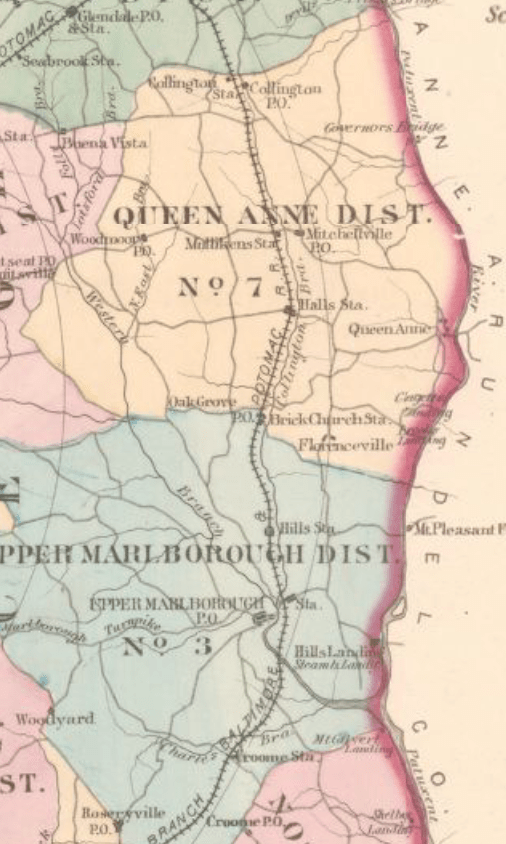
This 1861 map of the Queen Anne District illustrates the dense network of kin and property that defined Polly’s world. Highlighted are the lands of S. Peach (the family of her new owner, William E. Peach), Dr. Geo. C. Ogle (the enslaver of her husband, Peter), and Dr. Jas Macgill (her previous enslaver). The close proximity of these estates visualizes the community she was desperate to remain within, turning her flight into a calculated risk to preserve her family bonds.

the heart: her husband and relations

As the estate was divided and re-divided, first through the death of James and then through the death of James’ relict and again, as the children came of age, Polly, “a mulatto of neat and tidy appearance” watched as her extended family was separated, corralled and moved from estate to estate.  Individuals were sold to new husbands or liquidated to cover bequests and estate charges.

Amid this decade of instability, a transaction was initiated that would move Polly from her legal owner, Thomas Ma[c]gill, to his sister’s new husband, William Elson Peach. Seizing on this moment, Polly appealed directly to the young doctor, requesting that the terms of his purchase ensure she “might enjoy the society of her husband and relations.” Her husband, Peter, was enslaved by the Ogles at Bel-Air, the neighboring estate. According to a “certificate” from Geo. C. Ogle referenced in the bounty notice, Peter was “in bad health and unable to leave the house.” For Polly, a move away from the Queen Anne area would mean the permanent loss of her husband and the kinship network she fought to maintain.

the skin layer: the language of control and value

At “not less than forty years old,” Polly was an elder in her community. Her labor was likely shifting from fieldwork to tasks essential for the plantation’s maintenance: cooking, nursing, gardening, and sewing. In the logic of chattel slavery, Polly’s advanced age meant her external market value had diminished. This is starkly visible in the twenty-dollar bounty Peach placed on her body; he valued the conviction of the person who disrupted his power more than seven times higher than the return of Polly herself. Peach’s language paints him as a paternalist allowing Polly to “enjoy” her family, yet he simultaneously admits his authority is so weak that he needs help to “convince her of the fact of his purchase” and to “secure her to me.”

Daina Ramey Berry, in The Price for Their Pound of Flesh, discusses the range of attitudes toward elderly enslaved people. While the enslaved community valued their wisdom and the connections they fostered, enslavers saw only a diminished capacity for labor. This led to either “neglectful paternalism” or “disregarded isolation.” Polly, legally conveyed to an orphaned son whose estate was managed by a series of guardians and second husbands, had likely endured years of disregarded isolation as her value was debated in inventories and accounts. Sarah’s marriage to the paternalistic William Peach provided Polly an opportunity to navigate from disregarded isolation into neglectful paternalism. In this transition, she found an opening to assert her own agency.

the blood of the veins: the flow toward kin

Polly was likely living in the Queen Anne District on the former Ma[c]gill estate when Peach finalized her purchase. From there, she had access to travel lanes and turnpikes leading toward Washington, D.C., and the free states north of Maryland. Yet Peach’s ad reports she was last seen in Anne Arundel County near West River, a journey east, away from the most direct path to freedom. This eastward movement was not a mistake; it was a choice. It suggests Polly was seeking reunification with the family members who had been separated from her years before, when James Ma[c]gill first established his Anne Arundel property. Her journey suggests she was seeking reunification with children or other kin who, despite the legal lines drawn in the will, were physically located at the family’s Anne Arundel property. Her flight was therefore a calculated risk, flowing toward the heart of her kinship network, wherever it was located.


I want to acknowledge historians Daina Ramey Berry (The Price for Their Pound of Flesh) and Edward E. Baptist (The Half Has Never Been Told), whose scholarship was foundational to the anatomical metaphor used as an analytical tool in this research.

For those who wish to delve deeper into these topics, I highly recommend reading these books. You can learn more about them on Bookshop.org (I do not receive a commission from these links)

Thomas Reeder vs. James Thomas Reeder

Known Information

Two Thomas Reeders lived in DC after the Civil War.

Sources

Freedmen’s Records

District of Columbia, Freedmen’s Bureau Field Office Records, 1863-1872,” database with images, FamilySearch (https://familysearch.org/ark:/61903/3:1:3QS7-8937-FP18?cc=2333782&wc=9J3J-SPX%3A1069293302%2C1069293906 : 3 August 2016), Assistant inspector general > Roll 1, Letters sent, Mar 21, 1866-Sep 7, 1868 > image 41 of 146; citing NARA microfilm publication M1902 (Washington, D.C.: National Archives and Records Administration, n.d.).

City Directory

Washington, District of Columbia, City Directory, Various

There were two Thomas Reeders who lived in DC after the Civil War. James Thomas Reeder, who alternatively went by James and Thomas, married Clara Woodland and they had one son, John V. Thomas Reeder, married to Martha, lived in Jackson Alley for the bulk of his life in DC.

  • Freedmen’s Records

    Clara Reeder claimed that she and Thomas Reeder had selected two lots in Barry Farm and was inquiring in the case.

    James Reeder, from Anne Arundel County, and Clarissa with their son John V, are living in Freedmen’s Village.

    Thomas Reeder, with John and Benjamin Fountain, received goods from the Superintendent at the Kendall Green Barracks.

  • 1870 Census

    James T. Reeder is listed in the household of Mary Woodland and her daughters, including Clara Woodland. He is listed as Thomas Reeder. John V. Reeder is listed as his son. They are living in Ward 3. Other surnames in the household include Chesley.

    Thomas Reeder is living with his wife, Martha and his infant daughter Mary E. Reeder. They are living in Ward 3.

  • 1871 City Directory

    James T. Reeder is living at 1214 3d NW.

    Thomas Reeder is living at 1417 1st NW.

    This address is consistent with the tax records in the newspapers addressed in a different post.

  • 1873 City Directory

    Thomas Reeder is living at 813 L NE. He is a porter

    Thomas Reeder is living at 811 L NW. So is James Reeder.

  • 1877 City Directory

    James T Reeder is living at 1622 2d Street.

    Thomas Reeder is living at 1419 1st NW.

  • 1879 City Directory

    James T Reeder is living at 43 Pierce.

    Thomas Reeder is living at Pierce Street Alley NW

  • 1880 Census

    James T. Reeder is listed as head of a household that includes Mary Woodland. His wife is named a Clarissa Reeder and his son, John V is listed. He is also living with his niece, Mary Reeder, age 24. They are living on N Street NW. Other surnames include Chisley

    Thomas Reeder is living with his wife, Martha and his three children, Mary, Joseph and Georgiana. They are living on Jackson Alley.

  • 1883-4 City Directory

    James T & Thomas Reeder is living at 418 N NW. He is working as a laborer. His son is also listed as living here.

    Thomas Reeder is living at 71 Jackson Alley. He is working as a laborer

  • 1885 City Directory

    James T Reeder is living at 418 N NW. He is working as a laborer.

    Thomas Reeder is living at Jackson Alley. The address is unnumbered. He is working as a laborer

  • 1893 City Directory

    J Thomas Reeder is living at 444 Ridge NW. He is working as a laborer. His son is also listed as living here.

    Thomas Reeder is living at Jackson Alley. The address is unnumbered. He is working as a laborer

  • 1894 City Directory

    J Thomas Reeder is living at 444 Ridge NW. He is working as a laborer. His son is also listed as living here.

    Thomas Reeder is living at 34 Jackson Alley. He is working as a laborer

  • 1895 City Directory

    J Thomas Reeder is living at 462 Ridge NW. He is working as a laborer. His son is also listed as living here.

    Thomas Reeder is living at 36 Jackson Alley. He is working as a laborer

  • 1898 City Directory

    James T. Reeder is living at 462 Ridge NW. He is working as a laborer. His son is also listed as living here.

    Thomas Reeder is living at 50 Jackson Alley. He is working as a laborer

  • 1900 Census

    Thomas Reeder is listed as head of a household with his wife Clara, their son John and his wife. John is a musician. They are living on Ridge NW

    Thomas Reeder is living with his wife, Martha and his two children, Joseph and Charles. They are living on Jackson Alley.

  • 1901 City Directory

    James T. Reeder is living at 462 Ridge NW. He is working as a laborer. His son is also listed as living here.

    Thomas Reeder is living at 50 Jackson Alley. He is working as a laborer

  • 1910 Census

    James T and Clara W are living in the household of of John V on Ridge St NW. It indicates that John V is their only child.

    Thomas Reeder is the Home for the Aged and Infirm. He is living as a widower.

  • 1920 Census

    James T and Clara W are living in the household of of John V on Ridge St NW.

    Thomas Reeder is the Home for the Aged and Infirm. He is living as a widower.

  • Death

    The Evening Star ran the obituary of James Thomas Reeder. It names his son, John V, and his daughter in law as well as their home address on Ridge NW. His death record lists his parents: Barnes Reeder and Henrietta Reeder. He was born in St. Mary’s County, MD.

    A Thomas Reeder, without identifying information died in 1929. This is consistent with a death in an institution where there is little information about his background.

    Another Thomas Reeder is listed with a death in 1924, however, an obituary lists family members not consistent with either Reeder and his age places his birth year in the 1880s. His death records lists his address as 2nd Street SE which is not consistent with City Directories or Census Records.

related posts

Wedge and Lee families | marriages

Known Information

Emma Lee and James Wedge are listed as the parents on the death certificates of Sarah Irene Snowden, Emma M Wedge, and Joseph A. Wedge

Sources

Death Certificates

District of Columbia Deaths, 1874-1961

Image Number 01805, 1421, 1199

Marriage Records

PRINCE GEORGE’S COUNTY
CIRCUIT COURT
(Marriage License Applications)
1886-1984
T757

1900 Census

1900; Census Place: Election District 1, Anne Arundel, Maryland; Page: 25

Emma M. Lee and Jas. Edward Wedge applied for a marriage license in Prince George’s County, Maryland in 1900. They married in Upper Marlboro on 27 Jun 1900. Eddie Wedge applied for the license.

Catherine Lee and Robert Wedge also applied for a marriage license in Prince George’s County in 1904. They married in Upper Marlboro on 28 Dec 1904. George Wedge applied for the license.

1900 Census

Both Robert and James are listed in the 1900 Census with their father, George Wedge in the Queen Anne’s District of Prince George’s County. The census was enumerated at the beginning of June prior to the marriage of Emma and James at the end of June.

This suggests that Robert and James are brothers and it is likely that they married sisters from a Lee family living in the vicinity.

Emma Lee | possible census records

A search for Emma Lee in both Prince George’s County and Anne Arundel County does not return a census record that is overtly consistent with what is known about Emma Lee.

A possible record is of an Emma Lee, age 24, who is living as a boarder in a household in Annapolis. Other household members include Susan Wright.

Catherine Lee | possible census records

A search for Catherine Lee in both Prince George’s County and Anne Arundel County returns a possible record in District 1 of Anne Arundel County.

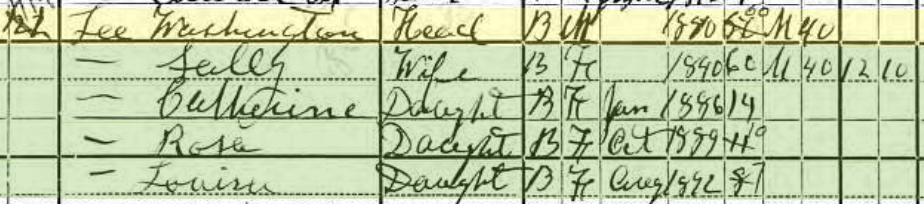
Catherine Lee is living in the household of Washington and Sallie Lee. Two sisters, Rose and Louisa are also listed in the household. Emma is not present.

Emma has several children recorded in the 1920 census, including a daughter named Catherine and Rose L(ouise). The names of her daughters suggests a connection to Washington and Sallie Lee.

In a previous post, a review of Washington Lee’s census records listed his children. Among these children were a Peter, Benjamin, Susan. Emma also has children named Peter Benjamin and Susanna in the 1920 census.

The similarity in names, as well as the proximity of Washington Lee in Anne Arundel County to the Wedge family across the river in Queen Anne’s District of Prince George’s County, suggests that Washington and Sallie Lee are Emma’s parents.

Further Research Needed:

  • What other connections can be made between the Emma Lee/James Wedge household and the Washington Lee household and or Catherine Lee/Robert Wedge household?

related posts

Washington Lee and Sallie Stewart

Over the decades through census records

Known Information

Washington Lee & Sallie Stewart were married in 1870 and raised their family in and around Queen Anne’s District of Prince George’s County, Maryland

Sources

1880 Census

1880; Census Place: Marlboro, Prince George’s, Maryland; Roll: 513;Page: 75B | ancestry.com

1900 Census

1900; Census Place: Election District 1, Anne Arundel, Maryland; Page: 25 | ancestry.com

1910 Census

1910; Census Place: Election District 1, Anne Arundel, Maryland; Roll: T624_550; Page: 12A | ancestry.com

The slideshow has the records for Washington and Sallies family from 1880, 1900 and 1910. The 1890 Census was burned in a fire and generally unavailable. The individuals and their ages are recorded in the table.

Note on census locations

Marlboro District is located directly south of Queen Anne’s District within Prince George’s County.

District 1 is located in the western part of Anne Arundel County, opposite Queen Anne’s District in Prince George’s County

Excerpt from Hopkins Map of 1878

Name1880
Marlboro District, PG
1900
District 1, AA
1910
District 1, AA
Washington Lee406073
Sallie356070
12 Children Born
8 Children still living
Jane7
Susan6
Benjamin5
Sallie3
Peterinfant
Lizzie2
Catherine14
Rosa10
Louisa7
Edwardgrandson, 3

1880 Census | Community Context

Washington and his family were recorded in Marlboro District; the location of their home can be approximated by comparing the names of their neighbors with the Hopkins’ Map of 1878. They did not live very far from their 1870 home which was northwest of Oak Grove in Queen Anne’s district.

A review of the page immediately preceding and following Washington Lee’s record shows that they lived near town. There are at least three carpenters, a bricklayer, storekeeper and hotel keeper listed among the occupation.

Geo. W Brooke and Upton Brooke are listed on the next page. They can be identified on the Marlboro District detail map from Hopkin’s Atlas as being near the Oak Grove Post Office and Brick Church Station. St. Barnabas Episcopal Church was well known for its brick construction and the station on the railroad was later renamed Leeland. It is at the intersection of the modern roads Oak Grove Rd and Leeland Road.

Hopkins created an Atlas of the fifteen miles around Washington DC including the County of Prince George, Maryland in 1878, which also lists landowners.

Hopkins, Griffith Morgan, Jr. Atlas of fifteen miles around Washington, including the County of Prince George, Maryland. Philadelphia: G.M. Hopkins, 1878.

1900-1910 Community Context

In the margin of the 1910 Census is written Governor’s Bridge to Queen Anne, which suggests that the Lee family lived near the Patuxent river between Governor’s Bridge to the north and Queen Anne’s Bridge to the south.

The Paul Sharps family is a relative neighbor of the Lee family in both the 1900 and 1910 census. In 1900, Paul Sharps is listed on page 22 of the census, while the Lee family is listed on page 25. In 1910, Paul Sharps is on the same page as the Lee family.

Washington Lee is listed as the owner of the land in the 1910 Census, while Paul Sharps rents the land he is working.

The Selman family is listed on page 26. There are two Sellman families located near Governor’s Bridge on the 1878 map of District 1 of Anne Arundel. This suggests that the Lee family lived closer to Governor’s Bridge than to Queen Anne.

This area is roughly southeast of the modern day exchange of US Highways 301 and 50.

In both census records, the Parker family has numerous households in close proximity to the Lee family, prompting the research question if they are connected.

Hopkins, Griffith Morgan, Jr. Atlas of fifteen miles around Baltimore, including Anne Arundel County, Maryland. Philadelphia, 1878. Map. 

Further Research Needed:

  • What connections exist between the Parker family and the Lee family?
  • What records exist corroborate the census record that Washington Lee owned his property in 1910?
  • Where did the children live in the 1900 census?

related posts