A DNA match between descendants initiated an investigation into the probable shared ancestry of two Black individuals living in Prince George’s County after emancipation. Washington Lee, a Civil War veteran, appeared in the Western Branch Neighborhood of Queen Anne District after the Civil War without visible connections to any kinship clusters. In contrast, Maria Matthews, with her husband and children, could be traced to Bel-Air, the Ogle estate situated relatively near Governor’s Bridge. This genetic link between the two individuals suggests a shared ancestry, offering a rare glimpse into the kinship networks formed under chattel slavery in antebellum Maryland.
historical threads: the documentary evidence
Maria Matthews, daughter of Peter Lee
Maria Matthews died in 1903, having lived in Prince George’s County for the majority of her life. Her death certificate identified Peter Lee as her father. This discovery potentially linked Maria Matthews and Peter Lee to Washington Lee, as a shared family name emerged. An elderly Peter (born circa 1800) was listed in the probate records of the Ogle network along with Maria, corroborating the connection between Bel-Air and Maria’s lineal family.
Polly, Wife of Peter
In 1855, Polly, a woman not less than 40 years old, self-liberated herself from William E. Peach. Peach had purchased Polly from the Macgill estate “at her request so that she may enjoy the society of her husband and relatives.” Peach included a certification from Geo. C. Ogle stating that Polly’s husband, Peter, was “anxious that she come home to her master.” Despite Peach’s apparent fulfillment of her request, Polly was not convinced of his purchase and left Prince George’s County, making her way to West River Post Office in Anne Arundel County. Polly had been enslaved on Macgill’s Prince George’s estate, which bordered Bel-Air, where her husband was enslaved. Her journey to West River, in Anne Arundel County, where Macgill’s second estate was situated, suggests the presence of kin in bondage in that location.
Washington Lee, a man of two counties
Washington Lee, a man without readily apparent kinship connections, lived in both Prince George’s County and Anne Arundel County after the Civil War. Marrying Sarah Stewart in Upper Marlboro in 1870, he lived in and around Oak Grove Post Office before moving to Anne Arundel County, near the post offices of Dodon and Harwood, in relative vicinity of West River Post Office. In his waning years, he returned to Prince George’s County to be cared for by his daughter. This combination of Washington Lee’s geographic connections to West River and Queen Anne District, along with the DNA match to Maria Matthews and, presumably, Peter and Polly who also spanned both districts, suggests that Washington Lee was connected with the Lee individuals enslaved on the Macgill estates.
Washington, a boy in the records
A boy named Washington is listed in the probate records of James Macgill. He was held in bondage on Macgill’s Anne Arundel estate near West River, the same area Polly traveled to after her self-liberation from Peach. He was 13 years old in 1844, suggesting a birth year around 1831. His age and location suggest he could be a son or nephew of Polly’s, separated from the Lee individuals who remained in Prince George’s County. Polly’s escape to Anne Arundel County may have been an attempt to reunite with children and kin who had been separated from her in an earlier sale or division of property.
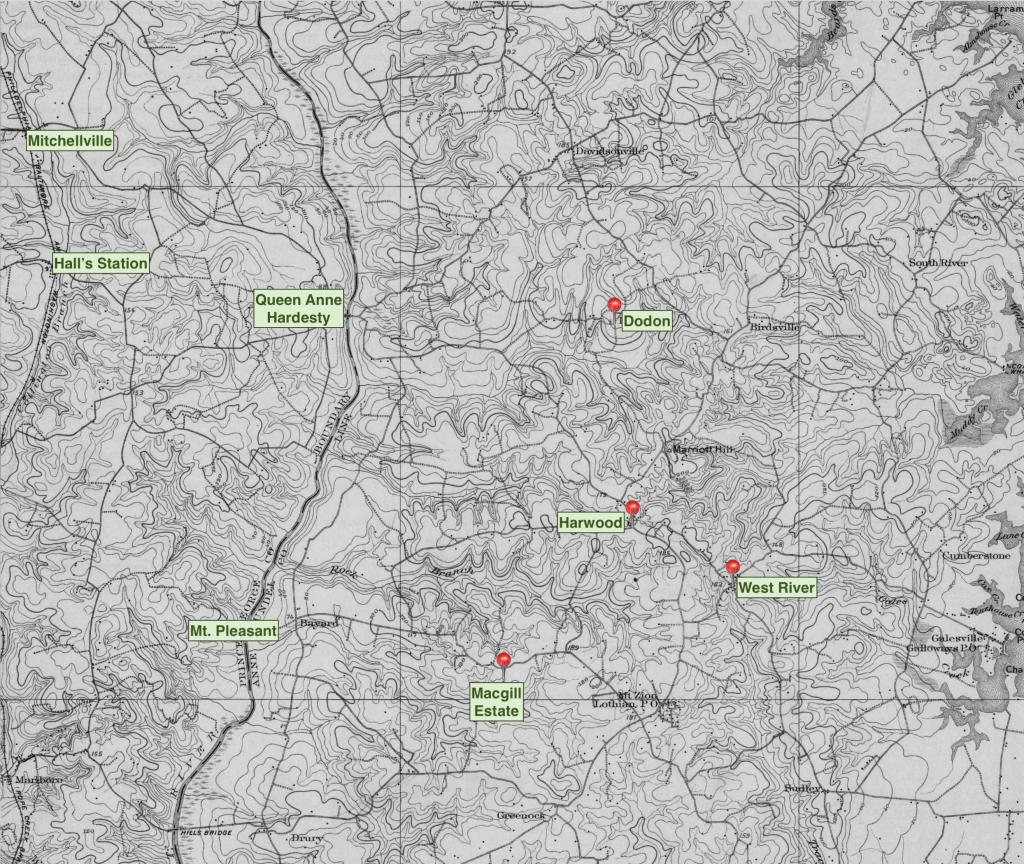
The landscape of southern Anne Arundel County, Maryland, circa 1905. This map illustrates the proximity of key locations in the shared ancestry of Maria Matthews and Washington Lee, including the areas of Dodon, Harwood, and West River. This geographical context is essential for understanding the origins of their kinship connection. Source: U.S. Geological Survey, “Owensville, MD” Quadrangle, 1905, 1918 edition.
weaving the kinship tapestry
The convergence of genetic evidence and meticulously researched historical records allows for the reconstruction of a probable kinship connection linking Maria Matthews and Washington Lee. The shared 62 centimorgans (cM) between their descendants provides a genetic foundation, supporting the documentary trail that places Maria as the daughter of Peter Lee. Given Polly’s documented status as Peter’s wife, her determined self-liberation to be with him, and Washington’s enslavement on a Macgill estate geographically tied to Polly’s post-escape movements, the evidence strongly suggests Washington Lee was a relative of Peter Lee and Polly. This case illustrates how DNA analysis, combined with a deep examination of fragmented historical records, can contribute to understanding kinship networks that were systematically disrupted and obscured by chattel slavery. It underscores the enduring impact of the institution on individuals and their descendants, and the vital role of persistent research in revealing these crucial connections.
The story of Polly is one of resistance against a world designed to commodify her existence. Sold from the estate of her long-time enslaver, she escaped her new owner in a daring attempt to re-stitch the torn fabric of her own kinship community. To understand her actions, one must first examine the complex tapestry of the world that sought to control her.
Dr. James Macgill, heir to his uncle of the same name, presided over a sizable estate in Prince George’s County in the 1830s. His 740+ acre plantation was stitched together from various land tracts along present-day Annapolis Road, a significant crossroads in the Vansville District (later Queen Anne District). The estate was bordered by massive operations: the Jesuit’s 2,000-acre White Marsh plantation, the Ogle family’s 2,000+ acre Bel-air estate, and the Bowie family’s 570+ acre Locust Grove. An 1828 tax list documents the human dimension of this operation, enumerating the 34 people Dr. Macgill enslaved: six elders, eleven adults, four adolescents, and thirteen young children under the age of eight.
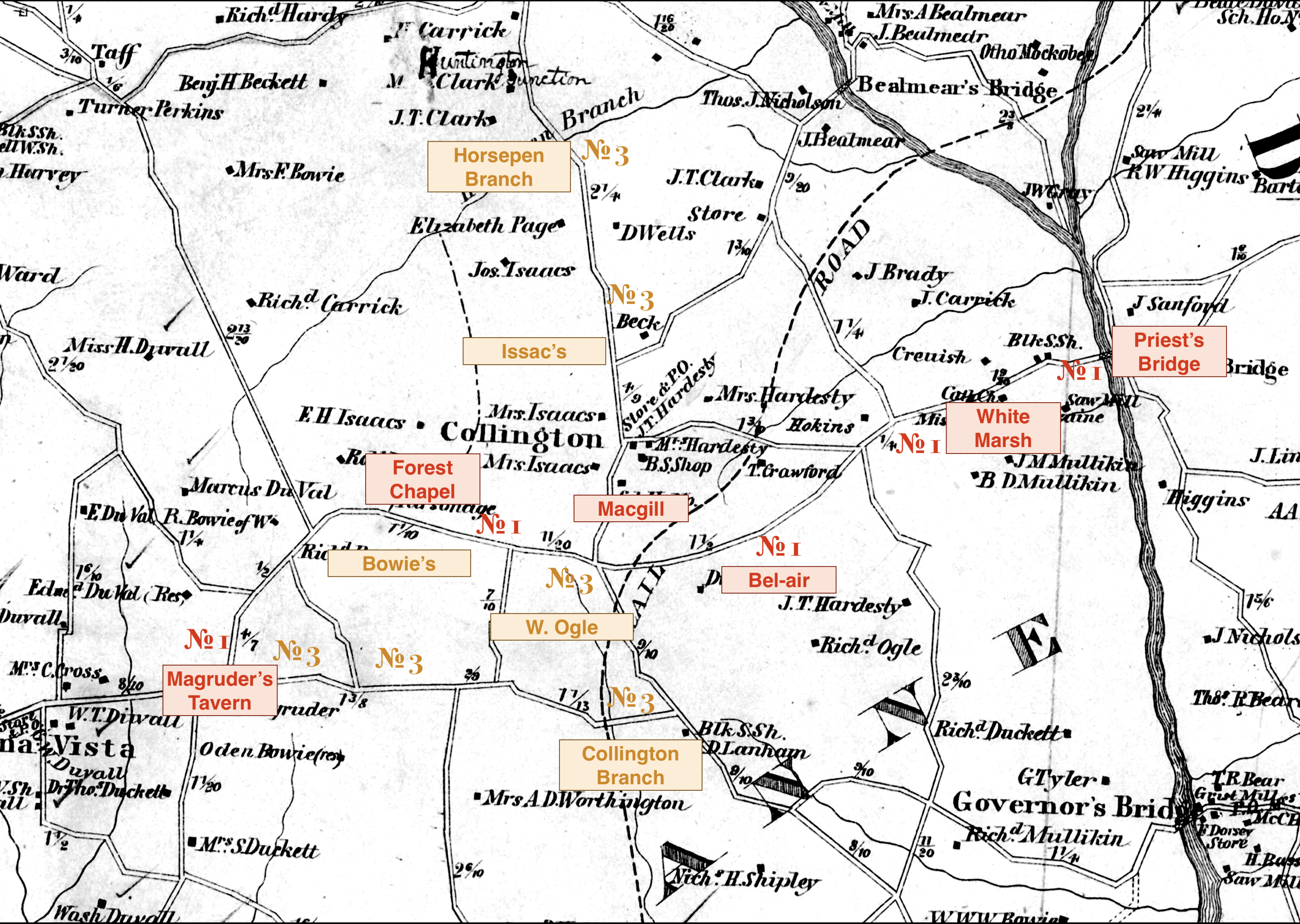
The 1828 Levy Court Road Survey details the estate’s strategic location, providing access to the Patuxent River and placing it in direct proximity to the Ogle’s Bel-air plantation—the community where Polly’s future husband, Peter, was enslaved.
Road No. 1 [now-Annapolis Road]: Commencing at the Priests Bridge on the Patuxent, thence through the White Marsh Plantation; then through Bel-air, thence through the plantation of Dr. James Magill by the Forest Chapel, thence by Magruders Tavern…
Road No. 3: …across Collington Branch, thence with the plantations of William Ogle, James Magill, and Walter Bowie…
Using details from the 1828 Levy Court Road Survey, Martenet’s annotated 1861 map details the route of the area’s primary artery (present-day Annapolis Road), an economic corridor connecting the adjacent plantations of Macgill, Ogle (Bel-air), and the Jesuit’s White Marsh.
Married to Julia Ann Compton in 1829, Macgill also owned property in Anne Arundel County near West River Post Office and Samuel Carr, the husband of Mary Compton. The property was situated in the First District along the road that led to Mount Pleasant Ferry, connecting Anne Arundel to Prince George’s County closer to Upper Marlboro, the county seat. The estates wove together the family’s interests across two counties, creating a broader and more complex tapestry of land and human property.
the Snag: the death of the patriarch (1840)
A decade after his marriage, Macgill’s impending death created a snag in the tapestry of his estate, and he composed his last will and testament, dividing his real and personal property among his wife and three born children, while making provisions for his unborn child. Like his uncle, he dictated how the fabric of his estate was to be cut and divided, specifically naming different mother-child family groups and directing the heir who would acquire four family groups, with a third being conveyed to Macgill’s wife as her right of dower, and the unnamed “balance” going to James P. Macgill.
ripped threads of kinship
Macgill’s division in his will ripped the threads of kinship among the community enslaved on his estates. While he nominally kept mother-child groups together, Polly and her children were divided from her larger extended family. As the wife of Peter, she became part of the larger Lee family group, and with Macgill’s will, she was separated from Harriet Lee and her children, Daniel, Oswald [Osborn], Caroline, Ann, and Amelia, who, while unnamed in the will, were named in the inventory and much later in the 1867’s Compensation List of Septimus J. Cook, the second husband of Julia Macgill. Whereas, Polly and her children were conveyed to Thomas Macgill, the oldest son, who would also receive a sizable portion of the Prince George’s estate through provisions of the 1833 will of the older Dr. James Macgill. Polly, Peter, their children, and the family of Harriet Lee were the threads that gave the plantation its texture and life. Macgill’s death subjected these threads to immense strain. They were stretched thin across counties, torn from one another, and tangled with new and unfamiliar threads.
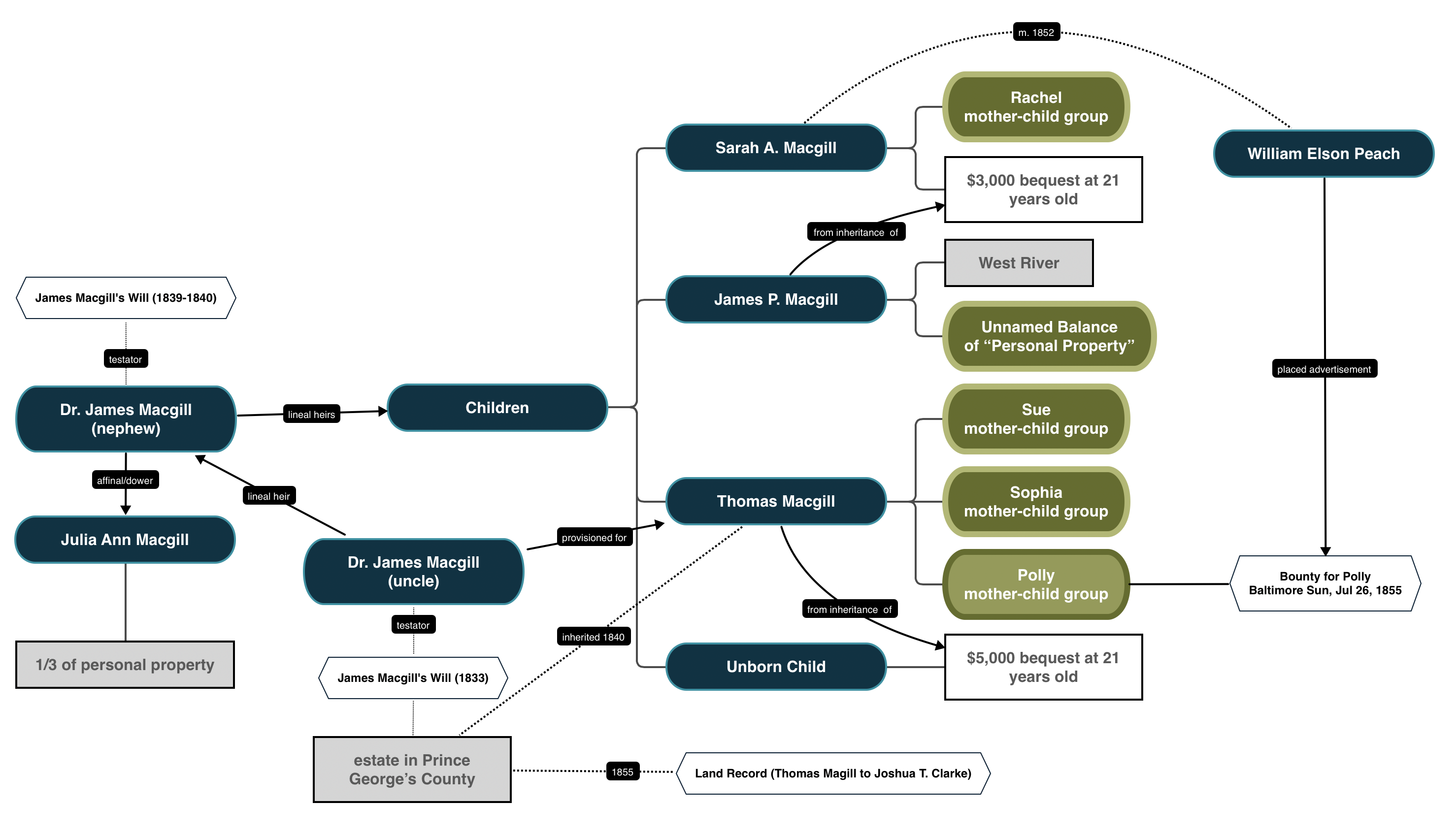
This diagram illustrates the legal fracturing of an enslaved community following the 1840 death of Dr. James Macgill. His will distributed specific mother-child groups, including those of Rachel, Sue, Sophia, and Polly, among his heirs, pulling the kinship network apart and setting the stage for future sales and separations.
threads of inheritance
The will, far from ensuring a smooth transition, pulled the tightly woven kinship community of the enslaved in three distinct directions. Each heir represented a thread pulling part of the tapestry away from the whole. These distinct lines of inheritance did not exist in isolation; they actively pulled the community apart, a process accelerated by the legal and personal entanglements of the heirs.
the dower of the widow: the cook connection
Under Maryland law, Julia Ann Compton Macgill had a dower right to one-third of her husband’s property. This included the enslaved families Macgill designated for her, most notably Harriet Lee and her children. When Julia remarried to Septimus J. Cook in 1845, her dower portion—including Harriet’s family—was legally absorbed into the Cook household. This single act pulled an entire branch of the original enslaved community away, transplanting them into a new network under a new enslaver.
the son’s portion: the line of thomas macgill
Thomas Macgill’s inheritance was anchored in Prince George’s County. As stipulated in two generations of wills, he received a large portion of the home plantation and legal ownership of Polly and her children. While this provision placed Polly in the community where her husband Peter lived, it rested on the financial acumen of the Magill’s guardians to maintain a sizable estate without need to sell off “assets” This thread represented the patriarchal line of succession from uncle to nephew to son.
the balance of the estate: the line of james p. macgill
The younger son, James P. Macgill, inherited the family’s Anne Arundel County property near West River, along with the “balance” of the enslaved people not otherwise assigned. This act created an immediate geographic fracture in the community, moving another group of individuals to a different county and physically separating them from the kinship network on the home plantation. This thread established the West River estate as a distinct, yet connected, Macgill holding—and created the destination Polly would later seek in her flight.
The division of human property among Julia, Thomas, and James P. Macgill set the stage for further disruption. The fifteen years that followed Macgill’s death were marked by a cascade of events—probate, remarriage, and death—that continued to unravel the fabric of the enslaved community.
unraveling in motion: 1840-1855
Multiple events occurred in the years after Macgill’s death that led to self-liberation of Polly in 1855. First, there was the division of the estate as it traveled through probate, followed by the marriage of Julia Macgill to Septimus J. Cook and her subsequent death in 1846, and the re-division of her estate with her children’s. There were sales to settle the debts of the estate. Ultimately in 1855, Thomas Macgill sold his estate that inherited from his uncle to Joshua T. Clark, a neighbor and Justice of the Peace. It is most likely this sale that prompted Polly to seek ways to weave a new beginning for her family.
Polly’s design: weaving against the grain
The impending 1855 sale of the plantation from Thomas Macgill to Joshua T. Clark likely acted as the final catalyst. In response, Polly leveraged her social capital within the enslaver’s network to reach out to William Elson Peach, her late enslaver’s son-in-law. She initiated her own sale, requesting that Peach purchase her to ensure her continued proximity to her husband, Peter. However, while navigating this arrangement with Peach, she almost certainly utilized her own community’s social networks to connect with individuals who offered an alternative path. The “designing person” mentioned in the subsequent bounty notice suggests Polly was not merely seeking a new enslaver but was simultaneously orchestrating an escape. This was her attempt to gather the scattered threads of her own kinship and find lasting liberty beyond the reach of Peach, Clark, and the unraveling Macgill estate.
Sources
1828 Tax List, Prince George’s County
1828 Levy Court Road Survey, Prince George’s County
Marriage Records, for the Macgill-Compton union (1829) and the Macgill-Cook union (1845)
Maryland, U.S., Compiled Marriages, 1655-1850
Maryland, U.S., Compiled Marriages, 1667-1899
Last Will and Testament of Dr. James Macgill (the elder), 1833, PC 1:1
Last Will and Testament of Dr. James Macgill (the nephew), ca. 1840, PC 1:129
Probate Records, Estate of Dr. James Macgill (the nephew), post-1840, which would include:
Inventory and Sales Records of the Estate (PC 4:43, 57, 299; JH 1:20,107,268, 273)
Land Records, for the sale of the Macgill estate to Joshua T. Clark (ca. 1855); EWB 1:137
Newspaper Bounty Notice for the capture of Polly (1855), Baltimore Sun, newspapers.com
The Baltimore Sun’s printer placed the ad in the last column of page 2, underneath a bounty for Peter Culver who had absconded with a “free boy, hired by me, named Alexander” and an ad for Ohio Flour.
$150 REWARD WILL BE GIVEN FOR THE POSITIVE CONVICTION of any one who shall be guilty of harboring my NEGRO WOMAN POLLY, after a knowledge of this notice, whom I purchased lately of the estate of Dr. Magill.—As I have bought Polly through motives of pure humanity, and at her own request, that she might enjoy the society of her husband and relatives, I feel satisfied that she will come to me unless deceived by some designing person in relation thereto. POLLY is not less than forty years of age, a mulatto of neat and tidy appearance, and was last seen on West River. I will give Twenty Dollars if in Anne Arundel, or Thirty if elsewhere, to any one who shall convince her of the fact of my purchase and secure her to me. I also subjoin a certificate of Dr. OGLE, the owner of Polly’s husband. WM. E. PEACH, M. D., Queen Ann, Prince George’s co., Md.
I hereby certify that I have talked with PETER, the husband of Polly, and he says he is very anxious that she should come home to her master, Dr. Peach, immediately. Peter is in bad health and unable to leave the house. [jy25-St*] GEO. C. OGLE.
Within this mundane context of commerce and control, William E. Peach’s advertisement primarily sought the conviction of the “designing person” who “deceived” Polly and harbored her away from Peach who had purchased her “through motives of pure humanity” and while placing a bounty on the return of Polly so he could “secure her to me” almost as an afterthought.
the skeleton layer: who, what, and where
The basic facts of the notice form the skeleton of the story. In July 1855, Wm. E. Peach, M.D., living near Queen Anne in Prince George’s County sought the return of Polly, “not less than forty years of age” who was purchased from Dr. Magill’s estate. In her escape, she was last seen near West River in Anne Arundel County. He offered a tiered $20-30 for Polly’s return and a significantly larger sum of $150 dollars for the conviction of the “designing person”.
the sinews layer: the network of kin and property
The names in the advertisement are held together by a dense network of marriage and property. William E. Peach, son of Queen Anne District landowner Samuel Peach, had married Sarah Alexander Ma[c]gill in 1852. Sarah was the orphaned daughter of Dr. James Ma[c]gill and Julia Ann Compton, having lost her father in 1840 and her mother in 1846. Her life was split between Prince George’s and Anne Arundel Counties. Before her father’s death, she lived on his 740-acre estate along present-day Annapolis Road, situated between the Jesuit’s White Marsh plantation and Magruder’s Tavern, adjacent to Bel-Air, the Ogle estate.
After Dr. Ma[c]gill’s death, Sarah’s world was destabilized. Her mother’s remarriage to Septimus J. Cook and her mother’s subsequent death resulted in Sarah and her sister, James Anna, being shuffled to Anne Arundel County to live with their aunt and uncle, Samuel and Mary Carr. The Carrs owned land near the Ma[c]gill property at West River, which had been inherited by Sarah’s brother, James P. Ma[c]gill. The 1839 will of Dr. Ma[c]gill had stipulated that Polly and her children be conveyed specifically to his other son, Thomas Ma[c]gill.
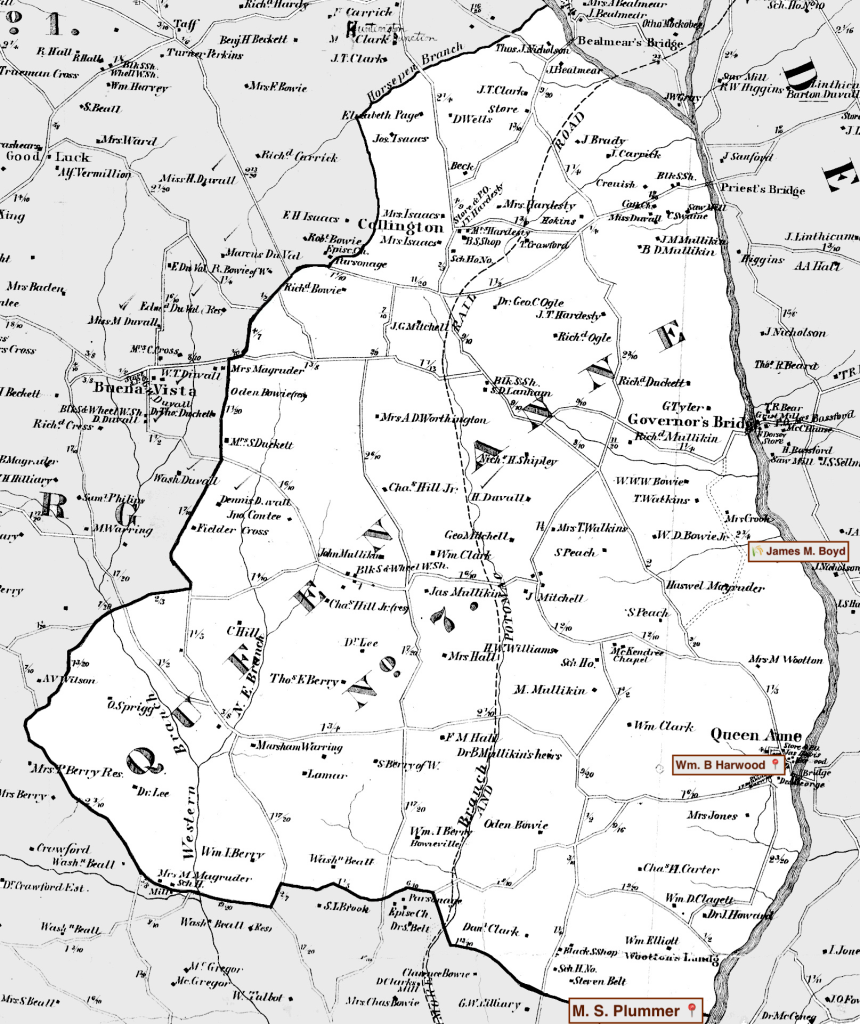
This 1861 map of the Queen Anne District illustrates the dense network of kin and property that defined Polly’s world. Highlighted are the lands of S. Peach (the family of her new owner, William E. Peach), Dr. Geo. C. Ogle (the enslaver of her husband, Peter), and Dr. Jas Macgill (her previous enslaver). The close proximity of these estates visualizes the community she was desperate to remain within, turning her flight into a calculated risk to preserve her family bonds.
the heart: her husband and relations
As the estate was divided and re-divided, first through the death of James and then through the death of James’ relict and again, as the children came of age, Polly, “a mulatto of neat and tidy appearance” watched as her extended family was separated, corralled and moved from estate to estate. Individuals were sold to new husbands or liquidated to cover bequests and estate charges.
Amid this decade of instability, a transaction was initiated that would move Polly from her legal owner, Thomas Ma[c]gill, to his sister’s new husband, William Elson Peach. Seizing on this moment, Polly appealed directly to the young doctor, requesting that the terms of his purchase ensure she “might enjoy the society of her husband and relations.” Her husband, Peter, was enslaved by the Ogles at Bel-Air, the neighboring estate. According to a “certificate” from Geo. C. Ogle referenced in the bounty notice, Peter was “in bad health and unable to leave the house.” For Polly, a move away from the Queen Anne area would mean the permanent loss of her husband and the kinship network she fought to maintain.
the skin layer: the language of control and value
At “not less than forty years old,” Polly was an elder in her community. Her labor was likely shifting from fieldwork to tasks essential for the plantation’s maintenance: cooking, nursing, gardening, and sewing. In the logic of chattel slavery, Polly’s advanced age meant her external market value had diminished. This is starkly visible in the twenty-dollar bounty Peach placed on her body; he valued the conviction of the person who disrupted his power more than seven times higher than the return of Polly herself. Peach’s language paints him as a paternalist allowing Polly to “enjoy” her family, yet he simultaneously admits his authority is so weak that he needs help to “convince her of the fact of his purchase” and to “secure her to me.”
Daina Ramey Berry, in The Price for Their Pound of Flesh, discusses the range of attitudes toward elderly enslaved people. While the enslaved community valued their wisdom and the connections they fostered, enslavers saw only a diminished capacity for labor. This led to either “neglectful paternalism” or “disregarded isolation.” Polly, legally conveyed to an orphaned son whose estate was managed by a series of guardians and second husbands, had likely endured years of disregarded isolation as her value was debated in inventories and accounts. Sarah’s marriage to the paternalistic William Peach provided Polly an opportunity to navigate from disregarded isolation into neglectful paternalism. In this transition, she found an opening to assert her own agency.
the blood of the veins: the flow toward kin
Polly was likely living in the Queen Anne District on the former Ma[c]gill estate when Peach finalized her purchase. From there, she had access to travel lanes and turnpikes leading toward Washington, D.C., and the free states north of Maryland. Yet Peach’s ad reports she was last seen in Anne Arundel County near West River, a journey east, away from the most direct path to freedom. This eastward movement was not a mistake; it was a choice. It suggests Polly was seeking reunification with the family members who had been separated from her years before, when James Ma[c]gill first established his Anne Arundel property. Her journey suggests she was seeking reunification with children or other kin who, despite the legal lines drawn in the will, were physically located at the family’s Anne Arundel property. Her flight was therefore a calculated risk, flowing toward the heart of her kinship network, wherever it was located.
I want to acknowledge historians Daina Ramey Berry (The Price for Their Pound of Flesh) and Edward E. Baptist (The Half Has Never Been Told), whose scholarship was foundational to the anatomical metaphor used as an analytical tool in this research.
For those who wish to delve deeper into these topics, I highly recommend reading these books. You can learn more about them on Bookshop.org (I do not receive a commission from these links)
William B. Harwood operated as a merchant in Queen Anne on the Patuxent River during the 1850s. The 1850 census enumerated his household, including a wife and child, and recorded his modest real estate valued at $1,200, likely a town lot and store. An 1852 Bill of Sale documents his role as a purveyor to the local planter class, detailing a substantial sale to Haswell Magruder of dry goods, spirits, groceries, and 1,000 cigars. Yet, by 1857, Harwood was insolvent, unable to pay his creditors.
Transcription of Insolvent Notice
INSOLVENT NOTICE.
PRINCE GEORGE’S COUNTY, TO WIT:
ON application to the subscriber, Judge of the Circuit Court for Prince George’s County by petition in writing of WILLIAM B. HARWOOD, of said county, stating that he is in insolvent circumstances and unable to pay his debts, and praying for the benefit of the act of the General Assembly of Maryland, entitled “An act for the relief of insolvent debtors,” passed at January session, eighteen hundred and fifty-four, on the terms therein mentioned, a schedule of his property and a list of his creditors on oath, as far as he can ascertain the same, being annexed to his petition; and the said WILLIAM B. HARWOOD, having taken the oath by the said act prescribed, for the delivering up of his property, and given sufficient security for his personal appearance at the Circuit Court for Prince George’s County to answer such interrogatories and allegations as may be made against him; and the said WILLIAM B. HARWOOD, having further made oath, that he has not, at any time, sold, lessened, transferred or disposed of any part of his property, for the use and benefit of any person or entrusted any part of his money or other property, debts, rights or claims, thereby to delay or defraud his creditors or any of them, or to secure the same, so as to receive or expect to receive any profit, benefit or advantage himself therefrom; and having appointed JAMES M. BOYD his Trustee, who has given bond as such, and received from the said WILLIAM B. HARWOOD a conveyance and possession of all his property, real, personal and mixed—I do hereby order and adjudge that the said WILLIAM B. HARWOOD be discharged; and that he give notice to his creditors by causing a copy of this order to be inserted in some newspaper published in Prince George’s County, once a week for three consecutive months, before the next November Term of said Circuit Court, to appear before the said Circuit Court, at the Court House of said County at the said Term, to show cause if any they have, why the said William B. Harwood should not have the benefit of said act as prayed.
Given under my hand this eighth day of June, in the year of our Lord one thousand eight hundred and fifty-seven.
PETER W. CRAIN.
True copy—Test: CHARLES S. MIDDLETON, Clerk.
June 10, 1857—3t [Planters’ Advocate]
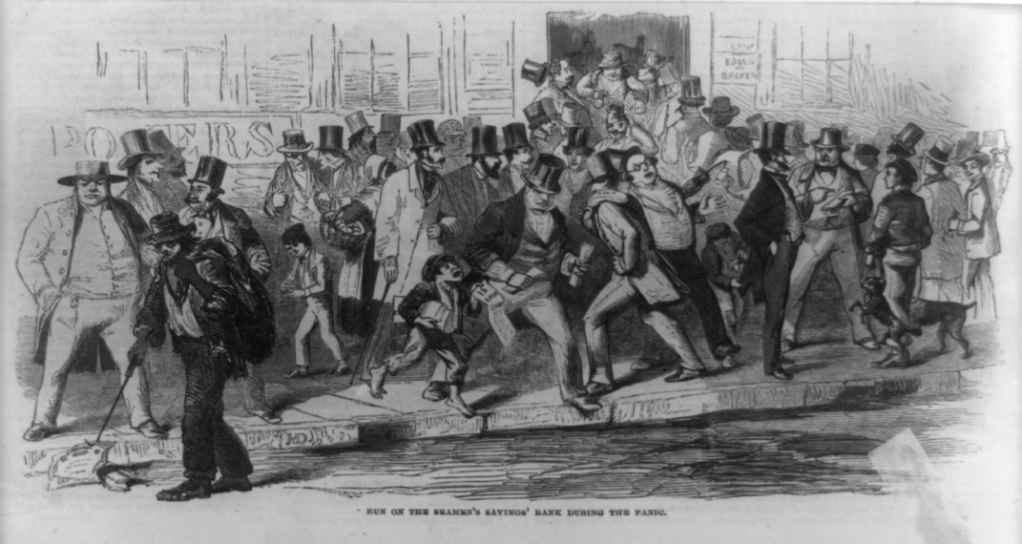
Despite his established business, the economic pressures that precipitated the Panic of 1857 proved insurmountable. The panic was fanned by overspeculation, falling grain prices after the Crimean War, and tightening credit. Harwood, a merchant in Queen Anne, would have been reliant on credit and the local farmers ability to pay their bills. Falling crop prices and credit crisis would have crushed his ability to navigate the market, leading to his unpaid debts. By June 1857, Harwood petitioned the Circuit Court, declaring himself insolvent and unable to pay his creditors.
Queen Anne District from 1861 Martenet Map
a trustee’s ledger: seizing a merchant’s accounts
The court appointed James M. Boyd to act as trustee for Harwood’s accounts. Boyd was a landholder whose 160-acre farm, part of the tract “Ample Grange,” was situated about two miles north of Queen Anne Town. His property holdings, which included a tobacco house, corn house, granary, and “quarters for servants,” marked him as a successful small yeoman, a class of farmer holding between 40 and 280 acres. The scale of his diversified operation placed him at the upper end of this group, a man of sufficient standing and perceived stability to be entrusted by the court with the assets of a failed peer.
The legal process of insolvency, while offering relief from creditors, stripped Harwood of his economic autonomy and subjected his actions to the scrutiny of both the court and his community. The oath he swore—that he had not hidden assets to “delay or defraud his creditors”—would soon become a focal point of conflict. Within months, accusations would surface that directly challenged this sworn statement, moving the conflict from the formal setting of the courthouse to the arena of public opinion and vigilante action, where the planter network sought to enforce its own economic and social order.
the underground economy
an Economy within an economy: the m.s. plummer notice
M. S. Plummer was a large planter whose estate on the border of Queen Anne and Marlboro District was home to the hundreds of people he enslaved. His real estate was valued at $120,000 and his personal property $500,000 in the 1860 census, speaking to his wealth acquired from the labor of the people enslaved on his estates. The heir of William Wells of George and married into the Waring family of Mt. Pleasant, M. S. Plummer was established among the large planter class.
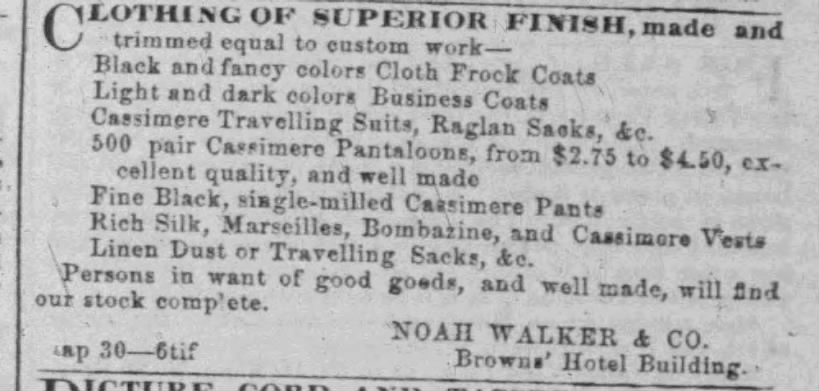
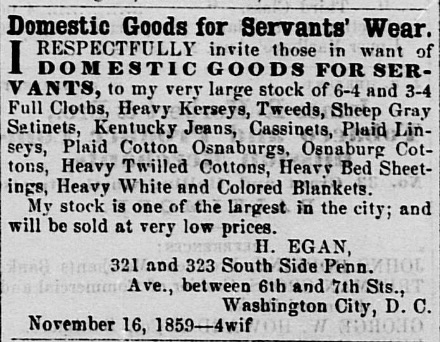
In July 1857, just months before the official start of a national financial panic, an unknown thief entered a cabin within the quarters on Plummer’s estate and stole clothing belonging to the enslaved occupants. The stolen items—including cassimere pants, a flowered vest, and lawn dresses—were not the rough, utilitarian workwear of tweed or osnaburg issued to field hands. Instead, they were fashionable, ready-made garments that, along with the five dollars also taken, point to the owners’ participation in the internal economy of the enslaved.
This underground economy was essential for survival and for carving out a space for self-expression. Through activities outside their forced labor, enslaved people generated income that allowed them to supplement the meager provisions provided by enslavers. They completed “overwork” tasks, sold produce from their garden plots, marketed handmade goods like baskets, and sometimes hired out their own time on Sundays or holidays. The resulting income enabled them to purchase goods from merchants or peddlers, trade for different foods, and acquire clothing that reflected their own tastes and style.
Transcription of Advertisement and Notice
$50 Reward.
I WILL give a reward of FIFTY DOLLARS for the apprehension and conviction of the rogue or rogues who entered one of my quarters on Thursday morning, the 9th instant, between ten and eleven o’clock, and took therefrom the following articles:
1 pair blue cassimere Pants, 1 black summer cloth Coat, 1 white Skirt, 1 white Vest with blue flower, 1 pair Shoes, with brass tacks, 1 blue lawn Dress, 1 pink lawn Dress. Also—Five Dollars in money.
And I also forewarn all free negroes, mulattos or slaves from Anne Arundel or Prince George’s Counties from crossing over or through my farm, either day or night, Sunday or any other time, without permission of myself or my overseers; and I will give TEN DOLLARS reward for the apprehension of every free negro or mulatto caught so trespassing.
I will give TWENTY DOLLARS reward for the conviction of any person or persons who deal with or purchase hogs, shoats, pigs, lambs, meal, fish or bacon from any of my servants, or who purchase such articles from others, stolen from my farm. And I will also give a liberal reward for any information that will lead to such conviction.
M. S. PLUMMER.
July 15, 1857—tf
Queen Anne District from 1861 Martenet Map
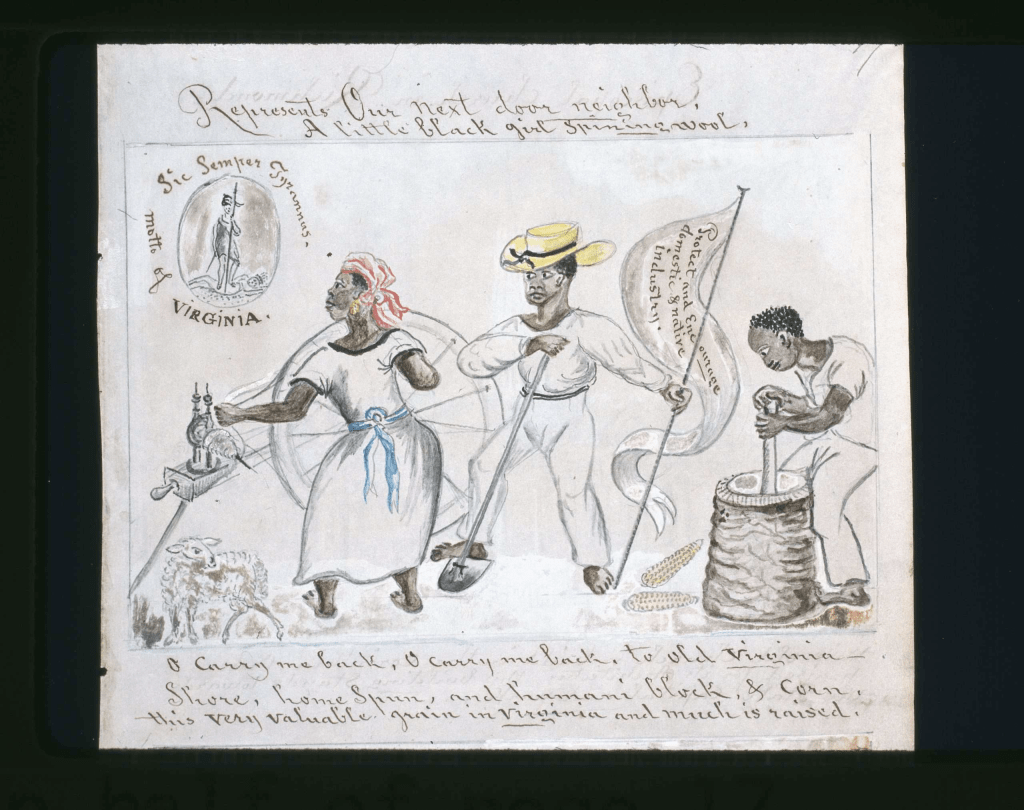
Clothing Advertisements and Sketch of Enslaved People
Richmond Dispatch, 1857
Daily National Intelligencer and Washington Express 1857
Planters’ Advocate, 1859
Miller, Lewis. Represents Our next door neighbor. Mid-nineteenth century. Watercolor and ink on paper. The Abby Aldrich Rockefeller Folk Art Museum, The Colonial Williamsburg Foundation, Williamsburg, VA. As published in Encyclopedia Virginia. Accessed July 6, 2025. https://encyclopediavirginia.org/4118hpr-00ee78908746584/.
Plummer’s notice sought more than the return of the stolen articles; it was a comprehensive effort to sever the networks that sustained the enslaved community. He issued a strict prohibition against Black people—enslaved or free—traversing his extensive estates, not only during the day but specifically at night and on Sundays, the very periods that allowed for a greater freedom of movement and social interaction. This clampdown on physical movement was directly linked to a more critical prohibition against economic exchange. By offering a reward for the conviction of anyone who purchased goods from his “servants,” Plummer attempted to dismantle the underground economy itself, denying the enslaved community the ability to profit from their own production and to exercise consumer choice.
opportunity knocks at the Quarters’ door
By publishing his notice in the Planters’ Advocate—a newspaper that served the interests of Prince George’s County’s white society with its advertisements for runaway enslaved people, trustee sales, and plantation managers—M.S. Plummer did more than just report a theft. He publicly drew a line against the local underground economy, threatening conviction for “any person or persons” who dared to purchase goods from the people he enslaved. This public ultimatum raises a critical question: who in the community would risk social condemnation and legal trouble by engaging in this forbidden trade? The circumstances of William B. Harwood, a merchant residing just a few miles away in Queen Anne Town, present a compelling answer. Declared insolvent just one month prior, his legitimate business shuttered and his assets seized by a trustee, Harwood possessed both the motive of financial desperation and the commercial skills of a merchant, making him an ideal candidate to operate within this illicit, cash-based market.
Although no single document provides direct evidence of William B. Harwood’s participation in the underground economy, a powerful case can be built from the convergence of his financial ruin and his social position. The 1850 census is a critical source, recording him not only as a merchant in Queen Anne but also as the head of a household that included the Coursey family, a free Black family. This long-standing association could have provided Harwood with a level of access and familiarity within the broader Black community—both free and enslaved. When his formal business collapsed in 1857, this pre-existing social network, combined with his skills as a merchant, would have made him an accessible and logical, if illicit, trading partner.
1850 Census for Queen Anne District, Prince George’s County, ancestry.com
panic ignited
Northern part of Prince George’s County from 1861 Martenet Map
While Plummer was attempting to control the economic activities of the Black community, local enslavers were fearing the escape of their “valuable servants” through the Underground Railroad, often blaming “outside agitators.” Two attempts at self-emancipation from the summer of 1857 highlight this conflict between the enslavers’ public narrative and the reality of enslaved resistance.
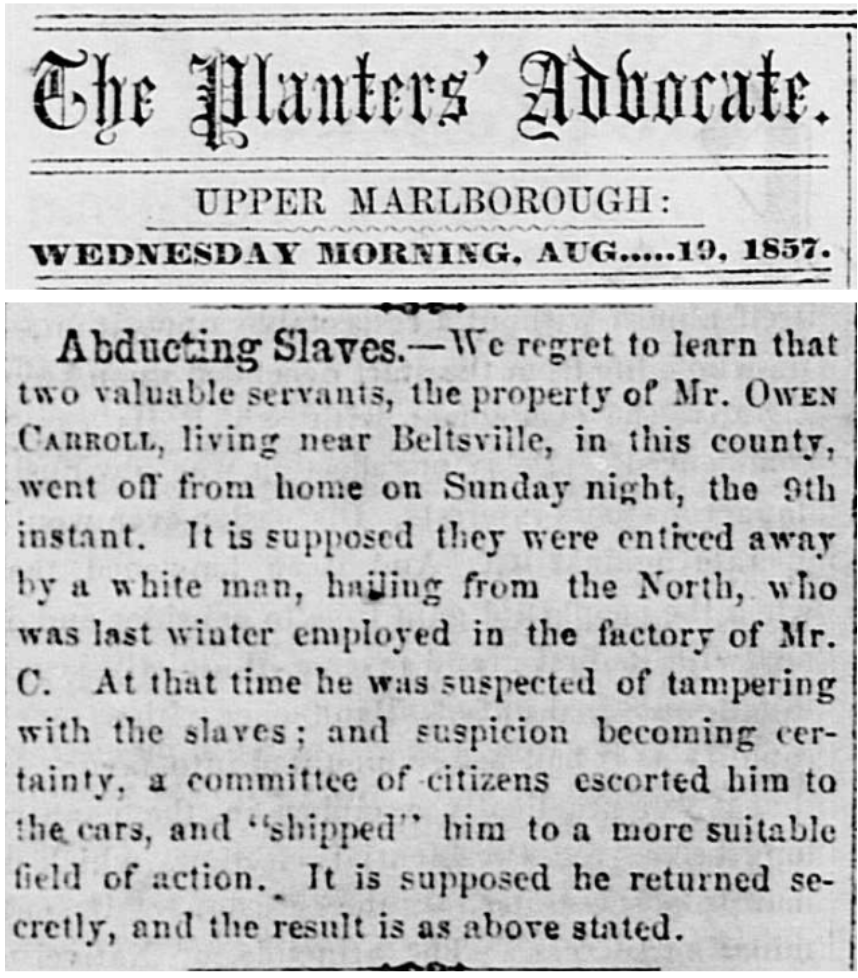
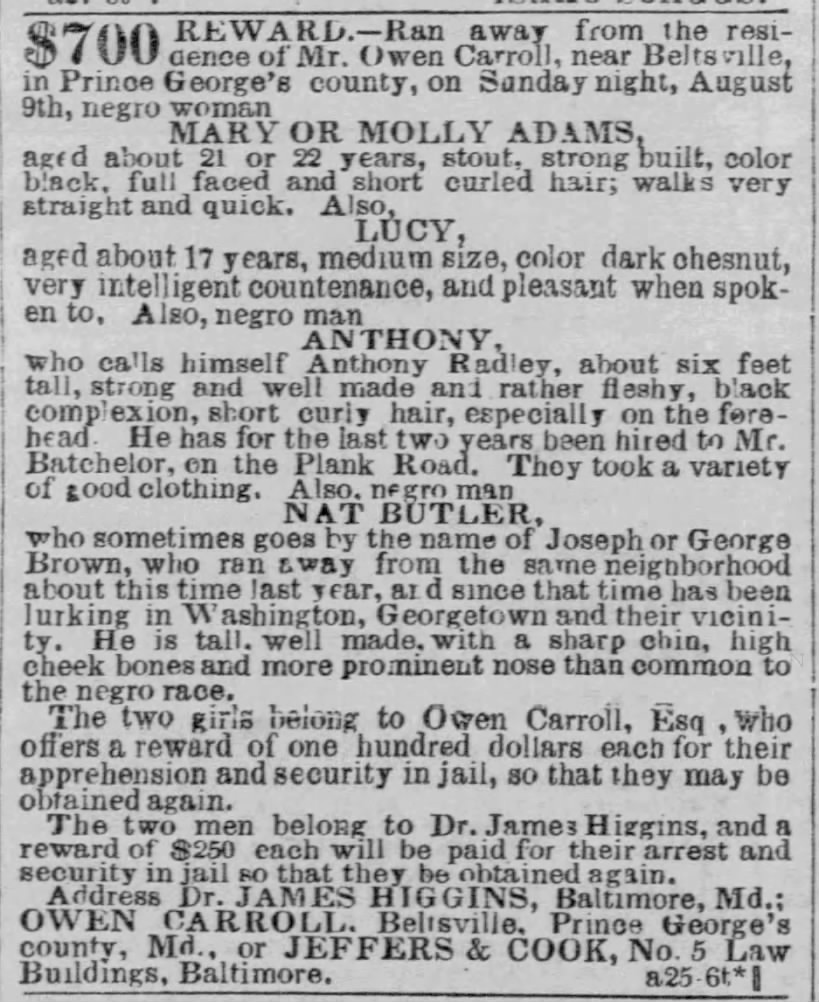
The first event was the coordinated escape of two enslaved women, Mary (Molly) Adams and Lucy, from Owen Carroll’s property, and two enslaved men, Anthony and Nat Butler, from a neighboring enslaver. The two news artifacts detailing this escape present conflicting stories. An article in the Planters’ Advocate frames the event as an abduction by a white Northerner, portraying the actions of a vigilante “committee of citizens” not as extra-legal intimidation but as a decorous civic procedure. This sanitized version stands in stark contrast to the reward notice placed by the enslavers. The bounty ad’s detailed descriptions of Lucy’s “intelligent countenance” and the men’s worldliness—Anthony having been hired out for years and Nat Butler being a prior runaway familiar with Washington and Georgetown—point to a group of capable, knowledgeable individuals. The joint escape of Mary, Lucy, Anthony, and Nat Butler suggests a carefully planned operation, undermining the paternalistic propaganda of the Planters’ Advocate, which sought to erase the agency of the self-liberating individuals by portraying them as guileless “servants.”
“Abducting Slaves.” The Planters’ Advocate [Upper Marlborough, MD], 19 Aug. 1857. MSATranscription of “Abducting Slaves”
Abducting Slaves.—We regret to learn that two valuable servants, the property of Mr. OWEN CARROLL, living near Beltsville, in this county, went off from home on Sunday night, the 9th instant. It is supposed they were enticed away by a white man, hailing from the North, who was last winter employed in the factory of Mr. C. At that time he was suspected of tampering with the slaves; and suspicion becoming certainty, a committee of citizens escorted him to the cars, and “shipped” him to a more suitable field of action. It is supposed he returned secretly, and the result is as above stated.
“$700 REWARD,” The Baltimore Sun (Baltimore, MD), August 29, 1857, 3.
Transcription of Bounty for Freedom Seekers
$700 REWARD.—Ran away from the residence of Mr. Owen Carroll, near Beltsville, in Prince George’s county, on Sunday night, August 9th, negro woman MARY OR MOLLY ADAMS, aged about 21 or 22 years, stout, strong built, color black, full faced and short curled hair; walks very straight and quick. Also, LUCY, aged about 17 years, medium size, color dark chesnut, very intelligent countenance, and pleasant when spoken to. Also, negro man ANTHONY, who calls himself Anthony Radley, about six feet tall, strong and well made and rather fleshy, black complexion, short curly hair, especially on the forehead. He has for the last two years been hired to Mr. Batchelor, on the Plank Road. They took a variety of good clothing. Also, negro man NAT BUTLER, who sometimes goes by the name of Joseph or George Brown, who ran away from the same neighborhood about this time last year, and since that time has been lurking in Washington, Georgetown and their vicinity. He is tall, well made, with a sharp chin, high cheek bones and more prominent nose than common to the negro race.
The two girls belong to Owen Carroll, Esq., who offers a reward of one hundred dollars each for their apprehension and security in jail, so that they may be obtained again.
The two men belong to Dr. James Higgins, and a reward of $250 each will be paid for their arrest and security in jail so that they be obtained again.
Address DR. JAMES HIGGINS, Baltimore, Md.; OWEN CARROLL, Beltsville, Prince George’s county, Md., or JEFFERS & COOK, No. 5 Law Buildings, Baltimore. a25-6t*
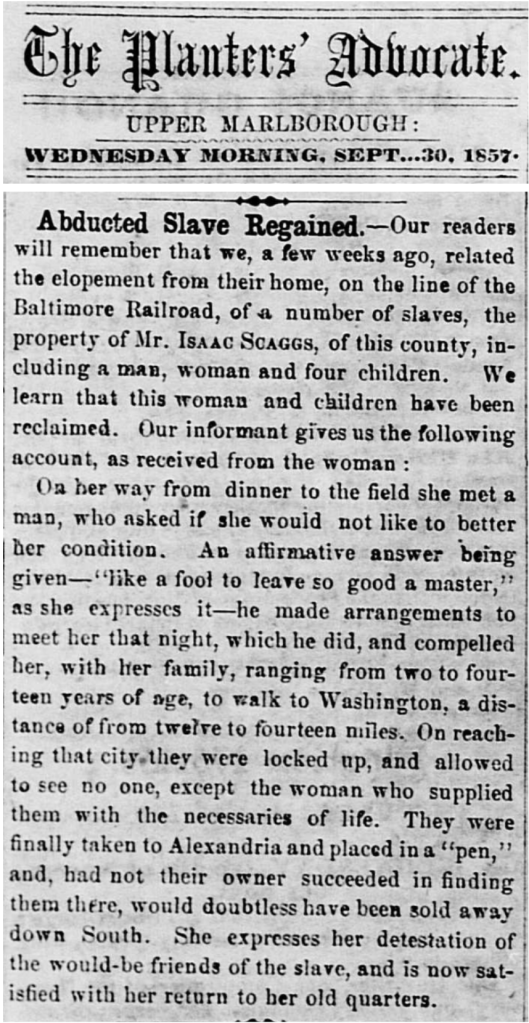
The second escape occurred in the same relative vicinity, involving a family from the farm of Isaac Scaggs. A series of articles and runaway ads describe the flight and subsequent recapture of Maria and her four children: Dall, Lem, Bill, and Ben. An initial report describes their escape as part of a larger “Stampede of Slaves,” noting the clear evidence of coordination as they acquired a wagon under the pretense of attending a camp meeting. Another article speculated they were seen on a canal boat near Cumberland, Maryland, suggesting they were using the C&O Canal to make their way north.
The bounty ads Scaggs placed, however, reveal a more intimate and courageous story. Adam Smith first self-liberated with the larger group, then risked his newfound freedom by returning to Scaggs’s farm to help his partner, Maria, and their four children escape with him. After the family was recaptured, Scaggs’s narrative shifted. He claimed in the press that a “would-be friend” had actually abducted them, intending to sell them into the domestic slave trade through a slave “pen” in Alexandria. This story, which contradicted earlier reports of an Underground Railroad escape, served to delegitimize abolitionist aid. As a final act of control, Scaggs had the newspapers publish Maria’s coerced “script of penitence.” Her forced expression of gratitude towards her enslaver was a calculated mode of survival, likely performed to ensure she and her children would not be sold South as punishment for their bid for freedom.
A post-emancipation record offers a final, telling chapter to the family’s story. In the Slave Statistics submitted by enslavers for potential compensation, Isaac Scaggs listed the people he held in bondage as of November 1, 1864, the date of Maryland’s emancipation. On that list were the four children: Dal (spelled Dall in the 1857 notice), Lem, Bill, and Ben.
Maria, their mother, was absent.
Her absence from the record points to one of two likely, and equally tragic, outcomes. It is possible that between 1857 and 1864, Maria made another, successful bid for freedom, a choice that would have required the devastating sacrifice of leaving her children behind. Alternatively, Scaggs may have made good on the implicit threat in the recapture notice, selling Maria to the domestic slave trade as a final act of retribution for her agency in the 1857 escape. Regardless of the specific path, the official record confirms the family unit was violently and permanently broken before emancipation arrived.
“STAMPEDE OF SLAVES.” Evening Star [Washington, D.C.], 25 Aug. 1857, p. 3. newspapers.comTranscription of Stampede of Slaves
STAMPEDE OF SLAVES.—On Saturday, a number of slaves, belonging to various citizens of the District, obtained a covered wagon, under pretence of going to the camp meeting in the adjoining county. They departed, but have not returned, and their owners have reason to believe that they have emigrated by the underground railroad. Some fifteen slaves are missing, most of them belonging in this city and county. Among the losers are Messrs. Linton, Randolph, Harbaugh, and Isaac Scaggs. Officers have been in search of the fugitives, but up to this time none have been recovered.
Transcription of Abducted Slave Regained
Abducted Slave Regained.—Our readers will remember that we, a few weeks ago, related the elopement from their home, on the line of the Baltimore Railroad, of a number of slaves, the property of Mr. ISAAC SCAGGS, of this county, including a man, woman and four children. We learn that this woman and children have been reclaimed. Our informant gives us the following account, as received from the woman:
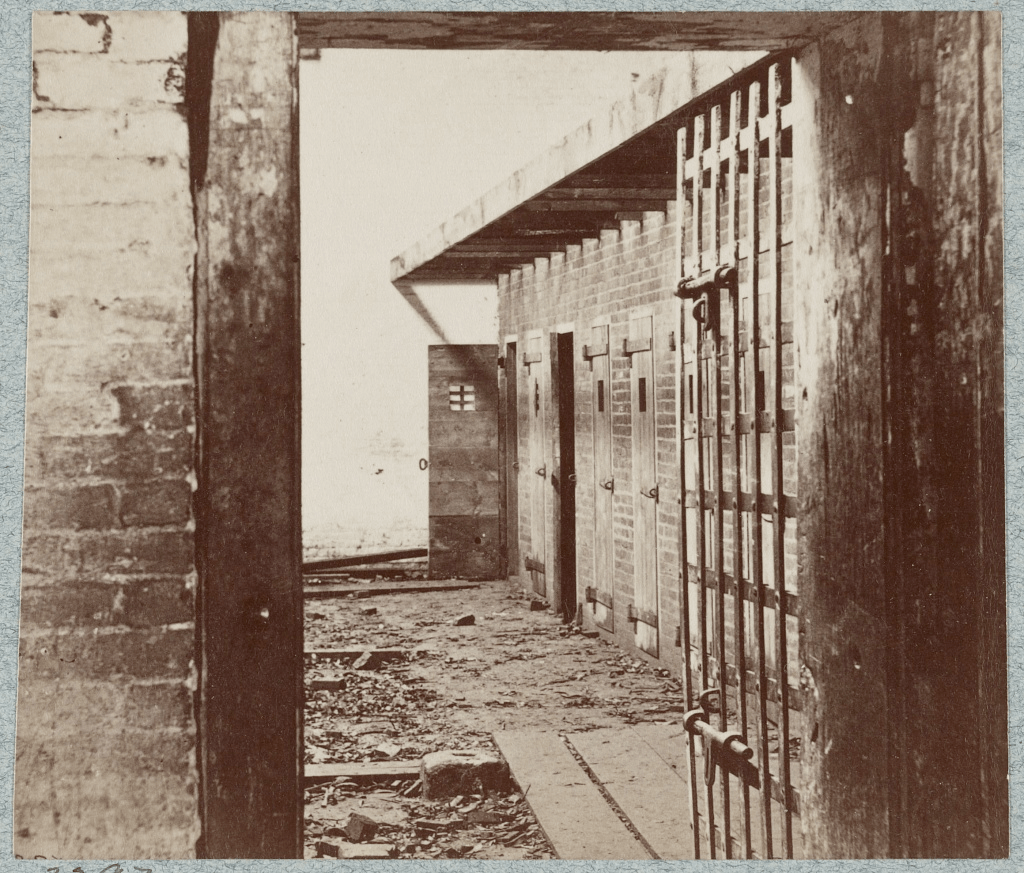
On her way from dinner to the field she met a man, who asked if she would not like to better her condition. An affirmative answer being given—“like a fool to leave so good a master,” as she expresses it—he made arrangements to meet her that night, which he did, and compelled her, with her family, ranging from two to fourteen years of age, to walk to Washington, a distance of from twelve to fourteen miles. On reaching that city they were locked up, and allowed to see no one, except the woman who supplied them with the necessaries of life. They were finally taken to Alexandria and placed in a “pen,” and, had not their owner succeeded in finding them there, would doubtless have been sold away down South. She expresses her detestation of the would-be friends of the slave, and is now satisfied with her return to her old quarters.
Slave pen, Alexandria, Va. Virginia Alexandria United States, None. [Photographed between 1861 and 1865, printed between 1880 and 1889] Photograph. https://www.loc.gov/item/2013651888/.American Anti-Slavery Society. Slave market of America. New York: Published by the American Anti-Slavery Society, 1836. Broadside. Library of Congress, Rare Book and Special Collections Division, Washington, D.C. Accessed July 6, 2025. https://www.loc.gov/pictures/item/2008661294/.
exorcism
illusion of Justice and Mercy
These events shook the established sense of security in Queen Anne District, creating a panic to rival the Panic of 1857. Not only was the global market in crisis, imperiling the sale of the planters’ cash crops, but Harwood’s insolvency was a stark reminder of the crisis that beheld the perilous role of credit in the lives of American capitalists. Moreover, agitators, decoys and the Underground Railroad was stealing the planters’ most valuable assets: the people they enslaved. This double threat to the financial security of planters required them to convene and establish a response to the threats to their security.
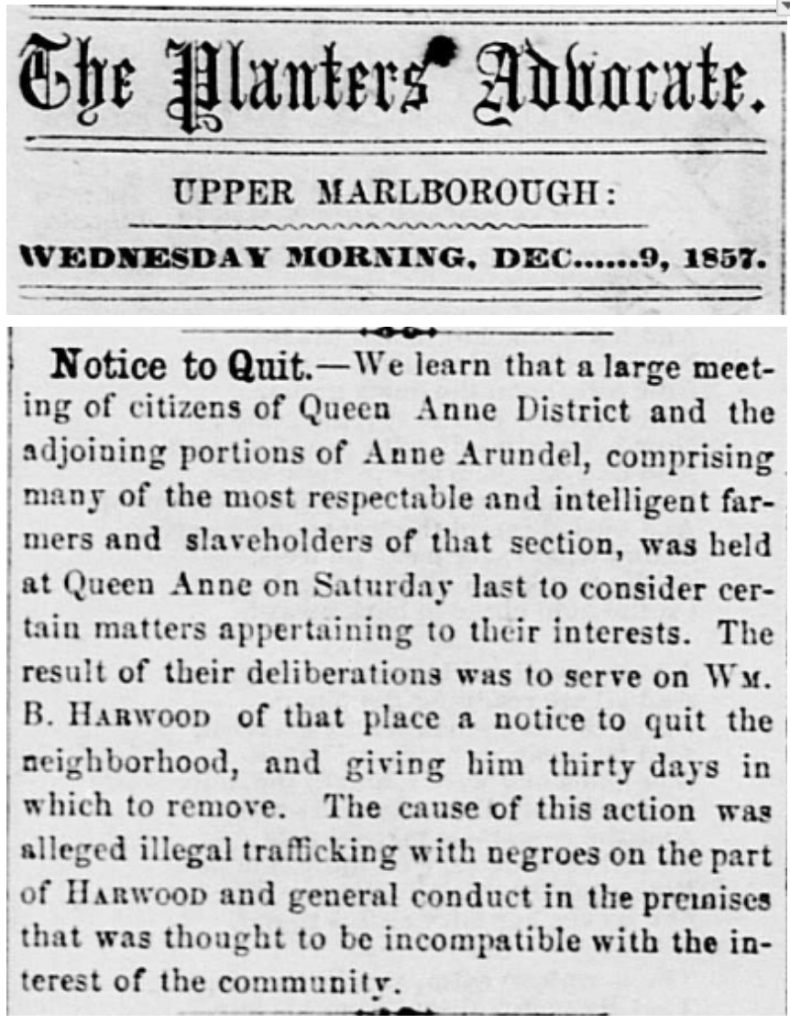
The planters of Queen Anne District, roiled by the recent events, met as a committee of citizens and as such, resolved that William B. Harwood, disgraced merchant, be expelled from Queen Anne for his “illegal trafficking with negroes” — the phrase “trafficking with negroes” could refer to the trafficking of stolen goods, warned about by M. S. Plummer, or could refer to the trafficking of stolen people, warned about by Isaac Scaggs. In either situation, the “most respectable and intelligent farmers and slaveholders of that section” acted outside of a legal court proceeding and as a self-appointed vigilance committee. By framing their meeting as a consideration of “matters appertaining to their interests,” they were asserting their collective power to define and enforce the social and economic rules of the community.
Occurring in the midst of a national financial panic and after a summer of high-profile escapes, the expulsion of William B. Harwood was the culmination of multiple crises. He was the perfect scapegoat: a failed merchant with a history of violating social norms. The “Notice to Quit” was the planter community’s definitive response, an act of vigilantism that purged a man they saw as a threat to their economic interests, their social order, and the institution of slavery itself.
“Notice to Quit,” The Planters’ Advocate (Upper Marlborough, MD), December 9, 1857.Transcription of “Notice to Quit”
**Notice to Quit.—**We learn that a large meeting of citizens of Queen Anne District and the adjoining portions of Anne Arundel, comprising many of the most respectable and intelligent farmers and slaveholders of that section, was held at Queen Anne on Saturday last to consider certain matters appertaining to their interests. The result of their resolutions was to serve on WM. B. HARWOOD of that place a notice to quit the neighborhood, and giving him thirty days in which to remove. The cause of this action was alleged illegal trafficking with negroes on the part of HARWOOD and general conduct in the premises that was thought to be incompatible with the interest of the community.
Queen Anne District was situated in the “Forest of Prince George’s County”, and a contributor to the New York Times described it as “the great tobacco region of Maryland, and probably no other territory of equal extent in America produces so much of that famous weed.” [Dec 6, 1861] This immense agricultural output depended entirely on a vast population of enslaved people, who by 1860 constituted the majority of the county’s residents. From preparing the soil and the seedbeds, to tending the transplanted seedlings, to the constant worming and topping of the plants, to the harvest where entire stalks were cut, hung to cure, and stripped of their leaves for passage to the markets, the work was tedious and back-breaking.
lord of thorpland and thomas circle
Charles Hill was a descendant of Clement Hill, who owned Compton Bassett, a large estate to the east of Upper Marlboro near Hill’s Landing. Since 1700, the Hill family had implemented strategic marriages with the Darnalls, Digges, and other prominent Catholic families, establishing their status among the elite planters. Charles Hill purchased the nearby Thorpland in the 1810s and later acquired other lands throughout Queen Anne District. By 1828, his holdings were assessed at nearly 2,000 acres. An estate of this scale, classified as a large plantation, depended on the forced labor of more than one hundred enslaved people to generate the profits necessary to sustain and expand his agricultural enterprise. In addition to his holdings in Prince George’s County, Hill was a director for the Bank of Metropolis in Washington, cementing his role as a capitalist with a fashionable city residence in Thomas Circle.
plows, prizes, and profit
The hands of enslaved people plucked worms from the plants, their fingers snapped buds off the top, and their arms swung hoes to clear the weeds as they slowly moved up and down the rows of the cultivated fields. In addition to the labor of the field hand, the enslaved laborers used a variety of agricultural implements as they moved the stalks and leaves from the fields to the tobacco houses.
Planters’ Advocate and Southern Maryland Advertiser | MSA Special Collection
Transcription of Advertisement
A Card.
THE undersigned respectfully informs his friends and the public generally that he will continue the MACHINE AND BLACKSMITH BUSINESS, at the old stand, formerly occupied by Mr. FREDERICK GRIEß, in the Town of Upper Marlborough, and will be prepared at all times to make, mend and repair all kinds of AGRICULTURAL IMPLEMENTS, in a substantial and workmanlike manner. TOBACCO PRIZES, THRESHERS, Corn SHELLERS, WHEAT FANS, and all other Implements, made at the shortest notice. Connected with the Machine Shop he has a Blacksmith Shop, and will keep in his employ none but first-rate workmen. He pledges himself to make good work, and to use every effort to please, and respectfully solicits the public patronage.
JOSEPH B. HARRIS. Upper Marlboro’ Jan. 21, 1857—1y
lighting a firework on a hot july night
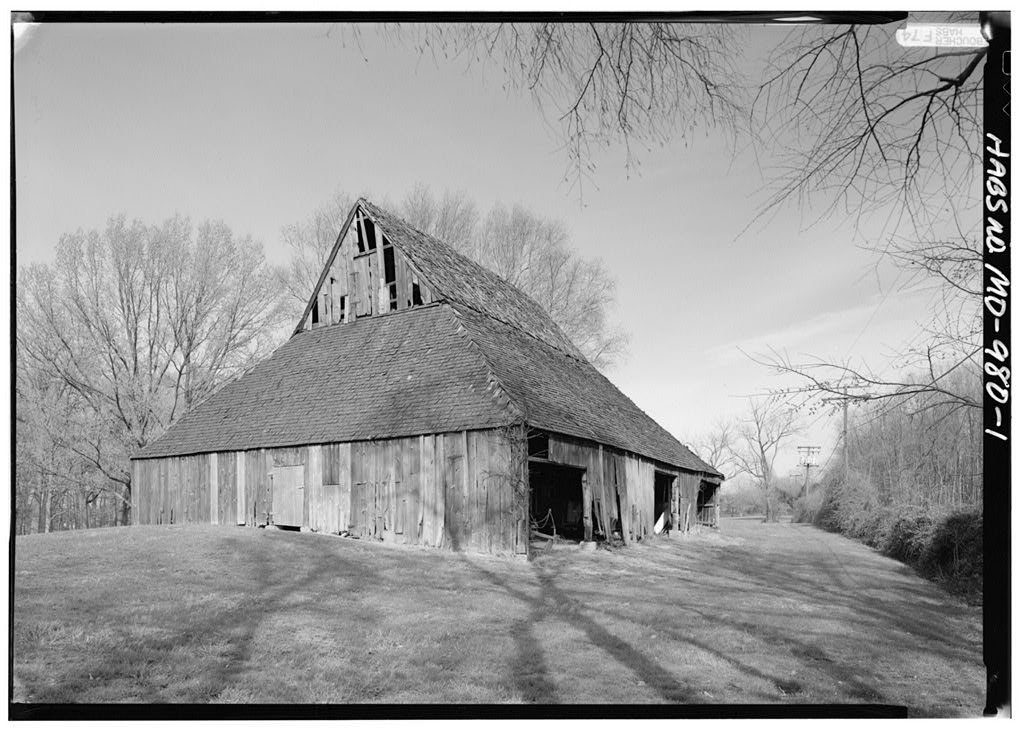
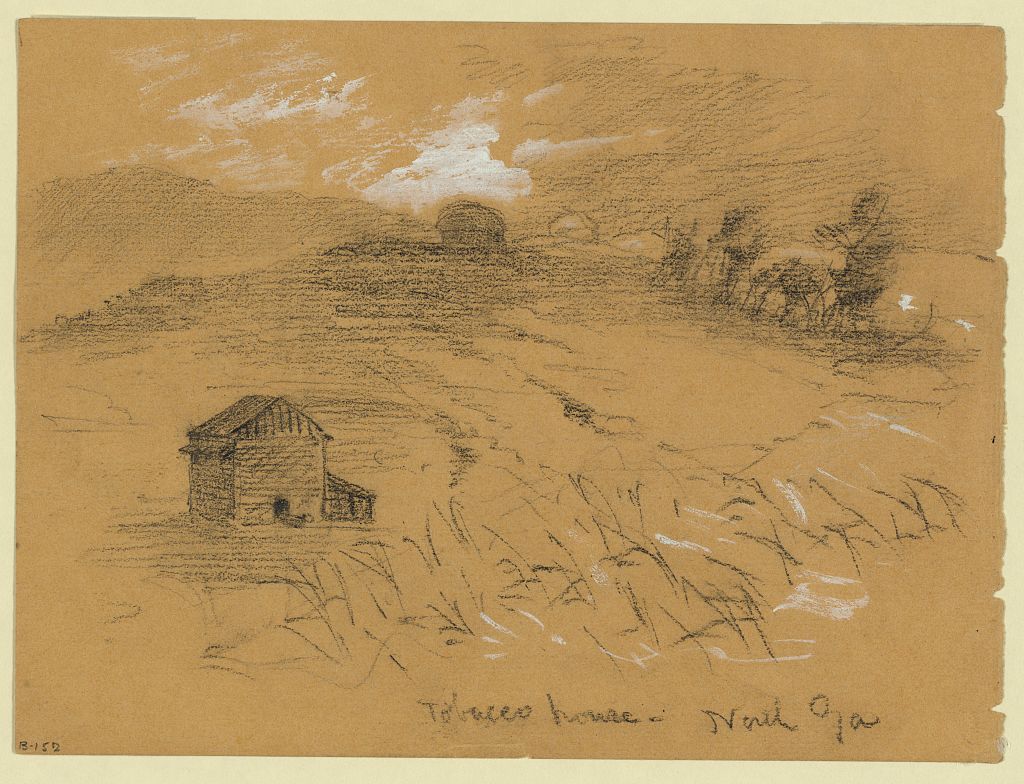
Waud, Alfred R. , Artist. Tobacco House. United States, None. [Between 1860 and 1865] Photograph. https://www.loc.govHistoric American Buildings Survey, Creator, and Catherine C Lavoie, Boucher, Jack E, photographer. Warington Tobacco Barn,Enterprise Road, Mitchellville, Prince George’s County, MD. Mitchellville Prince George’s County Maryland, 1933. Documentation Compiled After. Photograph. https://www.loc.govWaud, Alfred R. , Artist. Tobacco house. North Ga. Georgia United States, None. [Between 1860 and 1865] Photograph. https://www.loc.gov
This unremitting cycle of labor, designed to maximize profit for the enslaver, was met with calculated resistance by the enslaved people forced to endure it. Resistance took many forms, from slowing the pace of work and breaking tools to more overt and dangerous acts of defiance and were often direct assaults on the economic engine of the plantation.
During the hot, humid months of July, while enslaved men, women and children were expected to be vigilant for worms and weeds, while their bodies were bent with the tasks of hoeing, topping, and weeding, the tobacco barns sat empty, waiting for the harvest that was to come in late summer.
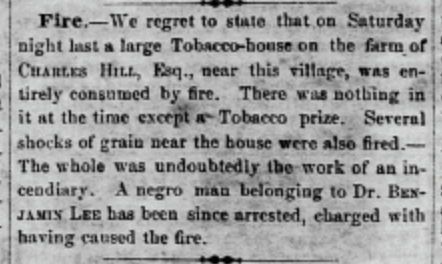
One late night in July, a man left the estate of Dr. Benjamin Lee and walked to a farm of Charles Hill. There, he set fire to the empty tobacco house, which contained a valuable tobacco prize, burning the wooden structure along with nearby shocks of grain.
Fire.—We regret to state that on Saturday night last a large Tobacco-house on the farm of CHARLES HILL, Esq., near this village, was entirely consumed by fire. There was nothing in it at the time except a Tobacco prize. Several shocks of grain near the house were also fired.—The whole was undoubtedly the work of an incendiary. A negro man belonging to Dr. BENJAMIN LEE has been since arrested, charged with having caused the fire.
a journey of two miles or four
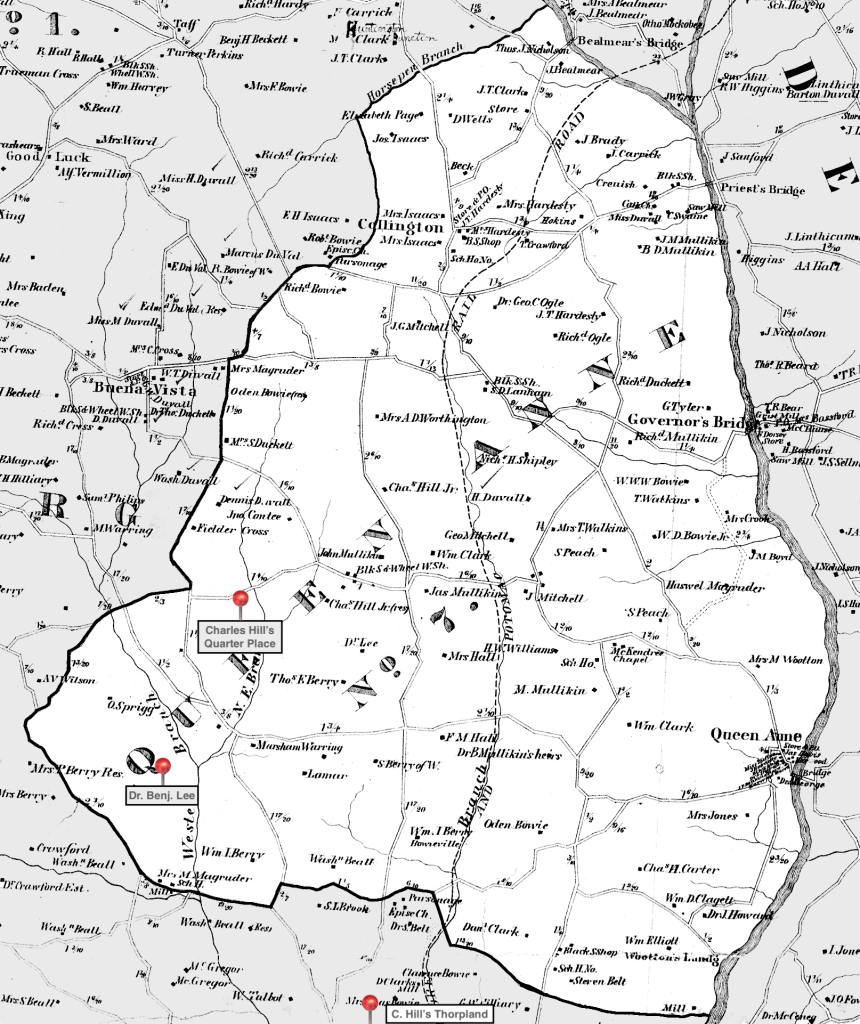
The newspaper’s reference to the fire occurring at a farm “near this village” [Upper Marlboro] initially suggests the target was Charles Hill’s primary residence, Thorpland, located in the Marlboro District. The geography, however, presents a logistical challenge to this assumption. Thorpland was situated four miles from Dr. Benjamin Lee’s property near the Northampton estate, a significant distance for the accused man to travel covertly on foot at night.
A more probable location was a satellite plantation owned by Hill, known as his “Quarter Place.” This farm, managed by an overseer and worked by a contingent of enslaved people, was located only two miles northwest of Dr. Lee’s residence in the Western Branch neighborhood. The shorter, more manageable distance makes this quarter farm the most likely target of the arson, rather than Hill’s more distant home plantation.
Moreover, the report describes the location simply as a “farm.” Had the fire been set at “Thorpland”, the site of Hill’s main residence, the paper likely would have used more specific language to denote the home of a prominent planter, such as “dwelling house,” “estate,” or “the residence of Charles Hill.” The generic term “farm” aligns perfectly with the status of a quarter place—a property that was purely an agricultural operation, distinct from the family seat.
an anxious planter class reassured
The enslaver class responded swiftly through both the legal system and the press. Initially reported in the local Planters’ Advocate, the story was picked up by the Alexandria Gazette, the Baltimore Sun, and the Port Tobacco Times and Advertiser.
His fate now hung precariously between two systems of control. Would he be turned over to the formal legal system to be sold out of state at a public auction, chained in a coffle, and sent to the cotton plantations of the Deep South? Or would his enslaver, Dr. Lee, arrange for his release from the jail, only to “resolve” the situation through the private violence of “plantation justice”—either by a public whipping or a more profitable private sale to a slave dealer from the District?
The fleeting, fiery assertion of his will—a profound risk for liberty—was answered with the permanent, crushing reality of the slave system, a midnight conflagration met with the cold finality of the chain and the coffle under the hot sun.
The 1836 schedule for the deed of trust transferring the Goodwood plantation to Rosalie E. Carter from the Calverts lists Eleanor “Nelly” Brown at age 35, establishing her calculated birth year as 1801. Her youth unfolded during the Early Republic Generation (1790-1815), a period of significant economic volatility shaped by the Napoleonic Wars. Trade embargoes depressed agricultural prices, creating economic distress for yeoman farmers who could not afford to store their produce. In contrast, the economic structure enabled elite planters like the Calverts to leverage their substantial capital and storage capacity. They acquired tobacco and other commodities at low rates from distressed sellers and profited when markets rebounded, a cycle that consolidated their wealth and reinforced the system of chattel slavery that held Nelly Brown in bondage.
By the time of the deed of trust, written during the Jacksonian Generation Eleanor Brown was nearing the end of her “prime years” as a laborer and breeder for the Calverts. Despite the commodification of her body by the Calverts and the Carters, Eleanor Brown maintained a soul value in her roles as mother and aunt on the large estate of Goodwood.
Daina Ramey Berry’s book Their The Price for Their Pound of Flesh: The Value of the Enslaved, from Womb to Grave, in the Building of a Nation offers a critical examination of the commodification of enslaved people. Berry meticulously details how enslavers and the slave market assigned an “external appraisal value” or “external market value” to enslaved individuals based on factors such as age, gender, health, and perceived productivity, and contrasts this with “internal spirit value” or “soul value” of enslaved people. While enslavers reduced individuals to mere commodities, Berry highlights the ways in which enslaved people themselves cultivated an intrinsic sense of self-worth and humanity that defied their commodification.
While it is unclear why the Calvert-Carter network designated her family name, she was grouped in the schedule of enslaved people in what appears to be a mother-child lineal grouping, signifying her kinship role to the larger enslaved community. As an adult woman, she was followed by the names of five children — usually this was an organization technique used by clerks to infer kinship.
Nelly Brown
age 35
Emeline
age 14
William
age 11
Dennis
age 8
Maria
age 4
John
an infant
The mother-child lineal grouping raises questions that are not answered in the records. For example, the gap in ages between Maria and Dennis is four years, which is longer than the three year gaps between Emeline-William, William-Dennis. This longer gap suggests three possibilities grounded in the exploitative structure of chattel slavery. The first possibility is an unrecorded infant death. Nelly may have borne a child who did not survive long enough to be recorded, a frequent outcome resulting from the inadequate nutrition, disease, and physical demands of enslavement. Second, the interval may reflect a period of poor maternal health, where a difficult prior birth or illness precluded a subsequent pregnancy. The third possibility is forced separation, a method enslavers used to exert control. The Calverts could have separated Nelly from her partner by selling him, hiring him out to another location, or moving Nelly herself. The archival record does not reveal which of these realities Nelly experienced, and its silence underscores the system’s disregard for the integrity of enslaved families.
liberation of William Brown
Seventeen years later, in an advertisement dated April 20, 1853, Charles H. Carter announced that William Brown, an enslaved man, had self-liberated from Goodwood. Carter described William as “about thirty years of age”. This detail provides a calculated birth year of approximately 1823, which is consistent with the inferred son of Nelly Brown, listed in the 1836 schedule, as William, age 11.
Given that enslavers often provided estimated ages in runaway advertisements, the two-year age difference is minor and the shared family name “Brown” from the 1836 schedule strongly suggests that the man who self-liberated in 1853 was part of this kinship network at Goodwood.
Tracing William Brown beyond the advertisement is difficult as both his given and family name are common, obscuring if he found a temporary freedom or a permanent liberation from slavery.
advertisement
$100 REWARD
WILL be paid for the apprehension of my negro man, William Brown, who left home on the 14th instant. He is a mulatto, about thirty years of age, five feet eight or nine inches high, rather stout make: turns his toes out in walking and limps in consequence of a sprained ankle. He has a wife at Mr. Azell Beall’s, near Buena Vista, and may be there, or in the neighborhood.
I will give fifty dollars for his apprehension, if taken in the District of Columbia, Prince George’s or Anne Arundel Counties—seventy-five dollars, if taken in Baltimore—and one hundred dollars, if taken elsewhere—in either case, he must be secured, so that I get possession of him again.
C. H. CARTER,”Good Wood,”Near Queen Anne,P. G. Co.
April 20, 1853—2w [Planters’ Advocate and Southern Maryland Advertiser; MSA]
post-emancipation life of Emeline
While the fate of William Brown is obscured, Eleanor (Nelly) Brown’s daughter has been tentatively identified in the 1870 Census, living near Queen Anne Towne.
The household of Benjamin “Benny” West and Emily Brown, located in close proximity to Charles H. Carter’s former Goodwood estate was enumerated at dwelling number 48. The presence of this family presents a compelling, though not conclusive, hypothesis for a direct link to the community enslaved at Goodwood three decades prior.
1870 Census
🟢👑 DN 48 | 📮: Mitchellville | 📍 Queen Anne Towne Benny West, age 50 (calc. birth year 1820) Emily Brown, age 45 (calc. birth year 1825) Morris Brown, age 19 (calc. birth year 1851) Maria Brown, age 14 (calc. birth year 1856) Ella Brown, age 12 (calc. birth year 1858) James Brown, age 5 (calc. birth year 1865) Eleanor Brown, age 12 (calc. birth year 1858) Sophia Brown, age 3 (calc. birth year 1867) Louisa Brown, age [1] (calc. birth year 1869)
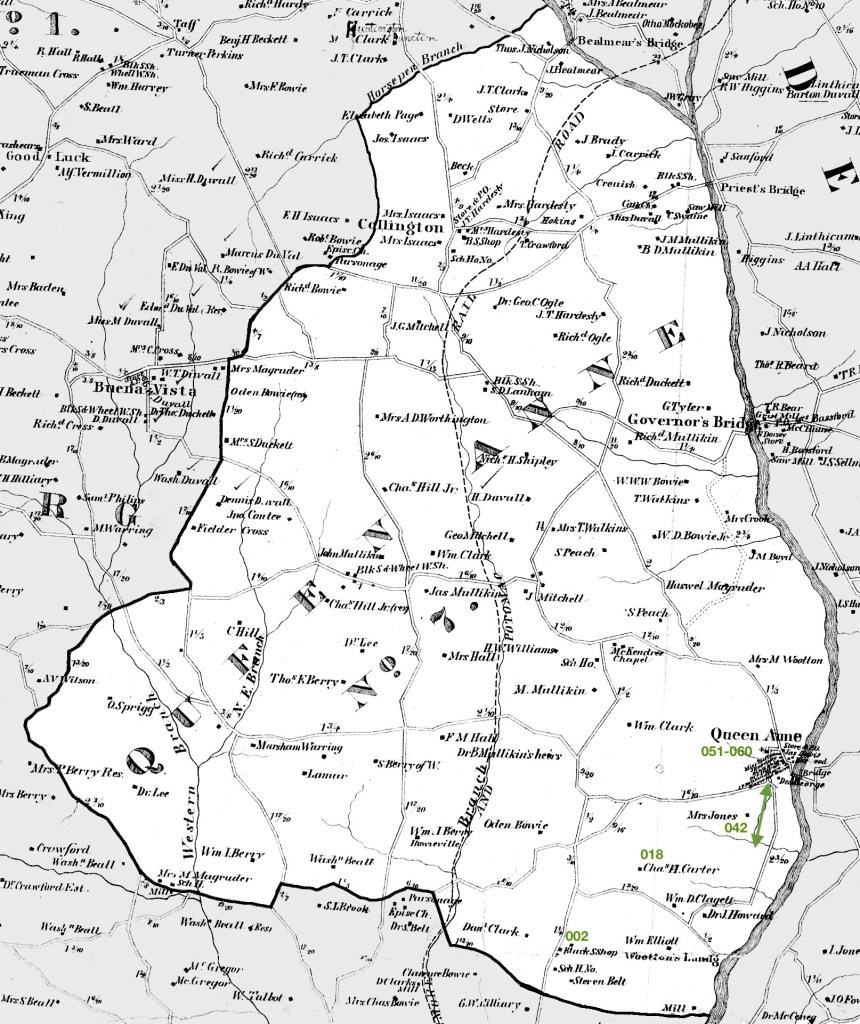
Annotated with Green Numbers which correlate of Head of Households with names from the 1870 Census; the names in both the census were compared against the 1878 Hopkins map and verified where possible by land records.
The primary evidence centers on Emily Brown, listed as 45 years old in 1870, and her potential connection to Emeline, a 14-year-old girl enumerated in the 1836 Deed of Trust schedule for Goodwood. While the calculated birth years (~1825 for Emily vs. ~1822 for Emeline) show a minor three-year discrepancy, such inconsistencies are common in records where ages were often estimated. The link is strengthened through given name analysis. Given this context, “Emeline” and “Emily” are recognized as plausible variations for the same individual, much like other variants such as “Amelia” or “Emilia.”
The most powerful, albeit circumstantial, evidence lies in the naming patterns that suggest a deliberate effort to maintain kinship identity. The 1836 schedule lists Emeline as part of a cohort headed by Nelly Brown, age 35. The discovery of a daughter named Eleanor in Emily Brown’s 1870 household is therefore highly significant. For communities emerging from chattel slavery—an institution that systematically severed familial bonds—the act of naming a child after a parent or grandparent was a potent method of reinforcing lineage. As “Nelly” is a common diminutive for “Eleanor,” it is a strong possibility that Emily Brown named her daughter in honor of her own mother, Nelly Brown. While no single piece of this evidence is definitive, the combination of proximate age, plausible name variation, and the commemorative naming choice makes a strong circumstantial case for the continuity of the Brown family line from enslavement into freedom.
The 1851 marriage of Alice Carter, daughter of Charles H. Carter and Rosalie E. Calvert, to Oden Bowie, solidified a powerful alliance between two prominent enslaving networks. This union not only consolidated significant landholdings but also intertwined the complex kinship networks of the hundreds of Black people they held in bondage, whose forced labor was the bedrock of their wealth and political power.
Alice Carter was a scion of the Calverts, descendants of the colonial proprietors of Maryland, and the Carters of Shirley Plantation. Her father, Charles H. Carter operated the “Goodwood” plantation in the Queen Anne’s District, which was inherited from his wife’s family: George and Rosalie Calvert of Riverdale.
Oden Bowie was the heir of William Duckett Bowie and Eliza Mary Oden, with connections to Bowie, Duckett and Oden networks, with their extensive landholdings, including the “Fairview” plantation in the Darnall’s Grove Neighborhood, were equally entrenched in the economic and political fabric of the state. Oden Bowie, a rising figure in Maryland politics, would later become governor.
Excerpt of the 1861 Martenet Map showing the location of Fairview in the Darnall’s Grove neighborhood.
While Oden and Alice Bowie resided at “Fairview” in the Darnall’s Grove Neighborhood, they purchased a consolidated tract of 471+ acres, composed of land from four older tracts: Smith’s Purchase, part of Dundee, part of Strife, part of Swanson’s Lot in the Wootton’s Landing Neighborhood (CSM 4:177).
Hienton and Martenet’s map shown side-by-side with land tracts and landowner name marked. See page on geographic mapping for more detail
This purchases complicates analysis of Oden Bowie’s 1867 compensation list, as the list does not specify which estate the enslaved people labored on (i.e., Fairview or Smith’s Purchase). Another complication in the reconstruction of kinship groups is the lack of transparency around the transfer of ownership during land purchases. Research has shown that land purchases within Queen Anne District may only document the transfer of land with its metes and bounds, but would also contain the transfer of the people who labored in the fields. For example, the Tilghman kinship group conveyed within the Hall network from Francis Magruder Hall to Notley Young’s son in 1826 Hall’s will appears in Charles C. Hill’s 1867 compensation list; Charles C. Hill purchased Elverton Hall from the Young family in the 1850s.
A review of the 1850 and 1860 Slave Schedules show the change in population of the communities enslaved by Oden Bowie. In 1850, prior to his marriage and the acquisition of Smith’s Purchase, the census enumerated 47 people. In 1860, at the dawn of the Civil War, the census enumerated 101 people. The 1867 Compensation List submitted by Bowie lists the names of 103 people.
George Calvert‘s position as a nexus in the Wootton’s Landing Neighborhood was cemented not only through his vast landholdings but also through strategic affinal kinship ties that extended his influence into Virginia. This was a common practice within the planter class to consolidate wealth and forge powerful alliances. This pattern is evident in the 1830 marriage of his daughter, Rosalie Eugenia Calvert, to Charles Henry Carter, a son of the Carter family of Shirley Plantation, one of Virginia’s most powerful slaveholding dynasties. This alliance forged a strategic affinal bridge between a powerful Maryland enslaver network and the Carter dynasty of Virginia.
The scale of the Calvert operation that Carter would come to control is evident in earlier tax assessments. While George Calvert resided at Riverdale in the Bladensburg District in the 19th century, his maintained his Mount Albion plantation in the Wootton’s Landing Neighborhood. In 1828, George Calvert was assessed for 2,777 acres and 93 enslaved people in the Horsepen and Patuxent Hundreds. By 1833, his personal property assessment for the Third District (including what would be Queen Anne District) showed an increase to 100 enslaved people on one list, likely representing the workforce at Mount Albion. Another 1833 list for the same district enumerated 26 enslaved people, possibly those at Oatlands, another Calvert property in the Partnership Neighborhood of Queen Anne District.
Image from 1836 Deed of Trust | mdlandrec.net Calvert George H_Rosalie Eugenie Carter + husband_AB-11-32-Deed of Trust
Calvert would transfer this property to his daughter in the 1830s. This transfer of property was not merely a familial gift but a calculated transmission of a massive agricultural operation and the enslaved labor force that made it profitable. A Deed of Trust dated November 12, 1836, solidified this alliance and detailed the significant transfer of wealth. The indenture documents how George Calvert conveyed a substantial estate into a trust for his daughter Rosalie’s sole and separate use, managed by himself and Robert E. Lee of Arlington. The assets included a 728 ½-acre tract of land known as “Goodwood,” formerly the core of Mount Albion. Critically, the deed also explicitly transferred the legal title to a community of enslaved people, listing 42 men, women, and children by name and age in an attached schedule. This single transaction established the material basis for Charles H. Carter’s standing within the Prince George’s County enslaver network.
The enslaved population at Goodwood grew under Carter’s control, from the initial 42 individuals in 1836 to 52 by the 1840 census, 58 in 1850, and 76 by 1860. After Rosalie Carter’s death in 1848, the land was conveyed directly to her husband, fully transferring this portion of the Calvert family’s Maryland wealth into the Carter lineage. By 1860, Charles H. Carter’s real estate was valued at $70,000, and his personal estate—a value primarily derived from the external market value of the people he enslaved—was assessed at $55,000. This concentration of wealth and power in the Wootton’s Landing neighborhood was further solidified in the next generation through the marriages of Carter’s daughters, Rosalie Eugenia Carter and Alice Carter, into the Francis Magruder Hall and Oden Bowie families, respectively, perpetuating the cycle of elite kinship consolidation within Prince George’s County.
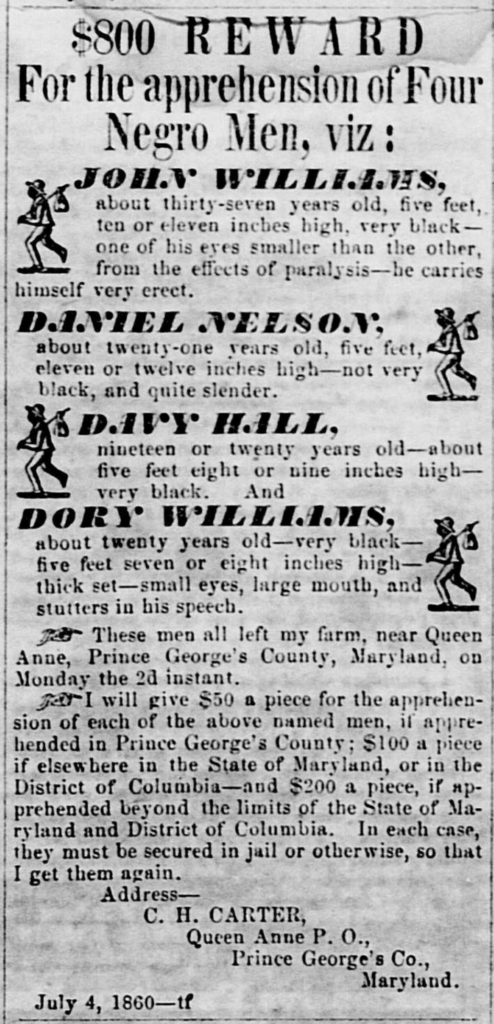
The reconstruction of kinship networks among the people enslaved at Goodwood is fundamentally obstructed by a documentary void. Two key record sets that typically name enslaved individuals from the late antebellum and emancipation era are missing: a probate inventory for Rosalie E. Carter and a post-emancipation compensation claim from Charles H. Carter. While Rosalie E. Carter created a will, it functioned primarily to affirm the conditions of the 1836 Deed of Trust, which stipulated that all real and personal property would be conveyed to her husband for his lifetime, precluding the need for a separate probate inventory. Furthermore, Charles H. Carter, as a nephew of Robert E. Lee, did not file a compensation claim in 1867 for his formerly enslaved human property, likely due to his Confederate ties.Consequently, research must proceed using a limited set of documents. The primary sources are the 1836 Deed of Trust, which provides a schedule of 42 named individuals, including one, Nelly Brown, with a family name, and the anonymous demographic data in the 1840, 1850, and 1860 U.S. Census Slave Schedules. This direct evidence is supplemented by three runaway slave advertisements that identify additional family names: Lloyd Wood, William Brown, John Williams, Dory Williams, Daniel Nelson, and Davy Hall.
Adverstisements
Planter’s Advocate, July 4, 1860 | MSA
Planters Advocate, Apr 20 1853 | MSADaily National Intelligencer, Dec 16 1839 | newspapers.com
Wootton’s Landing Neighborhood, located in the southeastern part of Queen Anne District, bordered the Patuxent River to the east and Marlboro District to the south. The neighborhood’s namesake, Wootton’s Landing, provided direct control for enslavers over the collection, storage, and transport of agricultural commodities produced by enslaved labor. Martenet’s 1861 map shows the landing situated south of Queen Anne Towne and near a mill. This area’s proximity to the Patuxent River, a vital waterway for connecting inland agricultural production to the global market system, and its shared border with Marlboro District, which contained the county seat of Upper Marlboro, underscored its economic significance in pre-emancipation Prince George’s County.
Excerpt from Simon Martenet’s Map of Prince George’s County highlighting Queen Anne District. Edits by the researcher from original map sourced from Library of Congress.
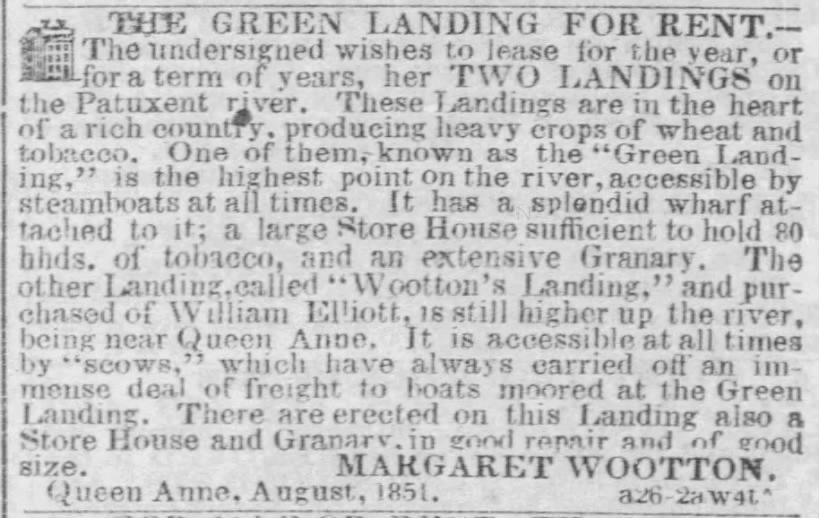
An 1851 advertisement placed by Margaret Wootton in The Baltimore Sun details the logistical importance of these riverfront properties. In seeking to lease her two landings, Wootton described them as being ‘in the heart of a rich country, producing heavy crops of wheat and tobacco,’ a direct acknowledgment of the output generated by the region’s enslaved workforce. The landings had large stores and granaries to hold both tobacco and grain. Some of the landings were accessible by steamboats, while others required scows, flat bottom sailboats to transfer the goods to the larger vessels likely traveling to Baltimore where merchants would handle the inspection, sale, and final shipment of the hogsheads to international buyers.
advertisement
THE GREEN LANDING FOR RENT.– The undersigned wishes to lease for the year, or for a term of years, her TWO LANDINGS on the Patuxent river. These Landings are in the heart of a rich country, producing heavy crops of wheat and tobacco. One of them, known as the “Green Landing,” is the highest point on the river, accessible by steamboats at all times. It has a splendid wharf attached to it; a large Store House sufficient to hold 80 bhds. of tobacco, and an extensive Granary. The other Landing, called “Wootton’s Landing,” and purchased of William Elliott, is still higher up the river, being near Queen Anne. It is accessible at all times by “scows,” which have always carried off an immense deal of freight to boats moored at the Green Landing. There are erected on this Landing also a Store House and Granary, in good repair and of good size. MARGARET WOOTTON. Queen Anne, August, 1851.
Baltimore Sun, Sep 16, 1851 | newspapers.com
calvert nexus: influence and alliances in the Wootton’s Landing neighborhood
This economic significance was directly tied to the individuals who comprised the enslaver networks in the Wootton’s Landing Neighborhood, profoundly shaping agricultural production and commerce. The enslaver networks of Wootton’s Landing were influenced by George Calvert (1768-1838), who married Rosalie Stier, and was one of the wealthiest landowners and enslavers in Prince George’s County during the Imperial Tensions Generation.
The enslaver networks of Wootton’s Landing were dominated by figures like George Calvert (1768-1838), who married Rosalie Stier and, during the Imperial Tensions Generation, became one of the wealthiest landowners in the county. As a lineal descendant of Benedict Swingate Calvert of Mt. Airy, George Calvert inherited a vast portfolio of land that he consolidated into the Mount Albion plantation. This holding, totaling 2,233 acres, was composed of numerous tracts, including “Swanson’s Lot,” “Part of Coolspring Manor,” “Addition to Leaving,” “Griffith’s Purchase,” “Part of Cuckolds Delight,” and “Part of Riley’s Landing,” among others, firmly rooting his economic power in the Wootton’s Landing neighborhood.The 1798 Federal Direct Tax provides a stark inventory of the infrastructure required for such an operation. On this land, Calvert maintained a frame dwelling house, a kitchen, a ‘brick cow house and stables,’ a large corn house, and, critically, an overseer’s house and 14 quarters for enslaved people. This collection of buildings documents a large, forced-labor camp designed for the mass production of tobacco and other crops. The tax list assessed Calvert for 69 enslaved people, making him the largest single enslaver in the Patuxent and Horsepen Hundreds. The scale of his operation, built on the labor of these 69 individuals, surpassed even that of the Jesuit-owned White Marsh plantation managed by John Ashton.



















 stories of Then