Known Information
James Reeder is listed as living on in Pierce Street Alley in the 1880s.
Sources
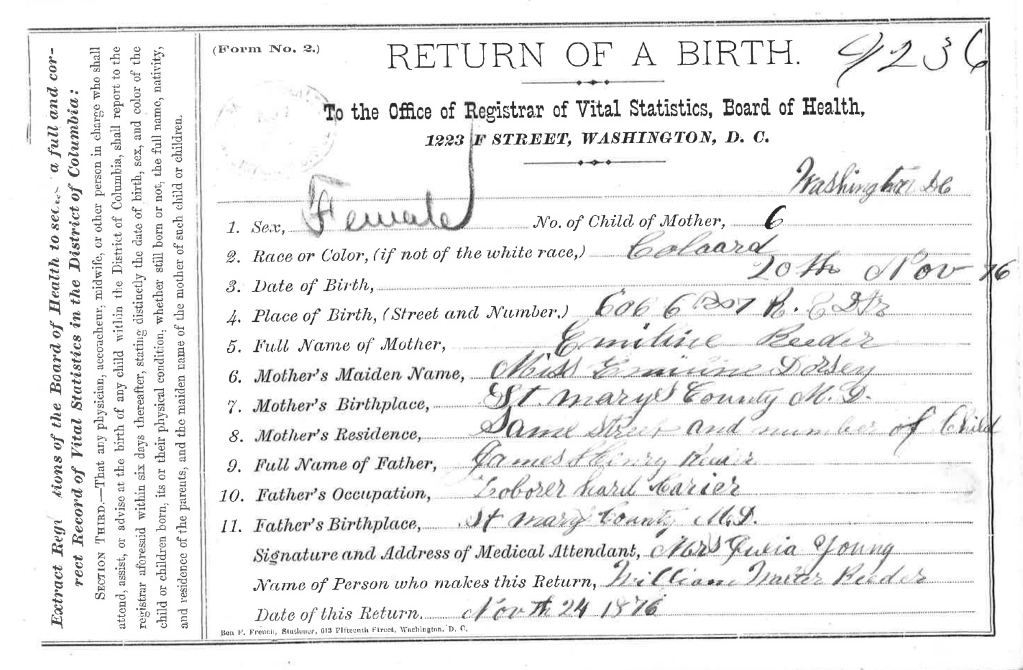
Birth Return
Reeder, Baby, 9236, 20 Nov 1876 | DC Archives
Map
A Complete Set of Surveys and Plats of Properties in the City of Washington, District of Columbia is a real estate atlas published by G. M. Hopkins and Co. in 1887. | DC Public Library
Newspapers
National Republican
Washington, District of Columbia
06 Jul 1881, Wed • Page 2
Evening Star
Washington, District of Columbia
01 Dec 1876, Fri • Page 2
The Critic
Washington, District of Columbia
27 Aug 1881, Sat • Page 3
National Republican
Washington, District of Columbia
04 Mar 1884, Tue • Page 6
Evening Star
Washington, District of Columbia
15 Mar 1884, Sat • Page 1
Evening Star
Washington, District of Columbia
22 Mar 1884, Sat • Page 2
The Critic
Washington, District of Columbia
20 Mar 1889, Wed • Page 4
Evening Star
Washington, District of Columbia
04 Apr 1889, Thu • Page 1
Mydans, Carl, photographer. Untitled photo, possibly related to: Hod carriers at Greenbelt, Maryland. , 1936. [July] Photograph. https://www.loc.gov/item/2017715805/.
The hod-carrier’s song. Air.- Villikens and his Dinah. H. De Marsan, Publisher, 60 Chatham Street, N.Y. Monographic. Online Text. https://www.loc.gov/item/amss.as201350/.
In the 1880 Census, James H Reeder is listed as living at 141 Pierce Street, with his family including his wife Emeline. His occupation is listed as a junk dealer. There are six families living in the home. This suggests that it was a larger apartment style home.

The map shows Pierce Street in 1887 and its alleys.

The 1876 birth return for the daughter of James and Emeline lists James’ occupation as laborer “hard career”, or hod-carrier.
Hod-Carriers
Hod-Carriers were tradesmen who supported bricklayers in the construction of buildings. They brought the supplies to the site. Details from an Evening Star article about a Hod-Carrier Strike in 1884 describes the work as strenuous. They carry the hod with bricks which can weigh up to 116 pounds. In the 22 Mar 1882, article, the Evening Star reported that six brick-layers with four hod-carriers could lay 9,000 bricks a day.


In 1881, James H Reeder and J. T. reeder, in connection with others, established “the Hod-carriers’ Society” for the mutual benefit of each other and to stop interference from their bosses. The 1887 Plat Book shows the Hod-Carrier’s Association building on Pierce Street, where James Reeder was living in the 1880s.
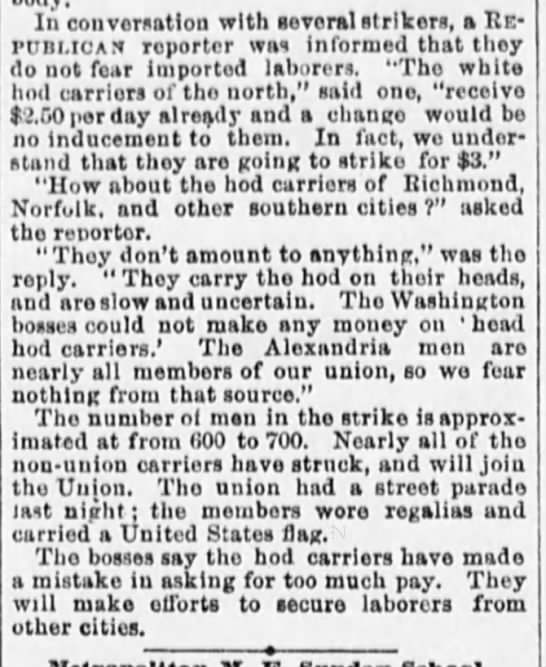
In 1884, there are numerous articles detailing tension between union and non-union hod-carriers and the strikes for better wages (from $2.00 to $2.50 a day). Thomas Reeder was charged with assault of a non-union man and charged $5 for hitting him on the back of his head with his open hand.
Due to the nature of their work (outside), laborers only worked for seven months of the year. There was competition between Irish laborers, “colored” laborers and “imported” laborers for the work. The National Republican ran an article in 1884 in which their sources described Northern Cities already paying $2.50/day and southern laborers as being “slow and uncertain”.
In 1889, there was a split in the Hod-Carrier’s Society. J. T. Reeder and others were charged with using the corporations name, banner and other insignia. Some of the articles names him as John T Reeder, others as J. F. Reeder. In May, Thomas Reeder (at times cites as James Thomas Reeder) filed suit claiming that the hod-carriers committed conspiracy by preventing him access to work as he was non-union. It is unclear whether this refers to Thomas Reeder, brother of James H Reeder, or James Thomas Reeder who lived on Ridge NW and unrelated to the Reeder brothers.

 stories of Then