paper trail’s Pulse: dissecting the search for Polly

The Baltimore Sun’s printer placed the ad in the last column of page 2, underneath a bounty for Peter Culver who had absconded with a “free boy, hired by me, named Alexander” and an ad for Ohio Flour.  

A historical advertisement from the 1850s offering a reward for the capture of a woman named Polly, describing her as a mulatto, not less than forty years old, last seen near West River.
“$150 REWARD,” advertisement. The Baltimore Sun (Baltimore, Maryland), July 29, 1855, p. 4. Accessed through Newspapers.com, July 10, 2025. https://www.newspapers.com/article/the-baltimore-sun/176173526/.
Transcription of Bounty

$150 REWARD WILL BE GIVEN FOR THE POSITIVE CONVICTION of any one who shall be guilty of harboring my NEGRO WOMAN POLLY, after a knowledge of this notice, whom I purchased lately of the estate of Dr. Magill.—As I have bought Polly through motives of pure humanity, and at her own request, that she might enjoy the society of her husband and relatives, I feel satisfied that she will come to me unless deceived by some designing person in relation thereto. POLLY is not less than forty years of age, a mulatto of neat and tidy appearance, and was last seen on West River. I will give Twenty Dollars if in Anne Arundel, or Thirty if elsewhere, to any one who shall convince her of the fact of my purchase and secure her to me. I also subjoin a certificate of Dr. OGLE, the owner of Polly’s husband. WM. E. PEACH, M. D., Queen Ann, Prince George’s co., Md.


I hereby certify that I have talked with PETER, the husband of Polly, and he says he is very anxious that she should come home to her master, Dr. Peach, immediately. Peter is in bad health and unable to leave the house. [jy25-St*] GEO. C. OGLE.

Within this mundane context of commerce and control, William E. Peach’s advertisement primarily sought the conviction of the “designing person” who “deceived” Polly and harbored her away from Peach who had purchased her “through motives of pure humanity” and while placing a bounty on the return of Polly so he could “secure her to me” almost as an afterthought.

the skeleton layer: who, what, and where

The basic facts of the notice form the skeleton of the story. In July 1855, Wm. E. Peach, M.D., living near Queen Anne in Prince George’s County sought the return of Polly, “not less than forty years of age” who was purchased from Dr. Magill’s estate.  In her escape, she was last seen near West River in Anne Arundel County.  He offered a tiered $20-30 for Polly’s return and a significantly larger sum of $150 dollars for the conviction of the “designing person”.  

the sinews layer: the network of kin and property

The names in the advertisement are held together by a dense network of marriage and property. William E. Peach, son of Queen Anne District landowner Samuel Peach, had married Sarah Alexander Ma[c]gill in 1852. Sarah was the orphaned daughter of Dr. James Ma[c]gill and Julia Ann Compton, having lost her father in 1840 and her mother in 1846. Her life was split between Prince George’s and Anne Arundel Counties. Before her father’s death, she lived on his 740-acre estate along present-day Annapolis Road, situated between the Jesuit’s White Marsh plantation and Magruder’s Tavern, adjacent to Bel-Air, the Ogle estate.

After Dr. Ma[c]gill’s death, Sarah’s world was destabilized. Her mother’s remarriage to Septimus J. Cook and her mother’s subsequent death resulted in Sarah and her sister, James Anna, being shuffled to Anne Arundel County to live with their aunt and uncle, Samuel and Mary Carr. The Carrs owned land near the Ma[c]gill property at West River, which had been inherited by Sarah’s brother, James P. Ma[c]gill. The 1839 will of Dr. Ma[c]gill had stipulated that Polly and her children be conveyed specifically to his other son, Thomas Ma[c]gill.

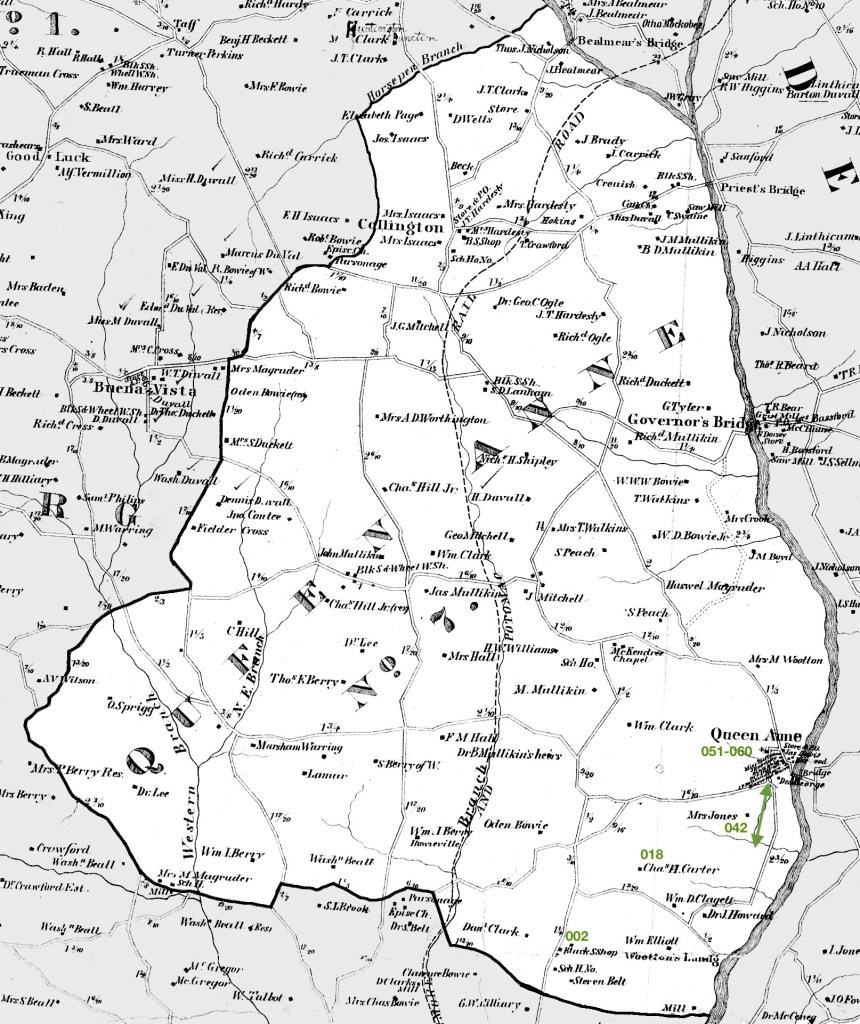
This 1861 map of the Queen Anne District illustrates the dense network of kin and property that defined Polly’s world. Highlighted are the lands of S. Peach (the family of her new owner, William E. Peach), Dr. Geo. C. Ogle (the enslaver of her husband, Peter), and Dr. Jas Macgill (her previous enslaver). The close proximity of these estates visualizes the community she was desperate to remain within, turning her flight into a calculated risk to preserve her family bonds.

the heart: her husband and relations

As the estate was divided and re-divided, first through the death of James and then through the death of James’ relict and again, as the children came of age, Polly, “a mulatto of neat and tidy appearance” watched as her extended family was separated, corralled and moved from estate to estate.  Individuals were sold to new husbands or liquidated to cover bequests and estate charges.

Amid this decade of instability, a transaction was initiated that would move Polly from her legal owner, Thomas Ma[c]gill, to his sister’s new husband, William Elson Peach. Seizing on this moment, Polly appealed directly to the young doctor, requesting that the terms of his purchase ensure she “might enjoy the society of her husband and relations.” Her husband, Peter, was enslaved by the Ogles at Bel-Air, the neighboring estate. According to a “certificate” from Geo. C. Ogle referenced in the bounty notice, Peter was “in bad health and unable to leave the house.” For Polly, a move away from the Queen Anne area would mean the permanent loss of her husband and the kinship network she fought to maintain.

the skin layer: the language of control and value

At “not less than forty years old,” Polly was an elder in her community. Her labor was likely shifting from fieldwork to tasks essential for the plantation’s maintenance: cooking, nursing, gardening, and sewing. In the logic of chattel slavery, Polly’s advanced age meant her external market value had diminished. This is starkly visible in the twenty-dollar bounty Peach placed on her body; he valued the conviction of the person who disrupted his power more than seven times higher than the return of Polly herself. Peach’s language paints him as a paternalist allowing Polly to “enjoy” her family, yet he simultaneously admits his authority is so weak that he needs help to “convince her of the fact of his purchase” and to “secure her to me.”

Daina Ramey Berry, in The Price for Their Pound of Flesh, discusses the range of attitudes toward elderly enslaved people. While the enslaved community valued their wisdom and the connections they fostered, enslavers saw only a diminished capacity for labor. This led to either “neglectful paternalism” or “disregarded isolation.” Polly, legally conveyed to an orphaned son whose estate was managed by a series of guardians and second husbands, had likely endured years of disregarded isolation as her value was debated in inventories and accounts. Sarah’s marriage to the paternalistic William Peach provided Polly an opportunity to navigate from disregarded isolation into neglectful paternalism. In this transition, she found an opening to assert her own agency.

the blood of the veins: the flow toward kin

Polly was likely living in the Queen Anne District on the former Ma[c]gill estate when Peach finalized her purchase. From there, she had access to travel lanes and turnpikes leading toward Washington, D.C., and the free states north of Maryland. Yet Peach’s ad reports she was last seen in Anne Arundel County near West River, a journey east, away from the most direct path to freedom. This eastward movement was not a mistake; it was a choice. It suggests Polly was seeking reunification with the family members who had been separated from her years before, when James Ma[c]gill first established his Anne Arundel property. Her journey suggests she was seeking reunification with children or other kin who, despite the legal lines drawn in the will, were physically located at the family’s Anne Arundel property. Her flight was therefore a calculated risk, flowing toward the heart of her kinship network, wherever it was located.


I want to acknowledge historians Daina Ramey Berry (The Price for Their Pound of Flesh) and Edward E. Baptist (The Half Has Never Been Told), whose scholarship was foundational to the anatomical metaphor used as an analytical tool in this research.

For those who wish to delve deeper into these topics, I highly recommend reading these books. You can learn more about them on Bookshop.org (I do not receive a commission from these links)

Eleanor (Nelly) Brown (1801-unk)

The 1836 schedule for the deed of trust transferring the Goodwood plantation to Rosalie E. Carter from the Calverts lists Eleanor “Nelly” Brown at age 35, establishing her calculated birth year as 1801. Her youth unfolded during the Early Republic Generation (1790-1815), a period of significant economic volatility shaped by the Napoleonic Wars. Trade embargoes depressed agricultural prices, creating economic distress for yeoman farmers who could not afford to store their produce. In contrast, the economic structure enabled elite planters like the Calverts to leverage their substantial capital and storage capacity. They acquired tobacco and other commodities at low rates from distressed sellers and profited when markets rebounded, a cycle that consolidated their wealth and reinforced the system of chattel slavery that held Nelly Brown in bondage.

To read more about the wealth inequalities of the Early Republic and specifically in relation to the Calverts, see Steven Sarson’s article: “It cannot be expected that I can defend every man’s turnip patch”: Embargoes, the War of 1812, and Inequality and Poverty in the Chesapeake Region

By the time of the deed of trust, written during the Jacksonian Generation Eleanor Brown was nearing the end of her “prime years” as a laborer and breeder for the Calverts. Despite the commodification of her body by the Calverts and the Carters, Eleanor Brown maintained a soul value in her roles as mother and aunt on the large estate of Goodwood.

Daina Ramey Berry’s book Their The Price for Their Pound of Flesh: The Value of the Enslaved, from Womb to Grave, in the Building of a Nation offers a critical examination of the commodification of enslaved people. Berry meticulously details how enslavers and the slave market assigned an “external appraisal value” or “external market value” to enslaved individuals based on factors such as age, gender, health, and perceived productivity, and contrasts this with “internal spirit value” or “soul value” of enslaved people. While enslavers reduced individuals to mere commodities, Berry highlights the ways in which enslaved people themselves cultivated an intrinsic sense of self-worth and humanity that defied their commodification.

While it is unclear why the Calvert-Carter network designated her family name, she was grouped in the schedule of enslaved people in what appears to be a mother-child lineal grouping, signifying her kinship role to the larger enslaved community. As an adult woman, she was followed by the names of five children — usually this was an organization technique used by clerks to infer kinship.

Nelly Brown age 35
Emelineage 14
Williamage 11
Dennisage 8
Mariaage 4
Johnan infant

The mother-child lineal grouping raises questions that are not answered in the records. For example, the gap in ages between Maria and Dennis is four years, which is longer than the three year gaps between Emeline-William, William-Dennis. This longer gap suggests three possibilities grounded in the exploitative structure of chattel slavery. The first possibility is an unrecorded infant death. Nelly may have borne a child who did not survive long enough to be recorded, a frequent outcome resulting from the inadequate nutrition, disease, and physical demands of enslavement. Second, the interval may reflect a period of poor maternal health, where a difficult prior birth or illness precluded a subsequent pregnancy. The third possibility is forced separation, a method enslavers used to exert control. The Calverts could have separated Nelly from her partner by selling him, hiring him out to another location, or moving Nelly herself. The archival record does not reveal which of these realities Nelly experienced, and its silence underscores the system’s disregard for the integrity of enslaved families.

liberation of William Brown

Seventeen years later, in an advertisement dated April 20, 1853, Charles H. Carter announced that William Brown, an enslaved man, had self-liberated from Goodwood. Carter described William as “about thirty years of age”. This detail provides a calculated birth year of approximately 1823, which is consistent with the inferred son of Nelly Brown,  listed in the 1836 schedule, as William, age 11

Given that enslavers often provided estimated ages in runaway advertisements, the two-year age difference is minor and the shared family name “Brown” from the 1836 schedule strongly suggests that the man who self-liberated in 1853 was part of this kinship network at Goodwood.

Tracing William Brown beyond the advertisement is difficult as both his given and family name are common, obscuring if he found a temporary freedom or a permanent liberation from slavery.

advertisement
$100 REWARD

WILL be paid for the apprehension of my negro man,
William Brown, who left home on the 14th instant.  He is a mulatto, about thirty years of age, five feet eight or nine inches high, rather stout make: turns his toes out in walking and limps in consequence of a sprained ankle. He has a wife at Mr. Azell Beall’s, near Buena Vista, and may be there, or in the neighborhood. 

I will give fifty dollars for his apprehension, if taken in the District of Columbia, Prince George’s or Anne Arundel Counties—seventy-five dollars, if taken in Baltimore—and one hundred dollars, if taken elsewhere—in either case, he must be secured, so that I get possession of him again. 

C. H. CARTER,”Good Wood,”Near Queen Anne,P. G. Co. 

April 20, 1853—2w 
[Planters’ Advocate and Southern Maryland Advertiser; MSA]

post-emancipation life of Emeline

While the fate of William Brown is obscured, Eleanor (Nelly) Brown’s daughter has been tentatively identified in the 1870 Census, living near Queen Anne Towne.

The household of Benjamin “Benny” West and Emily Brown, located in close proximity to Charles H. Carter’s former Goodwood estate was enumerated at dwelling number 48. The presence of this family presents a compelling, though not conclusive, hypothesis for a direct link to the community enslaved at Goodwood three decades prior.

1870 Census
🟢👑 DN 48 | 📮: Mitchellville | 📍 Queen Anne Towne
Benny West, age 50 (calc. birth year 1820) 
Emily Brown, age 45 (calc. birth year 1825) 
Morris Brown, age 19 (calc. birth year 1851) 
Maria Brown, age 14 (calc. birth year 1856) 
Ella Brown, age 12 (calc. birth year 1858) 
James Brown, age 5 (calc. birth year 1865) 
Eleanor Brown, age 12 (calc. birth year 1858) 
Sophia Brown, age 3 (calc. birth year 1867) 
Louisa Brown, age [1] (calc. birth year 1869)
Annotated with Green Numbers which correlate of Head of Households with names from the 1870 Census; the names in both the census were compared against the 1878 Hopkins map and verified where possible by land records.

The primary evidence centers on Emily Brown, listed as 45 years old in 1870, and her potential connection to Emeline, a 14-year-old girl enumerated in the 1836 Deed of Trust schedule for Goodwood. While the calculated birth years (~1825 for Emily vs. ~1822 for Emeline) show a minor three-year discrepancy, such inconsistencies are common in records where ages were often estimated. The link is strengthened through given name analysis. Given this context, “Emeline” and “Emily” are recognized as plausible variations for the same individual, much like other variants such as “Amelia” or “Emilia.”

The most powerful, albeit circumstantial, evidence lies in the naming patterns that suggest a deliberate effort to maintain kinship identity. The 1836 schedule lists Emeline as part of a cohort headed by Nelly Brown, age 35. The discovery of a daughter named Eleanor in Emily Brown’s 1870 household is therefore highly significant. For communities emerging from chattel slavery—an institution that systematically severed familial bonds—the act of naming a child after a parent or grandparent was a potent method of reinforcing lineage. As “Nelly” is a common diminutive for “Eleanor,” it is a strong possibility that Emily Brown named her daughter in honor of her own mother, Nelly Brown. While no single piece of this evidence is definitive, the combination of proximate age, plausible name variation, and the commemorative naming choice makes a strong circumstantial case for the continuity of the Brown family line from enslavement into freedom.