bounty for freedom seekers

The July 4, 1860, issue of the Planters’ Advocate and Southern Maryland Advertiser presented its readers with a portrait of a society celebrating freedom while actively profiting from its denial. One column announced a Fourth of July celebration at the Brick Church (St. Barnabas) in the Wootton’s Landing neighborhood. There, Gonsalvo Clagett was scheduled to read the Declaration of Independence, and the lawyer and enslaver Daniel Clarke would deliver an oration.
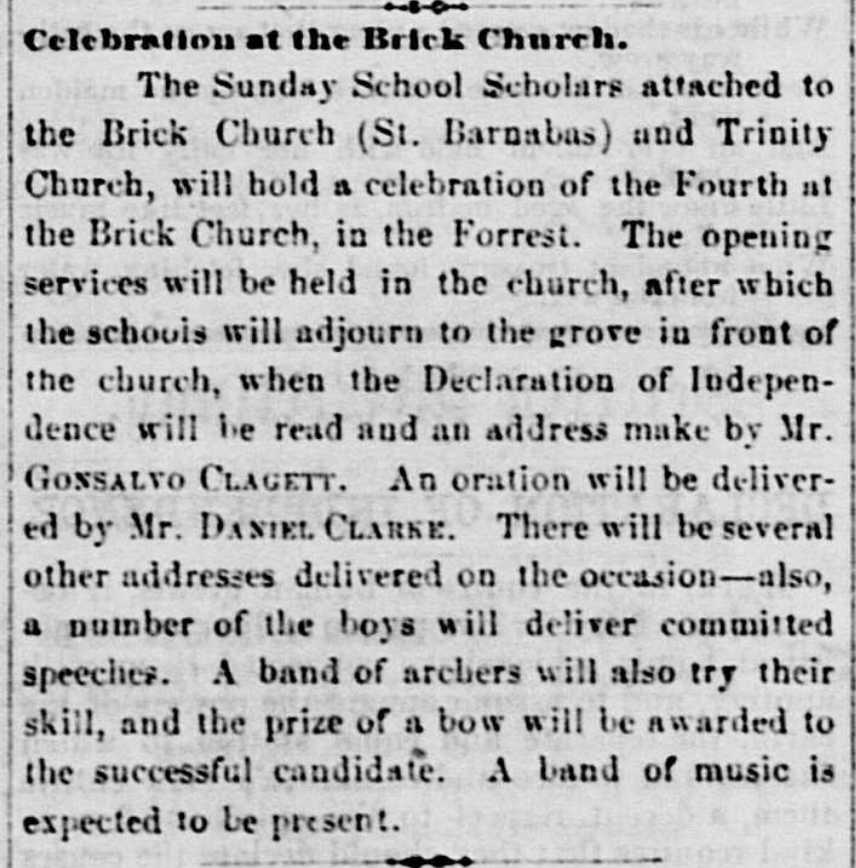
Notice for a Fourth of July celebration at the Brick Church (St. Barnabas), where local enslavers held speeches on liberty, publicly celebrating freedom while privately upholding the institution of chattel slavery.
Source: Planters’ Advocate and Southern Maryland Advertiser, 4 July 1860. Maryland State Archives, Special Collections (Digital Images).

This was not an isolated event. The same issue reported a “Celebration at Bladensburg,” where local militias used the national holiday for a display of military readiness. The “Vansville Rangers,” led by Captain Snowden, and the visiting “Severn (A. A. County) Guards” under Capt. Setros were to participate. These local militias, which had been forming and drilling in anticipation of the coming war, gathered in their military finery to march and listen to speeches before dining at Suit’s Hotel. Their very presence was a show of force, a demonstration of their commitment to preserving their way of life through armed strength.

An announcement for a militia celebration in Bladensburg on July 4, 1860. These gatherings demonstrated the rising militarization of the enslaver class as they organized to defend chattel slavery on the eve of the Civil War.
Source: Planters’ Advocate and Southern Maryland Advertiser, 4 July 1860. Maryland State Archives, Special Collections (Digital Images).

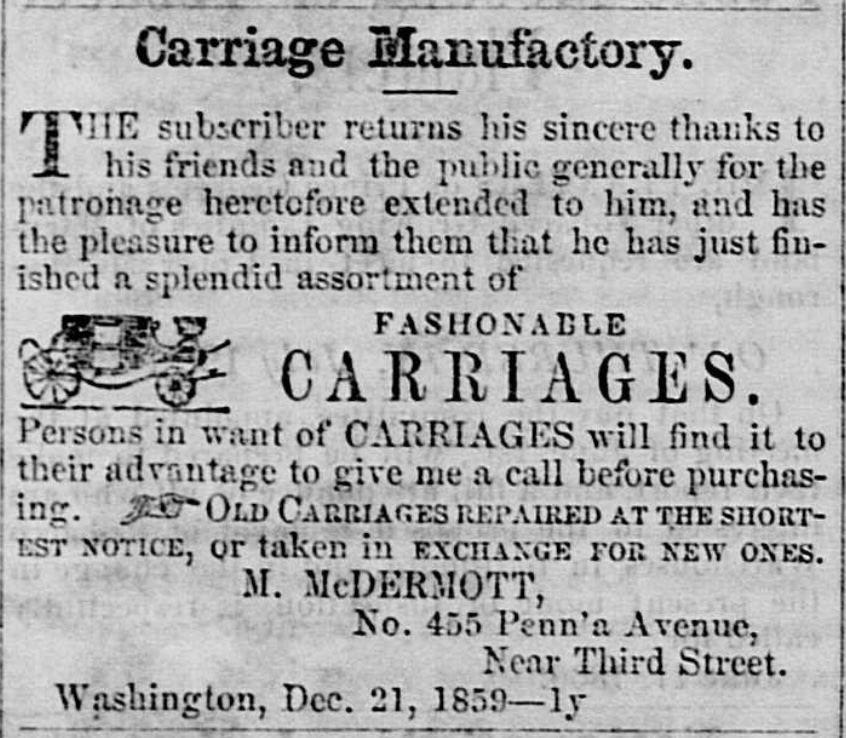
Advertisements throughout the paper catered to this class to project the status they were prepared to defend. These advertisements offered “FASHIONABLE CARRIAGES” from M. McDermott’s manufactory and the “FINEST STOCK OF CLOTHING” from J. M. McCamly, & Co. while Chas. H. Lane offered hats, caps, and gentlemen’s furnishing goods, “a superior and fashionable stock” for the enslaver class to display its status.

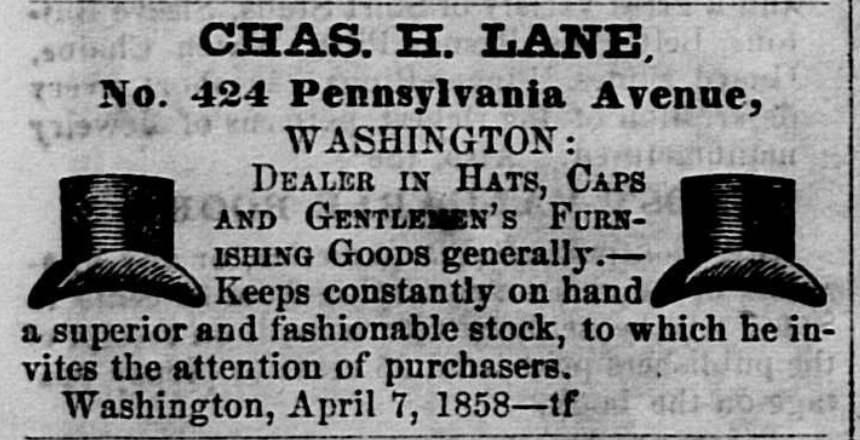
Advertisement for Washington D.C. stores catering to the enslaver class. Fashionable goods served as public symbols of the status and wealth generated by the forced labor of enslaved people.

Source: Planters’ Advocate and Southern Maryland Advertiser, 4 July 1860. Maryland State Archives, Special Collections (Digital Images).

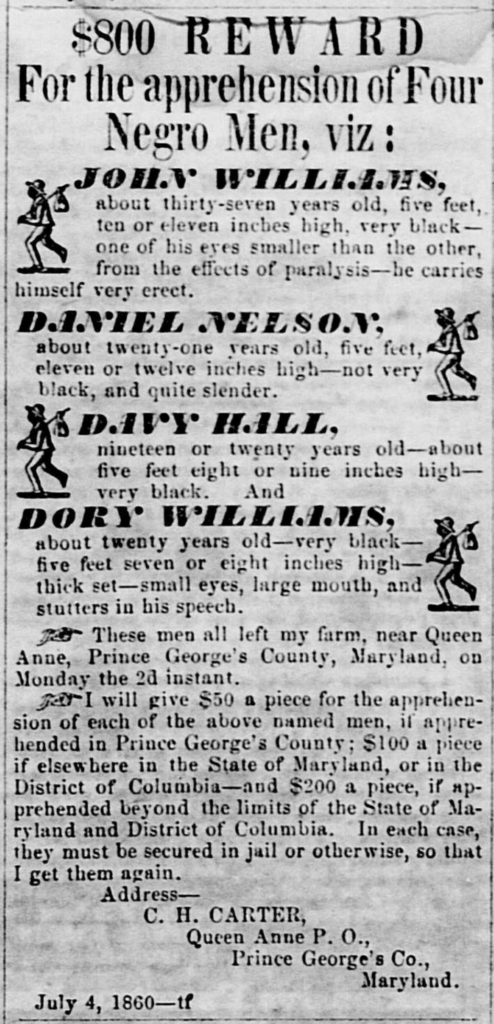
Juxtaposed with these notices of celebration and shopping was another, more sobering advertisement: an “$800 REWARD” placed by C. H. Carter from the Queen Anne Post Office. Carter was the nephew of Robert E. Lee, and owner of the 800 acre estate “Goodwood” on the land tract Cool Spring Manor. The ad, dated July 4th, sought the capture and return of four men who had escaped his authority two days prior.

A July 4, 1860, reward advertisement placed by enslaver C.H. Carter for the capture of four freedom seekers: John Williams, Daniel Nelson, Davy Hall, and Dory Williams. The tiered bounty demonstrates the commodification of human beings under chattel slavery.
Source: Planters’ Advocate and Southern Maryland Advertiser, 4 July 1860. Maryland State Archives, Special Collections (Digital Images).

The notice details the individuals, transforming them from a mere statistic into people:

  • John Williams, about 37, who carried himself “very erect” despite the effects of paralysis in one eye.
  • Daniel Nelson, about 21 and described as “quite slender.”
  • Davy Hall, 19 or 20 years old.
  • Dory Williams, about 20, who was “thick set” and stuttered.

While the community’s enslavers gathered at the Brick Church to hear proclamations of liberty, C. H. Carter was leveraging the economic and legal power of the press to reclaim these four men as property. The tiered bounty—$50 for capture in Prince George’s County, rising to $200 if they were apprehended “beyond the limits of the State of Maryland and District of Columbia”—methodically calculated the monetary value of their stolen freedom.

The pages of this single newspaper issue capture the fundamental hypocrisy of American Independence. The freedom celebrated with music and speeches at the Brick Church was an abstraction underwritten by the system of chattel slavery. For John Williams, Daniel Nelson, Davy Hall, and Dory Williams, freedom was not a quotation to be read aloud but a tangible, life-threatening pursuit undertaken in defiance of the men celebrating at the church.

By July 4th, as C. H. Carter’s reward notice was being printed, John Williams, Daniel Nelson, Davy Hall, and Dory Williams had been in flight for two full days. Their journey for freedom was a calculated rejection of the world celebrating at the Brick Church. Leaving behind “Goodwood”, their primary objective would have been freedom, which may have been the free state of Pennsylvania, a perilous overland journey of nearly one hundred miles. This route required moving covertly by night, navigating unfamiliar terrain, and evading the slave patrols mobilized by Carter’s advertisement. Alternatively, they might have sought refuge within the large free Black community of Washington, D.C. to the west—a known path for freedom seekers, as anticipated by Carter’s tiered reward for their capture in the District. Whether they followed roads, trails, or used the nearby Patuxent River as a guide, every step was fraught with the risk of discovery. For these four men, Independence Day 1860 was not a day of rest and speeches, but a critical point in a life-or-death flight where capture meant a violent return to chattel slavery and success promised a precarious new beginning.

goodwood: calvert-carter alliance

George Calvert‘s position as a nexus in the Wootton’s Landing Neighborhood was cemented not only through his vast landholdings but also through strategic affinal kinship ties that extended his influence into Virginia. This was a common practice within the planter class to consolidate wealth and forge powerful alliances. This pattern is evident in the 1830 marriage of his daughter, Rosalie Eugenia Calvert, to Charles Henry Carter, a son of the Carter family of Shirley Plantation, one of Virginia’s most powerful slaveholding dynasties. This alliance forged a strategic affinal bridge between a powerful Maryland enslaver network and the Carter dynasty of Virginia.

The scale of the Calvert operation that Carter would come to control is evident in earlier tax assessments. While George Calvert resided at Riverdale in the Bladensburg District in the 19th century, his maintained his Mount Albion plantation in the Wootton’s Landing Neighborhood. In 1828, George Calvert was assessed for 2,777 acres and 93 enslaved people in the Horsepen and Patuxent Hundreds. By 1833, his personal property assessment for the Third District (including what would be Queen Anne District) showed an increase to 100 enslaved people on one list, likely representing the workforce at Mount Albion. Another 1833 list for the same district enumerated 26 enslaved people, possibly those at Oatlands, another Calvert property in the Partnership Neighborhood of Queen Anne District.  

Image from 1836 Deed of Trust | mdlandrec.net
Calvert George H_Rosalie Eugenie Carter + husband_AB-11-32-Deed of Trust

Calvert would transfer this property to his daughter in the 1830s.  This transfer of property was not merely a familial gift but a calculated transmission of a massive agricultural operation and the enslaved labor force that made it profitable. A Deed of Trust dated November 12, 1836, solidified this alliance and detailed the significant transfer of wealth. The indenture documents how George Calvert conveyed a substantial estate into a trust for his daughter Rosalie’s sole and separate use, managed by himself and Robert E. Lee of Arlington. The assets included a 728 ½-acre tract of land known as “Goodwood,” formerly the core of Mount Albion. Critically, the deed also explicitly transferred the legal title to a community of enslaved people, listing 42 men, women, and children by name and age in an attached schedule. This single transaction established the material basis for Charles H. Carter’s standing within the Prince George’s County enslaver network.

The enslaved population at Goodwood grew under Carter’s control, from the initial 42 individuals in 1836 to 52 by the 1840 census, 58 in 1850, and 76 by 1860. After Rosalie Carter’s death in 1848, the land was conveyed directly to her husband, fully transferring this portion of the Calvert family’s Maryland wealth into the Carter lineage. By 1860, Charles H. Carter’s real estate was valued at $70,000, and his personal estate—a value primarily derived from the external market value of the people he enslaved—was assessed at $55,000. This concentration of wealth and power in the Wootton’s Landing neighborhood was further solidified in the next generation through the marriages of Carter’s daughters, Rosalie Eugenia Carter and Alice Carter, into the Francis Magruder Hall and Oden Bowie families, respectively, perpetuating the cycle of elite kinship consolidation within Prince George’s County.

The reconstruction of kinship networks among the people enslaved at Goodwood is fundamentally obstructed by a documentary void. Two key record sets that typically name enslaved individuals from the late antebellum and emancipation era are missing: a probate inventory for Rosalie E. Carter and a post-emancipation compensation claim from Charles H. Carter. While Rosalie E. Carter created a will, it functioned primarily to affirm the conditions of the 1836 Deed of Trust, which stipulated that all real and personal property would be conveyed to her husband for his lifetime, precluding the need for a separate probate inventory. Furthermore, Charles H. Carter, as a nephew of Robert E. Lee, did not file a compensation claim in 1867 for his formerly enslaved human property, likely due to his Confederate ties.Consequently, research must proceed using a limited set of documents. The primary sources are the 1836 Deed of Trust, which provides a schedule of 42 named individuals, including one, Nelly Brown, with a family name, and the anonymous demographic data in the 1840, 1850, and 1860 U.S. Census Slave Schedules. This direct evidence is supplemented by three runaway slave advertisements that identify additional family names: Lloyd Wood, William Brown, John Williams, Dory Williams, Daniel Nelson, and Davy Hall.

Adverstisements

Planter’s Advocate, July 4, 1860 | MSA
Planters Advocate, Apr 20 1853 | MSA
Daily National Intelligencer, Dec 16 1839 | newspapers.com