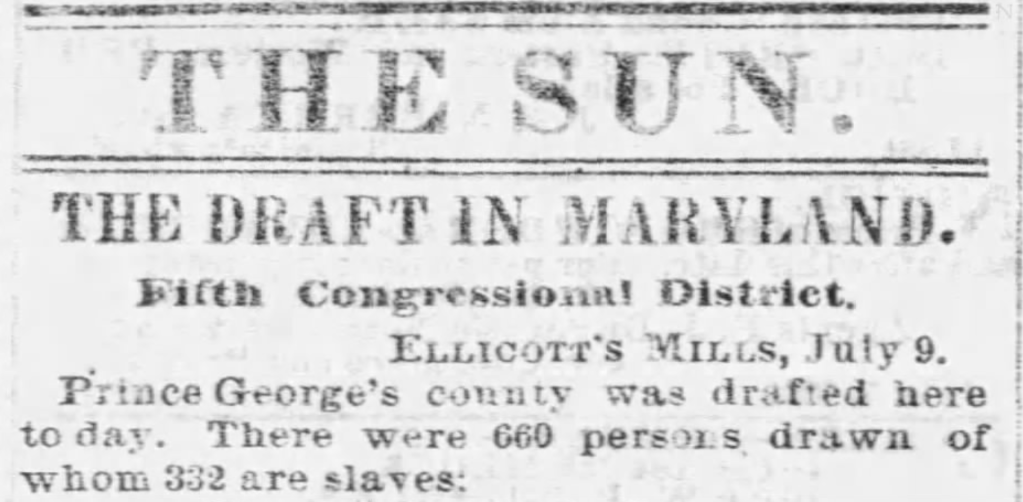
The Baltimore Sun | 12 Jul 1864, Tue · Page 1 | newspapers.com
In 1864, the Baltimore Sun ran the names of the people drafted for the Union Army from Prince George’s County, including the name of “Peter Stewart, slave of the estate of Benjamin Lee“.
Dr. Benjamin Lee had died during the war and his administrators created an inventory of his estate in 1863. The inventory did not include the name Peter.
The 1867 Slave Statistics provide an incomplete list of people enslaved in Queen Anne District [District 7] of Prince George’s County as reported by their enslavers. While submission of the list was voluntary, and not all estates and enslavers submitted a list. That said, it provides the names of over fourteen hundred enslaved people. The 1860 Slave Schedule recorded almost twenty-three hundred enslaved people. The Prince George’s County Slave Statistics names about 62% of the enslaved population in Queen Anne District. Of them, there is only one named Peter: Peter Ridout enslaved by Violetta Sprigg, the neighbor of Benjamin Lee. He was also named in the list.
The list also included the names of Thomas Brown and Jno Hamilton, enslaved on the estate of Benjamin Lee.
Jno. Hamilton is named — he and his partner Patsy are named near the beginning of the inventory list. In 1870, he and Patsy are living in the household of C. A Harding, the son-in-law of Benjamin Lee, and Eleanor Lee, Benjamin Lee’s widow. Patsy is working as a servant in the household, while John is laboring in the fields.
Inventory of Benjamin Lee estate WAJ 3:126 | Maryland State Archives
Thomas Brown, like Peter Stewart, is not named in the 1863 Inventory. He may be the “Tom” who fled Lee’s enslavement in 1859. Lee described him as a 32 or 33 year old man. Further information about Thomas Brown has not been found. If Peter fled Lee’s captivity, like Tom, then Lee does not appear to have advertised for his return.
The question persists if Peter Stewart was the name of a person enslaved by Benjamin Lee, or if the editors of the Draft List in the Baltimore Sun made a mistake as they transcribed and inserted names.
What connection if any does James Stewart have to the enslaved of Notley Young of Prince George’s County?
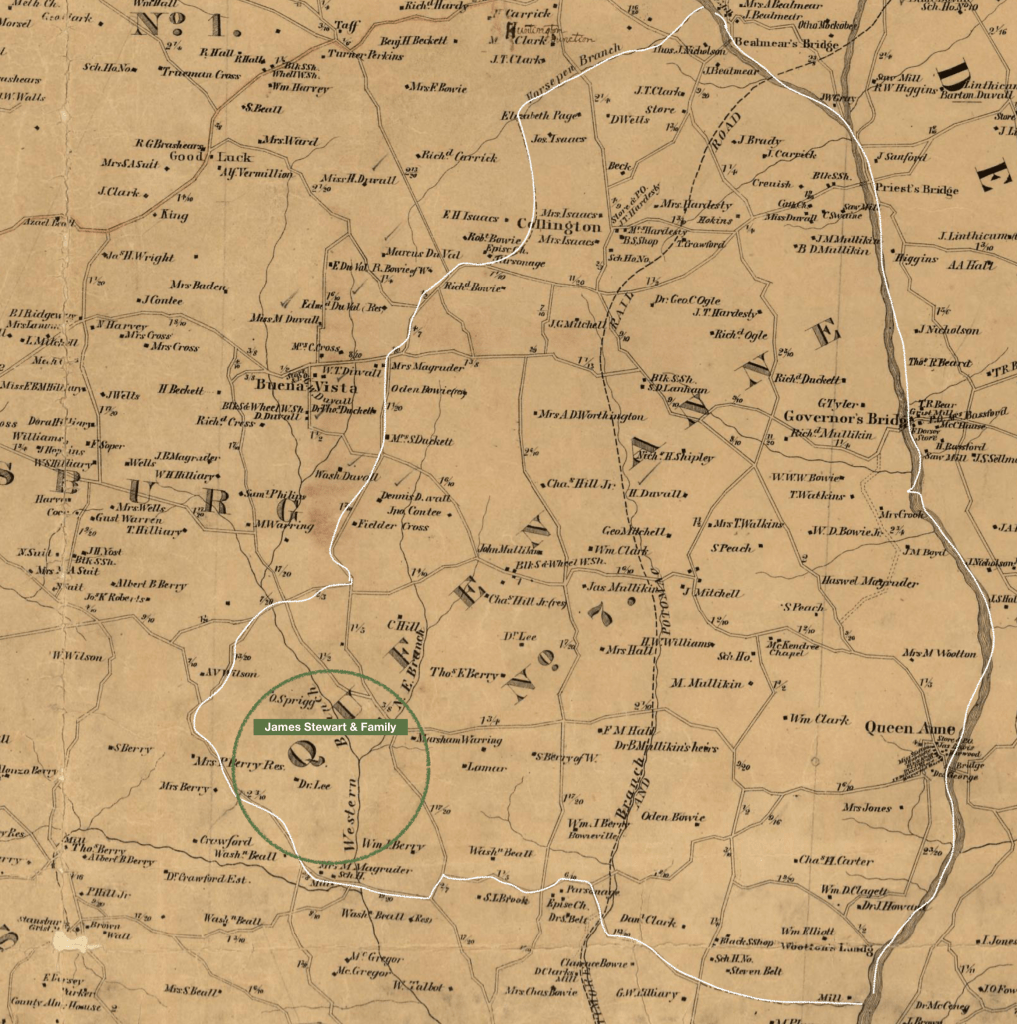
After emancipation in 1864, James Stewart and many of his children, including Notley Stewart, stayed on the lands of Dr. Benjamin Lee in Queen Anne District in Prince George’s County, Maryland.
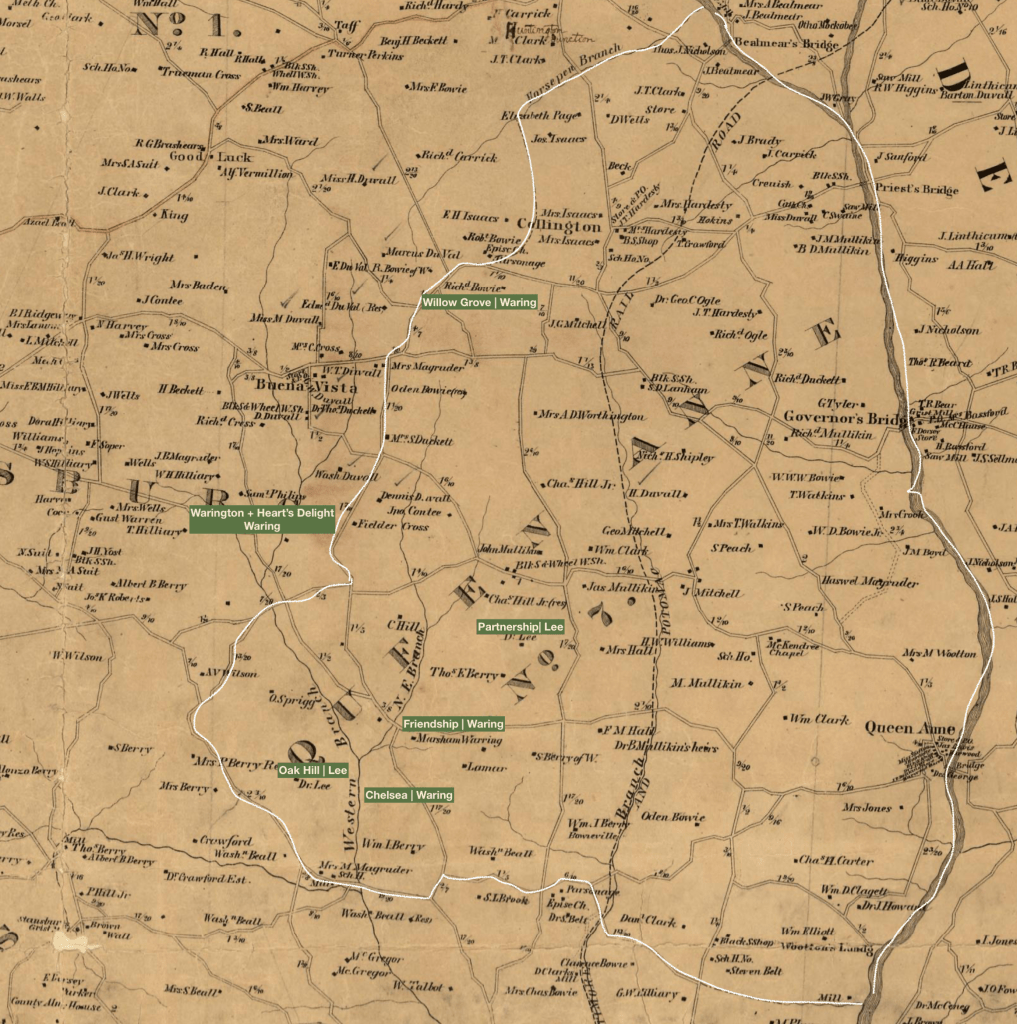
Annotated Excerpt from 1861 Martenet Map of Prince George’s County | loc.gov
Prior to emancipation, Stewart had been forced to labor for Marsham Waring’s estates, while his children labored on the estates on the Lee. Waring and Lee were brother-in-laws. Inventory records for Marsham (WAJ 2:321) and the post-emancipation records of the 1870 and 1880 records suggests that James was born a few years after 1800, and about a decade after Marsham Waring.
The name “Notley” has been used by multiple generations of the Stewart family — and one possible source for the given name is from the enslaver Notley Young. Other members of the Stewart family used names that were aligned to their (former) enslaver. For example, James’ son and daughter-in-law, George and Rebecca Stewart had daughters named Violetta and Eleanora, both names in common with the wives of Waring and Lee. Sarah (Sallie) Stewart and her husband Washington Lee named one of their sons, Benjamin, giving him both a given and surname that matches Sarah’s former enslaver, Dr. Benjamin Lee. The use of Notley in the family suggests a connection with a (former) enslaver named Notley, i.e., Notley Young.
There are three Notley Youngs in three successive generations:
Notley Young (I) who died in 1802. His estates and property were located within the parts of Prince George’s County that would become the District of Columbia.
Notley’s (I) son, Notley Young (II), a priest with connections to the Jesuits, Georgetown University and the White Marsh plantation along the Patuxent.
Notley’s (I) grandson, Notley Young (III), son of Benjamin Young. Notley Young (III) married Eleanor Hall, his second cousin, and lived in Queen Anne District, before dying in 1846.
In the 1828 Tax List for Prince George’s County, Notley Young (III) owned practically 735 acres of land in the Collington & Western Branch Hundreds, from which part of Queen Anne District would become. Both Waring and Lee owned property before the Civil War along the Western Branch, which divided the two hundreds.
Map of part of the city of Washington shewing the situation of the mansion house, grave yard & buildings belonging to Mr. Notley Young : original proprietor of that part of the city. | loc.gov
View of the city of Washington in 1792. | loc.gov
Inheritance
There are three ways to acquire an enslaved person: 1. purchase, 2. inheritance/gift, or 3. natural “increase”, i.e., claiming ownership of the children of enslaved women.
James Stewart was born prior Marsham Waring acquiring his father’s estate, who died in 1813. On his inventory, there was a child called Jim (James) age 12 with an estimate birth year of 1801, which is consistent with calculated birth years from the later documents. This suggests that Marsham Waring (Sr.) conveyed James along with his other property to Marsham Waring (Jr.) of the 1860 Inventory, and opens the line of inquiry of how Marsham Waring (Sr.) acquired him.
Purchase from Notley Young, Sr.
Notley Young’s grandfather died in 1802. Included in his inventory is a James age 3, who would have been born in 1799. This is within two years of the age on the 1813 inventory of Marsham Waring (Sr.) After making some specific bequeathals to his wife and for his real estate, Young’s grandfather divided his personal estate (including his chattel) to be equally divided among his five identified children/grandchildren.
As noted on the family tree, a cousin of Notley Young (II) is George Washington Young, who inherited his father’s estate Nonesuch along the Eastern Branch (what would become known as Anacostia) and within the District of Columbia. When the District abolished slavery in 1862, G. W. Young filed a claim for compensation for his “loss” that included a “Stuart” family group.
This suggests that the Young family had enslaved members of the Stewart/Stuart Family group, perhaps even the one that James Stewart came from.
It is possible that the heirs of Notley Young sold James and separated him from his family, sending him to Marsham Waring (II) and his estates. Both Marsham Waring (II) and Notley Young were involved in the creation of the District of Columbia and engaged in business together. In the 1830s, their heirs were sued as together they had put up sureties for Thomas S Lee and a loan he had taken from Charles Carroll of Carrollton (Charles Carroll of Carrollton vs. Marsham Waring, et al June 1832).
White Marsh Baptism Record
In 1832, the enslaved population of Waring and Lee grew through “natural increase”, the term enslavers used to conflate the language they used to talk about their livestock and their enslaved people, dehumanizing the latter. James “Stuart” and Susan (Suky) had their son, James, baptized by the priests of White Marsh, the Jesuit Catholic plantation near Priest’s Bridge which also enslaved numerous people.
The baptism record notes that James (Sr.) was enslaved by “Master” Warring and that Susan (Suky) was enslaved by Dr. Lee in Marlborough. The record also notes the sponsor/godmother as a person enslaved by Notley Young, mostly likely Notley Young (III) based on the year of the baptism. The name was transcribed as “__rvelide?”.
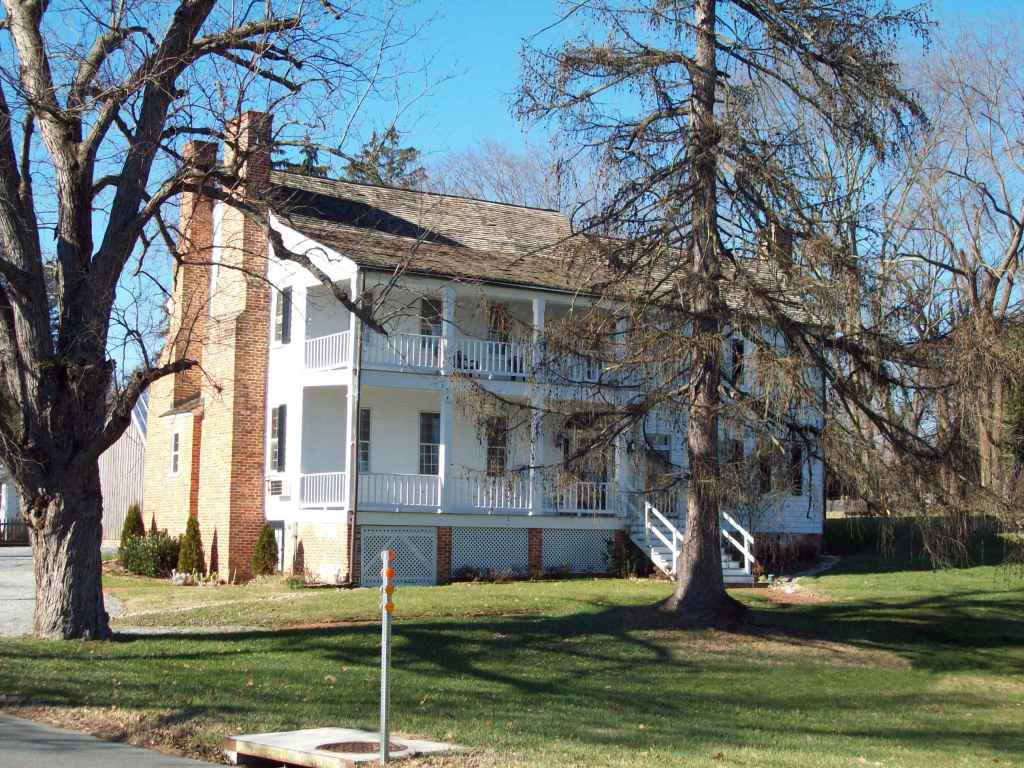
“Content” | wikipedia.com Dr. Benjamin Lee lived in this house in Upper Marlboro from 1821-1844 before moving to his estate in Queen Anne District. This is where Suky and her children most likely labored.
It is probable that the sponsor for the baptism of James and Suky’s son is a relative of either James or Suky, as godparents are usually chosen from within a kinship group, and therefore suggesting a connection between the Notley Young estates and James Stewart’s kinship group.
Reconstructing the Transcribed Name
My source document provides the typed transcription without access to the handwritten record of the priest, leaving the reader to guess at how the the transcriber interpreted the name. To complicate matters, the priests of White Marsh were not also fluent with Anglo-American names or the diminutives used by the enslaver and so there is often non-traditional spelling. With that in mind, the following three items helped to narrow the possibilities.
The transcriber noted it was a godmother, therefore looking for women’s names
The index to White Marsh Book 4 provides three plus page list of names of given names used by the priests, providing a sampling of names used during this time period by enslavers and enslaved.
The final syllable “-ide”
These three items helped to identify Adelaide and its variations as a probable given name for the godmother. Another possibility includes names like Emeline and its variations, though Matilda and Cornelia are also likelihoods.
Of note, on the same page, a Adelaide was noted as a person enslaved by Benjamin Young, likely Notley Young’s brother. She had a son, Alexander who was baptized the same year as James. In 1818, Sandy [Alexander] and Adelaide were married at White Marsh with the permission of their enslaver, though the record does not note their enslaver. That said, the repetition of Alexander and Sandy in both records suggests that Adelaide and Alexander married and had a son, named for his father, Alexander.
A 1821 records provides more insight into the Alexander + Adelaide family group. Francis and Moses Sandy were baptized in 1821, as one-day old sons of Sandy and Adelaide Cosy, servants of Mr. Benj. Young. In 1817, Peter Corsey escaped from Notley Young, he may be related to the Cosy’s of Benjamin Hall.
A review of the 1809 Inventory (TT 1:321) for the estate of Benjamin Young (the son of Notley Young (I) and the father of Notley Young (II) and Benjamin Hall Young provided a possible family group for Adelaide. The Inventory appears to be groups in families, as a few adults will be named then children, then adults and children again. The group identified occurs near the beginning of the inventory. The list includes a Suck, a name variation for Susan; though Susan was an extremely common name for the enslaved communities of Prince George’s County.
Name
Age in Inventory
Estimated Birth Year
Dolly
32
1777
Eliza
21
1788
Suck
15
1794
Louisa
12
1797
Adelaid
10
1799
Harry
12
1797
John
10
1799
Billey
10
1799
Maria
4
1805
Chrissy
5
1804
Edward
3
1806
Ned
4
1805
Robert
2
1807
Tentative Conclusion
The circumstantial evidence suggests that James Stewart came to the Waring family from the Young family.
The use of Notley as a given name within the Stewart Family
The presence of a James on the 1802 Notley Young (I) Inventory
The inclusion of other Stewart family groups on the Compensation List for G. W. Young
The presence of a White Marsh baptism record which indicates a godmother from the Notley Young estate for James Stewart’s son, James (Jr.)
Did James (Jim) Stewart (b. about 1800) have a son named James Stewart?
James Stewart, Senior
James Stewart (Sr.) was living in Queen Anne District of Prince George’s County after emancipation in 1864. He was residing near the estate of Dr. Benjamin Lee who had died during the war.
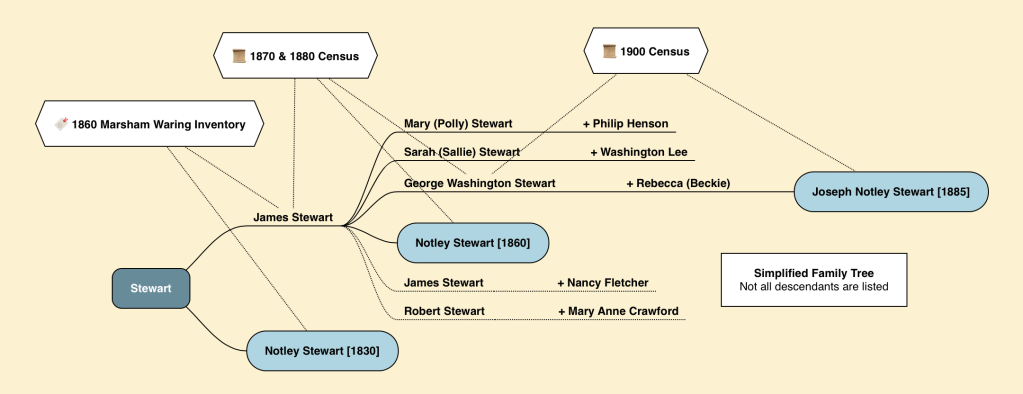
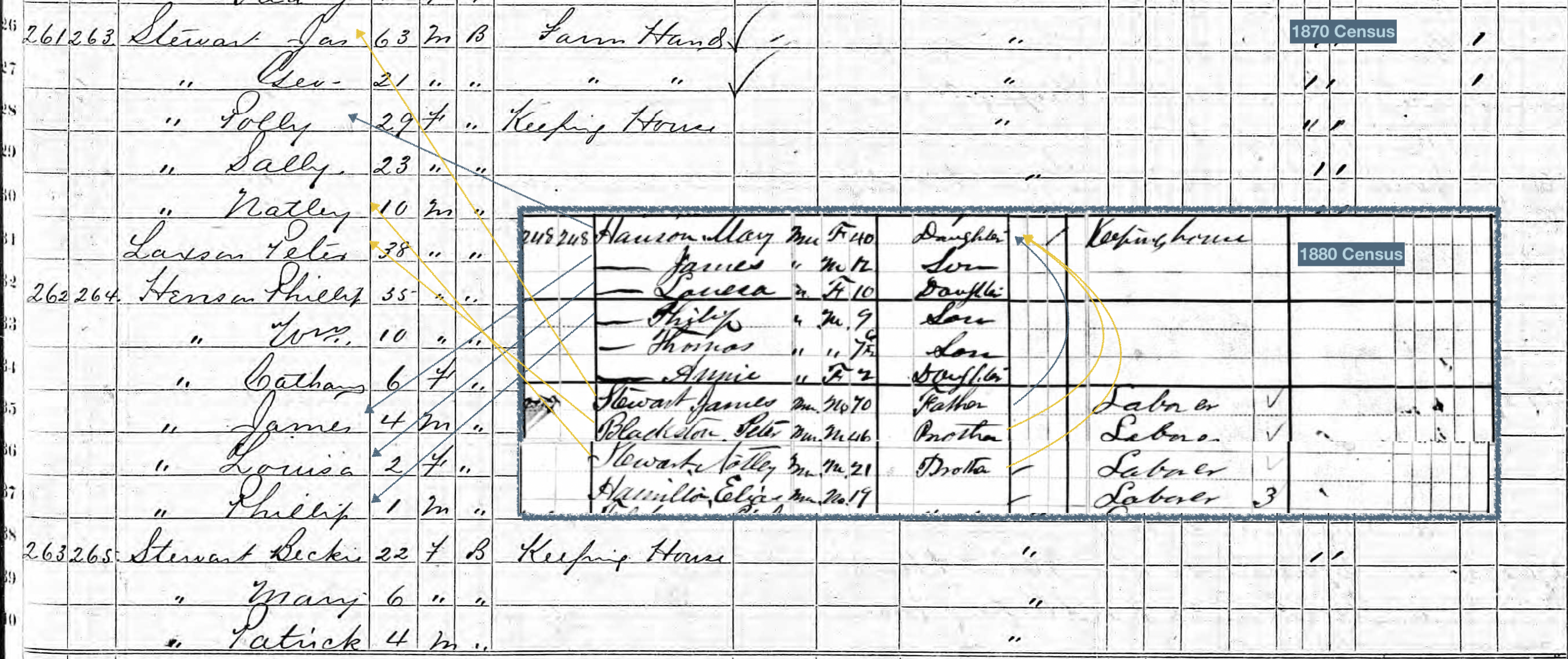
He lived with his inferred children, George, Mary (Polly), Sarah (Sallie), and Notley as well as Peter Laxson (Blackstone), and is neighbor to Philip Hanson and Beckie Stewart. The 1870 census record for James Stewart is best understood when compared to the 1880 census record for James Stewart, which identifies the relations between the households.
1870 Census with overlay of 1880 Census
Not present in the 1880 Census record are Sarah (Sallie) Stewart, who married Washington Lee in 1870 and established a separate household nearby and George and Rebecca (Beckie) Stewart who also established a separate household nearby.
The comparison of the two census records show however, that James Stewart was the head of a family with several adult children.
James Stewart, prior to Emancipation
In the 1870 Census, James Stewart and his children are enumerated directly after the heirs of Dr. Benjamin Lee and an overseer, suggesting that they lived near “Oak Hill”, the Lee estate.
1870 Census
Dr. Benjamin Lee was the brother-in-law of Marsham Waring. Both owned considerable amounts of property in the area. They married the daughters of Captain James Belt, who had bought parts of Chelsea from another branch of the Belt family and who conveyed the tracts to his daughters. Lee also acquired tracts of land from Northhampton, Partnership and other parcels. Waring also acquired land from nearby families, purchasing land from the Hillearys and the Bowies.
Lee and Waring died within a few years of each other. Marsham Waring died in 1860, and his wife in 1863. His probate records include an inventory (WAJ 2:323) with the names of the people enslaved on four separate estates. Benjamin Lee died in 1863 and also includes the names of those he enslaved (WAJ 3:127). Waring heirs, (his two daughters and son) had compensation lists submitted to the Commission on Slave Statistics which provided both a first and last name with an age for many. This allows us to identify the people on the Waring Inventory and which estate they were forced to labor on. Lee does not have a similar compensation list, and so identifying the people he enslaved requires more records to ensure identification of them.
James (Jim) Stewart is included in the Waring Inventory and in the list made by Waring’s daughter, Mrs. M. Virginia Mackubin [sic] for the Commission on Slave Statistics. In both documents he is listed as 50 years old. He labored for the Warings on the Warington Estate . He is the only James Stewart listed on the three compensation lists. The children in the inventory are not listed in the Waring inventories or compensation lists, rather they appear to be included in the 1863 Lee Inventory .
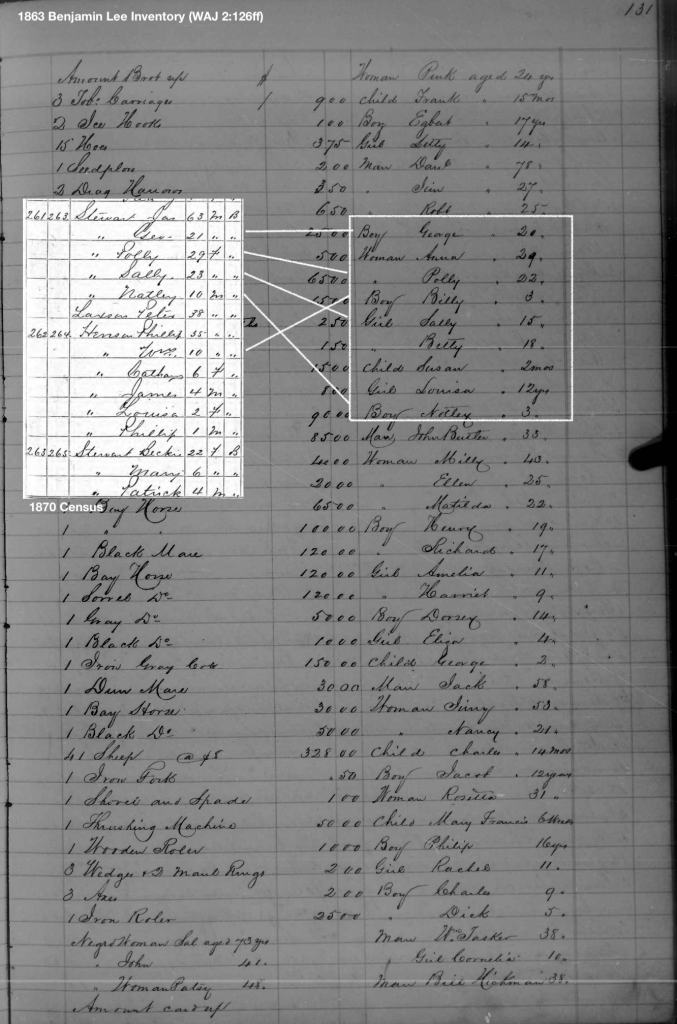
Lee’s inventory includes the names of James Stewart’s children as well as Mary’s oldest son, with ages that are comparable to the ones in the census. (As always there is some variability with ages for those enslaved, as the exact birth year is not always known by the enslaver or the person enslaved.)
Lee Inventory with overlay of 1870 Census
The Warings were Catholic and many of the people they enslaved were baptized by the priests of White Marsh, the Jesuit Plantation in Queen Anne District. The Early Records of White Marsh, Book Three contain baptismal records from 1853-1872.
In 1858, John Henson was baptized, the son of Nancy (Ann) Fletcher and James Stewart. The priests marked them “property of Marsham Waring.” Notley Stewart acted as a sponsor/godparent; this Notley Stewart is an older Notley, not the child in the 1870 Census. In the 1860 Inventory of Marsham Waring, listed two below James (Jim) Stewart, is Notley, age 30. He is also on the list submitted by M. Virginia Mackubin [sic].
In 1860, George Antony was baptized as James and Nancy Steward, with Elizabeth (Bezzie) Fletcher as sponsor/godmother.
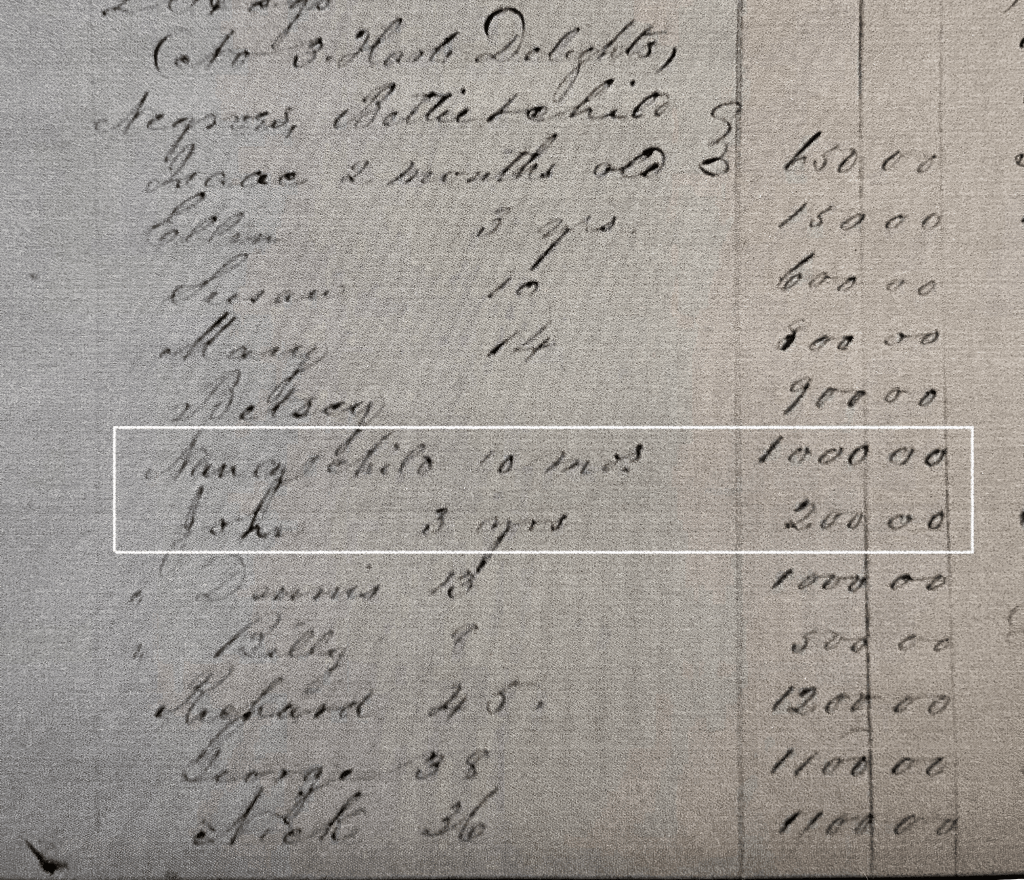
Ann (Nancy) Fletcher was enslaved by the Warings on the estate “Heart’s Delight”, which was inherited by James Waring. She was included on James Waring’s compensation list, as was “child of Nancy” [George Antony] and John. Above her is Betsy, who may be the same Elizabeth (Bezzie) who stood as sponsor at the baptism of the infant.
Marsham Waring Inventory
With only the census record, it was an assumption that the James Stewart mentioned in these records was James Stewart (Sr.). However, a registration list from the Freedmen’s Bureau with an 1870 Census record from the District of Columbia suggests that the James Stewart of the baptismal records is not James Stewart (Sr.), rather James Stewart (Jr.).
Flight to the District of Columbia
After slavery was abolished in the District of Columbia in 1862, the people enslaved in the neighboring jurisdictions saw an opportunity to grab freedom for themselves. Despite the fact that the roads toward the District were monitored by constables and private patrols, many of the people forced to labor fled their captivity and made their way to the District. Barbara Jeanne Fields wrote in her book, Slavery and Freedom on the Middle Ground that “Many an ex-fugitive later reported having left Maryland for the District during or after the spring of 1862. Families packed up such of their possessions as could be compactly assembled and departed, sometimes appropriating means of transportation from their owners.” (111)
As such camps were built in and around the District to house the incoming refugees from chattel slavery. One such camp was Camp Springdale which was made up of tents on the grounds of the “Arlington Estate”, owned by Robert E Lee’s wife. At the start of the Civil War, the Union Army occupied the site and the soldiers gave protection to fleeing refugees. Other camps were built in and around the District.
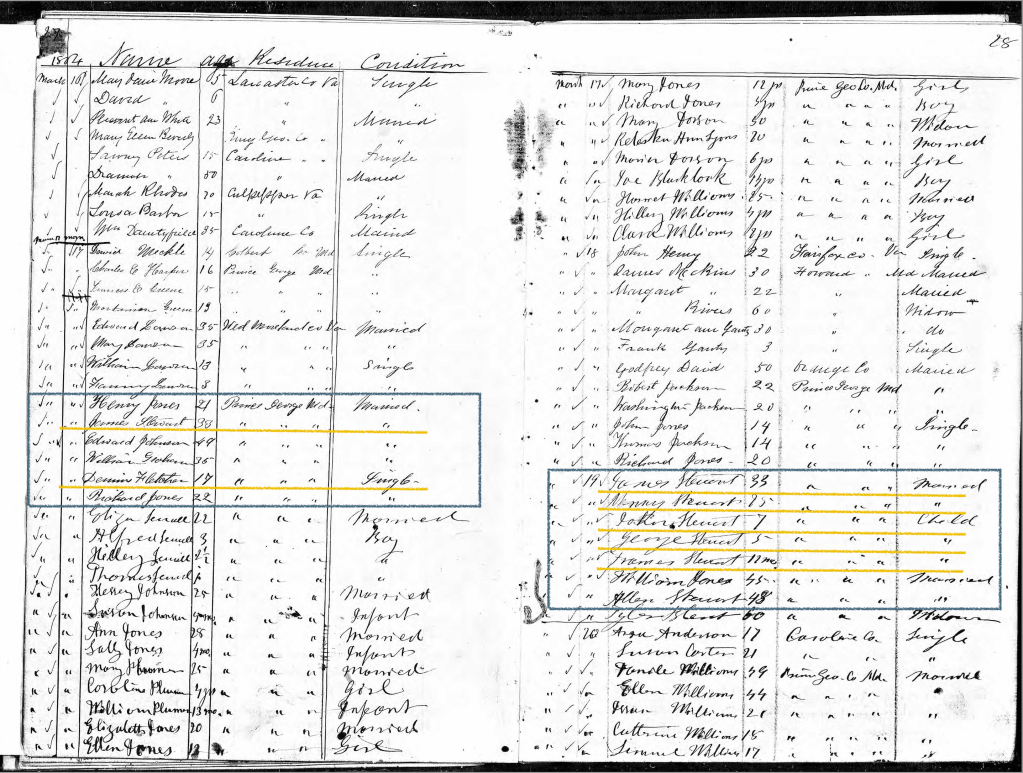
A registration list for Camp Springdale lists its residents and their former residence along with whether or not they are married.
In March 1864, James Stewart appears to have been registered with a group of male refugees. On March 17, James is listed with other men with the surname Jones and a Dennis Fletcher. Dennis Fletcher also appeared on the 1860 Marsham Waring Inventory, after Nancy and her children. This suggests he is a younger brother of Nancy, and therefore brother-in-law of James. James is 33 years old.
Then, on March 19, a 33 year old James Stewart is listed with Nanny Stewart, and the children, John, George, and Francis. The ages of John and George are consistent with the ages in the baptisms. This suggests that James of the baptismal record is not James (Sr), rather James (Jr.)
The National Archives in Washington, DC; Washington, DC; Records of the Field Offices For the District of Columbia, Bureau of Refugees, Freedmen, and Abandoned Lands, 1865-1870; NARA Series Number: M1902; NARA Reel Number: 21; NARA Record Group Number: 105
A review of Benjamin Lee’s inventory shows a Jim, age 27, above the identified area that contained the other names of James (Sr.)’s children. His age is consistent with that of James (Jr) who gave his age as 33 to the registrar at Camp Springdale.
Lee Inventory
1870
After the war, James and Nancy stayed in the District of Columbia. They lived in Ward 5, with James working as a scavenger. They are living with Elizabeth Fletcher, age 23, who has a son, Louis.
Update
The White Marsh Baptismal Records Book 4 contains earlier baptism records than Book 3 (1819-1833) and contains a baptism record for James, born 1832, son of “James Stuart, slave of Master Warring” and “Suky, slave of Dr. Lee in Marlborough”. This would be consistent with the 33 year old James Stewart who escaped to the District of Columbia.













 stories of Then