Over the decades through census records
Known Information
George Washington Wedge and Mary Elizabeth Sharps were married in 1872 and raised their family in and around Queen Anne’s District of Prince George’s County, Maryland
Sources
1880 Census
1880; Census Place: Marlboro, Prince George’, Maryland; Roll: 513;Page: 73B | ancestry.com
1900 Census
1900; Census Place: Queen Anne, Prince George, Maryland; Page: 3;Enumeration District: 0098 | ancestry.com
1910 Census
1910; Census Place: Election District 3, Prince George’s, Maryland; Roll: T624_567; Page: 7B | ancestry.com
1920 Census
1920; Census Place: Marlboro, Prince Georges, Maryland; Roll: T625_674;Page: 4A | ancestry.com
The table summarizes the household of George and Mary Wedge from 1880-1920. The 1890 Census was burned in a fire and generally unavailable. The individuals and their ages are recorded in the table.
Note on census locations
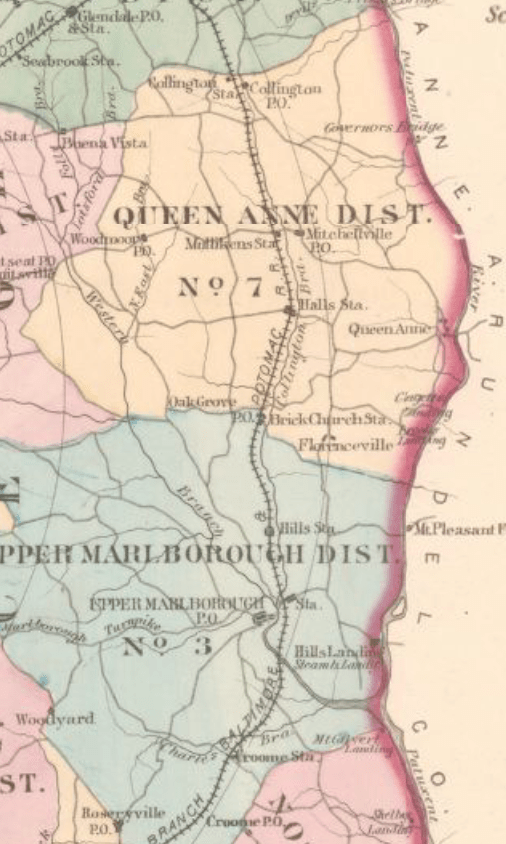
Marlboro District is located directly south of Queen Anne’s District within Prince George’s County.
| Name | 1880 Marlboro District, PG | 1900 Queen Anne, PG | 1910 District 3, PG (Marlboro) | 1920 Marlboro, PG |
|---|---|---|---|---|
| George (Washington) | 35 | 60 | 60 | 75 |
| Lizzie | 28 | 55 (10 children, 6 living) | 55 (10 children, 6 living) | 70 |
| Edward/Eddie J | 5 | 24 | ||
| George W/Willie | 1 | 21 | ||
| Martha | 16 | 35 | ||
| Robert | 15 | |||
| Bennie | 12 | 22 | 29 | |
| Ernest | 10 | |||
| Mary, (grand)mother | 60 | 80 | ||
| John, brother | 21 | 40 | ||
| Mary, sister | 16 | |||
| Berry Young, grandson | 13 | |||
| Benjamin, grandson | 1 | 10 | ||
| Julia, daughter in law | 24 | |||
| Robert Asbery, lodger | 20 | |||
| William Brice, lodger | 35 |
1880 Census | Community Context
Scanning names on either side of the 1880 census listing for George Wedge allows the identification of neighbors, which used in conjunction with landowner maps provides an approximate location for their residence.

The white text on the map excerpt indicate the individual’s dwelling number and page in the 1880 Census. Mordecai Plummer and Wm. B Hill were large white landowners. Walter Harrison and John Quander were Black landowners.
Plummer owned a large tract of land called “Spring Hill” that was partitioned in 1873 with some land being given to his daughter and her husband John Bowling. Henry W. Clagett, the nephew of Plummer, is listed south of the Mount Pleasant Ferry Road.
George Wedge was on page 73B, which suggest that the family lived slightly north of the Quander and Harrison house and on the east side of the road to Florenceville.
George and his family members, as well as his neighbors are listed as laborers, while Plummer and Hill are listed as farmers. In 1875, John Henry Quander purchased an acre from Clagett and worked a tenant farmer for John Bowling according to the Maryland Historical Trust Maryland Inventory of Historic Properties Form for his home. This suggests that George Wedge and his neighbors worked on the Plummer, Bowling, and Clagett properties, as well, as tenant farmers after the Civil War.
1910 Community Context
In 1910, George Wedge is listed on page 7b as John W Wedge. His wife, Lizzie, and son, Benjamin, are consistent with previous records, as is his middle initial, suggesting it was an error on the part of the census enumerator, recording John instead of George.

Their two neighbors, James Ireland and Benjamin Galloway, have the phrase “club house” listed in the notes about their occupation and in the margin of the Census page is written, “Marlborough Hills Landing Road”. This is the road on the east side Upper Marlborough that leads from Chas. Ridgeley past Wm. B Hill’s residence to a store and Boat Landing on the 1878 Hopkins Map.
The club house most likely refers to the Marlboro Hunt Club, which began in 1880. It operated as a sportsman’s club, with president’s like FDR and Teddy Roosevelt visiting. It was called the Patuxent Gun and Rod Club in the early 1900s.
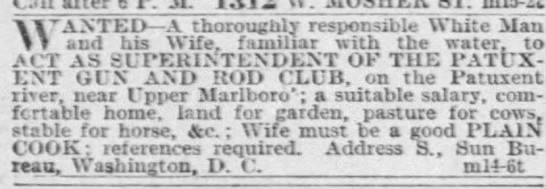
Baltimore Sun, 15 Mar 1899, p. 3
On the preceding page is the record for Reverdy Sasscer. According to the documentation included in the application for House at Hills Landing to be Maryland Historic Property, the Anne Brooke, the daughter of Wm Hill, conveyed the property to Sasscer in 1901. The address given is 5802 Green Landing Road, very near to the location of the Marlboro Hunt Club.
This suggests that George Wedge and his family were living in the Hill’s Landing Community, working as a tenant farmer on the lands that historically have been owned by the Hill family.
1920 Community Context
In 1920, George Wedge is listed on page 4A. In the margins of the page, the enumerator lists North Side of Marlborough to Wells Corner Road, and the locality at the top is listed as outside town limits.
“Sugar Hill” was the name of a small African-American community that lived outside of Upper Marlboro, near the railroad lines. It had been established when several African-Americans labored on the Baltimore and Potomac Railroad after the Civil War. (Approved Historic Sites and Districts Plan) On page 3B, several of the residents are laborers for the Steam Railroad, suggesting that the Wedge family lived in vicinity of the Sugar Hill neighborhood.
George Wedge is the neighbor of Robert L Hall who married the granddaughter of Mordecai Plummer. Hall’s son was a businessman at the tobacco market, also located in vicinity of Sugar Hill.
Further Research Needed:
- Locate records that better identify possible locations in Queen Anne’s District for the 1900 census.
 stories of Then