Asch, C. M., & Musgrove, G. D. (2019). Chocolate City: A History of Race and Democracy in the Nation’s Capital. Chapel Hill: University of North Carolina Press.
Mary Reeder, age 10, attended school in 1880 while living with her parents in Jackson Alley. She most likely attended School No. 5 in the second division based on its geographic proximity to Jackson Alley.
Education in post Civil War Washington
In 1862, Congress directed ten percent of tax money toward primary schools for Black students, and an independent Board of Trustees was established, which included S. J Bowen, who later became the mayor of DC in 1868. By the 1870s, the Board of Trustees was replaced by a superintendent of schools. Advocates demanded parity between both school systems schools and “the haphazard postwar collection of semiprivate black schools had solidified into a stable system of black public schools run by the Board of Trustees.” (Chocolate City)
“CITY NEWS IN A NUTSHELL: A DAY’S STORY OF THE CAPITAL CITY BRIEFLY TOLD BY “POST” REPORTERS.” The Washington Post (1877-1922), May 06 1893, p. 4. ProQuest.
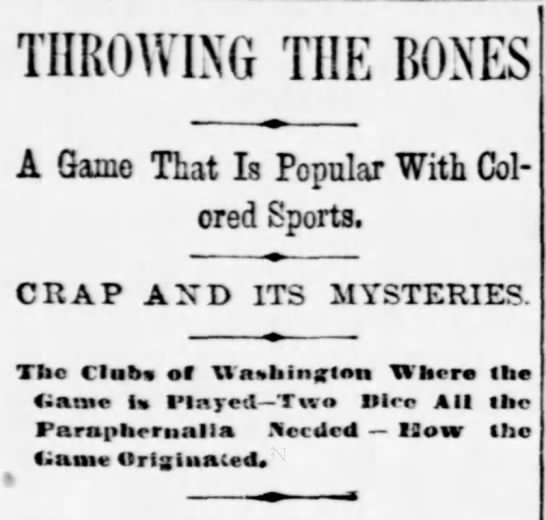
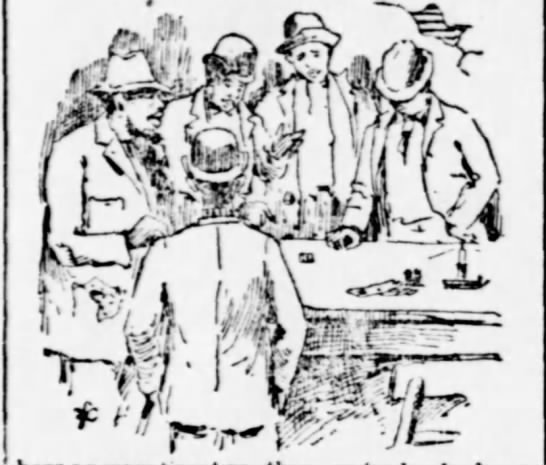
An 1890 article in the Evening Star claims that the game of craps was originated in the “cotton fields of the sunny south”, played by enslaved laborers forced to work in the fields and forbidden to take articles of entertainment with them. A game of craps only requires two “bones” to be thrown from the hand. Throwing a seven or a eleven is a “pass” and he wins the stake. Throwing two, three, or twelve means an automatic loss, while any other number is a “point” and a chance to throw again.
Historically, there are two forms of craps, “Casino Craps” and “Street Craps”. Dice games with any number of variants have been found in many cultures across time. In the 1700s, the French created a form of Hazard that transformed into Craps. French immigrants took it to Arcadia, Nova Scotia and then from there to New Orleans. From New Orleans, the African-Americans picked it up as a game and as with any game, it evolved. Casino Craps was introduced in settings like river boats where there were formal “banks” to bet against, whereas Street Craps were played by people anywhere they could get a smooth setting and placed their bets against each other. The players were referred to as “bone-shooters” and the game “shooting de bones” in newspaper briefs from the 1890s.
In contrast, the Evening Star ran hundreds of articles in the 1890s about the police raiding crap games. The police and the newspapers painted it as a type of robbery as the game “fleeced” young gamblers and allowed large groups of Black men to gather, who were characterized as “boisterous”, using profane language. The Washington Bee, an African-American newspaper from DC, printed a speech in which the speaker lamented “pool and crap games swallowing up their money and monopolizing their thoughts.”
An 1889 article about the “Foggy Bottom” gang, described an alley as “a place where loafers, thieves, crap-shooters, and murderers congregate”, exposing how the newspapers like to paint crap-shooting as a lurid game associated with violence.
Police Take Notice
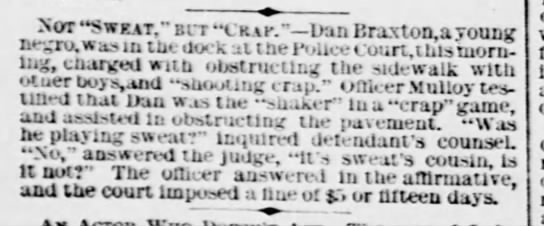
There were only a handful of articles about craps in the Evening Star in the 1880s. In 1887, it ran its first short brief and place the game in quotation marks, “shooting crap” and named the role of “shaker”. The article contrasts Craps with Sweat, a type of card game that resembles poker and considered the “Old Army and Navy game”, and another form of street gambling.
Damon Jackson
In May 1893, Damon Jackson was charged with an assault to kill. Damon had been playing a game of crap with Joseph Plummer which ended by “Damon’s little hatchet which clove the skull oof Joseph Plummer”. Damon had been winning the game, and Joseph requested that he be staked another nickel “to buck gain the fickle goddess once more.” Both Mrs. Jackson and Damon berated him and drove him into the street where he was struck with the hatchet. Witnesses for Damon “with equal zeal asseverated” that Jackson was trying to nail up the door to keep Plummer out. After the flowery and descriptive language of the article, the post article ends simple with “Jackson was acquitted.”
Further Research Needed:
Locate the court records in the National Archives.
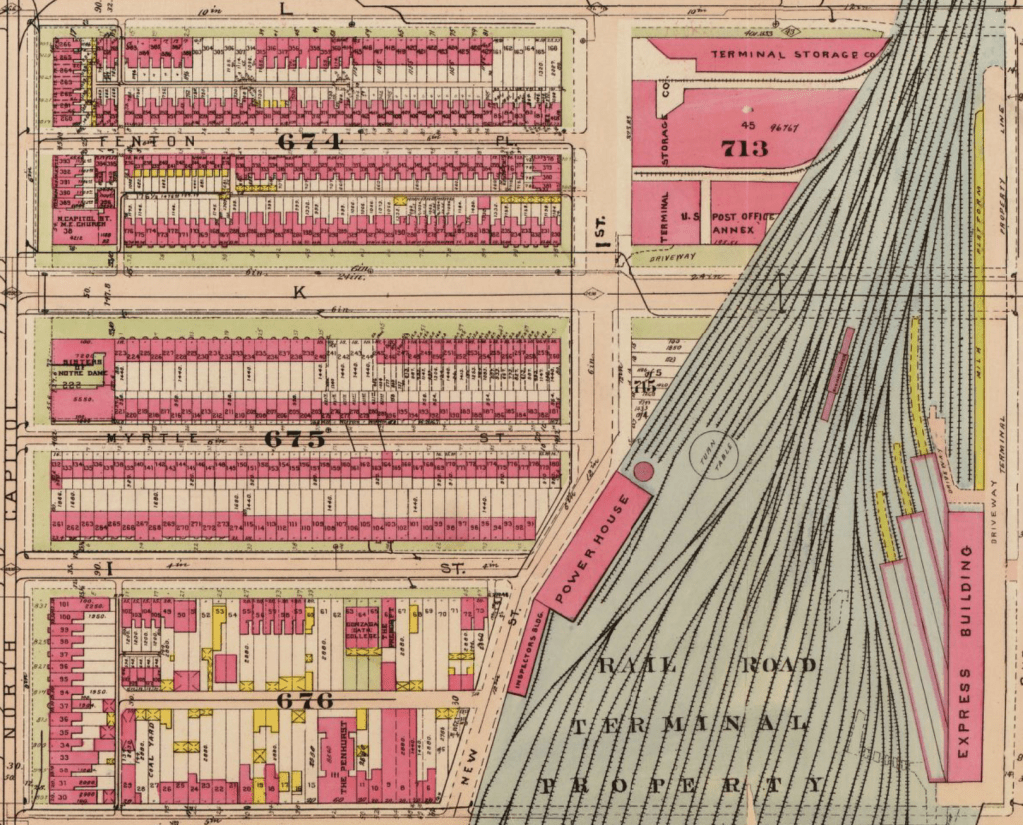
Baist, G. Wm, Wm. E Baist, and H. V Baist. Baist’s real estate atlas of surveys of Washington, District of Columbia: complete in four volumes. Philadelphia: G.W. Baist, -<1911 >, 1909. Map. https://www.loc.gov/item/87675120/
1872 | Estimated Birth Year
based on ages given in the 1880 and 1910 Census.
1880 Census
Living with parents, Thomas and Martha (Colbert) Reeder in Jackson Alley, the heart of Swampoodle. He is eight years old living with two sisters, Mary and Georgiana.
1891-97 | 809 N Capitol
The 1891, 1892, and 1897 City Directories list his address as 809 N Capitol street. This address is a block north of the Government Printing Office and within a stone’s throw of Jackson Alley. North Capitol is the N/S road on the right side of the map excerpt. 809 N Capitol is lot 34 on the block opposite DeFrees Street.
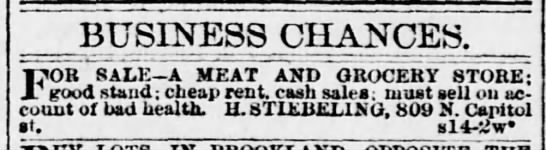
In 1887, the Evening Star ran an advertisement for the sale of the property as a grocery store
In 1889, the Evening star ran an advertisement for a laborer to help in the grocery store.
1900 Census
He is living at 50 Jackson Alley, with his parents and his brother, Charles. Both he and his father are working as day laborers while Charles has a job as a photographer. The census reports that he and his father haven’t been able to work in six months. The census enumerator indicated he had been married for 5 years, but doesn’t list a wife.
The Evening Star lists a marriage between Joseph Reeder and Josephine Lucas in 1895. She is living with parents in the 1900 Census and lists her status as a widow. She is living on Adams Express Alley. There is no death records in the index for a Joseph Reeder between 1895-1900 and a search of the newspapers does not return one either. However, the lack of a death record is inconclusive as one may not have been filed.
1904 Marriage
The Evening Star runs the list of marriage licenses, including Joseph D Reeder and Abbie Nelson. When he applied for the license, he expressed worry for the cake, as he had purchased it from a Seventh Street confectionary and was having it delivered to 809 North Capitol and it had yet to appear.
This article has him living back at the 809 North Capitol address suggesting he works again for the grocery story.
1907-1908 City Directory
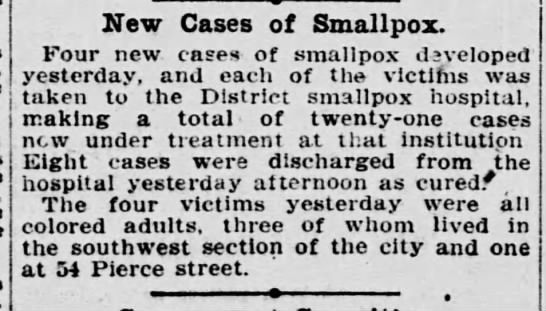
He and his wife are living at 54 Pierce Street NW. Pierce Street was undeveloped in the 1887 Plat Book. In the 1907 Baists Real Estate it was block of row houses. It has since be redesigned. It is one block over from where the Hodcarrier’s Association had their building in the 1880s and where James Reeder lived.
In 1908, there was a reported case of smallpox. No name was provided in the news report. It is unclear if it was in the Reeder household or another household residing in the house.
1910 Census | 1909-1912 City Directories
He is living on 17 Fenton St NE, where his aunts and uncles lived in the 1890s. He is living with his wife and son, Abbie and Frank Reeder. The census enumerator lists this as his first marriage and that they have been for 6 years. Frank is 4 years old.
Joseph is working as a teamster at a grocery store according to the census; the city directories list him as a clerk.
The map excerpt shows the block with the 809 North Capitol Street Grocery store, as the bottom block, with the RR Terminal property on the back side of the block. Two blocks north was Fenton Street, with townhouses packed in tightly.
1914-1915 | 809 N. Capitol
In the 1914 City Directory he is listed as living in rooms above the grocery store. A 1915 Washington Post article that calls him Joseph Reed states his residence as 809 N. Capitol; he was arrested at the rear of 18 L Street northwest and taken to Washington Asylum Hospital, a consolidated hospital, poorhouse and workhouse.
In the 1920 Census, Frank Reeder, Joseph and Abbie’s son, are living in the rear of L Street with Abbie’s parents, Kate and Thomas Simms. Kate died the next year, in 1921 and their address is listed as 13 L Street NW (rear). It lists her daughter and grandson, but not Joseph.
It is likely that Joseph was visiting his in-laws when he was arrested. In October, an Evening Star article states that he was acquitted for his perceived role in a robbery.
Unknown
Joseph and Abbie Reeder have yet to be located in the 1920 or 1930 census. Frank is recorded marrying in Detroit, Michigan in 1935. His parents are listed on the license. He lives there until his death in 1982. It is unclear if Joseph and Abbie also went to Michigan.
Further Research Needed:
Locate a death record for both Abbie and Joseph Reeder
Locate them in the 1920 and 1930 census (if living)
Gamble, W. H, and S. Augustus Mitchell. Plan of the city of Washington: the capitol sic of the United States of America. [Philadelphia: S. Augustus Mitchell Jr, 1869] Map. https://www.loc.gov/item/88693479/
Washington, District of Columbia, City Directory, 1864
Print
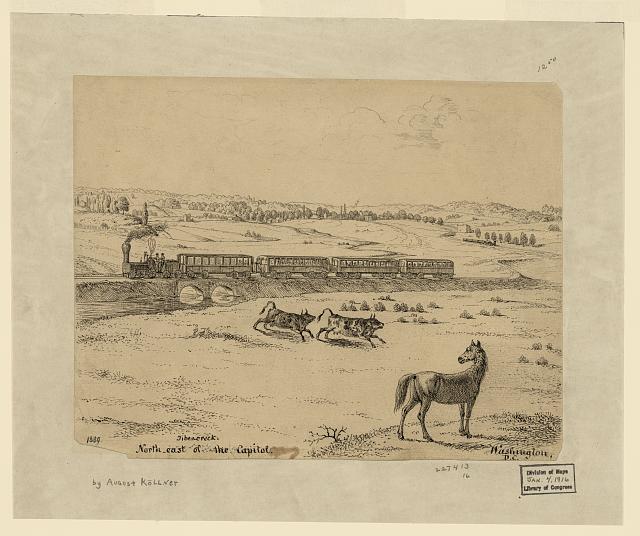
Kollner, Augustus, Artist. Tiber Creek north-east of the Capitol. Washington, D.C. Washington D.C. United States Tiber Creek, 1839. Photograph. https://www.loc.gov/item/2004662005/
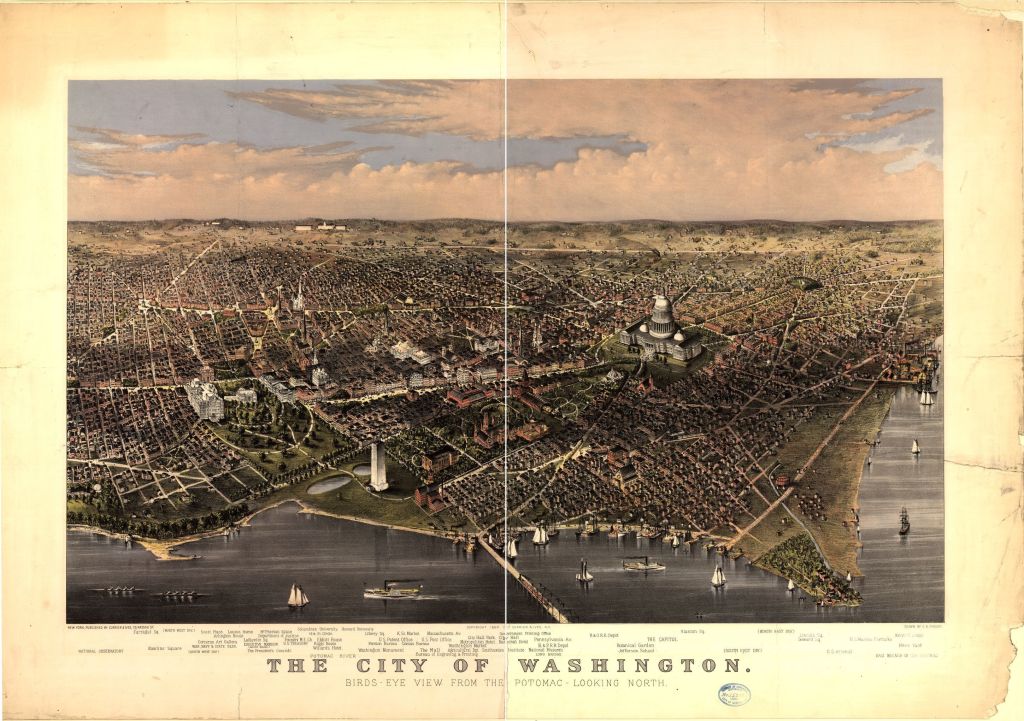
Currier & Ives, Publisher, and Charles R Parsons. The City of Washington birds-eye view from the Potomac-looking north / drawn by C.R. Parsons. United States Washington D.C. District of Columbia Washington, ca. 1880. New York: Published by Currier & Ives. Photograph. https://www.loc.gov/item/90716011/
Swampoodle
The Tiber Creek ran northeast of the Capitol, no longer a contained canal. When there were storms, the creek often flooded, washing away bridges and filling basements. Due to the swampy nature of this floodplain and the left behind puddles, the area near the Union Pr. Office was called Swampoodle.
In this rendering of Washington, Massachusetts Ave intersects with North Capitol Street near the center seam of the picture. The blocks north of this intersection was called Swampoodle and contained Jackson Alley.
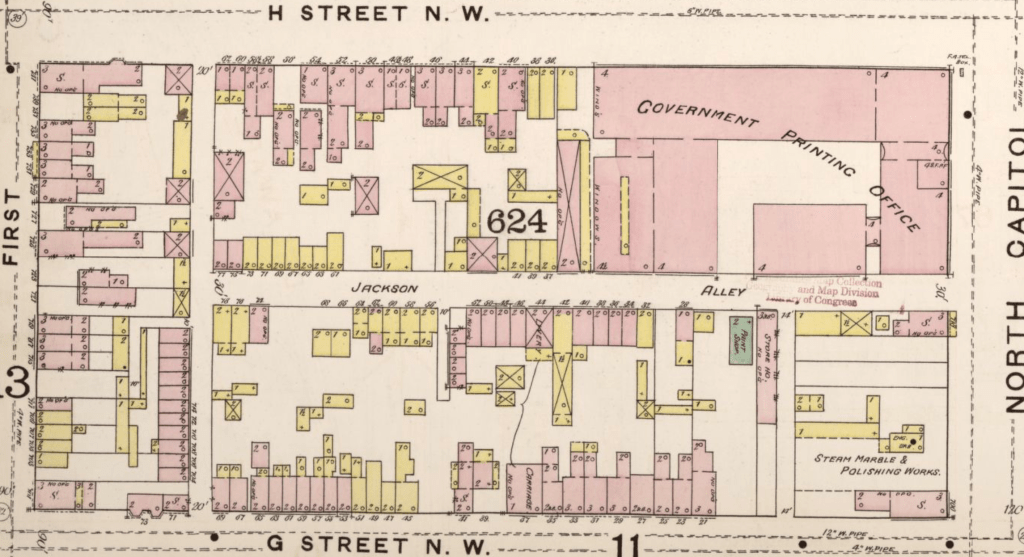
Jackson Alley was considered the heart of Swampoodle, and ran between G and H street, along the Printing Office. Originally an Irish enclave, when refugees from slavery arrived in the City of Washington during the Civil War, African-American families also found homes in Swampoodle.
1880 Census
In the 1880 Census, Thomas Reeder was recorded living with his family with Robert Childs and his family in 71 Jackson Alley. Thomas and his wife Martha had three children: Mary E, 10, Joseph, 8, and Georgiana, 4. Thomas and his wife, Martha, were born in Maryland while their children were all born in DC.
Mary E. is marked as having attended school.
The City Directories for 1883-1901 show Thomas living at various addresses in Jackson Alley; sometimes at #65, or #50, or #34. The variety of house numbers suggests that the Reeder family shifted as rent prices and space shifted in the alley. The excerpt from the Sanborn Fire Insurance maps shows the variation in size and that some homes were frame and some were brick. The end of the block near the Printing Office was more industrial in nature, containing a livery station, a factory and storehouse.












 stories of Then