at Her request: navigating the Unraveling of the macgill estate

the tapestry of macgill’s estate

The story of Polly is one of resistance against a world designed to commodify her existence. Sold from the estate of her long-time enslaver, she escaped her new owner in a daring attempt to re-stitch the torn fabric of her own kinship community. To understand her actions, one must first examine the complex tapestry of the world that sought to control her.

Dr. James Macgill, heir to his uncle of the same name, presided over a sizable estate in Prince George’s County in the 1830s. His 740+ acre plantation was stitched together from various land tracts along present-day Annapolis Road, a significant crossroads in the Vansville District (later Queen Anne District). The estate was bordered by massive operations: the Jesuit’s 2,000-acre White Marsh plantation, the Ogle family’s 2,000+ acre Bel-air estate, and the Bowie family’s 570+ acre Locust Grove. An 1828 tax list documents the human dimension of this operation, enumerating the 34 people Dr. Macgill enslaved: six elders, eleven adults, four adolescents, and thirteen young children under the age of eight.   

The 1828 Levy Court Road Survey details the estate’s strategic location, providing access to the Patuxent River and placing it in direct proximity to the Ogle’s Bel-air plantation—the community where Polly’s future husband, Peter, was enslaved.

 Road No. 1 [now-Annapolis Road]: Commencing at the Priests Bridge on the Patuxent, thence through the White Marsh Plantation; then through Bel-air, thence through the plantation of Dr. James Magill by the Forest Chapel, thence by Magruders Tavern…

Road No. 3: …across Collington Branch, thence with the plantations of William Ogle, James Magill, and Walter Bowie…
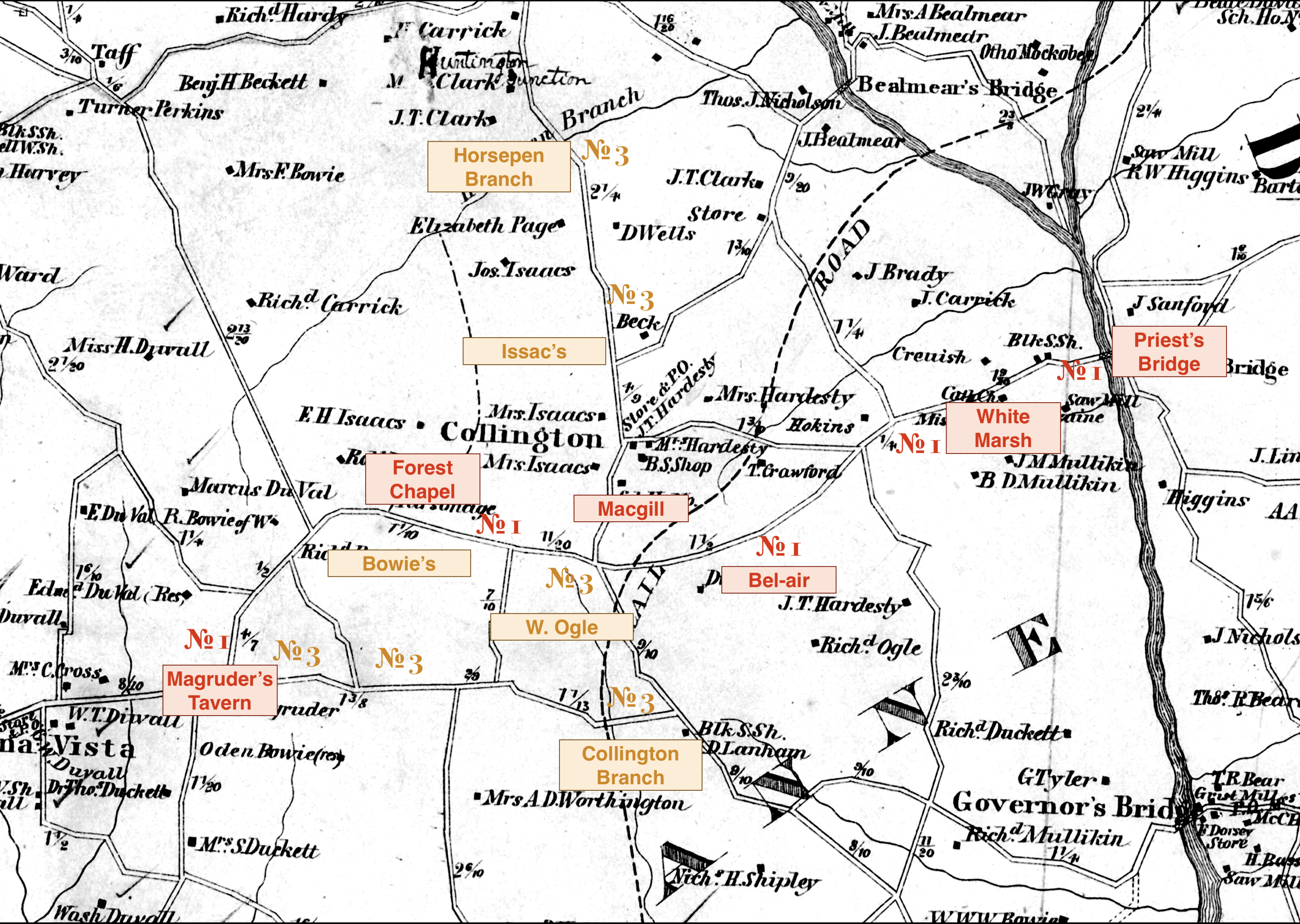
Using details from the 1828 Levy Court Road Survey, Martenet’s annotated 1861 map details the route of the area’s primary artery (present-day Annapolis Road), an economic corridor connecting the adjacent plantations of Macgill, Ogle (Bel-air), and the Jesuit’s White Marsh.

Married to Julia Ann Compton in 1829, Macgill also owned property in Anne Arundel County near West River Post Office and Samuel Carr, the husband of Mary Compton.  The property was situated in the First District along the road that led to Mount Pleasant Ferry, connecting Anne Arundel to Prince George’s County closer to Upper Marlboro, the county seat. The estates wove together the family’s interests across two counties, creating a broader and more complex tapestry of land and human property.

the Snag: the death of the patriarch (1840)

A decade after his marriage, Macgill’s impending death created a snag in the tapestry of his estate, and he composed his last will and testament, dividing his real and personal property among his wife and three born children, while making provisions for his unborn child.  Like his uncle, he dictated how the fabric of his estate was to be cut and divided, specifically naming different mother-child family groups and directing the heir who would acquire four family groups, with a third being conveyed to Macgill’s wife as her right of dower, and the unnamed “balance” going to James P. Macgill.   

ripped threads of kinship

Macgill’s division in his will ripped the threads of kinship among the community enslaved on his estates.  While he nominally kept mother-child groups together, Polly and her children were divided from her larger extended family.  As the wife of Peter, she became part of the larger Lee family group, and with Macgill’s will, she was separated from Harriet Lee and her children, Daniel, Oswald [Osborn], Caroline, Ann, and Amelia, who, while unnamed in the will, were named in the inventory and much later in the 1867’s Compensation List of Septimus J. Cook, the second husband of Julia Macgill.  Whereas, Polly and her children were conveyed to Thomas Macgill, the oldest son, who would also receive a sizable portion of the Prince George’s estate through provisions of the 1833 will of the older Dr. James Macgill.  Polly, Peter, their children, and the family of Harriet Lee were the threads that gave the plantation its texture and life. Macgill’s death subjected these threads to immense strain. They were stretched thin across counties, torn from one another, and tangled with new and unfamiliar threads.
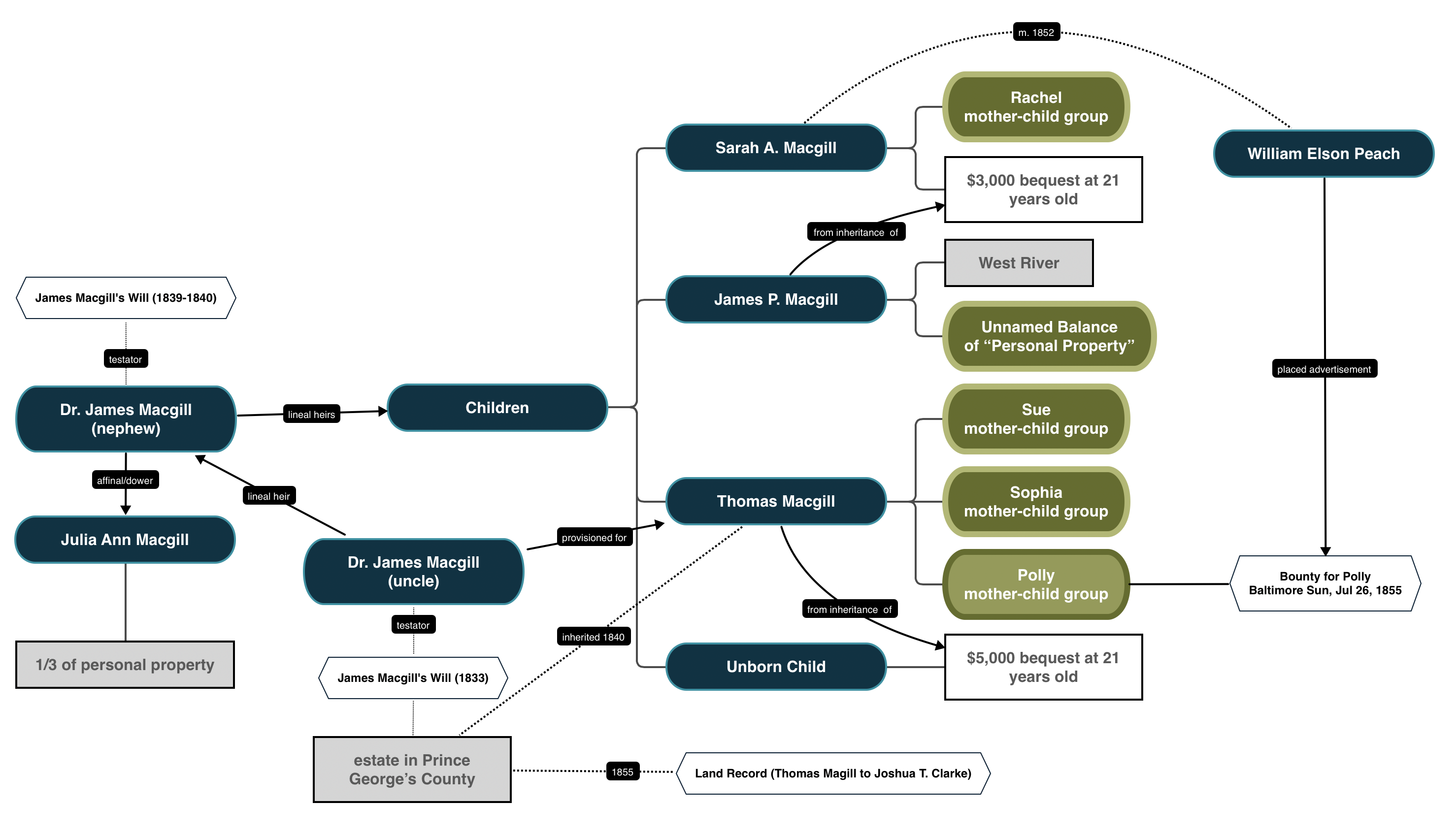
This diagram illustrates the legal fracturing of an enslaved community following the 1840 death of Dr. James Macgill. His will distributed specific mother-child groups, including those of Rachel, Sue, Sophia, and Polly, among his heirs, pulling the kinship network apart and setting the stage for future sales and separations.

threads of inheritance

The will, far from ensuring a smooth transition, pulled the tightly woven kinship community of the enslaved in three distinct directions. Each heir represented a thread pulling part of the tapestry away from the whole. These distinct lines of inheritance did not exist in isolation; they actively pulled the community apart, a process accelerated by the legal and personal entanglements of the heirs.

the dower of the widow: the cook connection 

Under Maryland law, Julia Ann Compton Macgill had a dower right to one-third of her husband’s property. This included the enslaved families Macgill designated for her, most notably Harriet Lee and her children. When Julia remarried to Septimus J. Cook in 1845, her dower portion—including Harriet’s family—was legally absorbed into the Cook household. This single act pulled an entire branch of the original enslaved community away, transplanting them into a new network under a new enslaver.

the son’s portion: the line of thomas macgill 

Thomas Macgill’s inheritance was anchored in Prince George’s County. As stipulated in two generations of wills, he received a large portion of the home plantation and legal ownership of Polly and her children. While this provision placed Polly in the community where her husband Peter lived, it rested on the financial acumen of the Magill’s guardians to maintain a sizable estate without need to sell off “assets” This thread represented the patriarchal line of succession from uncle to nephew to son.  

the balance of the estate: the line of james p. macgill 

The younger son, James P. Macgill, inherited the family’s Anne Arundel County property near West River, along with the “balance” of the enslaved people not otherwise assigned. This act created an immediate geographic fracture in the community, moving another group of individuals to a different county and physically separating them from the kinship network on the home plantation. This thread established the West River estate as a distinct, yet connected, Macgill holding—and created the destination Polly would later seek in her flight.

The division of human property among Julia, Thomas, and James P. Macgill set the stage for further disruption. The fifteen years that followed Macgill’s death were marked by a cascade of events—probate, remarriage, and death—that continued to unravel the fabric of the enslaved community.

unraveling in motion: 1840-1855

Multiple events occurred in the years after Macgill’s death that led to self-liberation of Polly in 1855.  First, there was the division of the estate as it traveled through probate, followed by the marriage of Julia Macgill to Septimus J. Cook and her subsequent death in 1846, and the re-division of her estate with her children’s.  There were sales to settle the debts of the estate.  Ultimately in 1855, Thomas Macgill sold his estate that inherited from his uncle to Joshua T. Clark, a neighbor and Justice of the Peace.  It is most likely this sale that prompted Polly to seek ways to weave a new beginning for her family. 

Polly’s design: weaving against the grain

The impending 1855 sale of the plantation from Thomas Macgill to Joshua T. Clark likely acted as the final catalyst. In response, Polly leveraged her social capital within the enslaver’s network to reach out to William Elson Peach, her late enslaver’s son-in-law. She initiated her own sale, requesting that Peach purchase her to ensure her continued proximity to her husband, Peter. However, while navigating this arrangement with Peach, she almost certainly utilized her own community’s social networks to connect with individuals who offered an alternative path. The “designing person” mentioned in the subsequent bounty notice suggests Polly was not merely seeking a new enslaver but was simultaneously orchestrating an escape. This was her attempt to gather the scattered threads of her own kinship and find lasting liberty beyond the reach of Peach, Clark, and the unraveling Macgill estate.

Sources

1828 Tax List, Prince George’s County

1828 Levy Court Road Survey, Prince George’s County

Marriage Records, for the Macgill-Compton union (1829) and the Macgill-Cook union (1845)

  • Maryland, U.S., Compiled Marriages, 1655-1850
  • Maryland, U.S., Compiled Marriages, 1667-1899

Last Will and Testament of Dr. James Macgill (the elder), 1833, PC 1:1

Last Will and Testament of Dr. James Macgill (the nephew), ca. 1840, PC 1:129

Probate Records, Estate of Dr. James Macgill (the nephew), post-1840, which would include:

  • Inventory and Sales Records of the Estate (PC 4:43, 57, 299; JH 1:20,107,268, 273)

Land Records, for the sale of the Macgill estate to Joshua T. Clark (ca. 1855); EWB 1:137

Newspaper Bounty Notice for the capture of Polly (1855), Baltimore Sun, newspapers.com

1867 Compensation List of Septimus J. Cook

paper trail’s Pulse: dissecting the search for Polly

The Baltimore Sun’s printer placed the ad in the last column of page 2, underneath a bounty for Peter Culver who had absconded with a “free boy, hired by me, named Alexander” and an ad for Ohio Flour.  

A historical advertisement from the 1850s offering a reward for the capture of a woman named Polly, describing her as a mulatto, not less than forty years old, last seen near West River.
“$150 REWARD,” advertisement. The Baltimore Sun (Baltimore, Maryland), July 29, 1855, p. 4. Accessed through Newspapers.com, July 10, 2025. https://www.newspapers.com/article/the-baltimore-sun/176173526/.
Transcription of Bounty

$150 REWARD WILL BE GIVEN FOR THE POSITIVE CONVICTION of any one who shall be guilty of harboring my NEGRO WOMAN POLLY, after a knowledge of this notice, whom I purchased lately of the estate of Dr. Magill.—As I have bought Polly through motives of pure humanity, and at her own request, that she might enjoy the society of her husband and relatives, I feel satisfied that she will come to me unless deceived by some designing person in relation thereto. POLLY is not less than forty years of age, a mulatto of neat and tidy appearance, and was last seen on West River. I will give Twenty Dollars if in Anne Arundel, or Thirty if elsewhere, to any one who shall convince her of the fact of my purchase and secure her to me. I also subjoin a certificate of Dr. OGLE, the owner of Polly’s husband. WM. E. PEACH, M. D., Queen Ann, Prince George’s co., Md.


I hereby certify that I have talked with PETER, the husband of Polly, and he says he is very anxious that she should come home to her master, Dr. Peach, immediately. Peter is in bad health and unable to leave the house. [jy25-St*] GEO. C. OGLE.

Within this mundane context of commerce and control, William E. Peach’s advertisement primarily sought the conviction of the “designing person” who “deceived” Polly and harbored her away from Peach who had purchased her “through motives of pure humanity” and while placing a bounty on the return of Polly so he could “secure her to me” almost as an afterthought.

the skeleton layer: who, what, and where

The basic facts of the notice form the skeleton of the story. In July 1855, Wm. E. Peach, M.D., living near Queen Anne in Prince George’s County sought the return of Polly, “not less than forty years of age” who was purchased from Dr. Magill’s estate.  In her escape, she was last seen near West River in Anne Arundel County.  He offered a tiered $20-30 for Polly’s return and a significantly larger sum of $150 dollars for the conviction of the “designing person”.  

the sinews layer: the network of kin and property

The names in the advertisement are held together by a dense network of marriage and property. William E. Peach, son of Queen Anne District landowner Samuel Peach, had married Sarah Alexander Ma[c]gill in 1852. Sarah was the orphaned daughter of Dr. James Ma[c]gill and Julia Ann Compton, having lost her father in 1840 and her mother in 1846. Her life was split between Prince George’s and Anne Arundel Counties. Before her father’s death, she lived on his 740-acre estate along present-day Annapolis Road, situated between the Jesuit’s White Marsh plantation and Magruder’s Tavern, adjacent to Bel-Air, the Ogle estate.

After Dr. Ma[c]gill’s death, Sarah’s world was destabilized. Her mother’s remarriage to Septimus J. Cook and her mother’s subsequent death resulted in Sarah and her sister, James Anna, being shuffled to Anne Arundel County to live with their aunt and uncle, Samuel and Mary Carr. The Carrs owned land near the Ma[c]gill property at West River, which had been inherited by Sarah’s brother, James P. Ma[c]gill. The 1839 will of Dr. Ma[c]gill had stipulated that Polly and her children be conveyed specifically to his other son, Thomas Ma[c]gill.

This 1861 map of the Queen Anne District illustrates the dense network of kin and property that defined Polly’s world. Highlighted are the lands of S. Peach (the family of her new owner, William E. Peach), Dr. Geo. C. Ogle (the enslaver of her husband, Peter), and Dr. Jas Macgill (her previous enslaver). The close proximity of these estates visualizes the community she was desperate to remain within, turning her flight into a calculated risk to preserve her family bonds.

the heart: her husband and relations

As the estate was divided and re-divided, first through the death of James and then through the death of James’ relict and again, as the children came of age, Polly, “a mulatto of neat and tidy appearance” watched as her extended family was separated, corralled and moved from estate to estate.  Individuals were sold to new husbands or liquidated to cover bequests and estate charges.

Amid this decade of instability, a transaction was initiated that would move Polly from her legal owner, Thomas Ma[c]gill, to his sister’s new husband, William Elson Peach. Seizing on this moment, Polly appealed directly to the young doctor, requesting that the terms of his purchase ensure she “might enjoy the society of her husband and relations.” Her husband, Peter, was enslaved by the Ogles at Bel-Air, the neighboring estate. According to a “certificate” from Geo. C. Ogle referenced in the bounty notice, Peter was “in bad health and unable to leave the house.” For Polly, a move away from the Queen Anne area would mean the permanent loss of her husband and the kinship network she fought to maintain.

the skin layer: the language of control and value

At “not less than forty years old,” Polly was an elder in her community. Her labor was likely shifting from fieldwork to tasks essential for the plantation’s maintenance: cooking, nursing, gardening, and sewing. In the logic of chattel slavery, Polly’s advanced age meant her external market value had diminished. This is starkly visible in the twenty-dollar bounty Peach placed on her body; he valued the conviction of the person who disrupted his power more than seven times higher than the return of Polly herself. Peach’s language paints him as a paternalist allowing Polly to “enjoy” her family, yet he simultaneously admits his authority is so weak that he needs help to “convince her of the fact of his purchase” and to “secure her to me.”

Daina Ramey Berry, in The Price for Their Pound of Flesh, discusses the range of attitudes toward elderly enslaved people. While the enslaved community valued their wisdom and the connections they fostered, enslavers saw only a diminished capacity for labor. This led to either “neglectful paternalism” or “disregarded isolation.” Polly, legally conveyed to an orphaned son whose estate was managed by a series of guardians and second husbands, had likely endured years of disregarded isolation as her value was debated in inventories and accounts. Sarah’s marriage to the paternalistic William Peach provided Polly an opportunity to navigate from disregarded isolation into neglectful paternalism. In this transition, she found an opening to assert her own agency.

the blood of the veins: the flow toward kin

Polly was likely living in the Queen Anne District on the former Ma[c]gill estate when Peach finalized her purchase. From there, she had access to travel lanes and turnpikes leading toward Washington, D.C., and the free states north of Maryland. Yet Peach’s ad reports she was last seen in Anne Arundel County near West River, a journey east, away from the most direct path to freedom. This eastward movement was not a mistake; it was a choice. It suggests Polly was seeking reunification with the family members who had been separated from her years before, when James Ma[c]gill first established his Anne Arundel property. Her journey suggests she was seeking reunification with children or other kin who, despite the legal lines drawn in the will, were physically located at the family’s Anne Arundel property. Her flight was therefore a calculated risk, flowing toward the heart of her kinship network, wherever it was located.


I want to acknowledge historians Daina Ramey Berry (The Price for Their Pound of Flesh) and Edward E. Baptist (The Half Has Never Been Told), whose scholarship was foundational to the anatomical metaphor used as an analytical tool in this research.

For those who wish to delve deeper into these topics, I highly recommend reading these books. You can learn more about them on Bookshop.org (I do not receive a commission from these links)

📍 wootton’s landing

Wootton’s Landing Neighborhood, located in the southeastern part of Queen Anne District, bordered the Patuxent River to the east and Marlboro District to the south. The neighborhood’s namesake, Wootton’s Landing, provided direct control for enslavers over the collection, storage, and transport of agricultural commodities produced by enslaved labor. Martenet’s 1861 map shows the landing situated south of Queen Anne Towne and near a mill. This area’s proximity to the Patuxent River, a vital waterway for connecting inland agricultural production to the global market system, and its shared border with Marlboro District, which contained the county seat of Upper Marlboro, underscored its economic significance in pre-emancipation Prince George’s County.

Excerpt from Simon Martenet’s Map of Prince George’s County highlighting Queen Anne District.
Edits by the researcher from original map sourced from Library of Congress.

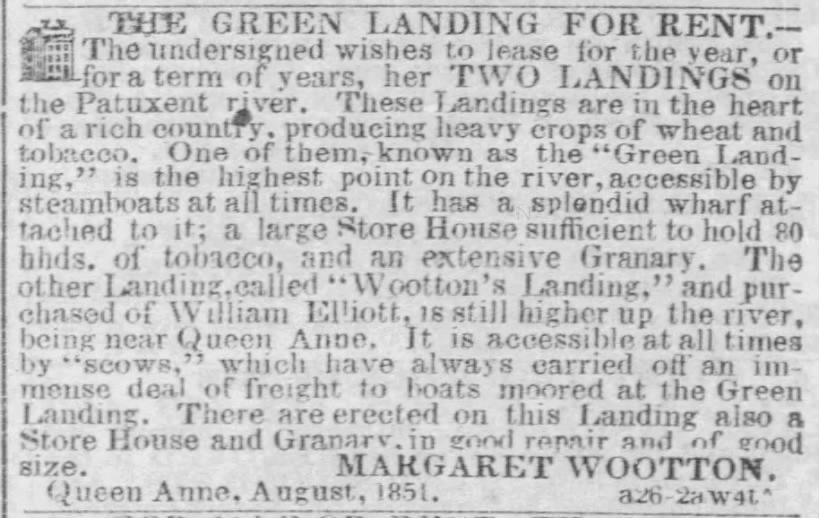
An 1851 advertisement placed by Margaret Wootton in The Baltimore Sun details the logistical importance of these riverfront properties. In seeking to lease her two landings, Wootton described them as being ‘in the heart of a rich country, producing heavy crops of wheat and tobacco,’ a direct acknowledgment of the output generated by the region’s enslaved workforce.  The landings had large stores and granaries to hold both tobacco and grain.  Some of the landings were accessible by steamboats, while others required scows, flat bottom sailboats to transfer the goods to the larger vessels likely traveling to Baltimore where merchants would handle the inspection, sale, and final shipment of the hogsheads to international buyers. 

advertisement
THE GREEN LANDING FOR RENT.– The undersigned wishes to lease for the year, or for a term of years, her TWO LANDINGS on the Patuxent river. These Landings are in the heart of a rich country, producing heavy crops of wheat and tobacco. One of them, known as the “Green Landing,” is the highest point on the river, accessible by steamboats at all times. It has a splendid wharf attached to it; a large Store House sufficient to hold 80 bhds. of tobacco, and an extensive Granary. The other Landing, called “Wootton’s Landing,” and purchased of William Elliott, is still higher up the river, being near Queen Anne. It is accessible at all times by “scows,” which have always carried off an immense deal of freight to boats moored at the Green Landing. There are erected on this Landing also a Store House and Granary, in good repair and of good size. MARGARET WOOTTON. Queen Anne, August, 1851.
Baltimore Sun, Sep 16, 1851 | newspapers.com

calvert nexus: influence and alliances in the Wootton’s Landing neighborhood

This economic significance was directly tied to the individuals who comprised the enslaver networks in the Wootton’s Landing Neighborhood, profoundly shaping agricultural production and commerce.  The enslaver networks of Wootton’s Landing were influenced by George Calvert (1768-1838), who married Rosalie Stier, and was one of the wealthiest landowners and enslavers in Prince George’s County during the Imperial Tensions Generation. 

The enslaver networks of Wootton’s Landing were dominated by figures like George Calvert (1768-1838), who married Rosalie Stier and, during the Imperial Tensions Generation, became one of the wealthiest landowners in the county. As a lineal descendant of Benedict Swingate Calvert of Mt. Airy, George Calvert inherited a vast portfolio of land that he consolidated into the Mount Albion plantation. This holding, totaling 2,233 acres, was composed of numerous tracts, including “Swanson’s Lot,” “Part of Coolspring Manor,” “Addition to Leaving,” “Griffith’s Purchase,” “Part of Cuckolds Delight,” and “Part of Riley’s Landing,” among others, firmly rooting his economic power in the Wootton’s Landing neighborhood.The 1798 Federal Direct Tax provides a stark inventory of the infrastructure required for such an operation. On this land, Calvert maintained a frame dwelling house, a kitchen, a ‘brick cow house and stables,’ a large corn house, and, critically, an overseer’s house and 14 quarters for enslaved people. This collection of buildings documents a large, forced-labor camp designed for the mass production of tobacco and other crops. The tax list assessed Calvert for 69 enslaved people, making him the largest single enslaver in the Patuxent and Horsepen Hundreds. The scale of his operation, built on the labor of these 69 individuals, surpassed even that of the Jesuit-owned White Marsh plantation managed by John Ashton.