In another set of posts, I explore the lives of Richard (Dick) and Mary (Polly) Jones, who were enslaved by the Waring Family in Queen Anne District of Prince George’s County, Maryland.
Connected Post: Richard & Mary Jones | Old Age
In this post, I explore the possible series of transactions that may have resulted in Richard (Dick) Jones being held in captivity by Marsham Waring (d. 1860) and his children. Richard’s name is not listed in the 1813 inventory of Waring’s father, Marsham Waring senior, and so I propose that he may have been transferred from Stephen West’s estate; West was a manufacturer during the Revolutionary War who operated the Woodyard. Or he may have been transferred from the Lansdale family who were Waring’s in-laws.
This post, on the other hand, explores a different Richard (Dick) who was enslaved by the Waring family and most likely did not survive into old age like Richard (Dick) Jones.
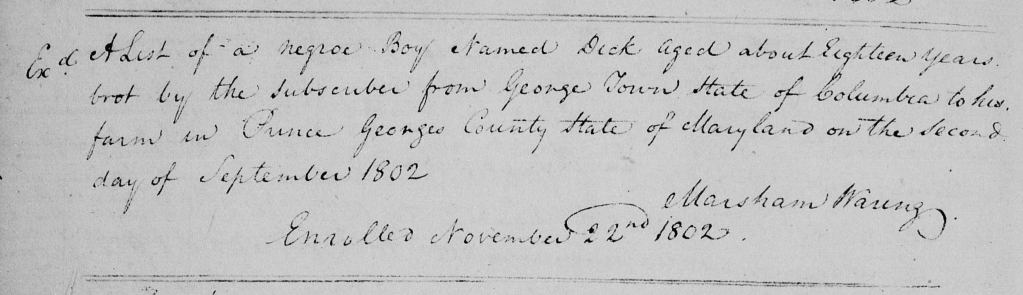
In 1802, eleven years prior to the senior Marsham Waring’s death, Waring recorded a “list” of enslaved people he brought from Georgetown to Prince George’s County. The list consists of a single name: a “boy” named Dick about 18 years old. Tax Assessments from 1800-1802 show that Marsham Waring was assessed for “2 negro boys” at his Georgetown residence– Richard (Dick) was likely one of the two listed in the tax record.

Eight years prior to this, Marsham Waring (senior) was recommended by David Stuart to George Washington for a position in the planning of the newly formed capital in the District of Columbia. In Stuart’s letter to the President, he described Waring as “a respectable sensible Merchant of Ge: town, who has never intermixed with any of the parties…As you are totally unacquainted I believe with Mr Waring, it may be necessary to say something more respecting him—he has been long an inhabitant of Ge: town, and some of his relations (I believe his brother) possessed large property in the city, but has sold out—he is universally well thought of, as a man of character, good temper and understanding.” Waring was also a Director for the Bank of Columbia, established in 1794.
It appears that while Waring did business in Georgetown in the 1790s, he soon moved from the District to his estate in Prince George’s County as evidenced by the document notating his removal of Richard (Dick) from Georgetown to Prince George’s County.
It may have been a shift in culture for Richard (Dick). It is unclear what his role was in Georgetown, being forced to labor for Waring either at his residence or place of business. However, an advertisement ran by Waring in 1794 may give a clue to the types of tasks Waring forced from those enslaved.
50 DOLLARS REWARD, RANAWAY very unexpectedly from the subscriber, on Saturday the 11th October, a Mulatto man named George, by his acquaintances called George Evans, about 25 years old, 5 feet 9 or 10 inches high, straight and well made; he has long bushy black hair, which he commonly wears queued his cheek bones rather high, his laugh simple, he has always served as a waiter was a favorite servant, and spoiled by excessive indulgences, understands dressing and shaving, and plays well on the violin, he took with him a brown fustain coatee and jacket, bound with yellow silk ferret, a pair of light coloured sagathy breeches and half boots; as he had many other cloths of cloth and light summer wear, it is probable he may change his dress. It is supposed he has crossed over to Virginia. Whoever secures the above man, shall receive the above reward, and reasonable charges, if brought home. All masters of vessels will receive him on board at their peril. MARSHAM WARING. George-Town, (in Columbia) Oct. 16, 1794.
Virginia Gazette and General Advertiser, October 29, 1794

