Nancy Fletcher | Widowhood

James Stewart (Jr) and his wife, Ann (Nancy) Fletcher, liberated themselves during the Civil War from their enslavement in Prince George’s County. Nancy was enslaved by Marsham Waring and his heirs, while her husband was enslaved by Waring’s brother-in-law, Benjamin Lee. Both Waring and Lee were large landowners along the Western Branch in Queen Anne District. 

Following the abolition of slavery in the District of Columbia in 1862, neighboring enslaved individuals seized an opportunity for freedom. Despite monitored roads and patrols, many fled their bondage and headed toward the District. Barbara Jeanne Fields highlighted in her book, Slavery and Freedom on the Middle Ground that “Many an ex-fugitive later reported having left Maryland for the District during or after the spring of 1862. Families packed up such of their possessions as could be compactly assembled and departed, sometimes appropriating means of transportation from their owners.” (111)

Camps emerged in and around the District to accommodate these incoming refugees from slavery. One such camp, Camp Springdale, comprised of tents on the grounds of the “Arlington Estate,” owned by Robert E. Lee’s wife. James and Nancy Stewart were recorded as residents of Camp Springdale in 1864 along with their three children: John (Henson), George (Anthony), and Frances. During this time, Nancy was a new mother, taking care of her infant daughter and her older sons. 

Freedmans village–Greene Heights Arlington, VA. | loc.gov

James and Nancy survived the war with their sons. After the war, they are living in the District, as recorded by the 1870 Census. Living in Ward 5, James is working as a scavenger while Nancy is “keeping house”. Scavenger is a euphemism, like night-soil man, for a person who collected human waste from households and transported the waste away from residential areas. The Evening Star reported in 1869, that because there was no designated place for depositing the “night soil”, it was dumped into the Potomac, the Tiber creek and the Canal. 

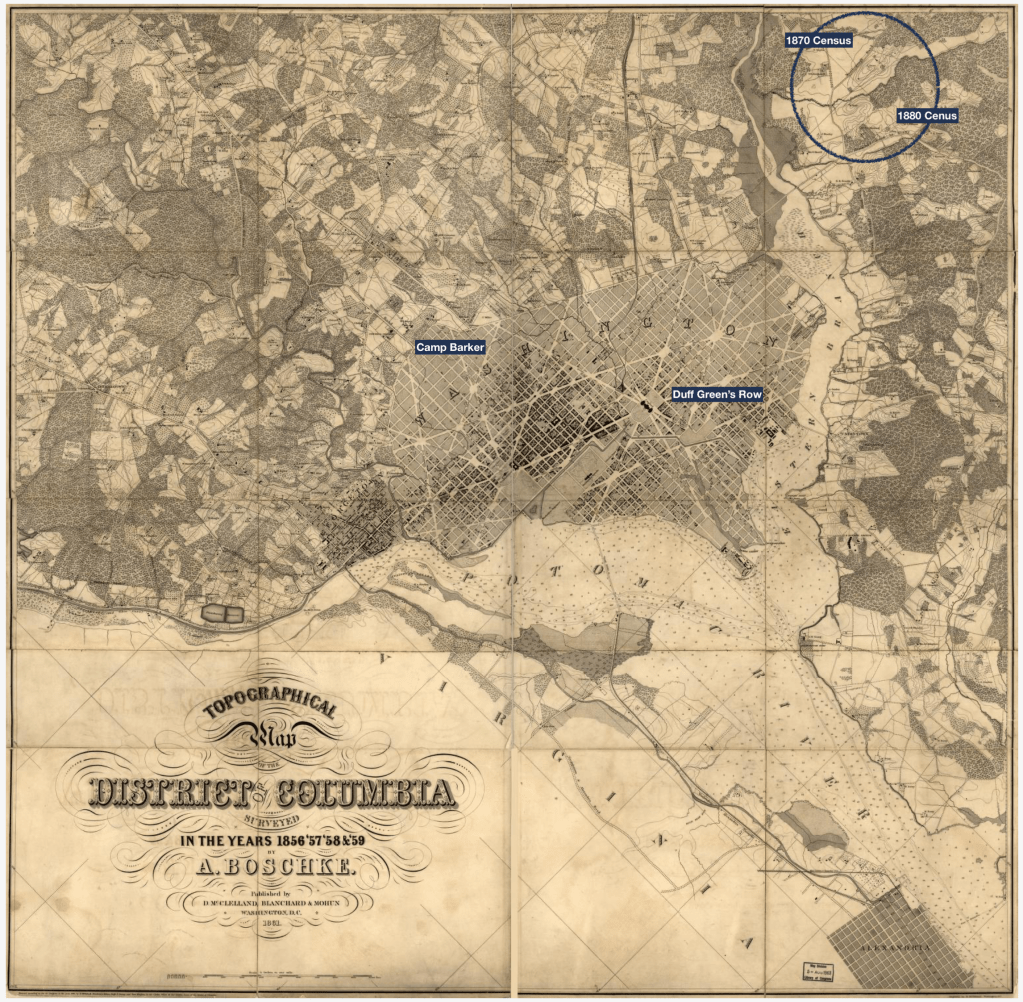
The 1870 Census did not record addresses or street names (like in later census records), however, by comparing names in the Census to the City Directories, a more precise location can be determined. The Stewart Family is enumerated immediately after Benton Russ, a guard at the Jail; in the City Directory, Benton Russ is recorded as living at 2d and A NE, near the location of another refugee camp, Duff’s Green Row. 

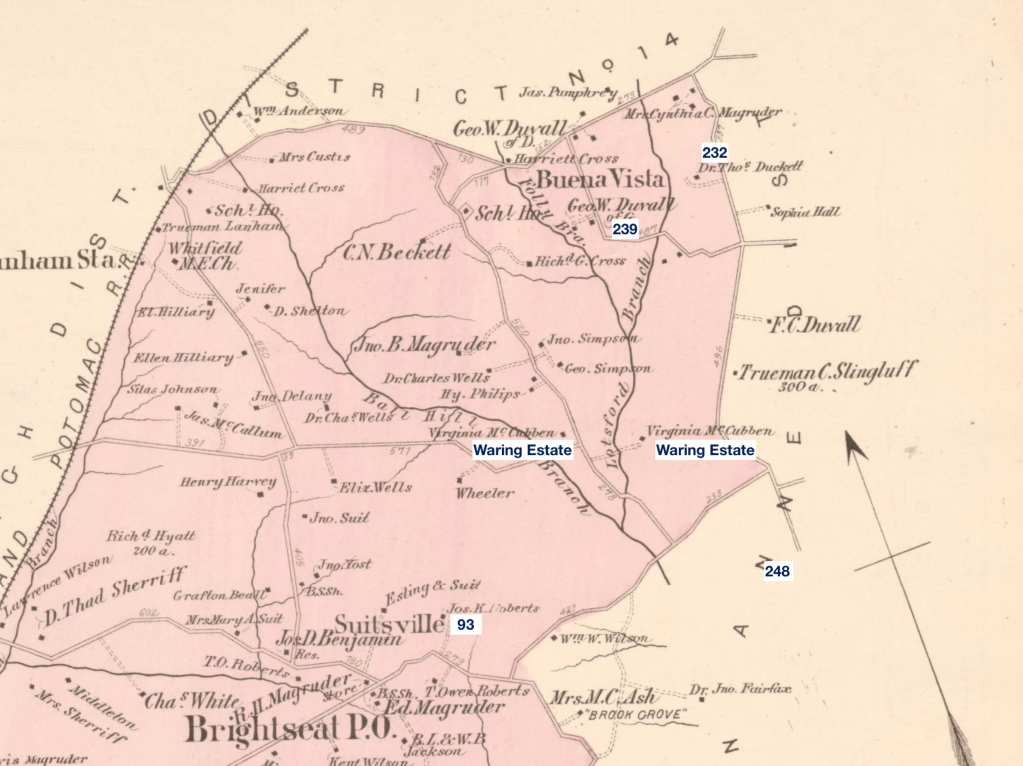
By 1880, the family appears to have been split up by economic necessity. Three separate census records have been identified that appear to represent the family based on the geographic proximity to their 1870 address of 2d and A NE. Nancy is living at 107 2nd NE while Ella and John Henson are working as servants at nearby addresses.  George Anthony has yet to be found. 

Nancy Stewart is enumerated in her household, a widow. Ella, age 12, is working as a servant at 18 2nd Street NE in the household of Isaac Bassett, a doorman at the Capitol Building. Both addresses are clustered around the intersection of A St NE and 2nd St NE.

(John) Henson Stewart is working in the household of Mary J Wheeler, who lived at 136 Pennsylvania Ave SE, which was at the the intersection of Independence Ave SE (then B St SE) and 2nd St SE. Essentially, Nancy and Ella lived by the Supreme Court and John Henson Stewart lived by the Library of Congress, a few short blocks away with East Capitol Street separating them. 

On the other hand, George (Anthony) is much more elusive. George Stewart was a common name and several men with the name were working as servants in city; none were near George Anthony’s family members. In 1885, a city directory entry records Anthony Steward living as a laborer at Bassett Alley NE, which is one block north of where Nancy Stewart was living in 1880. 

By 1900, Nancy Stewart has moved east of Lincoln Park and is living at 15 Fitzhugh Court, SE with her two sons: John and George A. She is living with Mary Jones, who is listed as her sister in the census record. 

Although the census lists inaccurate ages for them, shaving decades off of their ages, the address aligns with other records that suggest the high probability that this is the same family. The following records support this connection:

  1. 1907 City Directory entry for Nancy Stewart, wid. James, residing at 15 Fitzugh Court SE
  2. 1910 Census Entry for Nancy Stewart and John at 15 Fitzhugh Court, the age of Nancy is 71, aligning more closely with previous records. 
  3. 1919 Death Record for a widowed Nancy Stewart living at 15 Fitzhugh Court, with burial in Mt. Olivet, a Catholic Cemetery

Eliza Stewart

In 1830, Eliza Stewart was held in the prison in Washington County, District of Columbia. She was listed as 16 years old, wearing a country cloth frock, linen shift, and coarse shoes.

Burr, the jailor, advertised for her return to her enslaver: Joseph Wilson living near Bladensburg in Prince George’s County, Maryland.

(Daily National Intelligencer, DC, 12 April 1830)

From the age in the advertisement, she would have had an estimated birth year of 1814. Approaching puberty and her child-bearing years, it would have been an anxious time for Eliza Stewart. Enslavers often sold adolescents as the market valued the labor extracted from people aged 14 to 40. And as enslavers valued women who could be breeders to increase their chattel, the likelihood of sexual assault grew as well. While the advertisement omits much about her specific motivations, freedom from a system that reduce her to property and subject to abuse would motivate many to seek liberation.


Three years later in 1833, enslavers in Prince George’s County had their personal property assessed and the names of the people they enslaved were listed in the tax books. Joseph H Wilson had two women who were named with the diminutive “Bet“. One was given the external market appraisal value of $60, the other $120. These values, imposed on the women by men who commodified their bodies as property, allow us to estimate their age in 1833.

Elizabeth (Bet), appraised at $60, is likely either a small child between the ages of 3 and 6 or an elderly woman between the ages of 50 and 60. She was the first female listed which suggests that she was one of the oldest women on the estate. Usually at this age, the enslaved were no longer forced to labor in the fields, rather they took on labor roles that could be considered caretaker roles: cooks, nurses, midwives, seamstresses, caretakers of children. This Elizabeth is unlikely to have been the much younger Eliza Stewart who escaped to the District.

Elizabeth (Bet), appraised at $120, was likely between 6-10 years old, almost a full decade younger than the Eliza advertised in 1830.

This suggests that Eliza may not have returned to Wilson and instead was likely sold with other captured Black people into the domestic slave market, as the District was central to the forced migration of enslaved people from the Chesapeake Slave Society to the Deep South and the cotton plantations.

Joseph H. Wilson, the enslaver of Eliza Stewart, was married to Amelia Virginia Weems in 1825, five years prior to Eliza’s capture in 1830. Her brother, Nathanial Chapman Weems, Jr., owned a cotton plantation in Rapides Parish in Louisiana, after he migrated from Maryland to the Louisiana in the 1830s. While his migration was after the personal property assessment and the advertisement, it suggests the possibility that she was removed from Maryland and sent south.


Eliza Stewart is of interest due to her family name. The slave-holding Wilson family owned property in Prince George’s County near Northhampton, the Sprigg estate as well Marsham Waring and Benjamin Lee’s estates. Marsham Waring and Benjamin Lee both enslaved members of the Stewart family. Waring enslaved James Stewart, born around 1805, as well as Patrick and Notley who were born later in the 1820s. Eliza Stewart, with an estimated birth year of 1814, could be a sister or cousin of the Stewarts enslaved by Waring.

Patrick Stewart of Seat Pleasant


See “the many Patrick Stewarts” for the introduction to why this post was written.


Patrick Stewart of the Marsham Waring Inventory was 40 years old with an estimated birth year of 1820. Patrick Stewart of Seat Pleasant was 37 in the 1870 census, with an estimated birth year of 1833. It seems unlikely that they are the same Patrick Stewart. And as Patrick Stewart of Seat Pleasant is followed through the census records, it becomes even more unlikely that he is the Patrick Stewart of the Marsham Waring Inventory. In 1880, he was listed at 40, which shifted his birth year from 1833, to 1840, two decades after the Patrick Stewart of the Inventory was born; the same for the 1900 census, where he was listed as 60, making his birth year around 1840.

After Emancipation

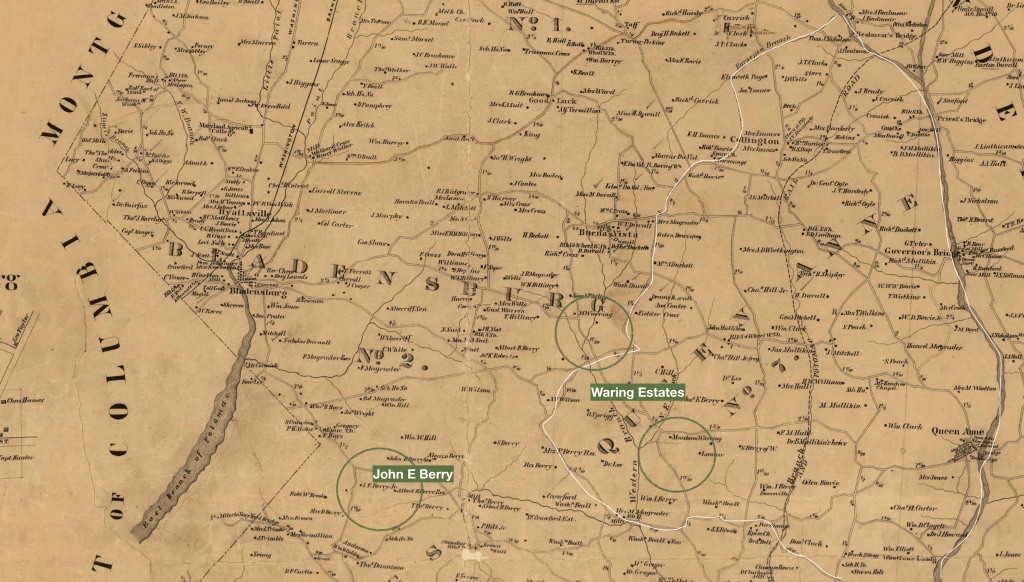
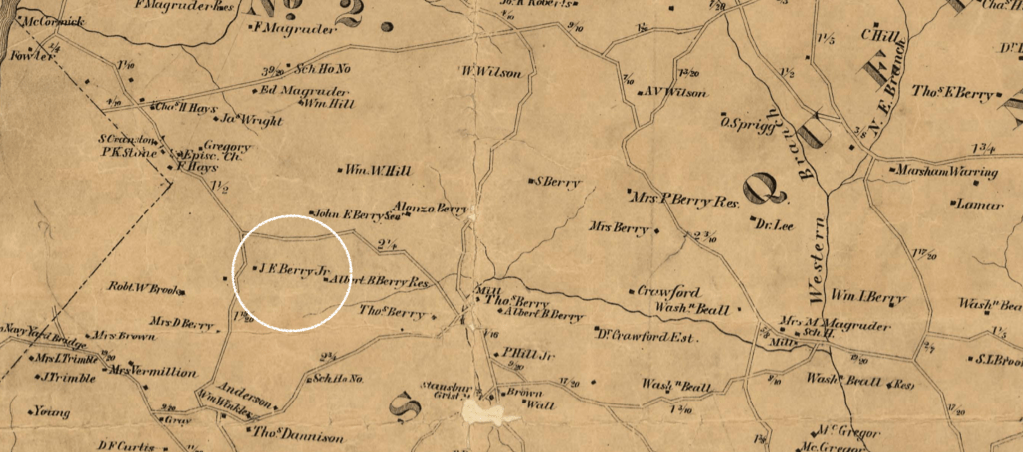
In the 1870 US Census, Patrick Stewart and his wife, Lidia, are living near John E. Berry, the son of Dr. John E Berry. They are near the intersection of what is now Addison Road and Central Avenue in Seat Pleasant.

In 1880, Patrick Stewart is still living in Kent, the district formed from Bladensburg. In his household is Patrick and Mary Stewart, an elderly couple. Patrick is listed as 70 years old and Mary is listed as 65. They are most likely his parents. Patrick is enumerated as Pat. Hen., which is consistent with the land record that is recorded in 1892.

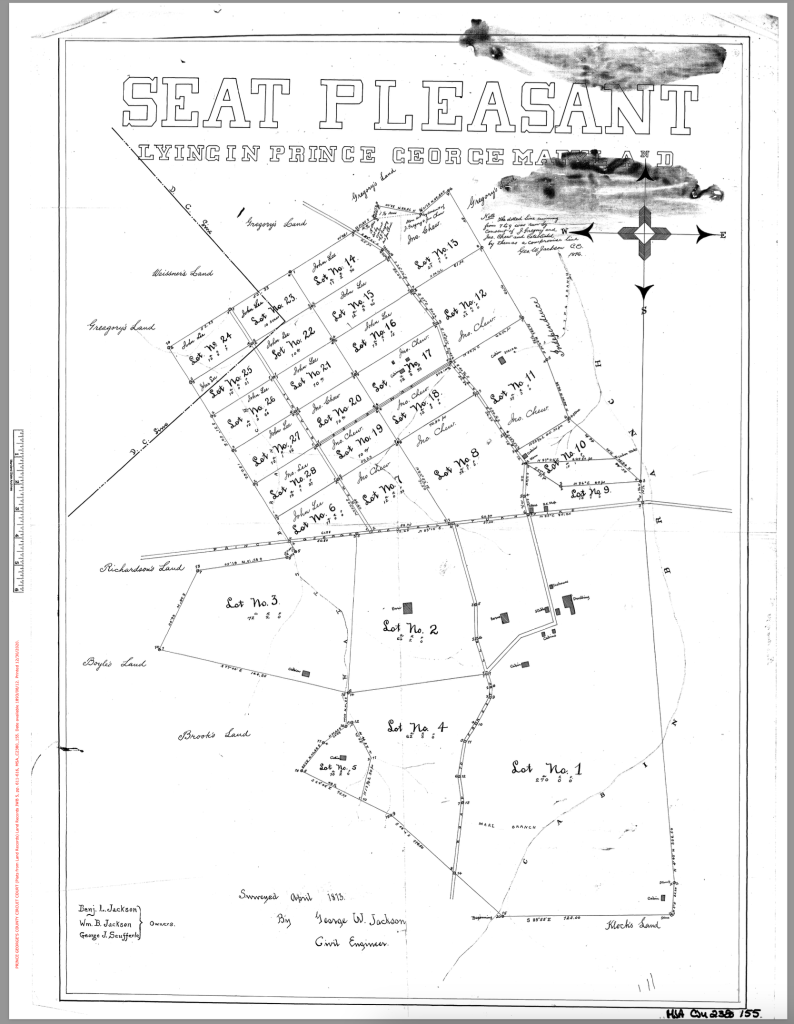
Patrick Henry Stewart purchased Lot #5 of the Seat Pleasant subdivision.  The land contained about 10.5 acres.  He paid $350 for the lot. (JWB 22:262; mdlandrec.net)

The land was situated near the corner of DC in the portion of Bladensburg District which was used to create the Kent District in the 1870s.  It sat on the former land of John E Berry, Jr., an enslaver and landowner in Prince George’s County prior to the Civil War.  Berry, Jr., purchased “Seat Pleasant” from his relative Thomas E Berry. At the close of the Civil War, the land was sold to real estate developers who created the town of Seat Pleasant.  Berry’s father, Dr. John E Berry, Sr., had a nearby plantation called Independence, and Berry’s brother, Albert B Berry had a farm called Sunnyside in addition to his other real estate holdings.

MSA_C2380_155_Jackson Plat of Seat Pleasant | Maryland State Archives

The survey of Seat Pleasant was completed in 1873.  In addition to detailing the lots, it marks what is likely the Seat Pleasant dwelling house and marks several cabins on the land, which may have be slave dwellings occupied by freedmen after manumission.  

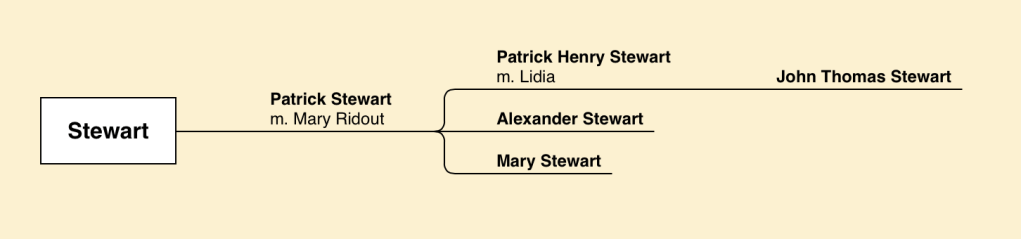
A death certificate records Patrick Stewart’s death in May 1929, when he died from “entero-colitis”. It lists his occupation as farmer and at the time of his death, he was living in the District at 30 H Street NE, the household of John Thomas Stewart, his son. The death certificate also lists his parents as Patrick Stewart and Mary Ridout, names consistent with the 1880 census.

Before Emancipation

Prior to emancipation, Patrick (Henry) Stewart was enslaved by John E. Berry, who submitted a compensation list to the 1867 Commission on Slave Statistics; Berry was also the landowner of Seat Pleasant. Patrick (Henry) Stewart was listed as 20 years old, giving him an estimated birth year of 1845. Also enslaved by John E Berry is Mary Stewart (II), who was 38, born about 1827.

John E. Berry also submitted a list as administrator of the estate of Albert B Berry, his brother, who owned adjacent land. On the list submitted for A. B. Berry are Mary Stewart (I), age 58, and Alexander, age 22. Working from the assumption that Mary Stewart (I) is Mary Ridout, this allows us to expand the outline of the family. I wrote another detailed post about Mary Ridout and her connection with other Ridout Branches (and therefore the Stewart family).

In brief, Mary Ridout is likely related to Ridout Family Group enslaved by the Sprigg Family (Northhampton) and Waring Family. The Sprigg family enslaved Margaret (Brooks) Ridout who was the inferred mother of Barbara Ridout who married Joseph Jones, both enslaved by the Warings. Many of the Ridouts can be found in the vicinity of Seat Pleasant after emancipation. This suggests the likelihood that Mary Ridout was married to Patrick Stewart of the Waring estate.

Disambiguation

Patrick Henry Stewart of Seat Pleasant is too young to be Patrick Stewart of the Waring estate and he can be found in the compensation lists of John E Berry with other relatives. However, Patrick Henry Stewart is the son of Patrick Stewart of the Waring Inventory, as evidenced by the direct evidence of his death certificate which names his father and his mother’s family name. His mother’s family name, Ridout, provides indirect evidence that there were connection to the Stewart estate.

Patrick Stewart of Hillsdale


See “the many Patrick Stewarts” for the introduction to why this post was written.


Patrick Stewart of Hillsdale was originally considered as Patrick Stewart of Queen Anne District due to his age and geographic location in the 1870 Census. The 1870 Census gave his age as 50 [1850] which makes him the same age as Patrick Stewart of Queen Anne District. Additionally, he was residing in Hillsdale, a community of freed Black people that had escaped to the District like Patrick Stewart of Queen Anne District had.

However, a review of further records related to him suggests he was not from Queen Anne District, but rather southern Prince George’s County and Charles County, Maryland.

After Emancipation

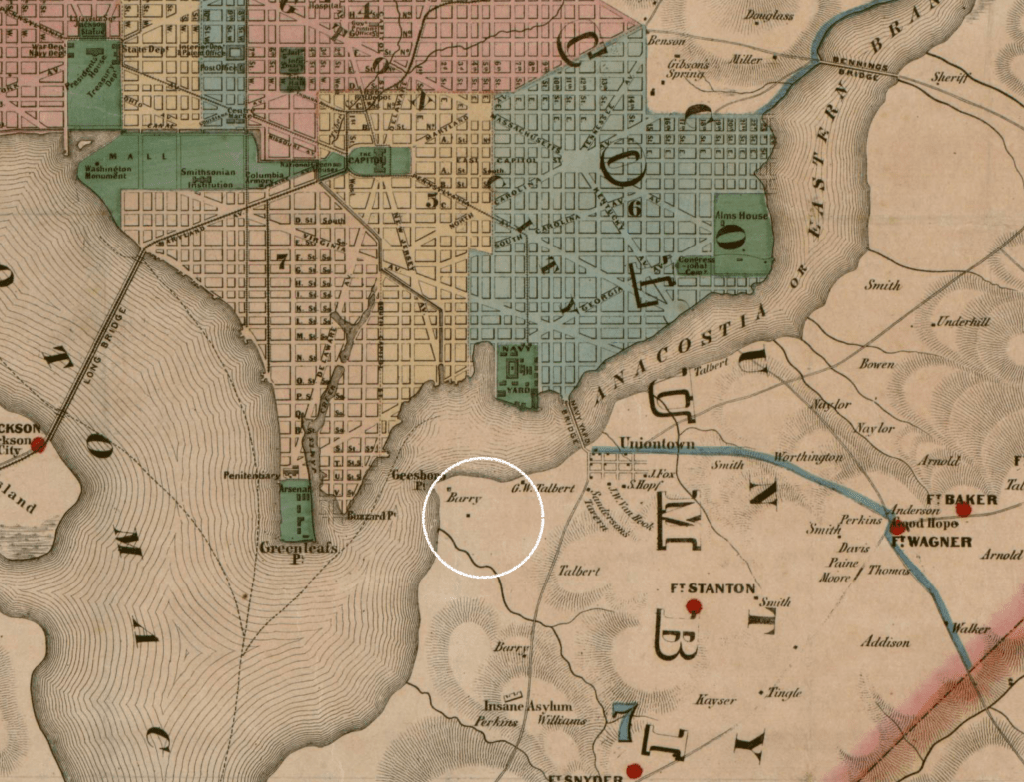
In the 1870 Census, Patrick Stewart is living in Hillsdale, a community of freed Black people, originally known as Barry Farm and run by the Freedmen’s Bureau.   It was called Barry Farm as it had been built on a 375 acre of land that had been owned by the Barry family. 

Topographical map of the original District of Columbia and environs showing the fortifications around the city of Washington | loc.gov

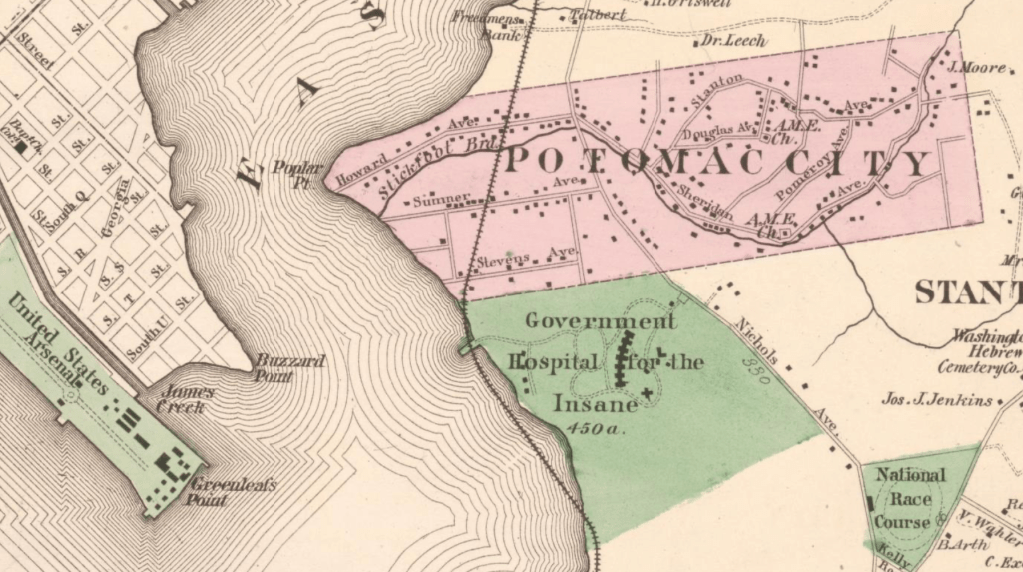
The 1878 Hopkins Map shows it as Potomac City.  An act passed in 1873 changing the name of “Barry Farm, or Potomac” to Hillsdale in 1873.  Charles R Douglass, a relative of Frederick Douglass, was a political leader within the Hillsdale community.  Douglass was enumerated at dwelling number (DN) 602; Patrick Stewart at DN 599.

Atlas of fifteen miles around Washington, including the County of Prince George, Maryland | loc.gov

In 1870, Patrick Stewart was not listed in the Washington, DC City Directories. He appeared in the City Directories in 1875 as living on Howard Avenue, in Hillsdale. Howard Avenue is situated in the northwest portion of HIllsdale, running parallel to Stickfoot Branch.  An 1867 Tax List ran in the National Republican and cited “Whole Tax on lot 38 and improvements in section 9, in Barry Farm subdivision, assessed to Patrick Stewart, $5.25”. 

Map of the division of the north half of a tract of land called “St. Elisabeth,” situated on the east side of the Anacostia River in the county of Washington, D.C. : surveyed into one acre lots for sale to freedmen | loc.gov

This lot sat on the end of Howard Ave along the river and was larger than the other 1 acre lots.  The acreage most likely allowed Patrick to ply his trade as a carpenter.  

“In order to purchase property, entire families worked in the city all day and walked at night to Barry’s Farm to develop their land and construct their homes by lantern and candlelight. As one man described it, ‘the hills and valleys were dotted with lights. The sound of hoe, pick, rake, shovel, saw and hammer rang through the late hours of the night.’” 

The Anacostia Story (1977) | Louise Daniel Hutchinson

In the 1870 Census, Patrick Stewart is living with his wife, Caroline, and his children: Julia, Georgie and Joseph.  They are also living with Henry Stewart, age 93.  Presumably, Henry is Patrick’s father. 

Two of the children, Julia and Georgie, were born prior to emancipation.  Joseph was born after emancipation and when the family was living in the District.

Before Emancipation

George Morton, a landholder and enslaver from the Eighth District, submitted a compensation list that included Caroline Stewart, Julia and Georgiana, as well as an older and younger daughter, who do not appear in the 1870 census with Patrick and Caroline. 

Prince George’s Slave Statistics | Maryland State Archives

The Eighth District was in the southernmost part of Prince George’s County, along the boundary with Charles County.  George Morton is shown on the Martenet Map as holding land east of Woodville. 

Martenet’s Map of Prince George’s County, Maryland. | loc.gov

Maria Stewart Briscoe

Maria Briscoe and her two children Henrietta and Ben Briscoe are enumerated immediately following Caroline Stewart and her named children in the 1867 compensation lists for George Morton.

Prince George’s Slave Statistics | Maryland State Archives

Like her parents and siblings, Maria and her partner, Richard Briscoe, left the Aquasco area and purchased a lot in Hillsdale. Richard Briscoe was assessed for his lot: “Whole Tax on lot 35 and improvements in section 8, Barry Farm Subdivision, assessed to Richard Briscoe, $4.13”  His lot was near but not adjacent to the Patrick Stewart lot.

Map of the division of the north half of a tract of land called “St. Elisabeth,” situated on the east side of the Anacostia River in the county of Washington, D.C. : surveyed into one acre lots for sale to freedmen | loc.gov

Both Richard Briscoe and Patrick Stewart were carpenters; many skilled workers found lots in Hillsdale.

Maria’s death record records her parents as Caroline Wood and Patrick Stewart and her husband as Richard Briscoe.  Her transcribed death record inaccurately records her age as 61.  Based on the emancipation records, she was in her eighties, which is consistent with her 1920 census record. 

Mattawoman Baptismal Records

In a no longer extant parish, “Upper and Lower Zachiah and Mattawoman”, there were three chapels:

  1. A private chapel on the estate of William Boaman (near Bryantown) in Lower Zachiah
  2. A chapel on Thomas Reeve’s land on the Upper Zachiah (later St. Peter’s parish in Waldorf)
  3. A chapel “located south of the later parish of St. Mary’s in Piscataway”
Topographical atlas of Maryland: counties of Calvert, Charles and St. Marys. | davidrumsey.com

There are three baptismal records in the Maryland, U.S., Births and Christenings Index, 1662-1911 Database associated with “Roman Catholic, Mattawoman, Charles, Maryland”.  

  • 25 Apr 1857, the baptism of Julia Stewart, daughter of Patrick Stewart and Caroline
  • 8 May 1859, the baptism of Georgiana Stewart, daughter of  Patrick and Carolina
  • 27 Jun 1859, the baptism of Henrietta Briscoe, daughter of Richard and Marg Briscoe

Disambiguation

Despite Patrick Stewart having a similar birth year, and reasonable 1870 residence, he is not Patrick Stewart of Queen Anne District. He was a carpenter from southern Prince George’s County and northern Charles County.

Robert Stewart | Patriarch

This post explores the possibility that Robert Stewart is the patriarch of branch of the Stewart Family Group enslaved by Marsham Waring near Buena Vista and Woodmore along the border of Bladensburg and Queen Anne Districts in Prince George’s County.


Background Information

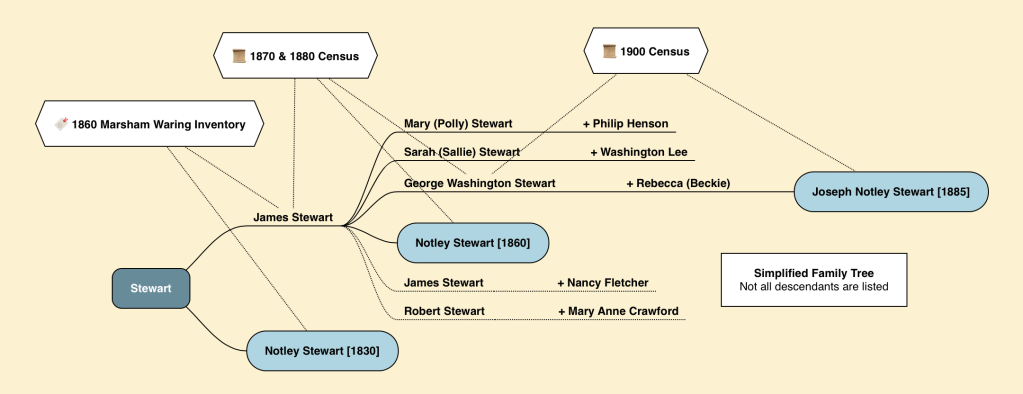
Marsham Waring died in 1860 and in the inventory of his estates are three adult males named James, Patrick and Notley. The men are enumerated with round ages of 50, 40, 30, suggesting that the listed ages are not precise ages, rather estimated. After the Civil War, the heirs of Marsham Waring submitted compensation lists to the 1867 Commission on Slave Statistics in hopes of being compensated for the emancipation of their “personal property”. While compensation never occurred, the lists provide the given and family name of people enslaved; the three men are listed with the family name Stewart.

During the Civil War, Patrick and Notley Stewart escaped Prince George’s County for the District of Columbia, where slavery had been abolished in 1862 with their extended kin group. James Waring, the son of Marsham Waring, filed an affidavit seeking the return of the refugees to his captivity in May 1862.

The relationship between James [est. 50 | 1810] and the other two men, Patrick and Notley, has been ambiguous due to a lack of definitive records stating a relationship between the men and due to the rounded ages. The thirty year gap between James and Notley leaves open the possibility of a son-father relationship, brother-brother relationship, uncle-nephew relationship, and no doubt other less likely relationships.

Post-Civil War records for Patrick Stewart are ambiguous as there are multiple Patricks with a wide range of birth years. A post seeking to differentiate between the Patricks and connect them with the appropriate branch of the Stewart Family Group is forthcoming.

White Marsh Baptism

Notley Stewart was baptized in 1829 by the Jesuit Priests at White Marsh, a plantation maintained by the Catholic Church near Priest’s Bridge in Queen Anne District, Prince George’s County.

Notley, son of Robert & Ann, his wife slave of Massin [Marsham] Waring, aged 4 months. Sponsor Amelia. JS

April 19, 1829

The baptismal record identifies the parents of Notley Stewart as Robert and Ann and does not mention James. This record removes the possibility that James is Notley’s father leaving open the two possibilities 1. that James and Notley are brothers, or 2. Robert and James are brothers, making Notley the nephew of James.

The baptismal records cover 1819-1833; they do not include James’ baptismal record as he was born prior to the extant records.

1833 Personal Property Assessment

In 1833, the tax assessors for Prince George’s county compiled a list that included the “Proprietors” Name (property owner) with the names of the people they enslaved and the enslaved person’s assessed property value. These values were determined by their gender and age range. For example, males age 50-60 were assessed at $100 and females age 50-60 were assessed at $60.

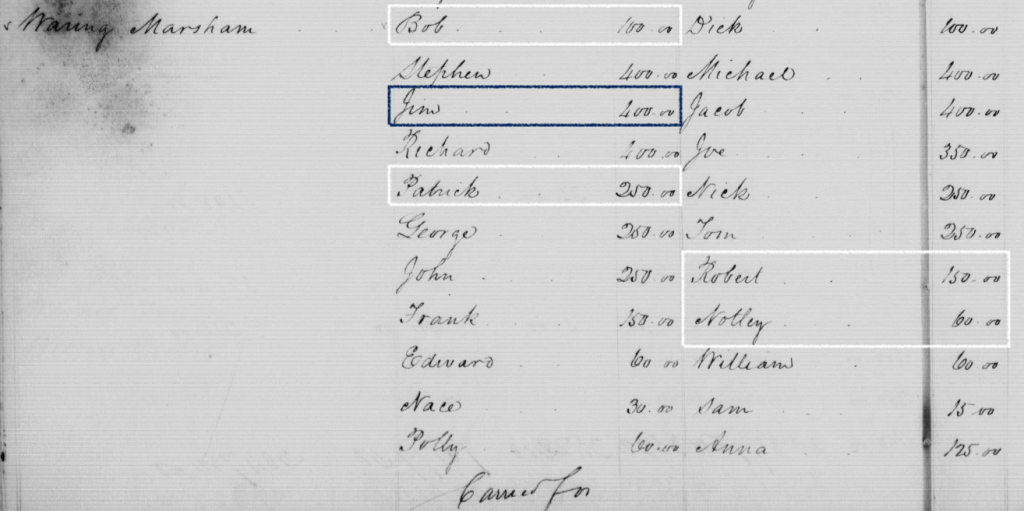
Marsham Waring’s property list includes the names of Robert, James, Patrick, and Notley.

NameValueAge RangeBirth Year Range
Robert (Bob)$10050-601773-1783
James (Jim)$40018-301803-1815
Patrick$25010-151818-1823
Robert$1506-101823-1827
Notley$603-61827-1830
James (Jim)$35015-18
or
35-40
1815-1818
or
1793-1798
1833 Personal Property Assessment for Marsham Waring, 2nd District | Maryland State Archives

James Stewart was enumerated in the 1870 and 1880 US Federal Census. In 1870, he was listed as 63 years old, with an estimated birth year of 1807; in 1880, he was 70 with an estimated birth year of 1810. This allows us to reasonably identify James Stewart as the James (Jim) valued at $400.

Notley’s inclusion in the assessment list is consistent with the information recorded in the White Marsh Baptismal Record; he is valued as a toddler who was born around 1830. His father, Robert from the White Marsh record, is most likely Robert (Bob) valued at $100, as this value allows us to estimate his age as 50-60. The other Robert is valued at $150, allowing for an estimated age of 6-10; he is likely a brother of Notley.

Robert (Bob), between 50 and 60 years old, would have been born during the Revolutionary War (1773-1783). He is old enough to be the father of James, Patrick, Robert and Notley.
At 50-60 years old, Robert (Bob) would already be considered an elderly man. He most likely was no longer used in the fields and instead was laboring as a body servant, gardener or caretaker. As one of the older men on the estate, he was likely a source of stability and wisdom for the younger enslaved family and friends. See Daina Ramey Berry, The Price for Their Pound of Flesh for a discussion of the lives of elderly enslaved people.

Peter Stewart | Draft

The Baltimore Sun | 12 Jul 1864, Tue · Page 1 | newspapers.com

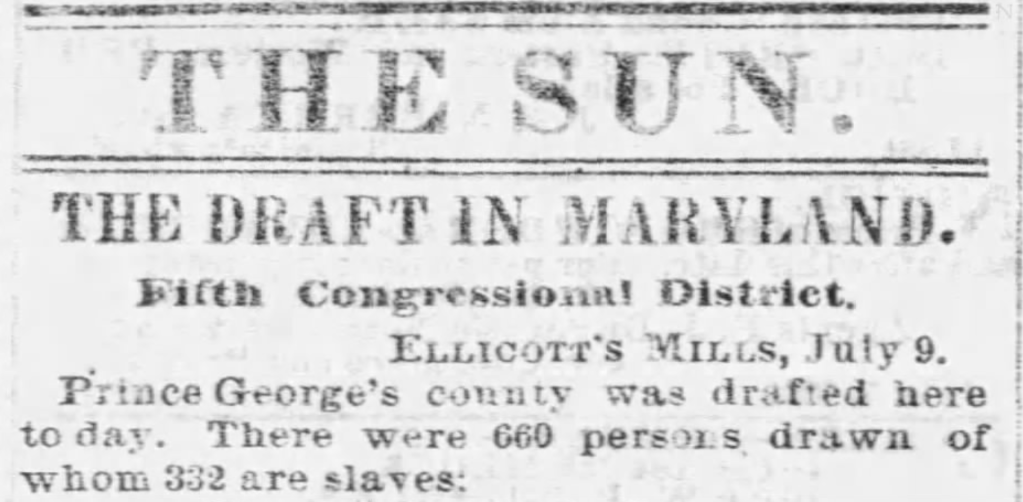
In 1864, the Baltimore Sun ran the names of the people drafted for the Union Army from Prince George’s County, including the name of “Peter Stewart, slave of the estate of Benjamin Lee“.

Dr. Benjamin Lee had died during the war and his administrators created an inventory of his estate in 1863. The inventory did not include the name Peter.


The 1867 Slave Statistics provide an incomplete list of people enslaved in Queen Anne District [District 7] of Prince George’s County as reported by their enslavers. While submission of the list was voluntary, and not all estates and enslavers submitted a list. That said, it provides the names of over fourteen hundred enslaved people. The 1860 Slave Schedule recorded almost twenty-three hundred enslaved people. The Prince George’s County Slave Statistics names about 62% of the enslaved population in Queen Anne District. Of them, there is only one named Peter: Peter Ridout enslaved by Violetta Sprigg, the neighbor of Benjamin Lee. He was also named in the list.


The list also included the names of Thomas Brown and Jno Hamilton, enslaved on the estate of Benjamin Lee.

Jno. Hamilton is named — he and his partner Patsy are named near the beginning of the inventory list. In 1870, he and Patsy are living in the household of C. A Harding, the son-in-law of Benjamin Lee, and Eleanor Lee, Benjamin Lee’s widow. Patsy is working as a servant in the household, while John is laboring in the fields.

Inventory of Benjamin Lee estate WAJ 3:126 | Maryland State Archives

Thomas Brown, like Peter Stewart, is not named in the 1863 Inventory. He may be the “Tom” who fled Lee’s enslavement in 1859. Lee described him as a 32 or 33 year old man. Further information about Thomas Brown has not been found. If Peter fled Lee’s captivity, like Tom, then Lee does not appear to have advertised for his return.


The question persists if Peter Stewart was the name of a person enslaved by Benjamin Lee, or if the editors of the Draft List in the Baltimore Sun made a mistake as they transcribed and inserted names.

Mary Ridout | Stewart Connection


In 1929, Patrick Stewart, age 84, died of a stomach ailment. His son, J. T. Stewart, furnished the information for the death certificate for the District of Columbia records.

Patrick Stewart, age 84, was the son of Patrick Stewart and Mary Ridout. He was born around the year 1845, twenty years prior to the emancipation of the enslaved in Maryland, where he and his parents were born into chattel slavery.


Enslaved by John E Berry

In 1867, John E Berry, of Bladensburg in Prince George’s County, Maryland, submitted a list to the Commission of Prince George’s County Slave Statistics of the people he enslaved prior to emancipation in hopes of compensation from the federal government. Among those he listed were Patrick Stewart, age 20 and Mary Stewart, age 38.

While we do not have an age for Mary from the death certificate, the ages of the two Patricks are consistent with each other, both are born around 1845 — and Mary, the other Stewart, is old enough to have borne Patrick as her son.

The identification of Patrick’s mother as Mary Ridout opens up a line of inquiry about whether or not Mary Ridout is connected to the Stewarts of the Waring estates and to the Ridouts enslaved in and around the Waring estates.

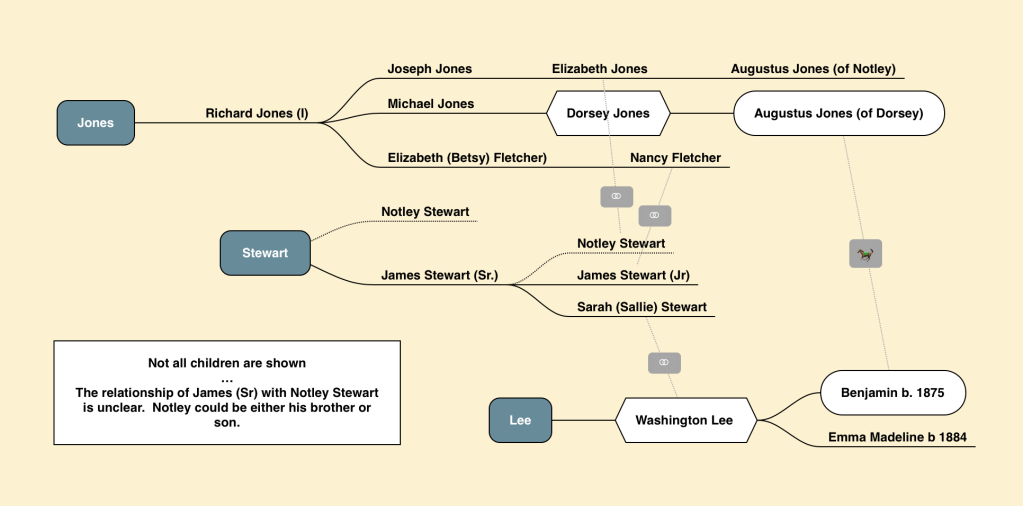
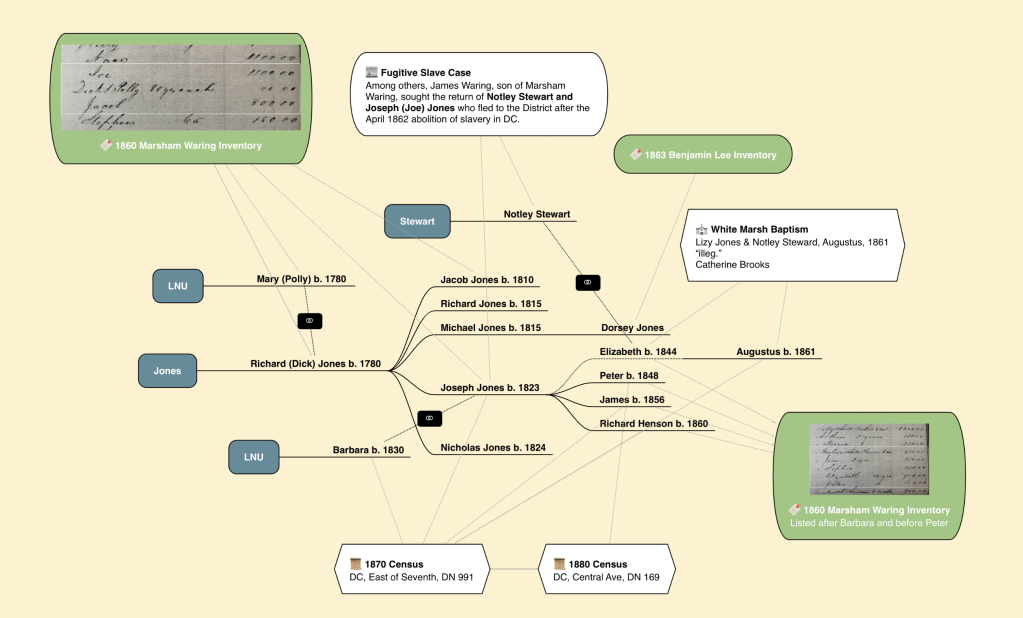
Connected Posts: Barbara Jones | Ridout Family & Benjamin Lee and Augustus Jones | Stealing Horses

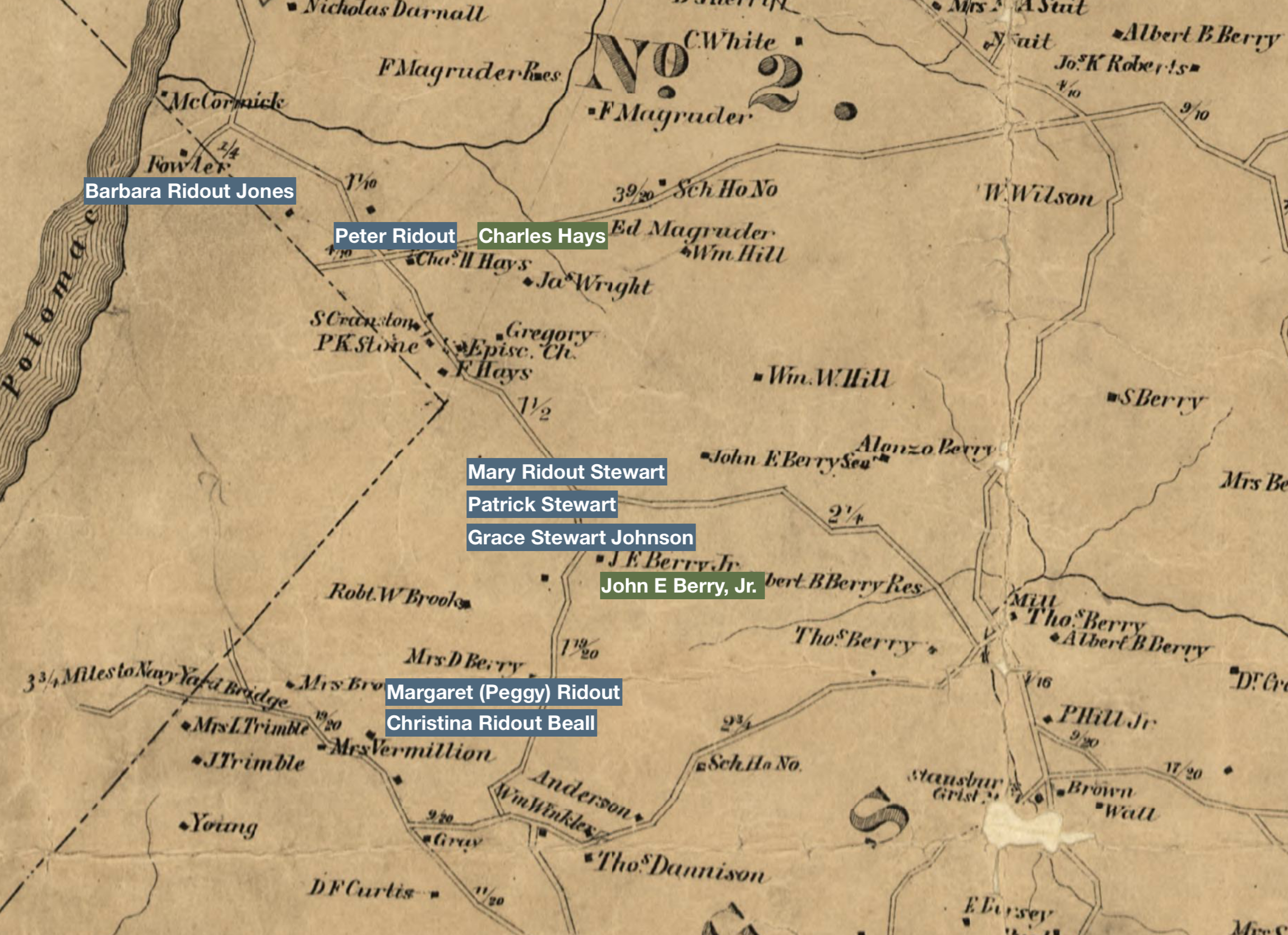
The connected posts discuss the details of this diagram more fully

Seat Pleasant

In the post on Barbara Jones’ connection to the Ridout family, we saw that Peter and Priscilla Ridout moved to the boundary between DC and Maryland, near Charles H Hays and we saw that Margaret (Peggy) Ridout and her daughter moved into the household of Geo R Wilfred Marshall, also near the boundary of DC and Maryland. The two families essentially bookend the area where Mary Stewart and her son Patrick are enslaved.

In the 1880s, Patrick Stewart purchased Lot #5 of the Seat Pleasant subdivision.  The land contained about 10.5 acres.  He paid $350 for the lot.

It sat on the former land of John E Berry, Jr. Berry, Jr., who purchased “Seat Pleasant” from his relative Thomas E Berry. At the close of the Civil War, the land was sold to real estate developers who created the town of Seat Pleasant.  Berry’s father, Dr. John E Berry, Sr., had a nearby plantation called Independence, and Berry’s brother, Albert B Berry had a farm called Sunnyside in addition to his other real estate holdings.  The survey of Seat Pleasant was completed in 1873.  In addition to detailing the lots, it marks what is likely the Seat Pleasant dwelling house and marks several cabins on the land, which may have be slave dwellings occupied by freedmen after emancipation.  

In the 1870 census, Patrick and his wife, Lidia, are living with their three daughters: Mary E [1864], Margaret [1866], and Rachel [1868]. By 1880, they have five more children: William [1870], Daniel [1872], John Thomas [1874], Jane E [1876], and Christiana [1880]. The name of their last daughter, Christiana illustrates the connection with the Ridout family. As seen, Barbara Ridout Jones had both a sister and daughter named a variation of Christiana.

Mary Ridout Stewart

Mary Ridout Stewart was living next door to her son, Patrick, in the 1870 census in the household of George and Grace Johnson and their children.

1870 Census for Bladensburg District in Prince George’s County | ancestry.com

This leads us to the suggestion that Grace is Mary’s daughter and Patrick’s sister.

Like Mary and Patrick Stewart, George Johnson was enslaved by John E Berry.  The two men likely worked the tobacco fields of Seat Pleasant, first as enslaved men and then as tenant farmers.  

Unlike the Patrick and George who were held in bondage on a large tobacco estate, Grace and her children were enslaved by a farmer, Charles H Hays, who likely grew produce for the Washington markets.  Hay’s farm was north of Seat Pleasant, along the DC border, where Peter and Priscilla moved after the war. 

When large estates were often valued above $10,000, Hay’s farm was valued at $2000.   Farms were smaller in this part of Prince George’s County and often grew other products instead of tobacco.  In 1864, Charles Hays advertised a reward of $5 for a cow that had strayed.  Upon his death, his farm of 105 acres was advertised for sale; the soil was described as well adapted for grazing and market gardening.  The land had a dwelling of six rooms and a tenement house of three rooms.  

The 1860 Slave Schedule lists 8 enslaved people for Hays, and Hays submitted the names of 10 people whom he enslaved. In addition to Grace and her children, Hays enslaved Letty Hanson, age 25.  Her first name is phonetically similar to that of Lidia, Patrick’s wife.  


By 1880, Mary Ridout Stewart and her husband, Patrick Stewart, are living together in the household of Patrick Stewart and Lidia with their children. Patrick (Jr.) has yet to buy the land in Seat Pleasant. From neighboring houses, it appears that they are living near Buena Vista near the Waring Estates, in the newly created Kent District along the boundary with Queen Anne District and near close and extended family.

Dwelling NumberRelativeRelationship to Mary Ridout
253Patrick Stewart (Sr.)Husband
253Patrick Stewart (Jr.)Son
258Grace JohnsonDaughter
247Michael JonesSon of Barbara’s brother-in-law
244Bettie FletcherBarbara’s sister in law
92Geo StewartInferred Nephew, as he is son of James Stewart

The table lists the dwelling numbers of people related within the extended kin group of Mary Ridout. Dwellings 253 & 258 are members of her immediate family and include her children. Dwellings 247 and 244 are members of the Jones family that Barbara Ridout, Mary’s inferred sister, partnered with. Elizabeth (Bettie) Fletcher was the daughter of Richard and Mary Jones. And dwelling 92, which can be identified as being in the geographic vicinity as it is neighboring Jos. K Roberts house is the household of George Stewart, the son of James Stewart.

James Stewart was listed in Marsham Waring’s 1860 inventory with Notley Stewart, who fathered Barbara Ridout Jones’s grandchild, Augustus Jones. Also listed with James and Notley was Patrick Stewart. During the Civil War and shortly after the abolition of slavery in the District, Patrick and Notley fled to DC with many others from the Waring estates. James Waring, as administrator of his father’s estate, went to the District to seek their return, swearing an affidavit that they were from Maryland and therefore subject to his enslavement. Records of Patrick Stewart are not found, though records of the others in Camp Barker and Camp Springdale have been found. Likewise, Patrick in the 1870 census has yet to be identified. However, it appears he reunited with his family by 1880.

Joseph Jones

Connected Post: Richard (Dick) Jones & Mary (Polly) Jones | Old Age

Richard (Dick) Jones and his wife, Mary (Polly) were born at the end of the Revolutionary War and lived until the start of the Civil War in Queen Anne District of Prince George’s County. The vast majority of their life was spent on the estates of Marsham Waring. They and their children labored for Waring and his three children, as well as neighboring estates. This post explores the life of one of their sons, Joseph Jones.

Chart showing Mary’s estimated child-bearing years and identified children | Subject to Change

Joseph Jones was one of Mary’s younger sons. He labored on Warington, which was the main dwelling estate for the Warings, along with his parents, wife and children

Joseph and Barbara had three of their children’s baptisms recorded by the priests of White Marsh.

  • “Johns, Christina, daughter of Jos. Johns & Barbara Reyder, his wife, born May 3, 1854, property of Mr. Marsh. Waring. Godmother: Susana Steward.”
  • “Do: James, 2 weeks old, of Joseph & Barbara, property of M. Waring. Sp: Selley.” [1857]
  • “Bapt’. Richard of Joe & Barbara Jones, col’, 10 weeks old. Spons: Bettzy Fletcher for Martha Colbert.” [1860]

In May 1862, a group of enslaved people from Waring’s estates fled to DC with James Waring, Marsham’s son, pursuing them. He swore out an affidavit, swearing that they were enslaved in Maryland, not the District, and therefore he was lawfully able to seek their return to bondage. Joseph Jones was among those named by Waring.

National Archives and Records Administration (NARA); Washington, D.C.; Records of the U.S. District Court for the District of Columbia Relating to Slaves, 1851-1863; Microfilm Serial: M433; Microfilm Roll: 3 | ancestry.com

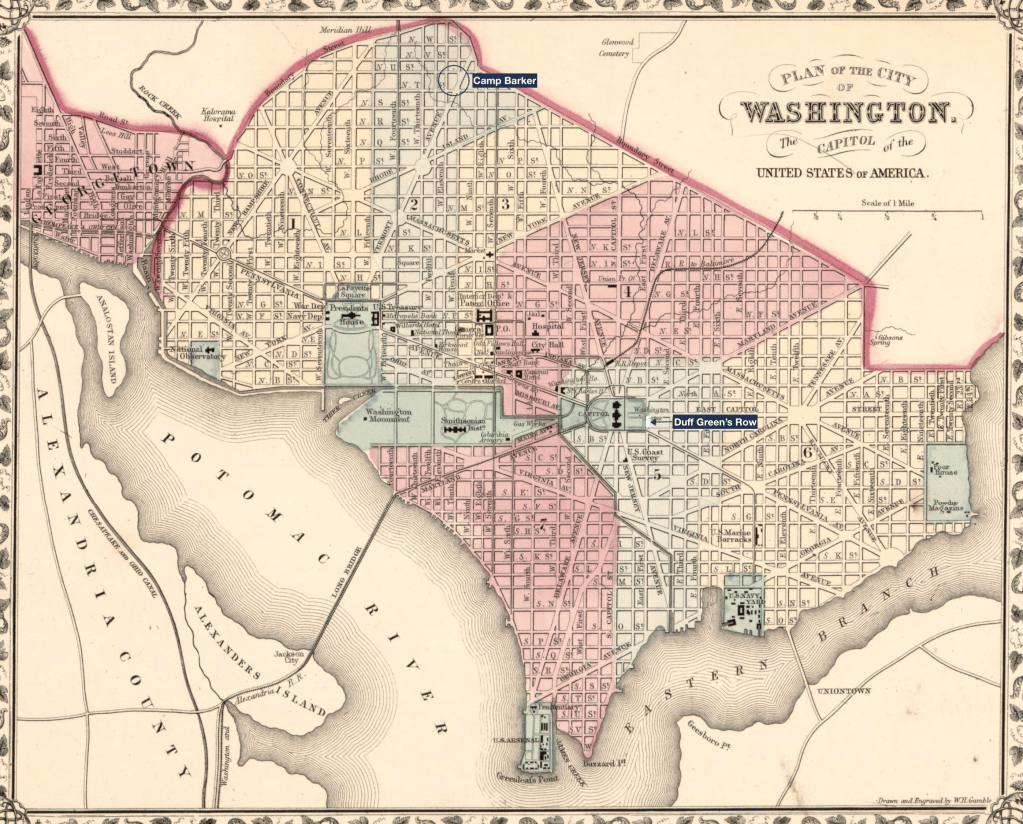
Joseph and his wife, Barbara, and their children are listed on a registration list for Camp Barker, a refugee camp set up in the northern part of the City of Washington, near U street and Vermont Avenue.

The image places the 1860 Waring Inventory on top for comparison with the names on the registration list estimated to be either in 1863 or 1864 based on other lists in the book.
U.S., Freedmen’s Bureau Records, 1865-1878 [database on-line]. Lehi, UT, USA: Ancestry.com Operations, Inc., 2021. | ancestry.com
Marsham Inventory WAJ 2:321 | Maryland State Archives
1869 Plan of the city of Washington : the capitol [sic] of the United States of America | loc.gov

“The present shelter of the refugees in Washington is called Camp Barker. We visited it on the 25th of 11th month. It consists of a large oblong square, surrounded on three sides by huts or barracks, and other buildings, all opening within the square; and by a high fence on the west side. The entrance is under a military guard. The huts, about forty-eight in number, are about twelve feet square, and each have from ten to twelve inmates. There are also several large tents, occupied by old or infirm men, and two buildings called hospitals—one for men, and one for women. The residence of the superintendent is within the enclosure.”

Report of a Committee of Representatives of New York Yearly Meeting of Friends upon the condition and wants of the colored refugees. | loc.gov

In 1861, the baptism for Augustus, the son of Lizy Jones and Notley Steward was recorded. Augustus is in the registration list for Camp Barker with Joe, Barbara [Patsy] and Elizabeth. Notley Stewart, with Joseph Jones, was listed on the affidavit by James Waring. Notley is not listed with the Jones family, though Elizabeth and Augustus are listed together.

At some point, they may have been transferred from Camp Barker to Camp Springdale, which was the precursor to Freedmen’s Village on the Arlington Estate (owned by Robert E Lee’s wife) and what would become Arlington Cemetery. They appear on a list of those who left Camp Springdale. The note indicates that they “gone to do for themselves”

U.S., Freedmen’s Bureau Records, 1865-1878 [database on-line]. Lehi, UT, USA: Ancestry.com Operations, Inc., 2021. | ancestry.com

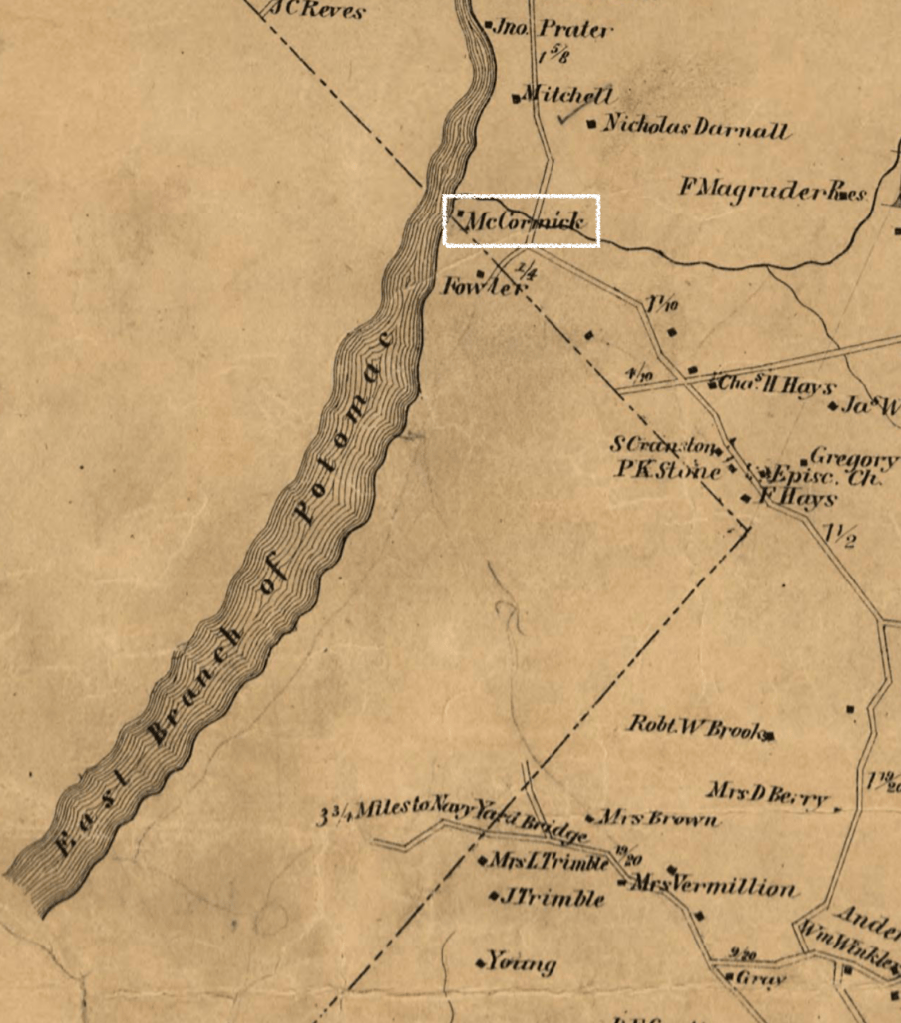
After the war, Joseph and his family settle outside the City of Washington in the District in and around Benning’s Road. In 1870, they lived near Alex McCormick along the Maryland-District Border. McCormick had used his location along the border to hide the people he enslaved in Maryland when the District abolished slavery. The family successfully petitioned for their freedom. See Civil War DC for more information about this petition. Living with McCormick in 1870 is Robert Jones, a nephew of Joseph Jones. Of their children, Sophia and Peter are not listed with them in 1870. Peter rejoins them in 1880, but not Sophia. This suggests the likelihood she died, though it is possible she married.

1861 Topographical map of the District of Columbia | loc.gov

It’s likely that Barbara died in 1896; a death record for a Barbara Jones, born around 1824 in Maryland can be found. She was buried in Mt. Olivet, a Catholic cemetery. No family members are listed.

Her son, Peter Jones, is still living in the vicinity of Benning’s Road in the 1900 Census. He is working in a stock yard, and his son, Peter Jones, Jr. is working as a jockey.

James Stewart | Acquisition

What connection if any does James Stewart have to the enslaved of Notley Young of Prince George’s County?


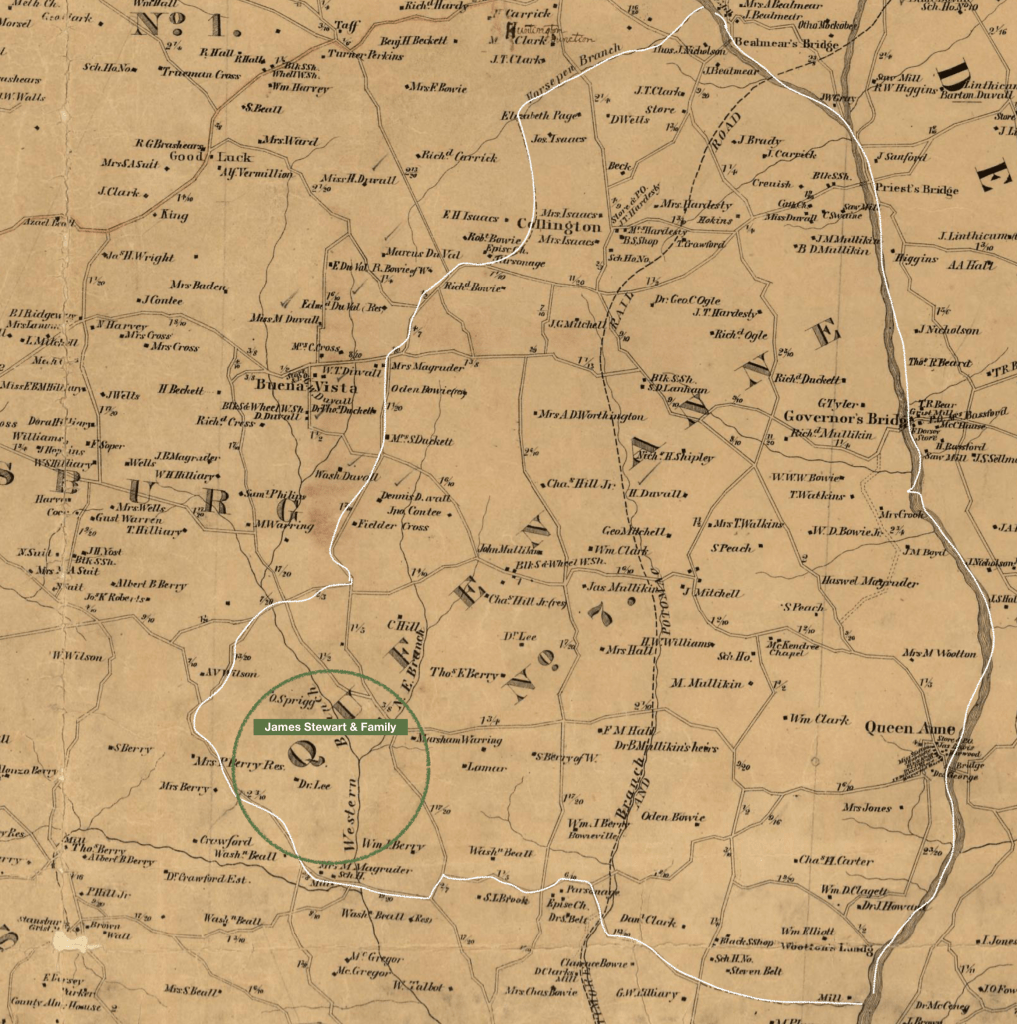
After emancipation in 1864, James Stewart and many of his children, including Notley Stewart, stayed on the lands of Dr. Benjamin Lee in Queen Anne District in Prince George’s County, Maryland.

Annotated Excerpt from 1861 Martenet Map of Prince George’s County | loc.gov

Prior to emancipation, Stewart had been forced to labor for Marsham Waring’s estates, while his children labored on the estates on the Lee. Waring and Lee were brother-in-laws. Inventory records for Marsham (WAJ 2:321) and the post-emancipation records of the 1870 and 1880 records suggests that James was born a few years after 1800, and about a decade after Marsham Waring.

The name “Notley” has been used by multiple generations of the Stewart family — and one possible source for the given name is from the enslaver Notley Young. Other members of the Stewart family used names that were aligned to their (former) enslaver. For example, James’ son and daughter-in-law, George and Rebecca Stewart had daughters named Violetta and Eleanora, both names in common with the wives of Waring and Lee. Sarah (Sallie) Stewart and her husband Washington Lee named one of their sons, Benjamin, giving him both a given and surname that matches Sarah’s former enslaver, Dr. Benjamin Lee. The use of Notley in the family suggests a connection with a (former) enslaver named Notley, i.e., Notley Young.

There are three Notley Youngs in three successive generations:

  1. Notley Young (I) who died in 1802. His estates and property were located within the parts of Prince George’s County that would become the District of Columbia.
  2. Notley’s (I) son, Notley Young (II), a priest with connections to the Jesuits, Georgetown University and the White Marsh plantation along the Patuxent.
  3. Notley’s (I) grandson, Notley Young (III), son of Benjamin Young. Notley Young (III) married Eleanor Hall, his second cousin, and lived in Queen Anne District, before dying in 1846.

In the 1828 Tax List for Prince George’s County, Notley Young (III) owned practically 735 acres of land in the Collington & Western Branch Hundreds, from which part of Queen Anne District would become. Both Waring and Lee owned property before the Civil War along the Western Branch, which divided the two hundreds.

Map of part of the city of Washington shewing the situation of the mansion house, grave yard & buildings belonging to Mr. Notley Young : original proprietor of that part of the city. | loc.gov

View of the city of Washington in 1792. | loc.gov

Inheritance

There are three ways to acquire an enslaved person: 1. purchase, 2. inheritance/gift, or 3. natural “increase”, i.e., claiming ownership of the children of enslaved women.

James Stewart was born prior Marsham Waring acquiring his father’s estate, who died in 1813. On his inventory, there was a child called Jim (James) age 12 with an estimate birth year of 1801, which is consistent with calculated birth years from the later documents. This suggests that Marsham Waring (Sr.) conveyed James along with his other property to Marsham Waring (Jr.) of the 1860 Inventory, and opens the line of inquiry of how Marsham Waring (Sr.) acquired him.

Purchase from Notley Young, Sr.

Notley Young’s grandfather died in 1802. Included in his inventory is a James age 3, who would have been born in 1799. This is within two years of the age on the 1813 inventory of Marsham Waring (Sr.) After making some specific bequeathals to his wife and for his real estate, Young’s grandfather divided his personal estate (including his chattel) to be equally divided among his five identified children/grandchildren.

As noted on the family tree, a cousin of Notley Young (II) is George Washington Young, who inherited his father’s estate Nonesuch along the Eastern Branch (what would become known as Anacostia) and within the District of Columbia. When the District abolished slavery in 1862, G. W. Young filed a claim for compensation for his “loss” that included a “Stuart” family group.

This suggests that the Young family had enslaved members of the Stewart/Stuart Family group, perhaps even the one that James Stewart came from.

It is possible that the heirs of Notley Young sold James and separated him from his family, sending him to Marsham Waring (II) and his estates. Both Marsham Waring (II) and Notley Young were involved in the creation of the District of Columbia and engaged in business together. In the 1830s, their heirs were sued as together they had put up sureties for Thomas S Lee and a loan he had taken from Charles Carroll of Carrollton (Charles Carroll of Carrollton vs. Marsham Waring, et al June 1832).

White Marsh Baptism Record

In 1832, the enslaved population of Waring and Lee grew through “natural increase”, the term enslavers used to conflate the language they used to talk about their livestock and their enslaved people, dehumanizing the latter. James “Stuart” and Susan (Suky) had their son, James, baptized by the priests of White Marsh, the Jesuit Catholic plantation near Priest’s Bridge which also enslaved numerous people.

The baptism record notes that James (Sr.) was enslaved by “Master” Warring and that Susan (Suky) was enslaved by Dr. Lee in Marlborough. The record also notes the sponsor/godmother as a person enslaved by Notley Young, mostly likely Notley Young (III) based on the year of the baptism. The name was transcribed as “__rvelide?”.

“Content” | wikipedia.com
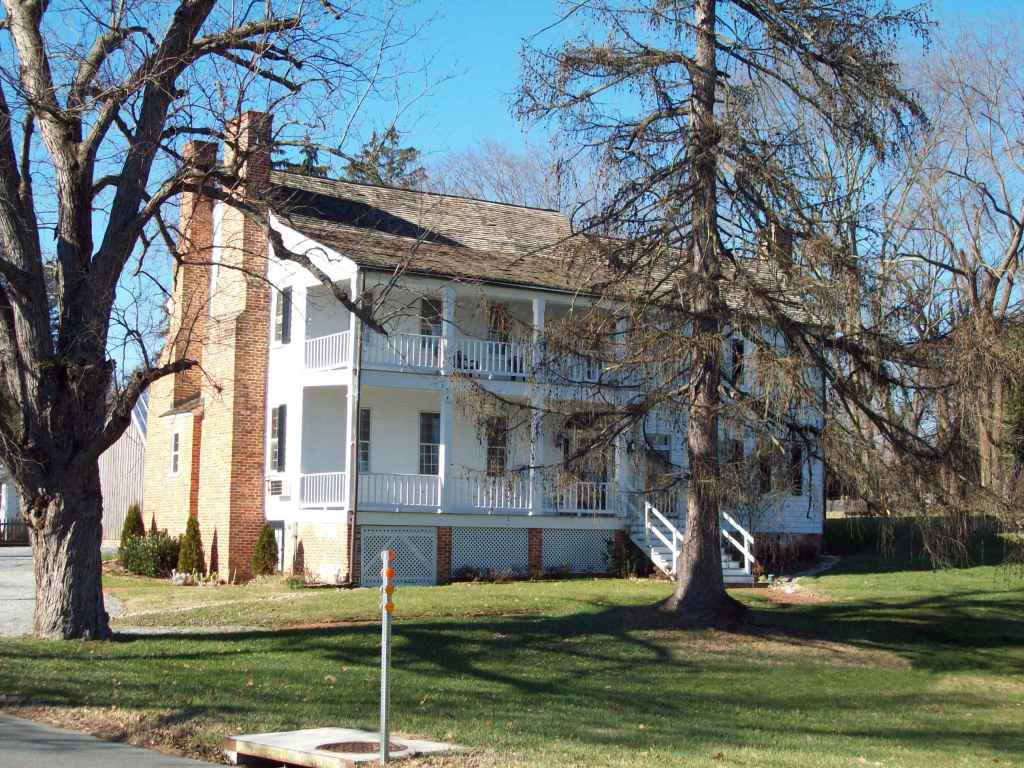
Dr. Benjamin Lee lived in this house in Upper Marlboro from 1821-1844 before moving to his estate in Queen Anne District. This is where Suky and her children most likely labored.

It is probable that the sponsor for the baptism of James and Suky’s son is a relative of either James or Suky, as godparents are usually chosen from within a kinship group, and therefore suggesting a connection between the Notley Young estates and James Stewart’s kinship group.

Reconstructing the Transcribed Name

My source document provides the typed transcription without access to the handwritten record of the priest, leaving the reader to guess at how the the transcriber interpreted the name. To complicate matters, the priests of White Marsh were not also fluent with Anglo-American names or the diminutives used by the enslaver and so there is often non-traditional spelling. With that in mind, the following three items helped to narrow the possibilities.

  1. The transcriber noted it was a godmother, therefore looking for women’s names
  2. The index to White Marsh Book 4 provides three plus page list of names of given names used by the priests, providing a sampling of names used during this time period by enslavers and enslaved.
  3. The final syllable “-ide”

These three items helped to identify Adelaide and its variations as a probable given name for the godmother. Another possibility includes names like Emeline and its variations, though Matilda and Cornelia are also likelihoods.

Of note, on the same page, a Adelaide was noted as a person enslaved by Benjamin Young, likely Notley Young’s brother. She had a son, Alexander who was baptized the same year as James. In 1818, Sandy [Alexander] and Adelaide were married at White Marsh with the permission of their enslaver, though the record does not note their enslaver. That said, the repetition of Alexander and Sandy in both records suggests that Adelaide and Alexander married and had a son, named for his father, Alexander.

A 1821 records provides more insight into the Alexander + Adelaide family group. Francis and Moses Sandy were baptized in 1821, as one-day old sons of Sandy and Adelaide Cosy, servants of Mr. Benj. Young. In 1817, Peter Corsey escaped from Notley Young, he may be related to the Cosy’s of Benjamin Hall.

A review of the 1809 Inventory (TT 1:321) for the estate of Benjamin Young (the son of Notley Young (I) and the father of Notley Young (II) and Benjamin Hall Young provided a possible family group for Adelaide. The Inventory appears to be groups in families, as a few adults will be named then children, then adults and children again. The group identified occurs near the beginning of the inventory. The list includes a Suck, a name variation for Susan; though Susan was an extremely common name for the enslaved communities of Prince George’s County.

NameAge in InventoryEstimated Birth Year
Dolly321777
Eliza211788
Suck151794
Louisa121797
Adelaid101799
Harry121797
John101799
Billey101799
Maria41805
Chrissy51804
Edward31806
Ned41805
Robert21807

Tentative Conclusion

The circumstantial evidence suggests that James Stewart came to the Waring family from the Young family.

  1. The use of Notley as a given name within the Stewart Family
  2. The presence of a James on the 1802 Notley Young (I) Inventory
  3. The inclusion of other Stewart family groups on the Compensation List for G. W. Young
  4. The presence of a White Marsh baptism record which indicates a godmother from the Notley Young estate for James Stewart’s son, James (Jr.)

Benjamin Lee and Augustus Jones | Stealing Horses

Stealing Horses

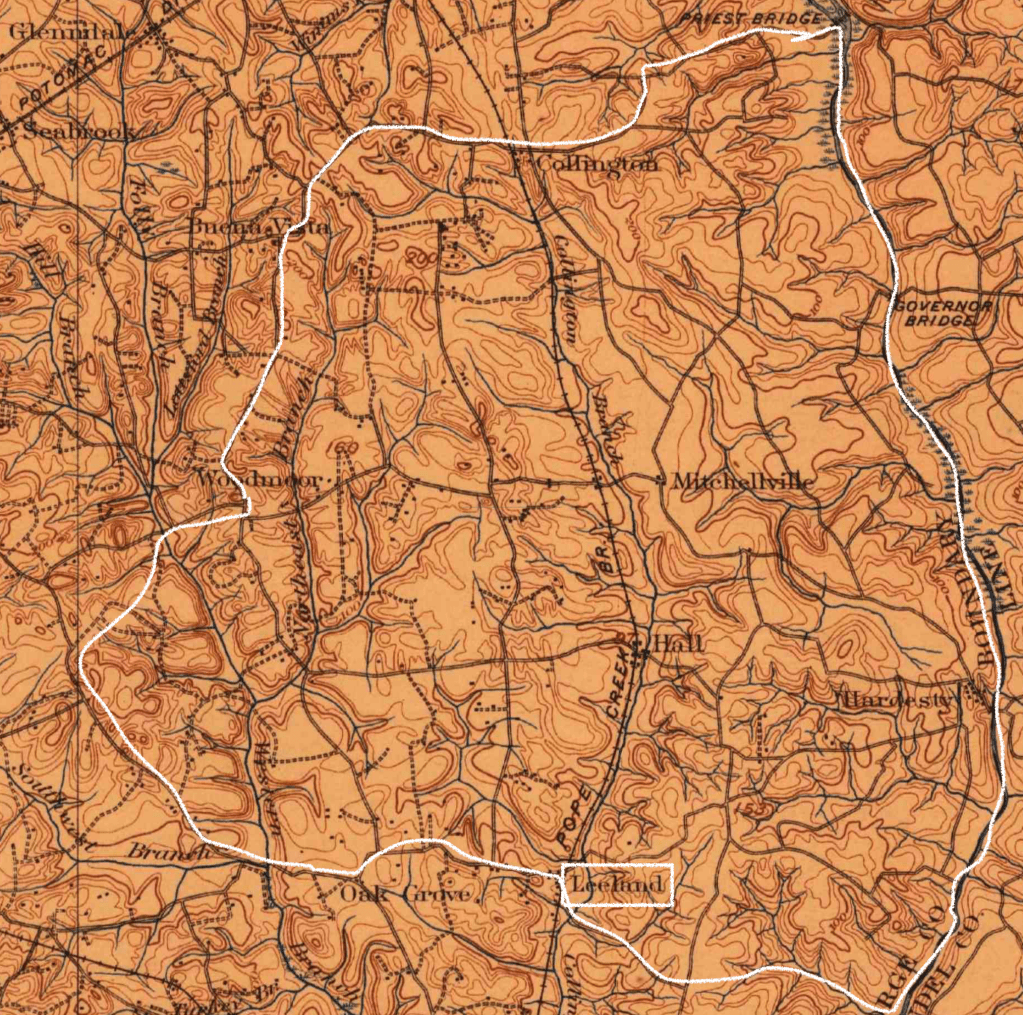
In the summer of 1900, two horses were stolen. One from the pasture of Dorsey Jones and one from the home of Washington Lee. Both men lived in Leeland, Maryland, a small community built up after the Civil War along the Pope Creek Railroad. It sits on the boundary between Queen Anne District and Marlboro.

1899 Top Map of Patuxent River | accessed from topoview

They alerted the authorities in Washington that their horses were stolen and the police were on the look-out for the thieves in the District. They arrested two men for trying to sell the horses near Centre Market in downtown DC near 11th and Louisiana, just north of the map about mid-point between the Eclipse and the Capitol.

According to the articles, the men arrested were their sons, Augustus Jones and Benjamin Lee.

21 Aug 1900, Evening Star | newspapers.com
22 Aug 1900, Evening Star | newspapers.com

Relatives

The two horse thieves, Augustus Jones and Benjamin Lee were distant cousins of each other. The first article says that Augustus was the son of Dorsey and the second article claims that Benjamin was the son of Washington Lee.

Reconstructed tree using a mixture of records. Subject to change to as more records are located.

Benjamin Lee

Washington Lee with his wife, Sarah (Sallie) Lee are enumerated with Benjamin Lee in the 1880 census. They were enumerated in the Marlboro district near Upton Brooke who was enumerated at DN 243. This places them in the vicinity of Brick Church Station which is where Leeland would grow over the next few decades.

Marlboro District, Prince George’s County 1880 Census | ancestry.com
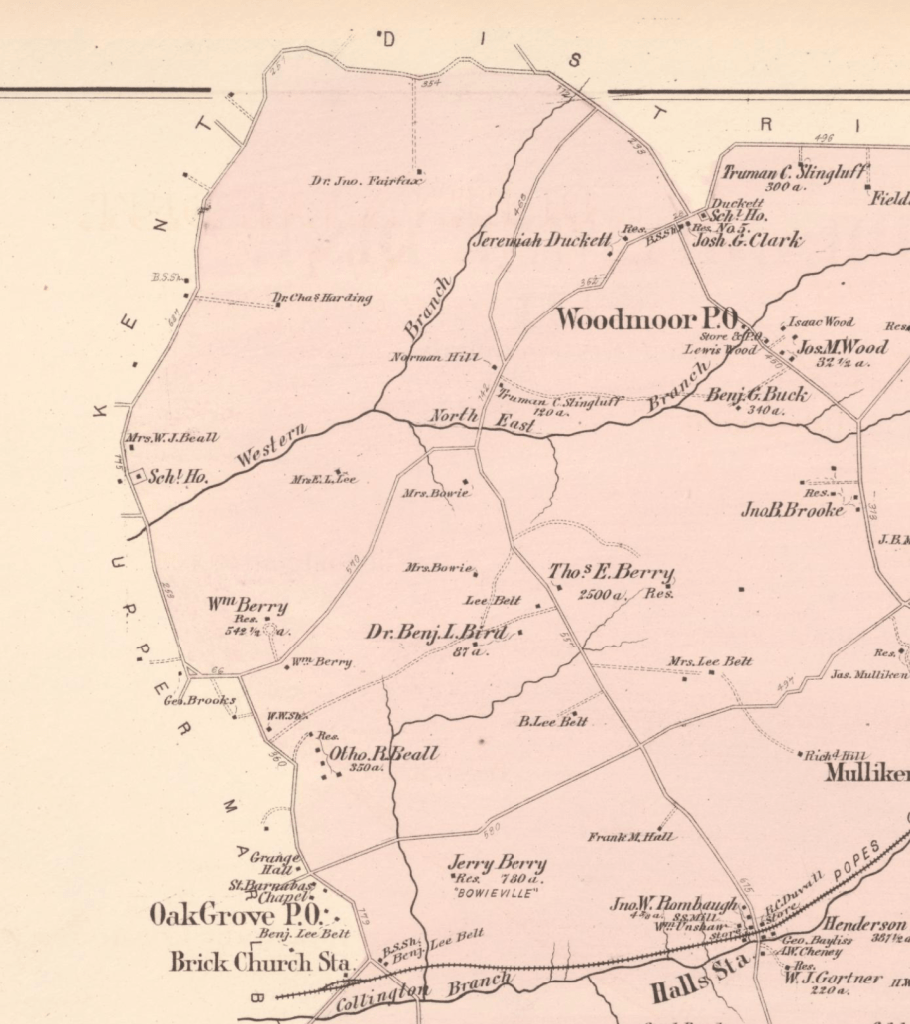
1878 Hopkins Atlas of Prince George’s County, Marlboro District | loc.gov

Augustus Jones

Augustus Jones is not found in the census with Dorsey Jones. In 1880, Dorsey Jones, age 30, is living with his father and mother, Michael and Amelia (Milly) Jones in Queen Anne’s District, likely near Woodmore P.O as they are enumerated a few pages from Jeremiah Duckett, who owned land near Woodmore. He does not have any children living with him in the 1880 census.

Queen Anne District, Prince George’s County 1880 Census | ancestry.com
1878 Hopkins Atlas of Prince George’s County, Queen Anne District | loc.gov
Note: North is to the right, not up like in most maps.

Neither Dorsey nor Augustus Jones have been located in the 1900 census. Dorsey died in July 1905, his death certificate indicated he was single, which is consistent with the 1880 Census.

Maryland State Archives

In the 1870 and 1880 Census, Augustus Jones was listed with Joseph and Barbara Jones in the District of Columbia. In 1870, they are enumerated near Alex McCormack who lived near the District/Maryland boundary. (In fact, the Wedge family had to petition for their freedom from McCormack during the Civil War when DC abolished slavery as McCormack sought to maintain their captivity by claiming they lived on his Maryland land and not his DC land. )

East of Seventh Street, District of Columbia 1870 census | ancestry.com
1861 Martenet Map of Prince George’s County | loc.gov

In 1880 they are enumerated near Daniel Stewart and Joseph Coven [Covington] which places them near Pleasant Grove and Benning’s P.O. and still near A. McCormack

Central Avenue, District of Columbia 1880 Census | ancestry.com

Augustus Jones is listed at the son of Joseph and Barbara Jones. However, based on other records, I would suggest that Augustus Jones is their grandson, and the son of Elizabeth (Lizy) Jones and Notley Stewart.

Reconstructures Family Tree with identified direct and indirect sources | Subject to Change

The Jones and Stewart family were enslaved primarily by Marsham Waring and also by Benjamin Lee, his brother-in-law in Queen Anne District prior to emancipation in 1864. Waring died in 1860, and among his probate records is an inventory that lists the people he enslaved. Lee died in 1863 and his probate records also include an inventory. Additionally, Waring’s children, Elizabeth L. Bowie, M. Virginia Mackubin [sic] and James Waring had compensation lists submitted to the Commission of Slave Statistics which lists both the first and last name of the people the Waring’s enslaved.

The Warings were Catholic and some of the people they enslaved had their children baptized by White Marsh Priests. Among them, Lizy Jones and Notley Stewart had their son Augustus baptized in 1861. A year later, Notley Stewart and Joseph Jones, Elizabeth’s father, are named in an affidavit, among others that they had fled to the District after the abolition of slavery there. Notley and Elizabeth Jones have not been located, though their son is living with Joseph and Barbara Jones, Elizabeth’s mother, in both the 1870 and 1880 Census.

Incidentally, Peter Jones, the son of Joseph and Barbara Jones, and uncle of Augustus (assuming my theory is correct), lived on Benning’s Road in 1900 and he worked at as a laborer in a stock yard, and his son Peter (Jr.) worked in a jockey house, suggesting the family worked with and knew horses.

Afterwards

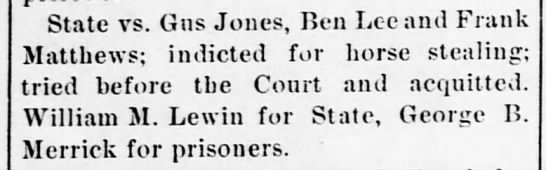
The local papers reported that “Gus Jones, Ben Lee, and Frank Matthew” were indicted for horse-stealing and that they were acquitted.

26 Oct 1900, Prince George’s Enquirer and Southern Advertiser | newspapers.com

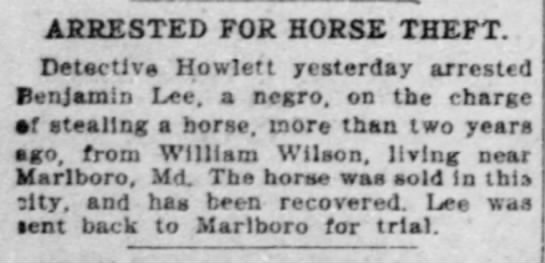
And, in 1903, Benjamin Lee was arrested again for stealing a horse in August of 1900. This time from William Wilson, who also lived near Marlboro and again, Lee is alleged to have sold the horse in the city. Wilson was a Black man who worked on the railroad.

27 July 1903, Washington Times | newspapers.com
23 Oct 1903, Prince George’s Enquirer and Southern Advertiser | newspapers.com

The Evening Star described his day in court as multiple days due to multiple technicalities. It was first delayed to a legal technicality, then a new jury had to be impaneled as his brother-in-law sat on the jury, then finally he was tried and found not guilty. The judge sentenced him to seven year. The paper reported he tried to escape and assaulted officers. His head was injured and he required bandages. The paper described hi as barely recognizing him the final time in the court, though if this referred to a change in demeanor or a multitude of bruises, or both, it doesn’t specify. Considering how the criminal system treated and treats Black men, it was probably a submission by force. This seems reflected in the Judge’s comment, “you got all that was coming for you.”

20 Oct 1903, Evening Star | newspapers.com

In the 1910 Census, a Benjamin Lee is listed as a prisoner in Baltimore working in the foundry.

One Final Note

The Washington Times seems to have been ahead of the police. While the Evening Star reported that “Gus” Jones and accomplices had been arrested for stealing horses from their family, and the Prince George’s Enquirer reported that they had been acquitted, and the thief of Wilson’s horse was not identified until 1903 for stealing William Wilson’s horse and not tried until October 1903, the Washington Times reported their arrest in 1900. They even knew Benjamin’s alias of Will.