Joseph Jones

Connected Post: Richard (Dick) Jones & Mary (Polly) Jones | Old Age

Richard (Dick) Jones and his wife, Mary (Polly) were born at the end of the Revolutionary War and lived until the start of the Civil War in Queen Anne District of Prince George’s County. The vast majority of their life was spent on the estates of Marsham Waring. They and their children labored for Waring and his three children, as well as neighboring estates. This post explores the life of one of their sons, Joseph Jones.

Chart showing Mary’s estimated child-bearing years and identified children | Subject to Change

Joseph Jones was one of Mary’s younger sons. He labored on Warington, which was the main dwelling estate for the Warings, along with his parents, wife and children

Joseph and Barbara had three of their children’s baptisms recorded by the priests of White Marsh.

  • “Johns, Christina, daughter of Jos. Johns & Barbara Reyder, his wife, born May 3, 1854, property of Mr. Marsh. Waring. Godmother: Susana Steward.”
  • “Do: James, 2 weeks old, of Joseph & Barbara, property of M. Waring. Sp: Selley.” [1857]
  • “Bapt’. Richard of Joe & Barbara Jones, col’, 10 weeks old. Spons: Bettzy Fletcher for Martha Colbert.” [1860]

In May 1862, a group of enslaved people from Waring’s estates fled to DC with James Waring, Marsham’s son, pursuing them. He swore out an affidavit, swearing that they were enslaved in Maryland, not the District, and therefore he was lawfully able to seek their return to bondage. Joseph Jones was among those named by Waring.

National Archives and Records Administration (NARA); Washington, D.C.; Records of the U.S. District Court for the District of Columbia Relating to Slaves, 1851-1863; Microfilm Serial: M433; Microfilm Roll: 3 | ancestry.com

Joseph and his wife, Barbara, and their children are listed on a registration list for Camp Barker, a refugee camp set up in the northern part of the City of Washington, near U street and Vermont Avenue.

The image places the 1860 Waring Inventory on top for comparison with the names on the registration list estimated to be either in 1863 or 1864 based on other lists in the book.
U.S., Freedmen’s Bureau Records, 1865-1878 [database on-line]. Lehi, UT, USA: Ancestry.com Operations, Inc., 2021. | ancestry.com
Marsham Inventory WAJ 2:321 | Maryland State Archives
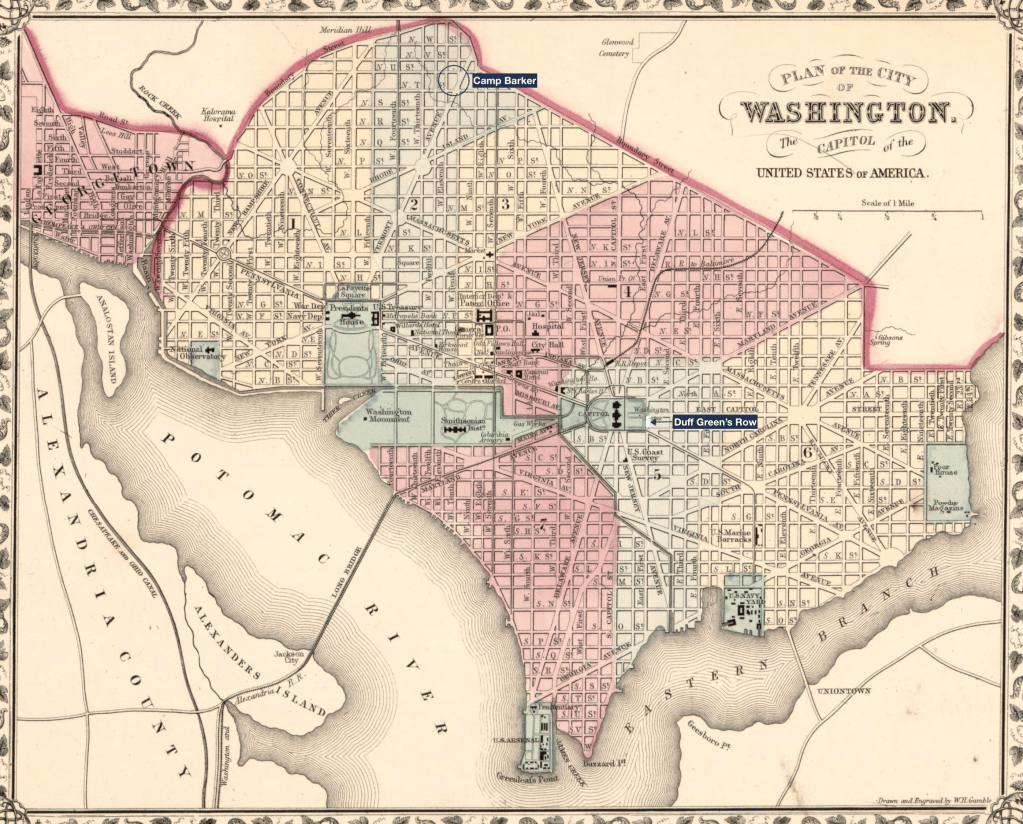
1869 Plan of the city of Washington : the capitol [sic] of the United States of America | loc.gov

“The present shelter of the refugees in Washington is called Camp Barker. We visited it on the 25th of 11th month. It consists of a large oblong square, surrounded on three sides by huts or barracks, and other buildings, all opening within the square; and by a high fence on the west side. The entrance is under a military guard. The huts, about forty-eight in number, are about twelve feet square, and each have from ten to twelve inmates. There are also several large tents, occupied by old or infirm men, and two buildings called hospitals—one for men, and one for women. The residence of the superintendent is within the enclosure.”

Report of a Committee of Representatives of New York Yearly Meeting of Friends upon the condition and wants of the colored refugees. | loc.gov

In 1861, the baptism for Augustus, the son of Lizy Jones and Notley Steward was recorded. Augustus is in the registration list for Camp Barker with Joe, Barbara [Patsy] and Elizabeth. Notley Stewart, with Joseph Jones, was listed on the affidavit by James Waring. Notley is not listed with the Jones family, though Elizabeth and Augustus are listed together.

At some point, they may have been transferred from Camp Barker to Camp Springdale, which was the precursor to Freedmen’s Village on the Arlington Estate (owned by Robert E Lee’s wife) and what would become Arlington Cemetery. They appear on a list of those who left Camp Springdale. The note indicates that they “gone to do for themselves”

U.S., Freedmen’s Bureau Records, 1865-1878 [database on-line]. Lehi, UT, USA: Ancestry.com Operations, Inc., 2021. | ancestry.com

After the war, Joseph and his family settle outside the City of Washington in the District in and around Benning’s Road. In 1870, they lived near Alex McCormick along the Maryland-District Border. McCormick had used his location along the border to hide the people he enslaved in Maryland when the District abolished slavery. The family successfully petitioned for their freedom. See Civil War DC for more information about this petition. Living with McCormick in 1870 is Robert Jones, a nephew of Joseph Jones. Of their children, Sophia and Peter are not listed with them in 1870. Peter rejoins them in 1880, but not Sophia. This suggests the likelihood she died, though it is possible she married.
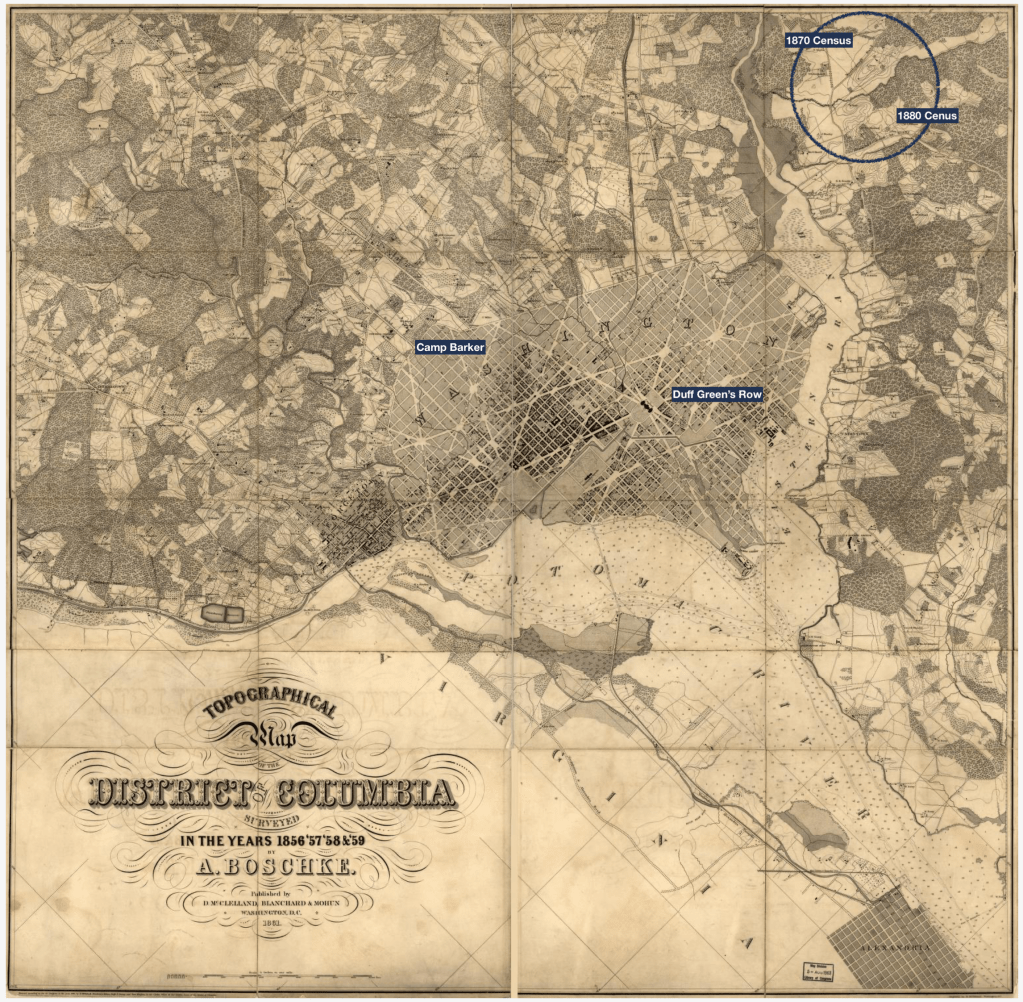
1861 Topographical map of the District of Columbia | loc.gov

It’s likely that Barbara died in 1896; a death record for a Barbara Jones, born around 1824 in Maryland can be found. She was buried in Mt. Olivet, a Catholic cemetery. No family members are listed.

Her son, Peter Jones, is still living in the vicinity of Benning’s Road in the 1900 Census. He is working in a stock yard, and his son, Peter Jones, Jr. is working as a jockey.
related posts

Benjamin Lee and Augustus Jones | Stealing Horses

Stealing Horses

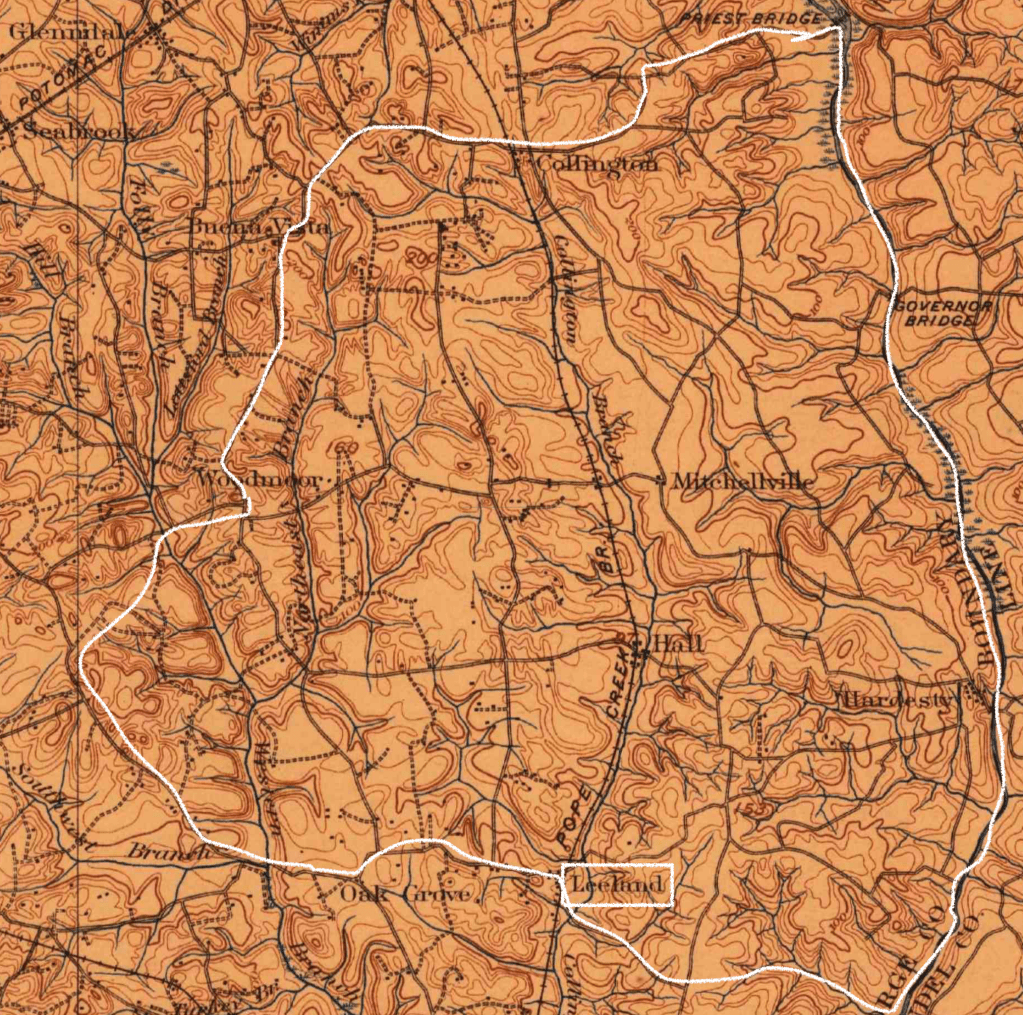
In the summer of 1900, two horses were stolen. One from the pasture of Dorsey Jones and one from the home of Washington Lee. Both men lived in Leeland, Maryland, a small community built up after the Civil War along the Pope Creek Railroad. It sits on the boundary between Queen Anne District and Marlboro.

1899 Top Map of Patuxent River | accessed from topoview

They alerted the authorities in Washington that their horses were stolen and the police were on the look-out for the thieves in the District. They arrested two men for trying to sell the horses near Centre Market in downtown DC near 11th and Louisiana, just north of the map about mid-point between the Eclipse and the Capitol.

According to the articles, the men arrested were their sons, Augustus Jones and Benjamin Lee.

21 Aug 1900, Evening Star | newspapers.com
22 Aug 1900, Evening Star | newspapers.com

Relatives

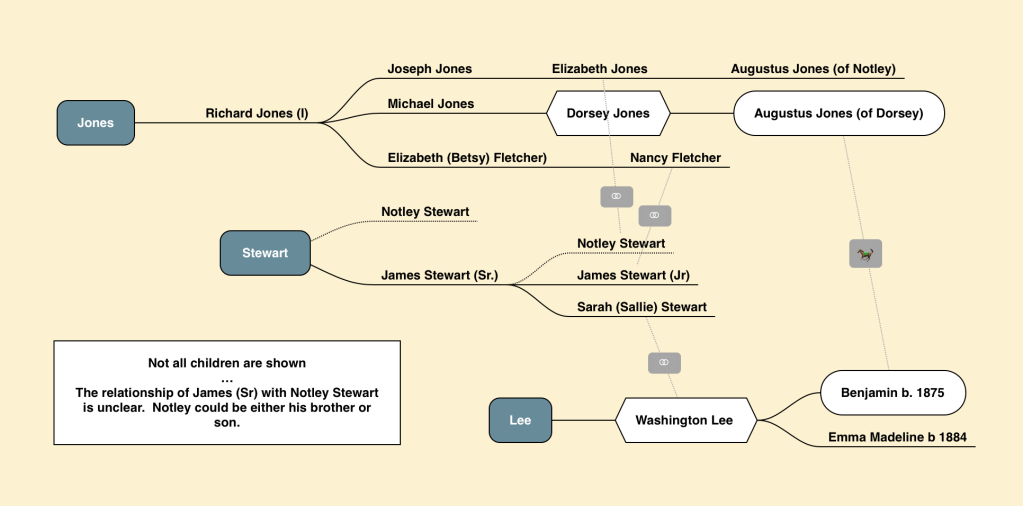
The two horse thieves, Augustus Jones and Benjamin Lee were distant cousins of each other. The first article says that Augustus was the son of Dorsey and the second article claims that Benjamin was the son of Washington Lee.

Reconstructed tree using a mixture of records. Subject to change to as more records are located.

Benjamin Lee

Washington Lee with his wife, Sarah (Sallie) Lee are enumerated with Benjamin Lee in the 1880 census. They were enumerated in the Marlboro district near Upton Brooke who was enumerated at DN 243. This places them in the vicinity of Brick Church Station which is where Leeland would grow over the next few decades.

Marlboro District, Prince George’s County 1880 Census | ancestry.com
1878 Hopkins Atlas of Prince George’s County, Marlboro District | loc.gov

Augustus Jones

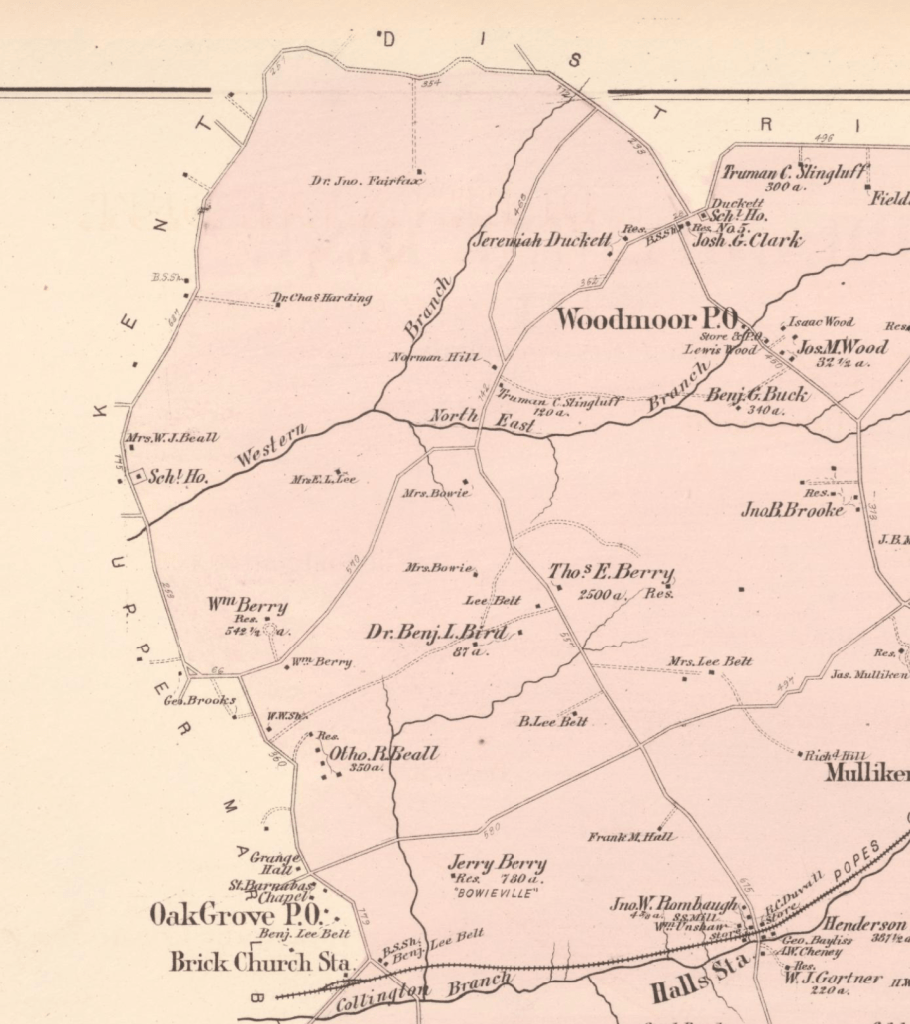
Augustus Jones is not found in the census with Dorsey Jones. In 1880, Dorsey Jones, age 30, is living with his father and mother, Michael and Amelia (Milly) Jones in Queen Anne’s District, likely near Woodmore P.O as they are enumerated a few pages from Jeremiah Duckett, who owned land near Woodmore. He does not have any children living with him in the 1880 census.

Queen Anne District, Prince George’s County 1880 Census | ancestry.com
1878 Hopkins Atlas of Prince George’s County, Queen Anne District | loc.gov
Note: North is to the right, not up like in most maps.

Neither Dorsey nor Augustus Jones have been located in the 1900 census. Dorsey died in July 1905, his death certificate indicated he was single, which is consistent with the 1880 Census.

Maryland State Archives

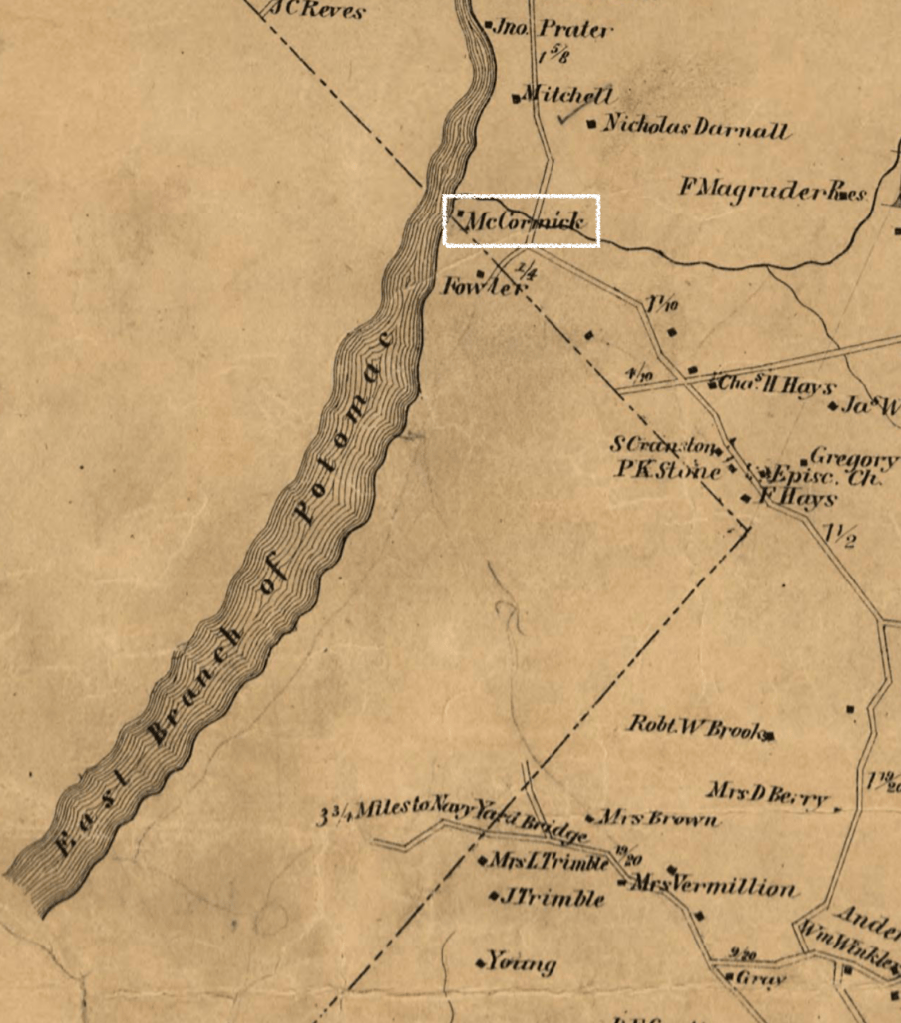
In the 1870 and 1880 Census, Augustus Jones was listed with Joseph and Barbara Jones in the District of Columbia. In 1870, they are enumerated near Alex McCormack who lived near the District/Maryland boundary. (In fact, the Wedge family had to petition for their freedom from McCormack during the Civil War when DC abolished slavery as McCormack sought to maintain their captivity by claiming they lived on his Maryland land and not his DC land. )

East of Seventh Street, District of Columbia 1870 census | ancestry.com
1861 Martenet Map of Prince George’s County | loc.gov

In 1880 they are enumerated near Daniel Stewart and Joseph Coven [Covington] which places them near Pleasant Grove and Benning’s P.O. and still near A. McCormack

Central Avenue, District of Columbia 1880 Census | ancestry.com

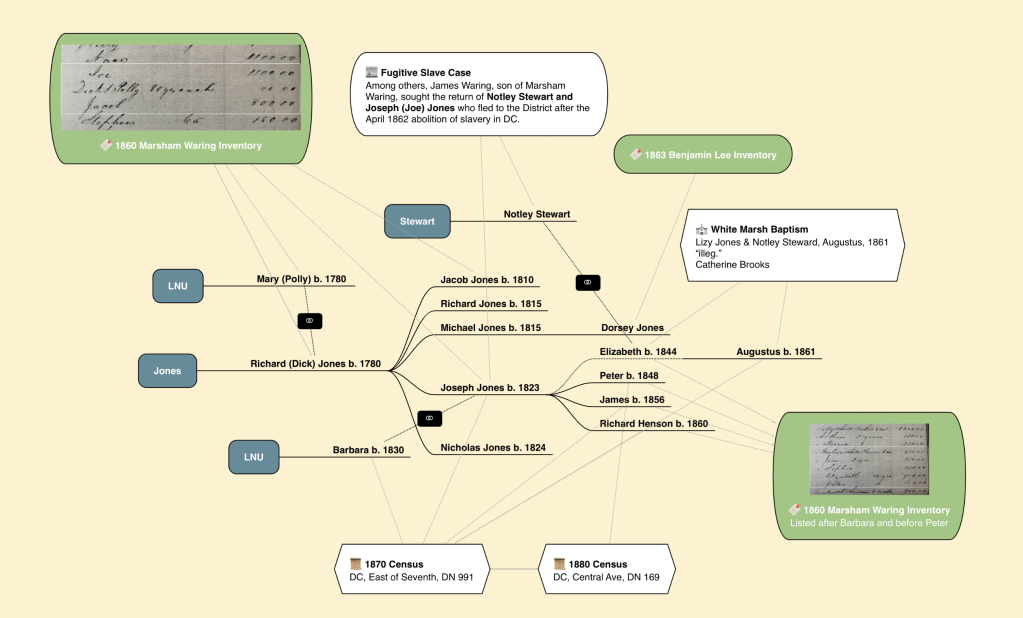
Augustus Jones is listed at the son of Joseph and Barbara Jones. However, based on other records, I would suggest that Augustus Jones is their grandson, and the son of Elizabeth (Lizy) Jones and Notley Stewart.

Reconstructures Family Tree with identified direct and indirect sources | Subject to Change

The Jones and Stewart family were enslaved primarily by Marsham Waring and also by Benjamin Lee, his brother-in-law in Queen Anne District prior to emancipation in 1864. Waring died in 1860, and among his probate records is an inventory that lists the people he enslaved. Lee died in 1863 and his probate records also include an inventory. Additionally, Waring’s children, Elizabeth L. Bowie, M. Virginia Mackubin [sic] and James Waring had compensation lists submitted to the Commission of Slave Statistics which lists both the first and last name of the people the Waring’s enslaved.

The Warings were Catholic and some of the people they enslaved had their children baptized by White Marsh Priests. Among them, Lizy Jones and Notley Stewart had their son Augustus baptized in 1861. A year later, Notley Stewart and Joseph Jones, Elizabeth’s father, are named in an affidavit, among others that they had fled to the District after the abolition of slavery there. Notley and Elizabeth Jones have not been located, though their son is living with Joseph and Barbara Jones, Elizabeth’s mother, in both the 1870 and 1880 Census.

Incidentally, Peter Jones, the son of Joseph and Barbara Jones, and uncle of Augustus (assuming my theory is correct), lived on Benning’s Road in 1900 and he worked at as a laborer in a stock yard, and his son Peter (Jr.) worked in a jockey house, suggesting the family worked with and knew horses.

Afterwards

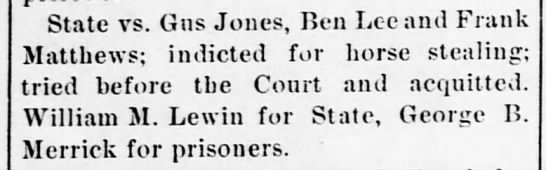
The local papers reported that “Gus Jones, Ben Lee, and Frank Matthew” were indicted for horse-stealing and that they were acquitted.

26 Oct 1900, Prince George’s Enquirer and Southern Advertiser | newspapers.com

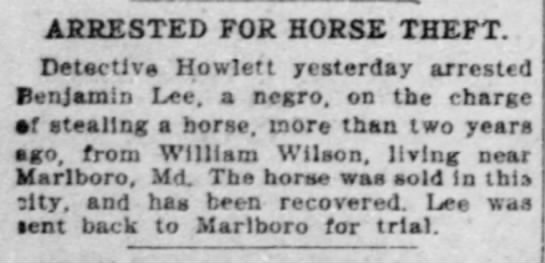
And, in 1903, Benjamin Lee was arrested again for stealing a horse in August of 1900. This time from William Wilson, who also lived near Marlboro and again, Lee is alleged to have sold the horse in the city. Wilson was a Black man who worked on the railroad.

27 July 1903, Washington Times | newspapers.com
23 Oct 1903, Prince George’s Enquirer and Southern Advertiser | newspapers.com

The Evening Star described his day in court as multiple days due to multiple technicalities. It was first delayed to a legal technicality, then a new jury had to be impaneled as his brother-in-law sat on the jury, then finally he was tried and found not guilty. The judge sentenced him to seven year. The paper reported he tried to escape and assaulted officers. His head was injured and he required bandages. The paper described hi as barely recognizing him the final time in the court, though if this referred to a change in demeanor or a multitude of bruises, or both, it doesn’t specify. Considering how the criminal system treated and treats Black men, it was probably a submission by force. This seems reflected in the Judge’s comment, “you got all that was coming for you.”

20 Oct 1903, Evening Star | newspapers.com

In the 1910 Census, a Benjamin Lee is listed as a prisoner in Baltimore working in the foundry.

One Final Note

The Washington Times seems to have been ahead of the police. While the Evening Star reported that “Gus” Jones and accomplices had been arrested for stealing horses from their family, and the Prince George’s Enquirer reported that they had been acquitted, and the thief of Wilson’s horse was not identified until 1903 for stealing William Wilson’s horse and not tried until October 1903, the Washington Times reported their arrest in 1900. They even knew Benjamin’s alias of Will.