Group 2: Sue and her Children

This post is one in a series in an attempt to identify members of the Clarke family groups among the people enslaved by Robert D Sewall at “Poplar Hill” in Prince George’s County.

Nathaniel Clark, Carpenter
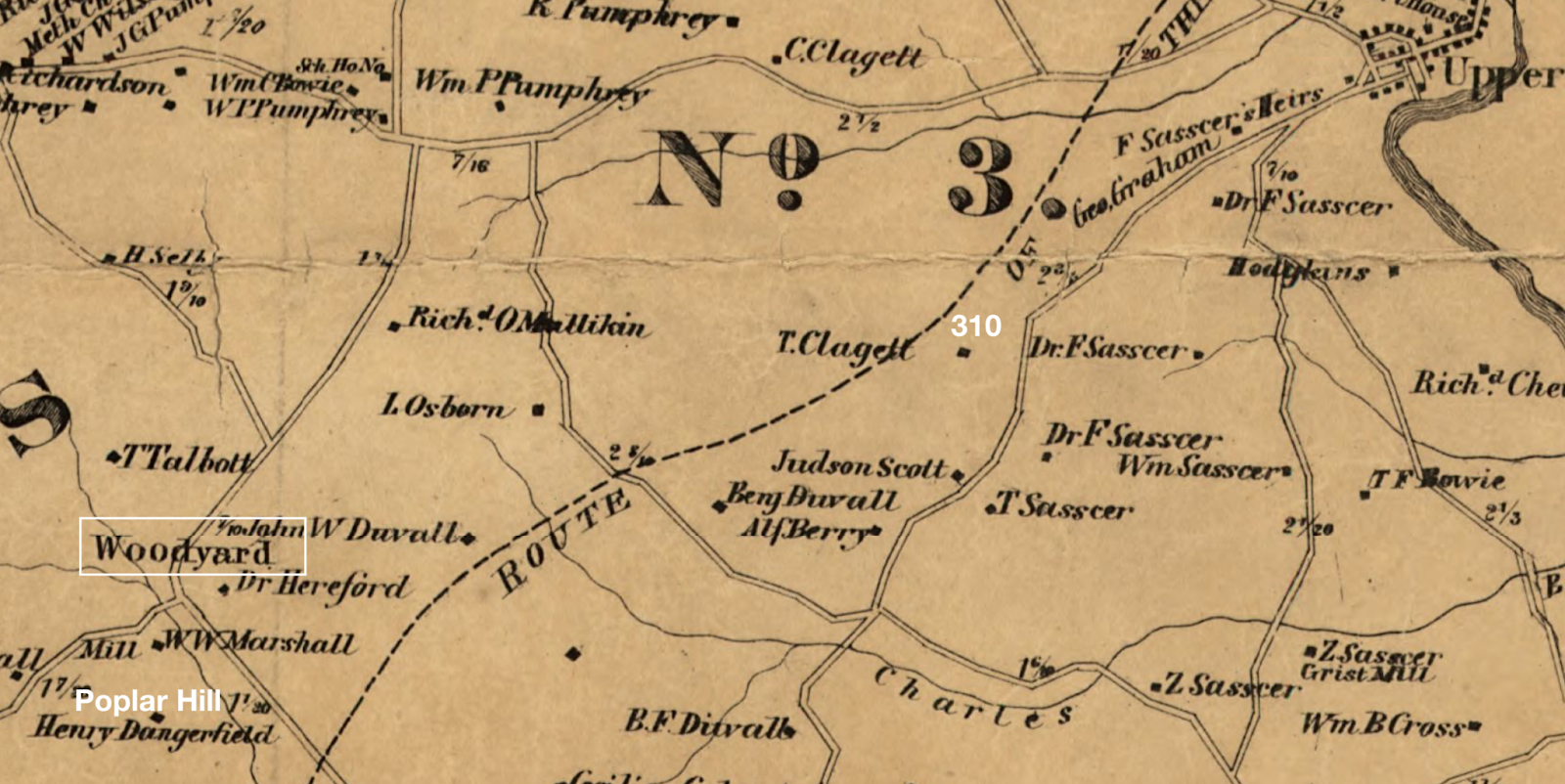
Near Woodyard, Martenet marked a mill on his 1863 map of Prince George’s County. This mill is adjacent to the lands owned by the Sewall-Dangerfield families. Its miller was enumerated in the 1870 census at dwelling number 21; the mother of W. H. Marshall at 22, and then the census enumerated 18 Black households among the next 24 households. These households are likely the households of freed Black people who had been held by the Sewall-Dangerfield families.

Among them, at household 25, is the household of Nathaniel Clark, his wife Milly, and their son, James. Nathaniel is listed as a carpenter.

As a carpenter, Nathaniel likely built and repaired carts, wheels, rakes, fences, while also maintaining the buildings, including quarters, barns, storehouses and the dwelling house itself. In the 1870 census, he was one of three carpenters in the Surratts District, along with two white carpenters (John Hutchison and John C Higdon).
| Name in 1853 Inventory | Appraised Value |
|---|---|
| Ned Wilkes, 47 | $550 |
| Natt (Clarke), 50 | $650 |
| Henry Brown, 50 | $700 |
| Issac Brown, 50 | $550 |
| Robert Adam, 51 | $500 |
| Lewis, 48 | $200 |
The table shows the names of enslaved men around the same age as Nathaniel Clark and their appraised value in the 1853 Inventory. His value of $650 is higher to most of the other men, suggesting that the appraiser took in account their labor skills in addition to age when providing a value. In the essay “Skilled Blacks in Antebellum St. Mary’s County, Maryland”, the author examines the occupations of both free and enslaved Black people in St. Mary’d county and states, “Carpenters were the most valuable of slaves skilled or otherwise.” The review of historical documentation revealed that skilled carpenters could be hired out for $100 annum in 1812 and $290 in 1824 for the enslaver. (Marks, p. 546)
His household in the 1870 census, is fairly consistent with the household of Natt and Milly in the 1853 inventory, with the age difference between Nathaniel and Milly about 5 years in both documents, and with James consistently having an estimated birth year of 1849 in both documents.
| Family in the 1853 Inventory | Family in the 1870 US Census |
|---|---|
| Natt, 50 | Nathaniel, 60 |
| Milly, 44 | Milly, 55 |
| George, 19 | |
| Barney, 16 | |
| Susannah, 13 | |
| James, 4 | James, 21 |
Son, James Clarke (1849-)
James, their youngest son, was still living with his parents in the 1870 census. A marriage record shows he married Phillis Wood, their neighbor’s daughter in 1870 (both enslaved by Robert D Sewall and identified in the inventory).
Like his father, he was a laborer and the 1900 census shows him with the occupation of carpenter. The 1880 census (in conjunction with the 1878 Hopkins Map; the map is rotated from a traditional north orientation) shows that he lived northeast of Robey’s Town (present-day Clinton), he is listed at dwelling number 177 near Joseph Stephenson and others.

Son, George Clark (1834-bef. 1880)
In 1870, George Clark, the oldest identified son of Nathaniel and Milly, was living in Marlboro District; he is enumerated at dwelling number 311, near the dwelling house of Thomas Clagett (310). He and his wife Ann have 4 children, all of whom were born after 1853. This location puts him on the road from Upper Marlboro to Rosaryville and northeast of Woodyard. He is working as a “farm hand” which suggests he is a tenant farmer after emancipation. His oldest son, Edward, is still living there in 1880 with his wife and children. George, Anne and the other siblings do not appear to be living in the vicinity.
Son, Barney Clarke (1837-1916)
Barney, the second oldest son, is enumerated as living in Marlboro as well, though not near the Clagett land. Like George, he is a tenant farmer.
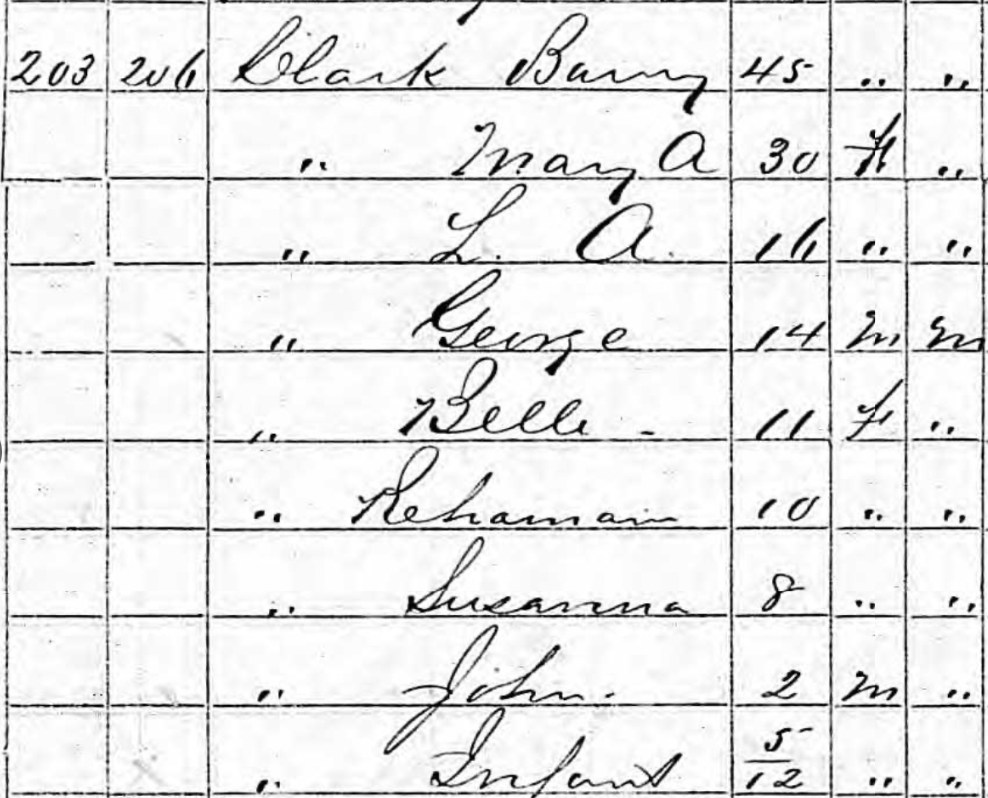
He and his wife, Mary Ann Burgess, have their marriage made official in 1870, though the ages of their children suggest that they had been partnered for a decade or more.
Mary Ann Burgess, enslaved by R. W. G Baden?
It is possible that Mary Ann Burgess was enslaved by R. W. G. Baden prior to the state emancipation in 1864. He lived in Nottingham District near Rock Creek. In 1867 he submitted a list of names that bear similarities to Mary Ann and her children:

Baden submitted a list Phoebe Clark and 5 children. With any of the lists submitted for the Commission on “Slave Statistics” it is ambiguous what age the enslaver noted, e.g., was it from 1864, when they were emancipated, was it from 1867 when the list was compiled, or was it from a previous list submitted without updated aged. For example, the Waring family submitted their list of individuals with ages from an 1860 inventory of their father’s estate (i.e., Mary Virginia Mackubin and Mrs. Elizabeth L Bowie). Additionally, the lists were voluntarily submitted meaning not every enslaver submitted a list. For example, the Sewall-Dangerfields did not submit a list for “Poplar Hill”.
[1] Considering Phoebe Clark, she is roughly the same age as Mary Ann (Burgess) Clark in the 1870 Census. Her name however is distinctly different. Two possibilities present themselves. First, the “slave statistic” list maker confused either Maria or Martha Ann for Phoebe and wrote the names incorrectly. Or, second, Phoebe was a name given by her enslaver, and Mary Ann chose Mary Ann for herself, and upon liberation chose the name she gave herself. Additonally, Mary Ann Clark or Burgess is not listed in the 1867 Slave Statistics.
[2] George Clark is roughly the same age as George Clark in the census
[3] William Clark is an outlier; and Will and Belle both contain an /l/ sound after a one-syllable name. The 1870 census could have misheard and wrote the wrong name.
[4] Lettie Clark could be L. A. Clark in the census. While the age is different, the names consistently begin with an “L”
[5] Both documents list a multi-syllabic distinct name that begins with “R”.
While there are similarities, this theory relies on a lot of errors on behalf of the record takers, and while probable is by no means definitive.
Barney Clark in 1870
Barney and his wife’s dwelling number 203 in the 1870 census places their residence north of Woodyard, closer to the village northwest of Woodyard which is represented by the cluster of names.

By 1880, the family has moved south to the Brandywine District. Brandywine was formed from the Nottingham District and suggests that the family moved into the area southwest of Woodyard, near the new villages of Rosaryville and Chelthenham, where many of the other formerly enslaved people of Poplar Hill settled. He is enumerated near Nathan Diehl, who bought the land of “Poplar Neck” [not to be confused with “Poplar Hill”] from Araminta Brooks in 1870. This places him and his family on the road running southeast to Rosaryville. He died in 1916, and is buried in Forestville, at the Mount Calvary Catholic Church Cemetery.
Census Comparison of Nathaniel Clark Family
| Family Member | 1870 Census | Marriage Records | 1880 Census |
|---|---|---|---|
| Nathaniel Clarke & Milly | Surratts District Living with other freedmen near dwelling house of “Poplar Hill” Listed as Carpenter | Not found; inferred dead | |
| George | Marlboro District Living with wife and childrenTenant farmer | Not located; inferred to Ann LNU | Not found |
| Barney | Marlboro District Living with wife and childrenTenant Farmer | Married to Mary Ann Burgess in 1870, | Brandywine District Living with wife and children Tenant Farmer |
| Susannah | Not found | Not found | |
| James | Surratts District Living with his parents | Married Phillis Wood, 1870 neighbor, in 1870 | Surratts District Marked on Hopkins Maps Occupation: Laborer |
Sources
Marks, Bayly E. “Skilled Blacks in Antebellum St. Mary’s County, Maryland.” The Journal of Southern History, vol. 53, no. 4, 1987, pp. 537–64, https://doi.org/10.2307/2208774. Accessed 7 Apr. 2022.
 stories of Then