In 1929, Patrick Stewart, age 84, died of a stomach ailment. His son, J. T. Stewart, furnished the information for the death certificate for the District of Columbia records.
Patrick Stewart, age 84, was the son of Patrick Stewart and Mary Ridout. He was born around the year 1845, twenty years prior to the emancipation of the enslaved in Maryland, where he and his parents were born into chattel slavery.

Enslaved by John E Berry
In 1867, John E Berry, of Bladensburg in Prince George’s County, Maryland, submitted a list to the Commission of Prince George’s County Slave Statistics of the people he enslaved prior to emancipation in hopes of compensation from the federal government. Among those he listed were Patrick Stewart, age 20 and Mary Stewart, age 38.

While we do not have an age for Mary from the death certificate, the ages of the two Patricks are consistent with each other, both are born around 1845 — and Mary, the other Stewart, is old enough to have borne Patrick as her son.
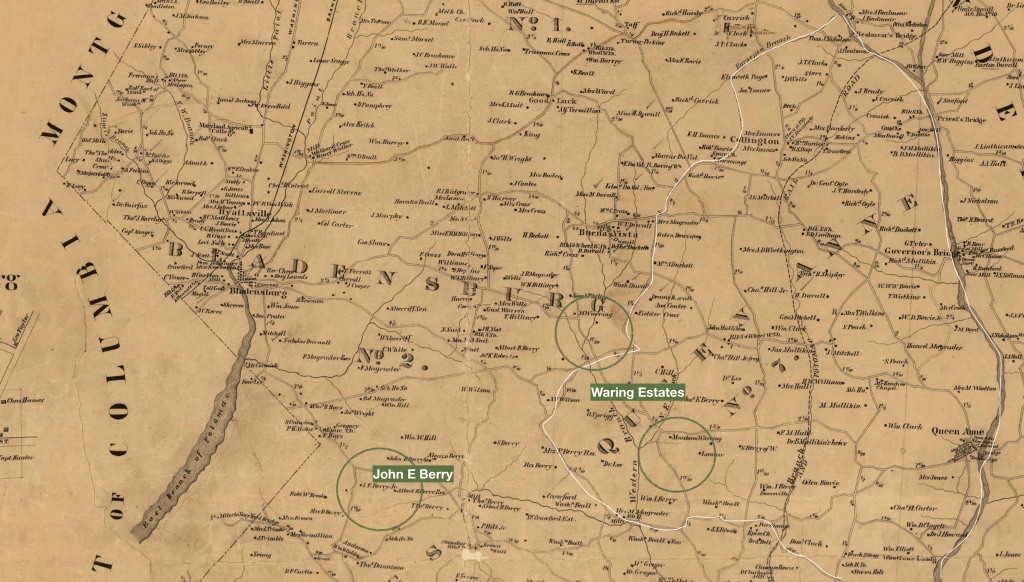
The identification of Patrick’s mother as Mary Ridout opens up a line of inquiry about whether or not Mary Ridout is connected to the Stewarts of the Waring estates and to the Ridouts enslaved in and around the Waring estates.
Connected Posts: Barbara Jones | Ridout Family & Benjamin Lee and Augustus Jones | Stealing Horses

Seat Pleasant
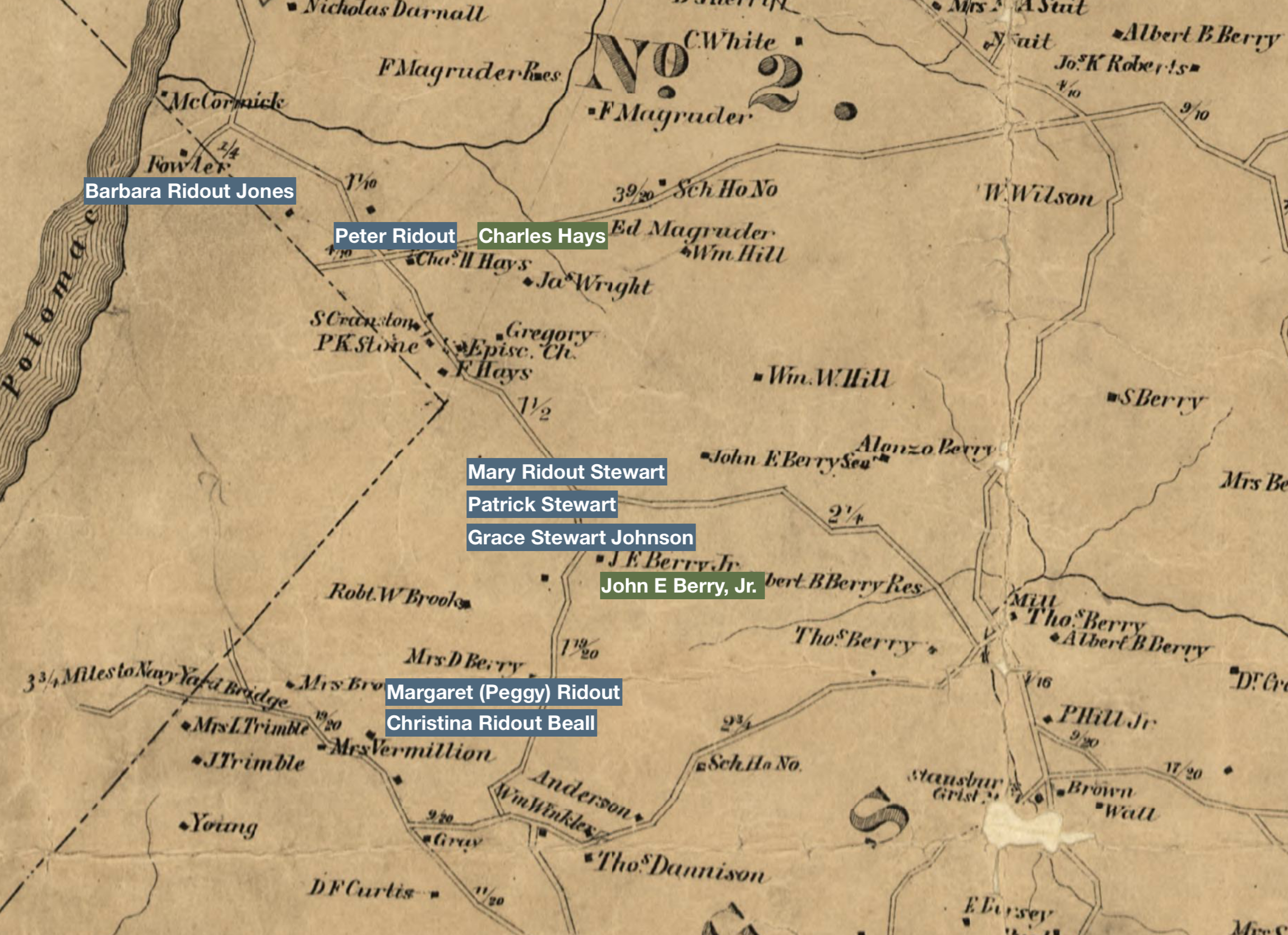
In the post on Barbara Jones’ connection to the Ridout family, we saw that Peter and Priscilla Ridout moved to the boundary between DC and Maryland, near Charles H Hays and we saw that Margaret (Peggy) Ridout and her daughter moved into the household of Geo R Wilfred Marshall, also near the boundary of DC and Maryland. The two families essentially bookend the area where Mary Stewart and her son Patrick are enslaved.
In the 1880s, Patrick Stewart purchased Lot #5 of the Seat Pleasant subdivision. The land contained about 10.5 acres. He paid $350 for the lot.

It sat on the former land of John E Berry, Jr. Berry, Jr., who purchased “Seat Pleasant” from his relative Thomas E Berry. At the close of the Civil War, the land was sold to real estate developers who created the town of Seat Pleasant. Berry’s father, Dr. John E Berry, Sr., had a nearby plantation called Independence, and Berry’s brother, Albert B Berry had a farm called Sunnyside in addition to his other real estate holdings. The survey of Seat Pleasant was completed in 1873. In addition to detailing the lots, it marks what is likely the Seat Pleasant dwelling house and marks several cabins on the land, which may have be slave dwellings occupied by freedmen after emancipation.
In the 1870 census, Patrick and his wife, Lidia, are living with their three daughters: Mary E [1864], Margaret [1866], and Rachel [1868]. By 1880, they have five more children: William [1870], Daniel [1872], John Thomas [1874], Jane E [1876], and Christiana [1880]. The name of their last daughter, Christiana illustrates the connection with the Ridout family. As seen, Barbara Ridout Jones had both a sister and daughter named a variation of Christiana.
Mary Ridout Stewart
Mary Ridout Stewart was living next door to her son, Patrick, in the 1870 census in the household of George and Grace Johnson and their children.

This leads us to the suggestion that Grace is Mary’s daughter and Patrick’s sister.
Like Mary and Patrick Stewart, George Johnson was enslaved by John E Berry. The two men likely worked the tobacco fields of Seat Pleasant, first as enslaved men and then as tenant farmers.
Unlike the Patrick and George who were held in bondage on a large tobacco estate, Grace and her children were enslaved by a farmer, Charles H Hays, who likely grew produce for the Washington markets. Hay’s farm was north of Seat Pleasant, along the DC border, where Peter and Priscilla moved after the war.
When large estates were often valued above $10,000, Hay’s farm was valued at $2000. Farms were smaller in this part of Prince George’s County and often grew other products instead of tobacco. In 1864, Charles Hays advertised a reward of $5 for a cow that had strayed. Upon his death, his farm of 105 acres was advertised for sale; the soil was described as well adapted for grazing and market gardening. The land had a dwelling of six rooms and a tenement house of three rooms.
The 1860 Slave Schedule lists 8 enslaved people for Hays, and Hays submitted the names of 10 people whom he enslaved. In addition to Grace and her children, Hays enslaved Letty Hanson, age 25. Her first name is phonetically similar to that of Lidia, Patrick’s wife.

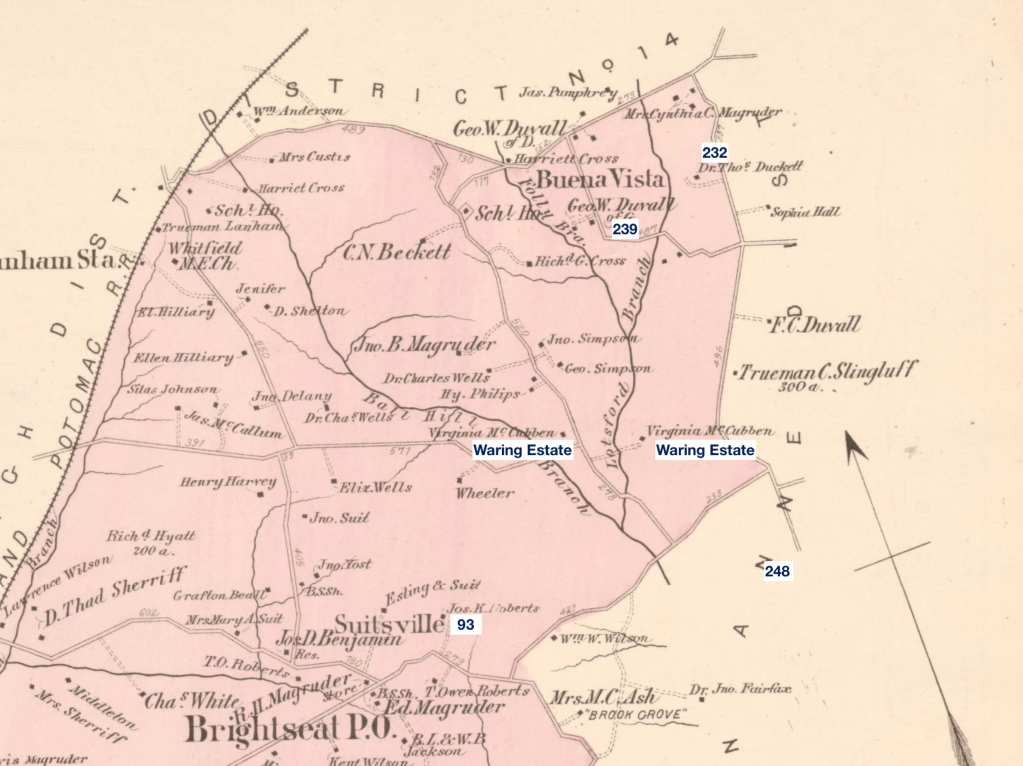
By 1880, Mary Ridout Stewart and her husband, Patrick Stewart, are living together in the household of Patrick Stewart and Lidia with their children. Patrick (Jr.) has yet to buy the land in Seat Pleasant. From neighboring houses, it appears that they are living near Buena Vista near the Waring Estates, in the newly created Kent District along the boundary with Queen Anne District and near close and extended family.
| Dwelling Number | Relative | Relationship to Mary Ridout |
|---|---|---|
| 253 | Patrick Stewart (Sr.) | Husband |
| 253 | Patrick Stewart (Jr.) | Son |
| 258 | Grace Johnson | Daughter |
| 247 | Michael Jones | Son of Barbara’s brother-in-law |
| 244 | Bettie Fletcher | Barbara’s sister in law |
| 92 | Geo Stewart | Inferred Nephew, as he is son of James Stewart |
The table lists the dwelling numbers of people related within the extended kin group of Mary Ridout. Dwellings 253 & 258 are members of her immediate family and include her children. Dwellings 247 and 244 are members of the Jones family that Barbara Ridout, Mary’s inferred sister, partnered with. Elizabeth (Bettie) Fletcher was the daughter of Richard and Mary Jones. And dwelling 92, which can be identified as being in the geographic vicinity as it is neighboring Jos. K Roberts house is the household of George Stewart, the son of James Stewart.
James Stewart was listed in Marsham Waring’s 1860 inventory with Notley Stewart, who fathered Barbara Ridout Jones’s grandchild, Augustus Jones. Also listed with James and Notley was Patrick Stewart. During the Civil War and shortly after the abolition of slavery in the District, Patrick and Notley fled to DC with many others from the Waring estates. James Waring, as administrator of his father’s estate, went to the District to seek their return, swearing an affidavit that they were from Maryland and therefore subject to his enslavement. Records of Patrick Stewart are not found, though records of the others in Camp Barker and Camp Springdale have been found. Likewise, Patrick in the 1870 census has yet to be identified. However, it appears he reunited with his family by 1880.
 stories of Then