Abraham Clarke (ca. 1815-1891)

Group 1: Polly & her children

This post is one in a series in an attempt to identify members of the Clarke family groups among the people enslaved by Robert D Sewall at “Poplar Hill” in Prince George’s County

Manumission

In 1852, Robert D. Sewall wrote his will, devising his property to his nieces and nephew.  The majority of it went to Susan and Ellen Daingerfield, with some devised to his nephew Henry S. Mitchell.  However, excepted from this was the man Abraham Clarke, as Sewall bequeathed “to my faithful and trustworthy house servant Abraham Clarke, his freedom”.  Along with his freedom, Sewall bequeathed 400 dollars to allow him to move outside of Prince George’s County.  

Robert D. Sewall Will | familysearch.org

When Abraham was emancipated by Sewall, he was living with his wife, Francis, and two children, Alice and John Henry, as evidenced by the 1853 Inventory.  While his manumission provided freedom for himself and some money to establish his life, it did not grant his family freedom. 

While Sewall died in 1853, it wasn’t until 5 years later, in 1858, Abraham Clarke was issued the certificate of freedom.  He was described as of “light complexion, five feet six…with a small scar on the forehead near the edge of his hair and a large scar on the cap of the left knee occasioned by a burn when a small child.”

Certificate of Freedom | MSA


Life in the District

By 1860, Abraham had left Prince George’s County and was living in Ward 2 of the City of Washington, with his daughter Alice.  It is unclear how he secured her freedom (by self-emancipation or purchase) and a new wife, Sarah.  His home, about a half mile north of the White House, was on the north edge of the inhabited city where the buildings gave way to empty lots.  It is unclear what the fates of Francis and John Henry were.  

Family in the 1853 Inventory Family in the 1860 US Census
Abraham, 38Abraham Clarke, 45
Francis, 23Sarah Clarke, 40
John Henry, 6
Alice, 2Alice, 9

Abraham was the neighbor to James Johnson, a man manumitted by Robert D. Sewall in 1845. (Prince George’s County, Land Records, JBB 4:576 | mdandrec.net).

The 1860 US Federal Census records James Johnson working as a cook, Abraham Clarke as a servant.  The City Directories for the 1860 lists his occupation as waiter. 

1860 US Federal Census, DC, Ward 2, Image 192 | ancestry.com

Both men owned real estate and had a small personal estate.  Based on the 1862 City Directory, they lived near Rhode Island Ave where it connects Scott and Logan Circles; an article in the Evening Star on May 7, 1863 describes it as 29 by 105 feet. In 1884, Sarah Clark, Abraham’s wife, died, bequeathing her husband use of lot 7 on block 211 during his natural life with her stepdaughter Alice (Clark) Jennifer. He died in 1891.

Author Annotated Excerpt of 1851 Map of the City of Washington DC | loc.gov

1821 Inventory and Family

While the 1853 inventory gave details of his adult life as a husband and father, the 1821 inventory gives evidence to his role as a son. Based on the ages provided in the Federal Censuses and the 1853 Inventory, we can estimate his birth year to be between 1815-1820.  Most records suggest a year closer to 1820.  

The 1821 inventory lists a two year old Abraham, grouped with inferred older sisters and his inferred mother, Polly.  (page 354-355)
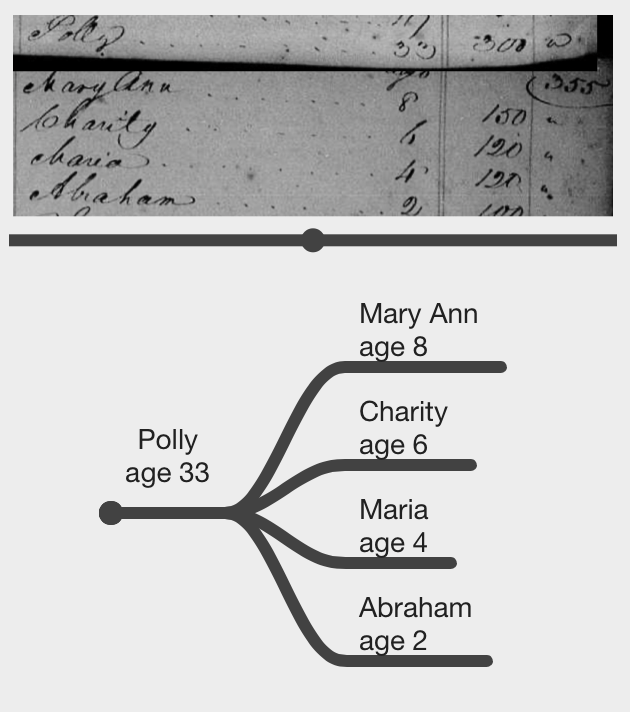
It is tempting to infer status in the eyes of the enslaver from arrangement on the inventory. The 1853 will bequeathed freedom to Abraham due to his “faithful and trustworthy” character, and he was listed first in the 1853 inventory, seeming to signify the closeness with which he labored to Robert D Sewall. In contrast, in the 1821 inventory lists Polly and her children toward the end of the list for the property in Prince George’s county. While it is tempting to drawn conclusions from this comparison, there is no indication that the organizers of the two inventories had similar thought processes.
George Brown | Escape

In May 1842, George Brown escaped.

[Legacy of Slavery Database | MSA]

Escape

The ad placed in the National Intelligencer by Robert D. Sewall’s plantation manager, Wm. G Jenkins, described George as “25 or 26 years old, 6 feet 2 or 3 inches high, dark complexion, very high forehead.” He was also described as “when spoken to has a quick speech and a smile on his countenance”.

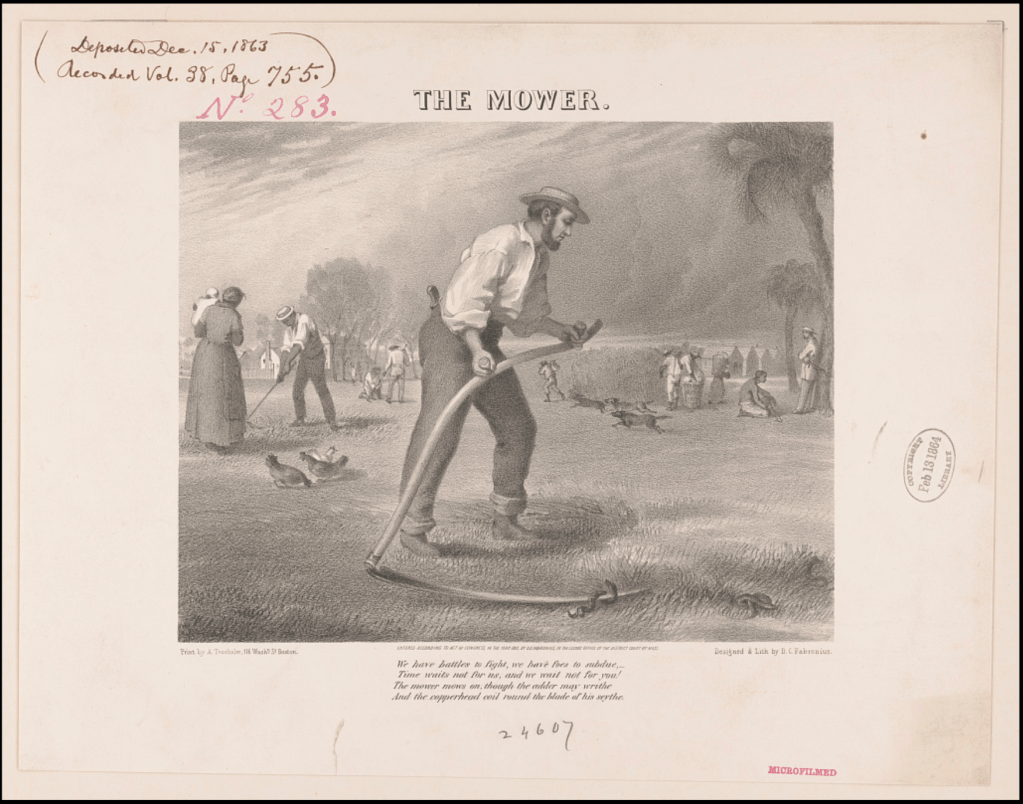
He most likely worked in the fields of the large estate, raising the tobacco and wheat for the Sewall as he was described with a scar on his knee, “occasioned by a cut from a scythe”. Scythes were use to harvest crops or clear fields.

An allegorical 1863 print using a scythe to criticize the plantation system.
See loc.gov for more details.

During his escape he was seen on the stage road leading from Upper Marlboro to Washington. A 1848 Baltimore Sun edition posted the male stage routes and included route 1936 “From Washington DC by Long Old Fields, MD., Upper Marlboro, Queen Anne and Davidsonville to Annapolis, three times a week. [24 Jan 1848 | newspapers.com]

Excerpt from 1863 Martenet Map of Prince George’s County annotated with location of Poplar Hill in relation to the describe mail route

Fanny and Henrietta Brown, Sold

The same year, Robert D Sewall sold the legal authority to enslave eight people to William J Stone, a resident of the District. Stone owned a tract of land called “Mount Pleasant” and a residence in town.

In August 1842, four months after George’s escape, Fanny and Henrietta Brown was among those included into the sale to Stone. [Civil War Washington] Fanny was described as twenty-two years old in the sale. Henrietta Brown was fifteen.

It is possible that George, Fanny and Henrietta were siblings, as they shared the same surname and were enslaved by the same person and similar in age.

Unlike George, who toiled in the fields, Fanny was described as a “cook and house servant” in the 1862 petition paperwork Stone presented to be compensated for her emancipation. Henrietta Brown was not included in the 1862 petition for compensation from her emancipation. A note was included regarding the 1842 sale “Fanny Brown & Cornelius Digges were valuable Servants (the bill of Sale is for 7 servants)—but the others were not so much so & some of them an actual expense for many years before their services were of any value $2200 was the price for all”. This suggests that Stone may have sold the other five included in the Bill of Sale prior to emancipation as he did not see value in their labor.

In 1850, William J Stone [real estate valued at $250000] enumerated 14 enslaved people in the US Federal Census Slave Schedule, included three adults females, ages 30, 29, 27. Fanny is likely listed among them (she would have been 29 in 1850) and possibly Henrietta as well. In 1854, a William Stone (note no use of middle initial) committed two enslaved people, Simon and Henny, to the DC Jail for “safekeeping” [Hynson, 42-43]. They were released to him nine days later. In “Freedom Seekers: Fugitive Slaves in North America, 1800–1860”, Pargas states that enslaved people were put in the jail for “safekeeping” pending a sale or estate division (110). Henny may have been Henrietta.

1821 Robert Sewall Inventory

Fanny and Henrietta are not listed in the 1821 Robert Sewall Inventory [TT 4:352]. Fanny was likely born around the time of the inventory and therefore born after its compilation, while Henrietta, at 15, was born five years after the compilation of the inventory.

George has an estimated birth year of 1816 calculated from the age of 26 given in the advertisement. If he and his family had been enslaved by the Sewall’s in 1821, his name and age [George, 6] should be expected.

On the second page of the inventory, there is a family group listed that included George, 8. This may be the same George.

folio 354 of the 1821 Robert Sewall Inventory.

There is no documentation located that connects the three, other than the Bill of Sale and Runaway Advertisement that details that they both left “Poplar Hill” in 1842. If Fanny and Henrietta’s forced departure from “Poplar Hill” was connected to George’s escape, it was not detailed in the Bill of Sale.

Sources:

Pargas, Damian Alan. Freedom Seekers: Fugitive Slaves in North America, 1800–1860. United States, Cambridge University Press.

Hynson, Jerry M.. District of Columbia Runaway and Fugitive Slave Cases, 1848-1863. United States, Willow Bend Books, 1999.

Charity Clarke (ca. 1816-unk)

Group 1: Polly & her Children

This post is one in a series in an attempt to identify members of the Clarke family groups among the people enslaved by Robert D Sewall at “Poplar Hill” in Prince George’s County.

Charity in 1821

Charity is listed in the 1821 inventory alongside Abraham Clarke, who was manumitted in Robert D Sewall’s will and who lived in DC after his manumission.

Charity in 1853

She is listed immediately after Abraham’s family in the 1853 inventory with two children: Daniel, age 14,  and Mary Mag, age 8

Excerpt from 1853 Inventory of Robert D Sewall | familysearch.org

The 1870 Census returns a record for Charity Jackson, age 50, living in the neighborhood of TB, in the Piscataway District.  Piscataway is the district immediately south of Surratts, where Poplar Hill is located.

Husband Daniel

She was living with her inferred husband: Daniel Jackson, age 40, and their two children: Alfred and Caroline.  The Prince George’s Marriage Licenses show they formalized their marriage in 1872.  Both were listed with the last name Jackson, suggesting they had been married informally for decades prior.

1870 US Federal Census, MD, PG, Piscataway, Image 4 | ancestry.com

A Daniel Jackson, age 40, is listed in the Prince George’s County “Slave Statistics”; Mrs. Jane P Williams submitted his name as a person she enslaved as of 1864.  She and her husband owned real estate valued at $10,000 in 1860 and personal property (including value of enslaved people) was recorded as $25,000.  In 1870, she was a widow with real estate valued at $8000 and personal property of $600.

Prince George’s County Commissioner of Slave Statistics 1867-1869 CE404 | Maryland State Archives

1870 Residence

The approximate location of Charity and Daniel’s residence after the Civil War can be inferred from the use of Martenet’s Map of Prince George’s County which shows landowners [1863] and the dwelling numbers of the landowners in the 1870 census. Williams can be identified on the road parallel to the district boundary, while W. A Gibbons is close to the TB Post Office, and Marshall and Gwynn are to the west.

Charity and Daniel are listed at dwelling number 25, suggesting that they are on the roads near Gibbons and the TB post office.

If Charity lived on “Poplar Hill” during her captivity by Sewall and if Daniel lived on the Williams’ tract of land (and possibily the residence he inhabited after emancipation by the state), this suggests that they were forced to live apart during their marriage.

If either of them had been granted a pass to visit the other, the walk would have been about 8 miles from one estate to the other, and would have taken about 3 hours.

Family in the 1853 Inventory Family in the 1870 US Census
Charity, 38Charity Jackson, 50
Daniel Jackson, 40
Daniel, 14
Mary Mag, 8
Alfred Jackson, 7
Caroline Jackson, infant

Died prior to 1880

Daniel Jackson (Sr) is recorded in the 1880 census with a wife, Clarisa, and his children Alfred and Carolina. Listed with the family is Elizabeth Duckett who is labeled as “mother”. The age difference between Daniel and Clarisa is small, Daniel is 54 and Clarisa is 53. This suggests that Charity died prior to 1880 and Daniel remarried.

Son, Daniel Jackson, Jr

Charity’s son, Daniel Jackson,  is listed in the 1853 inventory with her and not in the 1870 census.  His estimated birth year, based on the 1853 inventory is 1839, which in 1870, would make him 32.  As an adult, it is likely he is in his own household.

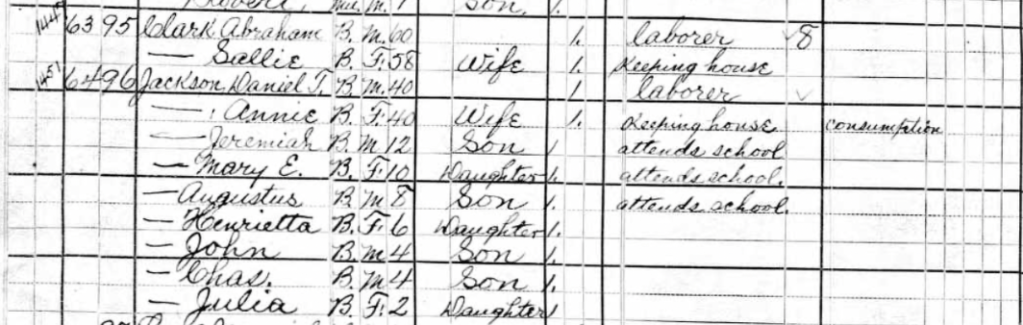
In the 1870 census, a Daniel T Jackson is living next to Abraham Clarke in the City.  He is the correct age to be Charity’s son, Daniel.  This suggests Daniel left Poplar Hill in pursuit of freedom during the Civil War, like many enslaved people who used the proximity to DC as a means for emancipation after 1862.   

1870 US Federal Census, DC, Ward 2, Image 315 | ancestry.com

Daniel married Annie Lowe in 1867 and settled into a home near his uncle.  The 1880 census indicated Annie had consumption, and she must have died by 1882, as the Evening Star lists an Equity Case (Lowe vs. Jackson), in which Daniel T Jackson was appointed guardian ad litem. 

1880 US Federal Census, DC, ED 23, Image 9 | ancestry.com

A Daniel Jackson, widower, died in 1886.  His estimated birth year was 1836 and he was buried in Mt. Olivet Cemetery, suggesting like many of the residents of Poplar Hill, he was Catholic.