After the Civil War ended, Dinah Brown married Lawrence Wood. Dinah was the daughter of Charles Brown and Susan Wood. She was named for the grandmother of Susan, who had been enslaved by Robert Darnall. [See Fishwick v. Sewall, and the post on Dinah’s Descendants] Dinah and her descendants were enslaved by the Robert Darnall and then devised to Robert Sewall and his heirs.
Dinah was listed as the youngest of Susan “Suck” Wood’s children in the 1853 Inventory of Robert D Sewall’s estate at “Poplar Hill”. Her age was recorded as 7; her estimated birth year was 1846.
Her marriage to Lawrence Wood was solemnized in January 1866 when she was 22 years old.
early marriage years
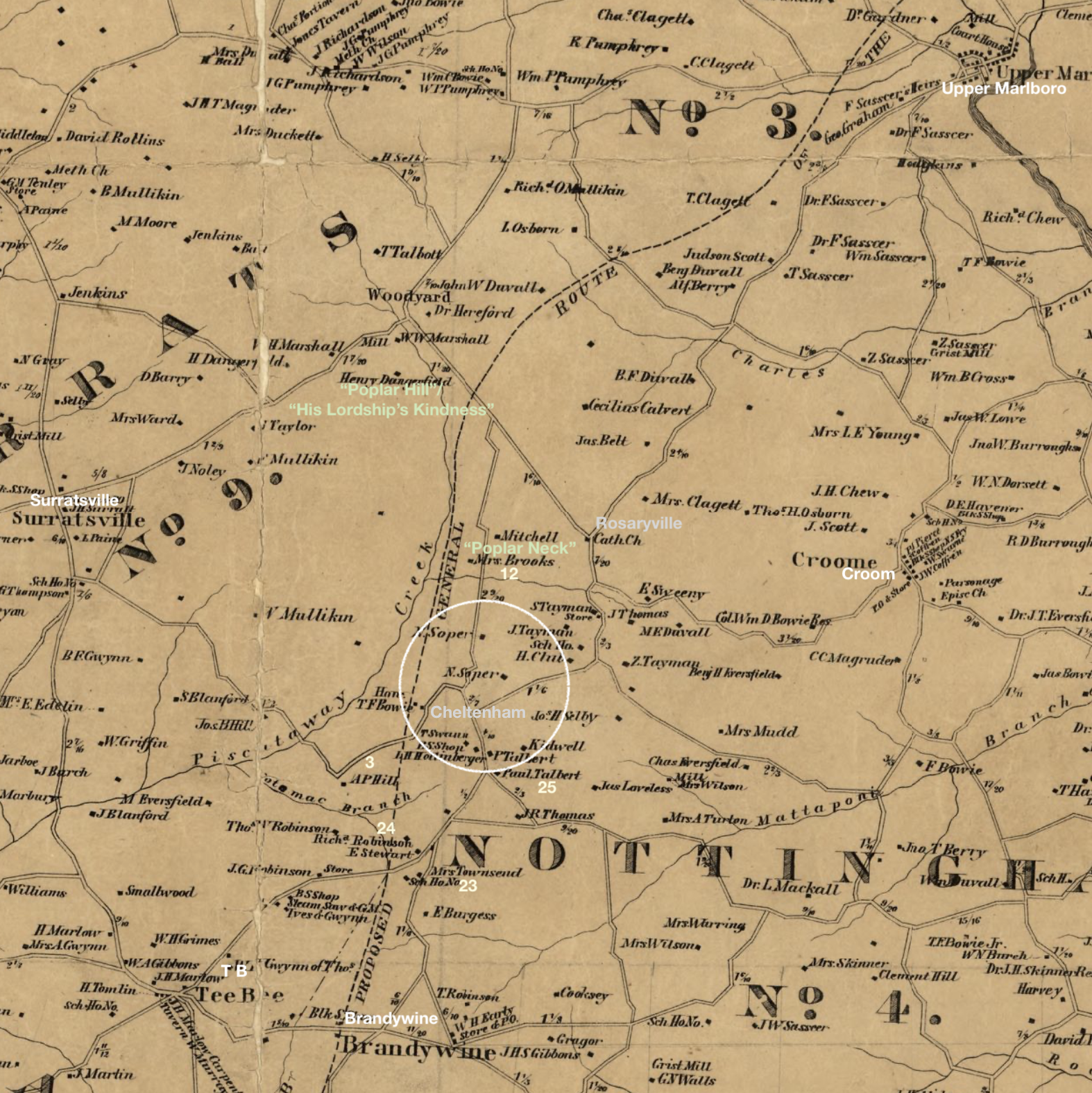
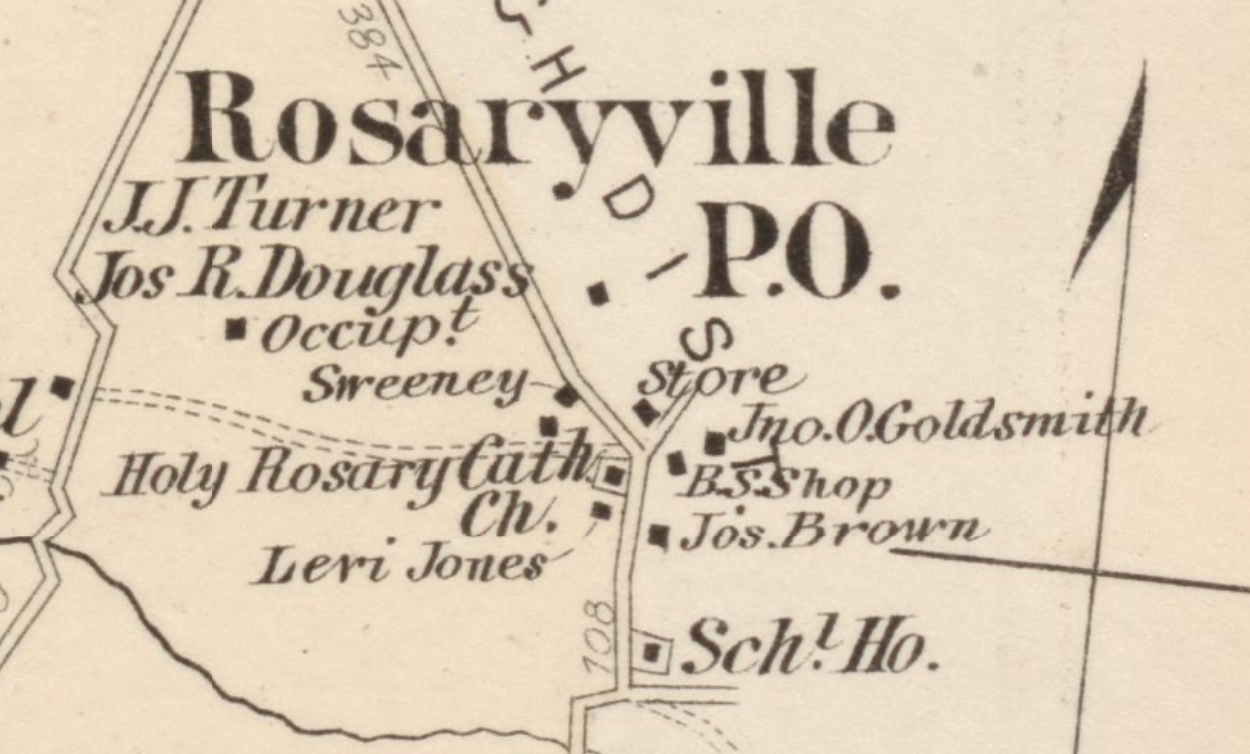
After their marriage, they lived near “Poplar Hill” and Dinah’s brother, Joseph Henry Brown, near the Catholic Church where Rosaryville would develop into a town. The first map is from Martenet’s Map of Prince George’s County in 1863. The second map is from Hopkin’s Atlas of Prince George’s County in 1878. The development of Cheltenham and Rosaryville results from the building of the railroad and the development of villages after emancipation.
Excerpt from Martenet’s 1863 Map with my annotations | loc.govExcerpt from Hopkin’s 1878 Atlas with my annotations | loc.gov
In the 1870 census, they lived with their two children: Louisa and Buddy, and a teenager named Thorton. The 1870 census did not record relationships leaving us to infer relationships.
In the 1880 census, they are still living near Dinah’s siblings and her mother. They have an additional son, which they named after Lawrence. Dinah is working as a cook.
searching for Lawrence Wood prior to emancipation
Dinah’s family has strong ties to “Poplar Hill” and the “Woodyard”, her family having lived there since Susan’s grandmother was brought from Dorchester County prior to 1775, when Darnall moved to “Poplar Hill” with his step-daughter Jane Fishwick who had enslaved Dinah prior to Darnall taking possession of Dinah.
Lawrence does not appear in the 1853 inventory and his name, Lawrence is not one that appears in the 1821 inventories or other identified records related to “Poplar Hill”.
enslaved by Charles F Calvert
A “Lorenzo Wood” appears in the lists submitted to Prince George’s County Commission on Slave Statistics and compiled in 1867 & 1868. As enslavers had been been compensated for their “lost property” when the District had emancipated the enslaved in 1862, Maryland enslavers also hoped for compensation and many submitted lists to the commission. The Dangerfield family who owned “Poplar Hill” did not submit a list. However, Charles F Calvert submitted the name “Lorenzo Wood” along with sixteen other names.
Charles F Calvert was descendant from “the Calverts”. He purchased the tract of land he called “Belle Chance” which situation on the north part of the land that would become Andrews Air Force Base in the 1840s. Prior to his purchase of “Belle Chance”, he is listed in the 1840 census near Wm. P Brinham and Joseph B Hill, suggesting he owned land near the southern edge of “Poplar Hill”.
From Google MapsExcerpt from Martenet’s 1863 Map with my annotations | loc.gov
Calvert, before and after his purchase of Belle Change” was a neighbor of the Sewalls and the Dangerfields at “Poplar Hill”. As evidenced by the “Early Records of White Marsh”, Sewall allowed the people he enslaved to enter into relationships on neighboring estates. 1828 Baptismal Records identifies the following relationships:
James and Sarah were identified as husband and wife; James was enslaved by Arthur West and Sarah was enslaved by Sewall.
Barney and Betsey were identified as husband and wife; Barney was enslaved by Jane Stone and Betsey by Sewall.
Nicholas and Ann were identified as husband and wife; Nicholas was enslaved by Sewall and Ann by Joseph Hill.
The same may be possible for the Dangerfields who inherited “Poplar Hill” after 1853, allowing Lawrence “Lorenzo” Wood to meet Dinah Brown.
The list submitted by Calvert lists 4 people with the surname Wood:
Betsy Wood, age 49
Francis L. Wood, age 17
Josephine Wood, age 15
Lorenzo Wood, age 18
Lawrence Wood is listed as 27 in the 1870 Census records, nine years older than the age reported in the “Slave Statistics”. It is often ambiguous what age the enslaver used for the “Slave Statistics”. For example, Marsham Waring’s heirs used the same ages as on the early 1860s inventory compiled for his estate, even though the list suggests it represents their age at 1864. Others used their 1867 age. For Lawrence Wood and Lorenzo Wood to be within 9 years of each other suggests that they are the same.
Maryland State Archives
The organization of his list makes it hard to tell if those with the same surname are closely related and if they are family groups. If we assume that they are, this suggests that Betsy Wood if the mother of the three teenagers.
Sources
Early Records of the White Marsh Church, Prince George’s County, Maryland. Bowie, MD: Prince Georges County Genealogical Society, 2005. Print.
In a previous post, we explored the children of Susan Wood, who married Charles Brown, both of whom were listed in the 1853 Inventory of Robert Darnall Sewall. One of Susan’s children was named Dinah. She was likely named after Susan Wood’s grandmother, Dina.
Dina in 1821
Dina, age 66, is listed in the 1821 inventory of Robert Sewall. She would have been born in 1755. She is listed with two adult males, Abraham, 38, and Jack, 19. Their relationship to Dina is unclear.
Dina before the Sewalls
Robert Sewall inherited the legal authority to enslave Dina and her offspring when Robert Darnall died in 1803. Prior to that Dina had been in the possession of Robert Darnall and his step-daughter, Jane Fishwick.
Prior to reacquiring “Poplar Hill” in 1773, Robert Darnall had lived in Dorchester County across the Chesapeake Bay, with his wife, the wealthy widow, Sarah Fishwick. When he was able to buy back “Poplar Hill”, Darnall brought his wife and his step-daughter from Dorchester County to Prince George’s County.
When the Darnalls moved, Jane Fishwick brought her personal “servant” with her, separating Dina from kin in Dorchester and bringing her to work in the Darnall household.
While in Prince George’s County, Jane fell ill and died in 1775. Her illness required medical care, which Darnall was not prepared to pay without being recompensed out of Fishwick’s estate. As a result, he claimed Dinah and her children as his chattel property.
Decades after Fishwick’s death, other kin laid claim to Dina and her children, saying that Darnall had illegally taking possession of her and her subsequent children.
The ensuing legal case, “Fenwick v Sewall” [1818], named Dinah and her children and grandchildren, which when compared against the 1821 Sewall Inventory [TT 4:352], provides additional connections between family members. Those named include: Fanny, Phillis, John, Paul, Moses, Susannah, Pat, Isaac, Charles, Nelly, Sally, John, Sampson, Tom, Nancy, Kit, Anna, Harriott. [p. 397]
“Dinah had seven children, to wit, Fanny, Patt, &c named in the declaration all of whom were living, and were born after the death of the plaintiff’s intestate:
John &c are the children of Fanny
Isaac, Nancy &c are the children of Patt and
Harriott is the daughter of Nancy who is deceased and who is the daughter of Dinah.”
[Bulleting mine]
In the dispositions, Dinah was said to have been the mother of seven children and ten grandchildren. In a later case, an additional claim was made as Sal, Pat, and Phyllis [1821] had a child in the interim.
Many of these names correspond to the names included in the 1821 Inventory of Robert Sewall [TT 4:352], the heir of Robert Darnall who is alleged to have taken unlawful possession of Dinah and her offspring after Fishwick’s death.
Dina
Inventory Line Number
Name
Age
Est BY
Notes
81
Dina
66
1755
There are two women named Dinah enumerated (age 66 and 37) in the inventory. If Dinah was old enough to be a mother and grandmother of 17 people in 1818, as well as seen by Dr. Digges in 1775 with a nursing child, then this excludes the younger Dina whose estimated birth year of 1784 makes her too young. And assumes the older Dina who would have an estimated birth year of 1755. Dina is listed with Abraham, age 38, and Jack, age 19; neither are listed in the court case.
Fan & children (1 child + 4 grandchildren) [Wood]
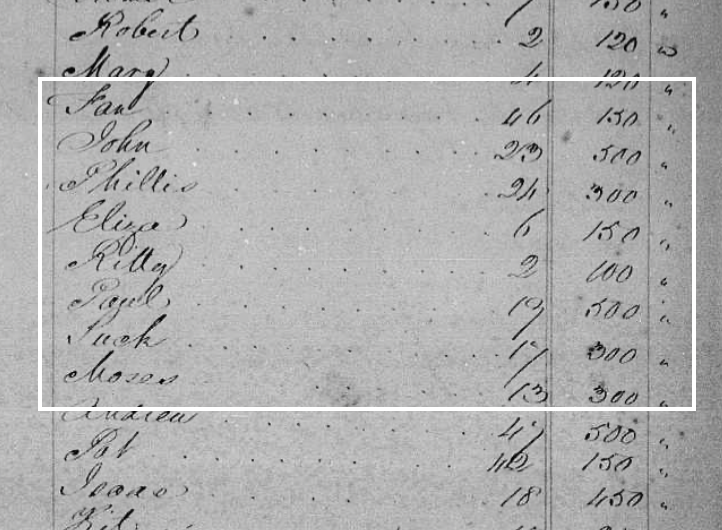
In the 1821 Inventory of Robert Sewall, the following family group is recorded:
Fan is listed with her four children, John, Paul, Suck, and Moses, and her daughter-in-law Phillis and her two grandchildren, Eliza and Kitty.
Fan is likely Fanny. She is listed with her children, one of who has children of their own. Based on her age, she is inferred to be the daughter of Dinah.
52
Phillis*
24
1797
She is listed with two children: Eliza, 6, Kitty, 2. Neither of these children would have been born when the suit was brought forth in 1812, and are not likely to be listed in the original list of seventeen.
Phyllis is named in the 1821 appeal for having a child in the interim and this could refer to Kitty born around 1819.
In the case summary, Richard Burgess testified that all Dinah was mother or grandmother of all, except one which the witness believed was a female but her name he did not recollect”
As Eliza was listed in the 1853 as a Wood, and John &c is named as a child of Fan and Phillis is listed prior to John in the list, it suggests that Phillis is John’s partner and not his sibling. [see below]
51
John
23
1798
John is likely the John Wood, age 55, named in the 1853 Robert D Sewall inventory [JH 2:699] who is listed between the family groups of Eliza and Kitta in the inventory. It is unclear from the 1821 inventory if John and Phyllis are siblings or partners. However, based on Burgess’s recollection it is likely they are partners.
Since he is listed as a descendant of Dinah in the court case, therefore the grandson of Dinah.
56
Paul
19
1802
Based on his age and the fact he is listed below Fan, he is inferred to be the grandson of Dinah.
Three Pauls appear in the 1853 Inventory, all born after the 1821 Inventory was compiled. One of the Pauls is the son of Charles and Suck. See more about this relationship in the row about “Suck”/Susannah.
57
Moses
13
1808
Based on his age and the fact he is listed below Fan, he is inferred to be the grandson of Dinah.
He is likely the Moses named in the will of William H B Sewall, the son of Richard Sewall and the brother of Robert D. Sewall. William had inherited the St. Mary’s County properties from his father Robert Sewall upon his death in 1820 and the legal authority to enslave a portion of the people enslaved by the Sewalls. In his will dated 1824, he requested that Robert D Sewall “give my servant Moses his freedom when he arrives at the age of 23.” [St. Mary’s EJM 1:225]
A Moses, 22, was included in Wm HB Sewall’s St. Mary’s County 1831 Tax Assessment. This is consistent with the age of Moses in the 1821 Inventory. In 1832, Robert D. Sewall fulfilled the request and registered Moses’ certificate of freedom in St. Mary’s County. As he was freed in 1832, it is not expected to find him in the 1853 inventory.
56
Suck
17
1804
Based on her age and the fact she is listed below Fan, she is inferred to be the granddaughter of Dinah.
She is in the 1853 inventory as “Luck” and is grouped with Charles, her inferred partner, and their children. Among her children’s names are Paul, Susannah, Phillis, Dinah, John, Charles. All of these names occur in the list compiled for the court case. Death certificates for Susan’s children (who lived in Rosaryville after the Civil War and emancipation) name their parents as Charles Brown and Susan Wood.
Pat & children (1 child + 3 grandchildren) [Brown]
Inventory Line Number
Name
Age
Est BY
Notes
59
Pat
42
1779
Based on her age, she is inferred to be the daughter of Dinah. She is listed with Andrew, age 47, and who is not named in the list, suggesting that Andrew is Pat’s partner and not her sibling. In the 1821 inventory she is listed with children ranging from ages 1 to 18 [eight children total]. Of the children: Isaac, Kitty and Charles were born prior to 1812 and the start of the court case.
Pat is named in the 1821 appeal for having a child in the interim and this could refer to her other children: Tom, Nancy, Milly, William and Nelly. Of these children, the names Tom, Nancy, and Nelly appear in the list, suggesting the familial relationship. She appears in the 1853 Inventory with her son, William.
60
Isaac
18
1803
Based on his age and the fact he is listed below Pat, he is inferred to be the grandson of Dinah.
Isaac is likely the Isaac Brown, age 50, listed in the 1853 Robert D Sewall inventory. He is listed with an inferred partner, Sally Ann, and his children, among whom are Patsey, 20, Isaac, 19, Kitty, 11, Charles, 8, and Sam 6. These names correspond with the original list.
62
Charles
11
1810
Based on his age and the fact he is listed below Pat, he is inferred to be the grandson of Dinah.
Charles does not appear to be listed in the 1853 inventory.
Susannah “Suck” Wood, daughter of Pat, partnered with a Charles Brown and fathered many children. It is possible that she partnered with her first-cousin Charles, son of Pat. This has been ruled out due to the estimated birth years of both Charles. In 1821, Charles Brown, son of Pat, has an estimated birth year of 1810. In 1853, Charles, partner of Susannah, is listed as 54 years old, giving him an estimated birth years of 1799, a full decade earlier. His age in the 1853 inventory is consistent with the 1870 census which lists him as 75 and gives him an estimated birth year of 1795, ruling this Charles out as her partner.
61
Kitty
15
1805
Based on her age and the fact she is listed below Pat, she is inferred to be the granddaughter of Dinah.
The five inferred children of Fan were listed immediately after Fan in the list provided by Berry and assumed to be copied in the same order as the primary source. However, Kit in the list, is not immediately after Charles, which suggests that it may be a different Kit/Kitty.
Based on her age, she is inferred to be the daughter of Dinah.
Like Moses, son of Fan, she appears to have been separated from her family and kept at the St. Mary’s County properties. She was listed with a child, Eliza, who would have been born after 1812 and prior to the 1818 judgment. She appears in Wm HB Sewall’s St. Mary’s County 1831 Tax Assessment; she is listed as 40, giving her the same estimated birth year of 1791. The assessment is sorted by age and so it is difficult to infer if she had additional children.
Sally (1 child + 1 grandchild)
There are three Sal/Sal/Sale listed in the Inventory, all roughly the same age: 26, 29, 24.
Inventory Line Number
Name
Age
Est BY
Notes
19
Sale
24
1797
She is listed as “Sale”, which makes her name the most phonetically similar to Sally, listed in the court case. However, where she is positioned in the 1821 inventory places her far away from the other children and grandchildren of Dinah. This suggests that is not the daughter of Dinah.
68
Sal
29
1792
She is listed amidst the other children and grandchildren of Dinah, heading a household that immediately follows Pat’s. This would lend circumstantial support that this is the correct “Sally” Additionally, she has two children: Hariot, age 9 and William, age 5.
Sal is also named in the 1821 court case which suggests that William was born after the 1818 judgment, although his age of 5 suggests he was born before 1818.
Like Nelly and Moses, if this is the correct Sal, she would have been in St. Marys County.
She is listed with her children immediately prior to Nelly, which suggests the relationship between the two as inferred sisters. Likewise, she is listed with three children: Tom, born 1811 and possibly named in the list, and two children born after 1818 (17 months and 3 weeks). The ages of the children align better with the details from the court case.
Based on her age and the ages of her children, she is inferred to be the daughter of Dinah.
The Brothers Clarke (3 children)
Inventory Line Number
Name
Age
Est BY
Notes
73
John
41
1780
John Clarke “old” is listed in the 1853 Inventory after the Kitty (Wood) family group. He is listed without an age. Pat, his inferred sister, at 74 is listed as the oldest person in the inventory with a listed age. If “old” John Clarke is Pat’s brother, and the Capt John identified in the 1821 inventory, then he would have been born one year after Pat. The designation of Capt would indicate that he was trained as a carpenter.
72
Sampson
37
1784
After Sal, the inventory lists 4 adult males: Tom, Sampson, Capt John, and Capt George. These names [John, Sampson, Tom] occur in the same sequence and what we have seen is that the list of people mostly mirrors the list in the 1821 inventory.
71
Tom
32
1789
Thomas Clarke is listed in the 1853 Inventory near the start, between other identified Clarke children. He is listed as 70 (which may be an estimation of his old age).
In the 1821 Inventory he is listed with his brothers away from his partner and children, as was typical of plantations. The 1853 inventory lists him with partner Charity, allowing us to infer that his partner and children are listed in the 1821 inventory, albeit in a different section [Line Number 90-93]. This places them as the second family group after Dinah the matriarch.
Nancy [deceased] ( + grandchildren)
[Nancy], Kit, Anna, Harriott “Harriott is the daughter of Nancy, who is deceased”
Nancy does not appear in the 1821 inventory and it is unclear if Anna or Harriot are listed. A Harriot is listed as 9 years old who is the daughter of Sal, who was previously discussed and set aside as the Sal mentioned in the courtcase. However, she is listed between Fan and Pat (and their offspring) before the Brothers Clarke and their inferred wives and offspring. This suggests that Ann and Sal may be the same, as Sally Ann is a common combination.
If “Isaac, Nancy &c are the children of Patt”, this would suggest Sal/Ann took in Harriott after Nancy died. Without further documentation it is speculation.
William Hannibal Gantt, a Black landowner in Cheltenham, died prior to 1898 and the use of death certificates in Maryland. The purpose of this post is to propose a set of parents and siblings for William Hannibal Brown Gantt.
A Note, first, on William Hannibal Brown Gantt and his Surnames
Connecting the 1870 & 1880 Census
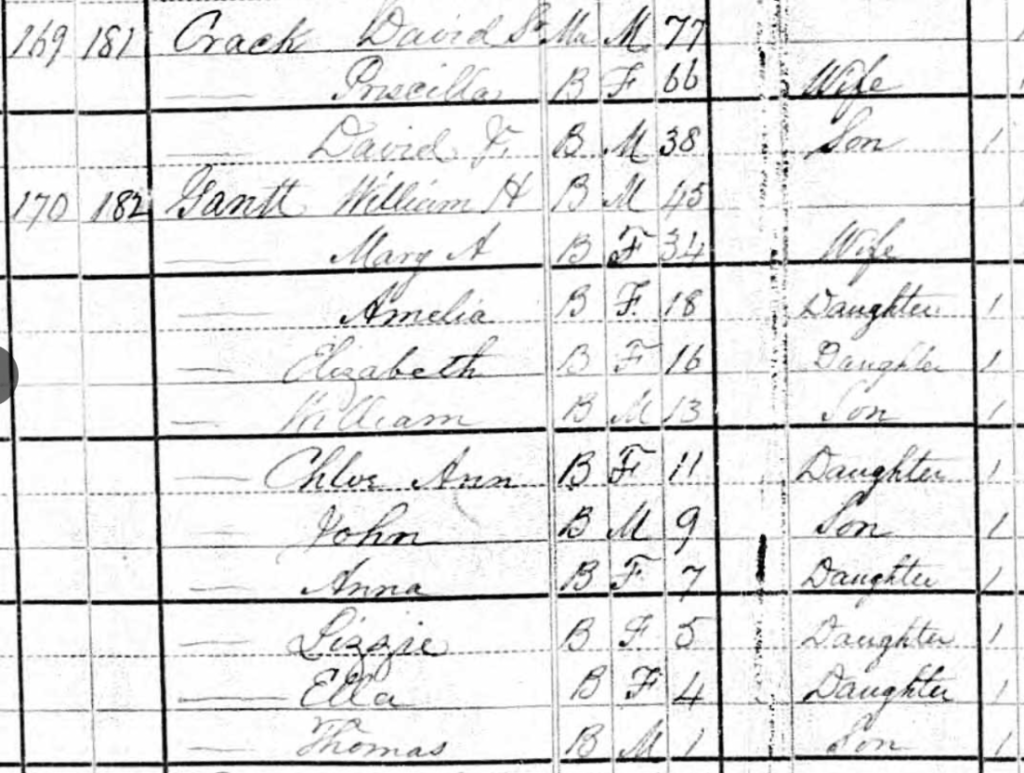
In 1880, William H Gantt was enumerated with David Crack in the district of Brandywine. David and his family are listed first, at dwelling number 169, and William H Gantt, with his wife, Mary A, and children, are listed at dwelling number 170.
1880; Census Place: Brandywine, Prince George’s, Maryland; Roll: 514; Page: 229B; Enumeration District: 131 | ancestry.com
In 1870, a William Brown was enumerated with Davy Crack at dwelling number 20; his wife, Agnes is not listed, however, the children match those of the 1880 William H Gantt entry. The alignment of children’s names with the inclusion of Davy Crack suggests that William Brown and William H Gantt are the same person.
1870; Census Place: Nottingham, Prince Georges, Maryland; Roll: M593_592;Page: 115B | ancestry.com
Land Records
Hannibal Gantt purchased property in Cheltenham, MD after the Civil War with David Crack that had been part of the “Poplar Neck” estate owned by the Brooke family in the 18th and 19th centuries. Araminta Brooke, the widow of John B Brooke, sold the land to Adam Diehl in 1870, who subdivided the land for small farmers. Their names appear on the 1878 Hopkins map of the Brandywine District as “H. Gaunt and D. Crack”. (Prince George’s Co. Land Records, HB 5:13-14, HB JWB 33:82-3, 79:99 | mdlandrec.net)
In the land records, he is consistently referenced as William H Gantt. In an 1874 Post Office Directory for Maryland, he is listed as Hannibal Gant, Farmer, which is consistent with the 1878 Hopkins map. This suggests he changed his surname between 1870 and 1874.
Marriage Record of Clora Ann Crack and Joseph Henry Brown
A review of the Index to Marriage Licenses for Prince George’s County does not return a marriage license for William Gantt/Brown and Agnes Crack. There are two entries for the surname Crack:
Clora Ann Crack to Joseph Henry Brown
John William Crack and Eliza Jane Savoy
As evidenced by the land records (namely the 1912 record in which the heirs of Clora Brown transfer their inherited property to Agnes Gantt: PG Land Records: 79:99), Clora Ann Crack and Agnes Crack are sisters. It appears that they may have married Brown brothers.
Brown-Wood Family Group
Joseph Henry Brown died in 1915; his death certificate lists his parents as “Charles Brown and ? Wood”. In 1870, Charles Brown, age 75, was living in the household enumerated immediately prior to William Brown. The geographic proximity of William Hannibal Brown Gantt to Charles and Susan Brown in the 1870 census with the twin marriages of siblings suggests further research into the Brown-Wood Family group to further identify relationships.
Death Certificates
In addition to Joseph Henry Brown, the following death certificates were identified:
John A Brown died in 1904; his death certificate lists his parents as “Charles Brown and Susan Wood”.
Crissie (Brown) Wilks died in 1912; her death certificate lists her parents as “Charles Brown and Susanna Wood”.
1853 Robert D Sewall Inventory
William and Agnes’s daughter, Ella Gantt married Frank Wilkes in 1898. In my search for Frank’s parents, I had researched the Wilkes family previous to this post. I have yet to definitively identify Frank’s parents. However, the search for Wilkes lead me to the Edward and Maria Wilkes family which had been enslaved by Robert D. Sewall, the owner of Poplar Hill, and identified on the 1853 Inventory of his estate.
“Poplar Hill”
Robert D Sewall owned Poplar Hill, a large tract of land near Woodyard, in Prince George’s County, MD. He died in the early 1850s, and as part of the probate process, an inventory was created of his estate (JH 2:699-703). It included the names and ages of over a hundred people he enslaved on the land. The Brown-Wood Family group is on page 702 in the portion detailed as “property managed by Mr. Jenkins”.
Charles and Luck are the inferred parents, Charles and Susan, from their ages of 54 & 47.
Sukey is a common nickname for Susan and the possibility exists that Luck was mistakenly written for Suck/Suckey. If so, this would suggest that the mother’s name was Susan
The 1853 inventory includes the names of eight children. No further information has been located for Paul, Michael and Philis.
Below, I attempt to track Charles and Susan, and their children, across the census records.
Census Comparison
The 1870 Census
Cheltenham
In 1870, Charles and Susan Brown (parents) are enumerated living in the Nottingham District in the neighborhood of the TB Post Office. Based on the landowners enumerated around them, it can be inferred that they are closer to what would become Cheltenham by the late 1870s.
On the annotated map, the villages of Upper Marlboro, Surratsville, Croom, Brandywine and TB are marked with white lettering. By 1880, the additional villages of Cheltenham and Rosaryville were developed and are seen on the 1878 Hopkins Map. These are marked in light gray.
Two tracts of land are identified in light green and placed by their landowners: Robert D. Sewall’s land (Poplar Hill) which is identified by the name Henry Dangerfield that guardian of Sewall’s heirs and the land of the Brooke family (Poplar Neck) which is identified by the name Mrs. Brooks, the widow of John B Brooke. The numbers represent the dwelling numbers, or the sequence of households visited by the census enumerator in the 1870 census.
Charles and Susan Brown are enumerated at dwelling 19, with their son, John Brown and a child named Alice Willis. They are enumerated next to William Brown (dwelling 20). William Brown is living with his father-in-law Davy Crack, who was enslaved by Mrs. Brookes on the “Poplar Neck” track. Davy Crack, his wife, and children were identified in the 1853 Inventory of her husband John B Brooke (WAJ 1 3-5). William Brown and Davy Crack purchased land in Cheltenham, which is at the center of the circle. They are identified on the 1878 Hopkins Map as H. Gaunt and D. Crack.
Charles is listed as 54 in the 1853 census and 75 in the 1870 census. This provides an estimated birth year range of 1795-1799.
Susan is listed as 47 in the 1853 census and as 60 in the 1870 census. This provides an estimated birth year range of 1806-1810.
John Brown appears unmarried in the 1870 census. Later census records suggest that he may have been married with two small toddlers living with his wife at another location. A marriage record for John Arthur Brown and Mary Jane Jackson is consistent with the older census record.
Susan Brown (age 40), the daughter of Charles and Susan, is living nearby working for the household of Martha Townshend.
Year: 1870; Census Place: Nottingham, Prince Georges, Maryland; Roll: M593_592;Page: 115B
Rosaryville
North of Cheltenham is the Holy Rosary Catholic Church, around which the village called Rosaryville developed. Rosaryville, not present on the 1861 map of Prince George’s County, is shown on the 1878 Hopkins Atlas of Prince George’s County. It sits on the border of the Brandywine District and Upper Marlboro District.
Joseph Henry Brown, the third youngest child in the 1853 inventory married Clora Ann Crack, the daughter of David Crack, in 1865 (Index to Marriage Licenses, PG Co).
In 1870, Joseph Henry Brown and his family were living in Marlboro District, at dwelling number 456 & 457. Joseph is listed in the household of Lawrence Wood, and his wife, Dinah. Chloe/Clora is listed in the next household with their children, James, Julia, Peter. The names of the children are consistent with the heirs of Clora Brown named in a 1912 land record (Liber 79, Folio 99).
Year: 1870; Census Place: Marlboro, Prince Georges, Maryland; Roll: M593_592; Page: 104A
They listed immediately prior to a merchant named Washington Beall. Both Beall and Joseph Brown are labeled on the 1878 Hopkins Map of Marlboro, showing their location in the village of Rosaryville.
Two land records show that Joseph H Brown purchased land in Rosaryville (JWB 1:130 & JWB 1:220). The first, dated 1882, shows that Joseph purchased a parcel of land from the tract “Woodstock” owned by Henry Clagett and adjoining the residence of Charles Brown. It is on the north east side of the main road leading from Rosaryville to Centreville. This is consistent with the map, as the pink area is north and east of the road that leads to Centreville (which is northwest of Rosaryville). The second, also dated 1882, shows that Joseph purchased land from James Belt, next to land owned by Peter Wood and Washington Beall.
Croom
Charles Henry Brown, the third oldest child of Charles and Susan (Wood) Brown was likely married to Annie Gordon in the 1850s, after 1853 (the inventory) and before 1856 (birth of his eldest child in the 1870 census.)
In 1870, he was enumerated in Marlboro District, at dwelling 105, living near the landowner W. D. Bowie.
This places him in the larger neighborhood of the Charles/Susan Brown family groups living near Cheltenham and Rosaryville. The proximity to W.D. Bowie suggests that he is on the road that runs between Rosaryville and Croom, which is the border between the two districts, Marlboro and Nottingham.
Charles’ household is himself, his wife Annie, and their children, whose ages range from 14 to 1, which allows for the estimated marriage year in the mid 1850s.
Immediately enumerated after Charles and his family are Joseph Gordon, age 50, and Polly, age 78. Based on Annie (Gordon) Brown’s death certificate, it is inferred that Joseph is an older brother, and Polly is her mother.
Maryland State Archives
1880 Census
Rosaryville
By 1880, the surviving members of the Charles-Susan Wood Brown family named in the inventory had moved to Rosaryville. Joseph Henry Brown, though documented in 1882 land records to be in the area and marked on the 1878 Hopkins Map, is not recorded in the 1880 census. His other siblings and mother are however.
Dwelling Number
Head of Household
Notes
139
Cornelius Gordon
Possibly related to Charles’ wife, Annie Gordon
140
James Dorsey
Contains the household member Lawrence Wilks
143
Henry Claggett
Large Landowner prior to the Civil War Residence noted on the 1878 Hopkin Map
146
John Brown
Son of Charles Brown and Susan Woods
147
John Thomas
Occupation listed as Teacher, suggesting residence near School House
151
Barney Johnson
Residence noted on the 1878 Hopkin Map
153
Lawerence Wood
Husband of Dinah WoodIncludes both Susan (mother) and Susan (daughter) in household
154
Charles Brown
Son of Charles Brown and Susan Woods
155
Robert Wilkes
Husband of Crissy (Brown) Wilks
157
Uriah Goldsmith
Residence noted on the 1878 Hopkin Map
As recorded in Marlboro District MapAs recorded in the Brandywine District Map
1900 Census
By 1900, Susan Brown has died, and Dinah (Brown) Wood, a widow, has moved to the District of Columbia.
The remaining male siblings are still living in Rosaryville. The census enumerator did not record complete details for the series of dwelling numbers recorded below. Ages and birth years are missing and relationships are not obviously clear. Numbers are crossed out in the column for dwelling numbers and other numbers are scribed above them.
Dwelling Number
Head of Household
Notes
40/41
Joseph Brown
Living with his daughter Mary, son Peter, his daughter-in-law- Mamie, and Peter and Mamie’s child, Ellen
41/42
Robert Wilks
Husband of Crissy (Brown) Wilks
42/43
John A Brown
Living with his wife and children
43/44
Barney Johnson
Residence noted on the 1878 Hopkin Map
54/53
Charles H Brown
Living with his wife and children
Christianna “Chrissy” (Brown) Wilks
Crissy Wilks is not included in the 1853 inventory of Robert D Sewall’s estate, though her estimated birth year (1840) suggests that she should have been if she was living with her family. Her husband, Robert Wilks, is listed on Sewall’s inventory, with the Wilks family group.
1853 Inventory of Robert D Sewall | JH 1:699 | familysearch.org
1870 Census
In 1870, Edward Wilks and his children are enumerated in the Surratt’s District in the neighborhood of the TB Post Office. They appear to be still living in the quarters provided them on Poplar Hill with a number of other people enslaved by the Sewalls/Dangerfields prior to emancipation in 1864.
Dwelling Number
Head of Household
Notes
21
Henry Tarman
His occupation is listed as a Miller; a mill is indicated on the Martenet Map at Woodyard, where “Poplar Hill”, or Sewall’s estate is located.
22
Annie Marshall
White landowner, likely the mother of William H Marshall who is listed as a planter with real estate valued at $14000 in Surratts. In 1870, he has moved to Kentucky.
24
Edward Wilks
Edward and Maria, inferred parentsLawrence, Richard, Susan, Washington are listed in household
29
Robert Wilks
Sole member of the household
30
Christinia Wilks
She is listed with 5 children, suggesting they had been married since at least 1860.
1880 & 1900 Census
Edward Wilks died in 1879. His account in the Freedmen’s Bank references his death and directs payments to his wife, Maria Wilkes, who is living with Robert in the 1880 census. His original deposit slip also notes his relationship to Poplar Hill.
As noted above, Robert Wilks, his wife Chrissy and his brother have moved to Rosaryville by 1880. Robert and Christiana/Crissy are enumerated as neighbors of the Brown siblings in both the 1880 and 1900 census.
Conclusions
Although there is no direct documentary connection between Charles and Susan Brown with William Hannibal Brown Gantt, I suggest that that the families are connected and that it is highly likely that William was the son of Charles and Susan and sold to another enslaver prior to the 1853 inventory.
They were neighbors in the 1870 census
Both William Brown and Joseph Henry Brown married daughters of David Crack
Crissie Brown married into the Wilks family; a daughter of William Hannibal Brown Gantt married a Wilkes man (connection unclear, though the surname occurs only in the Surrattsville/Rosaryville area)
Based on these reasons, I propose that Charles Brown and Susan Wood are the parents of William Hannibal Brown Gantt.







 stories of Then