Samuel and Sophia Crawford

In the 1863 Inventory of Benjamin Lee‘s estate, Sam, age 24, is listed two names below the name of Davy and Kizzy. No other details are recorded for him. The estate’s appraisers noted that “Owning to the unsafe conditions …. produced by the war” that raged on, they could not provide a market value for the people they commodified, marking only each person as $100, giving no other indication of health or skill. In October 1864, the Civil War Draft called the name of Samuel Crawford, “slave of the estate of Benj Lee”; based on the birth years of his children, he likely did not get called up.

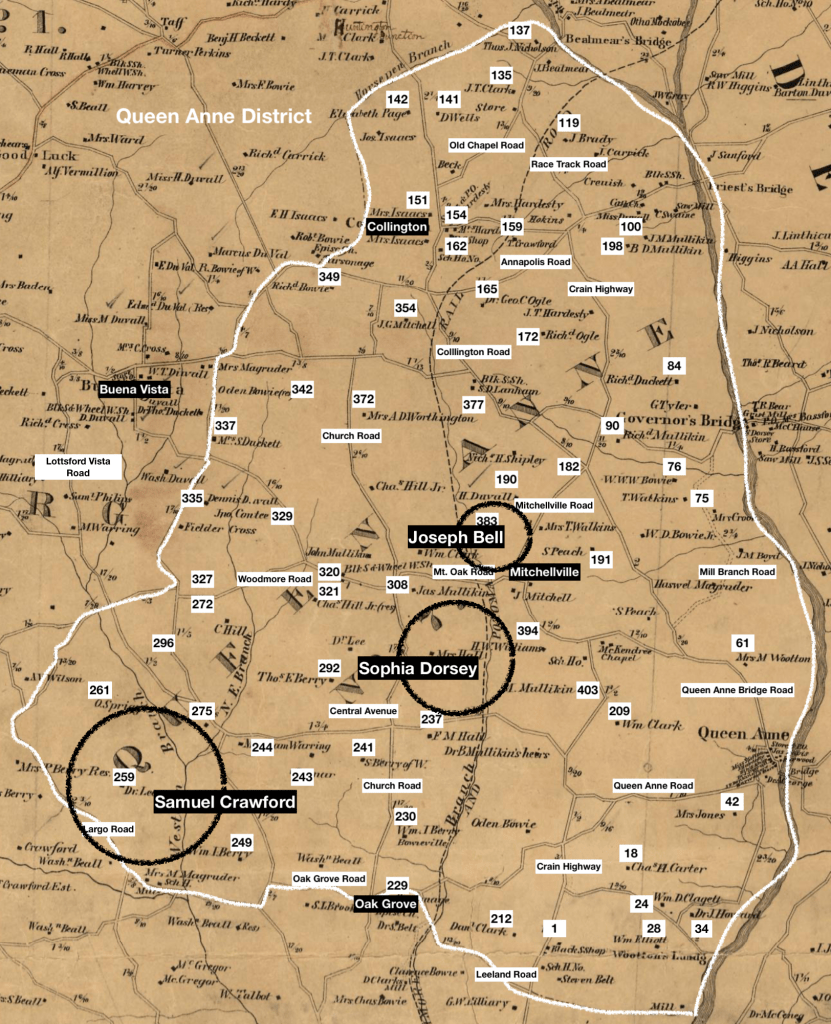
And in 1870, after the Civil War ended and the nation began the slow arduous work of reconstructing an economy based on a strict social hierarchy, Samuel Crawford, age 35, was living between Buena Vista and Mitchellville, two small mercantile communities among the plantations of the “Forest of Prince George’s County.”

Crawford lived near the convergence of Woodmore Road with Mt. Oak Road at Church Road near the estates of Mary Hall and James Mullikin, white landowners who had connections with some of the richest men in Prince George’s County, that derived their wealth from the labor of the enslaved and near Lee’s newly purchased Stewart Farm.

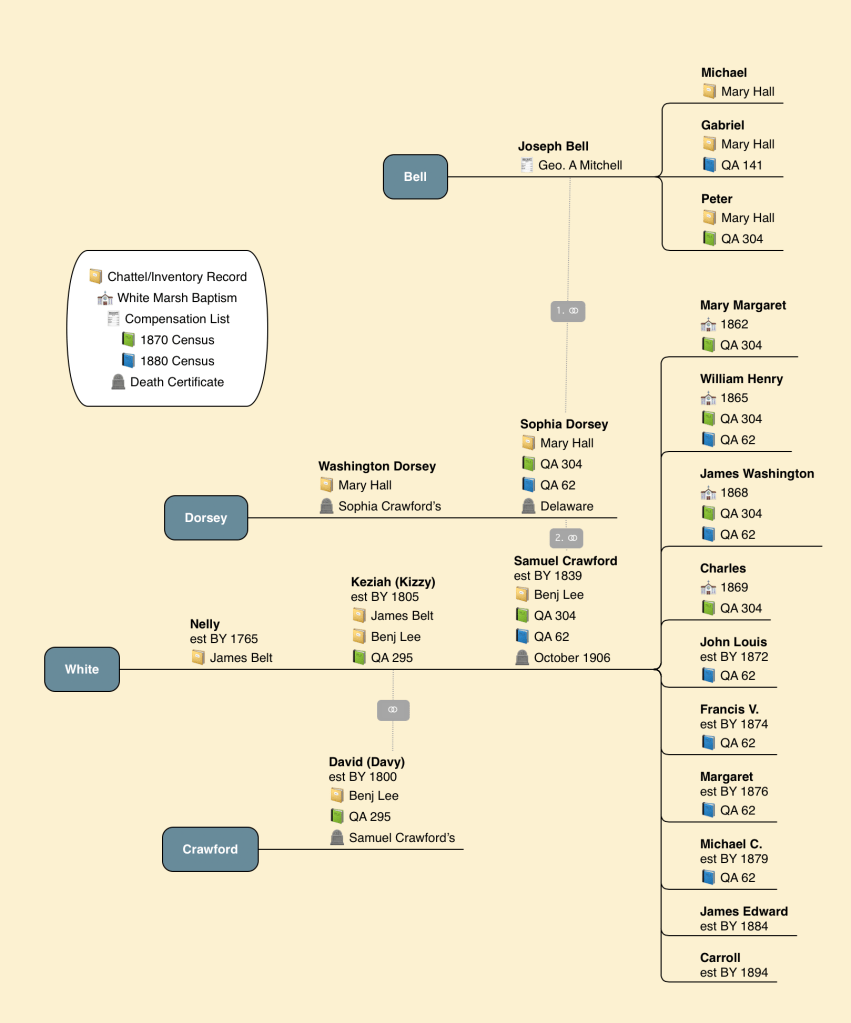
Samuel Crawford is living with his wife, Sophia Crawford, age 30 and their four children, Mary, age 8, William, age 5, Washington, age 3, and Charles age 1. Also living with them is Peter, age 10, not listed chronologically with the other children, suggesting a different relationship than biological.

Through the next three decades, Samuel would labor in the fields of Queen Anne District, renting his farm and providing for his family. He died in October 1906 from chronic gastritis. His son provided the information for the Certificate of Death, naming Sophia as his wife and David Crawford as his father. After his death, Sophia and many of their children migrated north away from Queen Anne District and Prince George’s County to Delaware.

Maryland State Archives

White Marsh Baptisms

Sophia died a few decades later in 1930. At the beginning of the Great Depression, Sophia Crawford lived in New Castle, Delaware, where she was living with her son, Edward. He gave the name of her parents as Wash. Dorsey and Mary Dorsey of Maryland for the death certificate.
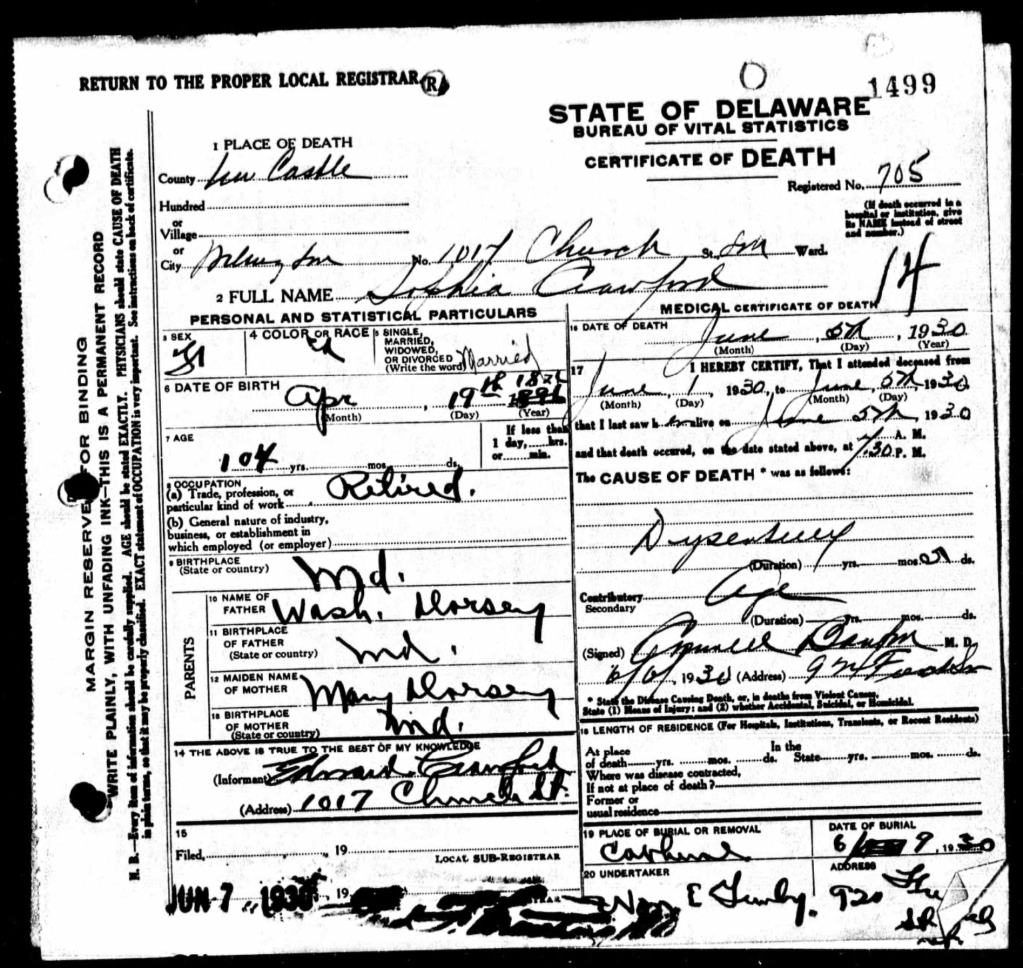
ancestry.com

The Evening Journal ran an obituary for her: “Former Slave Dead at Age of 104”

Life as a slave in Maryland, the Civil War and freedom which followed it, were vivid memories of Mrs. Sophie Crawford, who died last evening, at the age of 104 years, at the home of her son, James E. Crawford, 1017 Church Street. She had not been ill, but gradually weakened until she died.

She was born on April 19, 1826 on the estate of the late Mr. and Mrs. F. M. Hall in Prince George county, MD., and spent her life as a slave there. Sophie Dorsey married Joseph Bell when she was eighteen years old. Two sons that marriage, Gabriel Bell of Uniontown, PA., and Peter Bell of Baltimore, still survive her. Joseph Bell was killed in the Civil War. In 1865, she married Samuel Crawford. Eleven children were born to them, six boys and five girls. Of these children, John L. Crawford, Michael C. Crawford, and James E Crawford, all of this city, survive her.

The old colored woman had been reared a Catholic and since coming to Wilmington in 1911, was a member of St. Joseph’s parish. She was very devout and counseled her children to be temperate in all things.

Funeral Services will be held on Monday from her home. Solemn requiem mass will be said in St. Joseph’s Church and internment will be in Cathedral cemetery.

The News Journal, Wilmington, Delaware, 6 Jun 1930, page 39

The article notes her former enslaver. Mrs. F. M. Hall, or Mary Hall, was part of the Hill family, descendant from the Darnalls and other Catholics connected with the Calvert family, who had shaped much of Maryland’s culture and economy. Mary Hall, the widow of Francis Magruder Hall, had inherited a vast estate not only from her husband, but both of her parents, Clement and Eleanor Hill.

Connected as she was to the wealthy Catholic landowners, she also had connections to the White Marsh Jesuit Plantation near Priest’s Bridge in Queen Anne District along the Patuxent River. The priests of White Marsh baptized many of the Catholics living in Queen Anne District, both the white landowners and those they enslaved. The Jesuits kept records of their baptisms, noting often who enslaved the mother of the baptized child. Due to a fire in 1853, earlier records are incomplete with mostly only those from around 1820 preserved. “White Marsh Book 3” kept the records of the baptisms after 1853 and the fire. Among them, Samuel and Sophia Crawford had four children baptized and their sacrament recorded in the records of the Jesuit Priests.

  • In 1862, one year after the death of Mary Hall, Sophy Dorsey and Samuel Crawford had their daughter Marg. baptized. Sophy’s sister, Rosanna, sponsored the child. No enslaver is noted.
  • In 1865, as the Civil War drew to an end and after Maryland ended slavery, Saml. and Sophia Crawford had their son, William Henry, baptized. Harrietta Mitchell sponsored the child.
  • In 1868, Jas. Washington, the son of Sam. Crawford & Sophy, his wife, is baptized. Harriette Hall is the sponsor. The baptism occurred at Dr. Belt’s, a relative of Benjamin Lee. The same day, Sophy Crawford sponsored the baptism of Jas. Henry, the son of Philip Hall and Harriette, his wife, who had stood as sponsor for their children.
  • In 1869, Charles, the son of Samuel Crawford & Sophia Dorsey, his lawfull wife was baptized. Lowis [sic] Wood sponsored the baptism.

No record of their marriage has been found.

The four children baptized at White Marsh are the same four children listed in the 1870 census. Another White Marsh record provides clarity for the relationship of Peter, age 10 in the census.

1870 Census | ancestry.com

Her obituary notes eleven children for Samuel and Sophia, six boys and five girls. Reviewing the 1870, 1880, 1900, and 1910 census, this does not seem to be accurate.

  • 1870 Census: 1 girl and 3 boys
  • 1880 Census: 2 additional girls and 2 additional boys, for 3 girls and 5 boys total
  • 1900 Census: 2 additional boys, for 3 girls and 7 boys, for 10 total.

The 1900 census also marked 13 children total which would account for the 3 boys with Joseph Bell (see below) and 10 children from Samuel, with seven children living. The 1910 census also marked 13 children total with 10 children living.

Peter Dorsey Bell

In 1859, three years before the death of Mary Hall, Peter was baptized, the son of Joseph Bell and Sophia Dorsey, illeg.; the baptism was sponsored by William Weldon and the baptism occurred “at Mrs. Hall’s.”

Peter is the step-son of Samuel Crawford and the son of Joseph Bell and Sophia Dorsey. While marriage was not legally recognized by the state between enslaved people, and while slaveholders did not often recognize the rights of those partnered, the records of White Marsh show that Mrs. Hall had permitted and perhaps even encouraged a Catholic blessing for the unions of those enslaved by herself and her neighboring Catholic slaveholders. This suggests that the union between Joseph and Sophia Dorsey was not one sanctioned by Mary Hall or the other white slaveholders, though Sophia viewed it as a legitimate partnership.

Another record, in 1858, records the baptism of Gabriel, son of Sophey “of Mrs. Hall’s”. No father was listed. In 1880, there is a Gabriel Beall living in Queen Anne District who was estimated to have been born in 1858.

In Mary Hall’s 1861 Inventory, Sophy, age 24, is listed with her parents, Dorsey, 45, and Mary 40, and their family group is listed with Peter, age 1, and Gabriel, age 3. There is also a Michael age 5, suggesting that Sophy may have had another son, named Michael. She would later name another of her sons with Samuel Crawford, Michael.

Joseph Bell was enumerated by Geo. A. Mitchell in the 1867 Compensation Lists submitted to the Prince George’s Commission on Slave Statistics. Mitchell owned land on the east side of Collington Branch near the Mullikin’s and Halls. In the 1870 census, Mitchell was marked as a Merchant and Farmer and it is his name that was given to the community that grew after the war with the establishment of the railroad nearby. The article notes he was killed in the Civil War; a service record has yet to be located for him.
John and Patsy Hamilton

The eruption of the Civil War and the subsequent abolition of slavery in the District of Columbia disrupted social hierarchy of Prince George’s County The Cecil Whig estimated in March 1864 that over 30,000 enslaved people escaped their captivity across the state and found freedom from their enslavers. Census records show the same for Prince George’s County.

In the decades prior to the Civil War, the enslaved population of Prince George’s County grew from 10,636 in 1840 to 12,479 in 1860. In these decades, the birth rate of the enslaved population was likely offset by high mortality rates among children, a short life expectancy for adults, and sales to the Deep South. The Evening Star in October 1863 called it “the late very large exodus from [Maryland] of free [Black] and slave labor”

In 1860, at the start of the Civil War, the combined total for the free and enslaved population was 13,677. After the war ended and a new economic relationship between White employers and Black employees was being established, the Black population of Prince George’s County had dropped to 9,780, a total comparable to the enslaved population in 1810. About thirty percent of the population had disappeared during and after the war, either having fled their estates or having died from starvation and disease inevitable during times of war.

While John and Patsy Hamilton survived the war, their family group did not and their children had disappeared.


In 1863, as the war raged on, Dr. Benjamin Lee died. A large landowner in Queen Anne District of Prince George’s County, his inventory named seventy-six people he enslaved. He resided at “Oak Hill” near the Sprigg Northhampton estate and near the Western Branch. His inventory also indicated his “Chelsea Farm” and his “Stewart Farm”. Benjamin Lee’s nephew, James Waring, was one of the appraisers for the inventory, who notated at the end of the inventory:

Owing to he unsafe condition of the above property consistent of seventy-six [Black people] produced by the war, we can value them at but an average of one hundred dollars per head.”

WAJ 3:132 Inventory of Benjamin Lee

In his inventory are included the names John and Patsy. They are listed near the beginning of the inventory suggesting they were more likely to be house servants rather than farm laborers. With them are the names of four people who are likely their children and grandchild:

  • Pink, age 24
  • Frank, age 15 months
  • Egbert, age 17
  • Letty, age 14

The children/grandchild have yet to be located in the 1870 census, suggesting they fled or died during the War and the ensuing chaos. Barbara Jeanne Fields, in her book Slavery and Freedom on the Middle Ground: Maryland During the Nineteenth Century, wrote that after the abolition of slavery in the District, “families packed up such of their possessions as could be compactly assembled and departed, sometimes appropriating means of transportation from their owners”. The escape to DC was often along roads lined with slave patrols and local constables. James Waring, Lee’s nephew, had gone to DC in May 1862 to return a group of enslaved people who had fled from Waring’s estates. Because fleeing to DC meant the possibility of physical punishment resulting from exposure to elements and torture from patrols, it was often the “vigorous young men and women” who took their chances with the intention to come back for the rest of their family.

In June 1863, the Evening Star in the District of Columbia ran the headline:

EXTENSIVE STAMPEDE OF SLAVES

A FIGHT BETWEEN THEM AND AN INDEPENDENT PATROL

On Sunday night, some seventy-five slaves, belonging in the neighborhood of South River, Anne Arundel count and Queen Anne’s Prince George’s county, MD, stampeded, taking with them a wagon and cart, with horses and brining with them a portion of their effects. The party left the first named neighborhood about 11 o’clock at night, and travelled all night, at various points on the road being reinforced, until the number reached about seventy-five.

Yesterday morning, they were stopped near the “Long Old Fields” by a number of men styling themselves “patrols” armed with shot guns and pistols, but the party of slaves massed themselves and pushed on, the patrollers attempting to stop their profess and to drive them from the teams, and when about one mile from Fort Meigs, they fired into the fugitives, when it is said, one of the slaves returned the fire and selves other shots were fired. The party of fugitives separated and led and the patrollers also made off.

Among the fugitives there was two men an one woman killed and five wounded as far as known. The wounded persons were taken in charge and brough to the city, and th company in different bands arrived here yesterday afternoon and during the night– fifty having reported at Contraband Camp up to the his morning. Some of the wounded are not expected to live. One man received four balls in his head, face, shoulder and hip.”

Evening Star, 16 Jun 1862, page 3

Letitia Hamilton shows up in the White Marsh Records in 1868. In October, “Letitia, daughter of John and Betsy Hamilton, 18 years old” had converted to Catholicism and was baptized. The same day, she stood as a sponsor for the baptism of Eliza, the daughter of John Cameron and his wife, Matilda. The priests of White Marsh were inconsistent spellers, often from non-English spelling countries and using phonetic spelling. Hence, Betsy for Patsy. This record helps support the belief that the four names after John and Patsy in the Inventory are their children/grandchild.


In 1870, John and Patsy Hamilton are living in household of Violetta Harding, the daughter of Benjamin Lee, and heir of the estates. Patsy is given an estimated age of 50, while John is given an estimated age of 60. Despite their age, which for the formerly enslaved is quite elderly, they are working. Patsy is listed as a servant. John is listed as a farm hand. The next household listed is James Duvall, an overseer, who likely oversaw the tenant farmers, who were formerly enslaved.

By 1880, they are no longer listed in the census.


Prior to the war, John Hamilton had attempted an escape of his own from the estates of Benjamin Lee. In 1841, the Washington Daily Globe ran an advertisement for the return of John Hamilton.  He was described as “about 21 years of age, five feet seven or eight inches high, dark complexion, large head and short neck”.   Benjamin Lee offered a $100 reward for his return.

His clothing was described as “a dark kersey roundabout, white kersey pantaloons, blue and red striped home-spun waistcoat with metal buttons, and an old furred hat; he has other clothing and the probability is that he will change them”.

Kersey is a kind of coarse woolen cloth. Lee’s inventory showed he had about hundred sheep across his three estates with over 500 lbs of wool. Despite the wool production from the labor of the people he enslaved, there was no mention of a spinning wheel among his inventory. The kersey and the “home-spun” waistcoat was probably purchased from a local merchant or artisan rather than produced on the estate. Along with the world, was listed a small trunk with 16 pairs of stockings, 26 servant shirts, cloth for 12 coats and 6 servant frocks.

The color and the metal buttons of the homespun waistcoat suggests a more extravagant waistcoat than typically worn by a field laborer. The expense of the waistcoat suggested by the dye and metal buttons opens the possibility that John Hamilton is wearing a waistcoat handed down from Benjamin Lee; or that John Hamilton worked in the house and as such was dressed in his livery. Patricia Hunt-Hurst writes in her article about the clothing of the enslaved: “Unlike other items of clothing, vests [or waistcoats] were likely optional apparel, more decorative than functional, and thus rarely worn by slaves. They may have been a winter allotment for some plantations, perhaps as a hand-me-down or gift.”


During the war, on 12 July 1864, the Baltimore Sun ran a list of draftees for the Civil War.  Listed in the Seventh District for Prince George’s County is the name Jno. Hamilton, slave of the estate of Benj. Lee. Due to his age, it is unlikely he enlisted; no record has been found.

Sources:

Fields Barbara Jeanne. Slavery and Freedom on the Middle Ground : Maryland during the Nineteenth Century. Yale University Press 1985.

Hunt-Hurst, Patricia. “‘Round Homespun Coat & Pantaloons of the Same’: Slave Clothing as Reflected in Fugitive Slave Advertisements in Antebellum Georgia.” The Georgia Historical Quarterly, vol. 83, no. 4, 1999, pp. 727–40. JSTOR, http://www.jstor.org/stable/40584195. Accessed 21 May 2023.

Elizabeth Jones & Sally Woodard | Runaway

On August 29, 1858, Elizabeth Jones and Sally Woodward were committed to the DC Jail as runaways by S. W. Chipley. They were released to “Marshall Warren” two days later, on August 31.

In Chocolate City, the authors details that the Jail was built in 1839 and sits where the National Building Museum now sits. In the decades before the Civil War, the DC Jail was in the northeast corner of the block, near 4th and G, with the Tiber Creek trickling behind it. The building was known as the “Blue Jug” for the color of its walls and was three-stories of barred windows and stone cells and iron cages.

In 1861, The Frank Leslie’s Illustrated Newspaper ran an article entitled “Persecution of Negroes in the Capitol-Astounding Revelations” (28 Dec 1861). One of the people quoted in the article describe the conditions of the jail:

“I find incarcerated in the city jail in this city, in the midst of filth, vermin and contagious diseases, on a cold stone floor, many without shoes, nearly all without sufficient clothing, bedding or fire, and all in half-starving condition, 60 colored persons, male and female, confined because — in the language of their commitments — they were suspected of being runaways, and no proofs had been adduced that they were not runaways.


The man who captured Elizabeth Jones and Sally Woodward was a police officer who likely patrolled the Island. This suggests that Elizabeth and Sally had made it across the Eastern River from Prince George’s County and into the District near the southern side of the Mall.

Samuel N. Chipley was recorded in the 1860 Census as a policeman living in Ward 7, who had been a County Constable in Alexandria, Virginia, in 1850. He was elected for County Constable for several years in Alexandria. By 1858, he is working in the District. The Daily National Intelligencer announced his commission as a police officer in the Seventh Ward in July 1858. The 1858 City Directory lists the address for Samuel L. Shipley as 124 C South, on the Island and southwest of the Capitol. He died in 1887, and was buried in Alexandria, Virginia.


The women were released after two days in the DC Jail to “Marshall Warren” which is likely an error and reference Marsham Waring.

Elizabeth Jones was likely the daughter of Joseph Jones and Barbara Ridout. In 1858, she would have been twelve years old. She escaped the Warings again in 1862 with her family when they fled to the District. They were listed in the Camp Barker registrations. In 1861, Lizy Jones and Notley Steward had her son Augustus baptized by the priests of White Marsh. No record of her after the 1862 escape has been found.

Sally Woodard was claimed by M. Virginia Mackubin, the daughter of Marsham Waring, on the compensation list submitted to the 1867 Commission on Slave Statistics for Prince George’s County. Mackubin had inherited the legal authority to enslave Sally when her father, Marsham Waring, died in 1860. Sally was listed in Waring’s Inventory as one of the people enslaved on the main estate, Warington. In the inventory, she had three children: Maria, age 8, Arthur, age 7, and an infant child.

In the 1870 Census, Sally is living in Bladensburg District of Prince George’s County, near the Zachariah Berry and Edward Magruder, and so along the boundary between Bladensburg and Queen Anne District and near the estates of the Warings.

She is living with her husband, John, and four children: Arthur (14), Matthews (12), Ellen (6), and Michael (4).

Mathew is likely the infant child based on a 1860 White Marsh record which records the baptism of Mathew, son of John and Sarah Woodward. Edward Wood sponsored the child.

John Woodard was claimed by Mortimer L. Wilson, on a compensation list submitted to the 1867 Commission on Slave Statistics. Mortimer was the eldest son of Joseph Hickman Wilson, who lived in Bladensburg District, near the border of Queen Anne District in Prince Geore’s County, Maryland in the antebellum years, before his death in 1857. He was the stepson of Amelia Violetta (Weems) Wilson, Jospeh Wilson’s second wife.

This contrasts with records related to the Civil War. In 1864, John Woodard was drafted and called into service with the USCT. His selection is announced in the 12 July 1864 edition of the Baltimore Sun, “John Woodward, slave of Virginia Wilson” (Amelia Virginia Wilson, was Mortimer’s step-sister). Woodard’s USCT Service records show that he did not report as order and was arrested; the charge of desertion was removed by Special Order #15. Additionally, the army considered him free as they did not receive papers for him on some muster rolls; others cited him as a slave.  Mortimer Lawrence Wilson submitted an oath sewing that he was the master and owner, and that he was loyal to the United States in order to claim compensation for the enlisted slave.  In 1892, Sarah Woodard filed a claim for a widow’s pension for her husband’s service in the A Unit of the 4 USCT Infantry.