Cedar Point sits at the mouth of the Patuxent River as it empties into the Chesapeake Bay in St. Mary’s County.
1873 Topographical atlas of Maryland: counties of Calvert, Charles and St. Marys. | davidrumsey.com
Its location was useful for the British during the colonial period as they established customs official there to collect taxes from the passing ships laden with tobacco. In the 18th century, the land was transferred into the Carroll family by way of marriage to Araminta Thompson, who was the illegitimate daughter of the customs official, and had been bequeathed the manor by her father, John Rousby II. [Collection on the Susquehanna estate, Carroll family, and Rousby family]
Charles J Carroll, son of Henry and Araminta [Thompson] Carroll, lived at the manor house, called Susquehanna, before and during the War of 1812. Its location was useful for the British in 1812 as well. The British navy plundered the estates on the waterways, and the manor on Cedar Point was exposed and the British took 5 of the people enslaved by the Carrolls with them, including Lewis and Beck Medley, husband and wife.
In 1828, the heirs of Charles J Carroll, applied for compensation for their lost chattel. The claim included “A lost of the [enslaved people] belonging to Charles John Carroll of the County of Prince George’s County and State of Maryland which were taken or carried away by the British from the mouth of the Patuxent River during the years 1813 + 1814”. [MSA]
Case #612,
In the claim, it is reported that Charles John Carroll, with Nicholas Sewall and Robert Holton boarded the British ship San Domingo in order to reclaim Adam, Phil and Sandy. Another deposition in the claim, mentions Lewis Medley and Beck Medley, the wife of Lewis Medley. They, too, went with the British and did not return to the Carrolls. In April 1814, the British had issued the Cochrane Proclamation:
To encourage further unrest, on April 2, 1814, Admiral Alexander Cochrane of the British forces issued a proclamation offering immediate emancipation to any person willing to take up arms and join the colonial marines. The proclamation also included the families of any person who joined the colonial marines and settled in British Colonies.”
The claim recorded that Lewis and Beck Medley were on the list for Halifax. The Acadian Reporter issued announcements of ships that arrived in Halifax and it is estimate that 2000 refugees from slavery sailed to Nova Scotia between 1813 and 1816. Having escaped chattel slavery in the Chesapeake, the refugees in Halifax faced prejudice and resentment in Halifax at their arrival. [Nova Scotia Archives]
Lewis Medley, age 25, and his wife, age 21, with a child, is listed in the “Halifax List: Return of American Refugee Negroes who have been received into the Province of Nova Scotia from the United States of American between 27 April 1815 and 24 October 1818. [Nova Scotia Archives]
Halifax newspaper, Acadian Reporter, 13 May 1815 reporting the arrival of ships including Annapolis | Nova Scotia Archives
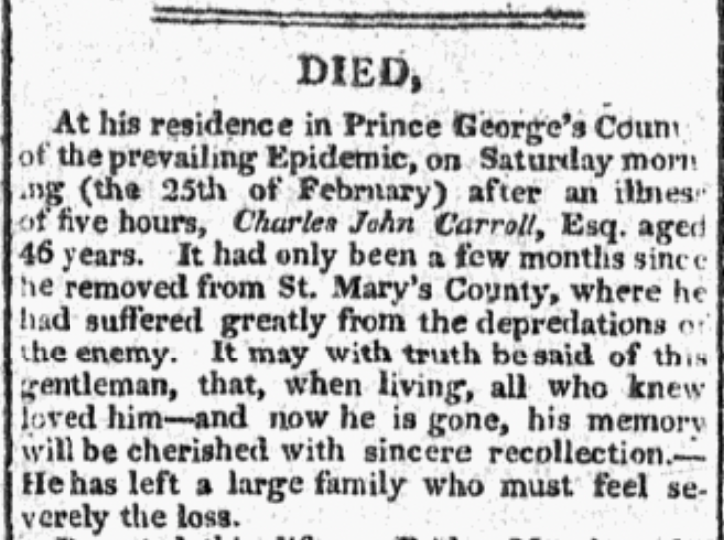
After the war, Carroll had moved to Prince George’s County, and had settled on the Patuxent River in the neighborhood of Nottingham, away from the British ships. Having escaped from the British, he died in 1815 from smallpox.
Daily National Intelligencer, Mar 9, 1815 | genealogybank.com
His children were raised by their grandmother, Araminta Thompson. His son, Michael B Carroll became a merchant and landowner; his daughter, Araminta Carroll, married John B Brooke, a wealthy lawyer, and settled at “Poplar Neck”, near Cheltenham and near the home of Robert Sewall of “Poplar Hill”.
Carroll-Sewall Connection
The Carrolls owned Susquehanna on Cedar Point in St. Mary’s County and were neighbors to the Sewalls, of Mattapany Sewall. Both families were prominent Catholic families with connections to power in colonial and early National Maryland.
Nicholas Sewall, who boarded the ship with Charles J Carroll, was a cousin of Robert Sewall, who had inherited “Poplar Hill” from the Darnalls. The Sewall’s owned land on Cedar Point throughout the 1700s.
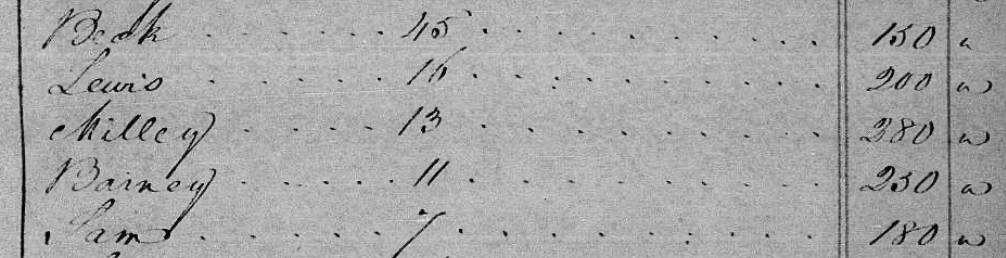
When Robert Sewall died in 1820, he had land in both Prince George’s County and St. Mary’s County. As a result, he had two inventories. In the inventory for St. Mary’s County, he included the names of the enslaved people on the property [TT 5:25]. Among them was a family group including an inferred mother, Beck (45), and her children, Lewis (16), Milley (13), Barney (11), and Sam (7).
1822 Inventory of St. Mary’s Property | family search.com
This raises the question, as often names repeat across generations, if Beck and her son Lewis were kin to the Lewis and Beck who went with the British. Their enslavers were connected to each other politically, religiously and geographically.
1814 Claim
1822 Inventory
Lewis Medley, 21 [1793]
Beck, 45 [1777]
Beck Medley, 17 [1797]
Lewis, 16 [1806]
Milley, 13 [1809]
Barney, 11 [1811]
Sam, 7 [1815]
Based on the given ages of the people in the two documents, estimated birth years can be given and from that, possibilities for kinship emerge. The Medley’s may be cousins to Beck’s children, either of their parents would have been in the same generation of Beck. Both Beck and the unknown parents could have used family names for their children. Or, Beck Medley, may be the daughter of Beck, as Beck would have been 20 when Beck Medley was born.
Alternatively, the reappearance of “Lewis” in both family groups could be because Lewis was a family name used by the Sewalls (see Nicholas Lewis Sewall, from whom Robert Sewall bought Mattapany Sewall) and the enslavers provided their own name to their enslaved.
Note on Plantation Size
Charles J Carroll died in 1815. His inventory was submitted to Prince George’s County County and included 11 names [TT 5:9] . Unlike Sewall’s inventory which appeared to be organized by family groups, Carroll’s is organized by age.
1815 Inventory of Charles J Carroll’s estate | familysearch.org
Carroll enslaved far fewer people than Sewall, which suggests that family groups were not sustained. In “Tobacco and Slaves”, Allan Kulikoff describes how enslavers with fewer people in captivity were less likely to sustain family groups. [See Chapter 9: Beginning of the Afro-American Family] He describes how [enslavers] would keep “women and small children together but did not keep husbands and teenage children with their immediate family” and that enslavers with small farms [enslaved less than 11 people] separated enslaved people “more frequently than those on large plantations” to pay debts or through bequeathals. This may explain why Sewall’s inventory was organized by family group and Carroll’s was not.
Of the five people who escaped with the British, there were four different surames: Barnes [Adam], Jackson [Philip], Lewis [Sandy], and Medley [Lewis]. This suggests Carroll bought enslaved people from other plantations and brought them to Susquehanna for labor. Kulikoff’s research into Chesapeake enslavers and the people they enslaved suggests that “cross-plantation” kin groups were established as often the enslaved were sold to and by neighboring enslavers.
The British took the four adult men with them, when they raided Susquehanna, as the 1815 inventory only lists males who are children: George, 10, Lewis, 6, Davy, 5.
This post is one in a series in an attempt to identify members of the Clarke family groups among the people enslaved by Robert D Sewall at “Poplar Hill” in Prince George’s County
Manumission
In 1852, Robert D. Sewall wrote his will, devising his property to his nieces and nephew. The majority of it went to Susan and Ellen Daingerfield, with some devised to his nephew Henry S. Mitchell. However, excepted from this was the man Abraham Clarke, as Sewall bequeathed “to my faithful and trustworthy house servant Abraham Clarke, his freedom”. Along with his freedom, Sewall bequeathed 400 dollars to allow him to move outside of Prince George’s County.
Robert D. Sewall Will | familysearch.org
When Abraham was emancipated by Sewall, he was living with his wife, Francis, and two children, Alice and John Henry, as evidenced by the 1853 Inventory. While his manumission provided freedom for himself and some money to establish his life, it did not grant his family freedom.
While Sewall died in 1853, it wasn’t until 5 years later, in 1858, Abraham Clarke was issued the certificate of freedom. He was described as of “light complexion, five feet six…with a small scar on the forehead near the edge of his hair and a large scar on the cap of the left knee occasioned by a burn when a small child.”
By 1860, Abraham had left Prince George’s County and was living in Ward 2 of the City of Washington, with his daughter Alice. It is unclear how he secured her freedom (by self-emancipation or purchase) and a new wife, Sarah. His home, about a half mile north of the White House, was on the north edge of the inhabited city where the buildings gave way to empty lots. It is unclear what the fates of Francis and John Henry were.
Family in the 1853 Inventory
Family in the 1860 US Census
Abraham, 38
Abraham Clarke, 45
Francis, 23
Sarah Clarke, 40
John Henry, 6
Alice, 2
Alice, 9
Abraham was the neighbor to James Johnson, a man manumitted by Robert D. Sewall in 1845. (Prince George’s County, Land Records, JBB 4:576 | mdandrec.net).
The 1860 US Federal Census records James Johnson working as a cook, Abraham Clarke as a servant. The City Directories for the 1860 lists his occupation as waiter.
1860 US Federal Census, DC, Ward 2, Image 192 | ancestry.com
Both men owned real estate and had a small personal estate. Based on the 1862 City Directory, they lived near Rhode Island Ave where it connects Scott and Logan Circles; an article in the Evening Star on May 7, 1863 describes it as 29 by 105 feet. In 1884, Sarah Clark, Abraham’s wife, died, bequeathing her husband use of lot 7 on block 211 during his natural life with her stepdaughter Alice (Clark) Jennifer. He died in 1891.
Author Annotated Excerpt of 1851 Map of the City of Washington DC | loc.gov
1821 Inventory and Family
While the 1853 inventory gave details of his adult life as a husband and father, the 1821 inventory gives evidence to his role as a son. Based on the ages provided in the Federal Censuses and the 1853 Inventory, we can estimate his birth year to be between 1815-1820. Most records suggest a year closer to 1820.
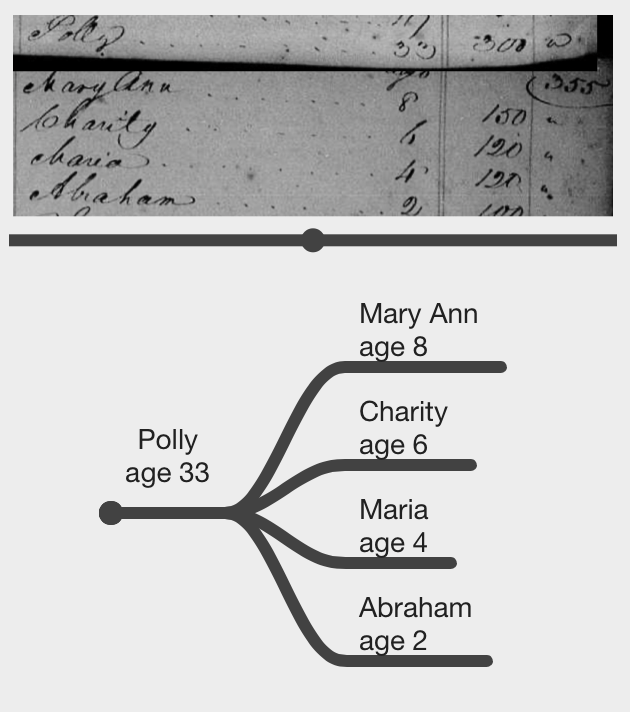
The 1821 inventory lists a two year old Abraham, grouped with inferred older sisters and his inferred mother, Polly. (page 354-355)
It is tempting to infer status in the eyes of the enslaver from arrangement on the inventory. The 1853 will bequeathed freedom to Abraham due to his “faithful and trustworthy” character, and he was listed first in the 1853 inventory, seeming to signify the closeness with which he labored to Robert D Sewall. In contrast, in the 1821 inventory lists Polly and her children toward the end of the list for the property in Prince George’s county. While it is tempting to drawn conclusions from this comparison, there is no indication that the organizers of the two inventories had similar thought processes.
The ad placed in the National Intelligencer by Robert D. Sewall’s plantation manager, Wm. G Jenkins, described George as “25 or 26 years old, 6 feet 2 or 3 inches high, dark complexion, very high forehead.” He was also described as “when spoken to has a quick speech and a smile on his countenance”.
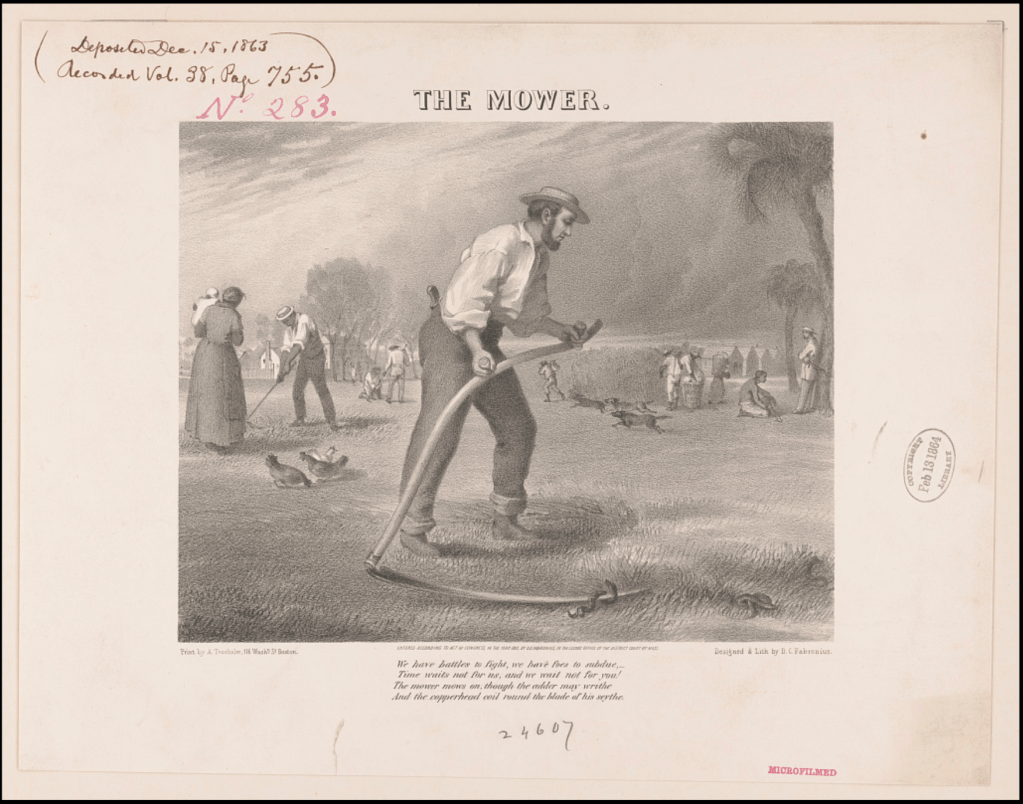
He most likely worked in the fields of the large estate, raising the tobacco and wheat for the Sewall as he was described with a scar on his knee, “occasioned by a cut from a scythe”. Scythes were use to harvest crops or clear fields.
An allegorical 1863 print using a scythe to criticize the plantation system. See loc.gov for more details.
During his escape he was seen on the stage road leading from Upper Marlboro to Washington. A 1848 Baltimore Sun edition posted the male stage routes and included route 1936 “From Washington DC by Long Old Fields, MD., Upper Marlboro, Queen Anne and Davidsonville to Annapolis, three times a week. [24 Jan 1848 | newspapers.com]
Excerpt from 1863 Martenet Map of Prince George’s County annotated with location of Poplar Hill in relation to the describe mail route
Fanny and Henrietta Brown, Sold
The same year, Robert D Sewall sold the legal authority to enslave eight people to William J Stone, a resident of the District. Stone owned a tract of land called “Mount Pleasant” and a residence in town.
In August 1842, four months after George’s escape, Fanny and Henrietta Brown was among those included into the sale to Stone. [Civil War Washington] Fanny was described as twenty-two years old in the sale. Henrietta Brown was fifteen.
It is possible that George, Fanny and Henrietta were siblings, as they shared the same surname and were enslaved by the same person and similar in age.
Unlike George, who toiled in the fields, Fanny was described as a “cook and house servant” in the 1862 petition paperwork Stone presented to be compensated for her emancipation. Henrietta Brown was not included in the 1862 petition for compensation from her emancipation. A note was included regarding the 1842 sale “Fanny Brown & Cornelius Digges were valuable Servants (the bill of Sale is for 7 servants)—but the others were not so much so & some of them an actual expense for many years before their services were of any value $2200 was the price for all”. This suggests that Stone may have sold the other five included in the Bill of Sale prior to emancipation as he did not see value in their labor.
In 1850, William J Stone [real estate valued at $250000] enumerated 14 enslaved people in the US Federal Census Slave Schedule, included three adults females, ages 30, 29, 27. Fanny is likely listed among them (she would have been 29 in 1850) and possibly Henrietta as well. In 1854, a William Stone (note no use of middle initial) committed two enslaved people, Simon and Henny, to the DC Jail for “safekeeping” [Hynson, 42-43]. They were released to him nine days later. In “Freedom Seekers: Fugitive Slaves in North America, 1800–1860”, Pargas states that enslaved people were put in the jail for “safekeeping” pending a sale or estate division (110). Henny may have been Henrietta.
1821 Robert Sewall Inventory
Fanny and Henrietta are not listed in the 1821 Robert Sewall Inventory [TT 4:352]. Fanny was likely born around the time of the inventory and therefore born after its compilation, while Henrietta, at 15, was born five years after the compilation of the inventory.
George has an estimated birth year of 1816 calculated from the age of 26 given in the advertisement. If he and his family had been enslaved by the Sewall’s in 1821, his name and age [George, 6] should be expected.
On the second page of the inventory, there is a family group listed that included George, 8. This may be the same George.
folio 354 of the 1821 Robert Sewall Inventory.
There is no documentation located that connects the three, other than the Bill of Sale and Runaway Advertisement that details that they both left “Poplar Hill” in 1842. If Fanny and Henrietta’s forced departure from “Poplar Hill” was connected to George’s escape, it was not detailed in the Bill of Sale.
Sources:
Pargas, Damian Alan. Freedom Seekers: Fugitive Slaves in North America, 1800–1860. United States, Cambridge University Press.
Hynson, Jerry M.. District of Columbia Runaway and Fugitive Slave Cases, 1848-1863. United States, Willow Bend Books, 1999.
This post is one in a series in an attempt to identify members of the Clarke family groups among the people enslaved by Robert D Sewall at “Poplar Hill” in Prince George’s County.
1842 Bill of Sale
In April 1862, Congress emancipated people enslaved within the District the Columbia. In May 1862, William J Stone, Sr. submitted a petition certifying that he was loyal to the US and that he claimed to have enslaved 8 Black people at the time of the act. Among them, Fanny Brown, age 43, “a good cook & family servant” and Cornelius Digges, age 23, “a good house servant, waiter and driver”, both of whom were purchased of Robert Sewall of Prince George’s County.
Petition #314 of William J Stone | ancestry.com
As part of Stone’s documentation that he was the rightful “owner”, he submitted the Bill of Sale between Robert D Sewall and William J Stone [Civil War Washington] which included the names and ages of other enslaved people that he purchased:
Fanny Brown, age 22
Henrietta Clarke, age 23
[Her Son] Nealy, age 2
Henrietta Brown, age 15
Minty Carroll, age 21
John Johnson, age 13
Basil Lee, age 8
Except for Henrietta Clarke, the people named were born after the 1821 Inventory of Robert Sewall’s Prince George’s Property.
1821 & 1853 Inventory
Henrietta, age 3 months old, appears in the 1821 Inventory in the family group with the inferred mother, Charity. This family group is immediately after the Polly [Clarke] family group with Abraham Clarke, who was manumitted by Robert D Sewall in 1852 and Charity (younger) who married Daniel Jackson [see additional posts].
1821 Robert Sewall Inventory [TT 4:352] | family search.org
I had assumed previously that Nelly was short for a female’s name. Comparing the 1862 Emancipation Petition and the 1842 Bill of sale with the 1821 Inventory, its possibly that Nelly is short for Cornelia for a female or Cornelius for a male. Cornelius Digges is listed in the petition as Cornelius, and assumed to be Nealy in the Bill of Sale.
While Henrietta is not included in Robert D Sewall’s 1853 Inventory, her parents, Thomas and Charity are.
1853 Robert D Sewall Inventory [JH 2:699] | familysearch.org
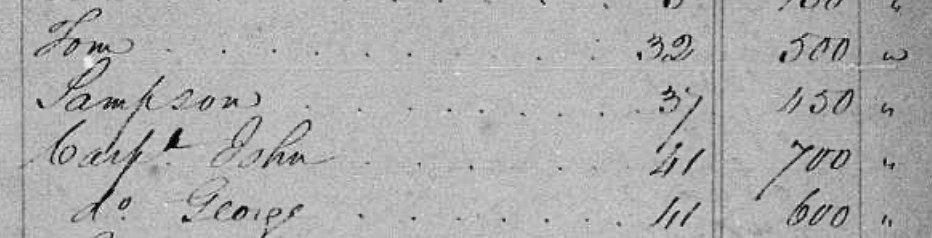
Thomas, while not included with Charity and her children in the 1821 inventory, appears to be included in the inventory:
1821 Robert Sewall Inventory [TT 4:352] | family search.org
He is on the previous page, about two-thirds of the way down the column, grouped with a cluster of adult men: Tom, 32, Sampson, 37, Capt. John, 41, and Capt. George, also 41.
Freed, Cornelius Digges
Based on the petition, which did not include Henrietta Clarke (or Digges), it is likely that Henrietta did not survive her captivity. Her son, Cornelius “Nealy” Diggs, did however, and was emancipated in 1862. The petition by William J Stone notes that he has a place near “Mount Pleasant”; it is unclear if Cornelius was held at “Mount Pleasant” in the county or at a city residence on 14th Street between F & G (Evening Star, 15 Sept 1859).
He was drafted into the 22nd Regiment of the US Colored Infantry and fought for the emancipation of all enslaved people.
USCT Service Records | fold3.com
After the war, he returned to DC where he found work as a coachman [1869], servant [1867] and waiter [1870], similar to the labor he preformed when he was held captive by Stone. (City Directories listed his occupation and residence in Ward 1).
In 1868, he married Evelina Moore, who had been brought to the District from Virginia by her enslaver, Mildred E Ewell, who was bequeathed the legal authority to enslave Evelina from her parents, Jesse Ewell and Mildred Ewell of Prince William County, 1848. She brought them to DC in 1851. (Emancipation Petitions, ancestry.com)
Notes on the Enslavers
William J Stone, Sr
In the 1860 US Federal Census, William J Stone is listed in Ward 2. He is estimated to have real estate valued at $157,000. In contrast, Robert D Sewall had real estate valued at $93,500 in 1850 and he was considered a wealth landowner by his peers. Stone was listed as a “Gentlemen” from England. He had an Irish servant listed with him in the census. His 1860 Slave Schedule lists six people (though he claimed eight on the petition). The ages roughly correspond with the petition (The Pleasants family and Fanny Brown) and appears to omit Cornelius. A web search shows that William J Stone was a engraver who was commissioned to reproduce the the “Declaration of Independence” and political ally of John Quincy Adams.
This post is one in a series in an attempt to identify members of the Clarke family groups among the people enslaved by Robert D Sewall at “Poplar Hill” in Prince George’s County.
Near Woodyard, Martenet marked a mill on his 1863 map of Prince George’s County. This mill is adjacent to the lands owned by the Sewall-Dangerfield families. Its miller was enumerated in the 1870 census at dwelling number 21; the mother of W. H. Marshall at 22, and then the census enumerated 18 Black households among the next 24 households. These households are likely the households of freed Black people who had been held by the Sewall-Dangerfield families.
Among them, at household 25, is the household of Nathaniel Clark, his wife Milly, and their son, James. Nathaniel is listed as a carpenter.
1870 US Federal Census, MD, PG, Surratts, Image 4 | ancestry.com
As a carpenter, Nathaniel likely built and repaired carts, wheels, rakes, fences, while also maintaining the buildings, including quarters, barns, storehouses and the dwelling house itself. In the 1870 census, he was one of three carpenters in the Surratts District, along with two white carpenters (John Hutchison and John C Higdon).
Name in 1853 Inventory
Appraised Value
Ned Wilkes, 47
$550
Natt (Clarke), 50
$650
Henry Brown, 50
$700
Issac Brown, 50
$550
Robert Adam, 51
$500
Lewis, 48
$200
The table shows the names of enslaved men around the same age as Nathaniel Clark and their appraised value in the 1853 Inventory. His value of $650 is higher to most of the other men, suggesting that the appraiser took in account their labor skills in addition to age when providing a value. In the essay “Skilled Blacks in Antebellum St. Mary’s County, Maryland”, the author examines the occupations of both free and enslaved Black people in St. Mary’d county and states, “Carpenters were the most valuable of slaves skilled or otherwise.” The review of historical documentation revealed that skilled carpenters could be hired out for $100 annum in 1812 and $290 in 1824 for the enslaver. (Marks, p. 546)
His household in the 1870 census, is fairly consistent with the household of Natt and Milly in the 1853 inventory, with the age difference between Nathaniel and Milly about 5 years in both documents, and with James consistently having an estimated birth year of 1849 in both documents.
Family in the 1853 Inventory
Family in the 1870 US Census
Natt, 50
Nathaniel, 60
Milly, 44
Milly, 55
George, 19
Barney, 16
Susannah, 13
James, 4
James, 21
Son, James Clarke (1849-)
James, their youngest son, was still living with his parents in the 1870 census. A marriage record shows he married Phillis Wood, their neighbor’s daughter in 1870 (both enslaved by Robert D Sewall and identified in the inventory).
Like his father, he was a laborer and the 1900 census shows him with the occupation of carpenter. The 1880 census (in conjunction with the 1878 Hopkins Map; the map is rotated from a traditional north orientation) shows that he lived northeast of Robey’s Town (present-day Clinton), he is listed at dwelling number 177 near Joseph Stephenson and others.
Son, George Clark (1834-bef. 1880)
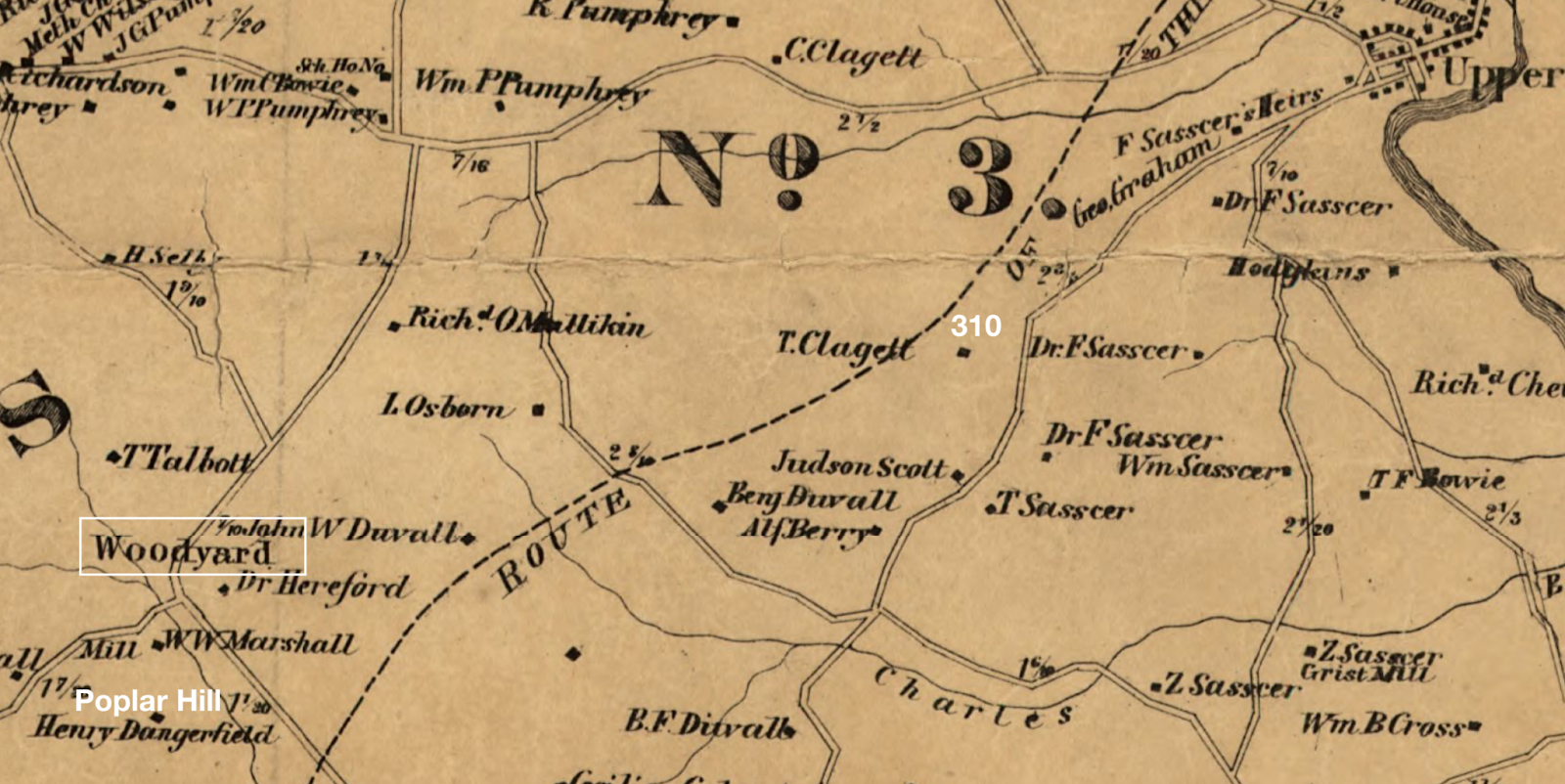
In 1870, George Clark, the oldest identified son of Nathaniel and Milly, was living in Marlboro District; he is enumerated at dwelling number 311, near the dwelling house of Thomas Clagett (310). He and his wife Ann have 4 children, all of whom were born after 1853. This location puts him on the road from Upper Marlboro to Rosaryville and northeast of Woodyard. He is working as a “farm hand” which suggests he is a tenant farmer after emancipation. His oldest son, Edward, is still living there in 1880 with his wife and children. George, Anne and the other siblings do not appear to be living in the vicinity.
Son, Barney Clarke (1837-1916)
Barney, the second oldest son, is enumerated as living in Marlboro as well, though not near the Clagett land. Like George, he is a tenant farmer.
He and his wife, Mary Ann Burgess, have their marriage made official in 1870, though the ages of their children suggest that they had been partnered for a decade or more.
1870 US Federal Census, MD, PG, Marlboro, Image 34 | ancestry.com
Mary Ann Burgess, enslaved by R. W. G Baden?
It is possible that Mary Ann Burgess was enslaved by R. W. G. Baden prior to the state emancipation in 1864. He lived in Nottingham District near Rock Creek. In 1867 he submitted a list of names that bear similarities to Mary Ann and her children:
Baden submitted a list Phoebe Clark and 5 children. With any of the lists submitted for the Commission on “Slave Statistics” it is ambiguous what age the enslaver noted, e.g., was it from 1864, when they were emancipated, was it from 1867 when the list was compiled, or was it from a previous list submitted without updated aged. For example, the Waring family submitted their list of individuals with ages from an 1860 inventory of their father’s estate (i.e., Mary Virginia Mackubin and Mrs. Elizabeth L Bowie). Additionally, the lists were voluntarily submitted meaning not every enslaver submitted a list. For example, the Sewall-Dangerfields did not submit a list for “Poplar Hill”.
[1] Considering Phoebe Clark, she is roughly the same age as Mary Ann (Burgess) Clark in the 1870 Census. Her name however is distinctly different. Two possibilities present themselves. First, the “slave statistic” list maker confused either Maria or Martha Ann for Phoebe and wrote the names incorrectly. Or, second, Phoebe was a name given by her enslaver, and Mary Ann chose Mary Ann for herself, and upon liberation chose the name she gave herself. Additonally, Mary Ann Clark or Burgess is not listed in the 1867 Slave Statistics.
[2] George Clark is roughly the same age as George Clark in the census
[3] William Clark is an outlier; and Will and Belle both contain an /l/ sound after a one-syllable name. The 1870 census could have misheard and wrote the wrong name.
[4] Lettie Clark could be L. A. Clark in the census. While the age is different, the names consistently begin with an “L”
[5] Both documents list a multi-syllabic distinct name that begins with “R”.
While there are similarities, this theory relies on a lot of errors on behalf of the record takers, and while probable is by no means definitive.
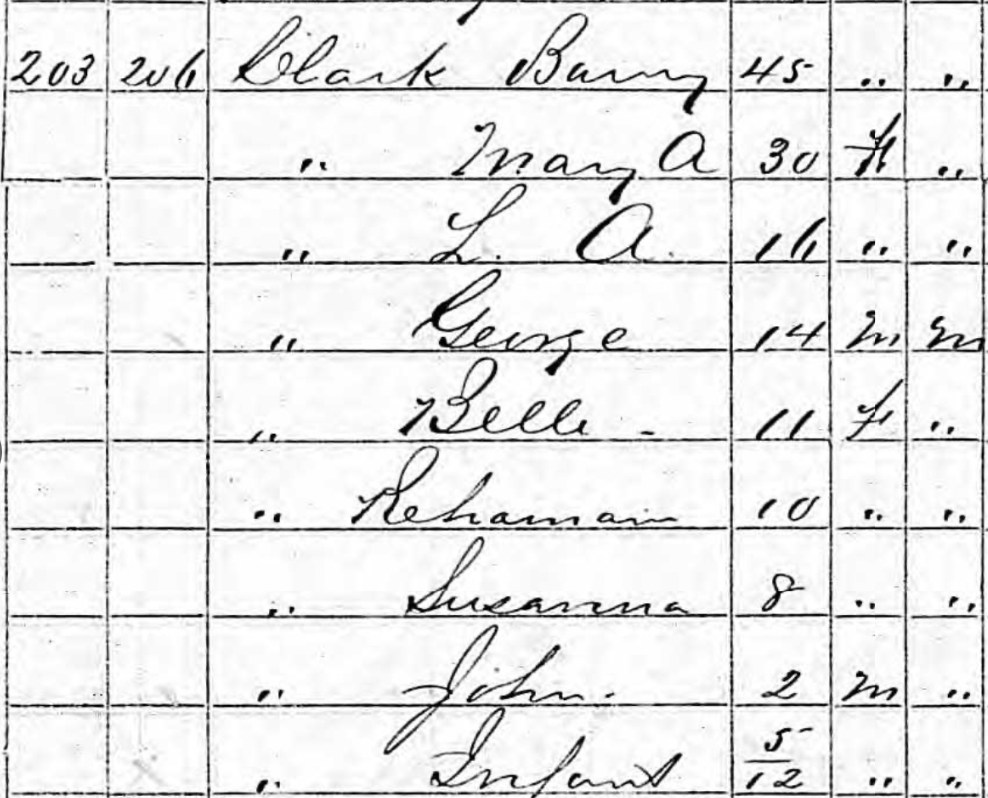
Barney Clark in 1870
Barney and his wife’s dwelling number 203 in the 1870 census places their residence north of Woodyard, closer to the village northwest of Woodyard which is represented by the cluster of names.
By 1880, the family has moved south to the Brandywine District. Brandywine was formed from the Nottingham District and suggests that the family moved into the area southwest of Woodyard, near the new villages of Rosaryville and Chelthenham, where many of the other formerly enslaved people of Poplar Hill settled. He is enumerated near Nathan Diehl, who bought the land of “Poplar Neck” [not to be confused with “Poplar Hill”] from Araminta Brooks in 1870. This places him and his family on the road running southeast to Rosaryville. He died in 1916, and is buried in Forestville, at the Mount Calvary Catholic Church Cemetery.
Census Comparison of Nathaniel Clark Family
Family Member
1870 Census
Marriage Records
1880 Census
Nathaniel Clarke & Milly
Surratts District Living with other freedmen near dwelling house of “Poplar Hill” Listed as Carpenter
Not found; inferred dead
George
Marlboro District Living with wife and childrenTenant farmer
Not located; inferred to Ann LNU
Not found
Barney
Marlboro District Living with wife and childrenTenant Farmer
Married to Mary Ann Burgess in 1870,
Brandywine District Living with wife and children Tenant Farmer
Susannah
Not found
Not found
James
Surratts District Living with his parents
Married Phillis Wood, 1870 neighbor, in 1870
Surratts District Marked on Hopkins Maps Occupation: Laborer
Sources
Marks, Bayly E. “Skilled Blacks in Antebellum St. Mary’s County, Maryland.” The Journal of Southern History, vol. 53, no. 4, 1987, pp. 537–64, https://doi.org/10.2307/2208774. Accessed 7 Apr. 2022.
This post is one in a series in an attempt to identify members of the Clarke family groups among the people enslaved by Robert D Sewall at “Poplar Hill” in Prince George’s County.
Charity in 1821
Charity is listed in the 1821 inventory alongside Abraham Clarke, who was manumitted in Robert D Sewall’s will and who lived in DC after his manumission.
Charity in 1853
She is listed immediately after Abraham’s family in the 1853 inventory with two children: Daniel, age 14, and Mary Mag, age 8
Excerpt from 1853 Inventory of Robert D Sewall | familysearch.org
The 1870 Census returns a record for Charity Jackson, age 50, living in the neighborhood of TB, in the Piscataway District. Piscataway is the district immediately south of Surratts, where Poplar Hill is located.
Husband Daniel
She was living with her inferred husband: Daniel Jackson, age 40, and their two children: Alfred and Caroline. The Prince George’s Marriage Licenses show they formalized their marriage in 1872. Both were listed with the last name Jackson, suggesting they had been married informally for decades prior.
1870 US Federal Census, MD, PG, Piscataway, Image 4 | ancestry.com
A Daniel Jackson, age 40, is listed in the Prince George’s County “Slave Statistics”; Mrs. Jane P Williams submitted his name as a person she enslaved as of 1864. She and her husband owned real estate valued at $10,000 in 1860 and personal property (including value of enslaved people) was recorded as $25,000. In 1870, she was a widow with real estate valued at $8000 and personal property of $600.
Prince George’s County Commissioner of Slave Statistics 1867-1869 CE404 | Maryland State Archives
1870 Residence
The approximate location of Charity and Daniel’s residence after the Civil War can be inferred from the use of Martenet’s Map of Prince George’s County which shows landowners [1863] and the dwelling numbers of the landowners in the 1870 census. Williams can be identified on the road parallel to the district boundary, while W. A Gibbons is close to the TB Post Office, and Marshall and Gwynn are to the west.
Charity and Daniel are listed at dwelling number 25, suggesting that they are on the roads near Gibbons and the TB post office.
If Charity lived on “Poplar Hill” during her captivity by Sewall and if Daniel lived on the Williams’ tract of land (and possibily the residence he inhabited after emancipation by the state), this suggests that they were forced to live apart during their marriage.
If either of them had been granted a pass to visit the other, the walk would have been about 8 miles from one estate to the other, and would have taken about 3 hours.
Family in the 1853 Inventory
Family in the 1870 US Census
Charity, 38
Charity Jackson, 50
Daniel Jackson, 40
Daniel, 14
Mary Mag, 8
Alfred Jackson, 7
Caroline Jackson, infant
Died prior to 1880
Daniel Jackson (Sr) is recorded in the 1880 census with a wife, Clarisa, and his children Alfred and Carolina. Listed with the family is Elizabeth Duckett who is labeled as “mother”. The age difference between Daniel and Clarisa is small, Daniel is 54 and Clarisa is 53. This suggests that Charity died prior to 1880 and Daniel remarried.
Son, Daniel Jackson, Jr
Charity’s son, Daniel Jackson, is listed in the 1853 inventory with her and not in the 1870 census. His estimated birth year, based on the 1853 inventory is 1839, which in 1870, would make him 32. As an adult, it is likely he is in his own household.
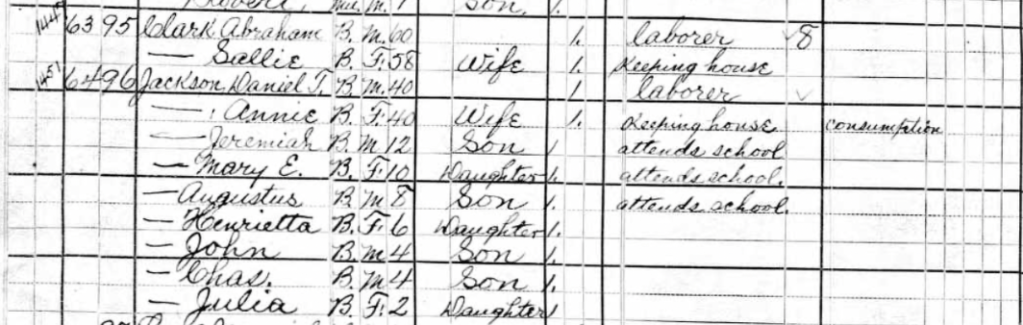
In the 1870 census, a Daniel T Jackson is living next to Abraham Clarke in the City. He is the correct age to be Charity’s son, Daniel. This suggests Daniel left Poplar Hill in pursuit of freedom during the Civil War, like many enslaved people who used the proximity to DC as a means for emancipation after 1862.
1870 US Federal Census, DC, Ward 2, Image 315 | ancestry.com
Daniel married Annie Lowe in 1867 and settled into a home near his uncle. The 1880 census indicated Annie had consumption, and she must have died by 1882, as the Evening Star lists an Equity Case (Lowe vs. Jackson), in which Daniel T Jackson was appointed guardian ad litem.
1880 US Federal Census, DC, ED 23, Image 9 | ancestry.com
A Daniel Jackson, widower, died in 1886. His estimated birth year was 1836 and he was buried in Mt. Olivet Cemetery, suggesting like many of the residents of Poplar Hill, he was Catholic.
William Hannibal Gantt, a Black landowner in Cheltenham, died prior to 1898 and the use of death certificates in Maryland. The purpose of this post is to propose a set of parents and siblings for William Hannibal Brown Gantt.
A Note, first, on William Hannibal Brown Gantt and his Surnames
Connecting the 1870 & 1880 Census
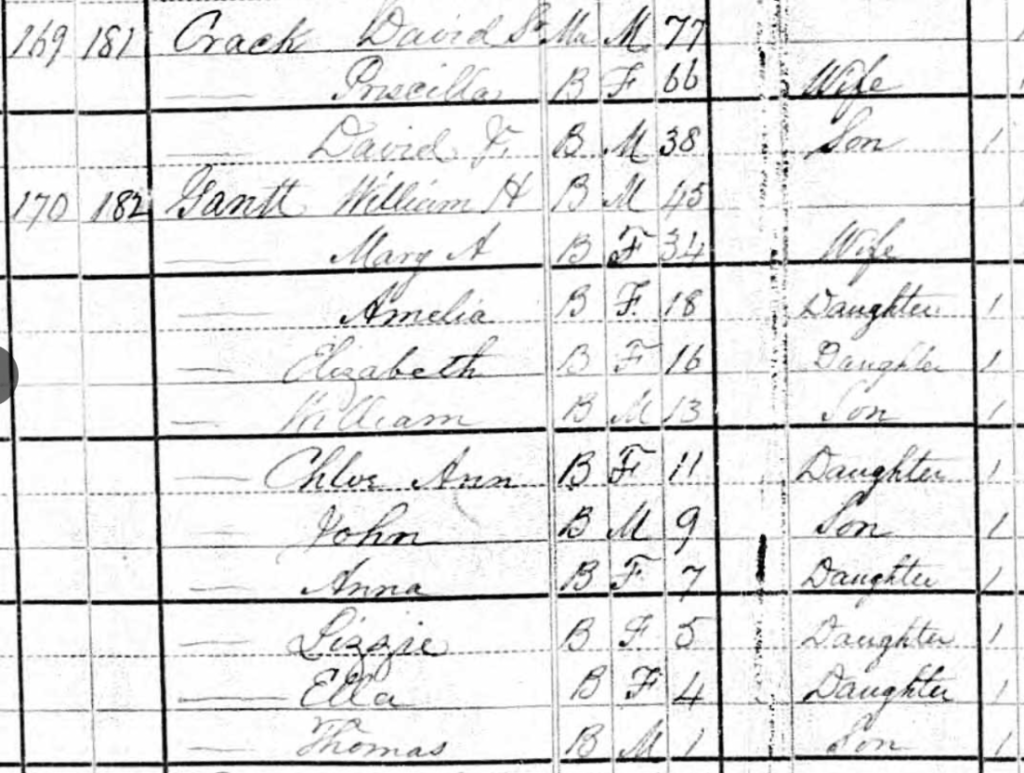
In 1880, William H Gantt was enumerated with David Crack in the district of Brandywine. David and his family are listed first, at dwelling number 169, and William H Gantt, with his wife, Mary A, and children, are listed at dwelling number 170.
1880; Census Place: Brandywine, Prince George’s, Maryland; Roll: 514; Page: 229B; Enumeration District: 131 | ancestry.com
In 1870, a William Brown was enumerated with Davy Crack at dwelling number 20; his wife, Agnes is not listed, however, the children match those of the 1880 William H Gantt entry. The alignment of children’s names with the inclusion of Davy Crack suggests that William Brown and William H Gantt are the same person.
1870; Census Place: Nottingham, Prince Georges, Maryland; Roll: M593_592;Page: 115B | ancestry.com
Land Records
Hannibal Gantt purchased property in Cheltenham, MD after the Civil War with David Crack that had been part of the “Poplar Neck” estate owned by the Brooke family in the 18th and 19th centuries. Araminta Brooke, the widow of John B Brooke, sold the land to Adam Diehl in 1870, who subdivided the land for small farmers. Their names appear on the 1878 Hopkins map of the Brandywine District as “H. Gaunt and D. Crack”. (Prince George’s Co. Land Records, HB 5:13-14, HB JWB 33:82-3, 79:99 | mdlandrec.net)
In the land records, he is consistently referenced as William H Gantt. In an 1874 Post Office Directory for Maryland, he is listed as Hannibal Gant, Farmer, which is consistent with the 1878 Hopkins map. This suggests he changed his surname between 1870 and 1874.
Marriage Record of Clora Ann Crack and Joseph Henry Brown
A review of the Index to Marriage Licenses for Prince George’s County does not return a marriage license for William Gantt/Brown and Agnes Crack. There are two entries for the surname Crack:
Clora Ann Crack to Joseph Henry Brown
John William Crack and Eliza Jane Savoy
As evidenced by the land records (namely the 1912 record in which the heirs of Clora Brown transfer their inherited property to Agnes Gantt: PG Land Records: 79:99), Clora Ann Crack and Agnes Crack are sisters. It appears that they may have married Brown brothers.
Brown-Wood Family Group
Joseph Henry Brown died in 1915; his death certificate lists his parents as “Charles Brown and ? Wood”. In 1870, Charles Brown, age 75, was living in the household enumerated immediately prior to William Brown. The geographic proximity of William Hannibal Brown Gantt to Charles and Susan Brown in the 1870 census with the twin marriages of siblings suggests further research into the Brown-Wood Family group to further identify relationships.
Death Certificates
In addition to Joseph Henry Brown, the following death certificates were identified:
John A Brown died in 1904; his death certificate lists his parents as “Charles Brown and Susan Wood”.
Crissie (Brown) Wilks died in 1912; her death certificate lists her parents as “Charles Brown and Susanna Wood”.
1853 Robert D Sewall Inventory
William and Agnes’s daughter, Ella Gantt married Frank Wilkes in 1898. In my search for Frank’s parents, I had researched the Wilkes family previous to this post. I have yet to definitively identify Frank’s parents. However, the search for Wilkes lead me to the Edward and Maria Wilkes family which had been enslaved by Robert D. Sewall, the owner of Poplar Hill, and identified on the 1853 Inventory of his estate.
“Poplar Hill”
Robert D Sewall owned Poplar Hill, a large tract of land near Woodyard, in Prince George’s County, MD. He died in the early 1850s, and as part of the probate process, an inventory was created of his estate (JH 2:699-703). It included the names and ages of over a hundred people he enslaved on the land. The Brown-Wood Family group is on page 702 in the portion detailed as “property managed by Mr. Jenkins”.
Charles and Luck are the inferred parents, Charles and Susan, from their ages of 54 & 47.
Sukey is a common nickname for Susan and the possibility exists that Luck was mistakenly written for Suck/Suckey. If so, this would suggest that the mother’s name was Susan
The 1853 inventory includes the names of eight children. No further information has been located for Paul, Michael and Philis.
Below, I attempt to track Charles and Susan, and their children, across the census records.
Census Comparison
The 1870 Census
Cheltenham
In 1870, Charles and Susan Brown (parents) are enumerated living in the Nottingham District in the neighborhood of the TB Post Office. Based on the landowners enumerated around them, it can be inferred that they are closer to what would become Cheltenham by the late 1870s.
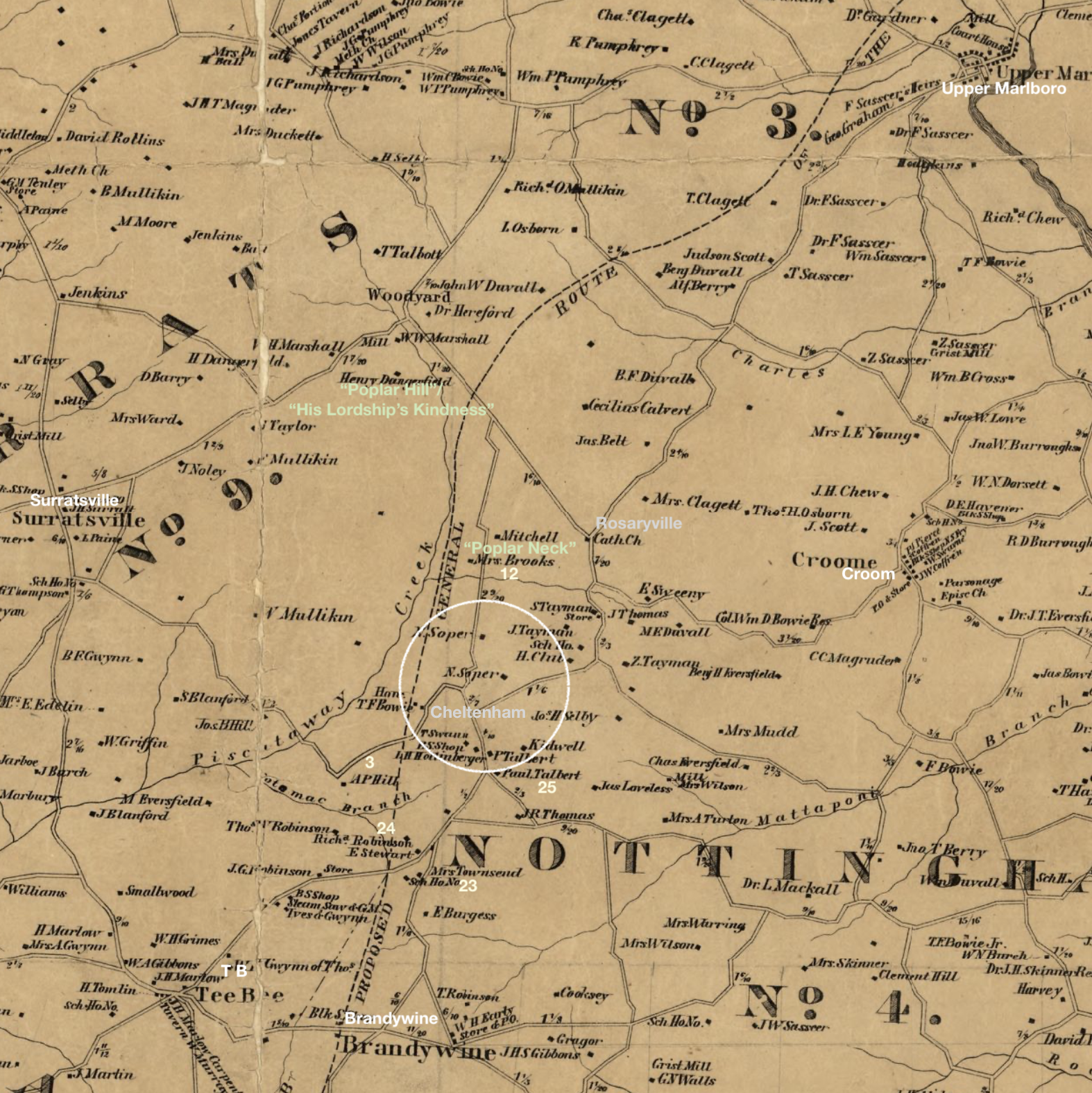
On the annotated map, the villages of Upper Marlboro, Surratsville, Croom, Brandywine and TB are marked with white lettering. By 1880, the additional villages of Cheltenham and Rosaryville were developed and are seen on the 1878 Hopkins Map. These are marked in light gray.
Two tracts of land are identified in light green and placed by their landowners: Robert D. Sewall’s land (Poplar Hill) which is identified by the name Henry Dangerfield that guardian of Sewall’s heirs and the land of the Brooke family (Poplar Neck) which is identified by the name Mrs. Brooks, the widow of John B Brooke. The numbers represent the dwelling numbers, or the sequence of households visited by the census enumerator in the 1870 census.
Charles and Susan Brown are enumerated at dwelling 19, with their son, John Brown and a child named Alice Willis. They are enumerated next to William Brown (dwelling 20). William Brown is living with his father-in-law Davy Crack, who was enslaved by Mrs. Brookes on the “Poplar Neck” track. Davy Crack, his wife, and children were identified in the 1853 Inventory of her husband John B Brooke (WAJ 1 3-5). William Brown and Davy Crack purchased land in Cheltenham, which is at the center of the circle. They are identified on the 1878 Hopkins Map as H. Gaunt and D. Crack.
Charles is listed as 54 in the 1853 census and 75 in the 1870 census. This provides an estimated birth year range of 1795-1799.
Susan is listed as 47 in the 1853 census and as 60 in the 1870 census. This provides an estimated birth year range of 1806-1810.
John Brown appears unmarried in the 1870 census. Later census records suggest that he may have been married with two small toddlers living with his wife at another location. A marriage record for John Arthur Brown and Mary Jane Jackson is consistent with the older census record.
Susan Brown (age 40), the daughter of Charles and Susan, is living nearby working for the household of Martha Townshend.
Year: 1870; Census Place: Nottingham, Prince Georges, Maryland; Roll: M593_592;Page: 115B
Rosaryville
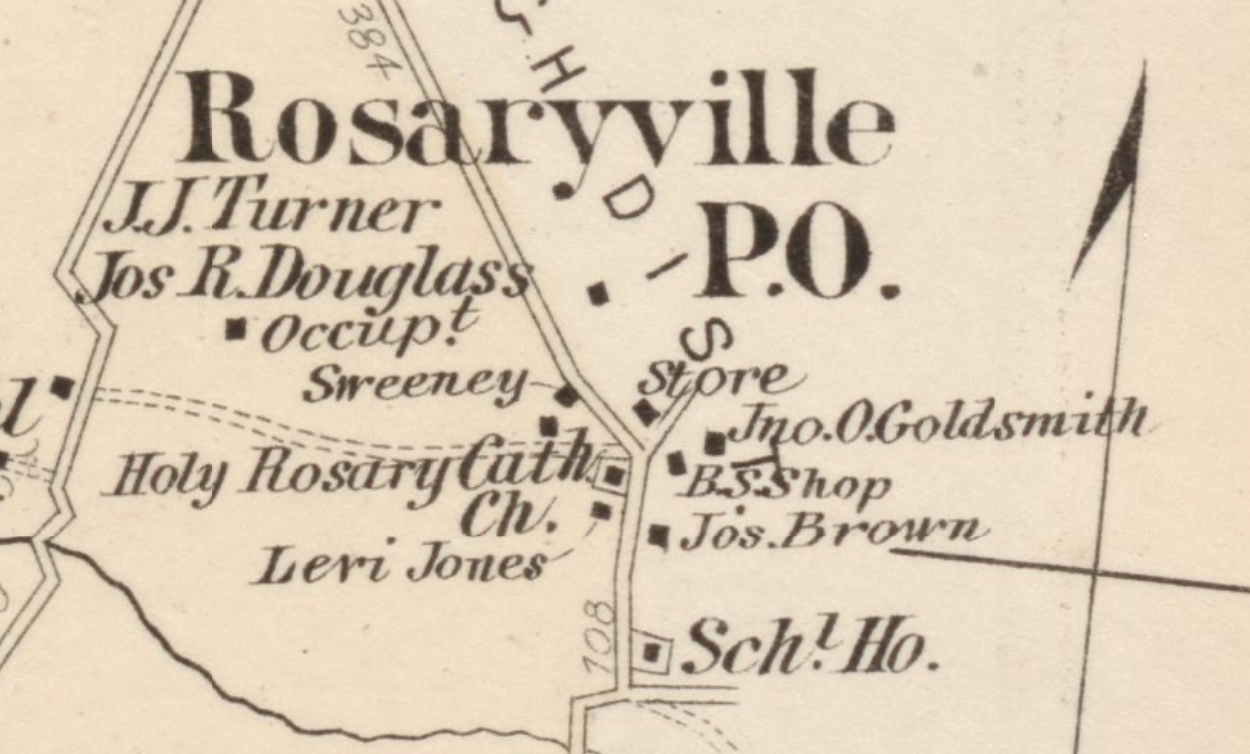
North of Cheltenham is the Holy Rosary Catholic Church, around which the village called Rosaryville developed. Rosaryville, not present on the 1861 map of Prince George’s County, is shown on the 1878 Hopkins Atlas of Prince George’s County. It sits on the border of the Brandywine District and Upper Marlboro District.
Joseph Henry Brown, the third youngest child in the 1853 inventory married Clora Ann Crack, the daughter of David Crack, in 1865 (Index to Marriage Licenses, PG Co).
In 1870, Joseph Henry Brown and his family were living in Marlboro District, at dwelling number 456 & 457. Joseph is listed in the household of Lawrence Wood, and his wife, Dinah. Chloe/Clora is listed in the next household with their children, James, Julia, Peter. The names of the children are consistent with the heirs of Clora Brown named in a 1912 land record (Liber 79, Folio 99).
Year: 1870; Census Place: Marlboro, Prince Georges, Maryland; Roll: M593_592; Page: 104A
They listed immediately prior to a merchant named Washington Beall. Both Beall and Joseph Brown are labeled on the 1878 Hopkins Map of Marlboro, showing their location in the village of Rosaryville.
Two land records show that Joseph H Brown purchased land in Rosaryville (JWB 1:130 & JWB 1:220). The first, dated 1882, shows that Joseph purchased a parcel of land from the tract “Woodstock” owned by Henry Clagett and adjoining the residence of Charles Brown. It is on the north east side of the main road leading from Rosaryville to Centreville. This is consistent with the map, as the pink area is north and east of the road that leads to Centreville (which is northwest of Rosaryville). The second, also dated 1882, shows that Joseph purchased land from James Belt, next to land owned by Peter Wood and Washington Beall.
Croom
Charles Henry Brown, the third oldest child of Charles and Susan (Wood) Brown was likely married to Annie Gordon in the 1850s, after 1853 (the inventory) and before 1856 (birth of his eldest child in the 1870 census.)
In 1870, he was enumerated in Marlboro District, at dwelling 105, living near the landowner W. D. Bowie.
This places him in the larger neighborhood of the Charles/Susan Brown family groups living near Cheltenham and Rosaryville. The proximity to W.D. Bowie suggests that he is on the road that runs between Rosaryville and Croom, which is the border between the two districts, Marlboro and Nottingham.
Charles’ household is himself, his wife Annie, and their children, whose ages range from 14 to 1, which allows for the estimated marriage year in the mid 1850s.
Immediately enumerated after Charles and his family are Joseph Gordon, age 50, and Polly, age 78. Based on Annie (Gordon) Brown’s death certificate, it is inferred that Joseph is an older brother, and Polly is her mother.
Maryland State Archives
1880 Census
Rosaryville
By 1880, the surviving members of the Charles-Susan Wood Brown family named in the inventory had moved to Rosaryville. Joseph Henry Brown, though documented in 1882 land records to be in the area and marked on the 1878 Hopkins Map, is not recorded in the 1880 census. His other siblings and mother are however.
Dwelling Number
Head of Household
Notes
139
Cornelius Gordon
Possibly related to Charles’ wife, Annie Gordon
140
James Dorsey
Contains the household member Lawrence Wilks
143
Henry Claggett
Large Landowner prior to the Civil War Residence noted on the 1878 Hopkin Map
146
John Brown
Son of Charles Brown and Susan Woods
147
John Thomas
Occupation listed as Teacher, suggesting residence near School House
151
Barney Johnson
Residence noted on the 1878 Hopkin Map
153
Lawerence Wood
Husband of Dinah WoodIncludes both Susan (mother) and Susan (daughter) in household
154
Charles Brown
Son of Charles Brown and Susan Woods
155
Robert Wilkes
Husband of Crissy (Brown) Wilks
157
Uriah Goldsmith
Residence noted on the 1878 Hopkin Map
As recorded in Marlboro District MapAs recorded in the Brandywine District Map
1900 Census
By 1900, Susan Brown has died, and Dinah (Brown) Wood, a widow, has moved to the District of Columbia.
The remaining male siblings are still living in Rosaryville. The census enumerator did not record complete details for the series of dwelling numbers recorded below. Ages and birth years are missing and relationships are not obviously clear. Numbers are crossed out in the column for dwelling numbers and other numbers are scribed above them.
Dwelling Number
Head of Household
Notes
40/41
Joseph Brown
Living with his daughter Mary, son Peter, his daughter-in-law- Mamie, and Peter and Mamie’s child, Ellen
41/42
Robert Wilks
Husband of Crissy (Brown) Wilks
42/43
John A Brown
Living with his wife and children
43/44
Barney Johnson
Residence noted on the 1878 Hopkin Map
54/53
Charles H Brown
Living with his wife and children
Christianna “Chrissy” (Brown) Wilks
Crissy Wilks is not included in the 1853 inventory of Robert D Sewall’s estate, though her estimated birth year (1840) suggests that she should have been if she was living with her family. Her husband, Robert Wilks, is listed on Sewall’s inventory, with the Wilks family group.
1853 Inventory of Robert D Sewall | JH 1:699 | familysearch.org
1870 Census
In 1870, Edward Wilks and his children are enumerated in the Surratt’s District in the neighborhood of the TB Post Office. They appear to be still living in the quarters provided them on Poplar Hill with a number of other people enslaved by the Sewalls/Dangerfields prior to emancipation in 1864.
Dwelling Number
Head of Household
Notes
21
Henry Tarman
His occupation is listed as a Miller; a mill is indicated on the Martenet Map at Woodyard, where “Poplar Hill”, or Sewall’s estate is located.
22
Annie Marshall
White landowner, likely the mother of William H Marshall who is listed as a planter with real estate valued at $14000 in Surratts. In 1870, he has moved to Kentucky.
24
Edward Wilks
Edward and Maria, inferred parentsLawrence, Richard, Susan, Washington are listed in household
29
Robert Wilks
Sole member of the household
30
Christinia Wilks
She is listed with 5 children, suggesting they had been married since at least 1860.
1880 & 1900 Census
Edward Wilks died in 1879. His account in the Freedmen’s Bank references his death and directs payments to his wife, Maria Wilkes, who is living with Robert in the 1880 census. His original deposit slip also notes his relationship to Poplar Hill.
As noted above, Robert Wilks, his wife Chrissy and his brother have moved to Rosaryville by 1880. Robert and Christiana/Crissy are enumerated as neighbors of the Brown siblings in both the 1880 and 1900 census.
Conclusions
Although there is no direct documentary connection between Charles and Susan Brown with William Hannibal Brown Gantt, I suggest that that the families are connected and that it is highly likely that William was the son of Charles and Susan and sold to another enslaver prior to the 1853 inventory.
They were neighbors in the 1870 census
Both William Brown and Joseph Henry Brown married daughters of David Crack
Crissie Brown married into the Wilks family; a daughter of William Hannibal Brown Gantt married a Wilkes man (connection unclear, though the surname occurs only in the Surrattsville/Rosaryville area)
Based on these reasons, I propose that Charles Brown and Susan Wood are the parents of William Hannibal Brown Gantt.
Jane Reeder and her children are recorded in the records of the Freedmen’s Bureau, both as residents at Kendall Green, a converted army hospital for refugees from chattel slavery, and as depositors in the Freedmen’s Bank. These records suggests that Jane and her children were among the refugees who came to DC looking for freedom from bondage. None of these records suggest a partner for Jane or father of her children.
In 1873, Jane Reeder is listed in the City Directories as “wid. Thos.” which is the only located record that connects Jane Reeder with Thomas Reeder as partner.
1873 City Directory of Washington DC | ancestry.com
Enslaved by James L Foxwell
Jane and her children escaped from enslavers in District 1 of Saint Mary’s County, Maryland, as documented by the St Mary’s “Slave Statistics”. St. Mary’s County in on the peninsula between the Potomac River and the Chesapeake Bay; District 1 encompasses the southern tip of the county.
St. Mary’s County, 1866 | davidrumsey.com
In 1867, Maryland created the “Commission of Slave Statistics” for former enslavers to submit enumerated lists of the people they held in bondage on November 1, 1864, when the new Constitution of Maryland emancipated the enslaved people of Maryland. The names of Jane and her children, as well as Thomas, were submitted by enslavers living in District 1 [St. Inigoes’s].
James L. Foxwell submitted a list of 34 names of people whom he enslaved, among them Thomas Reeder, age 45, who left with the Union Army on Dec 28, 1863. In the 1850s and 1860s, James L Foxwell purchased multiple tracts of land along St. Jerome’s Point called “Fresh Pond Neck” and purchased oyster patents.
Annotated Excerpt from 1866 Map of St. Mary’s County | davidrumsey.com
In addition to owning several schooners and purchasing oyster patent, Foxwell ran advertisements for his “Foxwell Wheat”.
Baltimore Sun | 18 Sep 1852 | newspapers.com
This suggests that the people he enslaved were forced to work the land and the water for his profit.
1850 and 1860 Slave Schedules
In 1850, James L Foxwell enumerated 8 people that he enslaved; 6 females and 2 males on the US Federal Census Slave Schedule. The males were under 10. This suggests that Thomas, who would have been 30, in 1850, was not held in bondage by Foxwell, but a different enslaver.
Foxwell most likely purchased the legal authority to enslave Reeder in the 1850s, as the 1860 US Slave Schedule enumerated 20 people, including a 45 year old male, which corresponds with the age of the list submitted to the commission on “slave statistics”.
Escape
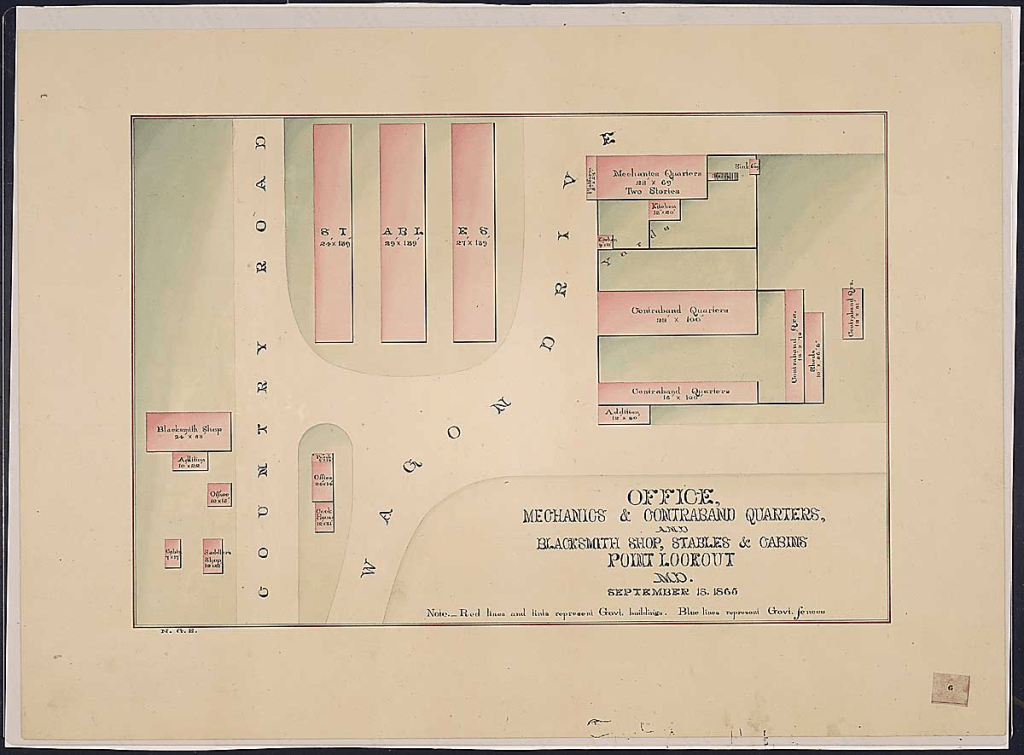
Foxwell recorded that Thomas Reeder, with Nellon Biscoe and Moses Cornish, left with the Union Army on Dec 28, 1863. Many of the people enslaved in St. Mary’s County made their way to Point Lookout, the site of a Union Hospital and Prison. Here, the Army had constructed “contraband” quarters to house the refugees from chattel slavery. Often, the sympathetic nurses and other Lookout personnel would help the refugees find boats to take them north to the District.
Moses Cornish, instead of going north to DC, made his way from Point Lookout to Fort Monroe, Virginia. Fort Monroe, a Union Fort, in Confederate Territory, attracted refugees from slavery as it was where the term “contraband” was coined when Maj. Gen. Butler deemed refugees “contraband” so as to avoid returning escaped people back to their enslavers. Butler was not anti-slavery; he simply did not want the Confederates to benefit from the labor the enslaved people were compelled to do, especially as enslavers shifted their duties from agricultural pursuits to fortifications.
Multiple boats traveled the waters between Fort Monroe and Point Lookout, steamboats, schooners, etc. Any of these may have been used to help Moses travel south instead of north.
Once Moses Cornish made it Fort Monroe, he enlisted in the US Army, joining Battery B of the Regiment 2 of the US Colored Artillery. The two other refugees, Nellon Biscoe and Thomas Reeder, do not appear with Cornish in the ranks of the US Colored Artillery, suggesting that they did not follow him to Fort Monroe.
The legal authority to enslave Nancy passed from Lewis Smith, when he died, to his heirs, including his children, George L and Sarah C Smith. Nancy, age 7, was listed in his 1853 inventory of goods and chattel. Her estimated birth year is 1846.
Parentage
It is unclear who her parents were.
Nace, age 45, likely Ignatius Gough, is the sole adult male listed on the page. His wife, Sarah and other children are held captive by an unknown enslaver as they do not appear in the 1867 lists submitted to the Commission of Slave Statistics and they are reunited with him in the 1870 census.
Louiza, age 20, could be her mother, as Nancy and Mary Ellen are listed below her in the inventory list.
Other records, however, indicate that Mary Ellen is Mary Ellen Reeder, the daughter of Jane Reeder, who was enslaved by Ann M. Chiveral during the Civil war. Mary Ellen and her mother are reunited after the war in the District of Columbia.
Louiza can be identified as Louise Demine, age 38 in the 1867 list submitted to the Commission of Slave Statistics. She and her children (Peter, 7, Teresa,5, Alexander,3, Cecilia,1) are listed. She and her children escaped from Abell’s estate in May 1864, most likely headed to Point Lookout.
Hired Out
Abell hired out Nancy and the other people the Smith children enslaved. In 1858, he recorded receiving $18 for her hire in the Guardian Accounts. In contrast, Abell received $60 for John’s labor and $30 for Stephen’s labor. This suggests that he hired her out for “unskilled” tasks such as a laundry or other domestic tasks.
Sold
She was sold in 1859 to Wm T. Campbell, affording the Abell family a $700 gain on the Smith estate. For Nancy, the sale of her body most likely meant a removal from St. Mary’s County and proximity to her kin.
In 1860, William T Campbell is enumerated in the federal census as a trader who lived in Allens Fresh, Charles County, Maryland in the neighborhood of Port Tobacco, the major trading port of Charles County.
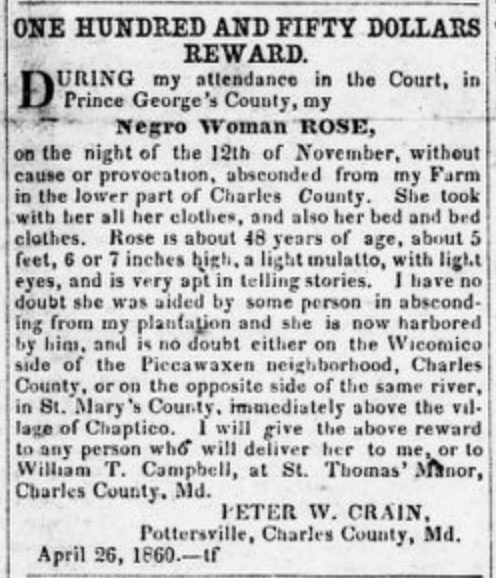
In 1860, Peter W. Crain, a landowner in Charles County, advertised the self-emancipation of Rose, who had fled her captivity on Crain’s farm in lower Charles County. He advertised for her return to his captivity: “I will give the above reward to any person who will deliver her to me, or to William T. Campbell, at St. Thomas’ Manor, Charles County, Md.” [Port Tobacco Times and Charles County Advertiser, May 24, 1860] This suggests that Campbell had the means to “store” Black people while waiting for enslavers. Evidence from Alexandria slave pens other slave trader sites suggests that Campbell had a store with cells and shackles to restrain Rose and others he held captive before selling.
In 1860, William T Campbell is enumerated as enslaving seven people at the time of the census. Among them, a 25 year old female. This age is consistent with Nancy. Campbell did not submit a list to the Commission of Slave Statistics.
Thomas, James, John, and Mary Ellen Reeder were enslaved by Edward S Abell; he listed their names on the enumerated list submitted to the Maryland Commission of “Slave Statistics” in hopes of federal compensation in 1867. He submitted the list as guardian of Sarah and George L Smith.
He documented that they left with the Union Army on the list. He recorded that Thomas left first, in Sept 1862, and that this siblings left in Oct 1863.
In 1860, Edward S Abell was recorded in the census as living in the neighborhood of St. Inigioes with real estate valued at $10,000 and personal estate valued at $15,000. He was married to Ann M. Crane (widow of Lewis Smith), the mother of George L and Sarah S Smith, his wards.
The July 22 1866 edition of the St Mary’s Gazette lists the expenses of the Commissioners for St. Mary’s County and demonstrates Abell’s connection with privilege and power: he was a judge, a trustee for the Poor House and a commissioner on the School Board.
In 1858, Abell advertised for sale a tract of land containing 140 acres near Cedar Point; the tract included the improvements of a dwelling, kitchen, barn, stables, and quarters.
Excerpt from 1873 Atlas of Maryland | davidrumsey.com Map shows District 1 of St. Mary’s County. St. Inigoes PO is in the north half of the District
Hired Out
Abell was required, as guardian to the Smith children, to make accounts to the court for monies received and spent on behalf the children.
In 1864, Abell submitted his “6th Account” for George L Smith and for Sarah Smith. In this account, he recorded the profit received from hiring out John Reeder in 1862.
6th Account Edward S Abell Guardian, George L Smith | familysearch.org6th Account Edward S Abell Guardian Sarah C Smith | familysearch.org
The account does not specify to whom Abell hired out the Reeder children. Abell was able to command a higher price for the male Reeders, James and Thomas ($55), than Mary Ellen ($15).
The economy in St. Mary’s County, while originally based on tobacco, had changed in the antebellum years to also include wheat and therefore milling. Indeed, Thomas Reeder (Sr.), father of the Reeder children, had been enslaved by James L. Foxwell who advertised his new “Foxwell Wheat” in the newspapers.
St. Mary’s Beacon 18 Sep 1962 chroniclingamerica.loc.gov
The geography of St. Mary’s County, i.e., a peninsula situated between the Chesapeake Bay and tidal Potomac River, meant that the maritime industry was also crucial to the economy, including coastal trade and transport as well as fishing and oystering. The men may well have been hired out to a fishery or oysterman. “There is a great deal of evidence that slaved worked seine nets, particularly during spawning runs, and tonged for oysters.” (Marks, 543)
Mary Ellen, due to her gender and race, was likely hired out as a cook, laundrywoman, or domestic servant. As “skilled labor” typically fetched higher rates than “unskilled labor”, it suggests that Mary Ellen was not viewed as “a skilled laborer” by Abell and those who hired her.
1862-1863 Escape
September 1862
Thomas Reeder, age 21, escaped Sunday, 14 Sept 1862. How Thomas Reeder escaped is unknown.
On October 2, 1862, the St. Mary’s Beacon reported that “There has been quite a stampede of ‘contrabands’ from our county during the past two weeks…Most likely, emissaries are amongst us, either itinerant or local, and that gunboats are employed to facilitate escape. Quite a number are reported to be harbored at Point Lookout, by Federal authority and all efforts to recover them have proven futile.” [Chronicling America | loc.gov]
In the same edition of the St. Mary Beacon, the Provost Marshal for St. Mary’s County warned it’s [white] citizens “to lock at night or otherwise secure their BOATS and CANOES of all kinds against probable or possible use of them by deserters,…,fugitive slaves from Maryland”
Thomas Reeder may have travelled to Point Lookout, located on the southern most tip of the peninsula where the federal government had established a hospital on the former grounds of a resort. Abby Hopper Gibbons, a Quaker nurse working at the hospital described in her diary:
“On the same day [Sept 1862], nineteen men and five women came–refugees; and the day after, fourteen men and five women, with some little children. They are making the most of the moonlight nights.”
Abby Hopper Gibbons, p. 373
In the early days of the hospital, the federal authorities were not prepared to provide a safe haven for the refugees who used the hospital as a means of escape from bondage. Gibbons wrote that at the beginning men and women who escaped to the hospital were returned to their enslavers if the enslavers swore an oath of loyalty to the Union (in contrast to the St. Mary’s Beacon article). [Gibbons, page 367]
In mid-1862, the hospital had no means to house the contrabands and a nurse, Sophronia Bucklin, who visited the camp on the edge of the hospital described their shelter in the pine trees north of the hospital:
Amidst the dense, dark pines they burrowed like beasts of the field in half-subterranean dens. A hole from three to four feet deep was dug by them in the black soil, and roofed over with boards, on which turf was closely packed. An opening, which admitted them on their hands and feet, and one for the escape of the smoke, which went up from an exceedingly primitive fireplace, were the only vents for the impure air, and the only openings for light. In these dens men, women and children burrowed all winter
Bucklin, 84
As time passed though, Gibbons described getting more and more refugees on the boats that went north to Washington. It is possible that Thomas was able to get aboard one of the boats to the District.
October 1863
James Reeder, age 19, escaped Saturday, October 17. His brother and sister, John, age 30 and Mary Ellen, age 16, escaped a week and a half later, on Wednesday October 28. Like Thomas, it is likely they made to Point Lookout in search of a boat that would take them north to the District and freedom.
By 1863, the hospital had built barracks for the refugees. The quarters were built near the blacksmith shop and the mechanics quarters, signifying how the hospital and the US Army changed their view of refugees; no longer property to be returned to the enslaver, rather a source of labor for the Army.
Maryland State Archives
Sources
Marks, Bayly E. “Skilled Blacks in Antebellum St. Mary’s County, Maryland.” The Journal of Southern History, vol. 53, no. 4, 1987, pp. 537–64, https://doi.org/10.2307/2208774. Accessed 5 Apr. 2022.
Gibbons, Abby Hopper. Life of Abby Hopper Gibbons: Told Chiefly Through Her Correspondence. United Kingdom, G.P. Putnam’s Sons, 1896. accessed from Google Books
Bucklin, Sophronia E.. In Hospital and Camp: A Woman’s Record of Thrilling Incidents Among the Wounded in the Late War. United States, J.E. Potter, 1869. accessed from Google Books




















 stories of Then