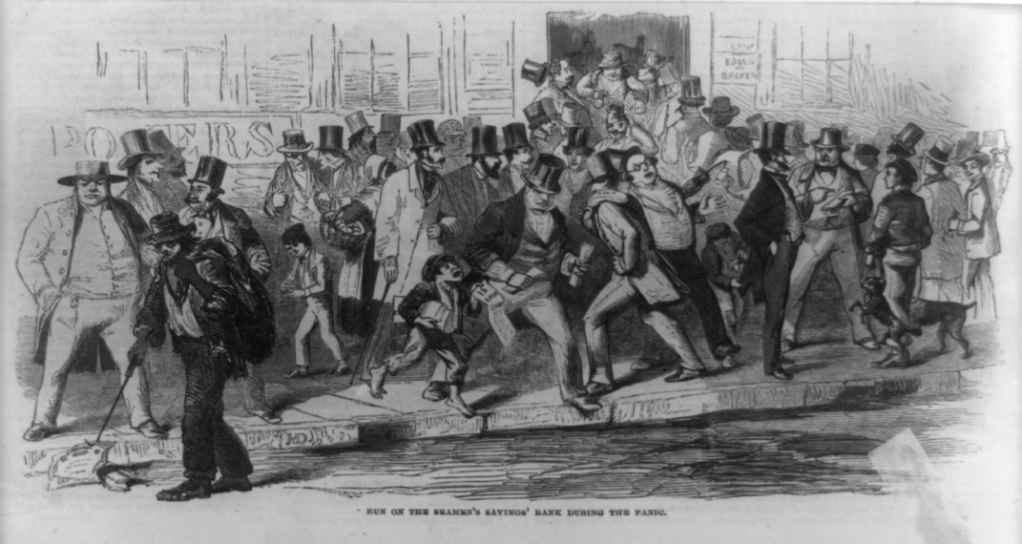
planter panic of 1857

An illustration depicting a chaotic scene outside a bank during a financial panic, featuring men in top hats and various individuals in distress.
“Run on the Seamen’s Savings’ Bank during the panic.” Illustration from Harper’s Weekly, August 11, 1857. As published on CultureNOW in “Panic of 1857.” Accessed July 5, 2025. https://culturenow.org/site/panic-of-1857/preview/74e9e4cf-1bce-4fe9-8459-72751b88269c.

a man Undone

merchant of queen anne

William B. Harwood operated as a merchant in Queen Anne on the Patuxent River during the 1850s. The 1850 census enumerated his household, including a wife and child, and recorded his modest real estate valued at $1,200, likely a town lot and store. An 1852 Bill of Sale documents his role as a purveyor to the local planter class, detailing a substantial sale to Haswell Magruder of dry goods, spirits, groceries, and 1,000 cigars. Yet, by 1857, Harwood was insolvent, unable to pay his creditors.

An 1857 insolvency notice for William B. Harwood, detailing his application to the Prince George's County Circuit Court for relief from debts.
Transcription of Insolvent Notice

INSOLVENT NOTICE.

PRINCE GEORGE’S COUNTY, TO WIT:

ON application to the subscriber, Judge of the Circuit Court for Prince George’s County by petition in writing of WILLIAM B. HARWOOD, of said county, stating that he is in insolvent circumstances and unable to pay his debts, and praying for the benefit of the act of the General Assembly of Maryland, entitled “An act for the relief of insolvent debtors,” passed at January session, eighteen hundred and fifty-four, on the terms therein mentioned, a schedule of his property and a list of his creditors on oath, as far as he can ascertain the same, being annexed to his petition; and the said WILLIAM B. HARWOOD, having taken the oath by the said act prescribed, for the delivering up of his property, and given sufficient security for his personal appearance at the Circuit Court for Prince George’s County to answer such interrogatories and allegations as may be made against him; and the said WILLIAM B. HARWOOD, having further made oath, that he has not, at any time, sold, lessened, transferred or disposed of any part of his property, for the use and benefit of any person or entrusted any part of his money or other property, debts, rights or claims, thereby to delay or defraud his creditors or any of them, or to secure the same, so as to receive or expect to receive any profit, benefit or advantage himself therefrom; and having appointed JAMES M. BOYD his Trustee, who has given bond as such, and received from the said WILLIAM B. HARWOOD a conveyance and possession of all his property, real, personal and mixed—I do hereby order and adjudge that the said WILLIAM B. HARWOOD be discharged; and that he give notice to his creditors by causing a copy of this order to be inserted in some newspaper published in Prince George’s County, once a week for three consecutive months, before the next November Term of said Circuit Court, to appear before the said Circuit Court, at the Court House of said County at the said Term, to show cause if any they have, why the said William B. Harwood should not have the benefit of said act as prayed.

Given under my hand this eighth day of June, in the year of our Lord one thousand eight hundred and fifty-seven.

PETER W. CRAIN.

True copy—Test: CHARLES S. MIDDLETON, Clerk.

June 10, 1857—3t [Planters’ Advocate]

Despite his established business, the economic pressures that precipitated the Panic of 1857 proved insurmountable. The panic was fanned by overspeculation, falling grain prices after the Crimean War, and tightening credit. Harwood, a merchant in Queen Anne, would have been reliant on credit and the local farmers ability to pay their bills. Falling crop prices and credit crisis would have crushed his ability to navigate the market, leading to his unpaid debts. By June 1857, Harwood petitioned the Circuit Court, declaring himself insolvent and unable to pay his creditors.

Map depicting the locations related to William B. Harwood and James M. Boyd in Queen Anne County.
Queen Anne District from 1861 Martenet Map

a trustee’s ledger: seizing a merchant’s accounts

The court appointed James M. Boyd to act as trustee for Harwood’s accounts. Boyd was a landholder whose 160-acre farm, part of the tract “Ample Grange,” was situated about two miles north of Queen Anne Town. His property holdings, which included a tobacco house, corn house, granary, and “quarters for servants,” marked him as a successful small yeoman, a class of farmer holding between 40 and 280 acres. The scale of his diversified operation placed him at the upper end of this group, a man of sufficient standing and perceived stability to be entrusted by the court with the assets of a failed peer.

The legal process of insolvency, while offering relief from creditors, stripped Harwood of his economic autonomy and subjected his actions to the scrutiny of both the court and his community. The oath he swore—that he had not hidden assets to “delay or defraud his creditors”—would soon become a focal point of conflict. Within months, accusations would surface that directly challenged this sworn statement, moving the conflict from the formal setting of the courthouse to the arena of public opinion and vigilante action, where the planter network sought to enforce its own economic and social order.

the underground economy

an Economy within an economy: the m.s. plummer notice

M. S. Plummer was a large planter whose estate on the border of Queen Anne and Marlboro District was home to the hundreds of people he enslaved. His real estate was valued at $120,000 and his personal property $500,000 in the 1860 census, speaking to his wealth acquired from the labor of the people enslaved on his estates. The heir of William Wells of George and married into the Waring family of Mt. Pleasant, M. S. Plummer was established among the large planter class.

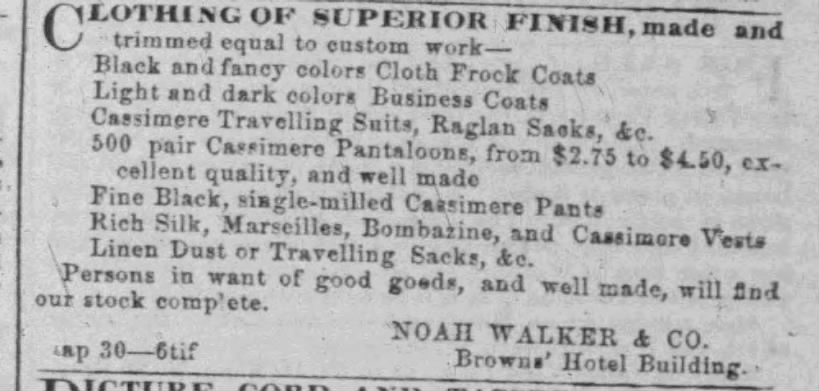
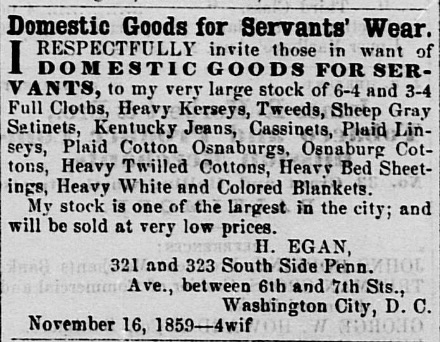
In July 1857, just months before the official start of a national financial panic, an unknown thief entered a cabin within the quarters on Plummer’s estate and stole clothing belonging to the enslaved occupants. The stolen items—including cassimere pants, a flowered vest, and lawn dresses—were not the rough, utilitarian workwear of tweed or osnaburg issued to field hands. Instead, they were fashionable, ready-made garments that, along with the five dollars also taken, point to the owners’ participation in the internal economy of the enslaved.

This underground economy was essential for survival and for carving out a space for self-expression. Through activities outside their forced labor, enslaved people generated income that allowed them to supplement the meager provisions provided by enslavers. They completed “overwork” tasks, sold produce from their garden plots, marketed handmade goods like baskets, and sometimes hired out their own time on Sundays or holidays. The resulting income enabled them to purchase goods from merchants or peddlers, trade for different foods, and acquire clothing that reflected their own tastes and style.

Advertisement for stolen clothes and notice to neighborhood about "free negores, mulattos, and slaves" from crossing the farm of M. S. Plummer
Transcription of Advertisement and Notice

$50 Reward.

I WILL give a reward of FIFTY DOLLARS for the apprehension and conviction of the rogue or rogues who entered one of my quarters on Thursday morning, the 9th instant, between ten and eleven o’clock, and took therefrom the following articles:

1 pair blue cassimere Pants, 1 black summer cloth Coat, 1 white Skirt, 1 white Vest with blue flower, 1 pair Shoes, with brass tacks, 1 blue lawn Dress, 1 pink lawn Dress. Also—Five Dollars in money.

And I also forewarn all free negroes, mulattos or slaves from Anne Arundel or Prince George’s Counties from crossing over or through my farm, either day or night, Sunday or any other time, without permission of myself or my overseers; and I will give TEN DOLLARS reward for the apprehension of every free negro or mulatto caught so trespassing.

I will give TWENTY DOLLARS reward for the conviction of any person or persons who deal with or purchase hogs, shoats, pigs, lambs, meal, fish or bacon from any of my servants, or who purchase such articles from others, stolen from my farm. And I will also give a liberal reward for any information that will lead to such conviction.

M. S. PLUMMER.

July 15, 1857—tf
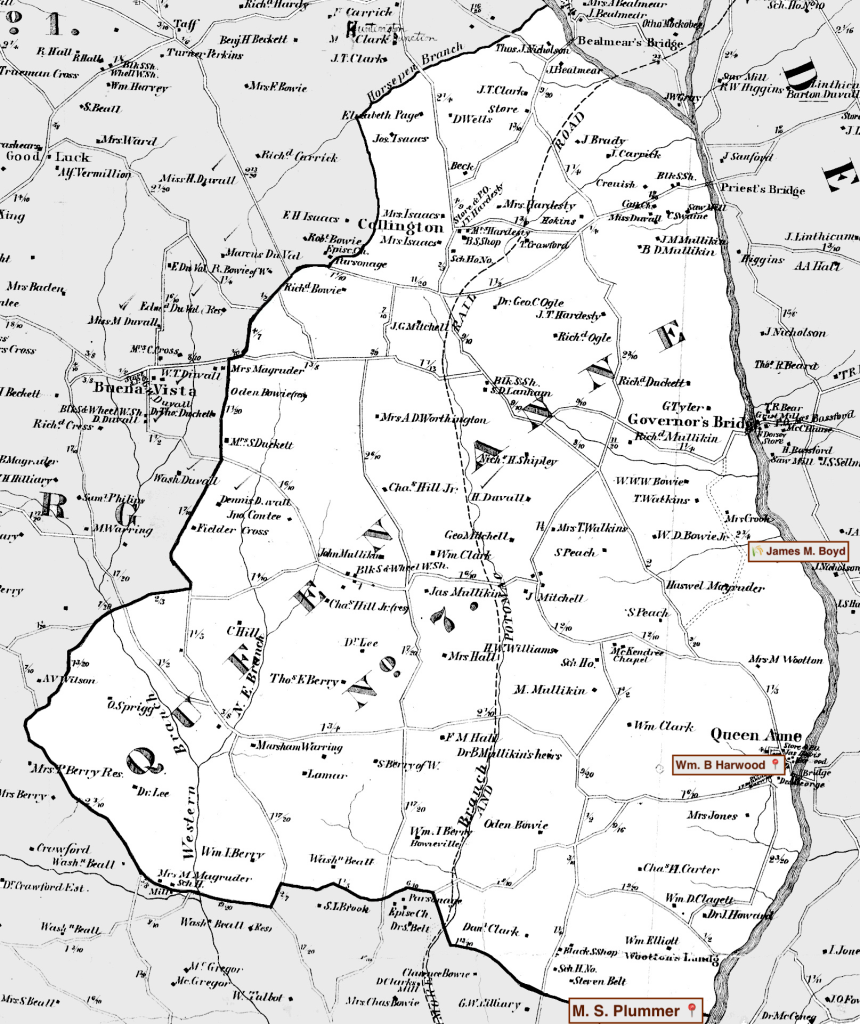
A historical map showing locations associated with William B. Harwood, James M. Boyd, and M. S. Plummer in Queen Anne and surrounding areas.
Queen Anne District from 1861 Martenet Map
Clothing Advertisements and Sketch of Enslaved People
A newspaper advertisement promoting various dry goods for sale, including dresses, handkerchiefs, ribbons, and fabrics, emphasizing low prices and variety.
Richmond Dispatch, 1857
Advertisement for clothing showcasing various items like cloth frock coats, cassimere suits, and pants, highlighting quality and prices.
Daily National Intelligencer and Washington Express 1857
Advertisement for Domestic Goods for Servants' Weart including kerseys, tweeds, jeans, cassinets, etc.
Planters’ Advocate, 1859
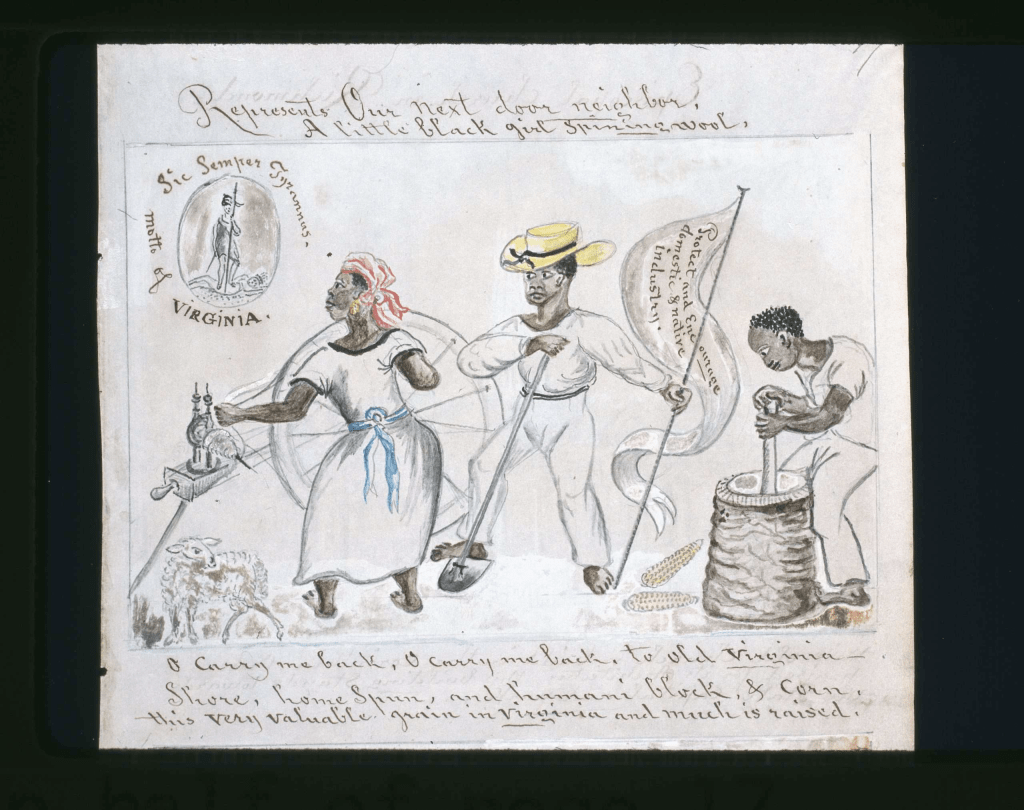
A historical illustration depicting three individuals engaged in agricultural work, highlighting aspects of labor and the home economy in Virginia. The figures are shown spinning wool, grinding corn, and using traditional tools, symbolizing the hard work and industry of the time by enslaved people
Miller, Lewis. Represents Our next door neighbor. Mid-nineteenth century. Watercolor and ink on paper. The Abby Aldrich Rockefeller Folk Art Museum, The Colonial Williamsburg Foundation, Williamsburg, VA. As published in Encyclopedia Virginia. Accessed July 6, 2025. https://encyclopediavirginia.org/4118hpr-00ee78908746584/.

Plummer’s notice sought more than the return of the stolen articles; it was a comprehensive effort to sever the networks that sustained the enslaved community. He issued a strict prohibition against Black people—enslaved or free—traversing his extensive estates, not only during the day but specifically at night and on Sundays, the very periods that allowed for a greater freedom of movement and social interaction. This clampdown on physical movement was directly linked to a more critical prohibition against economic exchange. By offering a reward for the conviction of anyone who purchased goods from his “servants,” Plummer attempted to dismantle the underground economy itself, denying the enslaved community the ability to profit from their own production and to exercise consumer choice.

opportunity knocks at the Quarters’ door

By publishing his notice in the Planters’ Advocate—a newspaper that served the interests of Prince George’s County’s white society with its advertisements for runaway enslaved people, trustee sales, and plantation managers—M.S. Plummer did more than just report a theft. He publicly drew a line against the local underground economy, threatening conviction for “any person or persons” who dared to purchase goods from the people he enslaved. This public ultimatum raises a critical question: who in the community would risk social condemnation and legal trouble by engaging in this forbidden trade? The circumstances of William B. Harwood, a merchant residing just a few miles away in Queen Anne Town, present a compelling answer. Declared insolvent just one month prior, his legitimate business shuttered and his assets seized by a trustee, Harwood possessed both the motive of financial desperation and the commercial skills of a merchant, making him an ideal candidate to operate within this illicit, cash-based market.

Although no single document provides direct evidence of William B. Harwood’s participation in the underground economy, a powerful case can be built from the convergence of his financial ruin and his social position. The 1850 census is a critical source, recording him not only as a merchant in Queen Anne but also as the head of a household that included the Coursey family, a free Black family. This long-standing association could have provided Harwood with a level of access and familiarity within the broader Black community—both free and enslaved. When his formal business collapsed in 1857, this pre-existing social network, combined with his skills as a merchant, would have made him an accessible and logical, if illicit, trading partner.

1850 Census for Queen Anne District, Prince George’s County, ancestry.com

panic ignited

A historical map highlighting locations in Montgomery County, Maryland, including Queen Anne, Bladensburg, and notable landmarks with labeled names.
Northern part of Prince George’s County from 1861 Martenet Map

While Plummer was attempting to control the economic activities of the Black community, local enslavers were fearing the escape of their “valuable servants” through the Underground Railroad, often blaming “outside agitators.” Two attempts at self-emancipation from the summer of 1857 highlight this conflict between the enslavers’ public narrative and the reality of enslaved resistance.

The first event was the coordinated escape of two enslaved women, Mary (Molly) Adams and Lucy, from Owen Carroll’s property, and two enslaved men, Anthony and Nat Butler, from a neighboring enslaver. The two news artifacts detailing this escape present conflicting stories. An article in the Planters’ Advocate frames the event as an abduction by a white Northerner, portraying the actions of a vigilante “committee of citizens” not as extra-legal intimidation but as a decorous civic procedure. This sanitized version stands in stark contrast to the reward notice placed by the enslavers. The bounty ad’s detailed descriptions of Lucy’s “intelligent countenance” and the men’s worldliness—Anthony having been hired out for years and Nat Butler being a prior runaway familiar with Washington and Georgetown—point to a group of capable, knowledgeable individuals. The joint escape of Mary, Lucy, Anthony, and Nat Butler suggests a carefully planned operation, undermining the paternalistic propaganda of the Planters’ Advocate, which sought to erase the agency of the self-liberating individuals by portraying them as guileless “servants.”
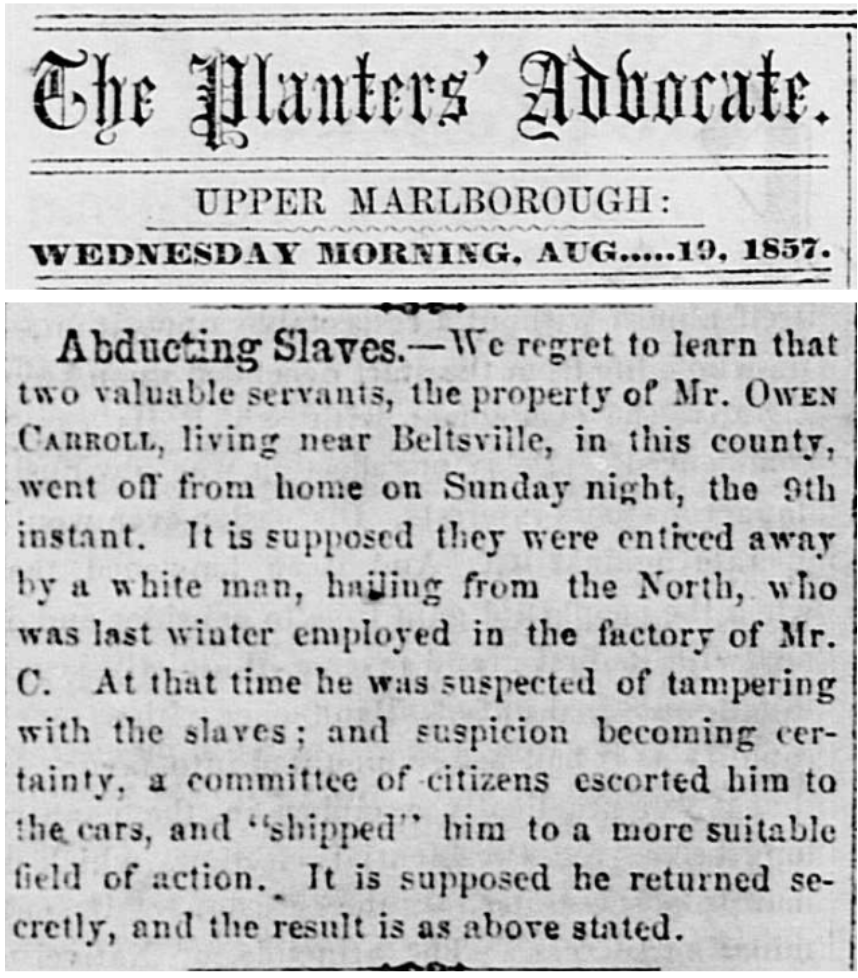
“Abducting Slaves.” The Planters’ Advocate [Upper Marlborough, MD], 19 Aug. 1857. MSA
Transcription of “Abducting Slaves”

Abducting Slaves.—We regret to learn that two valuable servants, the property of Mr. OWEN CARROLL, living near Beltsville, in this county, went off from home on Sunday night, the 9th instant. It is supposed they were enticed away by a white man, hailing from the North, who was last winter employed in the factory of Mr. C. At that time he was suspected of tampering with the slaves; and suspicion becoming certainty, a committee of citizens escorted him to the cars, and “shipped” him to a more suitable field of action. It is supposed he returned secretly, and the result is as above stated.
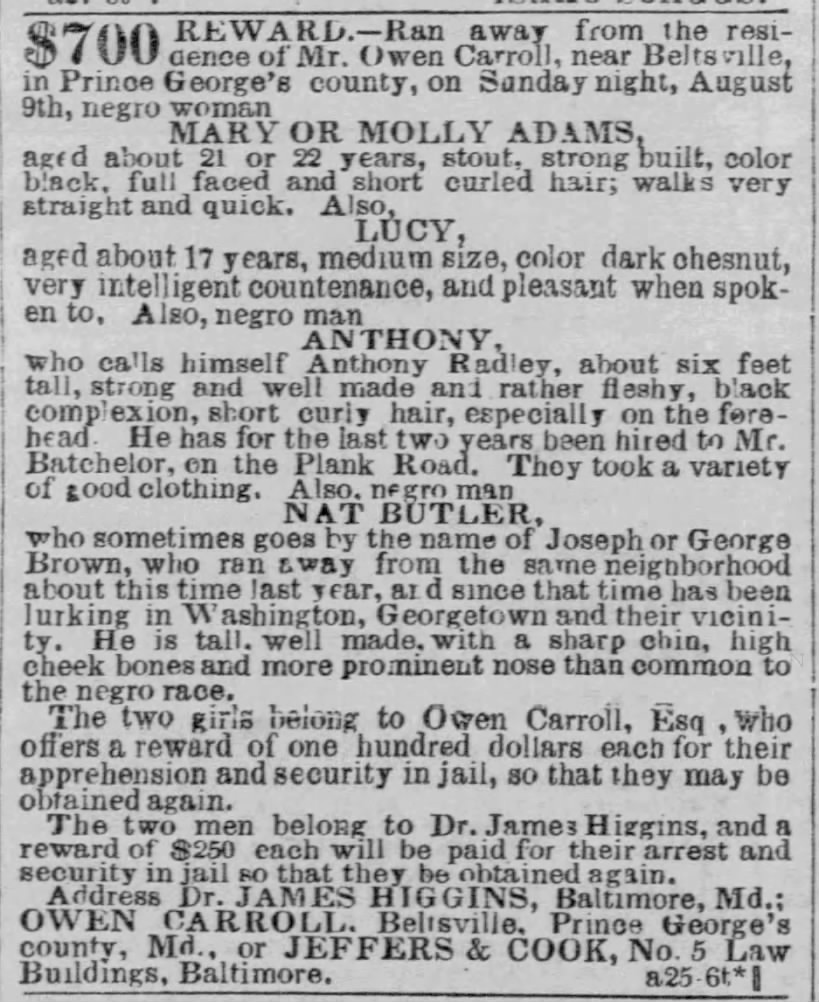
“$700 REWARD,” The Baltimore Sun (Baltimore, MD), August 29, 1857, 3.
Transcription of Bounty for Freedom Seekers

$700 REWARD.—Ran away from the residence of Mr. Owen Carroll, near Beltsville, in Prince George’s county, on Sunday night, August 9th, negro woman
MARY OR MOLLY ADAMS,
aged about 21 or 22 years, stout, strong built, color black, full faced and short curled hair; walks very straight and quick. Also,
LUCY,
aged about 17 years, medium size, color dark chesnut, very intelligent countenance, and pleasant when spoken to. Also, negro man
ANTHONY,
who calls himself Anthony Radley, about six feet tall, strong and well made and rather fleshy, black complexion, short curly hair, especially on the forehead. He has for the last two years been hired to Mr. Batchelor, on the Plank Road. They took a variety of good clothing. Also, negro man
NAT BUTLER,
who sometimes goes by the name of Joseph or George Brown, who ran away from the same neighborhood about this time last year, and since that time has been lurking in Washington, Georgetown and their vicinity. He is tall, well made, with a sharp chin, high cheek bones and more prominent nose than common to the negro race.

The two girls belong to Owen Carroll, Esq., who offers a reward of one hundred dollars each for their apprehension and security in jail, so that they may be obtained again.

The two men belong to Dr. James Higgins, and a reward of $250 each will be paid for their arrest and security in jail so that they be obtained again.

Address DR. JAMES HIGGINS, Baltimore, Md.; OWEN CARROLL, Beltsville, Prince George’s county, Md., or JEFFERS & COOK, No. 5 Law Buildings, Baltimore.
a25-6t*

The second escape occurred in the same relative vicinity, involving a family from the farm of Isaac Scaggs. A series of articles and runaway ads describe the flight and subsequent recapture of Maria and her four children: Dall, Lem, Bill, and Ben. An initial report describes their escape as part of a larger “Stampede of Slaves,” noting the clear evidence of coordination as they acquired a wagon under the pretense of attending a camp meeting. Another article speculated they were seen on a canal boat near Cumberland, Maryland, suggesting they were using the C&O Canal to make their way north.

The bounty ads Scaggs placed, however, reveal a more intimate and courageous story. Adam Smith first self-liberated with the larger group, then risked his newfound freedom by returning to Scaggs’s farm to help his partner, Maria, and their four children escape with him. After the family was recaptured, Scaggs’s narrative shifted. He claimed in the press that a “would-be friend” had actually abducted them, intending to sell them into the domestic slave trade through a slave “pen” in Alexandria. This story, which contradicted earlier reports of an Underground Railroad escape, served to delegitimize abolitionist aid. As a final act of control, Scaggs had the newspapers publish Maria’s coerced “script of penitence.” Her forced expression of gratitude towards her enslaver was a calculated mode of survival, likely performed to ensure she and her children would not be sold South as punishment for their bid for freedom.

A post-emancipation record offers a final, telling chapter to the family’s story. In the Slave Statistics submitted by enslavers for potential compensation, Isaac Scaggs listed the people he held in bondage as of November 1, 1864, the date of Maryland’s emancipation. On that list were the four children: Dal (spelled Dall in the 1857 notice), Lem, Bill, and Ben.

Maria, their mother, was absent.

Her absence from the record points to one of two likely, and equally tragic, outcomes. It is possible that between 1857 and 1864, Maria made another, successful bid for freedom, a choice that would have required the devastating sacrifice of leaving her children behind. Alternatively, Scaggs may have made good on the implicit threat in the recapture notice, selling Maria to the domestic slave trade as a final act of retribution for her agency in the 1857 escape. Regardless of the specific path, the official record confirms the family unit was violently and permanently broken before emancipation arrived.

“STAMPEDE OF SLAVES.” Evening Star [Washington, D.C.], 25 Aug. 1857, p. 3.
newspapers.com
Transcription of Stampede of Slaves

STAMPEDE OF SLAVES.—On Saturday, a number of slaves, belonging to various citizens of the District, obtained a covered wagon, under pretence of going to the camp meeting in the adjoining county. They departed, but have not returned, and their owners have reason to believe that they have emigrated by the underground railroad. Some fifteen slaves are missing, most of them belonging in this city and county. Among the losers are Messrs. Linton, Randolph, Harbaugh, and Isaac Scaggs. Officers have been in search of the fugitives, but up to this time none have been recovered.

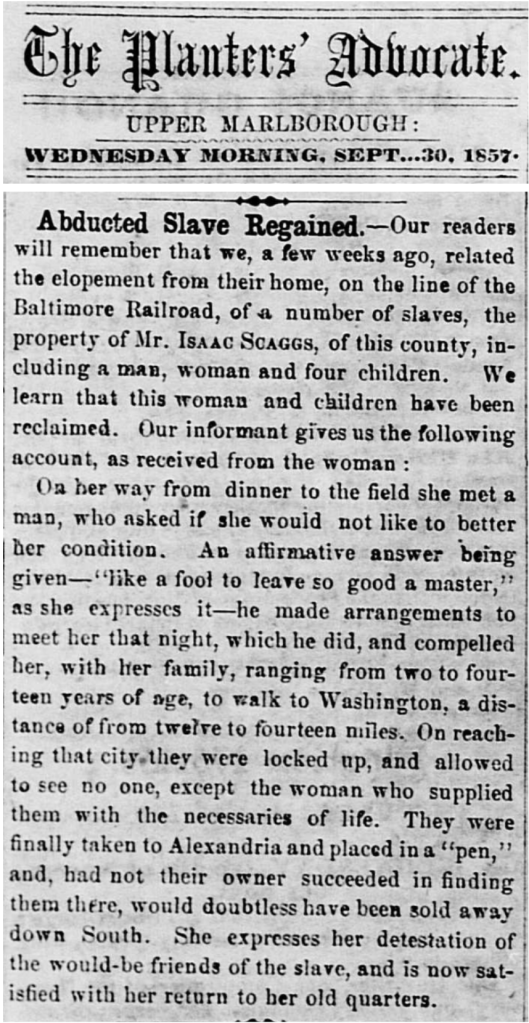
Transcription of Abducted Slave Regained

Abducted Slave Regained.—Our readers will remember that we, a few weeks ago, related the elopement from their home, on the line of the Baltimore Railroad, of a number of slaves, the property of Mr. ISAAC SCAGGS, of this county, including a man, woman and four children. We learn that this woman and children have been reclaimed. Our informant gives us the following account, as received from the woman:

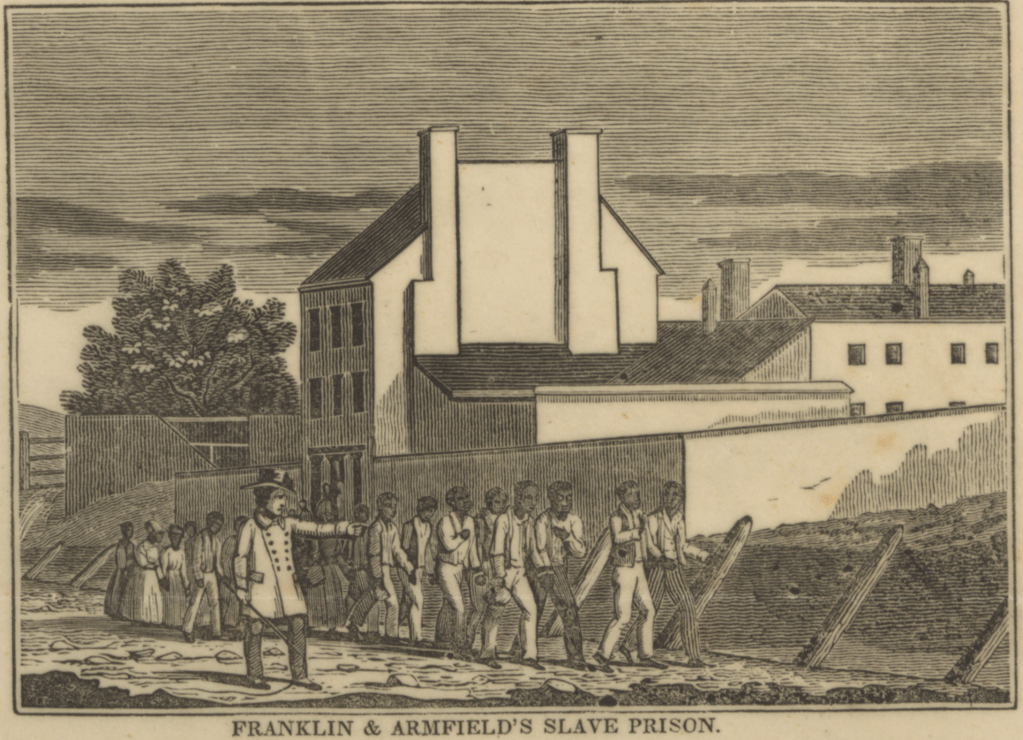
On her way from dinner to the field she met a man, who asked if she would not like to better her condition. An affirmative answer being given—“like a fool to leave so good a master,” as she expresses it—he made arrangements to meet her that night, which he did, and compelled her, with her family, ranging from two to fourteen years of age, to walk to Washington, a distance of from twelve to fourteen miles. On reaching that city they were locked up, and allowed to see no one, except the woman who supplied them with the necessaries of life. They were finally taken to Alexandria and placed in a “pen,” and, had not their owner succeeded in finding them there, would doubtless have been sold away down South. She expresses her detestation of the would-be friends of the slave, and is now satisfied with her return to her old quarters.
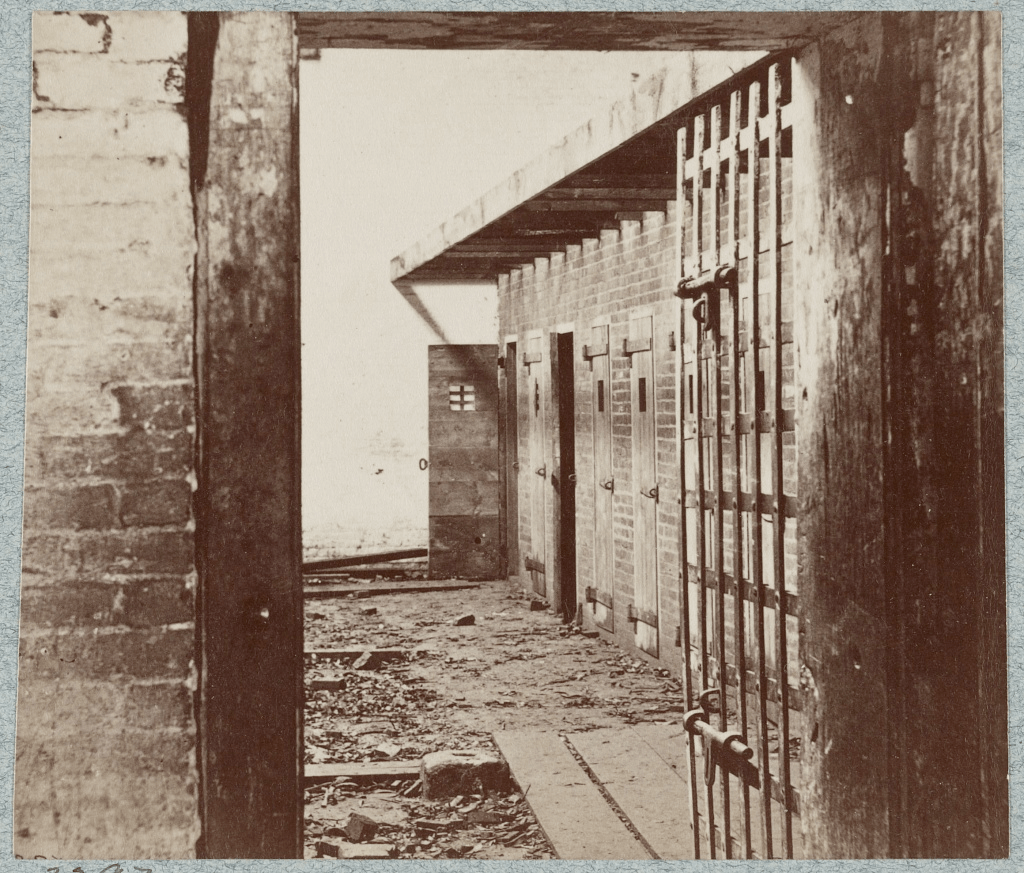
Interior view of a historical slave pen with barred doors and brick walls, showcasing empty cells
Slave pen, Alexandria, Va. Virginia Alexandria United States, None. [Photographed between 1861 and 1865, printed between 1880 and 1889] Photograph. https://www.loc.gov/item/2013651888/.
An engraving of Franklin and Armfield's slave prison, featuring enslaved individuals being marched past a large building with multiple stories and a walled enclosure.
American Anti-Slavery Society. Slave market of America. New York: Published by the American Anti-Slavery Society, 1836. Broadside. Library of Congress, Rare Book and Special Collections Division, Washington, D.C. Accessed July 6, 2025. https://www.loc.gov/pictures/item/2008661294/.

exorcism

illusion of Justice and Mercy

These events shook the established sense of security in Queen Anne District, creating a panic to rival the Panic of 1857. Not only was the global market in crisis, imperiling the sale of the planters’ cash crops, but Harwood’s insolvency was a stark reminder of the crisis that beheld the perilous role of credit in the lives of American capitalists. Moreover, agitators, decoys and the Underground Railroad was stealing the planters’ most valuable assets: the people they enslaved. This double threat to the financial security of planters required them to convene and establish a response to the threats to their security.

The planters of Queen Anne District, roiled by the recent events, met as a committee of citizens and as such, resolved that William B. Harwood, disgraced merchant, be expelled from Queen Anne for his “illegal trafficking with negroes” — the phrase “trafficking with negroes” could refer to the trafficking of stolen goods, warned about by M. S. Plummer, or could refer to the trafficking of stolen people, warned about by Isaac Scaggs. In either situation, the “most respectable and intelligent farmers and slaveholders of that section” acted outside of a legal court proceeding and as a self-appointed vigilance committee. By framing their meeting as a consideration of “matters appertaining to their interests,” they were asserting their collective power to define and enforce the social and economic rules of the community.

Occurring in the midst of a national financial panic and after a summer of high-profile escapes, the expulsion of William B. Harwood was the culmination of multiple crises. He was the perfect scapegoat: a failed merchant with a history of violating social norms. The “Notice to Quit” was the planter community’s definitive response, an act of vigilantism that purged a man they saw as a threat to their economic interests, their social order, and the institution of slavery itself.
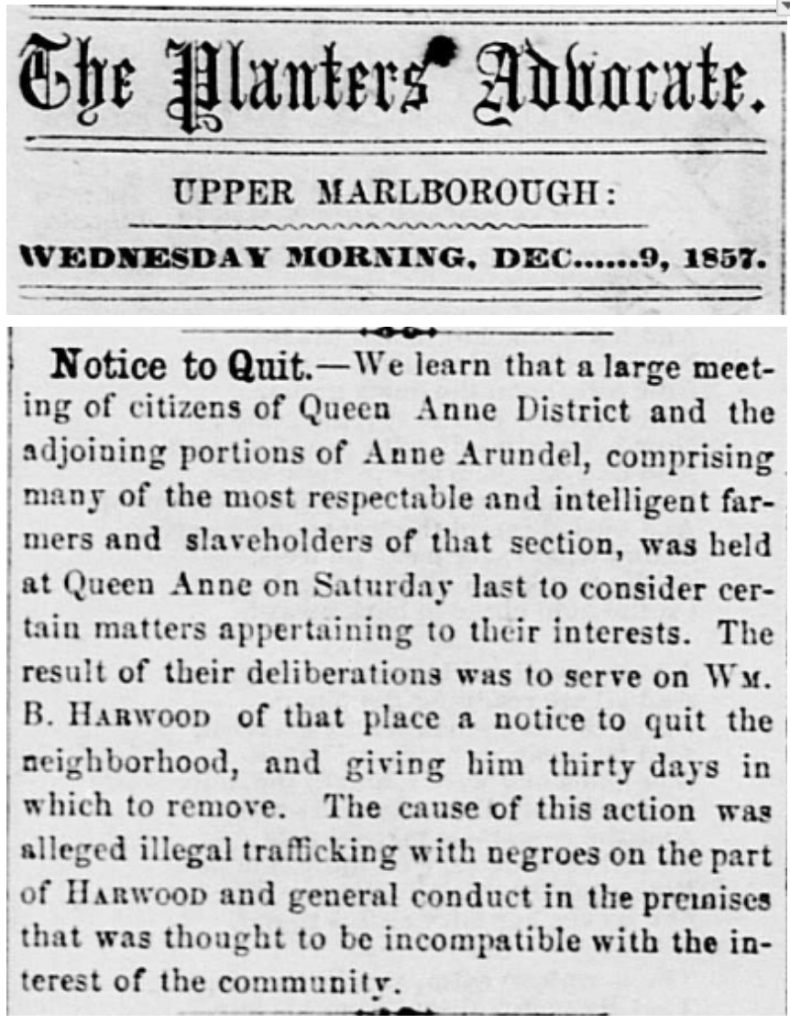
“Notice to Quit,” The Planters’ Advocate (Upper Marlborough, MD), December 9, 1857.
Transcription of “Notice to Quit”

**Notice to Quit.—**We learn that a large meeting of citizens of Queen Anne District and the adjoining portions of Anne Arundel, comprising many of the most respectable and intelligent farmers and slaveholders of that section, was held at Queen Anne on Saturday last to consider certain matters appertaining to their interests. The result of their resolutions was to serve on WM. B. HARWOOD of that place a notice to quit the neighborhood, and giving him thirty days in which to remove. The cause of this action was alleged illegal trafficking with negroes on the part of HARWOOD and general conduct in the premises that was thought to be incompatible with the interest of the community.


Nancy Fletcher | Widowhood

James Stewart (Jr) and his wife, Ann (Nancy) Fletcher, liberated themselves during the Civil War from their enslavement in Prince George’s County. Nancy was enslaved by Marsham Waring and his heirs, while her husband was enslaved by Waring’s brother-in-law, Benjamin Lee. Both Waring and Lee were large landowners along the Western Branch in Queen Anne District. 

Following the abolition of slavery in the District of Columbia in 1862, neighboring enslaved individuals seized an opportunity for freedom. Despite monitored roads and patrols, many fled their bondage and headed toward the District. Barbara Jeanne Fields highlighted in her book, Slavery and Freedom on the Middle Ground that “Many an ex-fugitive later reported having left Maryland for the District during or after the spring of 1862. Families packed up such of their possessions as could be compactly assembled and departed, sometimes appropriating means of transportation from their owners.” (111)

Camps emerged in and around the District to accommodate these incoming refugees from slavery. One such camp, Camp Springdale, comprised of tents on the grounds of the “Arlington Estate,” owned by Robert E. Lee’s wife. James and Nancy Stewart were recorded as residents of Camp Springdale in 1864 along with their three children: John (Henson), George (Anthony), and Frances. During this time, Nancy was a new mother, taking care of her infant daughter and her older sons. 

Freedmans village–Greene Heights Arlington, VA. | loc.gov

James and Nancy survived the war with their sons. After the war, they are living in the District, as recorded by the 1870 Census. Living in Ward 5, James is working as a scavenger while Nancy is “keeping house”. Scavenger is a euphemism, like night-soil man, for a person who collected human waste from households and transported the waste away from residential areas. The Evening Star reported in 1869, that because there was no designated place for depositing the “night soil”, it was dumped into the Potomac, the Tiber creek and the Canal. 

The 1870 Census did not record addresses or street names (like in later census records), however, by comparing names in the Census to the City Directories, a more precise location can be determined. The Stewart Family is enumerated immediately after Benton Russ, a guard at the Jail; in the City Directory, Benton Russ is recorded as living at 2d and A NE, near the location of another refugee camp, Duff’s Green Row. 

By 1880, the family appears to have been split up by economic necessity. Three separate census records have been identified that appear to represent the family based on the geographic proximity to their 1870 address of 2d and A NE. Nancy is living at 107 2nd NE while Ella and John Henson are working as servants at nearby addresses.  George Anthony has yet to be found. 

Nancy Stewart is enumerated in her household, a widow. Ella, age 12, is working as a servant at 18 2nd Street NE in the household of Isaac Bassett, a doorman at the Capitol Building. Both addresses are clustered around the intersection of A St NE and 2nd St NE.

(John) Henson Stewart is working in the household of Mary J Wheeler, who lived at 136 Pennsylvania Ave SE, which was at the the intersection of Independence Ave SE (then B St SE) and 2nd St SE. Essentially, Nancy and Ella lived by the Supreme Court and John Henson Stewart lived by the Library of Congress, a few short blocks away with East Capitol Street separating them. 

On the other hand, George (Anthony) is much more elusive. George Stewart was a common name and several men with the name were working as servants in city; none were near George Anthony’s family members. In 1885, a city directory entry records Anthony Steward living as a laborer at Bassett Alley NE, which is one block north of where Nancy Stewart was living in 1880. 

By 1900, Nancy Stewart has moved east of Lincoln Park and is living at 15 Fitzhugh Court, SE with her two sons: John and George A. She is living with Mary Jones, who is listed as her sister in the census record. 

Although the census lists inaccurate ages for them, shaving decades off of their ages, the address aligns with other records that suggest the high probability that this is the same family. The following records support this connection:

  1. 1907 City Directory entry for Nancy Stewart, wid. James, residing at 15 Fitzugh Court SE
  2. 1910 Census Entry for Nancy Stewart and John at 15 Fitzhugh Court, the age of Nancy is 71, aligning more closely with previous records. 
  3. 1919 Death Record for a widowed Nancy Stewart living at 15 Fitzhugh Court, with burial in Mt. Olivet, a Catholic Cemetery

Jane Colbert | Kendall Green

In May 1862, shortly after the emancipation of enslaved people in the District of Columbia, a large groups of enslaved people made their way to the District in order to be free. The newspapers are filled with reports with descriptions of men carrying and baggage from Loudoun County, Virginia, and armed groups coming for the District carrying weapons. On May 7, 1862, the Evening Star reported “the first arrests under the emancipation law were made this morning” when police arrested “two slaves who had run away from their masters in Prince George’s County, were on their way to the city and had crossed the District Line”.

Jane Colbert‘s husband, Daniel Colbert (Calvert) was named in affidavit seeking his return by James Waring, along with others from his estates. The people named, like Daniel had wives and partners living on other estates who were not named, and were likely part of the group that sough freedom in the district.

Their marriage was recorded by agents working for the Freedmen’s Bureau in 1867. They noted along with hundreds of other freedmen marriages and partnerships. Daniel Colbert and Jane Dorsey were married in 1859 by a Jesuit Priest named Bague and had two children. In 1862, 5 months prior to their escape, they had their son, George W Colbert, baptized by the Jesuits at White Marsh.

Daniel Calvert was most likely born enslaved to Marsham Waring in Prince George’s County, the son of George Calvert and Amelia Jones.  He was enslaved on Waring’s Chelsea estate and while Jane Dorsey was likely enslaved by the Hall family on their nearby estate.  Both slaveholding families were Catholic and multiple people they enslaved were married by Jesuit Priests and had their children baptized.


On 20 January 1868, “Jane Colbert” is recorded in the Freedmen’s Bureau records as living in the Kendall Green Barracks and receiving supplies.  Her age and relationship to others is not noted in the document.  The Barracks had suffered a fire in mid January, as reported by the Daily Morning Chronicle. 

The names Mary Dorsey and Malvina Jones are also recorded on the list, suggesting the possibility that there may be a connection between Jane Colbert and the larger Calvert-Dorsey-Jones kin group. While Mary Dorsey has an extremely common given name, Malvina is a more unusual given name and may be used to show a connection between the individuals at Kendall Green and the kin group. 

Malvina Jones, age 34, was claimed by Miss Mary Cornelia Wilson, the daughter of Joseph H. Wilson,  in the 1867 Compensation Lists.  The Wilsons owned land near Marsham Waring, who enslaved Daniel Calvert.  Waring and Wilson enslaved other people who partnered, e.g., John Woodward and Sallie Jones.  

Two children of Malvina Jones were baptized in the 1850s. In 1854, Cornelia “Johns”, daughter of Will. Johns and Livana “Ahlens”, “property of Jos. Wilson”, was baptized by the priests of White Marsh.  In 1859, Richard Jones, son of William and Livinia Jones, was baptized by the priests of White Marsh; no enslaver was noted.  William Jones, named in the baptismal records, is a brother of Amelia Jones, Daniel Colbert’s sister. 

Like Daniel, Waring listed him in the 1862 affidavit. In 1864, William Jones, age 45, is listed in the Freedmen’s Bureau Records as a refugee from Prince George’s County living in Camp Springfield with multiple other names from the 1862 affidavit.  In 1870, William Jones and his wife Malvina Jones were enumerated living in Ward 6, which is on the eastern side of the City near Kendall Green.  While the 1870 Census does not lists specific street addresses, the Jones family was enumerated at DN 1533; Ignatius Tabbs was enumerated at 1538 and was also listed in the 1871 City Directory as living at 324 15th NE, near Howard’s Row and Tennessee Avenue.  This connects with an 1872 address for Daniel Colbert. Daniel Colbert is listed in the City Directory (66 Howard’s Row NE), living close to William and Malvina Jones’ inferred address.  Daniel Calvert is not listed in the 1870 census in their neighborhood.  

Both Sallie Jones Woodward and William Jones are inferred siblings of Amelia Jones, the mother of Daniel Calvert and were enslaved by the Warings, like Daniel.  The presence of both Malvina Jones and Jane Colbert on the same list suggests that Jane may be Daniel Calvert’s partner, and suggesting that she too escaped to DC.


Patrick Stewart of Seat Pleasant


See “the many Patrick Stewarts” for the introduction to why this post was written.


Patrick Stewart of the Marsham Waring Inventory was 40 years old with an estimated birth year of 1820. Patrick Stewart of Seat Pleasant was 37 in the 1870 census, with an estimated birth year of 1833. It seems unlikely that they are the same Patrick Stewart. And as Patrick Stewart of Seat Pleasant is followed through the census records, it becomes even more unlikely that he is the Patrick Stewart of the Marsham Waring Inventory. In 1880, he was listed at 40, which shifted his birth year from 1833, to 1840, two decades after the Patrick Stewart of the Inventory was born; the same for the 1900 census, where he was listed as 60, making his birth year around 1840.

After Emancipation

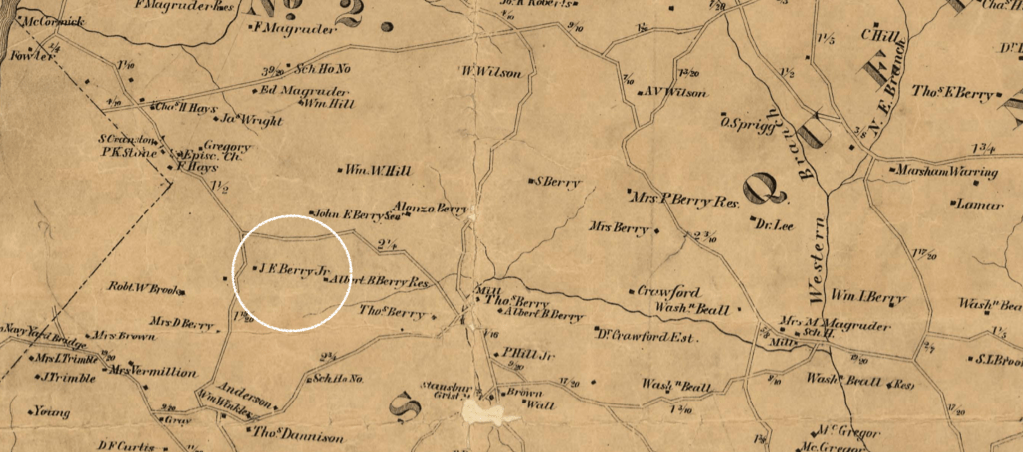
In the 1870 US Census, Patrick Stewart and his wife, Lidia, are living near John E. Berry, the son of Dr. John E Berry. They are near the intersection of what is now Addison Road and Central Avenue in Seat Pleasant.

In 1880, Patrick Stewart is still living in Kent, the district formed from Bladensburg. In his household is Patrick and Mary Stewart, an elderly couple. Patrick is listed as 70 years old and Mary is listed as 65. They are most likely his parents. Patrick is enumerated as Pat. Hen., which is consistent with the land record that is recorded in 1892.

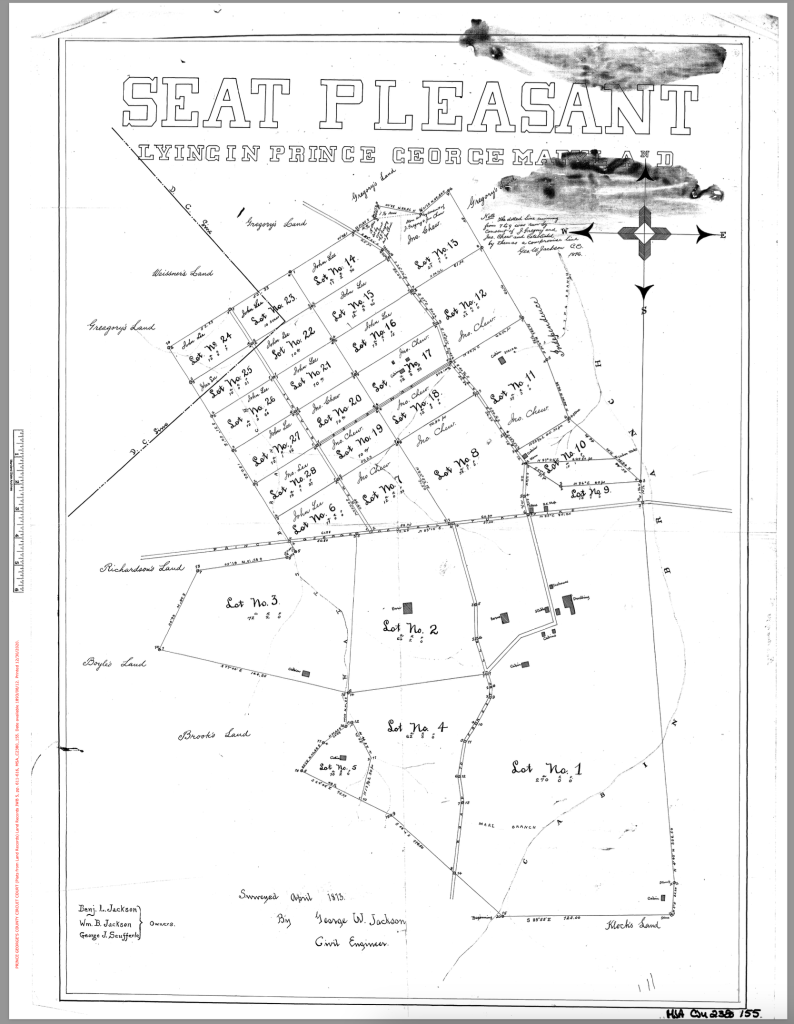
Patrick Henry Stewart purchased Lot #5 of the Seat Pleasant subdivision.  The land contained about 10.5 acres.  He paid $350 for the lot. (JWB 22:262; mdlandrec.net)

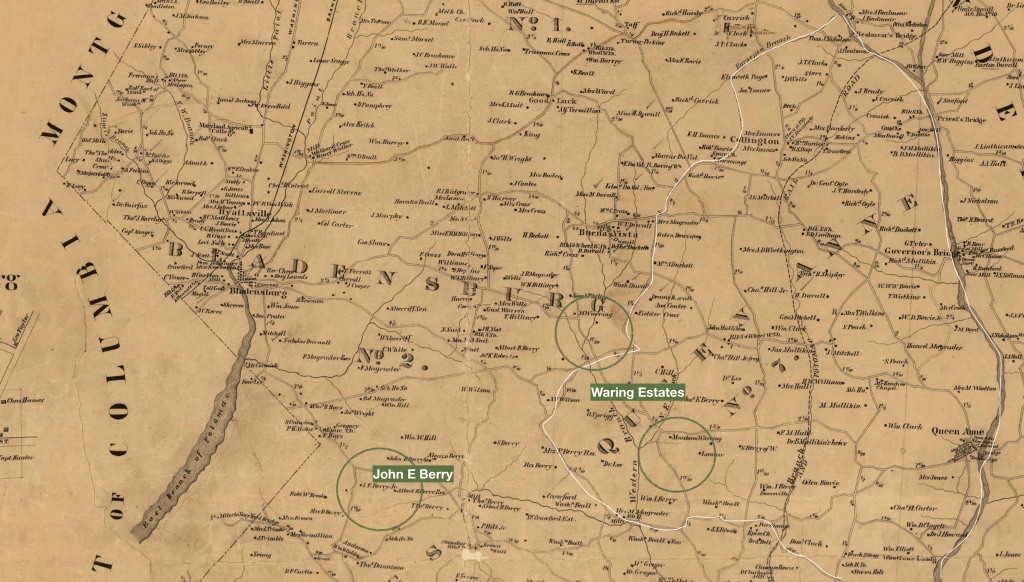
The land was situated near the corner of DC in the portion of Bladensburg District which was used to create the Kent District in the 1870s.  It sat on the former land of John E Berry, Jr., an enslaver and landowner in Prince George’s County prior to the Civil War.  Berry, Jr., purchased “Seat Pleasant” from his relative Thomas E Berry. At the close of the Civil War, the land was sold to real estate developers who created the town of Seat Pleasant.  Berry’s father, Dr. John E Berry, Sr., had a nearby plantation called Independence, and Berry’s brother, Albert B Berry had a farm called Sunnyside in addition to his other real estate holdings.

MSA_C2380_155_Jackson Plat of Seat Pleasant | Maryland State Archives

The survey of Seat Pleasant was completed in 1873.  In addition to detailing the lots, it marks what is likely the Seat Pleasant dwelling house and marks several cabins on the land, which may have be slave dwellings occupied by freedmen after manumission.  

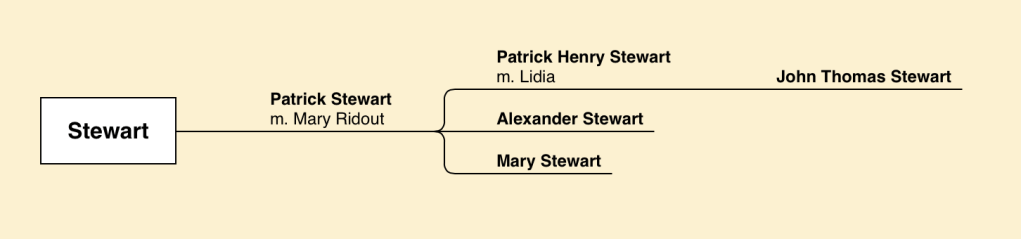
A death certificate records Patrick Stewart’s death in May 1929, when he died from “entero-colitis”. It lists his occupation as farmer and at the time of his death, he was living in the District at 30 H Street NE, the household of John Thomas Stewart, his son. The death certificate also lists his parents as Patrick Stewart and Mary Ridout, names consistent with the 1880 census.

Before Emancipation

Prior to emancipation, Patrick (Henry) Stewart was enslaved by John E. Berry, who submitted a compensation list to the 1867 Commission on Slave Statistics; Berry was also the landowner of Seat Pleasant. Patrick (Henry) Stewart was listed as 20 years old, giving him an estimated birth year of 1845. Also enslaved by John E Berry is Mary Stewart (II), who was 38, born about 1827.

John E. Berry also submitted a list as administrator of the estate of Albert B Berry, his brother, who owned adjacent land. On the list submitted for A. B. Berry are Mary Stewart (I), age 58, and Alexander, age 22. Working from the assumption that Mary Stewart (I) is Mary Ridout, this allows us to expand the outline of the family. I wrote another detailed post about Mary Ridout and her connection with other Ridout Branches (and therefore the Stewart family).

In brief, Mary Ridout is likely related to Ridout Family Group enslaved by the Sprigg Family (Northhampton) and Waring Family. The Sprigg family enslaved Margaret (Brooks) Ridout who was the inferred mother of Barbara Ridout who married Joseph Jones, both enslaved by the Warings. Many of the Ridouts can be found in the vicinity of Seat Pleasant after emancipation. This suggests the likelihood that Mary Ridout was married to Patrick Stewart of the Waring estate.

Disambiguation

Patrick Henry Stewart of Seat Pleasant is too young to be Patrick Stewart of the Waring estate and he can be found in the compensation lists of John E Berry with other relatives. However, Patrick Henry Stewart is the son of Patrick Stewart of the Waring Inventory, as evidenced by the direct evidence of his death certificate which names his father and his mother’s family name. His mother’s family name, Ridout, provides indirect evidence that there were connection to the Stewart estate.

Patrick Stewart of Hillsdale


See “the many Patrick Stewarts” for the introduction to why this post was written.


Patrick Stewart of Hillsdale was originally considered as Patrick Stewart of Queen Anne District due to his age and geographic location in the 1870 Census. The 1870 Census gave his age as 50 [1850] which makes him the same age as Patrick Stewart of Queen Anne District. Additionally, he was residing in Hillsdale, a community of freed Black people that had escaped to the District like Patrick Stewart of Queen Anne District had.

However, a review of further records related to him suggests he was not from Queen Anne District, but rather southern Prince George’s County and Charles County, Maryland.

After Emancipation

In the 1870 Census, Patrick Stewart is living in Hillsdale, a community of freed Black people, originally known as Barry Farm and run by the Freedmen’s Bureau.   It was called Barry Farm as it had been built on a 375 acre of land that had been owned by the Barry family. 

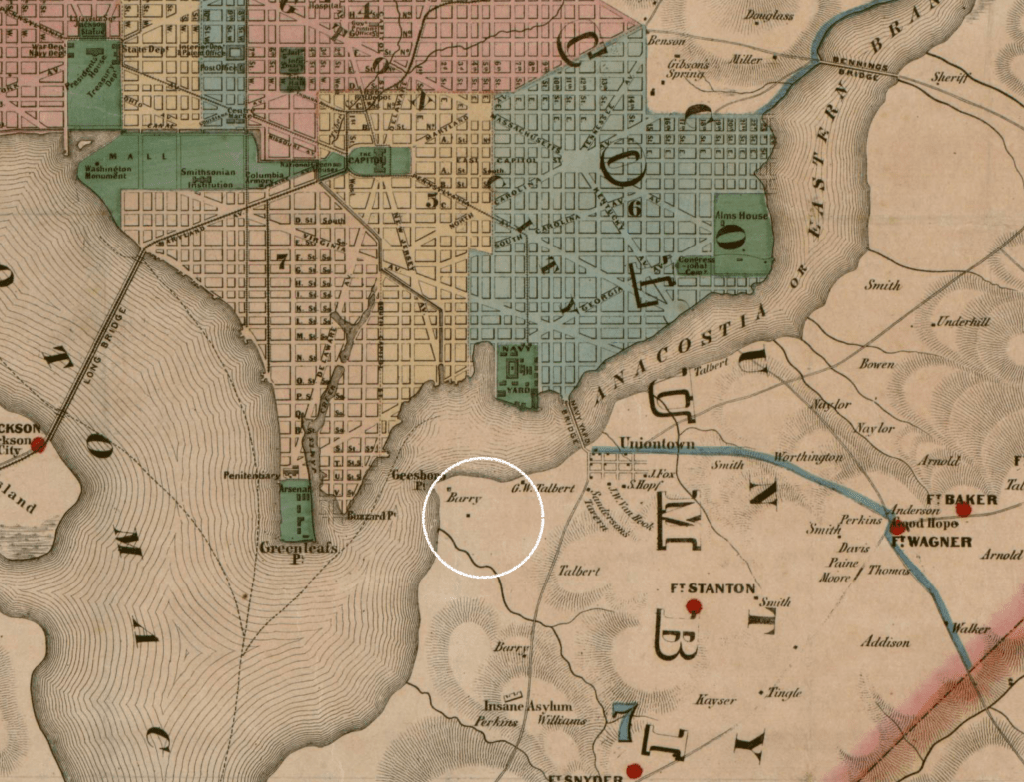
Topographical map of the original District of Columbia and environs showing the fortifications around the city of Washington | loc.gov

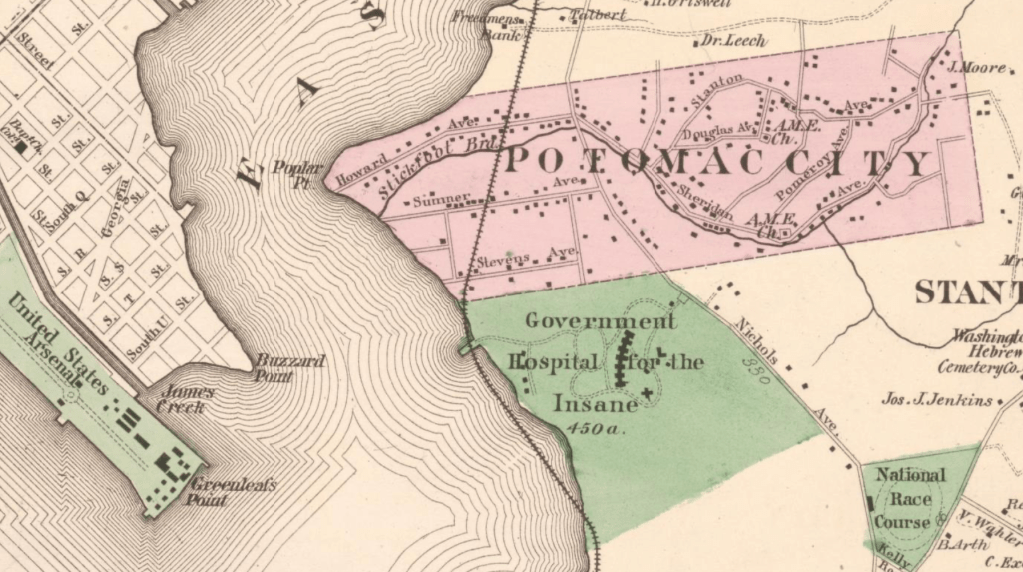
The 1878 Hopkins Map shows it as Potomac City.  An act passed in 1873 changing the name of “Barry Farm, or Potomac” to Hillsdale in 1873.  Charles R Douglass, a relative of Frederick Douglass, was a political leader within the Hillsdale community.  Douglass was enumerated at dwelling number (DN) 602; Patrick Stewart at DN 599.

Atlas of fifteen miles around Washington, including the County of Prince George, Maryland | loc.gov

In 1870, Patrick Stewart was not listed in the Washington, DC City Directories. He appeared in the City Directories in 1875 as living on Howard Avenue, in Hillsdale. Howard Avenue is situated in the northwest portion of HIllsdale, running parallel to Stickfoot Branch.  An 1867 Tax List ran in the National Republican and cited “Whole Tax on lot 38 and improvements in section 9, in Barry Farm subdivision, assessed to Patrick Stewart, $5.25”. 

Map of the division of the north half of a tract of land called “St. Elisabeth,” situated on the east side of the Anacostia River in the county of Washington, D.C. : surveyed into one acre lots for sale to freedmen | loc.gov

This lot sat on the end of Howard Ave along the river and was larger than the other 1 acre lots.  The acreage most likely allowed Patrick to ply his trade as a carpenter.  

“In order to purchase property, entire families worked in the city all day and walked at night to Barry’s Farm to develop their land and construct their homes by lantern and candlelight. As one man described it, ‘the hills and valleys were dotted with lights. The sound of hoe, pick, rake, shovel, saw and hammer rang through the late hours of the night.’” 

The Anacostia Story (1977) | Louise Daniel Hutchinson

In the 1870 Census, Patrick Stewart is living with his wife, Caroline, and his children: Julia, Georgie and Joseph.  They are also living with Henry Stewart, age 93.  Presumably, Henry is Patrick’s father. 

Two of the children, Julia and Georgie, were born prior to emancipation.  Joseph was born after emancipation and when the family was living in the District.

Before Emancipation

George Morton, a landholder and enslaver from the Eighth District, submitted a compensation list that included Caroline Stewart, Julia and Georgiana, as well as an older and younger daughter, who do not appear in the 1870 census with Patrick and Caroline. 

Prince George’s Slave Statistics | Maryland State Archives

The Eighth District was in the southernmost part of Prince George’s County, along the boundary with Charles County.  George Morton is shown on the Martenet Map as holding land east of Woodville. 

Martenet’s Map of Prince George’s County, Maryland. | loc.gov

Maria Stewart Briscoe

Maria Briscoe and her two children Henrietta and Ben Briscoe are enumerated immediately following Caroline Stewart and her named children in the 1867 compensation lists for George Morton.

Prince George’s Slave Statistics | Maryland State Archives

Like her parents and siblings, Maria and her partner, Richard Briscoe, left the Aquasco area and purchased a lot in Hillsdale. Richard Briscoe was assessed for his lot: “Whole Tax on lot 35 and improvements in section 8, Barry Farm Subdivision, assessed to Richard Briscoe, $4.13”  His lot was near but not adjacent to the Patrick Stewart lot.

Map of the division of the north half of a tract of land called “St. Elisabeth,” situated on the east side of the Anacostia River in the county of Washington, D.C. : surveyed into one acre lots for sale to freedmen | loc.gov

Both Richard Briscoe and Patrick Stewart were carpenters; many skilled workers found lots in Hillsdale.

Maria’s death record records her parents as Caroline Wood and Patrick Stewart and her husband as Richard Briscoe.  Her transcribed death record inaccurately records her age as 61.  Based on the emancipation records, she was in her eighties, which is consistent with her 1920 census record. 

Mattawoman Baptismal Records

In a no longer extant parish, “Upper and Lower Zachiah and Mattawoman”, there were three chapels:

  1. A private chapel on the estate of William Boaman (near Bryantown) in Lower Zachiah
  2. A chapel on Thomas Reeve’s land on the Upper Zachiah (later St. Peter’s parish in Waldorf)
  3. A chapel “located south of the later parish of St. Mary’s in Piscataway”
Topographical atlas of Maryland: counties of Calvert, Charles and St. Marys. | davidrumsey.com

There are three baptismal records in the Maryland, U.S., Births and Christenings Index, 1662-1911 Database associated with “Roman Catholic, Mattawoman, Charles, Maryland”.  

  • 25 Apr 1857, the baptism of Julia Stewart, daughter of Patrick Stewart and Caroline
  • 8 May 1859, the baptism of Georgiana Stewart, daughter of  Patrick and Carolina
  • 27 Jun 1859, the baptism of Henrietta Briscoe, daughter of Richard and Marg Briscoe

Disambiguation

Despite Patrick Stewart having a similar birth year, and reasonable 1870 residence, he is not Patrick Stewart of Queen Anne District. He was a carpenter from southern Prince George’s County and northern Charles County.

Abraham Henry | USCT

Abraham (Abram) Henry enlisted in the 1st Regiment of the US Colored Infantry in June 1863, when the regiment was being organized in the District.

His service records indicate that he was a free man and as such could receive $100 bounty for enlisting.

US Colored Troops Military Service Records “Abram Henry” | ancestry.com

Alexander Hawkins was another free man who joined the same regiment and same company, who was also from Upper Marlboro. Neither man is found in the 1860 census for Prince George’s County.

Both men enlisted a year after the abolition of slavery in DC, and in that year, many enslaved people in neighboring jurisdictions fled their enslavers and the estates where they were held captive, escaping to DC where they could claim freedom. This flight came at the risk of encountering slave patrols and constables who preyed on Black people (regardless of official status), capturing them, confiscating their property and (re)enslaving them.

Chandra Manning wrote in her book Troubled Refuge: Struggling for Freedom in the Civil War, that “despite the chronic threat of kidnapping, refugees from Maryland could at least hope to blend in among the capital city’s free black community.” With the abolition of slavery in DC, it is likely that Abram Henry claimed free status in an attempt to avoid recapture and a return to an enslaver. This theory is supported by documentary evidence both in Henry’s service record and in the registrations kept by the Freedmen’s Bureau. Henry’s wife, Celia, was living in a refugee camp.

Celia Henry

Freedmen and refugees gathered in the presence of the Union troops. Manning wrote, “Wherever the Union army went, tens of thousands of enslaved men, women, and children made their way to its blue lines, braving almost unimaginable risks to get there. They gambled against dogs, heavily armed search parties, jittery Confederate and Union pickets who might shoot at the very sound of an unexpected footstep…Still they came. Still they found work where they could. Still they aided the Union army when and where they were able.” Celia Henry and her two younger children are listed in the registration for the Freedmen’s Village, situated on the bluffs on the confiscated lands of the Lee family, where the federal government was creating a series of forts and entrenchments to protect the capital city.

Another record has her registering at Camp Wadsworth, one of the camps set up in Arlington to house the refugees and provide opportunities for employment. Camp Wadsworth was established on the land of Cooke, who had rebelled against the federal government and crossed to the confederacy. The Union army seized his land near Langley and converted it to Camp Wadsworth. There about 200 refugees grew winter wheat, corn, oat, potatoes, cabbage, turnips, buckwheat, melons, tomatoes and garden vegetables. Men are paid from $8 to $10 a month with rations and quarters. (Birmingham Daily Post, 02 Jun 1864) The Buffalo Morning Express reported that some of the crops grown were used as rations in the hospitals (04 Aug 1863)

Family Names

In addition to the record of Celia Henry finding refuge at Arlington Heights and at Camp Wadsworth, there is a pattern of family names that suggest that Abram Henry and his family escaped from Charles Hill.

Charles Hill, and his son, Charles C. Hill were among the largest slaveholders in Prince George’s County. They owned substantial estates in both Marlboro and Queen Anne District. In the 1860 census, Charles Hill’s real estate was valued at $300,000 and his personal estate (which included the value of commodified enslaved people) was $215,000. His son had real estate at $83,000 and a personal estate of $71,720. They enslaved around 280 people according to the 1860 US Slave Schedule.

In 1867, Charles C. Hill submitted compensation lists for himself and on behalf of his father’s estate, listing the given and family names of those he enslaved. Among the lists are the family names, Henry and Hawkins, the same family name as Abram Henry and Alexander Hawkins who enlisted as free men. In fact, the Hill family was the only family to submit the name Henry as a family name.

A review of the Freedmen’s Bureau registration lists shows other family names connected with the Hills’ compensation lists: Holland and Diggs. The Hill family claimed 35 people with the family name Diggs, and a Holland family. The Holland family was smaller: four people, one of whom was named Martha and her two children, who were the same approximate age of those in the Registration list.
The evidence is circumstantial and indirect — and it is possible that documentary evidence exists that counters this hypothesis. And yet, the evidence that has been found suggests the possibility that Abram and his wife Celia escaped to DC with their children, and Abram signed up to fight in the newly created regiment of the Colored Troops while Celia sought refuge at the freemen’s camps.

After the war, they returned to Prince George’s County where they raised a family, having many of their children baptized by the priests of White Marsh a Jesuit Plantation with connection to Charles Hill and other wealthy Catholic landowners.

Elizabeth Jones & Sally Woodard | Runaway

On August 29, 1858, Elizabeth Jones and Sally Woodward were committed to the DC Jail as runaways by S. W. Chipley. They were released to “Marshall Warren” two days later, on August 31.

In Chocolate City, the authors details that the Jail was built in 1839 and sits where the National Building Museum now sits. In the decades before the Civil War, the DC Jail was in the northeast corner of the block, near 4th and G, with the Tiber Creek trickling behind it. The building was known as the “Blue Jug” for the color of its walls and was three-stories of barred windows and stone cells and iron cages.

In 1861, The Frank Leslie’s Illustrated Newspaper ran an article entitled “Persecution of Negroes in the Capitol-Astounding Revelations” (28 Dec 1861). One of the people quoted in the article describe the conditions of the jail:

“I find incarcerated in the city jail in this city, in the midst of filth, vermin and contagious diseases, on a cold stone floor, many without shoes, nearly all without sufficient clothing, bedding or fire, and all in half-starving condition, 60 colored persons, male and female, confined because — in the language of their commitments — they were suspected of being runaways, and no proofs had been adduced that they were not runaways.


The man who captured Elizabeth Jones and Sally Woodward was a police officer who likely patrolled the Island. This suggests that Elizabeth and Sally had made it across the Eastern River from Prince George’s County and into the District near the southern side of the Mall.

Samuel N. Chipley was recorded in the 1860 Census as a policeman living in Ward 7, who had been a County Constable in Alexandria, Virginia, in 1850. He was elected for County Constable for several years in Alexandria. By 1858, he is working in the District. The Daily National Intelligencer announced his commission as a police officer in the Seventh Ward in July 1858. The 1858 City Directory lists the address for Samuel L. Shipley as 124 C South, on the Island and southwest of the Capitol. He died in 1887, and was buried in Alexandria, Virginia.


The women were released after two days in the DC Jail to “Marshall Warren” which is likely an error and reference Marsham Waring.

Elizabeth Jones was likely the daughter of Joseph Jones and Barbara Ridout. In 1858, she would have been twelve years old. She escaped the Warings again in 1862 with her family when they fled to the District. They were listed in the Camp Barker registrations. In 1861, Lizy Jones and Notley Steward had her son Augustus baptized by the priests of White Marsh. No record of her after the 1862 escape has been found.

Sally Woodard was claimed by M. Virginia Mackubin, the daughter of Marsham Waring, on the compensation list submitted to the 1867 Commission on Slave Statistics for Prince George’s County. Mackubin had inherited the legal authority to enslave Sally when her father, Marsham Waring, died in 1860. Sally was listed in Waring’s Inventory as one of the people enslaved on the main estate, Warington. In the inventory, she had three children: Maria, age 8, Arthur, age 7, and an infant child.

In the 1870 Census, Sally is living in Bladensburg District of Prince George’s County, near the Zachariah Berry and Edward Magruder, and so along the boundary between Bladensburg and Queen Anne District and near the estates of the Warings.

She is living with her husband, John, and four children: Arthur (14), Matthews (12), Ellen (6), and Michael (4).

Mathew is likely the infant child based on a 1860 White Marsh record which records the baptism of Mathew, son of John and Sarah Woodward. Edward Wood sponsored the child.

John Woodard was claimed by Mortimer L. Wilson, on a compensation list submitted to the 1867 Commission on Slave Statistics. Mortimer was the eldest son of Joseph Hickman Wilson, who lived in Bladensburg District, near the border of Queen Anne District in Prince Geore’s County, Maryland in the antebellum years, before his death in 1857. He was the stepson of Amelia Violetta (Weems) Wilson, Jospeh Wilson’s second wife.

This contrasts with records related to the Civil War. In 1864, John Woodard was drafted and called into service with the USCT. His selection is announced in the 12 July 1864 edition of the Baltimore Sun, “John Woodward, slave of Virginia Wilson” (Amelia Virginia Wilson, was Mortimer’s step-sister). Woodard’s USCT Service records show that he did not report as order and was arrested; the charge of desertion was removed by Special Order #15. Additionally, the army considered him free as they did not receive papers for him on some muster rolls; others cited him as a slave.  Mortimer Lawrence Wilson submitted an oath sewing that he was the master and owner, and that he was loyal to the United States in order to claim compensation for the enlisted slave.  In 1892, Sarah Woodard filed a claim for a widow’s pension for her husband’s service in the A Unit of the 4 USCT Infantry.


Richard (Dick) | From Georgetown

In another set of posts, I explore the lives of Richard (Dick) and Mary (Polly) Jones, who were enslaved by the Waring Family in Queen Anne District of Prince George’s County, Maryland.

Connected Post: Richard & Mary Jones | Old Age

In this post, I explore the possible series of transactions that may have resulted in Richard (Dick) Jones being held in captivity by Marsham Waring (d. 1860) and his children. Richard’s name is not listed in the 1813 inventory of Waring’s father, Marsham Waring senior, and so I propose that he may have been transferred from Stephen West’s estate; West was a manufacturer during the Revolutionary War who operated the Woodyard. Or he may have been transferred from the Lansdale family who were Waring’s in-laws.


This post, on the other hand, explores a different Richard (Dick) who was enslaved by the Waring family and most likely did not survive into old age like Richard (Dick) Jones.

JRM 9:388, mdlandrec.net

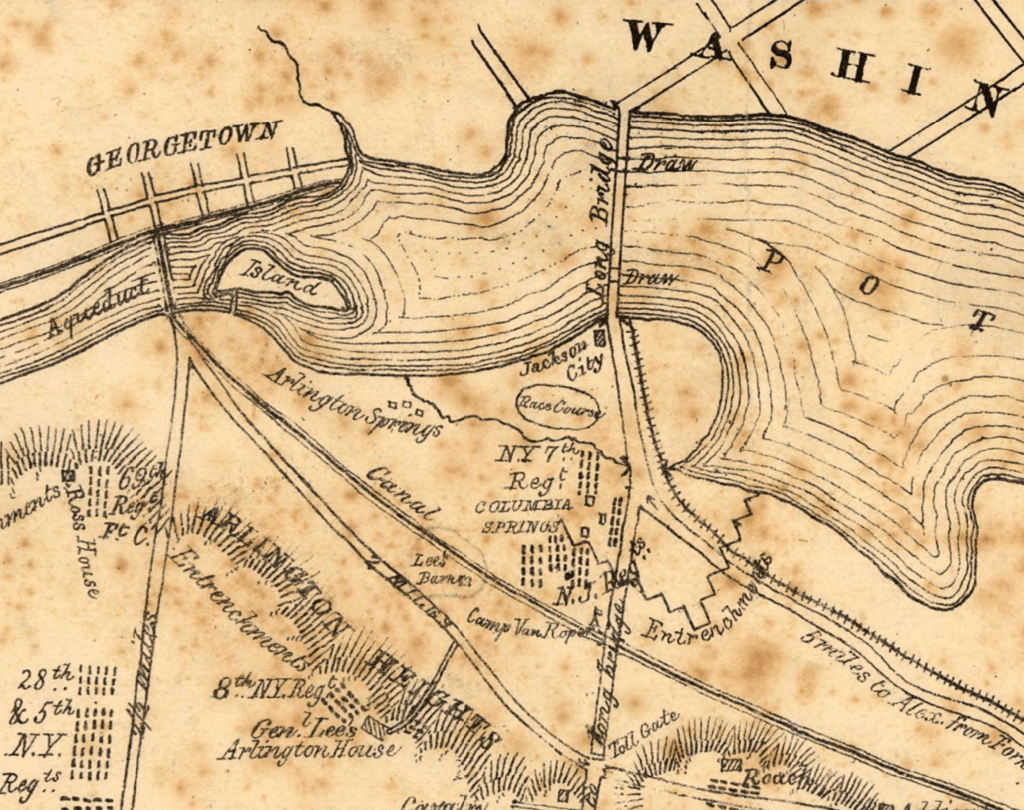
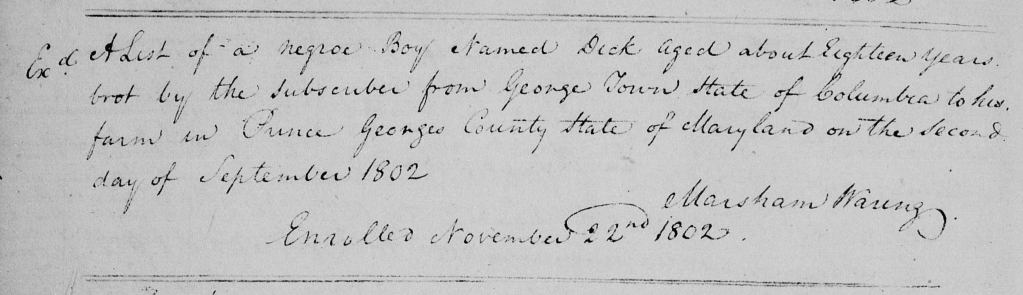
In 1802, eleven years prior to the senior Marsham Waring’s death, Waring recorded a “list” of enslaved people he brought from Georgetown to Prince George’s County. The list consists of a single name: a “boy” named Dick about 18 years old. Tax Assessments from 1800-1802 show that Marsham Waring was assessed for “2 negro boys” at his Georgetown residence– Richard (Dick) was likely one of the two listed in the tax record.

Georgetown Property Tax Records, 1800-1802, familysearch.org

Eight years prior to this, Marsham Waring (senior) was recommended by David Stuart to George Washington for a position in the planning of the newly formed capital in the District of Columbia. In Stuart’s letter to the President, he described Waring as “a respectable sensible Merchant of Ge: town, who has never intermixed with any of the parties…As you are totally unacquainted I believe with Mr Waring, it may be necessary to say something more respecting him—he has been long an inhabitant of Ge: town, and some of his relations (I believe his brother) possessed large property in the city, but has sold out—he is universally well thought of, as a man of character, good temper and understanding.” Waring was also a Director for the Bank of Columbia, established in 1794.

It appears that while Waring did business in Georgetown in the 1790s, he soon moved from the District to his estate in Prince George’s County as evidenced by the document notating his removal of Richard (Dick) from Georgetown to Prince George’s County.

It may have been a shift in culture for Richard (Dick). It is unclear what his role was in Georgetown, being forced to labor for Waring either at his residence or place of business. However, an advertisement ran by Waring in 1794 may give a clue to the types of tasks Waring forced from those enslaved.

50 DOLLARS REWARD, RANAWAY very unexpectedly from the subscriber, on Saturday the 11th October, a Mulatto man named George, by his acquaintances called George Evans, about 25 years old, 5 feet 9 or 10 inches high, straight and well made; he has long bushy black hair, which he commonly wears queued his cheek bones rather high, his laugh simple, he has always served as a waiter was a favorite servant, and spoiled by excessive indulgences, understands dressing and shaving, and plays well on the violin, he took with him a brown fustain coatee and jacket, bound with yellow silk ferret, a pair of light coloured sagathy breeches and half boots; as he had many other cloths of cloth and light summer wear, it is probable he may change his dress. It is supposed he has crossed over to Virginia. Whoever secures the above man, shall receive the above reward, and reasonable charges, if brought home. All masters of vessels will receive him on board at their peril. MARSHAM WARING. George-Town, (in Columbia) Oct. 16, 1794.

Virginia Gazette and General Advertiser, October 29, 1794

Mary Ridout | Stewart Connection


In 1929, Patrick Stewart, age 84, died of a stomach ailment. His son, J. T. Stewart, furnished the information for the death certificate for the District of Columbia records.

Patrick Stewart, age 84, was the son of Patrick Stewart and Mary Ridout. He was born around the year 1845, twenty years prior to the emancipation of the enslaved in Maryland, where he and his parents were born into chattel slavery.


Enslaved by John E Berry

In 1867, John E Berry, of Bladensburg in Prince George’s County, Maryland, submitted a list to the Commission of Prince George’s County Slave Statistics of the people he enslaved prior to emancipation in hopes of compensation from the federal government. Among those he listed were Patrick Stewart, age 20 and Mary Stewart, age 38.

While we do not have an age for Mary from the death certificate, the ages of the two Patricks are consistent with each other, both are born around 1845 — and Mary, the other Stewart, is old enough to have borne Patrick as her son.

The identification of Patrick’s mother as Mary Ridout opens up a line of inquiry about whether or not Mary Ridout is connected to the Stewarts of the Waring estates and to the Ridouts enslaved in and around the Waring estates.

Connected Posts: Barbara Jones | Ridout Family & Benjamin Lee and Augustus Jones | Stealing Horses

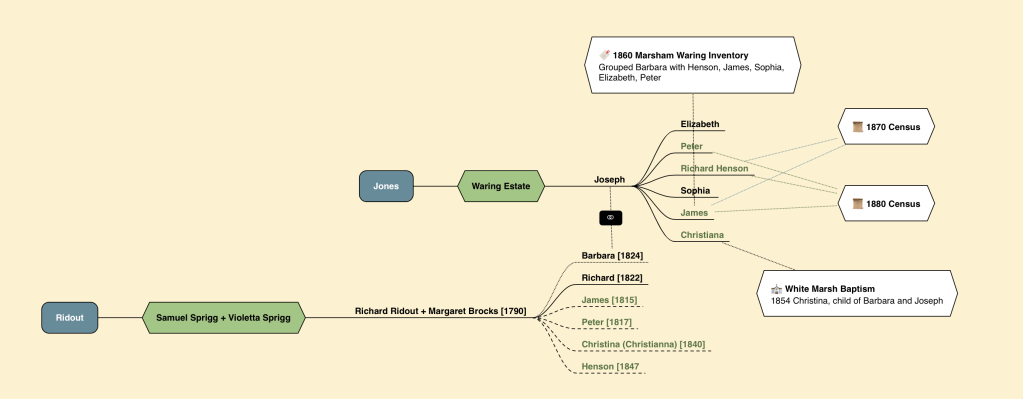
The connected posts discuss the details of this diagram more fully

Seat Pleasant

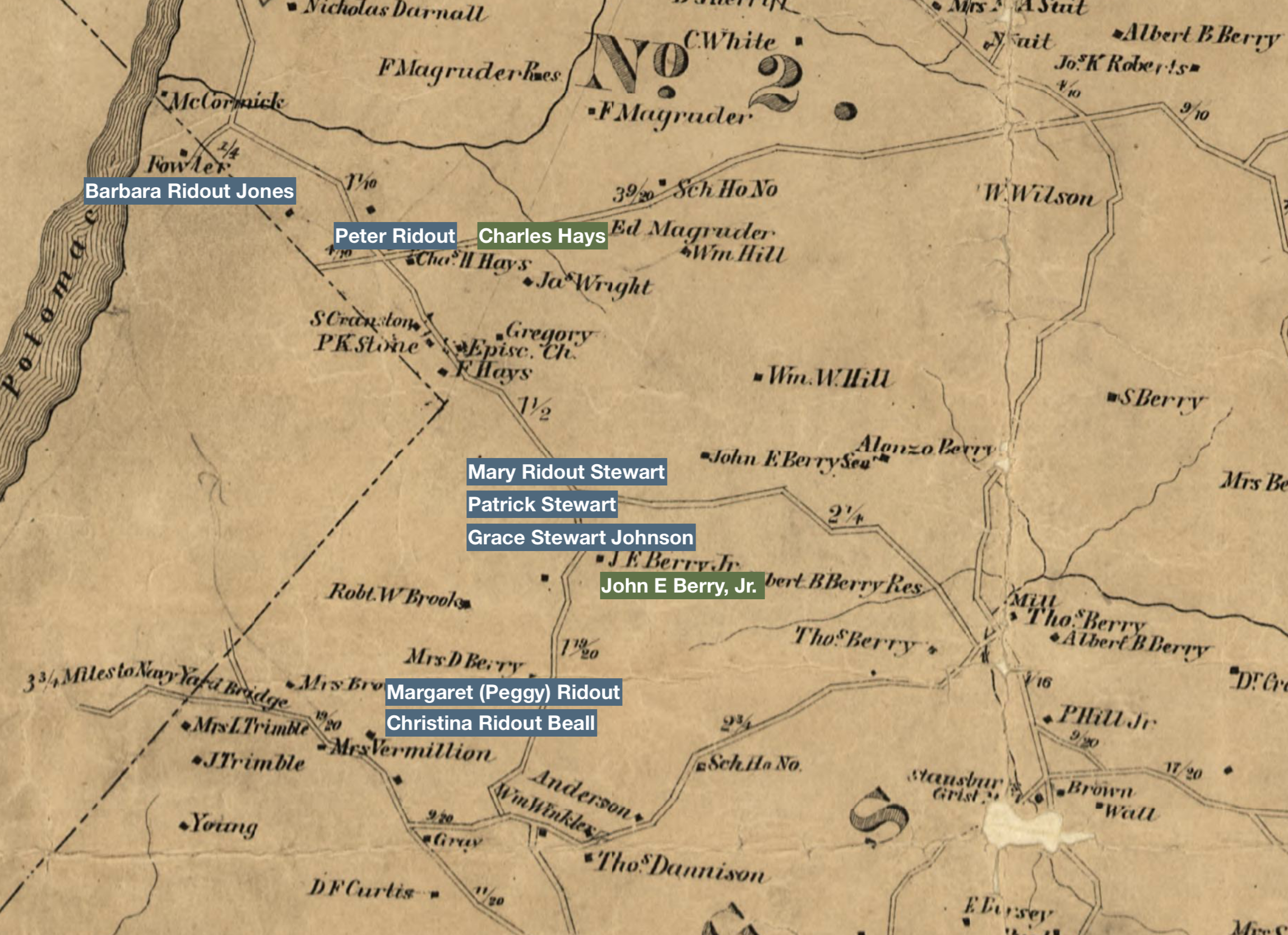
In the post on Barbara Jones’ connection to the Ridout family, we saw that Peter and Priscilla Ridout moved to the boundary between DC and Maryland, near Charles H Hays and we saw that Margaret (Peggy) Ridout and her daughter moved into the household of Geo R Wilfred Marshall, also near the boundary of DC and Maryland. The two families essentially bookend the area where Mary Stewart and her son Patrick are enslaved.

In the 1880s, Patrick Stewart purchased Lot #5 of the Seat Pleasant subdivision.  The land contained about 10.5 acres.  He paid $350 for the lot.

It sat on the former land of John E Berry, Jr. Berry, Jr., who purchased “Seat Pleasant” from his relative Thomas E Berry. At the close of the Civil War, the land was sold to real estate developers who created the town of Seat Pleasant.  Berry’s father, Dr. John E Berry, Sr., had a nearby plantation called Independence, and Berry’s brother, Albert B Berry had a farm called Sunnyside in addition to his other real estate holdings.  The survey of Seat Pleasant was completed in 1873.  In addition to detailing the lots, it marks what is likely the Seat Pleasant dwelling house and marks several cabins on the land, which may have be slave dwellings occupied by freedmen after emancipation.  

In the 1870 census, Patrick and his wife, Lidia, are living with their three daughters: Mary E [1864], Margaret [1866], and Rachel [1868]. By 1880, they have five more children: William [1870], Daniel [1872], John Thomas [1874], Jane E [1876], and Christiana [1880]. The name of their last daughter, Christiana illustrates the connection with the Ridout family. As seen, Barbara Ridout Jones had both a sister and daughter named a variation of Christiana.

Mary Ridout Stewart

Mary Ridout Stewart was living next door to her son, Patrick, in the 1870 census in the household of George and Grace Johnson and their children.

1870 Census for Bladensburg District in Prince George’s County | ancestry.com

This leads us to the suggestion that Grace is Mary’s daughter and Patrick’s sister.

Like Mary and Patrick Stewart, George Johnson was enslaved by John E Berry.  The two men likely worked the tobacco fields of Seat Pleasant, first as enslaved men and then as tenant farmers.  

Unlike the Patrick and George who were held in bondage on a large tobacco estate, Grace and her children were enslaved by a farmer, Charles H Hays, who likely grew produce for the Washington markets.  Hay’s farm was north of Seat Pleasant, along the DC border, where Peter and Priscilla moved after the war. 

When large estates were often valued above $10,000, Hay’s farm was valued at $2000.   Farms were smaller in this part of Prince George’s County and often grew other products instead of tobacco.  In 1864, Charles Hays advertised a reward of $5 for a cow that had strayed.  Upon his death, his farm of 105 acres was advertised for sale; the soil was described as well adapted for grazing and market gardening.  The land had a dwelling of six rooms and a tenement house of three rooms.  

The 1860 Slave Schedule lists 8 enslaved people for Hays, and Hays submitted the names of 10 people whom he enslaved. In addition to Grace and her children, Hays enslaved Letty Hanson, age 25.  Her first name is phonetically similar to that of Lidia, Patrick’s wife.  


By 1880, Mary Ridout Stewart and her husband, Patrick Stewart, are living together in the household of Patrick Stewart and Lidia with their children. Patrick (Jr.) has yet to buy the land in Seat Pleasant. From neighboring houses, it appears that they are living near Buena Vista near the Waring Estates, in the newly created Kent District along the boundary with Queen Anne District and near close and extended family.

Dwelling NumberRelativeRelationship to Mary Ridout
253Patrick Stewart (Sr.)Husband
253Patrick Stewart (Jr.)Son
258Grace JohnsonDaughter
247Michael JonesSon of Barbara’s brother-in-law
244Bettie FletcherBarbara’s sister in law
92Geo StewartInferred Nephew, as he is son of James Stewart

The table lists the dwelling numbers of people related within the extended kin group of Mary Ridout. Dwellings 253 & 258 are members of her immediate family and include her children. Dwellings 247 and 244 are members of the Jones family that Barbara Ridout, Mary’s inferred sister, partnered with. Elizabeth (Bettie) Fletcher was the daughter of Richard and Mary Jones. And dwelling 92, which can be identified as being in the geographic vicinity as it is neighboring Jos. K Roberts house is the household of George Stewart, the son of James Stewart.

James Stewart was listed in Marsham Waring’s 1860 inventory with Notley Stewart, who fathered Barbara Ridout Jones’s grandchild, Augustus Jones. Also listed with James and Notley was Patrick Stewart. During the Civil War and shortly after the abolition of slavery in the District, Patrick and Notley fled to DC with many others from the Waring estates. James Waring, as administrator of his father’s estate, went to the District to seek their return, swearing an affidavit that they were from Maryland and therefore subject to his enslavement. Records of Patrick Stewart are not found, though records of the others in Camp Barker and Camp Springdale have been found. Likewise, Patrick in the 1870 census has yet to be identified. However, it appears he reunited with his family by 1880.

related posts

Barbara Jones | Ridout Family

Joseph and Barbara had several children and lived on the Waring estates.

A White Marsh baptism record from 1854 gives a clue to her family before her union with Joseph. The priests recorded her family name as “Reyder”. Given the phonetic spelling of the priests who were not English, it suggests the possibility of Barbara being related to the Ridout family.

Peter and Priscilla Ridout, Inferred Brother

In the 1867 Commission on Slave Statistics, the estate for James Waring (dec.) submitted a compensation list that included other Ridouts:

Family NameGiven NameAge
RidoutPriscilla37
RidoutEliza22
RidoutHenny2

In the 1870 Census, Priscilla can be found in a household with Peter Ridout, which suggests that Priscilla’s family name is not Ridout, but adopted upon her union with Peter. Peter appears on a compensation list submitted by Violetta Sprigg, the widow of Samuel Sprigg, the former governor of Maryland. In 1870, Peter and Priscilla are living in Bladensburg, next door to Charles H Hays. They are also living within the vicinity of Alex McCormick, Barbara Jones’ neighbor in 1870.

1870 Census for Bladensburg District, Prince George’s County | ancestry.com
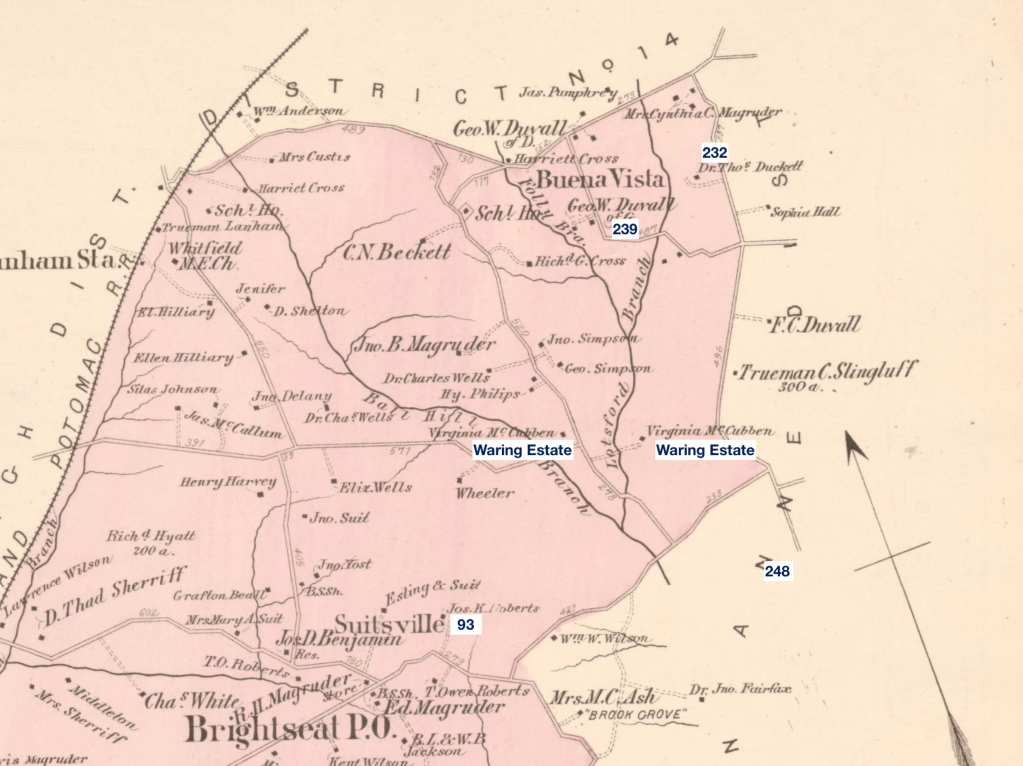
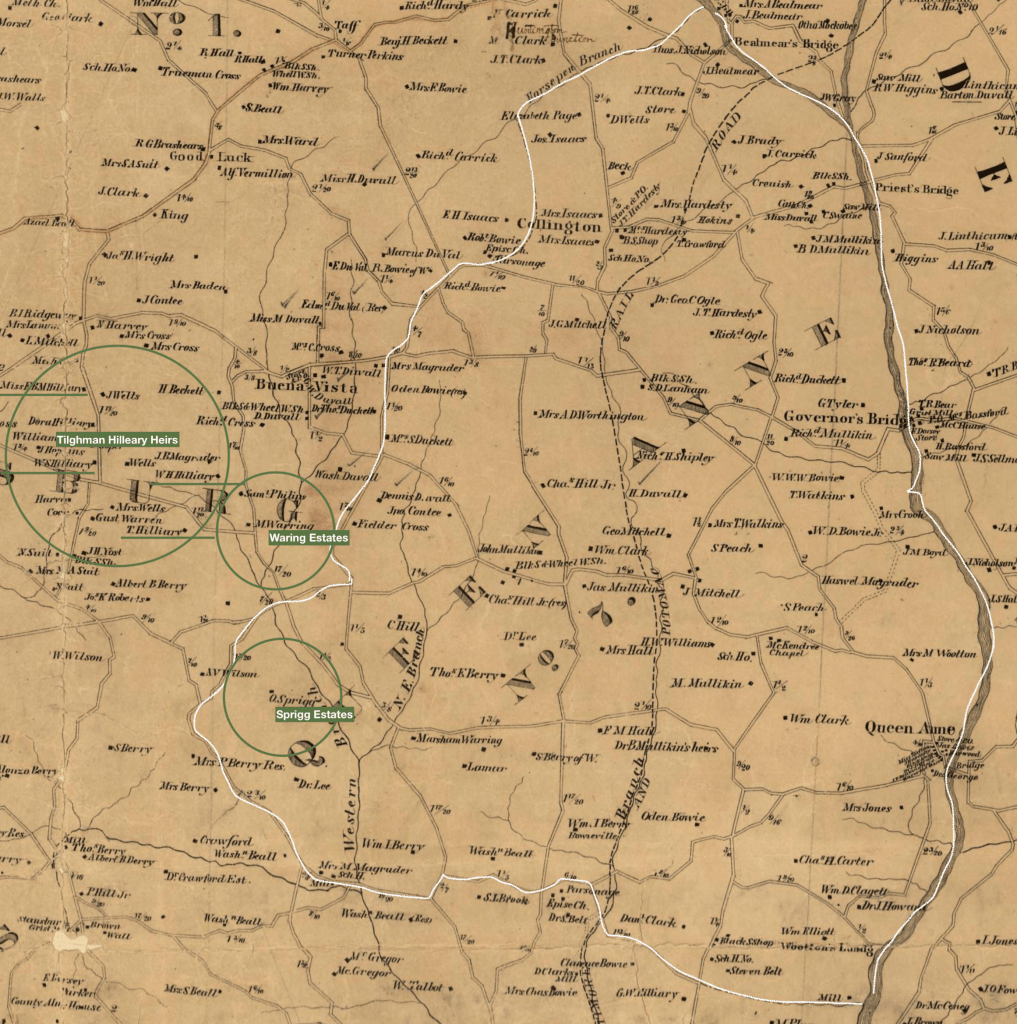
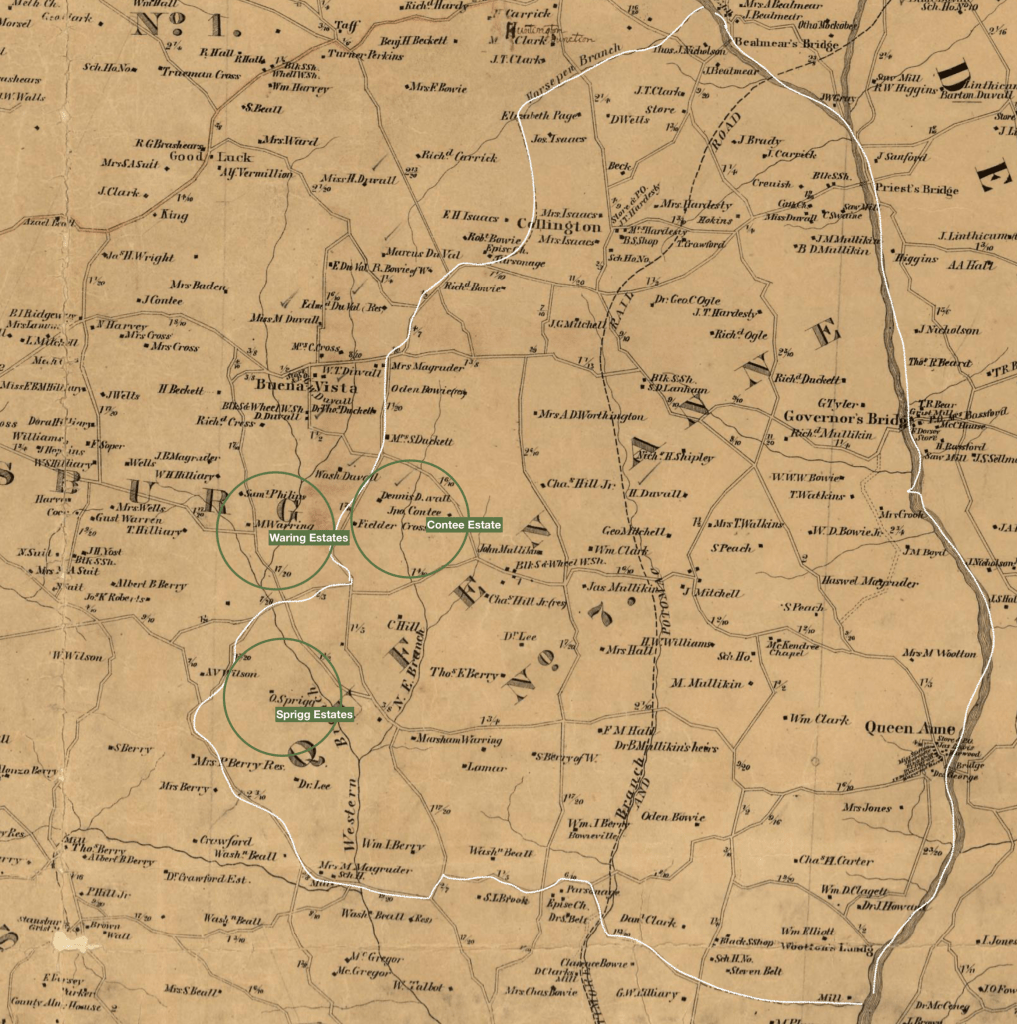
1861 Martenet Map of Prince George’s County with annotations marking McCormick, Hays, the Waring estate and the Sprigg estate | loc.gov

In 1880, Peter and Priscilla have moved into the District along Central Avenue, just as Joseph and Barbara have moved from McCormick’s farm to Central Avenue. Joseph and Barbara Jones are enumerated at household 169, while Peter and Priscilla are enumerated at household 171.

The likelihood of Peter and Barbara being siblings is based on a few things.

  1. Joseph and Barbara named one of their sons Peter, who would continue to live in the District near Central Avenue into the 20th century. It would appear they named Peter after Barbara’s brother Peter.
  2. Peter and Barbara’s estimated birth years: Barbara has an estimated birth year of [1829] based on the 1870 census, while Peter has an estimated birth year of [1817]. They are approximately 12 years apart; this difference falls within the range of a woman’s typical child-bearing years of 15-45 (or 30 years).
  3. Their geographic proximity to each other both prior and after emancipation. They resided on neighboring estates and left the immediate vicinity of the estates after emancipation and lived near each other after emancipation.

Ridouts of Sprigg’s Northampton Estate

Violetta Sprigg submitted not only the name of Peter Ridout to the 1867 Commission on Slave Statistics, but also the names of other Ridouts.

Family NameGiven Name [Name]Age
RidoutJames50
RidoutPeter48
RidoutPeggy [Margaret]66
RidoutHanson18
RidoutChristianna [Christina]25

Based on her age, Margaret (Peggy) Ridout is assumed to be the mother of the family group. The chart below was created to evaluate the likelihood that Margaret (Peggy) is the mother of the other Ridouts.

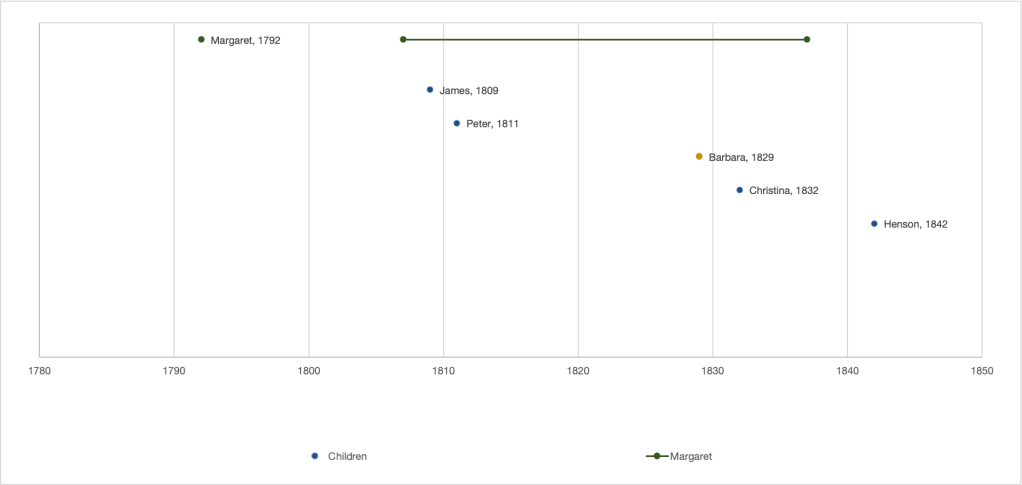
Using Margaret’s birth year, we can estimate her child-bearing years as when she was 15-45. In the 1870 census, Margaret (Peggy) Ridout is listed as 80 years old, which indicates it’s likely an estimated age, though it places her birth year as 1790. In the 1867 Prince George’s County Slave Statistics, she is 66, giving her an estimated birth year of 1801, a full decade later; while in Samuel Sprigg’s 1855 inventory, she is listed as 63, giving her an earlier estimated birth year of 1792, closer to her 1870 census age. For purposes of the chart, we will use the ages in the 1855 inventory, as it appears that the compiler of the compensation lists for the Prince George’s County Slave Statistics used the ages in the inventory.

Margaret is shown with her birth year mark and a line drawn to represent her child-bearing years, and her children’s estimated birth years are plotted as well. James and Peter appear to have been born toward the beginning of her child-bearing years while Christina was born later in her years. Henson falls outside of the 15-45 year range, though within a margin of error of five years.

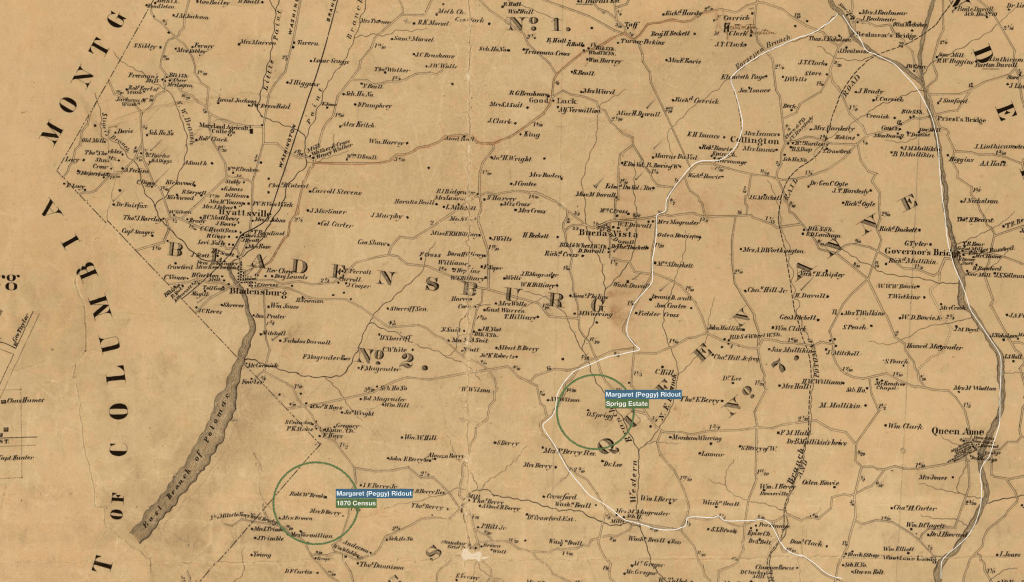
In 1870, Margaret has also left the Sprigg estate and moved closer to the District. She is living in the household of [Geo R] Wilfred Marshall, a neighbor of Robert W. Brooke.

Annotated Excerpt of 1861 Martenet Map of Prince George’s County marking the Sprigg Estate and household of Robert W Brooke | loc.gov

Also living in the household is Christy Ann [Christina] Beall. She is 35 years old with an estimated birth year of 1835, which suggests she is Christina (Christianna) Ridout, the inferred granddaughter of Margaret (Peggy) Ridout and is confirmed by her son’s death certificate. In 1911, Daniel Bell (Jr.) died in New York City, where he had migrated and was working as a driver. His death certificate lists his parents as Daniel Bell and Christina Ridout.

1870 Census for Bladensburg District, Prince George’s County | ancestry.com

In 1822, the priests of White Marsh recorded a baptism of Richard, the son of Richard Ridout and Margaret Brockx [sic]. The transcriber proposed the family name Briscoe in brackets. However, based on the family names of other people enslaved by the Spriggs in the 1867 Prince George’s County Slave Statistics, I suggest the surname Brookes. This will be explored further in a different post.


Patterns in Given Names

When looking at the given names of the enslaved, it is ambiguous who gave the name. Was it the parents, or was it the enslaver?

When looking at names of those born within the 18th century, and especially earlier in the century when Maryland planters were importing larger numbers of Africans to labor on their fields, it is more likely the names were imposed on the Africans by the Marylanders. In later generations, especially after the abolishment of the international slave trade in 1808, the names originally given by the Marylanders to the first generation of African appear to be given to their African-American descendants by their parents and grandparents as a way of marking kin groups within a world that cared little for their families and relationships.

The identified generations of Ridouts have names that repeat across the generations, suggesting kin groups.

Generation 1

Two white-generated source documents allow us to identify the first generation of Ridouts living in the vicinity of the Waring/Sprigg estates along the Western Branch of the Patuxent River:

  1. the White Marsh baptism record that identifies Margaret’s (Peggy) partner as Richard
  2. a War of 1812 claim for two enslaved people (more about War of 1812 claims in general can be read about on the Maryland State Archives site)

In 1828, Tilghman Hilleary, a neighbor of Marsham Waring, sought compensation for the Andrew and Peter Ridout, who runaway from the Hillearys during the War of 1812.

Born before 1808, it is possible that Richard, Andrew and Peter were forced to migrate from Africa to Maryland as laborers. However, due to a common family name, it is likely that Peter, Richard and Andrew are born in Maryland to enslaved Africans or African-Americans. Their exact relationship to each other is unknown; the common family name suggests brothers or cousins. Given the few number of Ridouts identified in the Prince George’s County records (e.g., the Prince George’s County Slave Statistics, the White Marsh Baptism records, the 1870 census), it seems more probable that they are brothers, rather than cousins, from a father brought to Prince George’s County by his enslaver (either by the Hilleary or Sprigg families, who appear to be an intertwined family themselves in previous generations).

Peter’s name gets repeated in later generations.

Generation 1 Names
Peter
Andrew
Richard

Generation 2

Shifting to the second generation, or specifically the children of Richard Ridout and Margaret (Peggy), we can identify the children from the Samuel Sprigg Inventory, the Prince George’s County Slave Statistics and the White Marsh records. No doubt there are as yet unidentified children of Richard and Margaret.

Of note, Richard and Peter are repeated. Richard (Jr.) is mostly named after his father, while the use of Peter for their other son, suggests that Peter (Sr.) was a close relative. The use reinforces the idea that Peter, Andrew and Richard of Generation 1 were brothers.

Generation 2 Names
Peter
James
Richard
Henson
Christina
Barbara

Possible Generation 2

One of the possible unidentified children of Richard and Margaret may be the partner of Sophia Ridout, claimed by John Contee’s administrator in the Prince George’s County Slave Statistics. She may also be partnered with either James or Richard. No other records related to Sophia and her children have been identified. Contee’s list did not name an adult male Ridout, suggesting that he may have been enslaved on another estate, leaving open the possibility that he was James, Richard, and Henson.

She uses the name Richard (Dick) for her son, likely named for either his father or uncle.

Contee’s estate was in the same neighborhood of Waring and Sprigg.

Generation 3

This generation brings us to Barbara (Ridout) Jones, who initiated the line of inquiry. She was identified in the White Marsh record as Barbara Reyder. The names of her children reinforce the idea that she was a Ridout descended from Richard and Margaret.

The use of White Marsh Baptism Records, the Prince George’s County Slave Statistics, and the 1870 & 1880 Census records allows us to identify the following children for Barbara (Ridout) Jones:

Four out of six of Barbara’s children share the names of her inferred siblings. The fifth child, Sophia, shares a name with the inferred sister-in-law, Sophia, who lived with her children on the neighboring Contee estate.

Generation 2 NamesGeneration 3 Names
PeterPeter Jones
JamesJames Jones
RichardRichard Henson Jones
HensonRichard Henson Jones
ChristinaChristina Jones
Barbara

Tentative Conclusion

The use of repeated given names across generations; the proximity to other Ridouts on neighboring estates, along with proximity after emancipation as they congregated toward Seat Pleasant and Lincoln suggests that Barbara was a child of Richard and Margaret Ridout.

related posts