In another set of posts, I explore the lives of Richard (Dick) and Mary (Polly) Jones, who were enslaved by the Waring Family in Queen Anne District of Prince George’s County, Maryland.
In this post, I explore the possible series of transactions that may have resulted in Richard (Dick) Jones being held in captivity by Marsham Waring (d. 1860) and his children. Richard’s name is not listed in the 1813 inventory of Waring’s father, Marsham Waring senior, and so I propose that he may have been transferred from Stephen West’s estate; West was a manufacturer during the Revolutionary War who operated the Woodyard. Or he may have been transferred from the Lansdale family who were Waring’s in-laws.
This post, on the other hand, explores a different Richard (Dick) who was enslaved by the Waring family and most likely did not survive into old age like Richard (Dick) Jones.
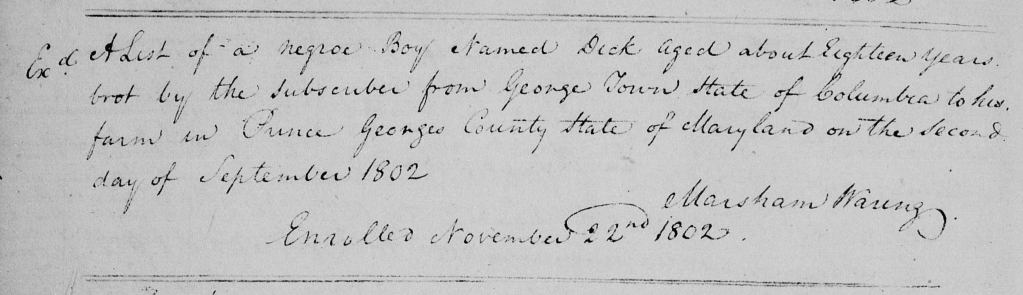
JRM 9:388, mdlandrec.net
In 1802, eleven years prior to the senior Marsham Waring’s death, Waring recorded a “list” of enslaved people he brought from Georgetown to Prince George’s County. The list consists of a single name: a “boy” named Dick about 18 years old. Tax Assessments from 1800-1802 show that Marsham Waring was assessed for “2 negro boys” at his Georgetown residence– Richard (Dick) was likely one of the two listed in the tax record.
Eight years prior to this, Marsham Waring (senior) was recommended by David Stuart to George Washington for a position in the planning of the newly formed capital in the District of Columbia. In Stuart’s letter to the President, he described Waring as “a respectable sensible Merchant of Ge: town, who has never intermixed with any of the parties…As you are totally unacquainted I believe with Mr Waring, it may be necessary to say something more respecting him—he has been long an inhabitant of Ge: town, and some of his relations (I believe his brother) possessed large property in the city, but has sold out—he is universally well thought of, as a man of character, good temper and understanding.” Waring was also a Director for the Bank of Columbia, established in 1794.
It appears that while Waring did business in Georgetown in the 1790s, he soon moved from the District to his estate in Prince George’s County as evidenced by the document notating his removal of Richard (Dick) from Georgetown to Prince George’s County.
It may have been a shift in culture for Richard (Dick). It is unclear what his role was in Georgetown, being forced to labor for Waring either at his residence or place of business. However, an advertisement ran by Waring in 1794 may give a clue to the types of tasks Waring forced from those enslaved.
50 DOLLARS REWARD, RANAWAY very unexpectedly from the subscriber, on Saturday the 11th October, a Mulatto man named George, by his acquaintances called George Evans, about 25 years old, 5 feet 9 or 10 inches high, straight and well made; he has long bushy black hair, which he commonly wears queued his cheek bones rather high, his laugh simple, he has always served as a waiter was a favorite servant, and spoiled by excessive indulgences, understands dressing and shaving, and plays well on the violin, he took with him a brown fustain coatee and jacket, bound with yellow silk ferret, a pair of light coloured sagathy breeches and half boots; as he had many other cloths of cloth and light summer wear, it is probable he may change his dress. It is supposed he has crossed over to Virginia. Whoever secures the above man, shall receive the above reward, and reasonable charges, if brought home. All masters of vessels will receive him on board at their peril. MARSHAM WARING. George-Town, (in Columbia) Oct. 16, 1794.
Virginia Gazette and General Advertiser, October 29, 1794
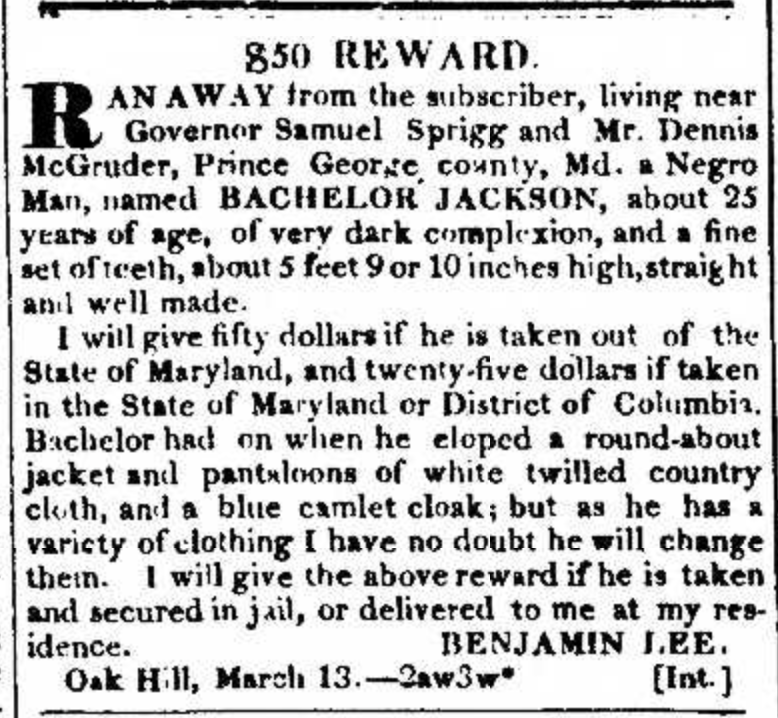
Washington Globe 13 Mar 1835, Washington | newspaperarchives.com
In 1835, Bachelor Jackson fled the capticity of Benjamin Lee, a physician and planter in Prince George’s County. His estate “Oak HIll” was located in Queen Anne District along the Western Branch of the Patuxent River.
Benjamin Lee most likely acquired Bachelor Jackson from his father-in-law, James Belt, who died in 1832. Bachelor, age 20, was listed in the 1832 Inventory of James Belt’s estate between Washington and Charles, both age 30.
Bachelor Jackson of Frederick County, MD
There was another Bachelor Jackson living in “Frederick Town” of Frederick County, Maryland, as a Black man with free status. Based on the census, he was betweeen the ages of 55 and 99. He had five other people in his household, both adults and children. It is possible that the enslaved Bachelor Jackson was related to him.
While geographically separated from Prince George’s County, there were connections between the two counties. Francis Scott Key, of “Star Spangled Banner” fame, was a lawyer in Frederick Town, and he was on the boat to observe the bombardment of Fort McHenry in order to secure the release of William Beanes, a Prince George’s County planter. Beane’s sister, Eleanor Beanes married James Mullikin of Mullikin’s Delight, situated to the northeast of the Sprigg and Lee estates. Samuel Sprigg, Lee’s neighbor, had lived in Frederick County prior to inheriting Northampton from his uncle Osborn Sprigg. Sprigg’s wife, Violetta Lansdale Sprigg was niece of James Belt via his wife Elizabeth Lansdale. Violetta Lansdale was the daughter of Thomas Lancaster Landale, a merchant in Queen Anne. Belt’s connection with the Lansdale and therefore Sprigg family suggests that Belt had connections with Frederick County.
Two pieces from newspapers further suggest the connection between Frederick and Prince George’s County.
In 1799, James Belt advertised for the return of Bob and Bash, two enslaved men who left his estate in Anne Arundel county. In his advertisment he shared that Bash had relations in Montgomery County on Hallings River, where Thomas Lansdale lately lived. Hallings river is presumably Hawlings River, a tributary of the Patuxent, near Brookeville.
In 1825, D Sprigg advertised, as an agent for James Belt, the sale of a House and Lot on Potomac Street in Hagerstown [Washington County], “belonging to Capt. James Belt of Prince George’s County, now occupied by Mr. John McCurdy.
The Torch Light And Public Advertiser 15 Nov 1825, Tue · Page 4 newspapers.com
Another Bachelor
In 1789, William Smith of Seneca, Montgomery County, MD, advertised for the return of Bachelor, no last name given. Bachelor was born in Prince George’s County, about 5 miles from Upper Marlborough, “and having a numerous set of acquaintances and relations, in that county, he may endeavour to get among them”. Smith, though, thought he was more likely to go to Baltimore-Town or Fell’s Pount, as “I understood his mother lives and is free, who is or was lately kept by a Spanish or Portuguese seafaring captain, and keeps his house.” Both Chelsea (the land tract Belt owned in Prince George’s County) and Hazelwood (the estate owned by Thomas Lancaster) were about 5-7 miles from Upper Marlborough.
I can’t help but wonder if Bash, age 36, in 1799 and Bachelor, age 25 in 1789, are the same man, determined to be free. Both men have an estimated birth year of 1764/1765 and Bash could very well be a shortened form of Bachelor. And I can’t help but wonder if they are Bachelor Jackson of Frederick County who would have been born before 1776.
Bachelor Jackson is not listed in the 1840 census, though other Black families of free status are: Maria Jackson and her son, William Jackson, with an eldery woman, and his family, Augustus Jackson and his family, Kitty Jackson and her children and finally John and his family. They are all living in District 8 of Frederick County.
Relatives Left Behind
When Bachelor Jackson escaped Benjamin Lee, he no doubt left behind people from his family and larger kinship group.
Bachelor’s family name Jackson connects him with others Jacksons, and Marsham Waring, Lee’s brother-in-law, had several Jacksons enslaved on his Chelsea estate as evidenced by the compensation lists submitted by his children to the Commission on Prince George’s County Slave Statistics.
This is significant as Waring inherited the Chelsea estate through his wife, Violetta Lansdale Belt, the daughter of James Belt — suggesting that he not only inherited the real estate associated with the estate but also its chattel and the people enslaved by Belt.
Given Name
Age
Est Birth Year
Name
Martha
35
1825
Martha
Minita
3
1857
Araminta
Sally
6
1854
Sarah
Maria
8
1852
Maria
Matilda
10
1850
Matilda
Washington
16
1844
Washington
Anna
16
1844
Ann
Ellen
30
1830
Eleanor
Mary Ellen
4
1856
Mary
Charles
30
1830
Charles
Robert
20
1840
Robert
Jim
4
1856
James
The chart shows the identified Jacksons in the Inventory; their given names and ages were compared to the given names and ages in the compensation list provided by James Waring’s administrator to the Commision on Prince George’s County Slave Statistics.
William and sons Charles & Robert Jackson
In 1831, a year before the death of James Belt, the priests of White Marsh recorded the baptism of Charles, the son of William Jackson (of James Belt) and Amelia (of Marsham Waring). Based on the 1832 Inventory, William was 24 and Bachelor was 20, suggesting that if they both had the family name Jackson that they were brothers.
Charles baptized by the priest appears in the 1860 Inventory of Marsham Waring’s estate, as they both have an estimated birth year of 1830/1831.
In 1870, Charles has reunited with his wife, Caroline, who was enslaved by Mary Hall. She is the daughter of Susan Weldon and Walter Harrison. Susan was enslaved by Mary Hall and Walter was ensalved by Walter W W Bowie. In 1870, they are living in Mitchellville, near the estate of Mary Hall.
Listed under Charles in the 1860 Marsham Waring Inventory is Robert, age 20. When he died in 1902, his son listed his parents as Amelia Stewart and William Jackson. We know the Warings enslaved other Stewarts as identified on the Prince George’s Slave Statistics.
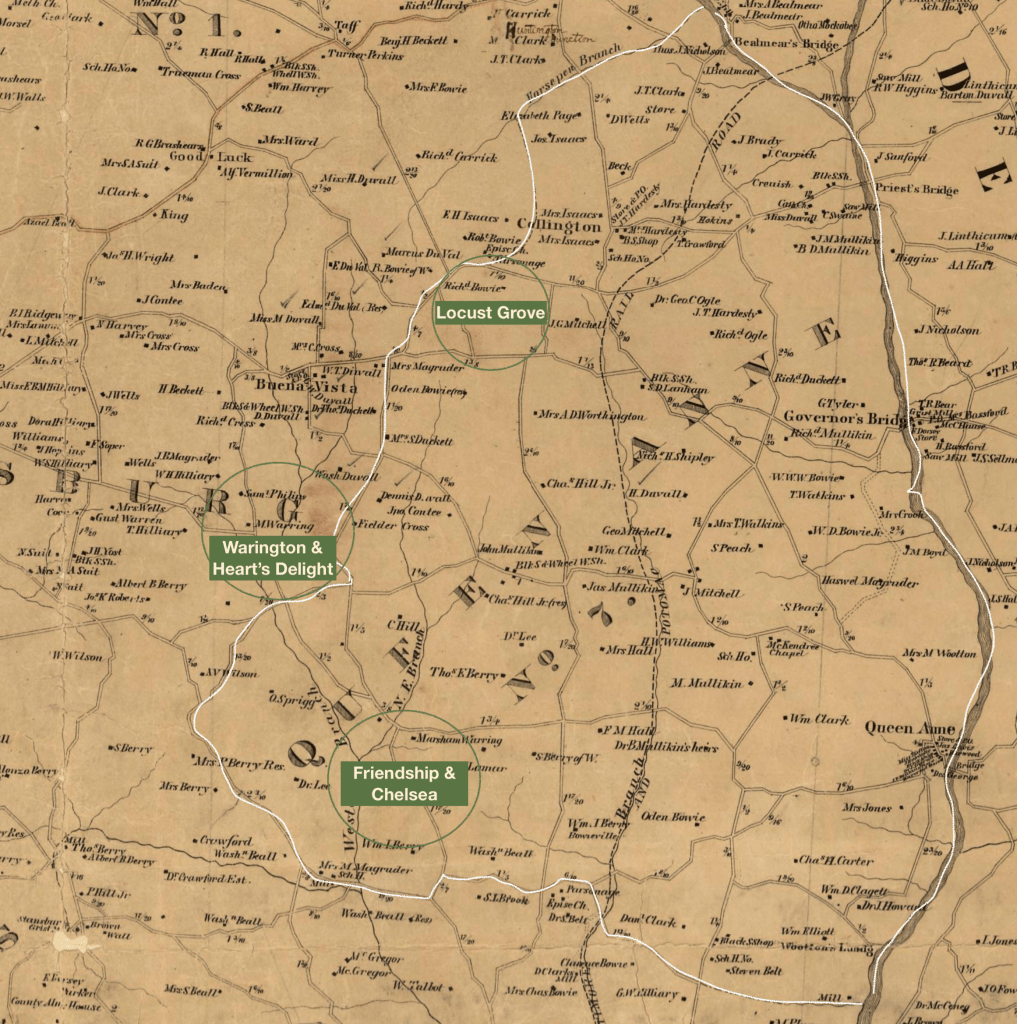
In 1870, Robert is living near Robert W. W. Bowie and his wife Elizabeth L Bowie, the daughter of Marsham Waring. The Bowies lived on the estate of Locust Grove, purchased for them by Waring. Robert Jackson is neighbors with Jacob Jones, another freedman from the estate of Waring. By 1880, he had moved near Woodmore, near other members of the Jones Family. The Jones family had been enslaved on the Waring estate as well.
Martha Jackson & Children
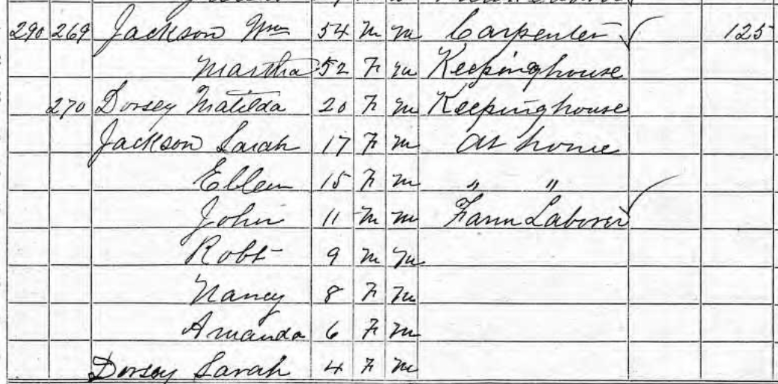
In 1870, Martha and her children have reunited with her partner William Jackson. They are living near Suitsville and William, in his work as a Carpenter, as acquired a bit of personal property. By 1880 William and Martha have moved near Robert Jackson, the inferred brother of Charles.
This chart shows the family trees with the sources for the inferred relationships. It is inferred that the William of the census records is the same William named in the James Belt Inventory and the White Marsh Baptism due to the geographic proximity to Robert and similar estimated birth year in the 1880 census record.
William is listed as a carpenter in the 1870 census. Interestingly, there is a Washington Jackson (estimated birth year 1811) that is also a carpenter who is living in Nottingham District of Prince George’s County. He is too old to be the Washington Jackson in the Marsham Waring Inventory and he could be a brother to William and Bachelor, and the Washington of the Marsham Waring Inventory could be a nephew named after the elder Washington.
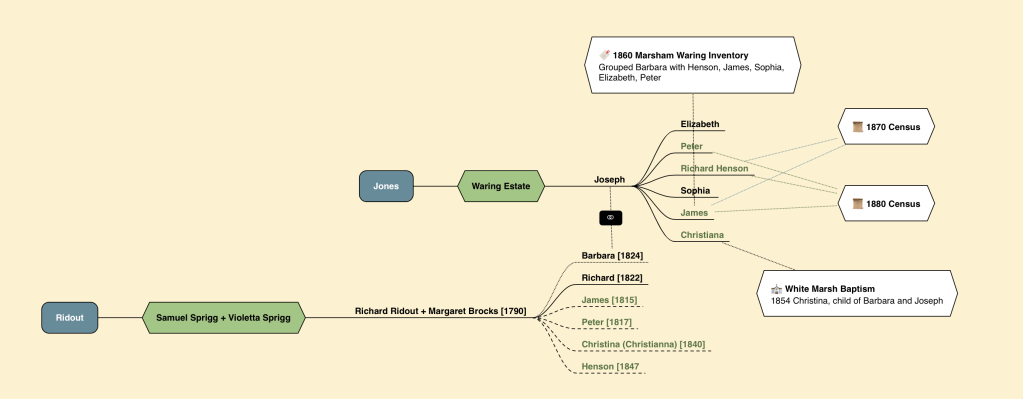
Joseph and Barbara had several children and lived on the Waring estates.
A White Marsh baptism record from 1854 gives a clue to her family before her union with Joseph. The priests recorded her family name as “Reyder”. Given the phonetic spelling of the priests who were not English, it suggests the possibility of Barbara being related to the Ridout family.
Peter and Priscilla Ridout, Inferred Brother
In the 1867 Commission on Slave Statistics, the estate for James Waring (dec.) submitted a compensation list that included other Ridouts:
Family Name
Given Name
Age
Ridout
Priscilla
37
Ridout
Eliza
22
Ridout
Henny
2
In the 1870 Census, Priscilla can be found in a household with Peter Ridout, which suggests that Priscilla’s family name is not Ridout, but adopted upon her union with Peter. Peter appears on a compensation list submitted by Violetta Sprigg, the widow of Samuel Sprigg, the former governor of Maryland. In 1870, Peter and Priscilla are living in Bladensburg, next door to Charles H Hays. They are also living within the vicinity of Alex McCormick, Barbara Jones’ neighbor in 1870.
1870 Census for Bladensburg District, Prince George’s County | ancestry.com1861 Martenet Map of Prince George’s County with annotations marking McCormick, Hays, the Waring estate and the Sprigg estate | loc.gov
In 1880, Peter and Priscilla have moved into the District along Central Avenue, just as Joseph and Barbara have moved from McCormick’s farm to Central Avenue. Joseph and Barbara Jones are enumerated at household 169, while Peter and Priscilla are enumerated at household 171.
The likelihood of Peter and Barbara being siblings is based on a few things.
Joseph and Barbara named one of their sons Peter, who would continue to live in the District near Central Avenue into the 20th century. It would appear they named Peter after Barbara’s brother Peter.
Peter and Barbara’s estimated birth years: Barbara has an estimated birth year of [1829] based on the 1870 census, while Peter has an estimated birth year of [1817]. They are approximately 12 years apart; this difference falls within the range of a woman’s typical child-bearing years of 15-45 (or 30 years).
Their geographic proximity to each other both prior and after emancipation. They resided on neighboring estates and left the immediate vicinity of the estates after emancipation and lived near each other after emancipation.
Ridouts of Sprigg’s Northampton Estate
Violetta Sprigg submitted not only the name of Peter Ridout to the 1867 Commission on Slave Statistics, but also the names of other Ridouts.
Family Name
Given Name [Name]
Age
Ridout
James
50
Ridout
Peter
48
Ridout
Peggy [Margaret]
66
Ridout
Hanson
18
Ridout
Christianna [Christina]
25
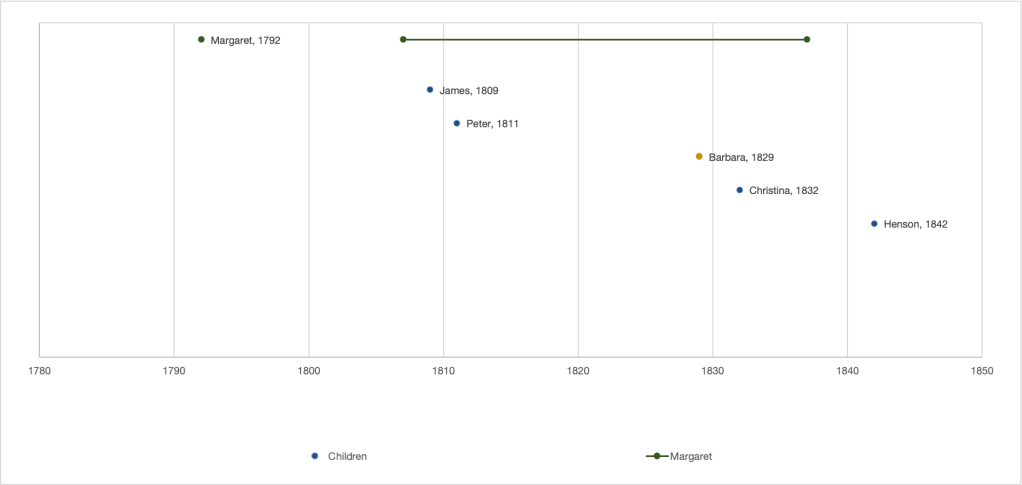
Based on her age, Margaret (Peggy) Ridout is assumed to be the mother of the family group. The chart below was created to evaluate the likelihood that Margaret (Peggy) is the mother of the other Ridouts.
Using Margaret’s birth year, we can estimate her child-bearing years as when she was 15-45. In the 1870 census, Margaret (Peggy) Ridout is listed as 80 years old, which indicates it’s likely an estimated age, though it places her birth year as 1790. In the 1867 Prince George’s County Slave Statistics, she is 66, giving her an estimated birth year of 1801, a full decade later; while in Samuel Sprigg’s 1855 inventory, she is listed as 63, giving her an earlier estimated birth year of 1792, closer to her 1870 census age. For purposes of the chart, we will use the ages in the 1855 inventory, as it appears that the compiler of the compensation lists for the Prince George’s County Slave Statistics used the ages in the inventory.
Margaret is shown with her birth year mark and a line drawn to represent her child-bearing years, and her children’s estimated birth years are plotted as well. James and Peter appear to have been born toward the beginning of her child-bearing years while Christina was born later in her years. Henson falls outside of the 15-45 year range, though within a margin of error of five years.
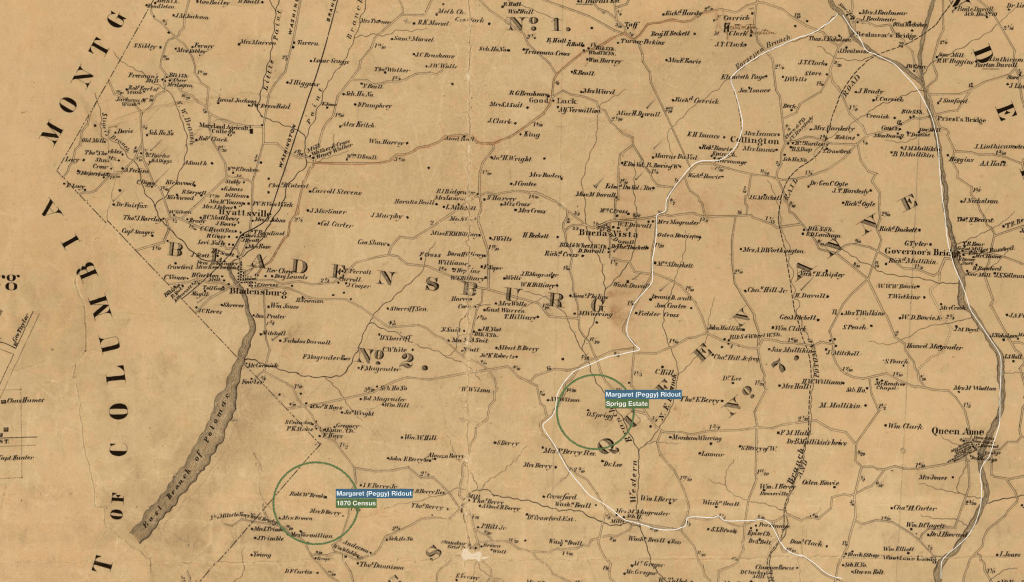
In 1870, Margaret has also left the Sprigg estate and moved closer to the District. She is living in the household of [Geo R] Wilfred Marshall, a neighbor of Robert W. Brooke.
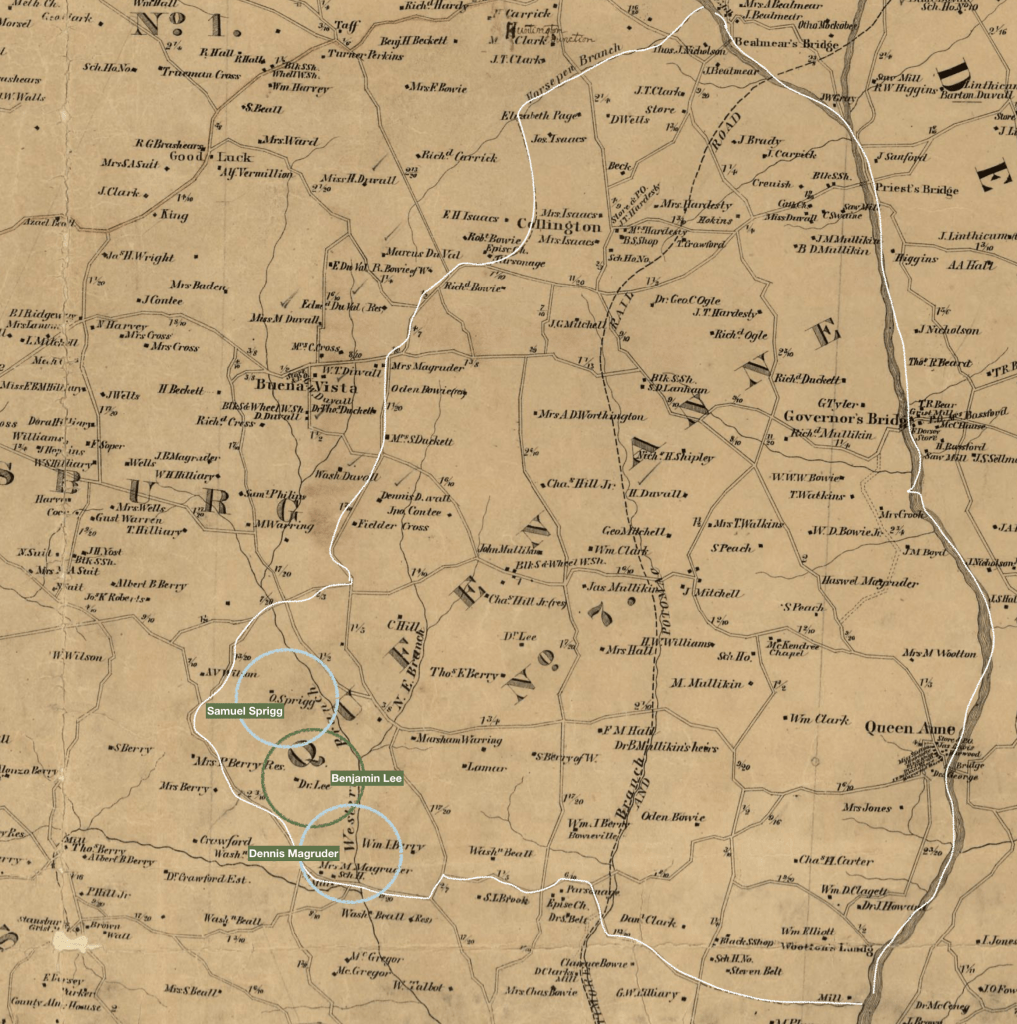
Annotated Excerpt of 1861 Martenet Map of Prince George’s County marking the Sprigg Estate and household of Robert W Brooke | loc.gov
Also living in the household is Christy Ann [Christina] Beall. She is 35 years old with an estimated birth year of 1835, which suggests she is Christina (Christianna) Ridout, the inferred granddaughter of Margaret (Peggy) Ridout and is confirmed by her son’s death certificate. In 1911, Daniel Bell (Jr.) died in New York City, where he had migrated and was working as a driver. His death certificate lists his parents as Daniel Bell and Christina Ridout.
1870 Census for Bladensburg District, Prince George’s County | ancestry.com
In 1822, the priests of White Marsh recorded a baptism of Richard, the son of Richard Ridout and Margaret Brockx [sic]. The transcriber proposed the family name Briscoe in brackets. However, based on the family names of other people enslaved by the Spriggs in the 1867 Prince George’s County Slave Statistics, I suggest the surname Brookes. This will be explored further in a different post.
Patterns in Given Names
When looking at the given names of the enslaved, it is ambiguous who gave the name. Was it the parents, or was it the enslaver?
When looking at names of those born within the 18th century, and especially earlier in the century when Maryland planters were importing larger numbers of Africans to labor on their fields, it is more likely the names were imposed on the Africans by the Marylanders. In later generations, especially after the abolishment of the international slave trade in 1808, the names originally given by the Marylanders to the first generation of African appear to be given to their African-American descendants by their parents and grandparents as a way of marking kin groups within a world that cared little for their families and relationships.
The identified generations of Ridouts have names that repeat across the generations, suggesting kin groups.
Generation 1
Two white-generated source documents allow us to identify the first generation of Ridouts living in the vicinity of the Waring/Sprigg estates along the Western Branch of the Patuxent River:
the White Marsh baptism record that identifies Margaret’s (Peggy) partner as Richard
a War of 1812 claim for two enslaved people (more about War of 1812 claims in general can be read about on the Maryland State Archives site)
In 1828, Tilghman Hilleary, a neighbor of Marsham Waring, sought compensation for the Andrew and Peter Ridout, who runaway from the Hillearys during the War of 1812.
Born before 1808, it is possible that Richard, Andrew and Peter were forced to migrate from Africa to Maryland as laborers. However, due to a common family name, it is likely that Peter, Richard and Andrew are born in Maryland to enslaved Africans or African-Americans. Their exact relationship to each other is unknown; the common family name suggests brothers or cousins. Given the few number of Ridouts identified in the Prince George’s County records (e.g., the Prince George’s County Slave Statistics, the White Marsh Baptism records, the 1870 census), it seems more probable that they are brothers, rather than cousins, from a father brought to Prince George’s County by his enslaver (either by the Hilleary or Sprigg families, who appear to be an intertwined family themselves in previous generations).
Peter’s name gets repeated in later generations.
Generation 1 Names
Peter
Andrew
Richard
Generation 2
Shifting to the second generation, or specifically the children of Richard Ridout and Margaret (Peggy), we can identify the children from the Samuel Sprigg Inventory, the Prince George’s County Slave Statistics and the White Marsh records. No doubt there are as yet unidentified children of Richard and Margaret.
Of note, Richard and Peter are repeated. Richard (Jr.) is mostly named after his father, while the use of Peter for their other son, suggests that Peter (Sr.) was a close relative. The use reinforces the idea that Peter, Andrew and Richard of Generation 1 were brothers.
Generation 2 Names
Peter
James
Richard
Henson
Christina
Barbara
Possible Generation 2
One of the possible unidentified children of Richard and Margaret may be the partner of Sophia Ridout, claimed by John Contee’s administrator in the Prince George’s County Slave Statistics. She may also be partnered with either James or Richard. No other records related to Sophia and her children have been identified. Contee’s list did not name an adult male Ridout, suggesting that he may have been enslaved on another estate, leaving open the possibility that he was James, Richard, and Henson.
She uses the name Richard (Dick) for her son, likely named for either his father or uncle.
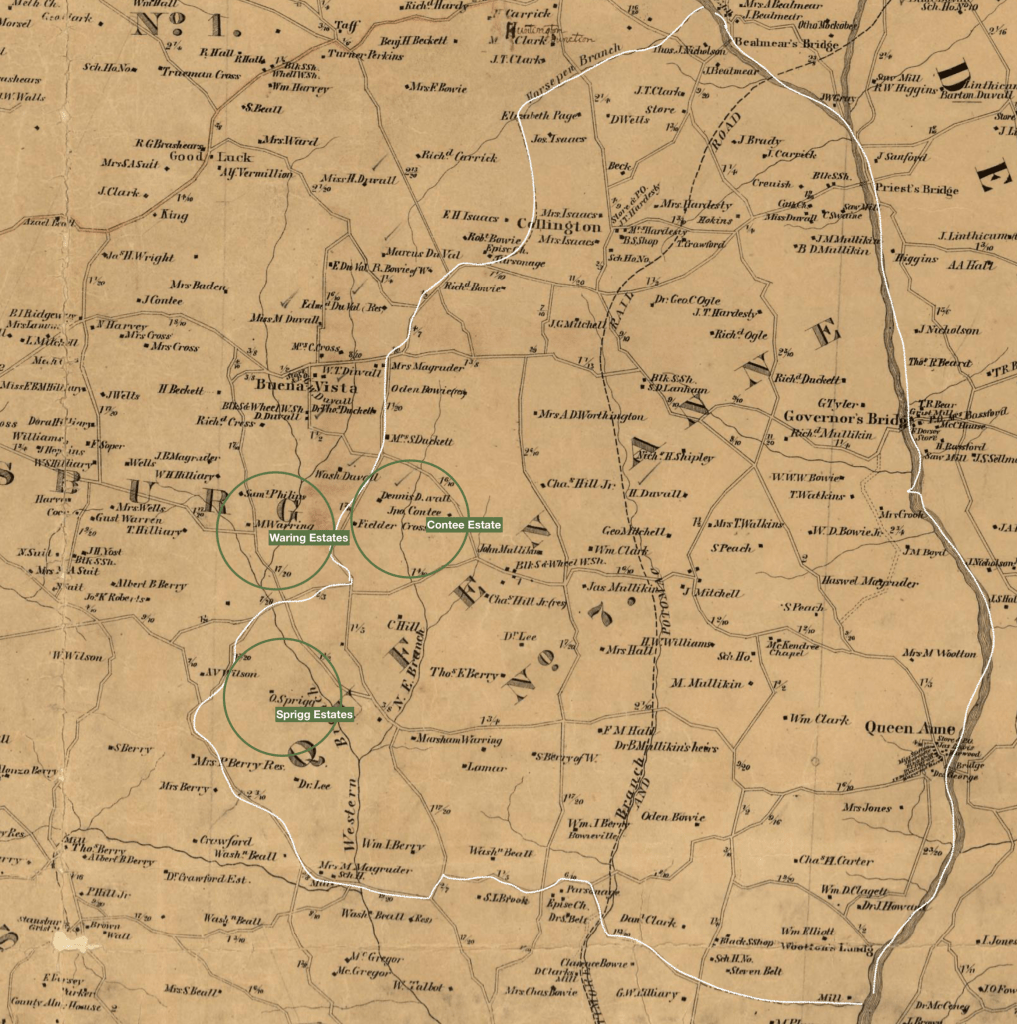
Contee’s estate was in the same neighborhood of Waring and Sprigg.
Generation 3
This generation brings us to Barbara (Ridout) Jones, who initiated the line of inquiry. She was identified in the White Marsh record as Barbara Reyder. The names of her children reinforce the idea that she was a Ridout descended from Richard and Margaret.
The use of White Marsh Baptism Records, the Prince George’s County Slave Statistics, and the 1870 & 1880 Census records allows us to identify the following children for Barbara (Ridout) Jones:
Four out of six of Barbara’s children share the names of her inferred siblings. The fifth child, Sophia, shares a name with the inferred sister-in-law, Sophia, who lived with her children on the neighboring Contee estate.
Generation 2 Names
Generation 3 Names
Peter
Peter Jones
James
James Jones
Richard
Richard Henson Jones
Henson
Richard Henson Jones
Christina
Christina Jones
Barbara
Tentative Conclusion
The use of repeated given names across generations; the proximity to other Ridouts on neighboring estates, along with proximity after emancipation as they congregated toward Seat Pleasant and Lincoln suggests that Barbara was a child of Richard and Margaret Ridout.
Richard (Dick) Jones and his wife, Mary (Polly) were born at the end of the Revolutionary War and lived until the start of the Civil War in Queen Anne District of Prince George’s County. The vast majority of their life was spent on the estates of Marsham Waring. They and their children labored for Waring and his three children, as well as neighboring estates. This post explores the life of one of their sons, Nicholas Jones.
Nicholas Jones was one of the younger sons of Richard and Mary born toward the end of Mary’s estimated child-bearing years (1795-1825), when she was 15 to 45 years old. If my theory is correct about Richard’s forced migration from Stephen West to Marsham Waring (see connected post), then Nicholas was named after his grandfather, Nick.
He labored on the Waring estate “Heart’s Delight”, which was in Bladensburg District near Buena Vista, near the Warington estate where his parents lived and labored. His wife and children labored on a neighboring estate owned by John B Magruder.
Nicholas and Martha had several of their children baptized by the priests of White Marsh.
1853: Richard Euseb., son of Nichol. [Johns] & [?] Williams, property of J. Magruder; Sponsor: Chas. Gasebeth
1856: Robert, son of Nichol [John] + Martha Williams, property of John Magruder; Sponsor: Thomas Allen
1858: Lucy, of Nic Jones & Martha Anne, property of J. Magruder; Sponsor: Susan
1862: Nicholas, of Martha & Nich Jones, col.; Sponsor: Carolina Green
In May 1862, a group of enslaved people from Waring’s estates fled to DC with James Waring, Marsham’s son, pursuing them. He swore out an affidavit, swearing that they were enslaved in Maryland, not the District, and therefore he was lawfully able to seek their return to bondage. Some of those named in the affidavit were Nicholas’s siblings, Joseph and Richard. Nicholas was not named, however, he is living in the District in the 1870 Census, suggesting he joined them later.
In 1864, Martha and her children are listed in the Freedmen Bureau’s Registration list for Camp Springdale, without Nicholas, her husband. She was recorded as Jones, and some of her children were recorded as Johnson. A comparison of the lists of names in the Freedmen’s Bureau Record with that of John B Magruder’s list of enslaved people he submitted to the Prince George’s Commission on Slave Statistics for compensation however show similar given names and ages and is similar to the list of names found in the White Marsh baptismal records. Again, Martha’s husband, Nicholas Jones is not listed with them.
Records of the Field Offices For the District of Columbia, Bureau of Refugees, Freedmen, and Abandoned Lands, 1865-1870; NARA Series Number: M1902; NARA Reel Number: 21; NARA Record Group Number: 105; NARA Record Group Name: Records of the Bureau of Refugees, Freedmen, and Abandoned Lands, 1861 – 1880 | ancestry.com — Prince George’s County Slave Statistics Original Scans | Maryland State Archives
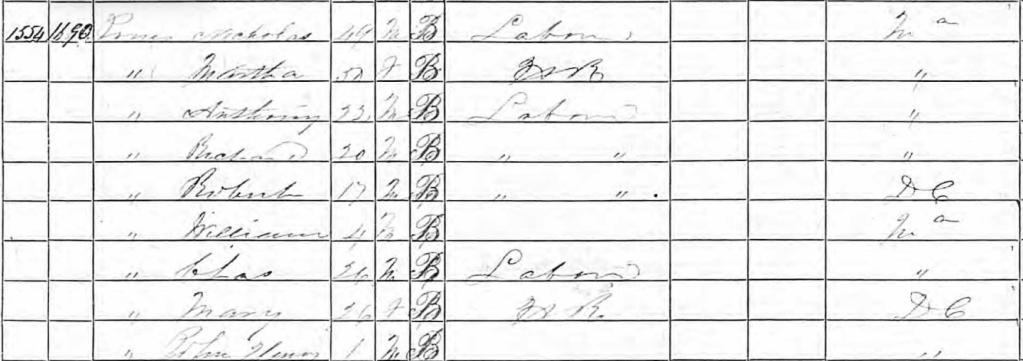
They are reunited by the 1870 Census. Nicholas and his wife lived with four of their sons; one of their sons, Charles, had married and his wife and children lived with them in the District. They worked as laborers. How and where they labored is unclear.
1870 Census, District of Columbia, Ward 6 | ancestry.com
They lived near D & 13th NE on the far edge of town, near the boundary with the county and along the road to Benning’s Bridge. Other siblings were found in the County near Benning’s Bridge in the 1870 and 1880 census records.
By October 1870, Martha, Nicholas’ wife had died of consumption, now more commonly called tuberculosis.
Annotated by author with residence’s of Nicholas Jones from City Directories | Entwistle’s handy map of Washington and vicinity : showing public buildings, churches, hotels, places of amusement, and lines of street rail roads. [1876] | loc.gov
After 1870, the lives of Nicholas and his children become obscured. Other than Nicholas consistently living in Ward 6, the family and its members are not reliably identified in the 1880 census records. A widowed Nicholas Jones is identified in the census, living on B Street SE, which would suggest it is the same Nicholas Jones. He is recorded as born in Virginia, though this could have been an error made by the census enumerator, as other senior members of the household are also listed as born in Virginia.
He is in the household of Frances Williams and her grown children; this suggests he moved in with one of his wife’s relatives, if this is the same Nicholas Jones.
A death record for 1899 lists Nicholas Jones, widowed, who was born around 1815. He was buried at Potter’s Field, part of the Washington Asylum, the “poor house”. It was located near where Nicholas Jones was recorded living in the City Directories.
Richard (Dick) Jones and his wife, Mary (Polly) were born at the end of the Revolutionary War and lived until the start of the Civil War in Queen Anne District of Prince George’s County. The vast majority of their life was spent on the estates of Marsham Waring. They and their children labored for Waring and his three children.
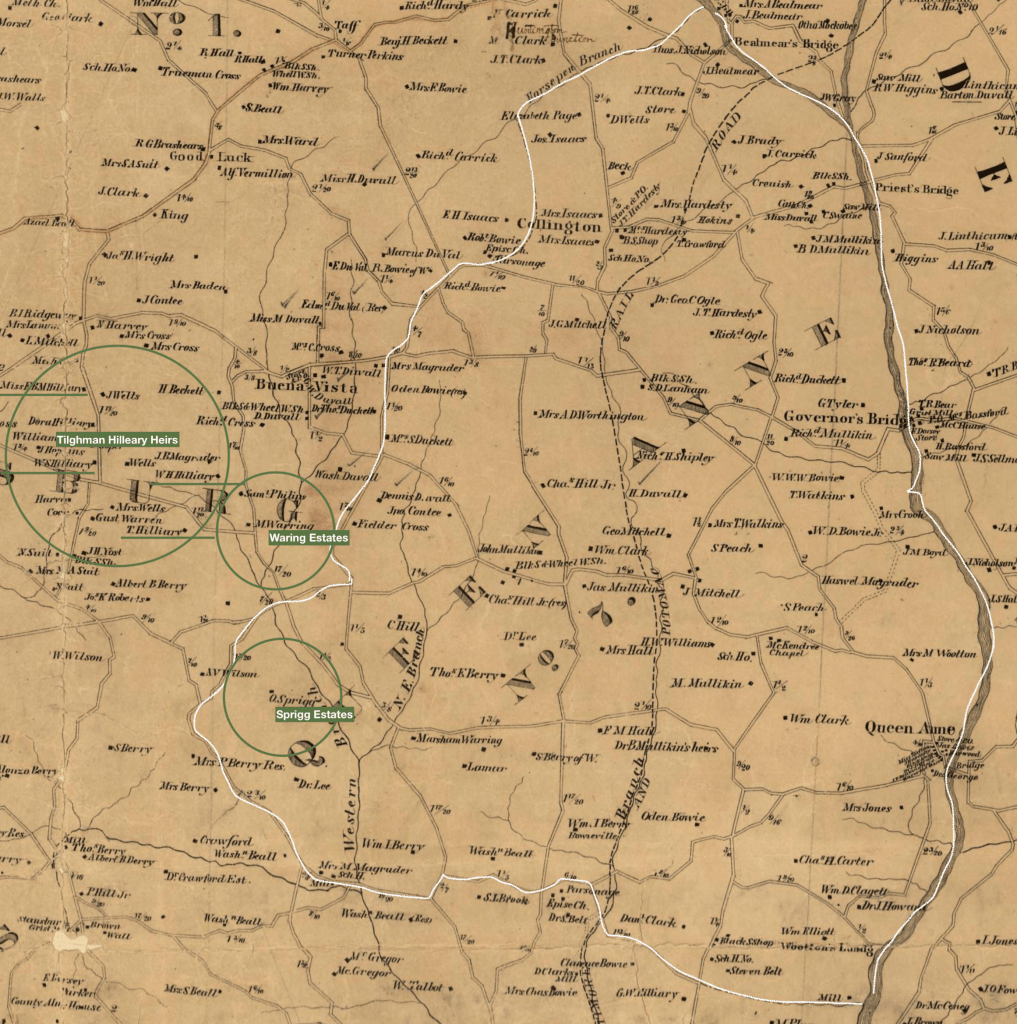
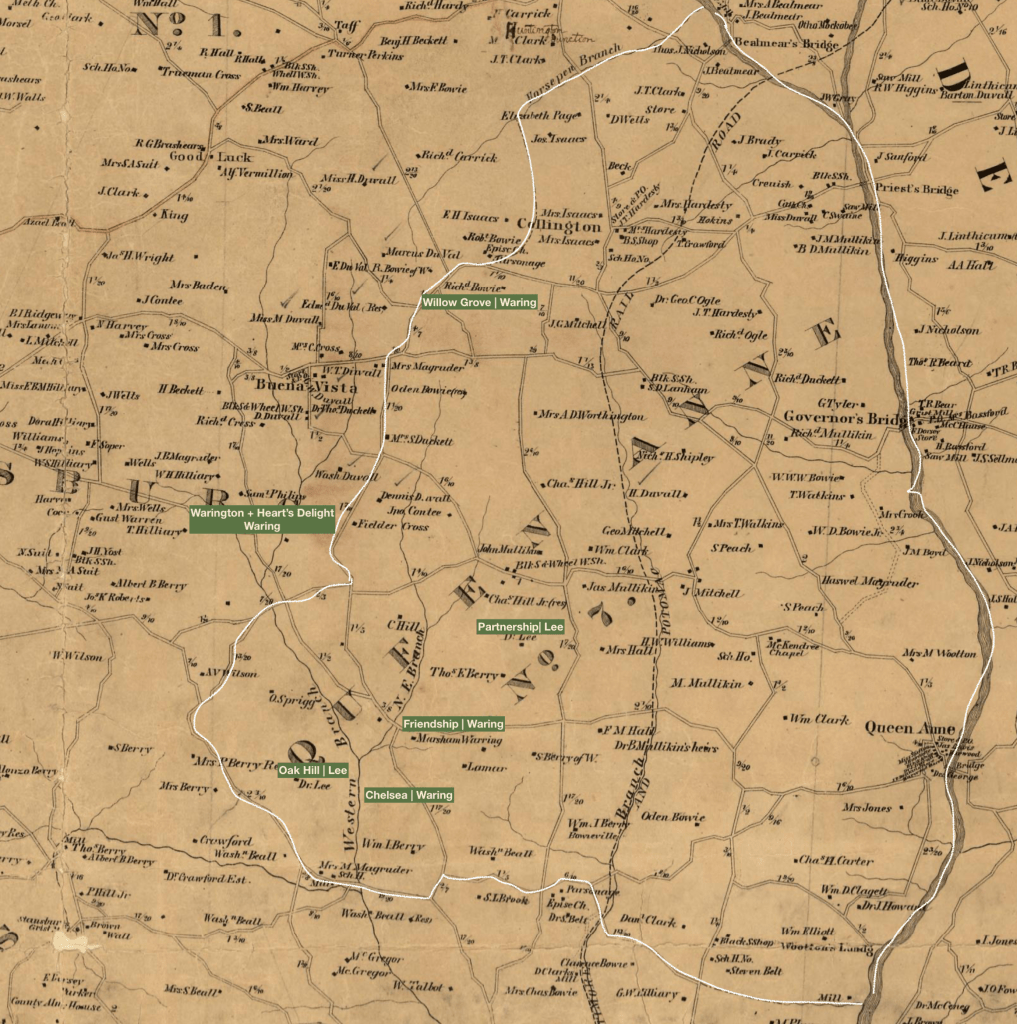
Annotated Excerpt from 1861 Martenet Map of Prince George’s County | loc.gov
Waring died in 1860 and his probate records and inventory (WAJ 2:321ff; not online) include the names of 106 people enslaved by the Waring family. Among them are “Dick + Polly, 80 years, each, $00.00”. Of the people provided an age on the inventory, they were the oldest.
Excerpt from Waring’s Inventory (WAJ 2:322)
As Daina Ramey Berry writes in her book, The Price of their Pound of Flesh, enslaved individuals have the external value imposed on them by the oppressor who commodified the enslaved and the internal value that she describes as a “spiritual soul value” that spoke to who they were as human beings. Their self-worth and value was not determined by the financial appraiser, rather the wealth of knowledge they brought to their families and community as they navigated being held in bondage on Waring’s estate over several generations. Between 1780 and 1860, they lived through four generations of children and grandchildren.
One of their children lived until 1900; when Elizabeth (Betsy) Fletcher died, the family members were able to identify her parents as Richard and Polly Jones.
Death Certificate from Maryland State Archives
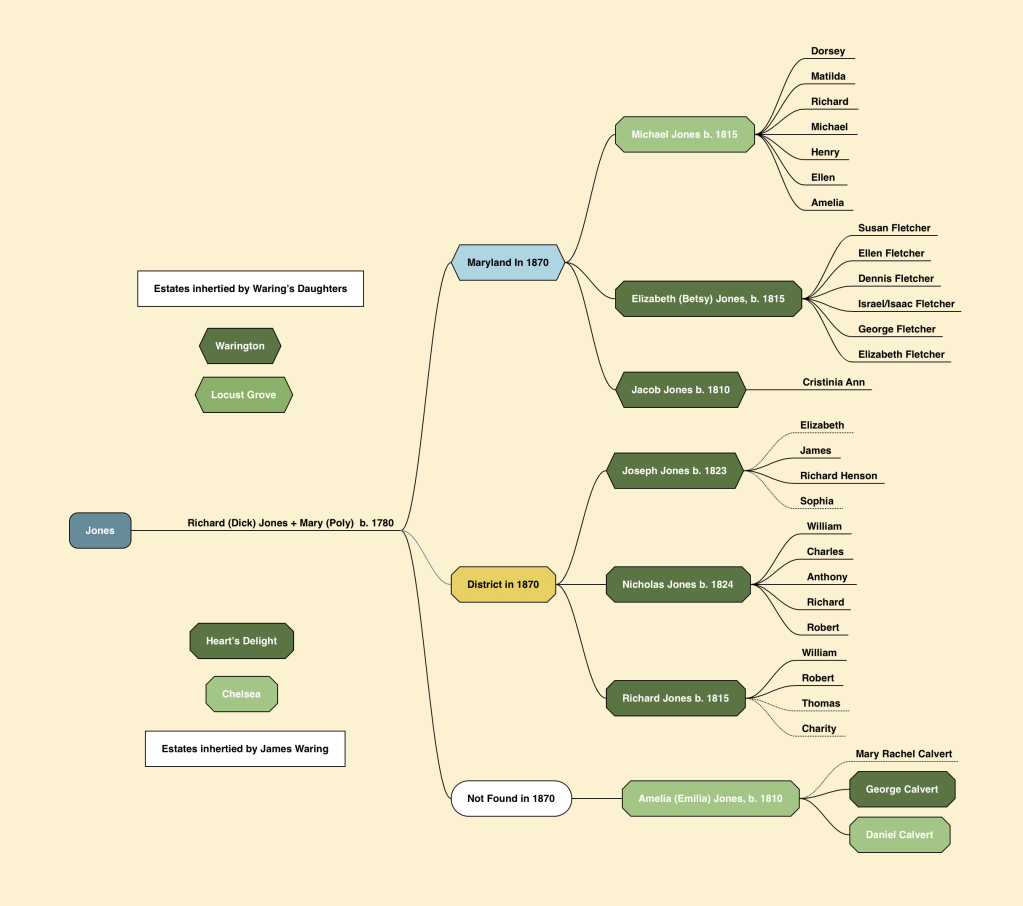
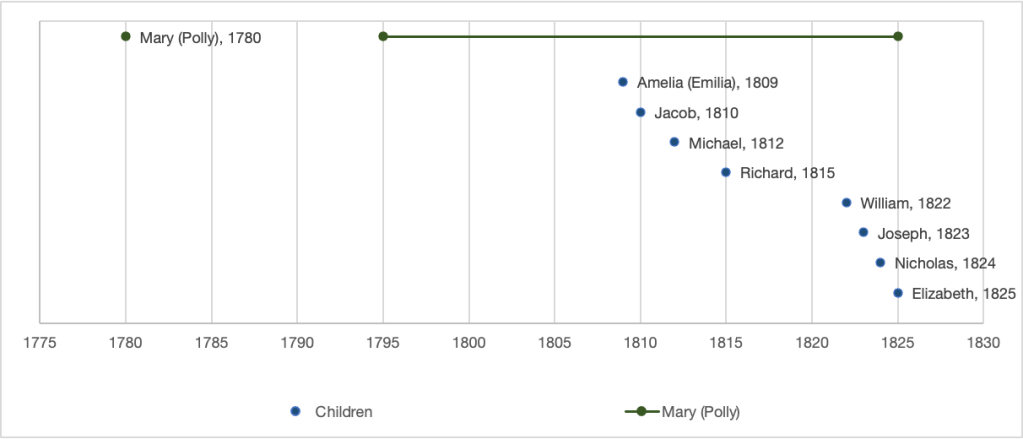
In addition to having identified Betsy Fletcher as their daughter, I have identified six additional children of Richard and Mary Jones, all enslaved by the Waring family. Due to the fragmentary nature of records related to enslaved people, there are likely unidentified connections among others he enslaved. Additionally, as other fragments are uncovered and pieced together, the connections may be redrawn.
Reconstructed from multiple sources | Subject to Change (Census, Inventory, Prince George’s County Slave Statistics, Death Certificates, White Marsh Baptism Records, Freedmen’s Bureau Records, Fugitive Slave Cases)
Berry wrote in her book that enslaved women were valued by some enslavers for “their fecundity” as their “increase consists of much of wealth”. For Waring, Mary’s children increased his wealth, especially as transatlantic slave trading was abolished in 1808 and enslavers had to rely on domestic trades or the “increase” of the people they enslaved to enlarge their slave community. In 1860, Richard and Mary’s children and grandchildren make up at least 20% of the people he enslaved.
Allan Kulikoff wrote in his book Tobacco and Slaves that “childbearing and the childrearing that followed, however were highly important rites of passage for most slave women. Once she had a child, she moved from her mother’s or parent’s home to her own hut”. Despite the threat of separation as a specter on the horizon for any enslaved family, families on large estates were less likely to be separated from their families as the landowners were able to weather fluctuations in the tobacco markets. As such, Mary and her children were able to maintain familial bonds despite the commodification of her and her children by the Warings and other “planters” who forced labor from them.
Chart showing Mary’s estimated child-bearing years and the children identified so far | Subject to Change
The kingroup is evident in records connected to the 1862 affidavit sworn by James Waring that documents the escape of several of the Jones family group to the District. This will be explored further in future posts. It is also evident in the 1870 and 1880 Census records as the nuclear families tended to live near one another, either in the District or in Prince George’s County.
Inheritance
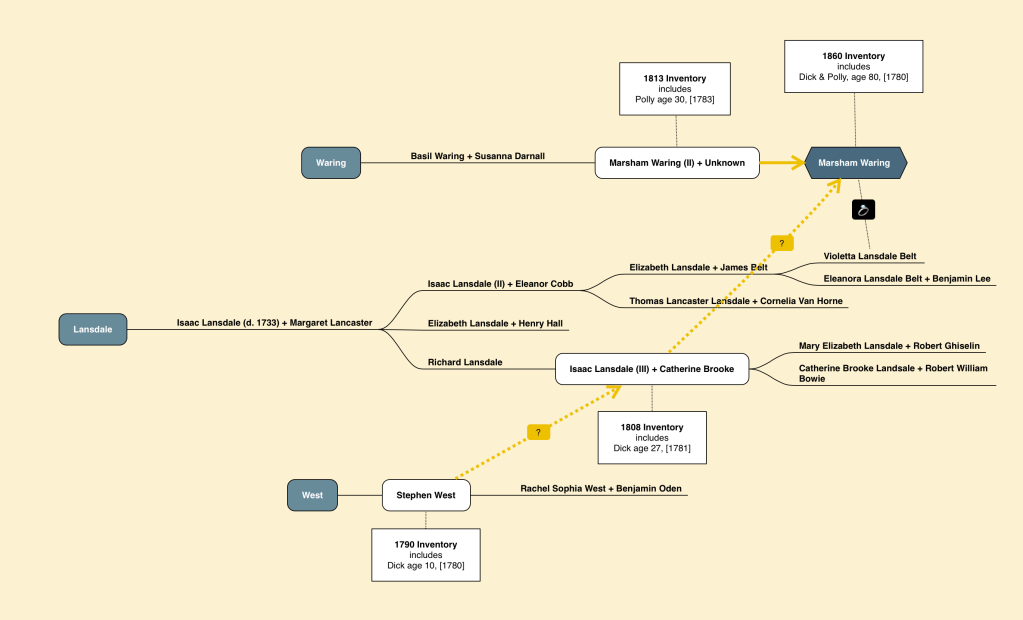
The following paragraphs hope to reconstruct the path that Richard and Mary Jones were forced to take prior to their enslavement by Waring. It is based on indirect evidence by matching names and ages in inventories of other enslavers in Prince George’s County who likely had connections with Marsham Waring. The search through inventories was not exhaustive. This path is based on indirect evidence and circumstances that suggest this as a possibility.
Marsham Waring was the son of Marsham (II) Waring, and grandson of Basil Waring, Jr and Susana Darnall. The Darnall family had connections with Stephen West, who acquired the Woodyard, which sat across the road from “Poplar Hill/His Lordship’s Kindness”. Isaac Lansdale (III) was the brother of Thomas L Lansdale, a merchant in Queen Anne, along the Patuxent River where a tobacco inspection site had been established in the 18th Century. They were both relatives of Violetta Lansdale Belt, Waring’s wife.
Reconstructed from information gathered from online family trees
Marsham Waring appears to have inherited the legal authority to enslave Mary (Polly) from his father, Marsham Waring (II) who left his estate, real and personal property to his son. In the 1813 inventory of his estate, Polly, age 30, with an estimated birth year of 1783 was listed. (TT 1:473). The inventory is sorted by gender and age, making it difficult to infer family groups. As opposed to Marsham Waring’s 1860 Inventory, which appears to be grouped by adult males and women with children. Some adult children are grouped with elderly parents.
There are at least two possibilities for Richard (Dick) Jones [1780]; these possibilities are not mutually exclusive, meaning the two inventories could possibly refer to the same man:
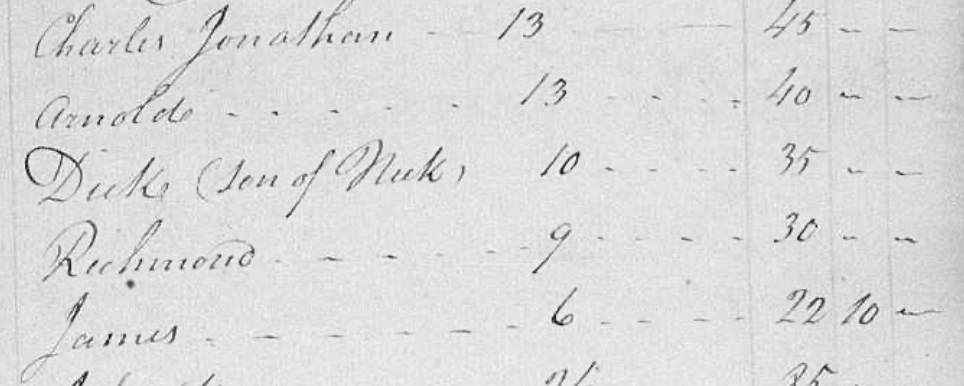
1790 Stephen West, the owner of the Woodyard and an enslaver of over a hundred people died in 1790. Among the inventory for his estate is Dick, age 10 [1780], who is notated as “son of Nick” (ST 3:47). This notation provides circumstantial evidence of a likely connection between the Richard of West’s Inventory and the Richard of Waring’s inventory as Richard Jones had a son named Nicholas, suggesting an older family member named Nicholas.
Excerpt from Stephen West’s Inventory
1808 Isaac Lansdale (III), the son of Richard Lansdale, died prior to 1808 when his inventory was created. Among this inventory is Dick, age 27 [1781].
Stephen West or one of his heirs may have conducted business with the Lansdale family, who had mercantile trade in Queen Anne, which may have resulted in use of Dick to settle a debt or purchase. Lansdale, in his relationship to Waring as a cousin of Waring’s wife may have gifted or traded Dick, as well.
Did James (Jim) Stewart (b. about 1800) have a son named James Stewart?
James Stewart, Senior
James Stewart (Sr.) was living in Queen Anne District of Prince George’s County after emancipation in 1864. He was residing near the estate of Dr. Benjamin Lee who had died during the war.
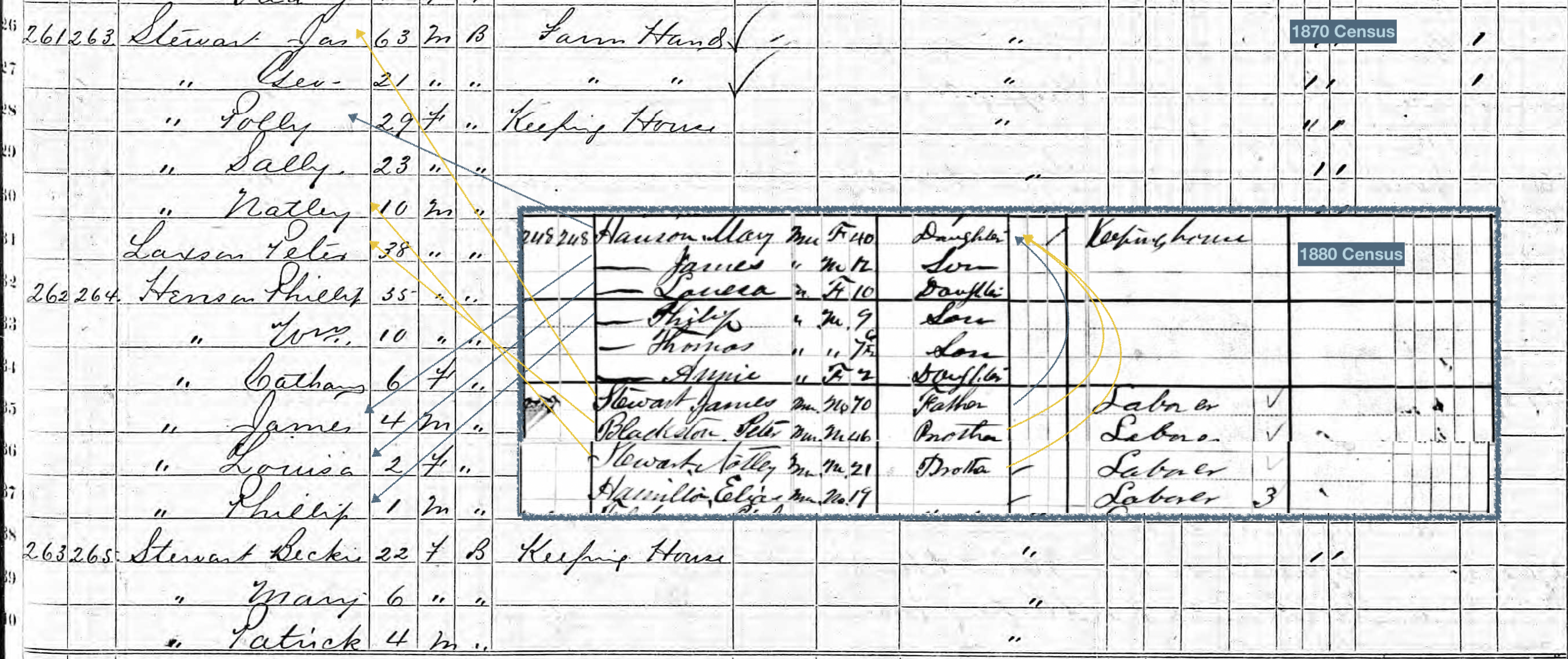
He lived with his inferred children, George, Mary (Polly), Sarah (Sallie), and Notley as well as Peter Laxson (Blackstone), and is neighbor to Philip Hanson and Beckie Stewart. The 1870 census record for James Stewart is best understood when compared to the 1880 census record for James Stewart, which identifies the relations between the households.
1870 Census with overlay of 1880 Census
Not present in the 1880 Census record are Sarah (Sallie) Stewart, who married Washington Lee in 1870 and established a separate household nearby and George and Rebecca (Beckie) Stewart who also established a separate household nearby.
The comparison of the two census records show however, that James Stewart was the head of a family with several adult children.
James Stewart, prior to Emancipation
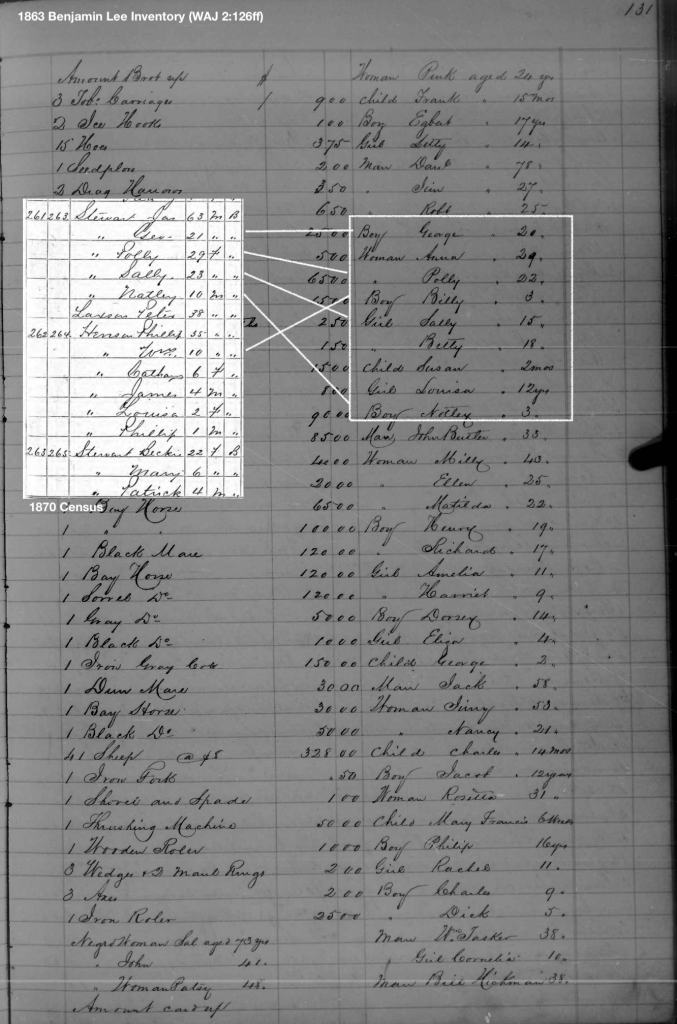
In the 1870 Census, James Stewart and his children are enumerated directly after the heirs of Dr. Benjamin Lee and an overseer, suggesting that they lived near “Oak Hill”, the Lee estate.
1870 Census
Dr. Benjamin Lee was the brother-in-law of Marsham Waring. Both owned considerable amounts of property in the area. They married the daughters of Captain James Belt, who had bought parts of Chelsea from another branch of the Belt family and who conveyed the tracts to his daughters. Lee also acquired tracts of land from Northhampton, Partnership and other parcels. Waring also acquired land from nearby families, purchasing land from the Hillearys and the Bowies.
Lee and Waring died within a few years of each other. Marsham Waring died in 1860, and his wife in 1863. His probate records include an inventory (WAJ 2:323) with the names of the people enslaved on four separate estates. Benjamin Lee died in 1863 and also includes the names of those he enslaved (WAJ 3:127). Waring heirs, (his two daughters and son) had compensation lists submitted to the Commission on Slave Statistics which provided both a first and last name with an age for many. This allows us to identify the people on the Waring Inventory and which estate they were forced to labor on. Lee does not have a similar compensation list, and so identifying the people he enslaved requires more records to ensure identification of them.
James (Jim) Stewart is included in the Waring Inventory and in the list made by Waring’s daughter, Mrs. M. Virginia Mackubin [sic] for the Commission on Slave Statistics. In both documents he is listed as 50 years old. He labored for the Warings on the Warington Estate . He is the only James Stewart listed on the three compensation lists. The children in the inventory are not listed in the Waring inventories or compensation lists, rather they appear to be included in the 1863 Lee Inventory .
Lee’s inventory includes the names of James Stewart’s children as well as Mary’s oldest son, with ages that are comparable to the ones in the census. (As always there is some variability with ages for those enslaved, as the exact birth year is not always known by the enslaver or the person enslaved.)
Lee Inventory with overlay of 1870 Census
The Warings were Catholic and many of the people they enslaved were baptized by the priests of White Marsh, the Jesuit Plantation in Queen Anne District. The Early Records of White Marsh, Book Three contain baptismal records from 1853-1872.
In 1858, John Henson was baptized, the son of Nancy (Ann) Fletcher and James Stewart. The priests marked them “property of Marsham Waring.” Notley Stewart acted as a sponsor/godparent; this Notley Stewart is an older Notley, not the child in the 1870 Census. In the 1860 Inventory of Marsham Waring, listed two below James (Jim) Stewart, is Notley, age 30. He is also on the list submitted by M. Virginia Mackubin [sic].
In 1860, George Antony was baptized as James and Nancy Steward, with Elizabeth (Bezzie) Fletcher as sponsor/godmother.
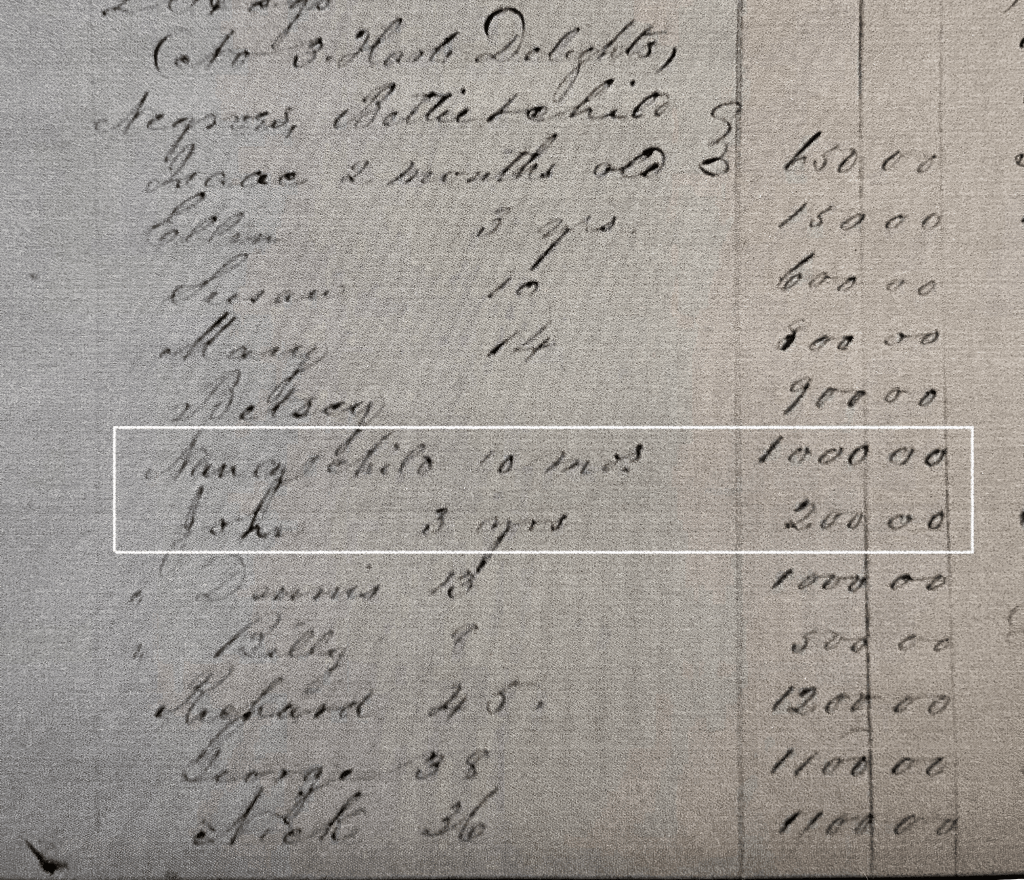
Ann (Nancy) Fletcher was enslaved by the Warings on the estate “Heart’s Delight”, which was inherited by James Waring. She was included on James Waring’s compensation list, as was “child of Nancy” [George Antony] and John. Above her is Betsy, who may be the same Elizabeth (Bezzie) who stood as sponsor at the baptism of the infant.
Marsham Waring Inventory
With only the census record, it was an assumption that the James Stewart mentioned in these records was James Stewart (Sr.). However, a registration list from the Freedmen’s Bureau with an 1870 Census record from the District of Columbia suggests that the James Stewart of the baptismal records is not James Stewart (Sr.), rather James Stewart (Jr.).
Flight to the District of Columbia
After slavery was abolished in the District of Columbia in 1862, the people enslaved in the neighboring jurisdictions saw an opportunity to grab freedom for themselves. Despite the fact that the roads toward the District were monitored by constables and private patrols, many of the people forced to labor fled their captivity and made their way to the District. Barbara Jeanne Fields wrote in her book, Slavery and Freedom on the Middle Ground that “Many an ex-fugitive later reported having left Maryland for the District during or after the spring of 1862. Families packed up such of their possessions as could be compactly assembled and departed, sometimes appropriating means of transportation from their owners.” (111)
As such camps were built in and around the District to house the incoming refugees from chattel slavery. One such camp was Camp Springdale which was made up of tents on the grounds of the “Arlington Estate”, owned by Robert E Lee’s wife. At the start of the Civil War, the Union Army occupied the site and the soldiers gave protection to fleeing refugees. Other camps were built in and around the District.
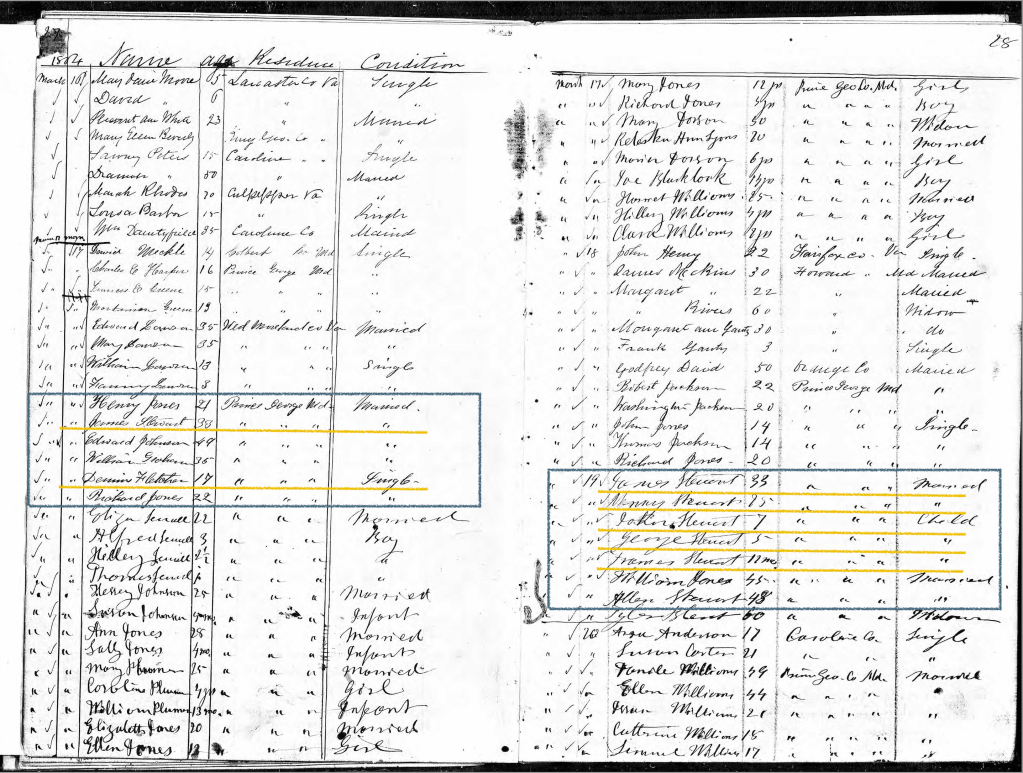
A registration list for Camp Springdale lists its residents and their former residence along with whether or not they are married.
In March 1864, James Stewart appears to have been registered with a group of male refugees. On March 17, James is listed with other men with the surname Jones and a Dennis Fletcher. Dennis Fletcher also appeared on the 1860 Marsham Waring Inventory, after Nancy and her children. This suggests he is a younger brother of Nancy, and therefore brother-in-law of James. James is 33 years old.
Then, on March 19, a 33 year old James Stewart is listed with Nanny Stewart, and the children, John, George, and Francis. The ages of John and George are consistent with the ages in the baptisms. This suggests that James of the baptismal record is not James (Sr), rather James (Jr.)
The National Archives in Washington, DC; Washington, DC; Records of the Field Offices For the District of Columbia, Bureau of Refugees, Freedmen, and Abandoned Lands, 1865-1870; NARA Series Number: M1902; NARA Reel Number: 21; NARA Record Group Number: 105
A review of Benjamin Lee’s inventory shows a Jim, age 27, above the identified area that contained the other names of James (Sr.)’s children. His age is consistent with that of James (Jr) who gave his age as 33 to the registrar at Camp Springdale.
Lee Inventory
1870
After the war, James and Nancy stayed in the District of Columbia. They lived in Ward 5, with James working as a scavenger. They are living with Elizabeth Fletcher, age 23, who has a son, Louis.
Update
The White Marsh Baptismal Records Book 4 contains earlier baptism records than Book 3 (1819-1833) and contains a baptism record for James, born 1832, son of “James Stuart, slave of Master Warring” and “Suky, slave of Dr. Lee in Marlborough”. This would be consistent with the 33 year old James Stewart who escaped to the District of Columbia.



















 stories of Then