Basil Medley, USCT

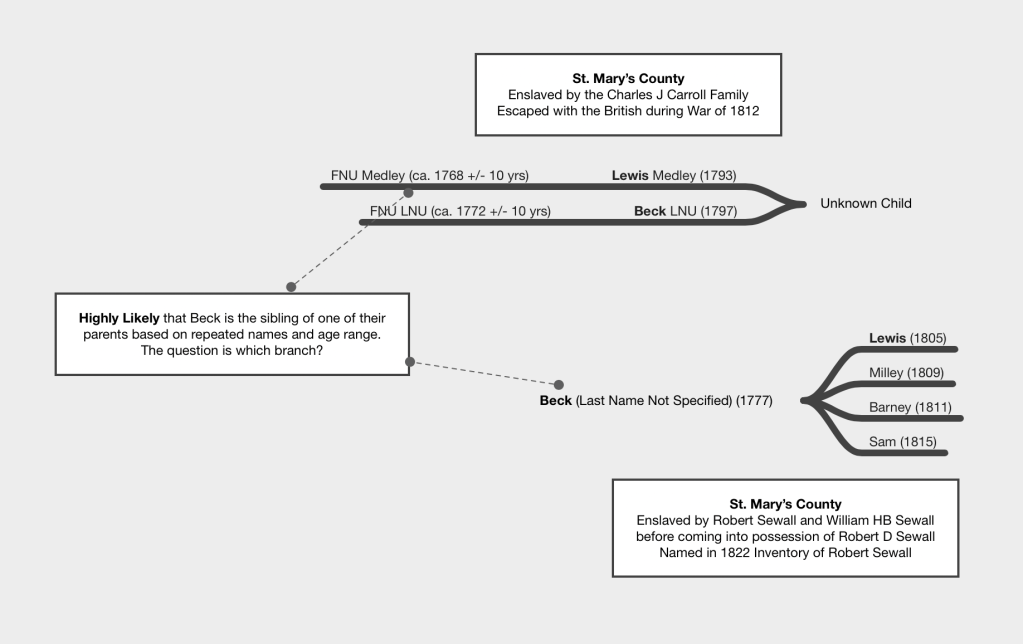
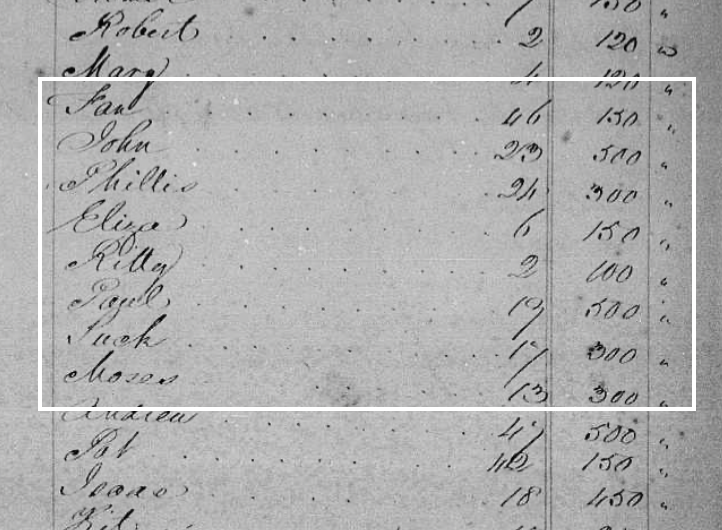
Lewis and Beck Medley, enslaved by Carroll family in St. Mary’s County escaped slavery by leaving with the British during the War of 1812. In the post [Lewis and Beck Medley | the British came], I speculated that because the Carroll family were neighbors to the Sewall family and both the Carrolls and the Sewall enslaved family groups with the names Lewis & Beck, that Lewis & Beck Medley may have been related to the Beck family group listed in the 1822 Robert Sewall Inventory of St. Mary’s County Property [TT 5:25].

1814 Claim1822 Inventory
Lewis Medley, 21 [1793]Beck, 45 [1777]
Beck Medley, 17 [1797]Lewis, 16 [1806]
Milley, 13 [1809]
Barney, 11 [1811]
Sam, 7 [1815]

Compensation for “Manumission”

Further documentation has been found to provide more information about the relationship between the two families.

In 1865, the Dangerfield Heirs of Robert D Sewall’s estate filed multiple Deeds of Manumission in Prince George’s County Land Records [FS 3:33-41 | mdlandrec.net]. These manumissions were filed in August 1865, almost a full year after the passage of the November 1864 Maryland Constitution which emancipated all enslaved people in Maryland. The manumissions effectively did not change the status of the named individuals as they had been previously freed by the State of Maryland.

Instead, these manumissions were filed in hopes of compensation for slaves who had been used by the US Army. In 1863, the US Government began to compensate slaveholders for the enlistment of enslaved people if they could prove their status. By filing the deed of manumission, the enslavers hoped to prove ownership of the enslaved people and receive $300 “upon filing a “manumission” or deed of ownership”. [US National Archives]. Multiple enslavers named those they had enslaved who enlisted in the FS Libers of the Prince George’s County Land Records. Some enslavers named the date of enlistment and the regiment within which the enslaved mustered. In the eleven manumissions filed by the Dangerfield Heirs, none stated a date of enlistment or regiment.

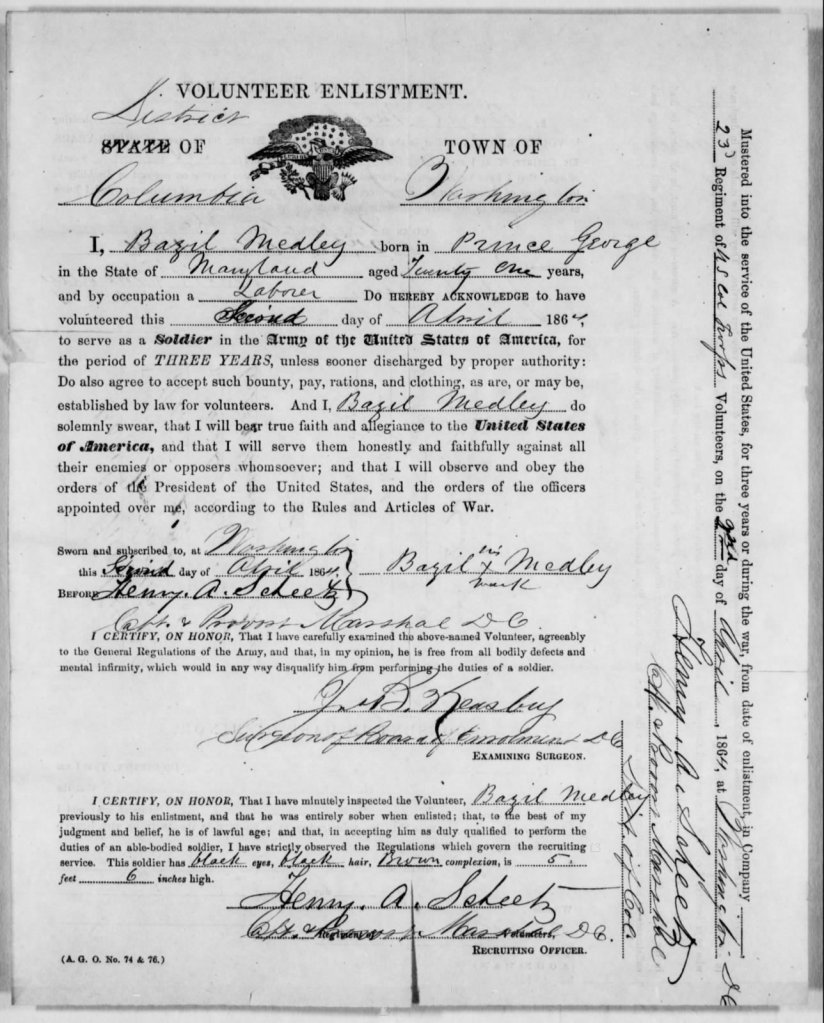
Basil Medley was one of the enslaved people named in the manumissions by the Dangerfield Heirs. USCT records have been located for him under the name “Bazil Medley” (fold3.com | ancestry.com)

Basil Medley was described as a 5 foot 6 inches man, 21 years old. He had brown skin with black eyes and hair. His birth (likely 1843) was listed as Prince George’s County, about ten years after Robert D Sewall inherited the St. Mary’s property and three years after Robert D Sewall sold the St. Mary’s property to George Forbes in 1840, consolidating his holdings in Prince George’s County.

Basil Medley enlisted into Company H of the 23rd Regiment in Washington DC in the spring of 1864. He signed his enlistment papers with his mark.

1853 Inventory

In the 1853 Robert D Sewall Inventory [JH 2:699], there is a family group that included the names Lewis and Basil.

It is in the portion of the inventory that lists the people “gifted” to William P Brinham and on the property in his possession. Brinham was a friend of both Robert D Sewall and Sewall’s brother, William HB. William HB Sewall had inherited the St. Mary’s property from his father in 1820 and upon his death in 1832 had devised it to Robert D Sewall. In the 1840s, Sewall had conveyed some of those who had previously been enslaved in St Mary’s county to Brinham [JBB 3:587]. Listed in the deed are “Louis and his wife Maria, and their children, to wit: Mary and John Louis.”

These names correspond with the first two children listed in the Lewis family group in the 1853 inventory.
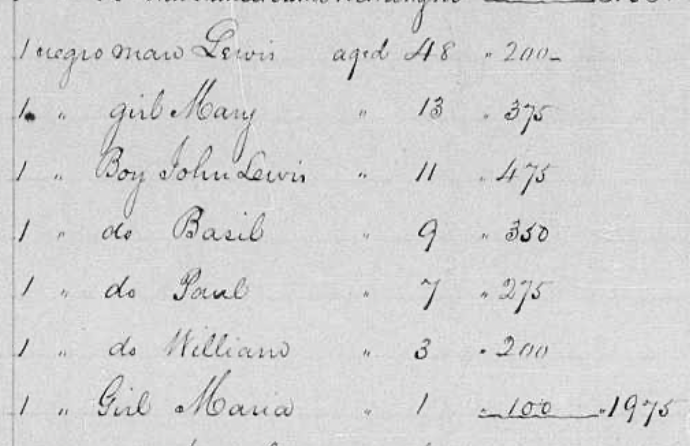
From 1853 Inventory of Robert D Sewall, Image 380, first column

In the family group, Lewis is listed as the inferred father, at 48 years old. This places his estimated birth year as 1805, which is consistent with the 1822 St. Mary’s inventory which estimates his birth year as 1806. The two inventories alone however did not indicate a surname name for either family. This left it open as to whether or not Beck and her children were related to the Lewis Medley who escaped the Carrolls and his Medleys, or related to his wife, Beck, and therefore related to a different family surname.

The USCT records cite Basil’s last name as Medley, which suggests that Lewis (born 1805/6) was also a Medley.

The presence of Medley for Basil suggests that Beck’s children and grandchildren are related to Lewis Medley who left with the British in 1812. It is likely that Beck’s partner and Lewis’s father is the Medley.

Thomas Clarke (b. ca 1783) & Charity (b. ca 1790)

This post is one in a series in an attempt to identify members of the Clarke family groups among the people enslaved by Robert D Sewall at “Poplar Hill” in Prince George’s County


Thomas Clarke, age 70, is listed in the 1853 Robert D Sewall inventory with Charity, age 63. [JH 2:699]. Having lived at least two decades past forty, they have surpassed the usual lifespan of an enslaved person. They were listed without an appraised value. Berry, in the The Price for their Pound, discusses the life cycle of the enslaved and in the chapter on the elderly (any enslaved person over 40), she writes “As the enslaved aged, their monetary values decreased and they became worthless on the market. Despite low external values, their soul values [internal values placed on themselves and by their kin] excelled. They carried great wisdom and stability for the community and were respected by the younger enslaved family and friends.” (130-131)

Thomas Clarke and Charity lived at “Poplar Hill” surrounded by their nieces and nephews and their children. The Sewalls and Dangerfields likely no longer had them working in the fields or the house, and so they were more likely providing child care for the small children under 10 while their parents worked under the watchful eye of the overseers and managers.


Thomas Clarke and Charity are also listed in the 1821 Robert Sewall Inventory, though they are not listed together. [TT 4:352] Thomas is listed with other adult males (Tom, Sampson, Capt John and Capt George — “Capt” signifying carpenters). Charity is listed with other female headed family groups with three children: Bob, age 7, Nelly, age 2, and Henrietta, infant. Immediately following her family group was that of Easter and her two children.

The “Early Records of White Marsh Church” includes baptismal records from White Marsh. “White Marsh was the center of Catholic life in Prince George’s County.” (Maryland State Archives). It was a Jesuit plantation that used enslaved labor for the profit of the Catholic Church. The Sewalls were a Catholic family with a private chapel included in the dwelling plantation.

In 1828, among the baptismal records of White Marsh was an April 9th baptism for “Mary, daughter of Thos. & Charity, servts [ensalved people] of Robert Sewall. The sponsor was Esther of same.”

This suggests the possibility that Charity and Easter/Esther are sisters and that they sponsored each others children.


The 1828 baptismal record also helps to the clarify the 1853 Inventory. Thomas and Charity Clarke are listed on page 1 of the inventory and the page breaks after their names. Without a value, they are not included in the subtotals on the first page or the second page, making it ambiguous if they are considered part of the family group that continues on page two.

NameAgeValue
Lucy + boy27 & 6825
Mary23650
Lewis29950

Lucy [1826], Mary [1830], Lewis [1824] would have been born after the 1821 inventory and close to Charity’s child-bearing year range (1805-1825 +/- a few years).

The baptismal record however, shows an earlier birth year for Mary — 1828– which places her birth in closer proximity to Charity’s child-bearing year range.

Sources

Berry, Daina R. The Price for Their Pound of Flesh: The Value of the Enslaved, from Womb to Grave, in the Building of a Nation. United States: Random House Inc, 2018. Print.

Early Records of the White Marsh Church, Prince George’s County, Maryland. Bowie, MD: Prince Georges County Genealogical Society, 2005. Print.

Eliza Wood

Eliza Wood is the daughter of John Wood; both are listed in the 1853 Inventory of Robert Darnall Sewall [JH 2:699].

Eliza’s Children

In the 1853 Inventory, Eliza is 38 years old and listed with six children. Her children are about two years apart. She is not listed with a partner, unlike other family groups. This suggests that her partner was likely enslaved by another. If Martha Ann is her oldest, then she began to have children when she was 26.

NameAgeEst BYIdentified Name Connections
Martha Ann121841
Henny101843
John Robert81845John is the name of Eliza’s father
Mary Jane61847
Fanny41849Fanny is the name of Eliza’s grandmother
Phillis11852Phillis is the name of Eliza’s mother

After Emancipation

Eliza and some of her children are identified in the US Federal Census as still living in close proximity to Poplar Hill after emancipation in 1870 and 1880. I have yet to locate John Robert and Mary Jane.

“Poplar Hill” can be identified on the 1863 Martenet Map of Prince George’s County by the name H(enry) Dangerfield, the guardian of Sewall’s nieces who inherited land from Sewall.  Immediately south of Woodyard in the north part of Surrats District, the road leading south to Surratsville (present-day Clinton) cut the land into two pieces.  

Martenet labeled a Mill near Henry Dangerfield and the Woodyard intersection.  This mill can be identified in the 1870 Census as dwelling number 21, with Head of Household Henry Tarman who was identified as a Miller.  Immediately enumerated after him is Annie Marshall in dwelling number 22. She is the mother of WH Marshall who is named on the map and who had moved out of state after the Civil War.  

Households 23-32, 35-42, 47-49 are freed Black families who have names with connections to the 1853 Inventory. The enumerator appears to have followed the road south from Woodyard and then turned right [northwest] onto the road to the Jenkins property.  

Members of the Eliza Wood family are enumerated among these households. 

Eliza & ‘Feles’ with grandchildren

In the 1870 census, Eliza is listed as the head of household with her occupation listed as “keeping house”, a phrase usually reserved for a woman taking care of her own house (as opposed to “domestic” which indicated work as a servant). There is no indication of a partner. She is living with ‘Feles’, age 19, likely to be Phillis who was one in the 1853 inventory, and two children: Susanna Johnson, age 7, and Fannie Johnson, infant.

They are listed in dwelling number 26.

Phillis was married in 1870; the officiant McDonald, was a priest for the Catholic Church. She married James Clarke in September. James was listed in dwelling number 25 of the 1870 census.

Martha Ann & Charles Johnson

In 1870, Martha and Charles are not found in the US Federal Census, though to of their children are listed with Eliza (Susanna and Fannie). This suggests that they either lived separated from the Wood family, or the enumerator only listed those “at home” at the time of the record, rather than asking about additional family members.

In 1880, Eliza is living with the Charles Johnson household (dwelling number 173). She is listed as a “Cook”. She likely worked for a private family. She may work for the same private family as her granddaughter, Christiana, age 16, who is listed as a servant. They are living adjacent to the Tenley family and Walters Family, both white. James Walters is indicated on the 1878 Hopkins map of Surratts District, allowing us to identify their residence in 1880.

On the same Census page, James and Phillis (Wood) Clarke are listed. They are listed with three grandchildren: Rose, James, and Agustus.

James Wood

Between the two Wood families in the 1880 census, sits James Wood, age 45. He is living with his wife, Annie, and their children: Eliza, Catherine, Edward, Nancy, Susanna, and Martha.

NameAgeEst BYIdentified Name Connections
Eliza A161866Possibly named after Eliza Wood, subject of post
Catherine A13?1867Possibly named after Eliza’s sister, Kitty
Edward H91871[Not discussed in this post and “Ned” is a name that will repeat in generations of Woods]
Nancy71873
Susanna41876[Not discussed in this post and “Susanna” is a name that will repeat in generations of Woods]
Martha21878Possibly named after Eliza’s oldest identified daughter.

The relationships of James Wood with Eliza Wood is unclear. The names of his children and his geographic proximity suggests a kin relationship.

If he is Eliza’s son, he would have been born around 1835 and he would have been older than the children listed in the 1853 Inventory. She would have been 20 when he was born which is within her child-bearing years.

It is possible, that he was sold as a teenager to a local enslaver, when Sewall needed ready cash. He was a reputed drinker and gambler. Berry, in The Price for Their Pound, describes how the teen years were when most separations from families occurred, as the children were older and able to perform heavy labor. “Most of the [enslaved people] sold in the Upper South were teenagers and young adults”. [p. 66]

In 1870, James and Ann are living in the Marlboro District with his two daughters, Eliza and Catherine and other freed people who appear unrelated (John King, Robert Smith, Henry Harley, Washington Marlow, Catherine Beall).

Henny

Henny, Eliza’s second oldest daughter, is listed with as the head of household of dwelling number 23 in the 1870 census. The enumerator records her as living with Lewis Brown, age 45.

Based on her listed occupation, “Domestic”, and that females were rarely listed as head of household if there was an older male, I propose the possibility that the enumerator miss identified the household. I suggest that Henrietta Wood, Domestic, age 28, should have been listed with the previous household, and Lewis should be head of household of his own house. If this is the case, then she would have been working the household of Annie Marshall, who lived in a dwelling house adjacent to the “Poplar Hill” tract of land.

Three years later, she married John H Jackson, in a ceremony officiated by Walsh. She and John moved to Rosaryville, nearby, and lived there with her children. They are living near the children of Charles and Susan (Wood) Brown, discussed in the post on William Hannibal Gantt Brown. Susan is like Henrietta’s great-aunt, as identified in the 1821 inventory [TT 4:352].

Sources

Berry, Daina R. The Price for Their Pound of Flesh: The Value of the Enslaved, from Womb to Grave, in the Building of a Nation. United States: Random House Inc, 2018. Print.

John Wood

John Wood is listed in the 1853 Inventory of Robert Darnall Sewall’s estate [JH 2:699] as a 55 year old man who was appraised at $400.

In her book, The Price for a Pound of Flesh, Berry talks about the stages of an enslaved person’s life. For John Wood, age 55, he would have been considered elderly as he had surpassed the age of forty, the boundary between mature and elderly. John may still have be performing labor for the Sewall family, and yet, he had surpassed the age of most of the enslaved whose life span was shortened by hard work and captivity. Berry described the work of the “able-bodied enslaved people” over forty as performing tasks including serving as cooks, body servants, gardeners, and caretakers of enslaved children. [page 133]

Berry separates out the “soul value” — “an intangible marker that often defied monetization yet spoke to the spirit and soul of who they were as human beings.” As an elderly member of the plantation, he would have been a valuable member for the community in terms of wisdom and kin connections. He may have taken on the role of caretaker as evidenced by his placement in the 1853 inventory.

John Wood’s Daughters

He is situated between two family groups: Eliza and her children and John and Kitta Brown and their children.

Annotated excerpt from 1853 Inventory showing John Wood between the two families.

It is inferred that Eliza and Kitta are John’s daughters due to their placement in the 1853 inventory, and when names and ages are compared with the 1821 [TT 4:352] and 1853 Inventory.

Name1821 Age & EST BY1853 Age & EST BY
John23 – 179855 – 1798
Eliza6 – 181538 – 1815
Kitta/Kitty2 – 181934 – 1819

John Wood may have taken care of his grandchildren and other small children as the adults and older children were sent to the fields to perform labor. He has not been located in the 1870 census suggesting that he may have died prior to 1870; he would have been 72 had he lived.

John and Phillis, partners

The 1821 Inventory shows John listed with a partner, Phillis, the inferred mother of his daughters, Eliza and Kitty. Phillis, age 24, in the 1821 inventory, would have been born in 1797. She would have been 18 when she gave birth to Eliza and 22 when gave birth to Kitty. The inventories do not indicate if they had additional children. Eliza named her youngest daughter after her mother. Phillis, the grand-daughter, is listed with Eliza in both the 1853 inventory and in the 1870 US Census.

Phillis is not listed in the 1853 Inventory when she would have been 56. This suggests that she either died prior to the inventory was taken, or that she was sold by the Sewall family.

It is also unclear if the relationship between John and Phillis was self-selected or if the overseers and enslavers chose the relationship between the two.

Sources

Berry, Daina R. The Price for Their Pound of Flesh: The Value of the Enslaved, from Womb to Grave, in the Building of a Nation. United States: Random House Inc, 2018. Print.