Richard & Mary Jones | Old Age

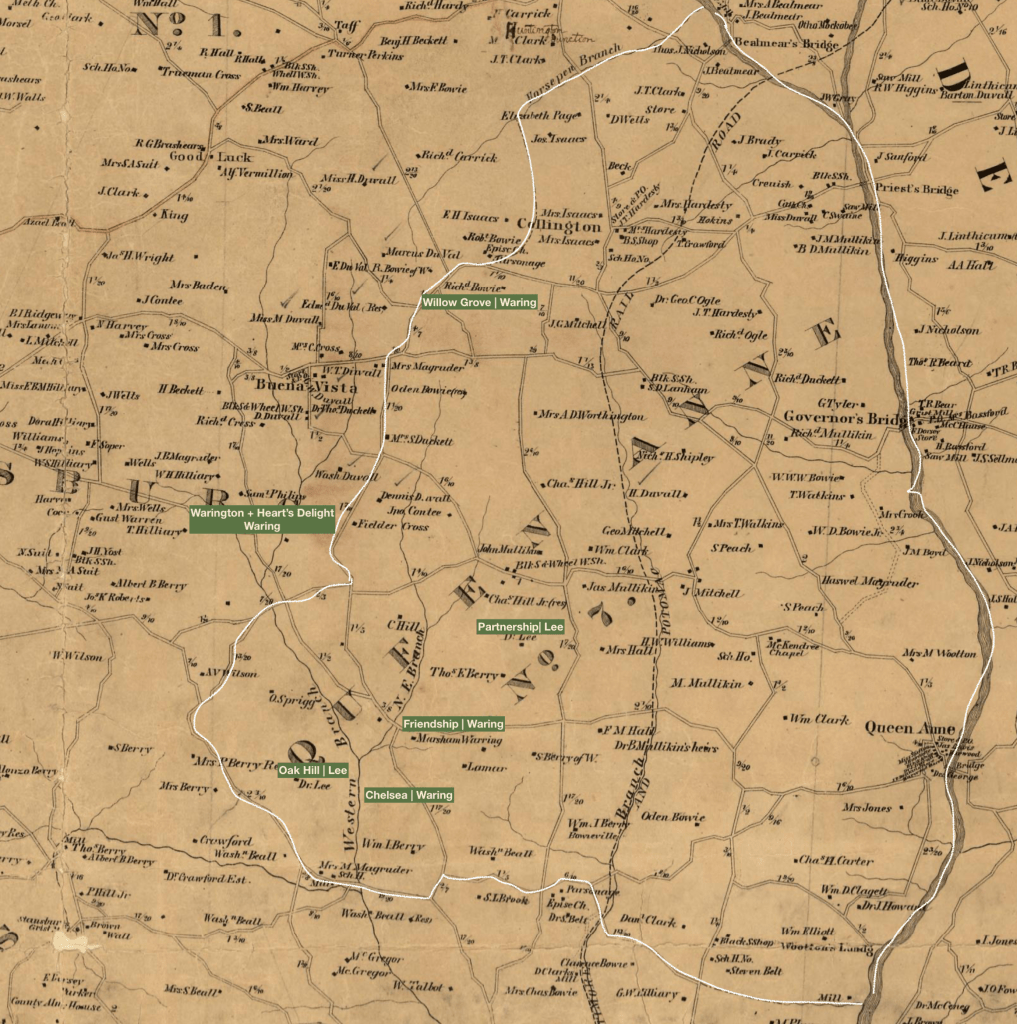
Richard (Dick) Jones and his wife, Mary (Polly) were born at the end of the Revolutionary War and lived until the start of the Civil War in Queen Anne District of Prince George’s County. The vast majority of their life was spent on the estates of Marsham Waring. They and their children labored for Waring and his three children.
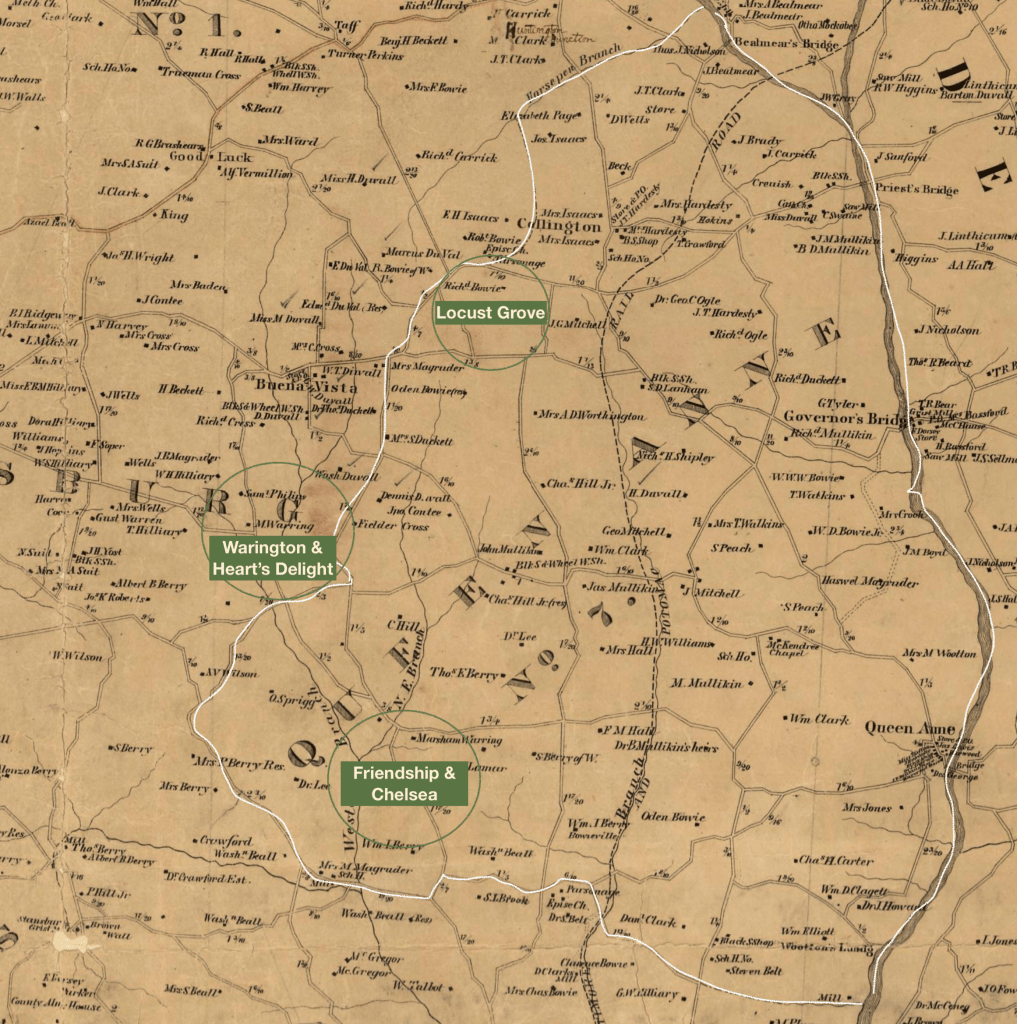
Annotated Excerpt from 1861 Martenet Map of Prince George’s County | loc.gov

Waring died in 1860 and his probate records and inventory (WAJ 2:321ff; not online) include the names of 106 people enslaved by the Waring family. Among them are “Dick + Polly, 80 years, each, $00.00”. Of the people provided an age on the inventory, they were the oldest.

Excerpt from Waring’s Inventory (WAJ 2:322)

As Daina Ramey Berry writes in her book, The Price of their Pound of Flesh, enslaved individuals have the external value imposed on them by the oppressor who commodified the enslaved and the internal value that she describes as a “spiritual soul value” that spoke to who they were as human beings.  Their self-worth and value was not determined by the financial appraiser, rather the wealth of knowledge they brought to their families and community as they navigated being held in bondage on Waring’s estate over several generations. Between 1780 and 1860, they lived through four generations of children and grandchildren.

One of their children lived until 1900; when Elizabeth (Betsy) Fletcher died, the family members were able to identify her parents as Richard and Polly Jones.

Death Certificate from Maryland State Archives

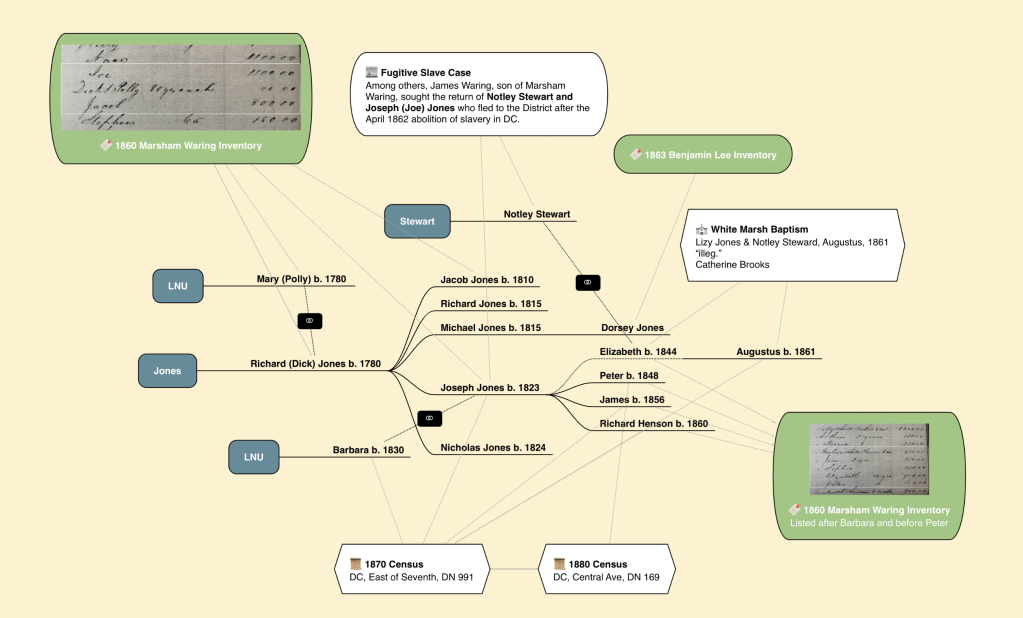
In addition to having identified Betsy Fletcher as their daughter, I have identified six additional children of Richard and Mary Jones, all enslaved by the Waring family. Due to the fragmentary nature of records related to enslaved people, there are likely unidentified connections among others he enslaved. Additionally, as other fragments are uncovered and pieced together, the connections may be redrawn.
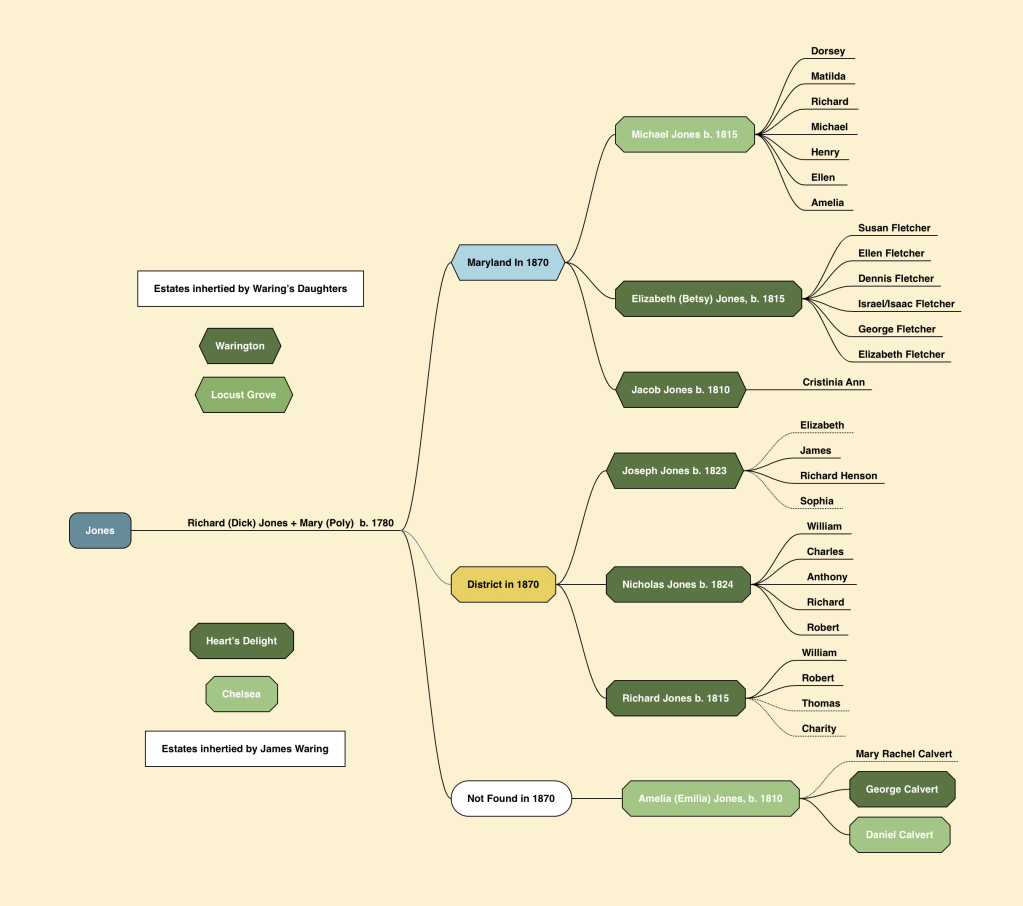
Reconstructed from multiple sources | Subject to Change
(Census, Inventory, Prince George’s County Slave Statistics, Death Certificates, White Marsh Baptism Records, Freedmen’s Bureau Records, Fugitive Slave Cases)

Berry wrote in her book that enslaved women were valued by some enslavers for “their fecundity” as their “increase consists of much of wealth”. For Waring, Mary’s children increased his wealth, especially as transatlantic slave trading was abolished in 1808 and enslavers had to rely on domestic trades or the “increase” of the people they enslaved to enlarge their slave community. In 1860, Richard and Mary’s children and grandchildren make up at least 20% of the people he enslaved.

Allan Kulikoff wrote in his book Tobacco and Slaves that “childbearing and the childrearing that followed, however were highly important rites of passage for most slave women. Once she had a child, she moved from her mother’s or parent’s home to her own hut”. Despite the threat of separation as a specter on the horizon for any enslaved family, families on large estates were less likely to be separated from their families as the landowners were able to weather fluctuations in the tobacco markets. As such, Mary and her children were able to maintain familial bonds despite the commodification of her and her children by the Warings and other “planters” who forced labor from them.
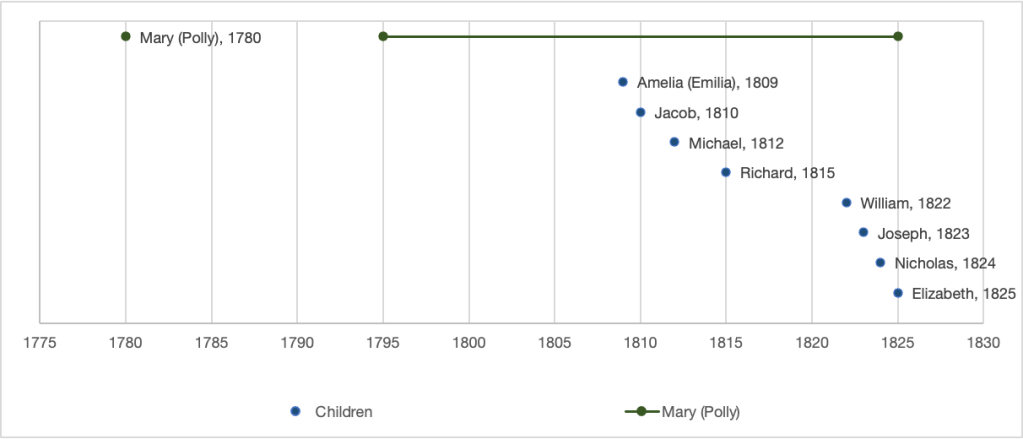
Chart showing Mary’s estimated child-bearing years and the children identified so far | Subject to Change

The kingroup is evident in records connected to the 1862 affidavit sworn by James Waring that documents the escape of several of the Jones family group to the District. This will be explored further in future posts. It is also evident in the 1870 and 1880 Census records as the nuclear families tended to live near one another, either in the District or in Prince George’s County.

Inheritance

The following paragraphs hope to reconstruct the path that Richard and Mary Jones were forced to take prior to their enslavement by Waring. It is based on indirect evidence by matching names and ages in inventories of other enslavers in Prince George’s County who likely had connections with Marsham Waring. The search through inventories was not exhaustive. This path is based on indirect evidence and circumstances that suggest this as a possibility.

Marsham Waring was the son of Marsham (II) Waring, and grandson of Basil Waring, Jr and Susana Darnall. The Darnall family had connections with Stephen West, who acquired the Woodyard, which sat across the road from “Poplar Hill/His Lordship’s Kindness”. Isaac Lansdale (III) was the brother of Thomas L Lansdale, a merchant in Queen Anne, along the Patuxent River where a tobacco inspection site had been established in the 18th Century. They were both relatives of Violetta Lansdale Belt, Waring’s wife.
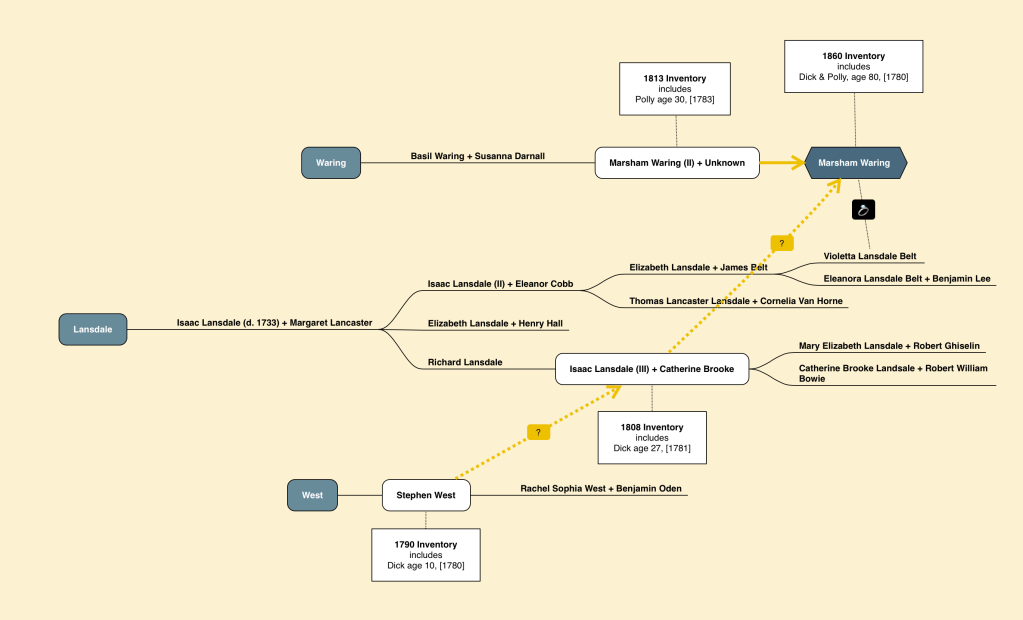
Reconstructed from information gathered from online family trees

Marsham Waring appears to have inherited the legal authority to enslave Mary (Polly) from his father, Marsham Waring (II) who left his estate, real and personal property to his son. In the 1813 inventory of his estate, Polly, age 30, with an estimated birth year of 1783 was listed. (TT 1:473). The inventory is sorted by gender and age, making it difficult to infer family groups. As opposed to Marsham Waring’s 1860 Inventory, which appears to be grouped by adult males and women with children. Some adult children are grouped with elderly parents.

There are at least two possibilities for Richard (Dick) Jones [1780]; these possibilities are not mutually exclusive, meaning the two inventories could possibly refer to the same man:

1790   Stephen West, the owner of the Woodyard and an enslaver of over a hundred people died in 1790.  Among the inventory for his estate is Dick, age 10 [1780], who is notated as “son of Nick” (ST 3:47).  This notation provides circumstantial evidence of a likely connection between the Richard of West’s Inventory and the Richard of Waring’s inventory as Richard Jones had a son named Nicholas, suggesting an older family member named Nicholas. 
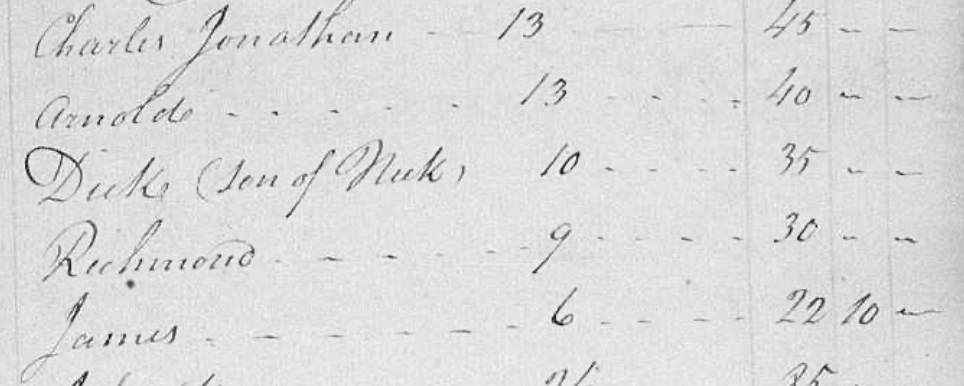
Excerpt from Stephen West’s Inventory

1808 Isaac Lansdale (III), the son of Richard Lansdale, died prior to 1808 when his inventory was created.  Among this inventory is Dick, age 27 [1781].

Stephen West or one of his heirs may have conducted business with the Lansdale family, who had mercantile trade in Queen Anne, which may have resulted in use of Dick to settle a debt or purchase. Lansdale, in his relationship to Waring as a cousin of Waring’s wife may have gifted or traded Dick, as well.
related posts

Benjamin Lee and Augustus Jones | Stealing Horses

Stealing Horses

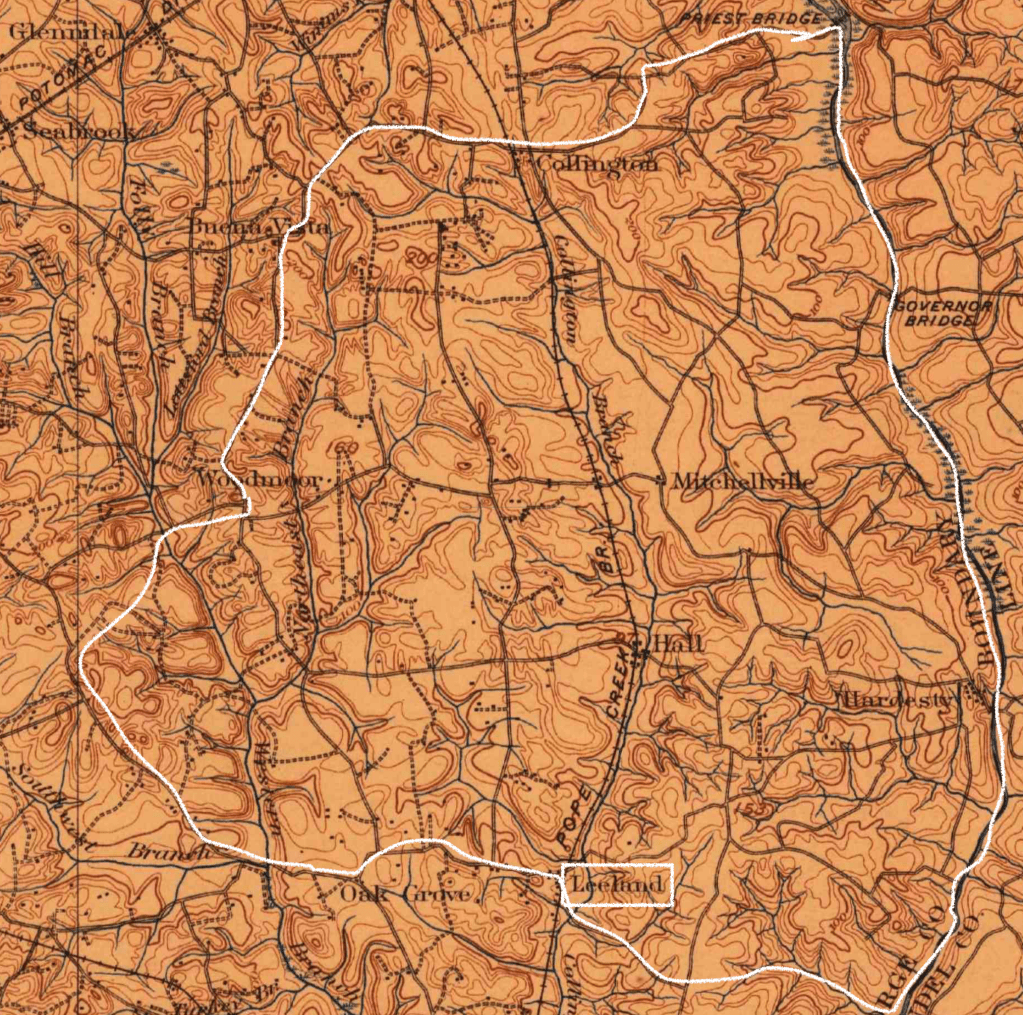
In the summer of 1900, two horses were stolen. One from the pasture of Dorsey Jones and one from the home of Washington Lee. Both men lived in Leeland, Maryland, a small community built up after the Civil War along the Pope Creek Railroad. It sits on the boundary between Queen Anne District and Marlboro.

1899 Top Map of Patuxent River | accessed from topoview

They alerted the authorities in Washington that their horses were stolen and the police were on the look-out for the thieves in the District. They arrested two men for trying to sell the horses near Centre Market in downtown DC near 11th and Louisiana, just north of the map about mid-point between the Eclipse and the Capitol.

According to the articles, the men arrested were their sons, Augustus Jones and Benjamin Lee.

21 Aug 1900, Evening Star | newspapers.com
22 Aug 1900, Evening Star | newspapers.com

Relatives

The two horse thieves, Augustus Jones and Benjamin Lee were distant cousins of each other. The first article says that Augustus was the son of Dorsey and the second article claims that Benjamin was the son of Washington Lee.

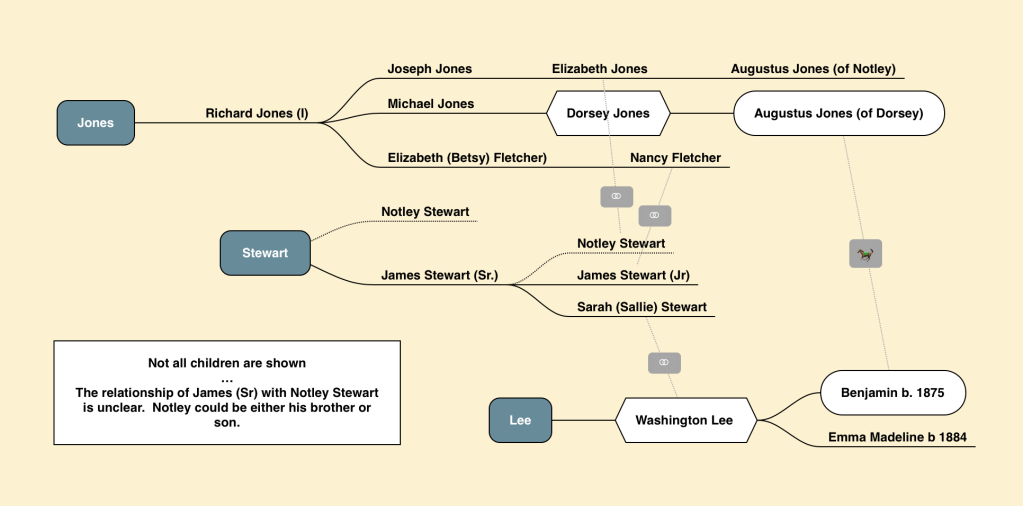
Reconstructed tree using a mixture of records. Subject to change to as more records are located.

Benjamin Lee

Washington Lee with his wife, Sarah (Sallie) Lee are enumerated with Benjamin Lee in the 1880 census. They were enumerated in the Marlboro district near Upton Brooke who was enumerated at DN 243. This places them in the vicinity of Brick Church Station which is where Leeland would grow over the next few decades.

Marlboro District, Prince George’s County 1880 Census | ancestry.com
1878 Hopkins Atlas of Prince George’s County, Marlboro District | loc.gov

Augustus Jones

Augustus Jones is not found in the census with Dorsey Jones. In 1880, Dorsey Jones, age 30, is living with his father and mother, Michael and Amelia (Milly) Jones in Queen Anne’s District, likely near Woodmore P.O as they are enumerated a few pages from Jeremiah Duckett, who owned land near Woodmore. He does not have any children living with him in the 1880 census.

Queen Anne District, Prince George’s County 1880 Census | ancestry.com
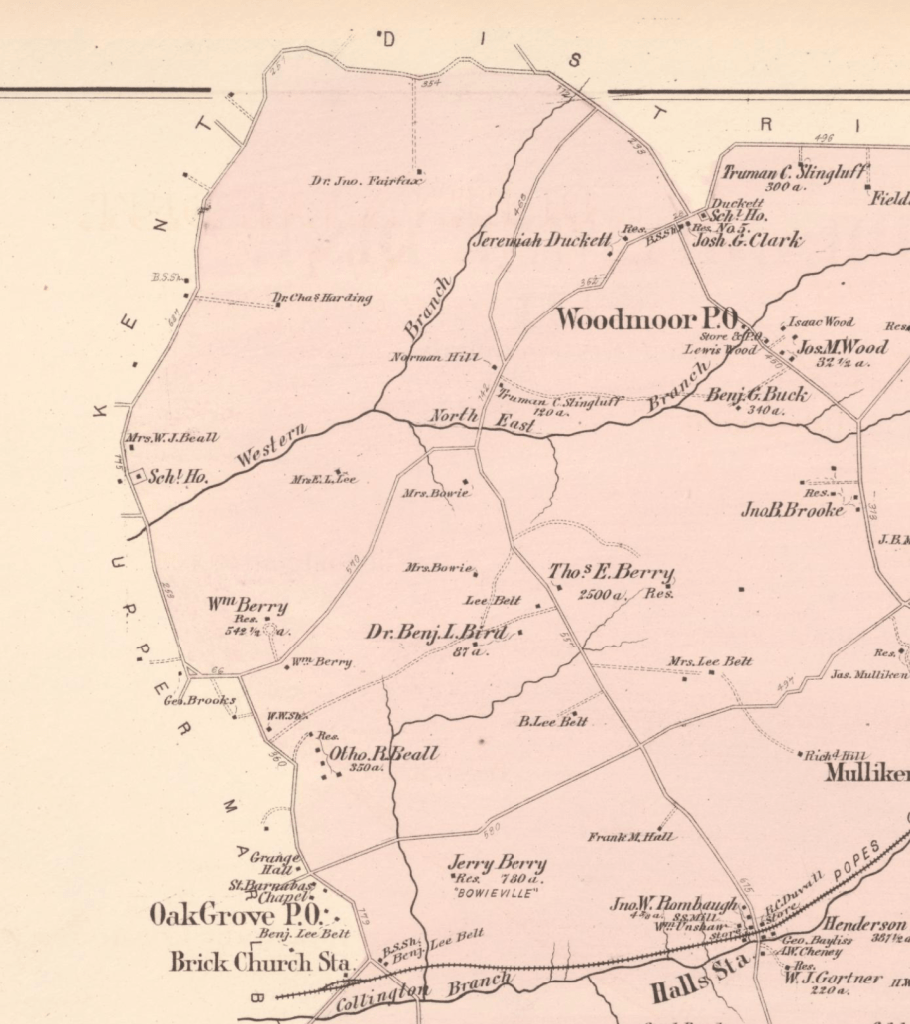
1878 Hopkins Atlas of Prince George’s County, Queen Anne District | loc.gov
Note: North is to the right, not up like in most maps.

Neither Dorsey nor Augustus Jones have been located in the 1900 census. Dorsey died in July 1905, his death certificate indicated he was single, which is consistent with the 1880 Census.

Maryland State Archives

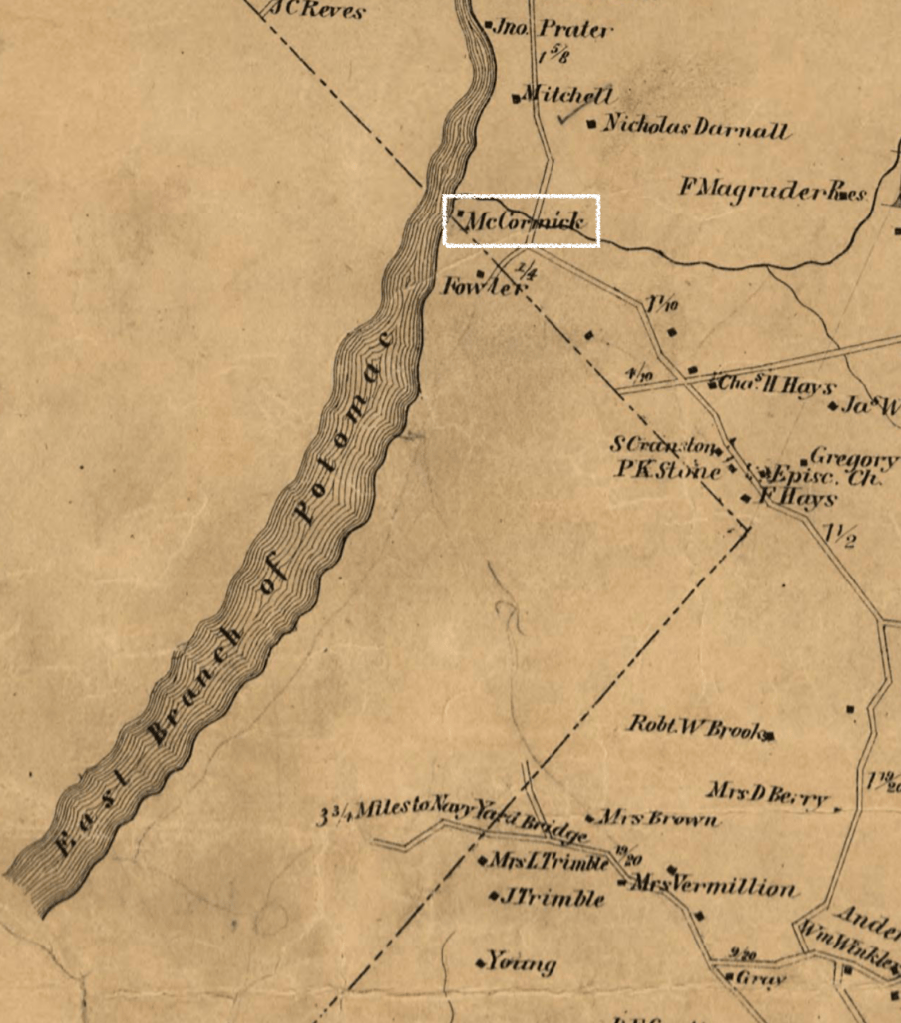
In the 1870 and 1880 Census, Augustus Jones was listed with Joseph and Barbara Jones in the District of Columbia. In 1870, they are enumerated near Alex McCormack who lived near the District/Maryland boundary. (In fact, the Wedge family had to petition for their freedom from McCormack during the Civil War when DC abolished slavery as McCormack sought to maintain their captivity by claiming they lived on his Maryland land and not his DC land. )

East of Seventh Street, District of Columbia 1870 census | ancestry.com
1861 Martenet Map of Prince George’s County | loc.gov

In 1880 they are enumerated near Daniel Stewart and Joseph Coven [Covington] which places them near Pleasant Grove and Benning’s P.O. and still near A. McCormack

Central Avenue, District of Columbia 1880 Census | ancestry.com

Augustus Jones is listed at the son of Joseph and Barbara Jones. However, based on other records, I would suggest that Augustus Jones is their grandson, and the son of Elizabeth (Lizy) Jones and Notley Stewart.

Reconstructures Family Tree with identified direct and indirect sources | Subject to Change

The Jones and Stewart family were enslaved primarily by Marsham Waring and also by Benjamin Lee, his brother-in-law in Queen Anne District prior to emancipation in 1864. Waring died in 1860, and among his probate records is an inventory that lists the people he enslaved. Lee died in 1863 and his probate records also include an inventory. Additionally, Waring’s children, Elizabeth L. Bowie, M. Virginia Mackubin [sic] and James Waring had compensation lists submitted to the Commission of Slave Statistics which lists both the first and last name of the people the Waring’s enslaved.

The Warings were Catholic and some of the people they enslaved had their children baptized by White Marsh Priests. Among them, Lizy Jones and Notley Stewart had their son Augustus baptized in 1861. A year later, Notley Stewart and Joseph Jones, Elizabeth’s father, are named in an affidavit, among others that they had fled to the District after the abolition of slavery there. Notley and Elizabeth Jones have not been located, though their son is living with Joseph and Barbara Jones, Elizabeth’s mother, in both the 1870 and 1880 Census.

Incidentally, Peter Jones, the son of Joseph and Barbara Jones, and uncle of Augustus (assuming my theory is correct), lived on Benning’s Road in 1900 and he worked at as a laborer in a stock yard, and his son Peter (Jr.) worked in a jockey house, suggesting the family worked with and knew horses.

Afterwards

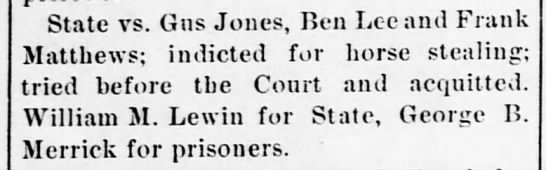
The local papers reported that “Gus Jones, Ben Lee, and Frank Matthew” were indicted for horse-stealing and that they were acquitted.

26 Oct 1900, Prince George’s Enquirer and Southern Advertiser | newspapers.com

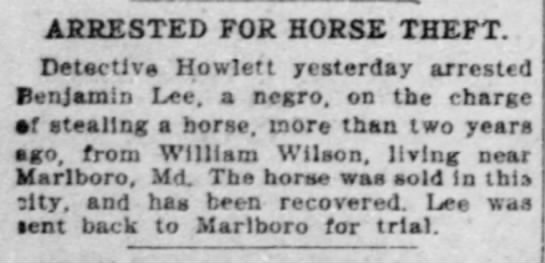
And, in 1903, Benjamin Lee was arrested again for stealing a horse in August of 1900. This time from William Wilson, who also lived near Marlboro and again, Lee is alleged to have sold the horse in the city. Wilson was a Black man who worked on the railroad.

27 July 1903, Washington Times | newspapers.com
23 Oct 1903, Prince George’s Enquirer and Southern Advertiser | newspapers.com

The Evening Star described his day in court as multiple days due to multiple technicalities. It was first delayed to a legal technicality, then a new jury had to be impaneled as his brother-in-law sat on the jury, then finally he was tried and found not guilty. The judge sentenced him to seven year. The paper reported he tried to escape and assaulted officers. His head was injured and he required bandages. The paper described hi as barely recognizing him the final time in the court, though if this referred to a change in demeanor or a multitude of bruises, or both, it doesn’t specify. Considering how the criminal system treated and treats Black men, it was probably a submission by force. This seems reflected in the Judge’s comment, “you got all that was coming for you.”

20 Oct 1903, Evening Star | newspapers.com

In the 1910 Census, a Benjamin Lee is listed as a prisoner in Baltimore working in the foundry.

One Final Note

The Washington Times seems to have been ahead of the police. While the Evening Star reported that “Gus” Jones and accomplices had been arrested for stealing horses from their family, and the Prince George’s Enquirer reported that they had been acquitted, and the thief of Wilson’s horse was not identified until 1903 for stealing William Wilson’s horse and not tried until October 1903, the Washington Times reported their arrest in 1900. They even knew Benjamin’s alias of Will.

James Stewart | Junior

Did James (Jim) Stewart (b. about 1800) have a son named James Stewart?

James Stewart, Senior

James Stewart (Sr.) was living in Queen Anne District of Prince George’s County after emancipation in 1864. He was residing near the estate of Dr. Benjamin Lee who had died during the war.

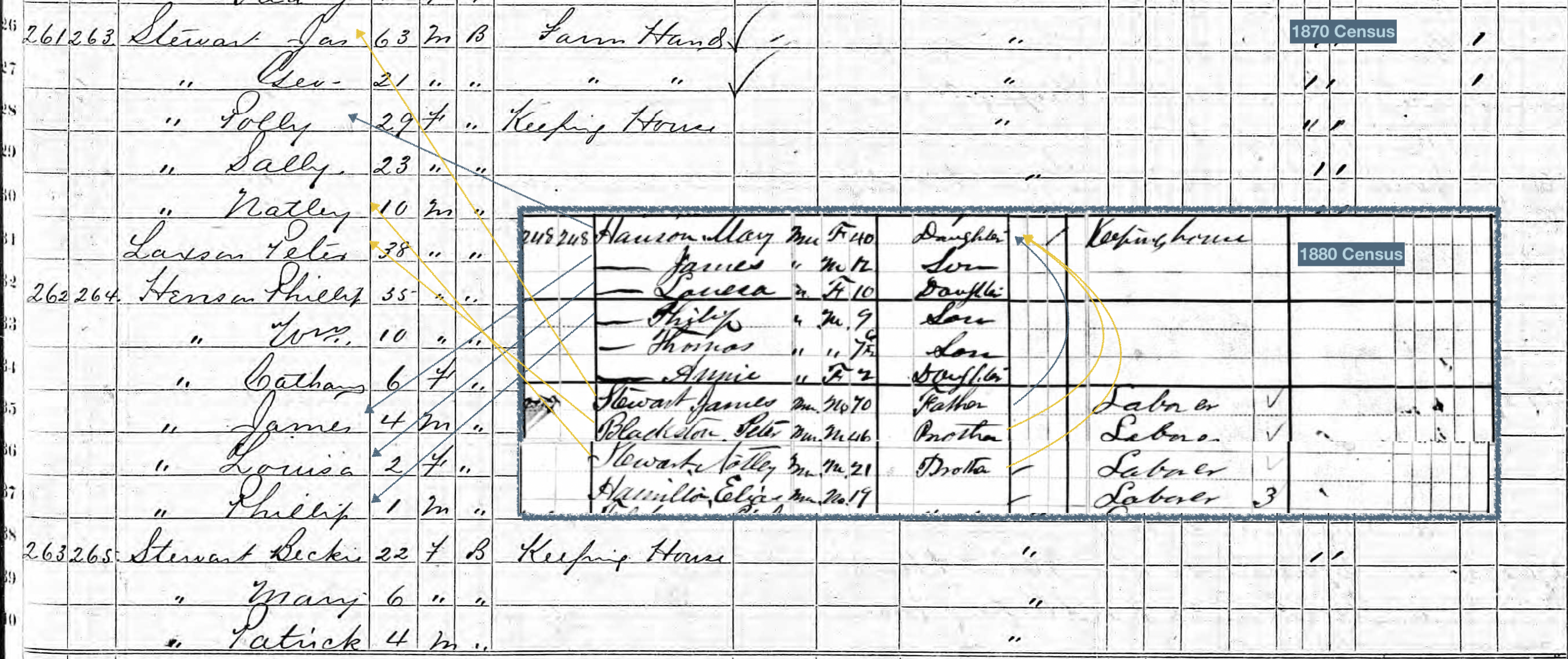
He lived with his inferred children, George, Mary (Polly), Sarah (Sallie), and Notley as well as Peter Laxson (Blackstone), and is neighbor to Philip Hanson and Beckie Stewart. The 1870 census record for James Stewart is best understood when compared to the 1880 census record for James Stewart, which identifies the relations between the households.

Not present in the 1880 Census record are Sarah (Sallie) Stewart, who married Washington Lee in 1870 and established a separate household nearby and George and Rebecca (Beckie) Stewart who also established a separate household nearby.

The comparison of the two census records show however, that James Stewart was the head of a family with several adult children.

James Stewart, prior to Emancipation

In the 1870 Census, James Stewart and his children are enumerated directly after the heirs of Dr. Benjamin Lee and an overseer, suggesting that they lived near “Oak Hill”, the Lee estate.

1870 Census

Dr. Benjamin Lee was the brother-in-law of Marsham Waring. Both owned considerable amounts of property in the area. They married the daughters of Captain James Belt, who had bought parts of Chelsea from another branch of the Belt family and who conveyed the tracts to his daughters. Lee also acquired tracts of land from Northhampton, Partnership and other parcels. Waring also acquired land from nearby families, purchasing land from the Hillearys and the Bowies.

Lee and Waring died within a few years of each other. Marsham Waring died in 1860, and his wife in 1863. His probate records include an inventory (WAJ 2:323) with the names of the people enslaved on four separate estates. Benjamin Lee died in 1863 and also includes the names of those he enslaved (WAJ 3:127). Waring heirs, (his two daughters and son) had compensation lists submitted to the Commission on Slave Statistics which provided both a first and last name with an age for many. This allows us to identify the people on the Waring Inventory and which estate they were forced to labor on. Lee does not have a similar compensation list, and so identifying the people he enslaved requires more records to ensure identification of them.

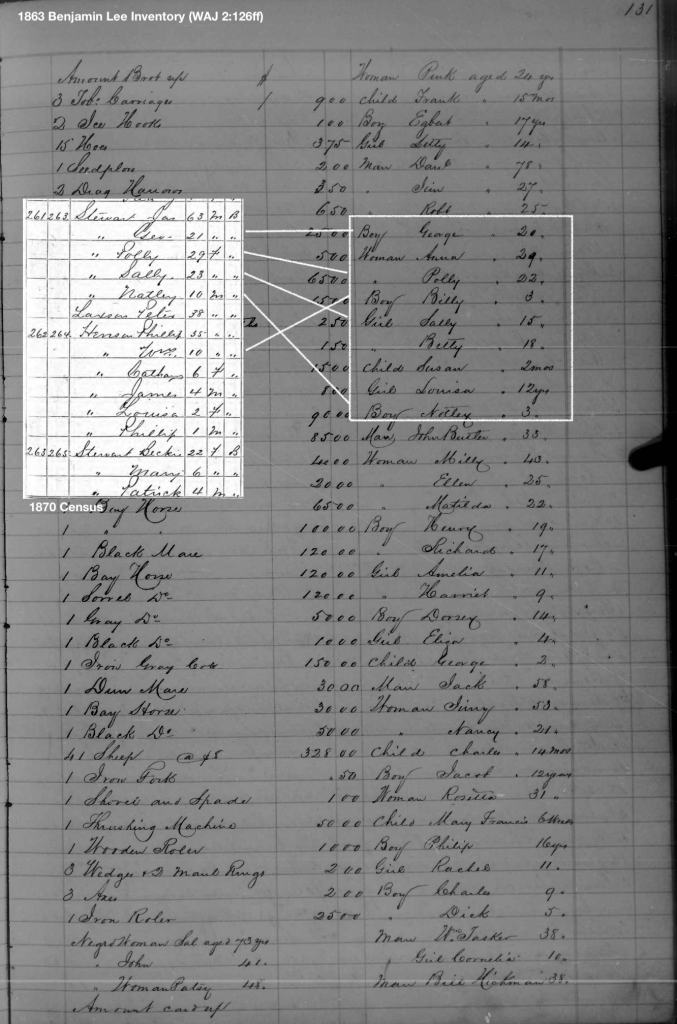
James (Jim) Stewart is included in the Waring Inventory and in the list made by Waring’s daughter, Mrs. M. Virginia Mackubin [sic] for the Commission on Slave Statistics. In both documents he is listed as 50 years old. He labored for the Warings on the Warington Estate . He is the only James Stewart listed on the three compensation lists. The children in the inventory are not listed in the Waring inventories or compensation lists, rather they appear to be included in the 1863 Lee Inventory .

Lee’s inventory includes the names of James Stewart’s children as well as Mary’s oldest son, with ages that are comparable to the ones in the census. (As always there is some variability with ages for those enslaved, as the exact birth year is not always known by the enslaver or the person enslaved.)

Lee Inventory with overlay of 1870 Census

The Warings were Catholic and many of the people they enslaved were baptized by the priests of White Marsh, the Jesuit Plantation in Queen Anne District. The Early Records of White Marsh, Book Three contain baptismal records from 1853-1872.

In 1858, John Henson was baptized, the son of Nancy (Ann) Fletcher and James Stewart. The priests marked them “property of Marsham Waring.” Notley Stewart acted as a sponsor/godparent; this Notley Stewart is an older Notley, not the child in the 1870 Census. In the 1860 Inventory of Marsham Waring, listed two below James (Jim) Stewart, is Notley, age 30. He is also on the list submitted by M. Virginia Mackubin [sic].

In 1860, George Antony was baptized as James and Nancy Steward, with Elizabeth (Bezzie) Fletcher as sponsor/godmother.

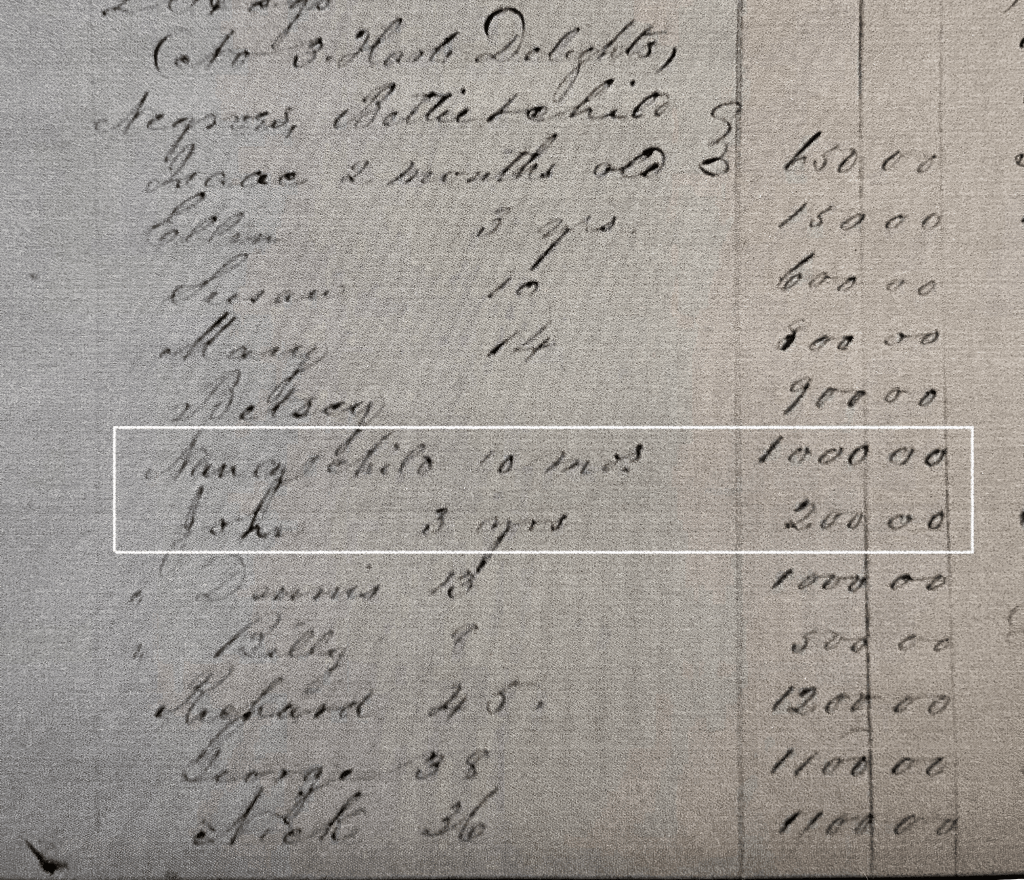
Ann (Nancy) Fletcher was enslaved by the Warings on the estate “Heart’s Delight”, which was inherited by James Waring. She was included on James Waring’s compensation list, as was “child of Nancy” [George Antony] and John. Above her is Betsy, who may be the same Elizabeth (Bezzie) who stood as sponsor at the baptism of the infant.

Marsham Waring Inventory

With only the census record, it was an assumption that the James Stewart mentioned in these records was James Stewart (Sr.). However, a registration list from the Freedmen’s Bureau with an 1870 Census record from the District of Columbia suggests that the James Stewart of the baptismal records is not James Stewart (Sr.), rather James Stewart (Jr.).

Flight to the District of Columbia

After slavery was abolished in the District of Columbia in 1862, the people enslaved in the neighboring jurisdictions saw an opportunity to grab freedom for themselves. Despite the fact that the roads toward the District were monitored by constables and private patrols, many of the people forced to labor fled their captivity and made their way to the District. Barbara Jeanne Fields wrote in her book, Slavery and Freedom on the Middle Ground that “Many an ex-fugitive later reported having left Maryland for the District during or after the spring of 1862. Families packed up such of their possessions as could be compactly assembled and departed, sometimes appropriating means of transportation from their owners.” (111)

As such camps were built in and around the District to house the incoming refugees from chattel slavery. One such camp was Camp Springdale which was made up of tents on the grounds of the “Arlington Estate”, owned by Robert E Lee’s wife. At the start of the Civil War, the Union Army occupied the site and the soldiers gave protection to fleeing refugees. Other camps were built in and around the District.

A registration list for Camp Springdale lists its residents and their former residence along with whether or not they are married.

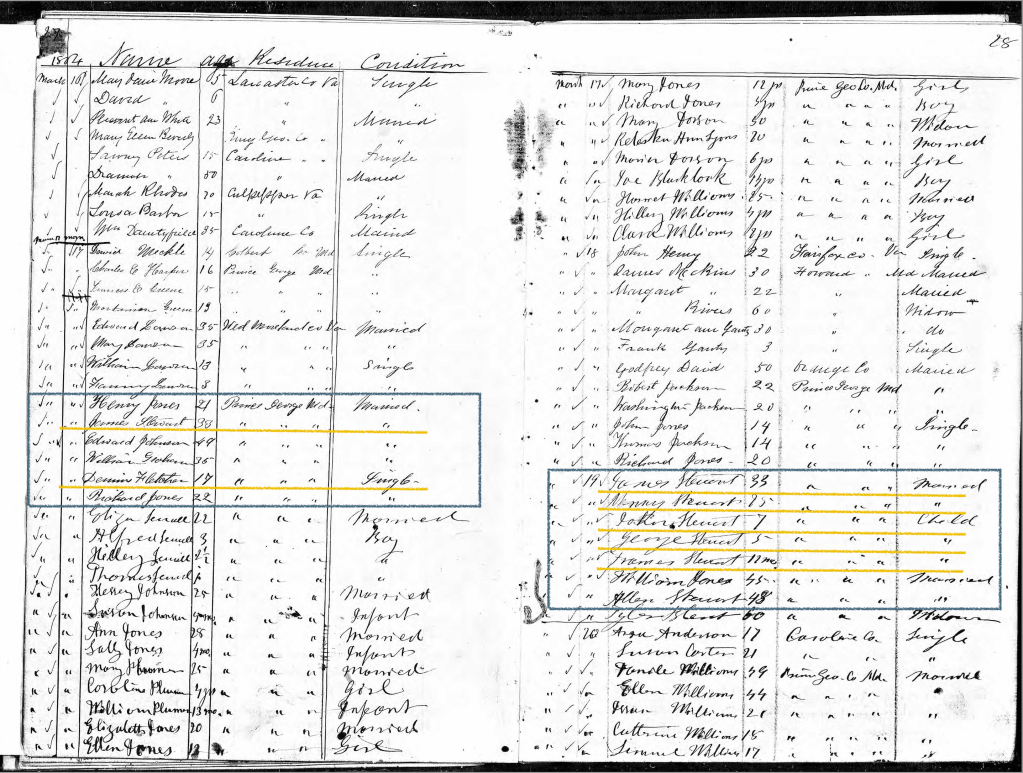
In March 1864, James Stewart appears to have been registered with a group of male refugees. On March 17, James is listed with other men with the surname Jones and a Dennis Fletcher. Dennis Fletcher also appeared on the 1860 Marsham Waring Inventory, after Nancy and her children. This suggests he is a younger brother of Nancy, and therefore brother-in-law of James. James is 33 years old.

Then, on March 19, a 33 year old James Stewart is listed with Nanny Stewart, and the children, John, George, and Francis. The ages of John and George are consistent with the ages in the baptisms. This suggests that James of the baptismal record is not James (Sr), rather James (Jr.)

The National Archives in Washington, DC; Washington, DC; Records of the Field Offices For the District of Columbia, Bureau of Refugees, Freedmen, and Abandoned Lands, 1865-1870; NARA Series Number: M1902; NARA Reel Number: 21; NARA Record Group Number: 105

A review of Benjamin Lee’s inventory shows a Jim, age 27, above the identified area that contained the other names of James (Sr.)’s children. His age is consistent with that of James (Jr) who gave his age as 33 to the registrar at Camp Springdale.

Lee Inventory

1870

After the war, James and Nancy stayed in the District of Columbia. They lived in Ward 5, with James working as a scavenger. They are living with Elizabeth Fletcher, age 23, who has a son, Louis.

Update

The White Marsh Baptismal Records Book 4 contains earlier baptism records than Book 3 (1819-1833) and contains a baptism record for James, born 1832, son of “James Stuart, slave of Master Warring” and “Suky, slave of Dr. Lee in Marlborough”. This would be consistent with the 33 year old James Stewart who escaped to the District of Columbia.

thomas j nicholson, enslaver

Thomas J Nicholson moved to Queen Anne District in Prince George’s County from Anne Arundel County in the 1850s. Living as a teenager with his father, Joseph Nicholson who was a farmer with real estate valued at $1000 in the 1850 Census; in the 1860 census, Thomas J Nicholson was a planter with both real estate and a personal estate each valued at $4000.

On the 1861 Martenet Map of Prince George’s County, he is living at the very north end of Queen Anne District along the Patuxent River and Bealmear’s Bridge. He enumerated six people in the 1860 US Census Slave Schedule.

GenderAge
Male53
Female40
Male21
Female17
Male14
Male4 months
1860 US Census Slave Schedule

In 1867, Thomas Nicholson and his wife submitted three lists to the Commission on Slave Statistics for Prince George’s County.

  • Thomas submitted the name of one person under his name: Mary Helen Headley, age 14
  • Sophia submitted the names of three people under her name: Louisa Hall, age 23, and two inferred children: Alfred, age 7, and Anne, age 4.
  • Sophia submitted another list “acting for the heirs of Mrs. Eleanor Sanford” with three people: Anne Lee, 45, Isaac Ennis, 35 and John Hall, 17

A comparison of the two lists suggests the following.

GenderAgePossible ID
Male53
Female40Anne Lee, 45
Male21Isaac Ennis, 35
Female17Louisa Hall, age 23
Male14John Hall, age 17
Male4 monthsAlfred, age 7
(born after 1860)Anne, age 4
(not listed)Mary Helen Headley, 14
1860 US Census Slave Schedule

The 53 year old male does not appear in the Prince George’s County Slave Statistics. This suggests that he either died or emancipated himself during the Civil War. Prince George’s County nearness to the District of Columbia, Nicholson’s proximity to the Patuxent River and the fact that over 30,000 enslaved individuals in Maryland self-emancipated themselves during the Civil war suggests the possibility that the male may have escaped. Barbara Jeanne Fields in Slavery and Freedom on the Middle Ground reminds us that those that escaped were more likely to be young as the flight to freedom endured slave patrols, exposure and physical punishment which was more difficult for the old and the very young. Diana Ramey Berry in The Price for Their Pound of Flesh that the enslaved people who lived beyond the age of 40 were considered elderly. (The average life expectancy of the enslaved was 25 while in the average life expectancy of the white population was thirty-nine). As a 53 year old, the male had exceeded the expectancy for an enslaved man.

Anne Lee, age 45, appears to be one of the women enumerated by Nicholson in the 1850 US Census Slave Schedule. In the 1870 US Census, she is enumerated immediately after the Nicholson family with Sophia, age 14.

Mary Helen Headley, 14, is possibly Mary Hadley, 23 living in the District of Columbia in the 1870 US Federal Census. She and Dennis Williams are working as black servants in the household of O. A. Dailey and Oliver Ambrose, dentists in Ward 4.

Thomas and Ellen Sanford

In 1818, Thomas Sandford and Eleanor Clarke were married in Prince George’s County, Maryland.

In 1840, Thomas Sanford is enumerated in the Prince George’s County in the US Federal Census. His neighbors include names of people living in and around Collington as evidenced by the 1861 Martenet Map of Prince George’s County.

In 1840, Thomas Sanford is enumerated with 8 enslaved people. By 1850, he is not longer listed in the household of Eleanor Sanford. She and Sophia are living in the household by themselves, neighbors with Richard Isaac of Joseph and Joshua T Clark, still in the neighborhood of north Colllington. She is enumerated in the 1850 US Census Slave Schedule with six enslaved people.

1850 Gender1850 Age1860 Gender1860 Age
Male43Male53
Female30Female40
Male11Male21
Female8Female17
Male3Male14
Male4 months
Male9
1860 US Census Slave Schedule

The continuity of ages and genders between the two slave schedules is remarkable considering the life expectancy of enslaved people and the documented likelihood that smaller households would often need to sell their enslaved as economic hardships hit.

Dinah Brown & Lawrence Wood

After the Civil War ended, Dinah Brown married Lawrence Wood. Dinah was the daughter of Charles Brown and Susan Wood. She was named for the grandmother of Susan, who had been enslaved by Robert Darnall. [See Fishwick v. Sewall, and the post on Dinah’s Descendants] Dinah and her descendants were enslaved by the Robert Darnall and then devised to Robert Sewall and his heirs.
Dinah was listed as the youngest of Susan “Suck” Wood’s children in the 1853 Inventory of Robert D Sewall’s estate at “Poplar Hill”. Her age was recorded as 7; her estimated birth year was 1846.

Her marriage to Lawrence Wood was solemnized in January 1866 when she was 22 years old.


early marriage years

After their marriage, they lived near “Poplar Hill” and Dinah’s brother, Joseph Henry Brown, near the Catholic Church where Rosaryville would develop into a town. The first map is from Martenet’s Map of Prince George’s County in 1863. The second map is from Hopkin’s Atlas of Prince George’s County in 1878. The development of Cheltenham and Rosaryville results from the building of the railroad and the development of villages after emancipation.

Excerpt from Martenet’s 1863 Map with my annotations | loc.gov
Excerpt from Hopkin’s 1878 Atlas with my annotations | loc.gov

In the 1870 census, they lived with their two children: Louisa and Buddy, and a teenager named Thorton. The 1870 census did not record relationships leaving us to infer relationships.

In the 1880 census, they are still living near Dinah’s siblings and her mother. They have an additional son, which they named after Lawrence. Dinah is working as a cook.


searching for Lawrence Wood prior to emancipation

Dinah’s family has strong ties to “Poplar Hill” and the “Woodyard”, her family having lived there since Susan’s grandmother was brought from Dorchester County prior to 1775, when Darnall moved to “Poplar Hill” with his step-daughter Jane Fishwick who had enslaved Dinah prior to Darnall taking possession of Dinah.

Lawrence does not appear in the 1853 inventory and his name, Lawrence is not one that appears in the 1821 inventories or other identified records related to “Poplar Hill”.

enslaved by Charles F Calvert

A “Lorenzo Wood” appears in the lists submitted to Prince George’s County Commission on Slave Statistics and compiled in 1867 & 1868. As enslavers had been been compensated for their “lost property” when the District had emancipated the enslaved in 1862, Maryland enslavers also hoped for compensation and many submitted lists to the commission. The Dangerfield family who owned “Poplar Hill” did not submit a list. However, Charles F Calvert submitted the name “Lorenzo Wood” along with sixteen other names.

Charles F Calvert was descendant from “the Calverts”. He purchased the tract of land he called “Belle Chance” which situation on the north part of the land that would become Andrews Air Force Base in the 1840s. Prior to his purchase of “Belle Chance”, he is listed in the 1840 census near Wm. P Brinham and Joseph B Hill, suggesting he owned land near the southern edge of “Poplar Hill”.

From Google Maps
Excerpt from Martenet’s 1863 Map with my annotations | loc.gov

Calvert, before and after his purchase of Belle Change” was a neighbor of the Sewalls and the Dangerfields at “Poplar Hill”. As evidenced by the “Early Records of White Marsh”, Sewall allowed the people he enslaved to enter into relationships on neighboring estates. 1828 Baptismal Records identifies the following relationships:

  • James and Sarah were identified as husband and wife; James was enslaved by Arthur West and Sarah was enslaved by Sewall.
  • Barney and Betsey were identified as husband and wife; Barney was enslaved by Jane Stone and Betsey by Sewall.
  • Nicholas and Ann were identified as husband and wife; Nicholas was enslaved by Sewall and Ann by Joseph Hill.

The same may be possible for the Dangerfields who inherited “Poplar Hill” after 1853, allowing Lawrence “Lorenzo” Wood to meet Dinah Brown.

The list submitted by Calvert lists 4 people with the surname Wood:

  • Betsy Wood, age 49
  • Francis L. Wood, age 17
  • Josephine Wood, age 15
  • Lorenzo Wood, age 18

Lawrence Wood is listed as 27 in the 1870 Census records, nine years older than the age reported in the “Slave Statistics”. It is often ambiguous what age the enslaver used for the “Slave Statistics”. For example, Marsham Waring’s heirs used the same ages as on the early 1860s inventory compiled for his estate, even though the list suggests it represents their age at 1864. Others used their 1867 age. For Lawrence Wood and Lorenzo Wood to be within 9 years of each other suggests that they are the same.

Maryland State Archives

The organization of his list makes it hard to tell if those with the same surname are closely related and if they are family groups. If we assume that they are, this suggests that Betsy Wood if the mother of the three teenagers.

Sources

Early Records of the White Marsh Church, Prince George’s County, Maryland. Bowie, MD: Prince Georges County Genealogical Society, 2005. Print.

Basil Medley, USCT

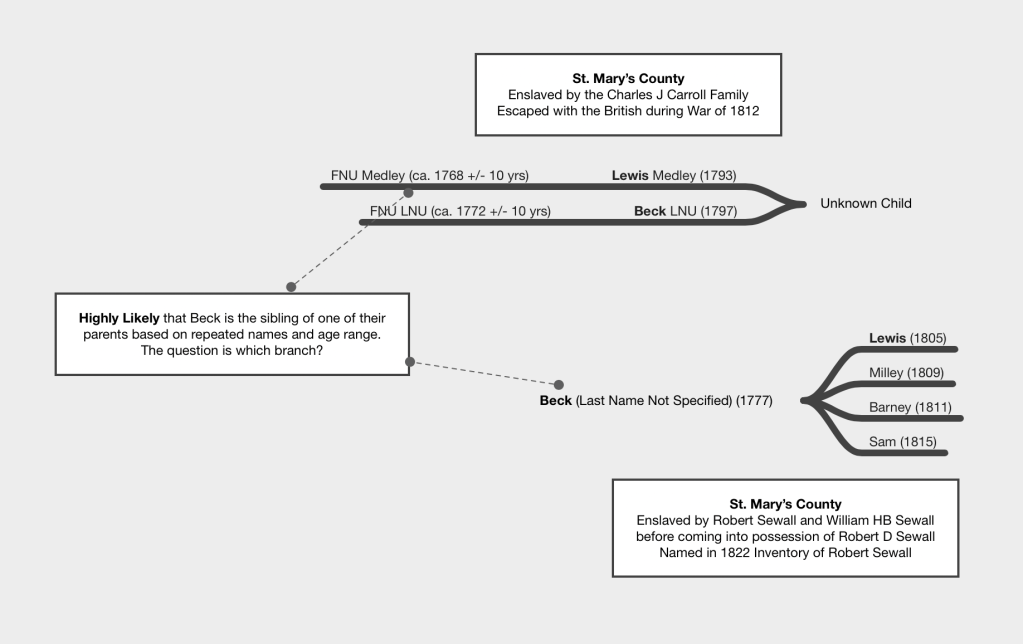
Lewis and Beck Medley, enslaved by Carroll family in St. Mary’s County escaped slavery by leaving with the British during the War of 1812. In the post [Lewis and Beck Medley | the British came], I speculated that because the Carroll family were neighbors to the Sewall family and both the Carrolls and the Sewall enslaved family groups with the names Lewis & Beck, that Lewis & Beck Medley may have been related to the Beck family group listed in the 1822 Robert Sewall Inventory of St. Mary’s County Property [TT 5:25].

1814 Claim1822 Inventory
Lewis Medley, 21 [1793]Beck, 45 [1777]
Beck Medley, 17 [1797]Lewis, 16 [1806]
Milley, 13 [1809]
Barney, 11 [1811]
Sam, 7 [1815]

Compensation for “Manumission”

Further documentation has been found to provide more information about the relationship between the two families.

In 1865, the Dangerfield Heirs of Robert D Sewall’s estate filed multiple Deeds of Manumission in Prince George’s County Land Records [FS 3:33-41 | mdlandrec.net]. These manumissions were filed in August 1865, almost a full year after the passage of the November 1864 Maryland Constitution which emancipated all enslaved people in Maryland. The manumissions effectively did not change the status of the named individuals as they had been previously freed by the State of Maryland.

Instead, these manumissions were filed in hopes of compensation for slaves who had been used by the US Army. In 1863, the US Government began to compensate slaveholders for the enlistment of enslaved people if they could prove their status. By filing the deed of manumission, the enslavers hoped to prove ownership of the enslaved people and receive $300 “upon filing a “manumission” or deed of ownership”. [US National Archives]. Multiple enslavers named those they had enslaved who enlisted in the FS Libers of the Prince George’s County Land Records. Some enslavers named the date of enlistment and the regiment within which the enslaved mustered. In the eleven manumissions filed by the Dangerfield Heirs, none stated a date of enlistment or regiment.

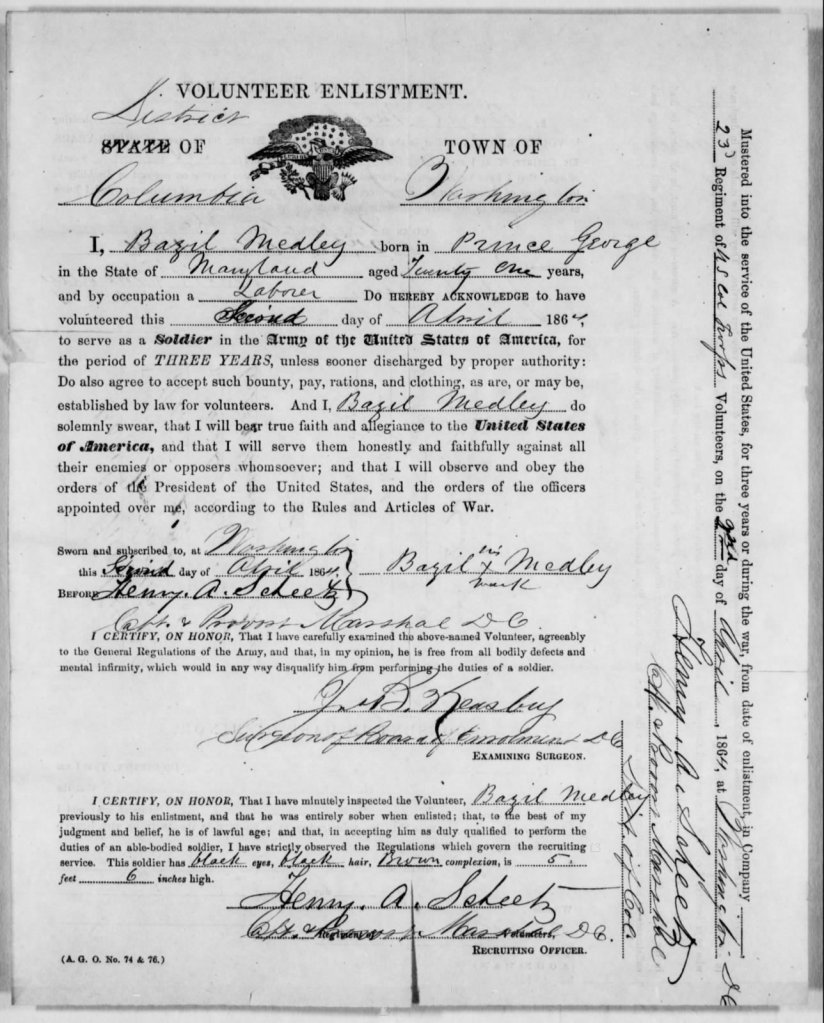
Basil Medley was one of the enslaved people named in the manumissions by the Dangerfield Heirs. USCT records have been located for him under the name “Bazil Medley” (fold3.com | ancestry.com)

Basil Medley was described as a 5 foot 6 inches man, 21 years old. He had brown skin with black eyes and hair. His birth (likely 1843) was listed as Prince George’s County, about ten years after Robert D Sewall inherited the St. Mary’s property and three years after Robert D Sewall sold the St. Mary’s property to George Forbes in 1840, consolidating his holdings in Prince George’s County.

Basil Medley enlisted into Company H of the 23rd Regiment in Washington DC in the spring of 1864. He signed his enlistment papers with his mark.


1853 Inventory

In the 1853 Robert D Sewall Inventory [JH 2:699], there is a family group that included the names Lewis and Basil.

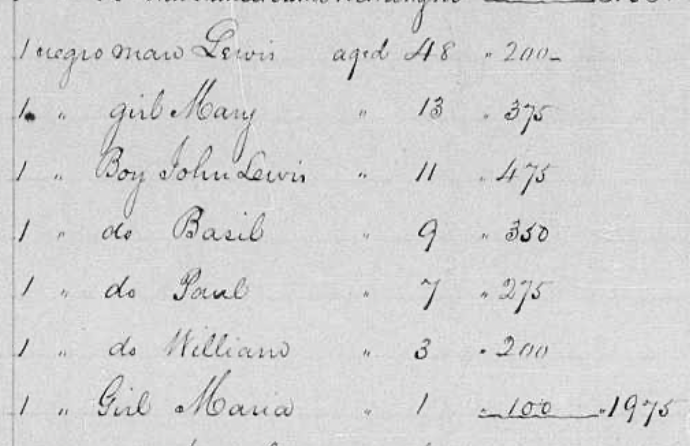
It is in the portion of the inventory that lists the people “gifted” to William P Brinham and on the property in his possession. Brinham was a friend of both Robert D Sewall and Sewall’s brother, William HB. William HB Sewall had inherited the St. Mary’s property from his father in 1820 and upon his death in 1832 had devised it to Robert D Sewall. In the 1840s, Sewall had conveyed some of those who had previously been enslaved in St Mary’s county to Brinham [JBB 3:587]. Listed in the deed are “Louis and his wife Maria, and their children, to wit: Mary and John Louis.”

These names correspond with the first two children listed in the Lewis family group in the 1853 inventory.

From 1853 Inventory of Robert D Sewall, Image 380, first column

In the family group, Lewis is listed as the inferred father, at 48 years old. This places his estimated birth year as 1805, which is consistent with the 1822 St. Mary’s inventory which estimates his birth year as 1806. The two inventories alone however did not indicate a surname name for either family. This left it open as to whether or not Beck and her children were related to the Lewis Medley who escaped the Carrolls and his Medleys, or related to his wife, Beck, and therefore related to a different family surname.

The USCT records cite Basil’s last name as Medley, which suggests that Lewis (born 1805/6) was also a Medley.

The presence of Medley for Basil suggests that Beck’s children and grandchildren are related to Lewis Medley who left with the British in 1812. It is likely that Beck’s partner and Lewis’s father is the Medley.

Thomas Clarke (b. ca 1783) & Charity (b. ca 1790)

This post is one in a series in an attempt to identify members of the Clarke family groups among the people enslaved by Robert D Sewall at “Poplar Hill” in Prince George’s County


Thomas Clarke, age 70, is listed in the 1853 Robert D Sewall inventory with Charity, age 63. [JH 2:699]. Having lived at least two decades past forty, they have surpassed the usual lifespan of an enslaved person. They were listed without an appraised value. Berry, in the The Price for their Pound, discusses the life cycle of the enslaved and in the chapter on the elderly (any enslaved person over 40), she writes “As the enslaved aged, their monetary values decreased and they became worthless on the market. Despite low external values, their soul values [internal values placed on themselves and by their kin] excelled. They carried great wisdom and stability for the community and were respected by the younger enslaved family and friends.” (130-131)

Thomas Clarke and Charity lived at “Poplar Hill” surrounded by their nieces and nephews and their children. The Sewalls and Dangerfields likely no longer had them working in the fields or the house, and so they were more likely providing child care for the small children under 10 while their parents worked under the watchful eye of the overseers and managers.


Thomas Clarke and Charity are also listed in the 1821 Robert Sewall Inventory, though they are not listed together. [TT 4:352] Thomas is listed with other adult males (Tom, Sampson, Capt John and Capt George — “Capt” signifying carpenters). Charity is listed with other female headed family groups with three children: Bob, age 7, Nelly, age 2, and Henrietta, infant. Immediately following her family group was that of Easter and her two children.

The “Early Records of White Marsh Church” includes baptismal records from White Marsh. “White Marsh was the center of Catholic life in Prince George’s County.” (Maryland State Archives). It was a Jesuit plantation that used enslaved labor for the profit of the Catholic Church. The Sewalls were a Catholic family with a private chapel included in the dwelling plantation.

In 1828, among the baptismal records of White Marsh was an April 9th baptism for “Mary, daughter of Thos. & Charity, servts [ensalved people] of Robert Sewall. The sponsor was Esther of same.”

This suggests the possibility that Charity and Easter/Esther are sisters and that they sponsored each others children.


The 1828 baptismal record also helps to the clarify the 1853 Inventory. Thomas and Charity Clarke are listed on page 1 of the inventory and the page breaks after their names. Without a value, they are not included in the subtotals on the first page or the second page, making it ambiguous if they are considered part of the family group that continues on page two.

NameAgeValue
Lucy + boy27 & 6825
Mary23650
Lewis29950

Lucy [1826], Mary [1830], Lewis [1824] would have been born after the 1821 inventory and close to Charity’s child-bearing year range (1805-1825 +/- a few years).

The baptismal record however, shows an earlier birth year for Mary — 1828– which places her birth in closer proximity to Charity’s child-bearing year range.

Sources

Berry, Daina R. The Price for Their Pound of Flesh: The Value of the Enslaved, from Womb to Grave, in the Building of a Nation. United States: Random House Inc, 2018. Print.

Early Records of the White Marsh Church, Prince George’s County, Maryland. Bowie, MD: Prince Georges County Genealogical Society, 2005. Print.

Dinah and her Daughters

In a previous post, we explored the children of Susan Wood, who married Charles Brown, both of whom were listed in the 1853 Inventory of Robert Darnall Sewall. One of Susan’s children was named Dinah. She was likely named after Susan Wood’s grandmother, Dina.

Dina in 1821

Dina, age 66, is listed in the 1821 inventory of Robert Sewall. She would have been born in 1755. She is listed with two adult males, Abraham, 38, and Jack, 19. Their relationship to Dina is unclear.

Dina before the Sewalls

Robert Sewall inherited the legal authority to enslave Dina and her offspring when Robert Darnall died in 1803. Prior to that Dina had been in the possession of Robert Darnall and his step-daughter, Jane Fishwick.

Prior to reacquiring “Poplar Hill” in 1773, Robert Darnall had lived in Dorchester County across the Chesapeake Bay, with his wife, the wealthy widow, Sarah Fishwick. When he was able to buy back “Poplar Hill”, Darnall brought his wife and his step-daughter from Dorchester County to Prince George’s County.

When the Darnalls moved, Jane Fishwick brought her personal “servant” with her, separating Dina from kin in Dorchester and bringing her to work in the Darnall household.

While in Prince George’s County, Jane fell ill and died in 1775. Her illness required medical care, which Darnall was not prepared to pay without being recompensed out of Fishwick’s estate. As a result, he claimed Dinah and her children as his chattel property.

Decades after Fishwick’s death, other kin laid claim to Dina and her children, saying that Darnall had illegally taking possession of her and her subsequent children.

The ensuing legal case, “Fenwick v Sewall” [1818], named Dinah and her children and grandchildren, which when compared against the 1821 Sewall Inventory [TT 4:352], provides additional connections between family members. Those named include: Fanny, Phillis, John, Paul, Moses, Susannah, Pat, Isaac, Charles, Nelly, Sally, John, Sampson, Tom, Nancy, Kit, Anna, Harriott. [p. 397]

“Dinah had seven children, to wit, Fanny, Patt, &c named in the declaration all of whom were living, and were born after the death of the plaintiff’s intestate:

  • John &c are the children of Fanny
  • Isaac, Nancy &c are the children of Patt and 
  • Harriott is the daughter of Nancy who is deceased and who is the daughter of Dinah.”

[Bulleting mine]

In the dispositions, Dinah was said to have been the mother of seven children and ten grandchildren.  In a later case, an additional claim was made as Sal, Pat, and Phyllis [1821] had a child in the interim.  

Many of these names correspond to the names included in the 1821 Inventory of Robert Sewall [TT 4:352], the heir of Robert Darnall who is alleged to have taken unlawful possession of Dinah and her offspring after Fishwick’s death. 

Dina

Inventory Line NumberNameAgeEst BYNotes
81Dina661755There are two women named Dinah enumerated (age 66 and 37) in the inventory.  If Dinah was old enough to be a mother and grandmother of 17 people in 1818, as well as seen by Dr. Digges in 1775 with a nursing child, then this excludes the younger Dina whose estimated birth year of 1784 makes her too young.  And assumes the older Dina who would have an estimated birth year of 1755. 
Dina is listed with Abraham, age 38, and Jack, age 19; neither are listed in the court case. 

Fan & children (1 child + 4 grandchildren) [Wood]

In the 1821 Inventory of Robert Sewall, the following family group is recorded:

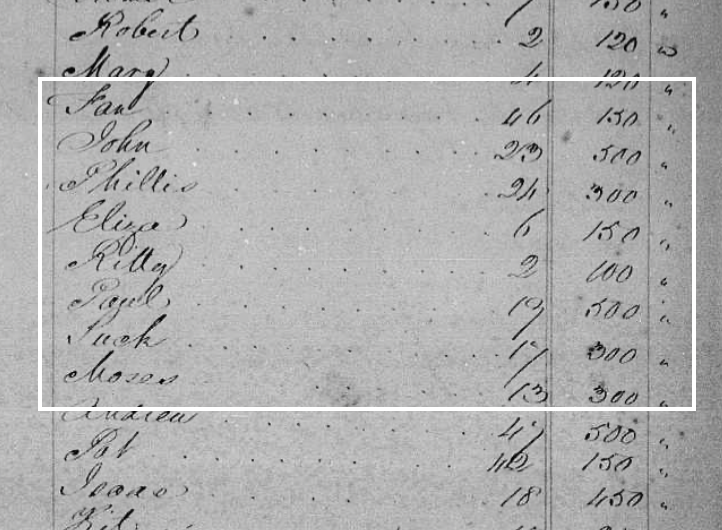
Fan is listed with her four children, John, Paul, Suck, and Moses, and her daughter-in-law Phillis and her two grandchildren, Eliza and Kitty.

Previous posts have talked about the children as individuals, and their children as identified in the 1870 census. [John Wood, Eliza Wood, William Hannibal Brown Gantt].

Inventory Line NumberNameAgeEst BYNotes
50Fan461775Fan is likely Fanny.  She is listed with her children, one of who has children of their own. 
Based on her age,  she is inferred to be the daughter of Dinah.  
52Phillis*241797She is listed with two children: Eliza, 6, Kitty, 2.  Neither of these children would have been born when the suit was brought forth in 1812, and are not likely to be listed in the original list of seventeen.
 
Phyllis is named in the 1821 appeal for having a child in the interim and this could refer to Kitty born around 1819.
 
In the case summary, Richard Burgess testified that all Dinah was mother or grandmother of all, except one which the witness believed was a female but her name he did not recollect” 

As Eliza was listed in the 1853 as a Wood, and John &c is named as a child of Fan and Phillis is listed prior to John in the list, it suggests that Phillis is John’s partner and not his sibling.  [see below] 
51John231798John is likely the John Wood, age 55, named in the 1853 Robert D Sewall inventory [JH 2:699] who is listed between the family groups of Eliza and Kitta in the inventory.  It is unclear from the 1821 inventory if John and Phyllis are siblings or partners. However, based on Burgess’s recollection it is likely they are partners.
 
Since he is listed as a descendant of Dinah in the court case, therefore the grandson of Dinah.  
56Paul191802Based on his age and the fact he is listed below Fan, he is inferred to be the grandson of Dinah. 

Three Pauls appear in the 1853 Inventory, all born after the 1821 Inventory was compiled.  One of the Pauls is the son of Charles and Suck.  See more about this relationship in the row about “Suck”/Susannah. 
57Moses131808Based on his age and the fact he is listed below Fan, he is inferred to be the grandson of Dinah. 

He is likely the Moses named in the will of William H B Sewall, the son of Richard Sewall and the brother of Robert D. Sewall.  William had inherited the St. Mary’s County properties from his father Robert Sewall upon his death in 1820 and the legal authority to enslave a portion of the people enslaved by the Sewalls.  In his will dated 1824, he requested that Robert D Sewall “give my servant Moses his freedom when he arrives at the age of 23.”  [St. Mary’s EJM 1:225]

A Moses, 22, was included in Wm HB Sewall’s St. Mary’s County 1831 Tax Assessment.  This is consistent with the age of Moses in the 1821 Inventory.  In 1832, Robert D. Sewall fulfilled the request and registered Moses’ certificate of freedom in St. Mary’s County.  As he was freed in 1832, it is not expected to find him in the 1853 inventory.  
56Suck171804Based on her age and the fact she is listed below Fan, she is inferred to be the granddaughter of Dinah.

She is in the 1853 inventory as “Luck” and is grouped with Charles, her inferred partner, and their children.  Among her children’s names are Paul, Susannah, Phillis, Dinah, John, Charles.  All of these names occur in the list compiled for the court case.  Death certificates for Susan’s children (who lived in Rosaryville after the Civil War and emancipation) name their parents as Charles Brown and Susan Wood.  

Pat & children (1 child + 3 grandchildren) [Brown]

Inventory Line NumberNameAgeEst BYNotes
59Pat421779Based on her age,  she is inferred to be the daughter of Dinah.  
She is listed with Andrew, age 47, and who is not named in the list, suggesting that Andrew is Pat’s partner and not her sibling. 
In the 1821 inventory she is listed with children ranging from ages 1 to 18 [eight children total].  Of the children: Isaac, Kitty and Charles were born prior to 1812 and the start of the court case.
 
Pat is named in the 1821 appeal for having a child in the interim and this could refer to her other children: Tom, Nancy, Milly, William and Nelly.  Of these children, the names Tom, Nancy, and Nelly appear in the list, suggesting the familial relationship.  
She appears in the 1853 Inventory with her son, William.  
60Isaac181803Based on his age and the fact he is listed below Pat, he is inferred to be the grandson of Dinah.
 
Isaac is likely the Isaac Brown, age 50,  listed in the 1853 Robert D Sewall inventory.  He is listed with an inferred partner, Sally Ann, and his children, among whom are Patsey, 20, Isaac, 19, Kitty, 11, Charles, 8, and Sam 6.  These names correspond with the original list.  
62Charles111810Based on his age and the fact he is listed below Pat, he is inferred to be the grandson of Dinah.

Charles does not appear to be listed in the 1853 inventory.
  
Susannah “Suck” Wood, daughter of Pat,  partnered with a Charles Brown and fathered many children.  It is possible that she partnered with her first-cousin Charles, son of Pat.  This has been ruled out due to the estimated birth years of both Charles.  In 1821, Charles Brown, son of Pat, has an estimated birth year of 1810.  In 1853, Charles, partner of Susannah, is listed as 54 years old, giving him an estimated birth years of 1799, a full decade earlier.  His age in the 1853 inventory is consistent with the 1870 census which lists him as 75 and gives him an estimated birth year of 1795, ruling this Charles out as her partner.    
61Kitty151805Based on her age and the fact she is listed below Pat, she is inferred to be the granddaughter of Dinah.

The five inferred children of Fan were listed immediately after Fan in the list provided by Berry and assumed to be copied in the same order as the primary source.  However, Kit in the list, is not immediately after Charles, which suggests that it may be a different Kit/Kitty. 

Nelly (1 child)

Inventory Line NumberNameAgeEst BYNotes
St Mary’s Inventory[TT 5:25]
Nelly301791Based on her age,  she is inferred to be the daughter of Dinah.
   
Like Moses, son of Fan, she appears to have been separated from her family and kept at the St. Mary’s County properties.  She was listed with a child, Eliza, who would have been born after 1812 and prior to the 1818 judgment.  She appears in Wm HB Sewall’s St. Mary’s County 1831 Tax Assessment; she is listed as 40, giving her the same estimated birth year of 1791.  The assessment is sorted by age and so it is difficult to infer if she had additional children.  

Sally (1 child + 1 grandchild) 

There are three Sal/Sal/Sale listed in the Inventory, all roughly the same age: 26, 29, 24.  

Inventory Line NumberNameAgeEst BYNotes
19Sale241797She is listed as “Sale”, which makes her name the most phonetically similar to Sally, listed in the court case.  However, where she is positioned in the 1821 inventory places her far away from the other children and grandchildren of Dinah.  
This suggests that is not the daughter of Dinah. 
68Sal291792She is listed amidst the other children and grandchildren of Dinah, heading a household that immediately follows Pat’s.  This would lend circumstantial support that this is the correct “Sally”
Additionally, she has two children: Hariot, age 9 and William, age 5. 

Sal is also named in the 1821 court case which suggests that William was born after the 1818 judgment, although his age of 5 suggests he was born before 1818. 
St Mary’s Inventory[TT 5:25]Sal261795Like Nelly and Moses, if this is the correct Sal, she would have been in St. Marys County.
  
She is listed with her children immediately prior to Nelly, which suggests the relationship between the two as inferred sisters.  Likewise, she is listed with three children: Tom, born 1811 and possibly named in the list, and two children born after 1818 (17 months and 3 weeks).  The ages of the children align better with the details from the court case.  

Based on her age and the ages of her children,  she is inferred to be the daughter of Dinah.  

The Brothers Clarke (3 children)

Inventory Line NumberNameAgeEst BYNotes
73John411780John Clarke “old” is listed in the 1853 Inventory after the Kitty (Wood) family group.  He is listed without an age.  Pat, his inferred sister, at 74 is listed as the oldest person in the inventory with a listed  age. If “old” John Clarke is Pat’s brother, and the Capt John identified in the 1821 inventory, then he would have been born one year after Pat. The designation of Capt would indicate that he was trained as a carpenter.   
72Sampson371784After Sal, the inventory lists 4 adult males: Tom, Sampson, Capt John, and Capt George. 
These names [John, Sampson, Tom] occur in the same sequence and what we have seen is that the list of people mostly mirrors the list in the 1821 inventory. 
71Tom321789Thomas Clarke is listed in the 1853 Inventory near the start, between other identified Clarke children.  He is listed as 70 (which may be an estimation of his old age). 
 
In the 1821 Inventory he is listed with his brothers away from his partner and children, as was typical of plantations.  The 1853 inventory lists him with partner Charity, allowing us to infer that his partner and children are listed in the 1821 inventory, albeit in a different section [Line Number 90-93]. This places them as the second family group after Dinah the matriarch.  

Nancy [deceased] ( + grandchildren)

[Nancy], Kit, Anna, Harriott  “Harriott is the daughter of Nancy, who is deceased” 

Nancy does not appear in the 1821 inventory and it is unclear if Anna or Harriot are listed.  A Harriot is listed as 9 years old who is the daughter of Sal, who was previously discussed and set aside as the Sal mentioned in the courtcase.  However, she is listed between Fan and Pat (and their offspring) before the Brothers Clarke and their inferred wives and offspring.  This suggests that Ann and Sal may be the same, as Sally Ann is a common combination. 

If “Isaac, Nancy &c are the children of Patt”, this would suggest Sal/Ann took in Harriott after Nancy died.  Without further documentation it is speculation. 

Eliza Wood

Eliza Wood is the daughter of John Wood; both are listed in the 1853 Inventory of Robert Darnall Sewall [JH 2:699].

Eliza’s Children

In the 1853 Inventory, Eliza is 38 years old and listed with six children. Her children are about two years apart. She is not listed with a partner, unlike other family groups. This suggests that her partner was likely enslaved by another. If Martha Ann is her oldest, then she began to have children when she was 26.

NameAgeEst BYIdentified Name Connections
Martha Ann121841
Henny101843
John Robert81845John is the name of Eliza’s father
Mary Jane61847
Fanny41849Fanny is the name of Eliza’s grandmother
Phillis11852Phillis is the name of Eliza’s mother

After Emancipation

Eliza and some of her children are identified in the US Federal Census as still living in close proximity to Poplar Hill after emancipation in 1870 and 1880. I have yet to locate John Robert and Mary Jane.

“Poplar Hill” can be identified on the 1863 Martenet Map of Prince George’s County by the name H(enry) Dangerfield, the guardian of Sewall’s nieces who inherited land from Sewall.  Immediately south of Woodyard in the north part of Surrats District, the road leading south to Surratsville (present-day Clinton) cut the land into two pieces.  

Martenet labeled a Mill near Henry Dangerfield and the Woodyard intersection.  This mill can be identified in the 1870 Census as dwelling number 21, with Head of Household Henry Tarman who was identified as a Miller.  Immediately enumerated after him is Annie Marshall in dwelling number 22. She is the mother of WH Marshall who is named on the map and who had moved out of state after the Civil War.  

Households 23-32, 35-42, 47-49 are freed Black families who have names with connections to the 1853 Inventory. The enumerator appears to have followed the road south from Woodyard and then turned right [northwest] onto the road to the Jenkins property.  

Members of the Eliza Wood family are enumerated among these households. 

Eliza & ‘Feles’ with grandchildren

In the 1870 census, Eliza is listed as the head of household with her occupation listed as “keeping house”, a phrase usually reserved for a woman taking care of her own house (as opposed to “domestic” which indicated work as a servant). There is no indication of a partner. She is living with ‘Feles’, age 19, likely to be Phillis who was one in the 1853 inventory, and two children: Susanna Johnson, age 7, and Fannie Johnson, infant.

They are listed in dwelling number 26.

Phillis was married in 1870; the officiant McDonald, was a priest for the Catholic Church. She married James Clarke in September. James was listed in dwelling number 25 of the 1870 census.

Martha Ann & Charles Johnson

In 1870, Martha and Charles are not found in the US Federal Census, though to of their children are listed with Eliza (Susanna and Fannie). This suggests that they either lived separated from the Wood family, or the enumerator only listed those “at home” at the time of the record, rather than asking about additional family members.

In 1880, Eliza is living with the Charles Johnson household (dwelling number 173). She is listed as a “Cook”. She likely worked for a private family. She may work for the same private family as her granddaughter, Christiana, age 16, who is listed as a servant. They are living adjacent to the Tenley family and Walters Family, both white. James Walters is indicated on the 1878 Hopkins map of Surratts District, allowing us to identify their residence in 1880.

On the same Census page, James and Phillis (Wood) Clarke are listed. They are listed with three grandchildren: Rose, James, and Agustus.

James Wood

Between the two Wood families in the 1880 census, sits James Wood, age 45. He is living with his wife, Annie, and their children: Eliza, Catherine, Edward, Nancy, Susanna, and Martha.

NameAgeEst BYIdentified Name Connections
Eliza A161866Possibly named after Eliza Wood, subject of post
Catherine A13?1867Possibly named after Eliza’s sister, Kitty
Edward H91871[Not discussed in this post and “Ned” is a name that will repeat in generations of Woods]
Nancy71873
Susanna41876[Not discussed in this post and “Susanna” is a name that will repeat in generations of Woods]
Martha21878Possibly named after Eliza’s oldest identified daughter.

The relationships of James Wood with Eliza Wood is unclear. The names of his children and his geographic proximity suggests a kin relationship.

If he is Eliza’s son, he would have been born around 1835 and he would have been older than the children listed in the 1853 Inventory. She would have been 20 when he was born which is within her child-bearing years.

It is possible, that he was sold as a teenager to a local enslaver, when Sewall needed ready cash. He was a reputed drinker and gambler. Berry, in The Price for Their Pound, describes how the teen years were when most separations from families occurred, as the children were older and able to perform heavy labor. “Most of the [enslaved people] sold in the Upper South were teenagers and young adults”. [p. 66]

In 1870, James and Ann are living in the Marlboro District with his two daughters, Eliza and Catherine and other freed people who appear unrelated (John King, Robert Smith, Henry Harley, Washington Marlow, Catherine Beall).

Henny

Henny, Eliza’s second oldest daughter, is listed with as the head of household of dwelling number 23 in the 1870 census. The enumerator records her as living with Lewis Brown, age 45.

Based on her listed occupation, “Domestic”, and that females were rarely listed as head of household if there was an older male, I propose the possibility that the enumerator miss identified the household. I suggest that Henrietta Wood, Domestic, age 28, should have been listed with the previous household, and Lewis should be head of household of his own house. If this is the case, then she would have been working the household of Annie Marshall, who lived in a dwelling house adjacent to the “Poplar Hill” tract of land.

Three years later, she married John H Jackson, in a ceremony officiated by Walsh. She and John moved to Rosaryville, nearby, and lived there with her children. They are living near the children of Charles and Susan (Wood) Brown, discussed in the post on William Hannibal Gantt Brown. Susan is like Henrietta’s great-aunt, as identified in the 1821 inventory [TT 4:352].

Sources

Berry, Daina R. The Price for Their Pound of Flesh: The Value of the Enslaved, from Womb to Grave, in the Building of a Nation. United States: Random House Inc, 2018. Print.

John Wood

John Wood is listed in the 1853 Inventory of Robert Darnall Sewall’s estate [JH 2:699] as a 55 year old man who was appraised at $400.

In her book, The Price for a Pound of Flesh, Berry talks about the stages of an enslaved person’s life. For John Wood, age 55, he would have been considered elderly as he had surpassed the age of forty, the boundary between mature and elderly. John may still have be performing labor for the Sewall family, and yet, he had surpassed the age of most of the enslaved whose life span was shortened by hard work and captivity. Berry described the work of the “able-bodied enslaved people” over forty as performing tasks including serving as cooks, body servants, gardeners, and caretakers of enslaved children. [page 133]

Berry separates out the “soul value” — “an intangible marker that often defied monetization yet spoke to the spirit and soul of who they were as human beings.” As an elderly member of the plantation, he would have been a valuable member for the community in terms of wisdom and kin connections. He may have taken on the role of caretaker as evidenced by his placement in the 1853 inventory.

John Wood’s Daughters

He is situated between two family groups: Eliza and her children and John and Kitta Brown and their children.

Annotated excerpt from 1853 Inventory showing John Wood between the two families.

It is inferred that Eliza and Kitta are John’s daughters due to their placement in the 1853 inventory, and when names and ages are compared with the 1821 [TT 4:352] and 1853 Inventory.

Name1821 Age & EST BY1853 Age & EST BY
John23 – 179855 – 1798
Eliza6 – 181538 – 1815
Kitta/Kitty2 – 181934 – 1819

John Wood may have taken care of his grandchildren and other small children as the adults and older children were sent to the fields to perform labor. He has not been located in the 1870 census suggesting that he may have died prior to 1870; he would have been 72 had he lived.

John and Phillis, partners

The 1821 Inventory shows John listed with a partner, Phillis, the inferred mother of his daughters, Eliza and Kitty. Phillis, age 24, in the 1821 inventory, would have been born in 1797. She would have been 18 when she gave birth to Eliza and 22 when gave birth to Kitty. The inventories do not indicate if they had additional children. Eliza named her youngest daughter after her mother. Phillis, the grand-daughter, is listed with Eliza in both the 1853 inventory and in the 1870 US Census.

Phillis is not listed in the 1853 Inventory when she would have been 56. This suggests that she either died prior to the inventory was taken, or that she was sold by the Sewall family.

It is also unclear if the relationship between John and Phillis was self-selected or if the overseers and enslavers chose the relationship between the two.

Sources

Berry, Daina R. The Price for Their Pound of Flesh: The Value of the Enslaved, from Womb to Grave, in the Building of a Nation. United States: Random House Inc, 2018. Print.