Nicholas Jones

Connected Post: Richard (Dick) Jones & Mary (Polly) Jones | Old Age

Richard (Dick) Jones and his wife, Mary (Polly) were born at the end of the Revolutionary War and lived until the start of the Civil War in Queen Anne District of Prince George’s County. The vast majority of their life was spent on the estates of Marsham Waring. They and their children labored for Waring and his three children, as well as neighboring estates. This post explores the life of one of their sons, Nicholas Jones.


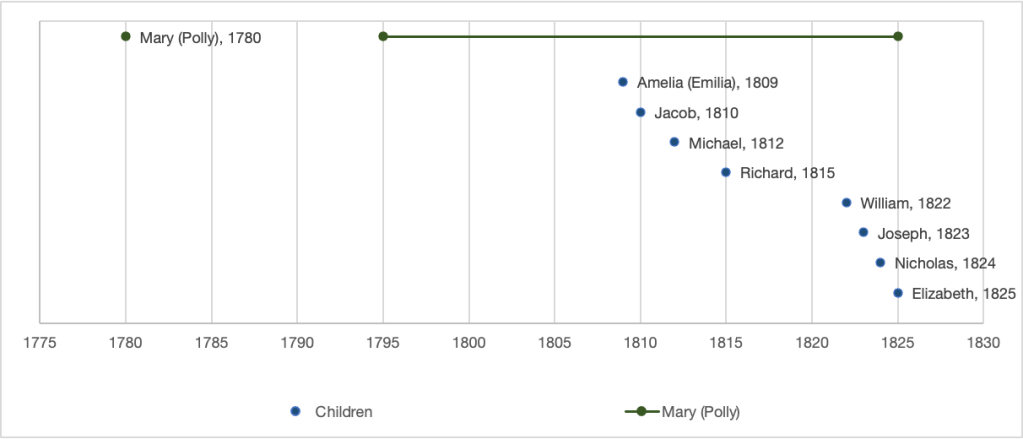
Nicholas Jones was one of the younger sons of Richard and Mary born toward the end of Mary’s estimated child-bearing years (1795-1825), when she was 15 to 45 years old. If my theory is correct about Richard’s forced migration from Stephen West to Marsham Waring (see connected post), then Nicholas was named after his grandfather, Nick.

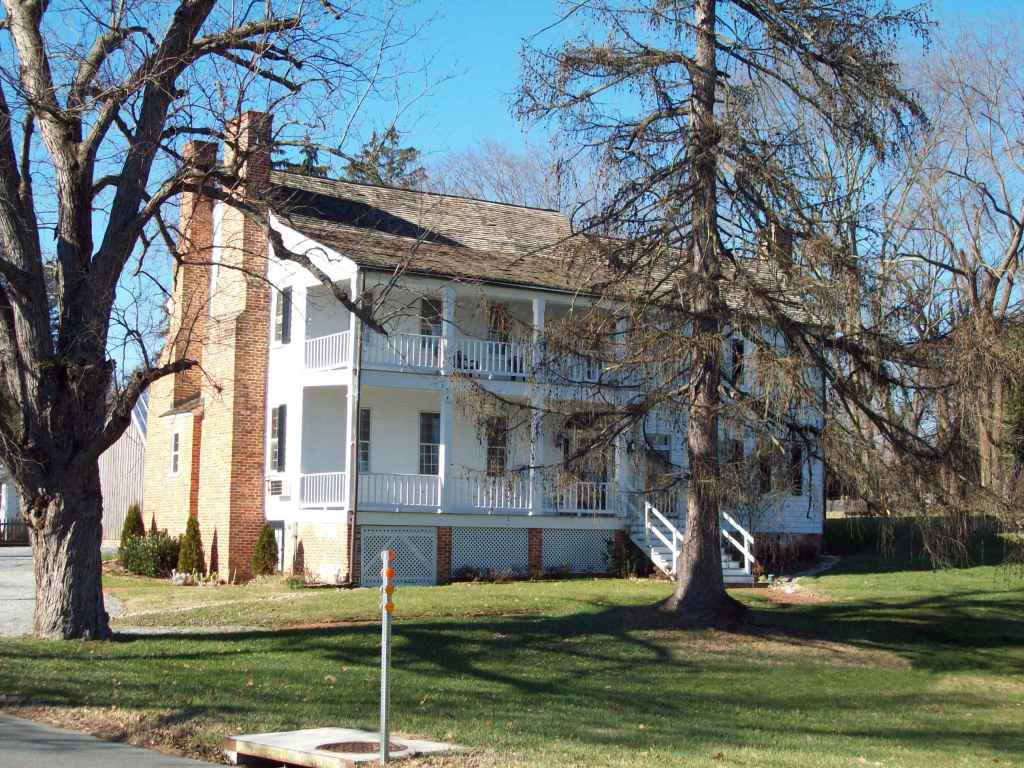
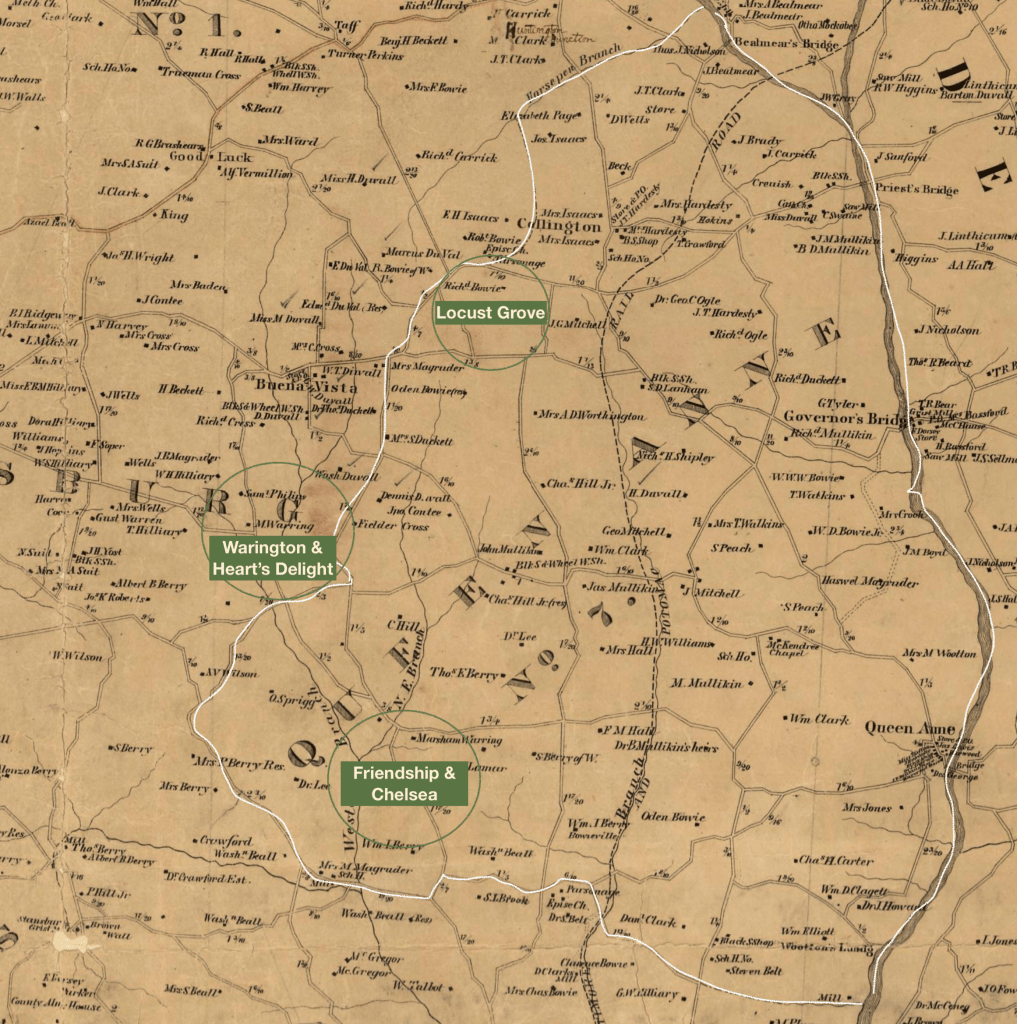
He labored on the Waring estate “Heart’s Delight”, which was in Bladensburg District near Buena Vista, near the Warington estate where his parents lived and labored. His wife and children labored on a neighboring estate owned by John B Magruder.

Nicholas and Martha had several of their children baptized by the priests of White Marsh.

  • 1853: Richard Euseb., son of Nichol. [Johns] & [?] Williams, property of J. Magruder; Sponsor: Chas. Gasebeth
  • 1856: Robert, son of Nichol [John] + Martha Williams, property of John Magruder; Sponsor: Thomas Allen
  • 1858: Lucy, of Nic Jones & Martha Anne, property of J. Magruder; Sponsor: Susan
  • 1862: Nicholas, of Martha & Nich Jones, col.; Sponsor: Carolina Green

In May 1862, a group of enslaved people from Waring’s estates fled to DC with James Waring, Marsham’s son, pursuing them. He swore out an affidavit, swearing that they were enslaved in Maryland, not the District, and therefore he was lawfully able to seek their return to bondage. Some of those named in the affidavit were Nicholas’s siblings, Joseph and Richard. Nicholas was not named, however, he is living in the District in the 1870 Census, suggesting he joined them later.

In 1864, Martha and her children are listed in the Freedmen Bureau’s Registration list for Camp Springdale, without Nicholas, her husband. She was recorded as Jones, and some of her children were recorded as Johnson. A comparison of the lists of names in the Freedmen’s Bureau Record with that of John B Magruder’s list of enslaved people he submitted to the Prince George’s Commission on Slave Statistics for compensation however show similar given names and ages and is similar to the list of names found in the White Marsh baptismal records. Again, Martha’s husband, Nicholas Jones is not listed with them.

Records of the Field Offices For the District of Columbia, Bureau of Refugees, Freedmen, and Abandoned Lands, 1865-1870; NARA Series Number: M1902; NARA Reel Number: 21; NARA Record Group Number: 105; NARA Record Group Name: Records of the Bureau of Refugees, Freedmen, and Abandoned Lands, 1861 – 1880 | ancestry.com

Prince George’s County Slave Statistics Original Scans | Maryland State Archives

They are reunited by the 1870 Census. Nicholas and his wife lived with four of their sons; one of their sons, Charles, had married and his wife and children lived with them in the District. They worked as laborers. How and where they labored is unclear.
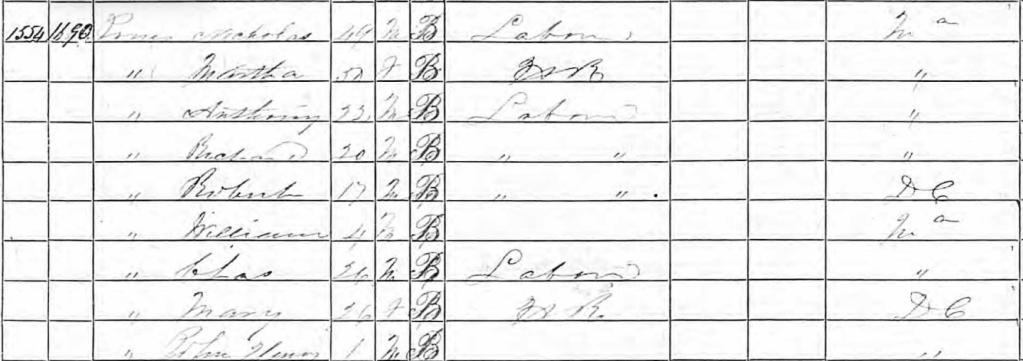
1870 Census, District of Columbia, Ward 6 | ancestry.com

They lived near D & 13th NE on the far edge of town, near the boundary with the county and along the road to Benning’s Bridge. Other siblings were found in the County near Benning’s Bridge in the 1870 and 1880 census records.

By October 1870, Martha, Nicholas’ wife had died of consumption, now more commonly called tuberculosis.

Annotated by author with residence’s of Nicholas Jones from City Directories | Entwistle’s handy map of Washington and vicinity : showing public buildings, churches, hotels, places of amusement, and lines of street rail roads. [1876] | loc.gov

After 1870, the lives of Nicholas and his children become obscured. Other than Nicholas consistently living in Ward 6, the family and its members are not reliably identified in the 1880 census records. A widowed Nicholas Jones is identified in the census, living on B Street SE, which would suggest it is the same Nicholas Jones. He is recorded as born in Virginia, though this could have been an error made by the census enumerator, as other senior members of the household are also listed as born in Virginia.

He is in the household of Frances Williams and her grown children; this suggests he moved in with one of his wife’s relatives, if this is the same Nicholas Jones.

A death record for 1899 lists Nicholas Jones, widowed, who was born around 1815. He was buried at Potter’s Field, part of the Washington Asylum, the “poor house”. It was located near where Nicholas Jones was recorded living in the City Directories.
related posts

James Stewart | Acquisition

What connection if any does James Stewart have to the enslaved of Notley Young of Prince George’s County?


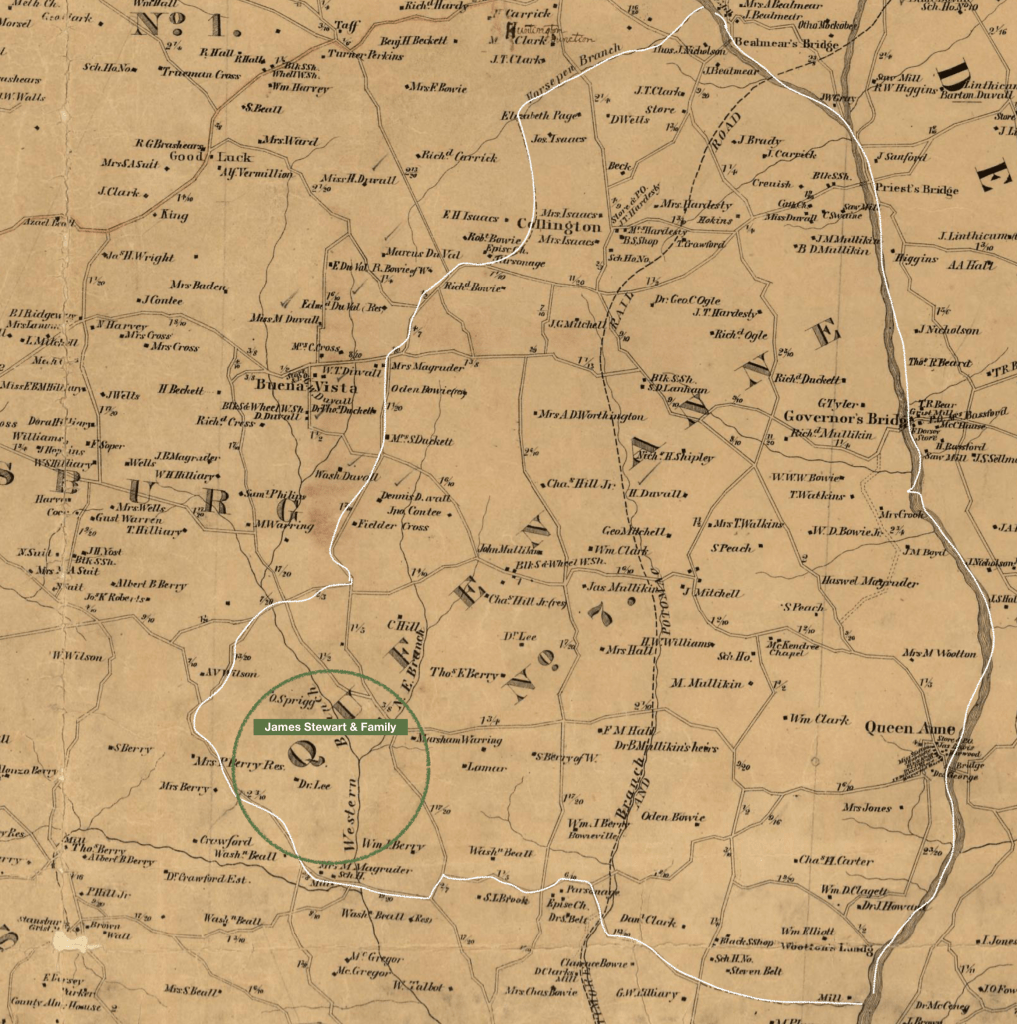
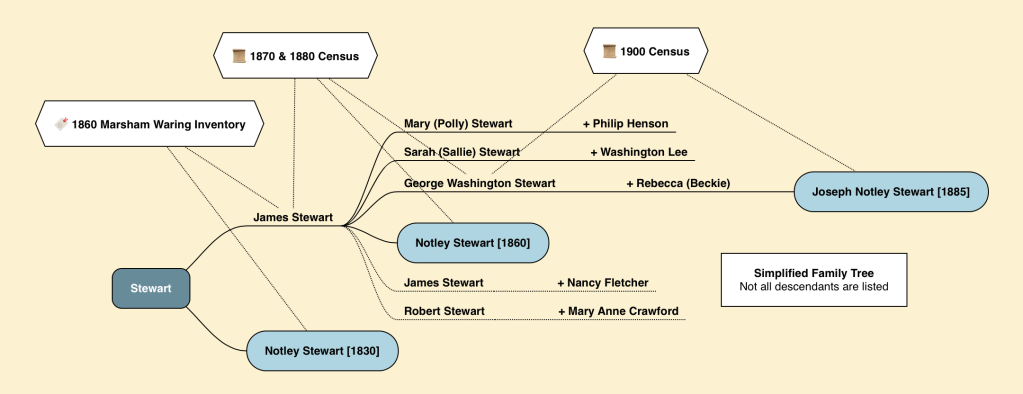
After emancipation in 1864, James Stewart and many of his children, including Notley Stewart, stayed on the lands of Dr. Benjamin Lee in Queen Anne District in Prince George’s County, Maryland.

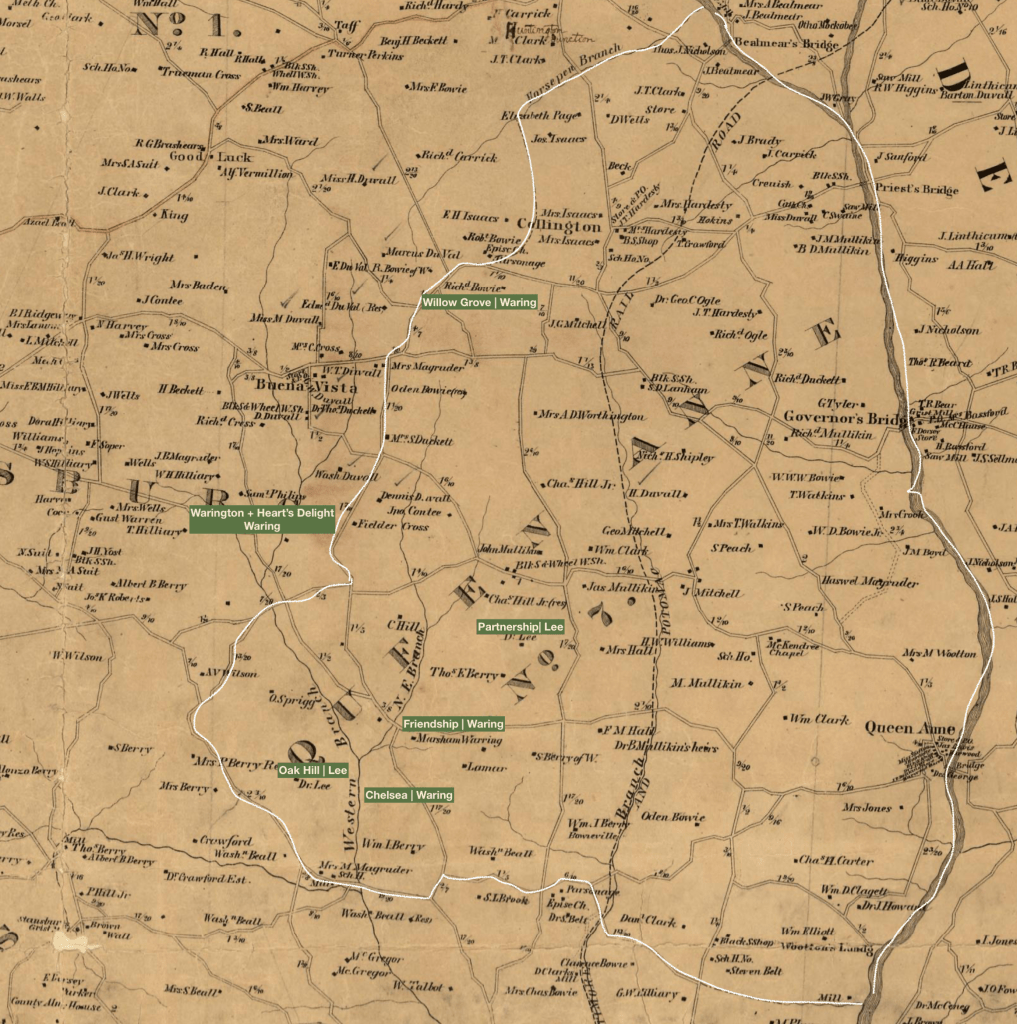
Annotated Excerpt from 1861 Martenet Map of Prince George’s County | loc.gov

Prior to emancipation, Stewart had been forced to labor for Marsham Waring’s estates, while his children labored on the estates on the Lee. Waring and Lee were brother-in-laws. Inventory records for Marsham (WAJ 2:321) and the post-emancipation records of the 1870 and 1880 records suggests that James was born a few years after 1800, and about a decade after Marsham Waring.

The name “Notley” has been used by multiple generations of the Stewart family — and one possible source for the given name is from the enslaver Notley Young. Other members of the Stewart family used names that were aligned to their (former) enslaver. For example, James’ son and daughter-in-law, George and Rebecca Stewart had daughters named Violetta and Eleanora, both names in common with the wives of Waring and Lee. Sarah (Sallie) Stewart and her husband Washington Lee named one of their sons, Benjamin, giving him both a given and surname that matches Sarah’s former enslaver, Dr. Benjamin Lee. The use of Notley in the family suggests a connection with a (former) enslaver named Notley, i.e., Notley Young.

There are three Notley Youngs in three successive generations:

  1. Notley Young (I) who died in 1802. His estates and property were located within the parts of Prince George’s County that would become the District of Columbia.
  2. Notley’s (I) son, Notley Young (II), a priest with connections to the Jesuits, Georgetown University and the White Marsh plantation along the Patuxent.
  3. Notley’s (I) grandson, Notley Young (III), son of Benjamin Young. Notley Young (III) married Eleanor Hall, his second cousin, and lived in Queen Anne District, before dying in 1846.

In the 1828 Tax List for Prince George’s County, Notley Young (III) owned practically 735 acres of land in the Collington & Western Branch Hundreds, from which part of Queen Anne District would become. Both Waring and Lee owned property before the Civil War along the Western Branch, which divided the two hundreds.

Map of part of the city of Washington shewing the situation of the mansion house, grave yard & buildings belonging to Mr. Notley Young : original proprietor of that part of the city. | loc.gov

View of the city of Washington in 1792. | loc.gov

Inheritance

There are three ways to acquire an enslaved person: 1. purchase, 2. inheritance/gift, or 3. natural “increase”, i.e., claiming ownership of the children of enslaved women.

James Stewart was born prior Marsham Waring acquiring his father’s estate, who died in 1813. On his inventory, there was a child called Jim (James) age 12 with an estimate birth year of 1801, which is consistent with calculated birth years from the later documents. This suggests that Marsham Waring (Sr.) conveyed James along with his other property to Marsham Waring (Jr.) of the 1860 Inventory, and opens the line of inquiry of how Marsham Waring (Sr.) acquired him.

Purchase from Notley Young, Sr.

Notley Young’s grandfather died in 1802. Included in his inventory is a James age 3, who would have been born in 1799. This is within two years of the age on the 1813 inventory of Marsham Waring (Sr.) After making some specific bequeathals to his wife and for his real estate, Young’s grandfather divided his personal estate (including his chattel) to be equally divided among his five identified children/grandchildren.

As noted on the family tree, a cousin of Notley Young (II) is George Washington Young, who inherited his father’s estate Nonesuch along the Eastern Branch (what would become known as Anacostia) and within the District of Columbia. When the District abolished slavery in 1862, G. W. Young filed a claim for compensation for his “loss” that included a “Stuart” family group.

This suggests that the Young family had enslaved members of the Stewart/Stuart Family group, perhaps even the one that James Stewart came from.

It is possible that the heirs of Notley Young sold James and separated him from his family, sending him to Marsham Waring (II) and his estates. Both Marsham Waring (II) and Notley Young were involved in the creation of the District of Columbia and engaged in business together. In the 1830s, their heirs were sued as together they had put up sureties for Thomas S Lee and a loan he had taken from Charles Carroll of Carrollton (Charles Carroll of Carrollton vs. Marsham Waring, et al June 1832).

White Marsh Baptism Record

In 1832, the enslaved population of Waring and Lee grew through “natural increase”, the term enslavers used to conflate the language they used to talk about their livestock and their enslaved people, dehumanizing the latter. James “Stuart” and Susan (Suky) had their son, James, baptized by the priests of White Marsh, the Jesuit Catholic plantation near Priest’s Bridge which also enslaved numerous people.

The baptism record notes that James (Sr.) was enslaved by “Master” Warring and that Susan (Suky) was enslaved by Dr. Lee in Marlborough. The record also notes the sponsor/godmother as a person enslaved by Notley Young, mostly likely Notley Young (III) based on the year of the baptism. The name was transcribed as “__rvelide?”.

“Content” | wikipedia.com
Dr. Benjamin Lee lived in this house in Upper Marlboro from 1821-1844 before moving to his estate in Queen Anne District. This is where Suky and her children most likely labored.

It is probable that the sponsor for the baptism of James and Suky’s son is a relative of either James or Suky, as godparents are usually chosen from within a kinship group, and therefore suggesting a connection between the Notley Young estates and James Stewart’s kinship group.

Reconstructing the Transcribed Name

My source document provides the typed transcription without access to the handwritten record of the priest, leaving the reader to guess at how the the transcriber interpreted the name. To complicate matters, the priests of White Marsh were not also fluent with Anglo-American names or the diminutives used by the enslaver and so there is often non-traditional spelling. With that in mind, the following three items helped to narrow the possibilities.

  1. The transcriber noted it was a godmother, therefore looking for women’s names
  2. The index to White Marsh Book 4 provides three plus page list of names of given names used by the priests, providing a sampling of names used during this time period by enslavers and enslaved.
  3. The final syllable “-ide”

These three items helped to identify Adelaide and its variations as a probable given name for the godmother. Another possibility includes names like Emeline and its variations, though Matilda and Cornelia are also likelihoods.

Of note, on the same page, a Adelaide was noted as a person enslaved by Benjamin Young, likely Notley Young’s brother. She had a son, Alexander who was baptized the same year as James. In 1818, Sandy [Alexander] and Adelaide were married at White Marsh with the permission of their enslaver, though the record does not note their enslaver. That said, the repetition of Alexander and Sandy in both records suggests that Adelaide and Alexander married and had a son, named for his father, Alexander.

A 1821 records provides more insight into the Alexander + Adelaide family group. Francis and Moses Sandy were baptized in 1821, as one-day old sons of Sandy and Adelaide Cosy, servants of Mr. Benj. Young. In 1817, Peter Corsey escaped from Notley Young, he may be related to the Cosy’s of Benjamin Hall.

A review of the 1809 Inventory (TT 1:321) for the estate of Benjamin Young (the son of Notley Young (I) and the father of Notley Young (II) and Benjamin Hall Young provided a possible family group for Adelaide. The Inventory appears to be groups in families, as a few adults will be named then children, then adults and children again. The group identified occurs near the beginning of the inventory. The list includes a Suck, a name variation for Susan; though Susan was an extremely common name for the enslaved communities of Prince George’s County.

NameAge in InventoryEstimated Birth Year
Dolly321777
Eliza211788
Suck151794
Louisa121797
Adelaid101799
Harry121797
John101799
Billey101799
Maria41805
Chrissy51804
Edward31806
Ned41805
Robert21807

Tentative Conclusion

The circumstantial evidence suggests that James Stewart came to the Waring family from the Young family.

  1. The use of Notley as a given name within the Stewart Family
  2. The presence of a James on the 1802 Notley Young (I) Inventory
  3. The inclusion of other Stewart family groups on the Compensation List for G. W. Young
  4. The presence of a White Marsh baptism record which indicates a godmother from the Notley Young estate for James Stewart’s son, James (Jr.)

related posts

Amelia (Emilia) Jones Calvert

Connected Post: Richard (Dick) Jones & Mary (Polly) Jones | Old Age

This post explores the possibility of Amelia (Emilia) Jones Calvert as a daughter for Richard and Mary Jones. She was first found in a White Marsh baptism record with the surname Jones and a documented connection to the Waring estates, which is where Richard and Mary Jones were enslaved, suggesting she was a relation.
White Marsh Baptism

In 1831, Amelia (Emilia) Jones, wife of George Colbert [Calvert], had their daughter Mary Rachel baptized by the White Marsh priests.  The priests recorded George as property of James Belt, Marsham Waring’s father-in-law, and recorded Amelia (Emilia) Jones as property of Marsham Waring. 

George Calvert [1794]

James Belt had purchased Chelsea, a tract of land from another branch of the Belt family and conveyed it to his two daughters, Violetta Lansdale Belt and Eleanor Belt. Violetta married Marsham Waring and Eleanor married Dr. Benjamin Lee.

Most likely James Belt purchased the legal authority to enslave George from Cornelia Lansdale, his sister-in-law, in 1826, when he satisfied two mortgages. (see Prince George’s County Land Records, AB 4:308; accessible through mdlandrec.net).  

George is also listed in James Belt’s 1832 Inventory (PC 2:20) as 38 years old [1794].  At 38, George had outlived the expectancy of most enslaved people and would be roughly 70 years old by the time of Benjamin Lee’s death in 1863 and Marsham Waring’s death in 1860; he is not listed in either inventory.

Indirect clues from Waring’s Inventory

In Marsham Waring’s 1860 Inventory,  George (II) Calvert, age 38 [1822] and Daniel Calvert, age 25 [1835] are listed.  When enslaved adults were partnered, any children usually stayed with the mother and the estate she was held captive on, until the enslaver chose to sell the child and/or the mother.  As Amelia was indicated property of Waring, it is probable that George (II) and Daniel are Amelia and George’s sons living with her on Waring’s estate. Additionally, their birth years bookend the baptism of Mary Rachel. The identification of George (II) and Daniel as probable sons, allows us to begin to identify a likely age range for Amelia along with the identification of George (I) Calvert.   

To begin, George’s ages in Belt’s inventory provides us with an upper limit to her age. Taking into consideration the life expectancy rates of enslaved people and its impact on the age of the partners in the union, then we can also predict the likelihood that Amelia was younger than George. She was likely not older than 38 (George’s age in the 1832 Inventory) and was more likely to be 5-10 years younger, suggesting an upper age of no more than 28-33 years old.

Her child-bearing years suggest a lower limit for her age. Women’s child-bearing years are roughly between the ages of 15 to 45, meaning that Amelia was most likely between 15 and 45 years old when she had the three identified children. If she was the father of George (II), then she would have been at least 15 years old in 1822, and therefore no younger than 24 in 1831, suggesting that she was between 24-33 at the time of birth for Mary Rachel.

As a result, this allows for an estimated birth year range of 1798-1807, which in turn places her within Mary (Polly) Jones’ child-bearing years, which places her as a likely daughter of Richard and Mary Jones.  

Amelia is possibly listed in the 1860 Marsham Waring Inventory as Amelia, age 50 [1810]. 50 may be an estimated age (allowing for a few years either way, this places the age on the upper limit of range.

In the inventory, she is listed near Daniel Calvert, her son, and Michael Jones, her likely brother, reinforcing the possibility that she is Amelia Jones Calvert of the 1831 baptism. 

related posts

Richard & Mary Jones | Old Age

Richard (Dick) Jones and his wife, Mary (Polly) were born at the end of the Revolutionary War and lived until the start of the Civil War in Queen Anne District of Prince George’s County. The vast majority of their life was spent on the estates of Marsham Waring. They and their children labored for Waring and his three children.

Annotated Excerpt from 1861 Martenet Map of Prince George’s County | loc.gov

Waring died in 1860 and his probate records and inventory (WAJ 2:321ff; not online) include the names of 106 people enslaved by the Waring family. Among them are “Dick + Polly, 80 years, each, $00.00”. Of the people provided an age on the inventory, they were the oldest.

Excerpt from Waring’s Inventory (WAJ 2:322)

As Daina Ramey Berry writes in her book, The Price of their Pound of Flesh, enslaved individuals have the external value imposed on them by the oppressor who commodified the enslaved and the internal value that she describes as a “spiritual soul value” that spoke to who they were as human beings.  Their self-worth and value was not determined by the financial appraiser, rather the wealth of knowledge they brought to their families and community as they navigated being held in bondage on Waring’s estate over several generations. Between 1780 and 1860, they lived through four generations of children and grandchildren.

One of their children lived until 1900; when Elizabeth (Betsy) Fletcher died, the family members were able to identify her parents as Richard and Polly Jones.

Death Certificate from Maryland State Archives

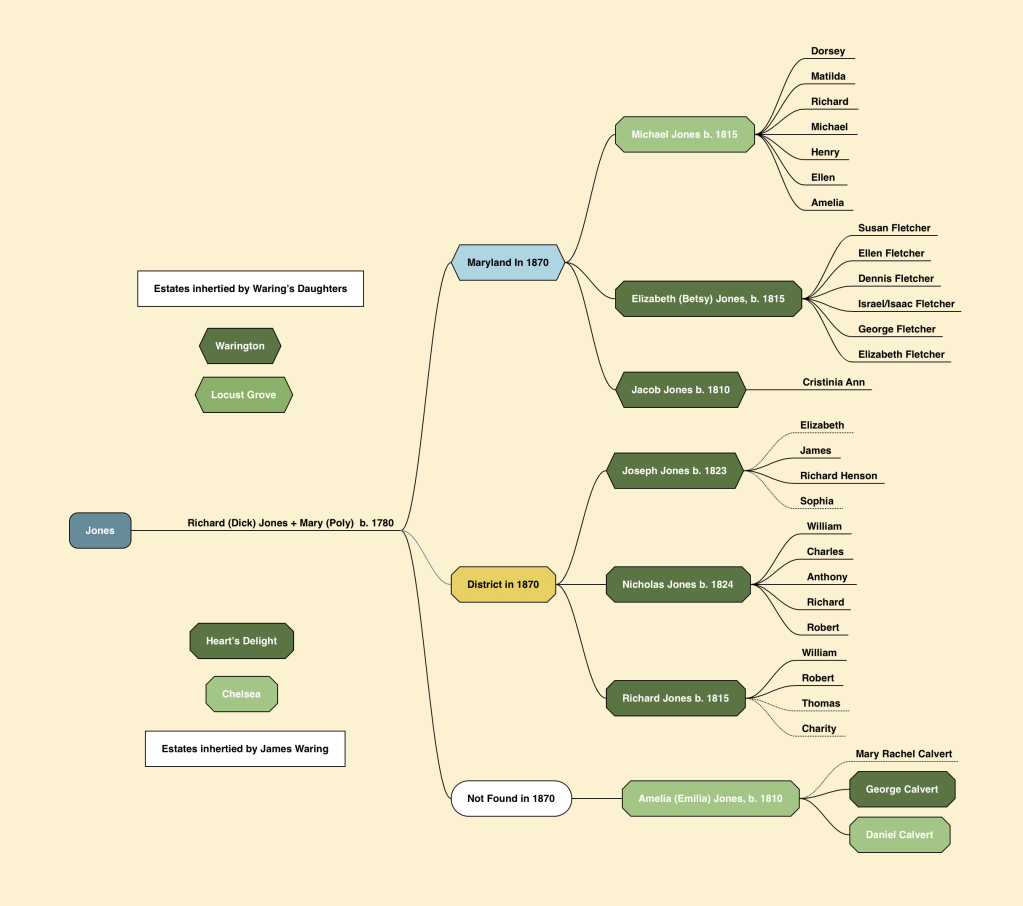
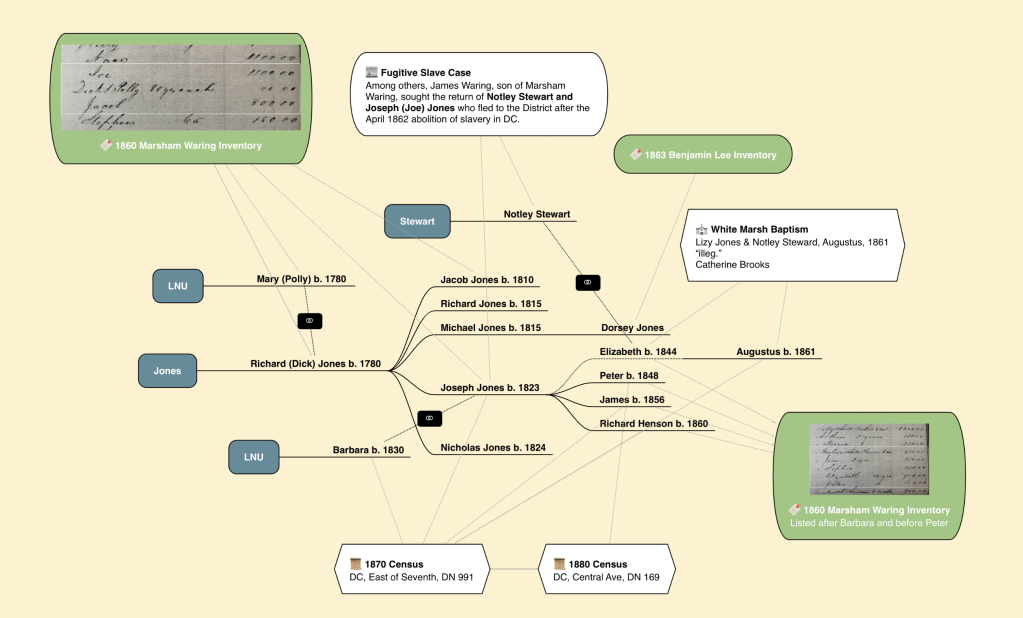
In addition to having identified Betsy Fletcher as their daughter, I have identified six additional children of Richard and Mary Jones, all enslaved by the Waring family. Due to the fragmentary nature of records related to enslaved people, there are likely unidentified connections among others he enslaved. Additionally, as other fragments are uncovered and pieced together, the connections may be redrawn.

Reconstructed from multiple sources | Subject to Change
(Census, Inventory, Prince George’s County Slave Statistics, Death Certificates, White Marsh Baptism Records, Freedmen’s Bureau Records, Fugitive Slave Cases)

Berry wrote in her book that enslaved women were valued by some enslavers for “their fecundity” as their “increase consists of much of wealth”. For Waring, Mary’s children increased his wealth, especially as transatlantic slave trading was abolished in 1808 and enslavers had to rely on domestic trades or the “increase” of the people they enslaved to enlarge their slave community. In 1860, Richard and Mary’s children and grandchildren make up at least 20% of the people he enslaved.

Allan Kulikoff wrote in his book Tobacco and Slaves that “childbearing and the childrearing that followed, however were highly important rites of passage for most slave women. Once she had a child, she moved from her mother’s or parent’s home to her own hut”. Despite the threat of separation as a specter on the horizon for any enslaved family, families on large estates were less likely to be separated from their families as the landowners were able to weather fluctuations in the tobacco markets. As such, Mary and her children were able to maintain familial bonds despite the commodification of her and her children by the Warings and other “planters” who forced labor from them.

Chart showing Mary’s estimated child-bearing years and the children identified so far | Subject to Change

The kingroup is evident in records connected to the 1862 affidavit sworn by James Waring that documents the escape of several of the Jones family group to the District. This will be explored further in future posts. It is also evident in the 1870 and 1880 Census records as the nuclear families tended to live near one another, either in the District or in Prince George’s County.

Inheritance

The following paragraphs hope to reconstruct the path that Richard and Mary Jones were forced to take prior to their enslavement by Waring. It is based on indirect evidence by matching names and ages in inventories of other enslavers in Prince George’s County who likely had connections with Marsham Waring. The search through inventories was not exhaustive. This path is based on indirect evidence and circumstances that suggest this as a possibility.

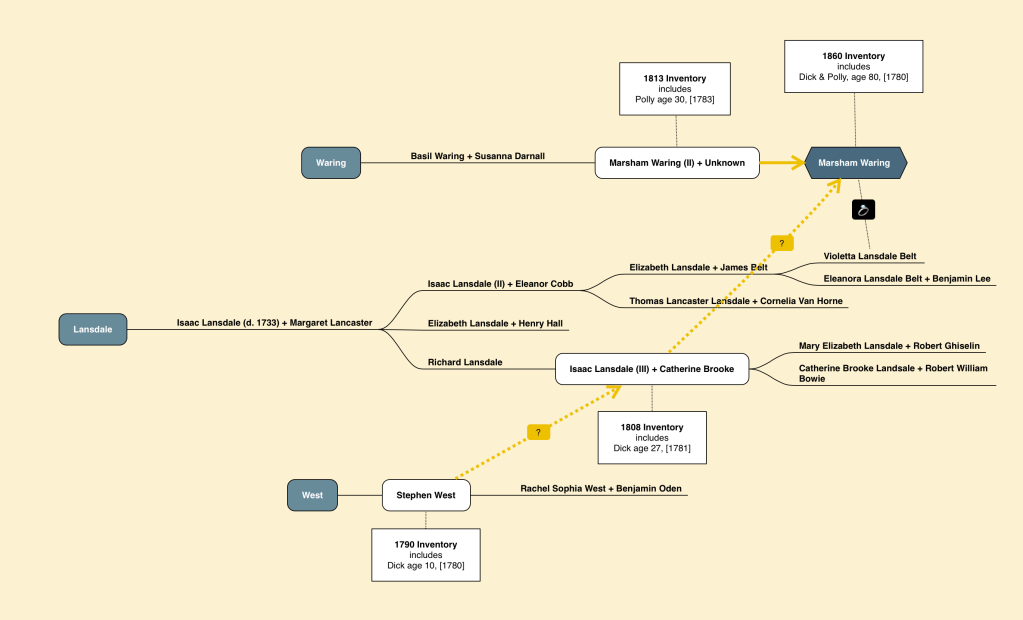
Marsham Waring was the son of Marsham (II) Waring, and grandson of Basil Waring, Jr and Susana Darnall. The Darnall family had connections with Stephen West, who acquired the Woodyard, which sat across the road from “Poplar Hill/His Lordship’s Kindness”. Isaac Lansdale (III) was the brother of Thomas L Lansdale, a merchant in Queen Anne, along the Patuxent River where a tobacco inspection site had been established in the 18th Century. They were both relatives of Violetta Lansdale Belt, Waring’s wife.

Reconstructed from information gathered from online family trees

Marsham Waring appears to have inherited the legal authority to enslave Mary (Polly) from his father, Marsham Waring (II) who left his estate, real and personal property to his son. In the 1813 inventory of his estate, Polly, age 30, with an estimated birth year of 1783 was listed. (TT 1:473). The inventory is sorted by gender and age, making it difficult to infer family groups. As opposed to Marsham Waring’s 1860 Inventory, which appears to be grouped by adult males and women with children. Some adult children are grouped with elderly parents.

There are at least two possibilities for Richard (Dick) Jones [1780]; these possibilities are not mutually exclusive, meaning the two inventories could possibly refer to the same man:

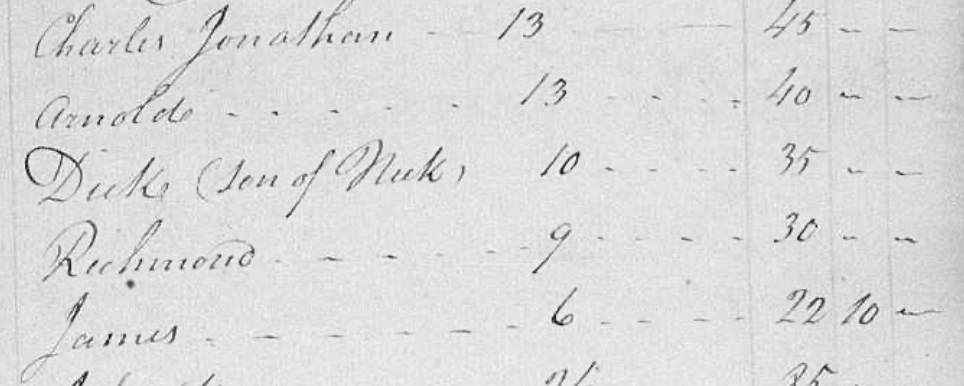
1790   Stephen West, the owner of the Woodyard and an enslaver of over a hundred people died in 1790.  Among the inventory for his estate is Dick, age 10 [1780], who is notated as “son of Nick” (ST 3:47).  This notation provides circumstantial evidence of a likely connection between the Richard of West’s Inventory and the Richard of Waring’s inventory as Richard Jones had a son named Nicholas, suggesting an older family member named Nicholas. 

Excerpt from Stephen West’s Inventory

1808 Isaac Lansdale (III), the son of Richard Lansdale, died prior to 1808 when his inventory was created.  Among this inventory is Dick, age 27 [1781].

Stephen West or one of his heirs may have conducted business with the Lansdale family, who had mercantile trade in Queen Anne, which may have resulted in use of Dick to settle a debt or purchase. Lansdale, in his relationship to Waring as a cousin of Waring’s wife may have gifted or traded Dick, as well.

related posts

Benjamin Lee and Augustus Jones | Stealing Horses

Stealing Horses

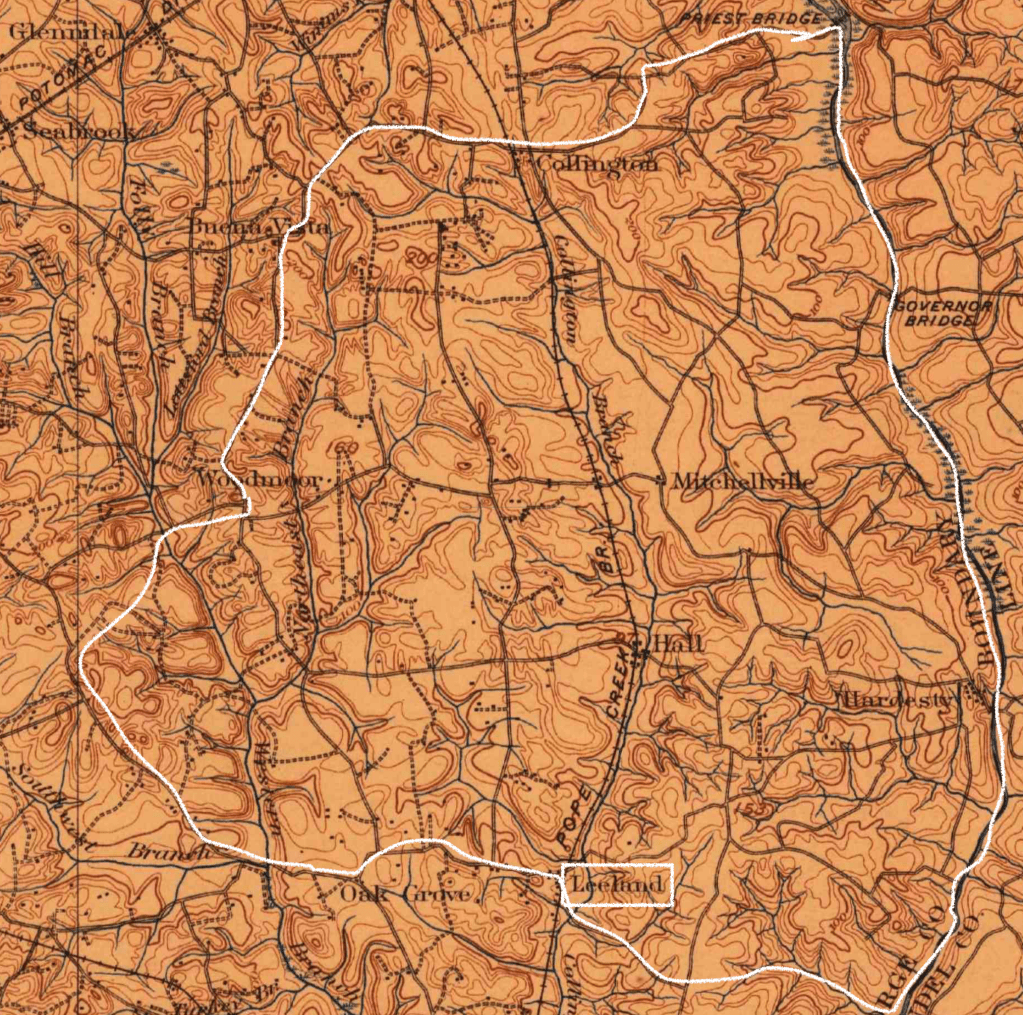
In the summer of 1900, two horses were stolen. One from the pasture of Dorsey Jones and one from the home of Washington Lee. Both men lived in Leeland, Maryland, a small community built up after the Civil War along the Pope Creek Railroad. It sits on the boundary between Queen Anne District and Marlboro.

1899 Top Map of Patuxent River | accessed from topoview

They alerted the authorities in Washington that their horses were stolen and the police were on the look-out for the thieves in the District. They arrested two men for trying to sell the horses near Centre Market in downtown DC near 11th and Louisiana, just north of the map about mid-point between the Eclipse and the Capitol.

According to the articles, the men arrested were their sons, Augustus Jones and Benjamin Lee.

21 Aug 1900, Evening Star | newspapers.com
22 Aug 1900, Evening Star | newspapers.com

Relatives

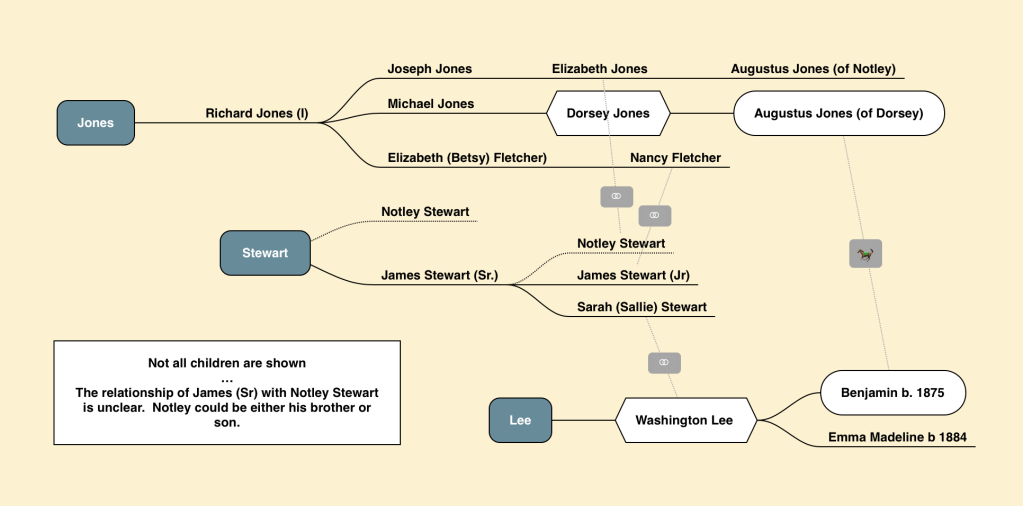
The two horse thieves, Augustus Jones and Benjamin Lee were distant cousins of each other. The first article says that Augustus was the son of Dorsey and the second article claims that Benjamin was the son of Washington Lee.

Reconstructed tree using a mixture of records. Subject to change to as more records are located.

Benjamin Lee

Washington Lee with his wife, Sarah (Sallie) Lee are enumerated with Benjamin Lee in the 1880 census. They were enumerated in the Marlboro district near Upton Brooke who was enumerated at DN 243. This places them in the vicinity of Brick Church Station which is where Leeland would grow over the next few decades.

Marlboro District, Prince George’s County 1880 Census | ancestry.com
1878 Hopkins Atlas of Prince George’s County, Marlboro District | loc.gov

Augustus Jones

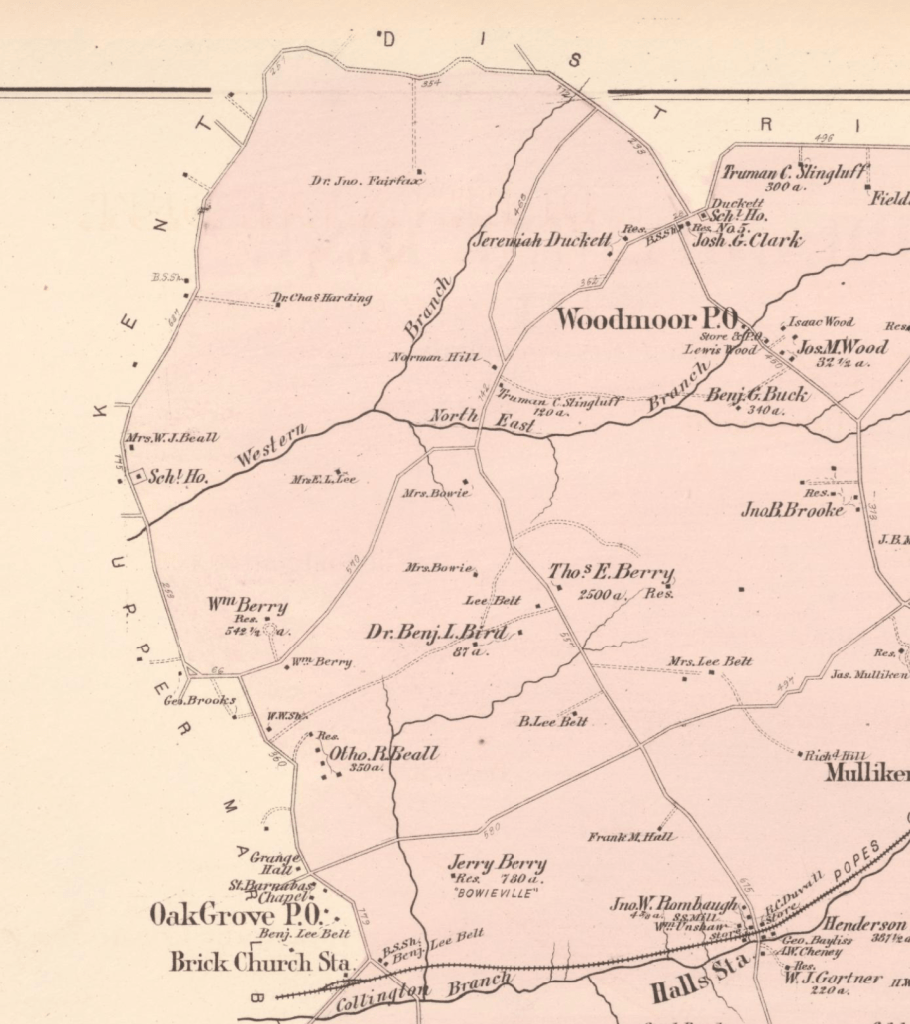
Augustus Jones is not found in the census with Dorsey Jones. In 1880, Dorsey Jones, age 30, is living with his father and mother, Michael and Amelia (Milly) Jones in Queen Anne’s District, likely near Woodmore P.O as they are enumerated a few pages from Jeremiah Duckett, who owned land near Woodmore. He does not have any children living with him in the 1880 census.

Queen Anne District, Prince George’s County 1880 Census | ancestry.com
1878 Hopkins Atlas of Prince George’s County, Queen Anne District | loc.gov
Note: North is to the right, not up like in most maps.

Neither Dorsey nor Augustus Jones have been located in the 1900 census. Dorsey died in July 1905, his death certificate indicated he was single, which is consistent with the 1880 Census.

Maryland State Archives

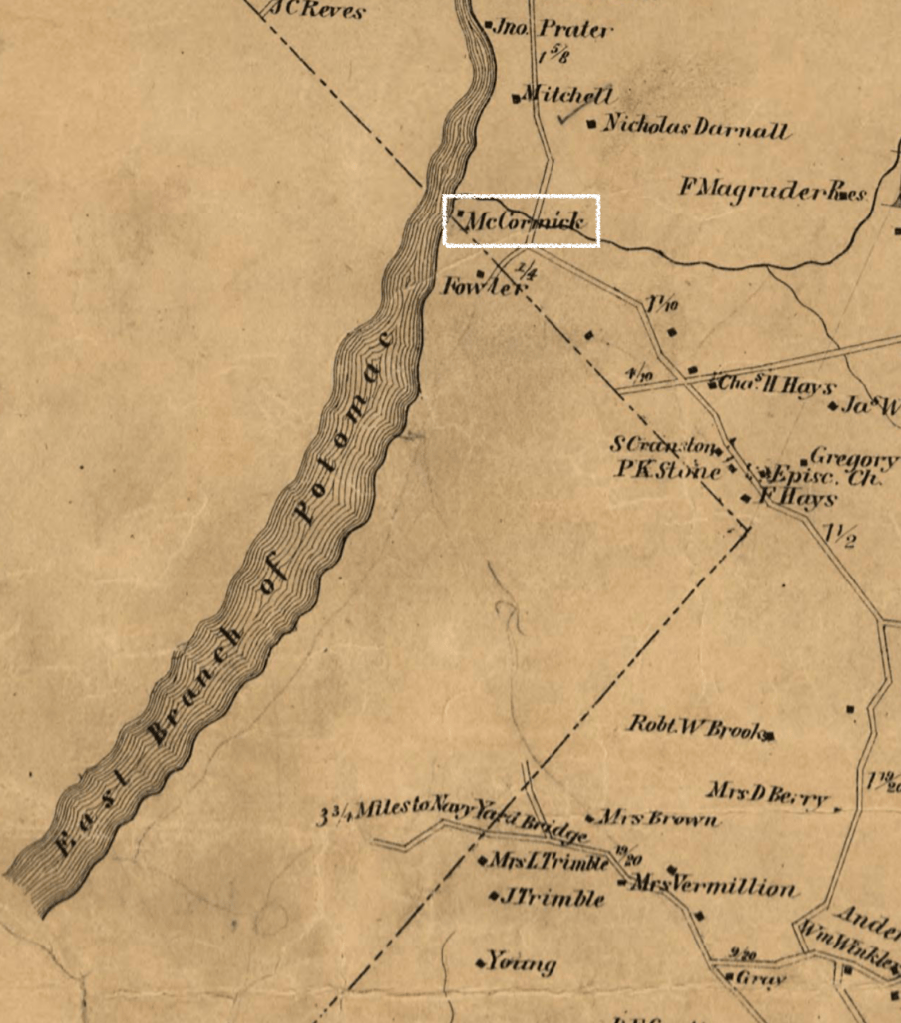
In the 1870 and 1880 Census, Augustus Jones was listed with Joseph and Barbara Jones in the District of Columbia. In 1870, they are enumerated near Alex McCormack who lived near the District/Maryland boundary. (In fact, the Wedge family had to petition for their freedom from McCormack during the Civil War when DC abolished slavery as McCormack sought to maintain their captivity by claiming they lived on his Maryland land and not his DC land. )

East of Seventh Street, District of Columbia 1870 census | ancestry.com
1861 Martenet Map of Prince George’s County | loc.gov

In 1880 they are enumerated near Daniel Stewart and Joseph Coven [Covington] which places them near Pleasant Grove and Benning’s P.O. and still near A. McCormack

Central Avenue, District of Columbia 1880 Census | ancestry.com

Augustus Jones is listed at the son of Joseph and Barbara Jones. However, based on other records, I would suggest that Augustus Jones is their grandson, and the son of Elizabeth (Lizy) Jones and Notley Stewart.

Reconstructures Family Tree with identified direct and indirect sources | Subject to Change

The Jones and Stewart family were enslaved primarily by Marsham Waring and also by Benjamin Lee, his brother-in-law in Queen Anne District prior to emancipation in 1864. Waring died in 1860, and among his probate records is an inventory that lists the people he enslaved. Lee died in 1863 and his probate records also include an inventory. Additionally, Waring’s children, Elizabeth L. Bowie, M. Virginia Mackubin [sic] and James Waring had compensation lists submitted to the Commission of Slave Statistics which lists both the first and last name of the people the Waring’s enslaved.

The Warings were Catholic and some of the people they enslaved had their children baptized by White Marsh Priests. Among them, Lizy Jones and Notley Stewart had their son Augustus baptized in 1861. A year later, Notley Stewart and Joseph Jones, Elizabeth’s father, are named in an affidavit, among others that they had fled to the District after the abolition of slavery there. Notley and Elizabeth Jones have not been located, though their son is living with Joseph and Barbara Jones, Elizabeth’s mother, in both the 1870 and 1880 Census.

Incidentally, Peter Jones, the son of Joseph and Barbara Jones, and uncle of Augustus (assuming my theory is correct), lived on Benning’s Road in 1900 and he worked at as a laborer in a stock yard, and his son Peter (Jr.) worked in a jockey house, suggesting the family worked with and knew horses.

Afterwards

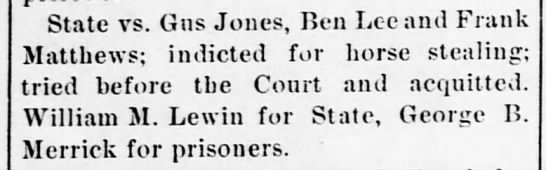
The local papers reported that “Gus Jones, Ben Lee, and Frank Matthew” were indicted for horse-stealing and that they were acquitted.

26 Oct 1900, Prince George’s Enquirer and Southern Advertiser | newspapers.com

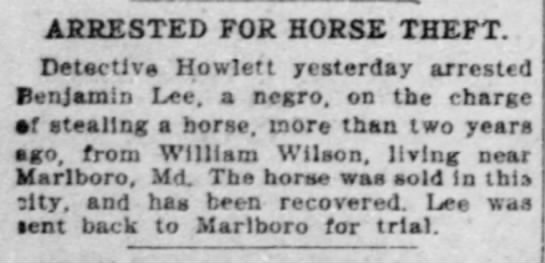
And, in 1903, Benjamin Lee was arrested again for stealing a horse in August of 1900. This time from William Wilson, who also lived near Marlboro and again, Lee is alleged to have sold the horse in the city. Wilson was a Black man who worked on the railroad.

27 July 1903, Washington Times | newspapers.com
23 Oct 1903, Prince George’s Enquirer and Southern Advertiser | newspapers.com

The Evening Star described his day in court as multiple days due to multiple technicalities. It was first delayed to a legal technicality, then a new jury had to be impaneled as his brother-in-law sat on the jury, then finally he was tried and found not guilty. The judge sentenced him to seven year. The paper reported he tried to escape and assaulted officers. His head was injured and he required bandages. The paper described hi as barely recognizing him the final time in the court, though if this referred to a change in demeanor or a multitude of bruises, or both, it doesn’t specify. Considering how the criminal system treated and treats Black men, it was probably a submission by force. This seems reflected in the Judge’s comment, “you got all that was coming for you.”

20 Oct 1903, Evening Star | newspapers.com

In the 1910 Census, a Benjamin Lee is listed as a prisoner in Baltimore working in the foundry.

One Final Note

The Washington Times seems to have been ahead of the police. While the Evening Star reported that “Gus” Jones and accomplices had been arrested for stealing horses from their family, and the Prince George’s Enquirer reported that they had been acquitted, and the thief of Wilson’s horse was not identified until 1903 for stealing William Wilson’s horse and not tried until October 1903, the Washington Times reported their arrest in 1900. They even knew Benjamin’s alias of Will.

James Stewart | Junior

Did James (Jim) Stewart (b. about 1800) have a son named James Stewart?

James Stewart, Senior

James Stewart (Sr.) was living in Queen Anne District of Prince George’s County after emancipation in 1864. He was residing near the estate of Dr. Benjamin Lee who had died during the war.

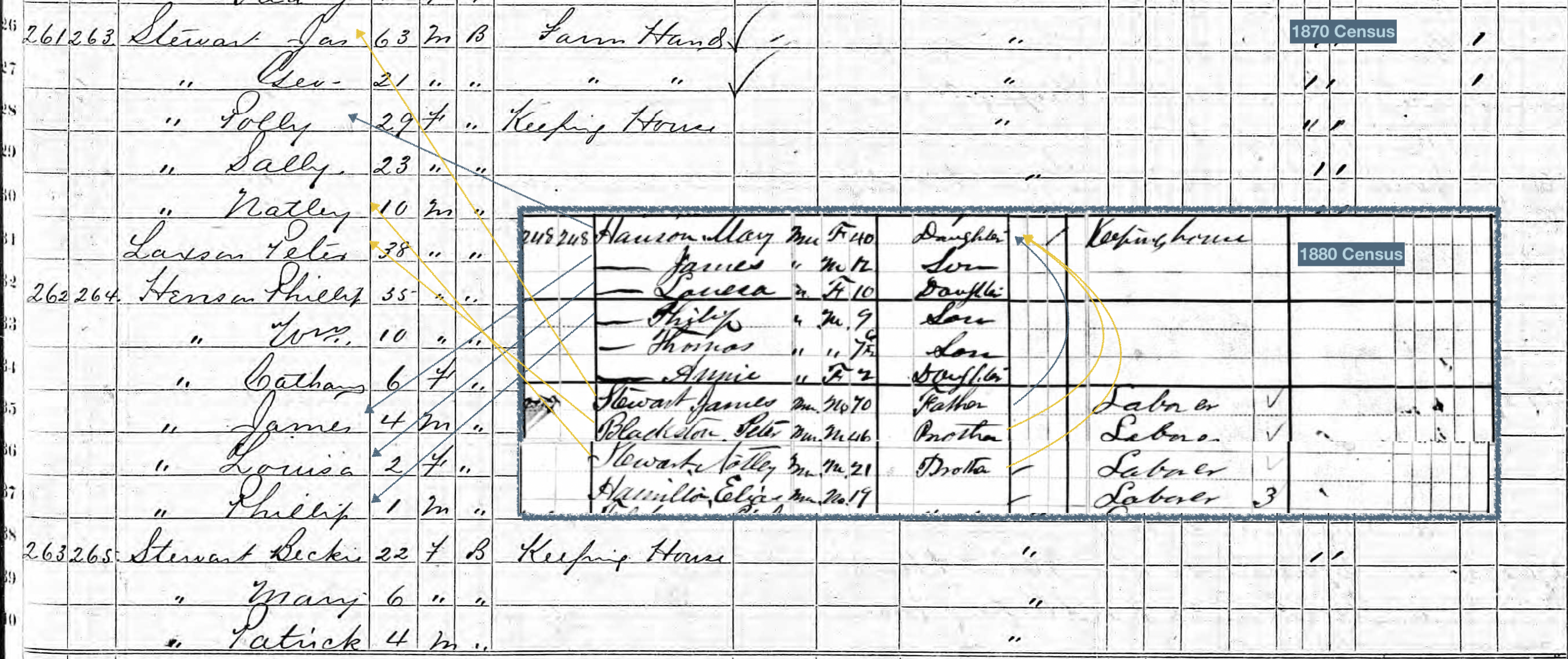
He lived with his inferred children, George, Mary (Polly), Sarah (Sallie), and Notley as well as Peter Laxson (Blackstone), and is neighbor to Philip Hanson and Beckie Stewart. The 1870 census record for James Stewart is best understood when compared to the 1880 census record for James Stewart, which identifies the relations between the households.

Not present in the 1880 Census record are Sarah (Sallie) Stewart, who married Washington Lee in 1870 and established a separate household nearby and George and Rebecca (Beckie) Stewart who also established a separate household nearby.

The comparison of the two census records show however, that James Stewart was the head of a family with several adult children.

James Stewart, prior to Emancipation

In the 1870 Census, James Stewart and his children are enumerated directly after the heirs of Dr. Benjamin Lee and an overseer, suggesting that they lived near “Oak Hill”, the Lee estate.

1870 Census

Dr. Benjamin Lee was the brother-in-law of Marsham Waring. Both owned considerable amounts of property in the area. They married the daughters of Captain James Belt, who had bought parts of Chelsea from another branch of the Belt family and who conveyed the tracts to his daughters. Lee also acquired tracts of land from Northhampton, Partnership and other parcels. Waring also acquired land from nearby families, purchasing land from the Hillearys and the Bowies.

Lee and Waring died within a few years of each other. Marsham Waring died in 1860, and his wife in 1863. His probate records include an inventory (WAJ 2:323) with the names of the people enslaved on four separate estates. Benjamin Lee died in 1863 and also includes the names of those he enslaved (WAJ 3:127). Waring heirs, (his two daughters and son) had compensation lists submitted to the Commission on Slave Statistics which provided both a first and last name with an age for many. This allows us to identify the people on the Waring Inventory and which estate they were forced to labor on. Lee does not have a similar compensation list, and so identifying the people he enslaved requires more records to ensure identification of them.

James (Jim) Stewart is included in the Waring Inventory and in the list made by Waring’s daughter, Mrs. M. Virginia Mackubin [sic] for the Commission on Slave Statistics. In both documents he is listed as 50 years old. He labored for the Warings on the Warington Estate . He is the only James Stewart listed on the three compensation lists. The children in the inventory are not listed in the Waring inventories or compensation lists, rather they appear to be included in the 1863 Lee Inventory .

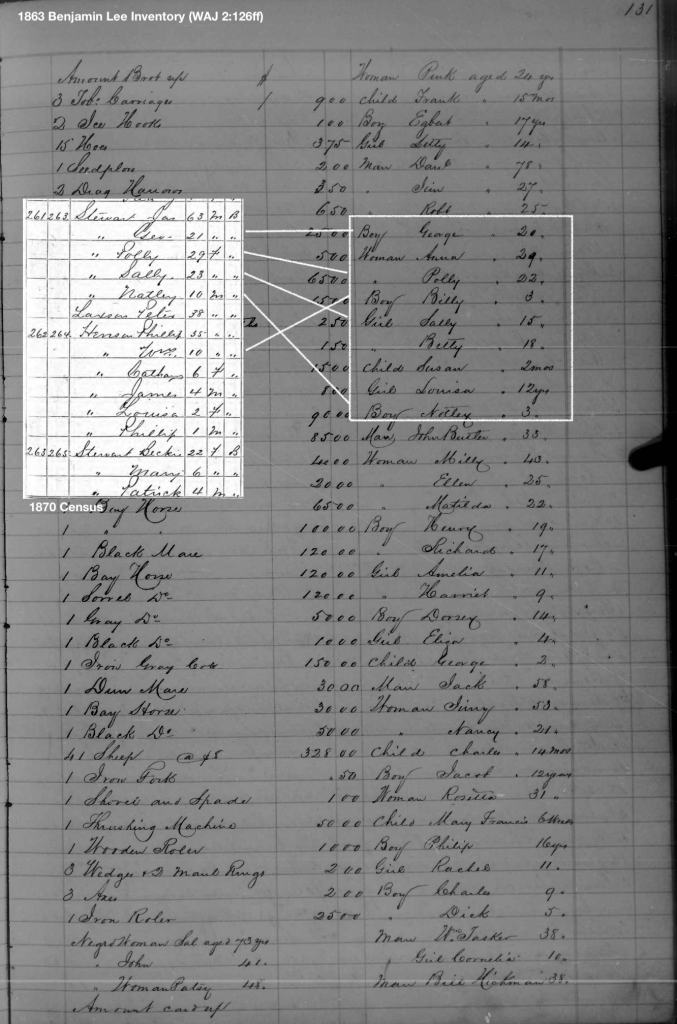
Lee’s inventory includes the names of James Stewart’s children as well as Mary’s oldest son, with ages that are comparable to the ones in the census. (As always there is some variability with ages for those enslaved, as the exact birth year is not always known by the enslaver or the person enslaved.)

Lee Inventory with overlay of 1870 Census

The Warings were Catholic and many of the people they enslaved were baptized by the priests of White Marsh, the Jesuit Plantation in Queen Anne District. The Early Records of White Marsh, Book Three contain baptismal records from 1853-1872.

In 1858, John Henson was baptized, the son of Nancy (Ann) Fletcher and James Stewart. The priests marked them “property of Marsham Waring.” Notley Stewart acted as a sponsor/godparent; this Notley Stewart is an older Notley, not the child in the 1870 Census. In the 1860 Inventory of Marsham Waring, listed two below James (Jim) Stewart, is Notley, age 30. He is also on the list submitted by M. Virginia Mackubin [sic].

In 1860, George Antony was baptized as James and Nancy Steward, with Elizabeth (Bezzie) Fletcher as sponsor/godmother.

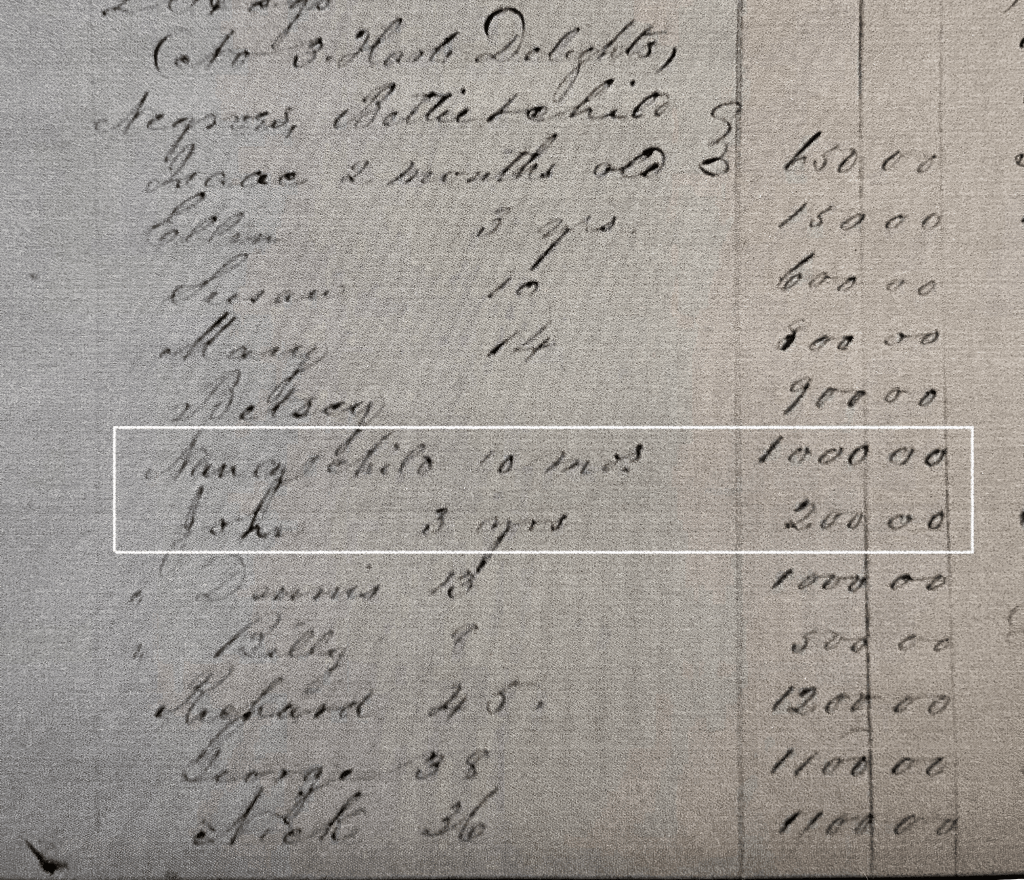
Ann (Nancy) Fletcher was enslaved by the Warings on the estate “Heart’s Delight”, which was inherited by James Waring. She was included on James Waring’s compensation list, as was “child of Nancy” [George Antony] and John. Above her is Betsy, who may be the same Elizabeth (Bezzie) who stood as sponsor at the baptism of the infant.

Marsham Waring Inventory

With only the census record, it was an assumption that the James Stewart mentioned in these records was James Stewart (Sr.). However, a registration list from the Freedmen’s Bureau with an 1870 Census record from the District of Columbia suggests that the James Stewart of the baptismal records is not James Stewart (Sr.), rather James Stewart (Jr.).

Flight to the District of Columbia

After slavery was abolished in the District of Columbia in 1862, the people enslaved in the neighboring jurisdictions saw an opportunity to grab freedom for themselves. Despite the fact that the roads toward the District were monitored by constables and private patrols, many of the people forced to labor fled their captivity and made their way to the District. Barbara Jeanne Fields wrote in her book, Slavery and Freedom on the Middle Ground that “Many an ex-fugitive later reported having left Maryland for the District during or after the spring of 1862. Families packed up such of their possessions as could be compactly assembled and departed, sometimes appropriating means of transportation from their owners.” (111)

As such camps were built in and around the District to house the incoming refugees from chattel slavery. One such camp was Camp Springdale which was made up of tents on the grounds of the “Arlington Estate”, owned by Robert E Lee’s wife. At the start of the Civil War, the Union Army occupied the site and the soldiers gave protection to fleeing refugees. Other camps were built in and around the District.

A registration list for Camp Springdale lists its residents and their former residence along with whether or not they are married.

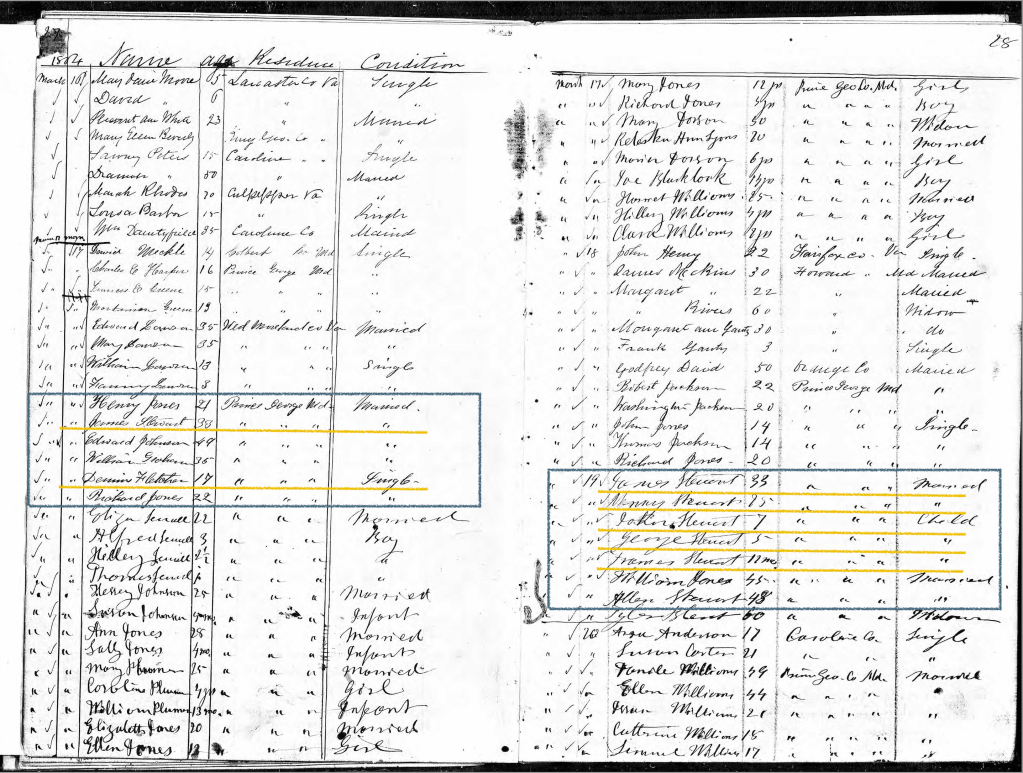
In March 1864, James Stewart appears to have been registered with a group of male refugees. On March 17, James is listed with other men with the surname Jones and a Dennis Fletcher. Dennis Fletcher also appeared on the 1860 Marsham Waring Inventory, after Nancy and her children. This suggests he is a younger brother of Nancy, and therefore brother-in-law of James. James is 33 years old.

Then, on March 19, a 33 year old James Stewart is listed with Nanny Stewart, and the children, John, George, and Francis. The ages of John and George are consistent with the ages in the baptisms. This suggests that James of the baptismal record is not James (Sr), rather James (Jr.)

The National Archives in Washington, DC; Washington, DC; Records of the Field Offices For the District of Columbia, Bureau of Refugees, Freedmen, and Abandoned Lands, 1865-1870; NARA Series Number: M1902; NARA Reel Number: 21; NARA Record Group Number: 105

A review of Benjamin Lee’s inventory shows a Jim, age 27, above the identified area that contained the other names of James (Sr.)’s children. His age is consistent with that of James (Jr) who gave his age as 33 to the registrar at Camp Springdale.

Lee Inventory

1870

After the war, James and Nancy stayed in the District of Columbia. They lived in Ward 5, with James working as a scavenger. They are living with Elizabeth Fletcher, age 23, who has a son, Louis.

Update

The White Marsh Baptismal Records Book 4 contains earlier baptism records than Book 3 (1819-1833) and contains a baptism record for James, born 1832, son of “James Stuart, slave of Master Warring” and “Suky, slave of Dr. Lee in Marlborough”. This would be consistent with the 33 year old James Stewart who escaped to the District of Columbia.

thomas j nicholson, enslaver

Thomas J Nicholson moved to Queen Anne District in Prince George’s County from Anne Arundel County in the 1850s. Living as a teenager with his father, Joseph Nicholson who was a farmer with real estate valued at $1000 in the 1850 Census; in the 1860 census, Thomas J Nicholson was a planter with both real estate and a personal estate each valued at $4000.

On the 1861 Martenet Map of Prince George’s County, he is living at the very north end of Queen Anne District along the Patuxent River and Bealmear’s Bridge. He enumerated six people in the 1860 US Census Slave Schedule.

GenderAge
Male53
Female40
Male21
Female17
Male14
Male4 months
1860 US Census Slave Schedule

In 1867, Thomas Nicholson and his wife submitted three lists to the Commission on Slave Statistics for Prince George’s County.

  • Thomas submitted the name of one person under his name: Mary Helen Headley, age 14
  • Sophia submitted the names of three people under her name: Louisa Hall, age 23, and two inferred children: Alfred, age 7, and Anne, age 4.
  • Sophia submitted another list “acting for the heirs of Mrs. Eleanor Sanford” with three people: Anne Lee, 45, Isaac Ennis, 35 and John Hall, 17

A comparison of the two lists suggests the following.

GenderAgePossible ID
Male53
Female40Anne Lee, 45
Male21Isaac Ennis, 35
Female17Louisa Hall, age 23
Male14John Hall, age 17
Male4 monthsAlfred, age 7
(born after 1860)Anne, age 4
(not listed)Mary Helen Headley, 14
1860 US Census Slave Schedule

The 53 year old male does not appear in the Prince George’s County Slave Statistics. This suggests that he either died or emancipated himself during the Civil War. Prince George’s County nearness to the District of Columbia, Nicholson’s proximity to the Patuxent River and the fact that over 30,000 enslaved individuals in Maryland self-emancipated themselves during the Civil war suggests the possibility that the male may have escaped. Barbara Jeanne Fields in Slavery and Freedom on the Middle Ground reminds us that those that escaped were more likely to be young as the flight to freedom endured slave patrols, exposure and physical punishment which was more difficult for the old and the very young. Diana Ramey Berry in The Price for Their Pound of Flesh that the enslaved people who lived beyond the age of 40 were considered elderly. (The average life expectancy of the enslaved was 25 while in the average life expectancy of the white population was thirty-nine). As a 53 year old, the male had exceeded the expectancy for an enslaved man.

Anne Lee, age 45, appears to be one of the women enumerated by Nicholson in the 1850 US Census Slave Schedule. In the 1870 US Census, she is enumerated immediately after the Nicholson family with Sophia, age 14.

Mary Helen Headley, 14, is possibly Mary Hadley, 23 living in the District of Columbia in the 1870 US Federal Census. She and Dennis Williams are working as black servants in the household of O. A. Dailey and Oliver Ambrose, dentists in Ward 4.

Thomas and Ellen Sanford

In 1818, Thomas Sandford and Eleanor Clarke were married in Prince George’s County, Maryland.

In 1840, Thomas Sanford is enumerated in the Prince George’s County in the US Federal Census. His neighbors include names of people living in and around Collington as evidenced by the 1861 Martenet Map of Prince George’s County.

In 1840, Thomas Sanford is enumerated with 8 enslaved people. By 1850, he is not longer listed in the household of Eleanor Sanford. She and Sophia are living in the household by themselves, neighbors with Richard Isaac of Joseph and Joshua T Clark, still in the neighborhood of north Colllington. She is enumerated in the 1850 US Census Slave Schedule with six enslaved people.

1850 Gender1850 Age1860 Gender1860 Age
Male43Male53
Female30Female40
Male11Male21
Female8Female17
Male3Male14
Male4 months
Male9
1860 US Census Slave Schedule

The continuity of ages and genders between the two slave schedules is remarkable considering the life expectancy of enslaved people and the documented likelihood that smaller households would often need to sell their enslaved as economic hardships hit.

Dinah Brown & Lawrence Wood

After the Civil War ended, Dinah Brown married Lawrence Wood. Dinah was the daughter of Charles Brown and Susan Wood. She was named for the grandmother of Susan, who had been enslaved by Robert Darnall. [See Fishwick v. Sewall, and the post on Dinah’s Descendants] Dinah and her descendants were enslaved by the Robert Darnall and then devised to Robert Sewall and his heirs.

Dinah was listed as the youngest of Susan “Suck” Wood’s children in the 1853 Inventory of Robert D Sewall’s estate at “Poplar Hill”. Her age was recorded as 7; her estimated birth year was 1846.

Her marriage to Lawrence Wood was solemnized in January 1866 when she was 22 years old.


early marriage years

After their marriage, they lived near “Poplar Hill” and Dinah’s brother, Joseph Henry Brown, near the Catholic Church where Rosaryville would develop into a town. The first map is from Martenet’s Map of Prince George’s County in 1863. The second map is from Hopkin’s Atlas of Prince George’s County in 1878. The development of Cheltenham and Rosaryville results from the building of the railroad and the development of villages after emancipation.

Excerpt from Martenet’s 1863 Map with my annotations | loc.gov
Excerpt from Hopkin’s 1878 Atlas with my annotations | loc.gov

In the 1870 census, they lived with their two children: Louisa and Buddy, and a teenager named Thorton. The 1870 census did not record relationships leaving us to infer relationships.

In the 1880 census, they are still living near Dinah’s siblings and her mother. They have an additional son, which they named after Lawrence. Dinah is working as a cook.


searching for Lawrence Wood prior to emancipation

Dinah’s family has strong ties to “Poplar Hill” and the “Woodyard”, her family having lived there since Susan’s grandmother was brought from Dorchester County prior to 1775, when Darnall moved to “Poplar Hill” with his step-daughter Jane Fishwick who had enslaved Dinah prior to Darnall taking possession of Dinah.

Lawrence does not appear in the 1853 inventory and his name, Lawrence is not one that appears in the 1821 inventories or other identified records related to “Poplar Hill”.

enslaved by Charles F Calvert

A “Lorenzo Wood” appears in the lists submitted to Prince George’s County Commission on Slave Statistics and compiled in 1867 & 1868. As enslavers had been been compensated for their “lost property” when the District had emancipated the enslaved in 1862, Maryland enslavers also hoped for compensation and many submitted lists to the commission. The Dangerfield family who owned “Poplar Hill” did not submit a list. However, Charles F Calvert submitted the name “Lorenzo Wood” along with sixteen other names.

Charles F Calvert was descendant from “the Calverts”. He purchased the tract of land he called “Belle Chance” which situation on the north part of the land that would become Andrews Air Force Base in the 1840s. Prior to his purchase of “Belle Chance”, he is listed in the 1840 census near Wm. P Brinham and Joseph B Hill, suggesting he owned land near the southern edge of “Poplar Hill”.

From Google Maps
Excerpt from Martenet’s 1863 Map with my annotations | loc.gov

Calvert, before and after his purchase of Belle Change” was a neighbor of the Sewalls and the Dangerfields at “Poplar Hill”. As evidenced by the “Early Records of White Marsh”, Sewall allowed the people he enslaved to enter into relationships on neighboring estates. 1828 Baptismal Records identifies the following relationships:

  • James and Sarah were identified as husband and wife; James was enslaved by Arthur West and Sarah was enslaved by Sewall.
  • Barney and Betsey were identified as husband and wife; Barney was enslaved by Jane Stone and Betsey by Sewall.
  • Nicholas and Ann were identified as husband and wife; Nicholas was enslaved by Sewall and Ann by Joseph Hill.

The same may be possible for the Dangerfields who inherited “Poplar Hill” after 1853, allowing Lawrence “Lorenzo” Wood to meet Dinah Brown.

The list submitted by Calvert lists 4 people with the surname Wood:

  • Betsy Wood, age 49
  • Francis L. Wood, age 17
  • Josephine Wood, age 15
  • Lorenzo Wood, age 18

Lawrence Wood is listed as 27 in the 1870 Census records, nine years older than the age reported in the “Slave Statistics”. It is often ambiguous what age the enslaver used for the “Slave Statistics”. For example, Marsham Waring’s heirs used the same ages as on the early 1860s inventory compiled for his estate, even though the list suggests it represents their age at 1864. Others used their 1867 age. For Lawrence Wood and Lorenzo Wood to be within 9 years of each other suggests that they are the same.

Maryland State Archives

The organization of his list makes it hard to tell if those with the same surname are closely related and if they are family groups. If we assume that they are, this suggests that Betsy Wood if the mother of the three teenagers.

Sources

Early Records of the White Marsh Church, Prince George’s County, Maryland. Bowie, MD: Prince Georges County Genealogical Society, 2005. Print.

Basil Medley, USCT

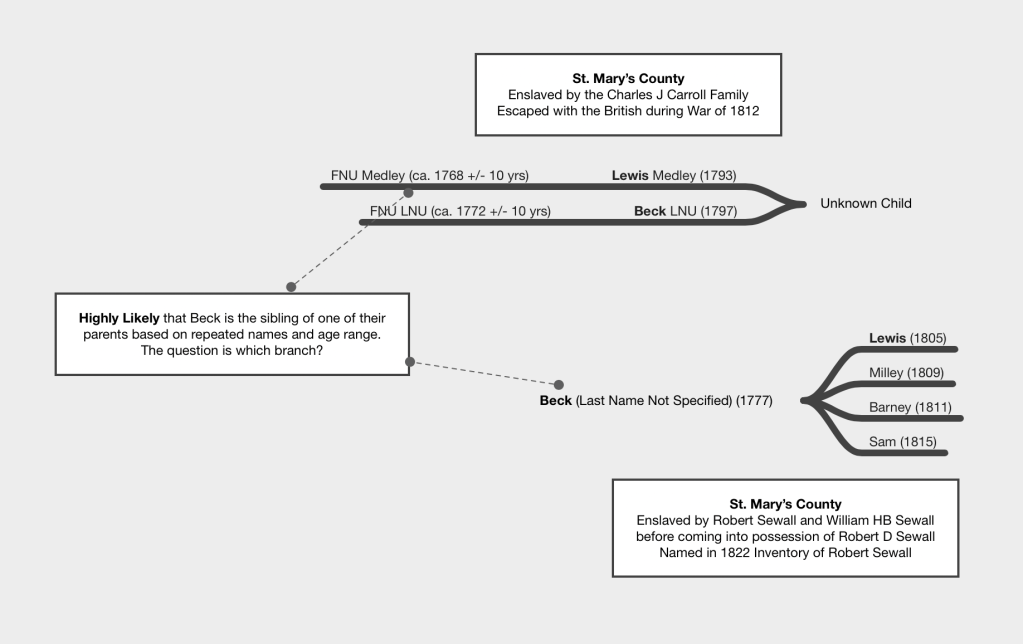
Lewis and Beck Medley, enslaved by Carroll family in St. Mary’s County escaped slavery by leaving with the British during the War of 1812. In the post [Lewis and Beck Medley | the British came], I speculated that because the Carroll family were neighbors to the Sewall family and both the Carrolls and the Sewall enslaved family groups with the names Lewis & Beck, that Lewis & Beck Medley may have been related to the Beck family group listed in the 1822 Robert Sewall Inventory of St. Mary’s County Property [TT 5:25].

1814 Claim1822 Inventory
Lewis Medley, 21 [1793]Beck, 45 [1777]
Beck Medley, 17 [1797]Lewis, 16 [1806]
Milley, 13 [1809]
Barney, 11 [1811]
Sam, 7 [1815]

Compensation for “Manumission”

Further documentation has been found to provide more information about the relationship between the two families.

In 1865, the Dangerfield Heirs of Robert D Sewall’s estate filed multiple Deeds of Manumission in Prince George’s County Land Records [FS 3:33-41 | mdlandrec.net]. These manumissions were filed in August 1865, almost a full year after the passage of the November 1864 Maryland Constitution which emancipated all enslaved people in Maryland. The manumissions effectively did not change the status of the named individuals as they had been previously freed by the State of Maryland.

Instead, these manumissions were filed in hopes of compensation for slaves who had been used by the US Army. In 1863, the US Government began to compensate slaveholders for the enlistment of enslaved people if they could prove their status. By filing the deed of manumission, the enslavers hoped to prove ownership of the enslaved people and receive $300 “upon filing a “manumission” or deed of ownership”. [US National Archives]. Multiple enslavers named those they had enslaved who enlisted in the FS Libers of the Prince George’s County Land Records. Some enslavers named the date of enlistment and the regiment within which the enslaved mustered. In the eleven manumissions filed by the Dangerfield Heirs, none stated a date of enlistment or regiment.

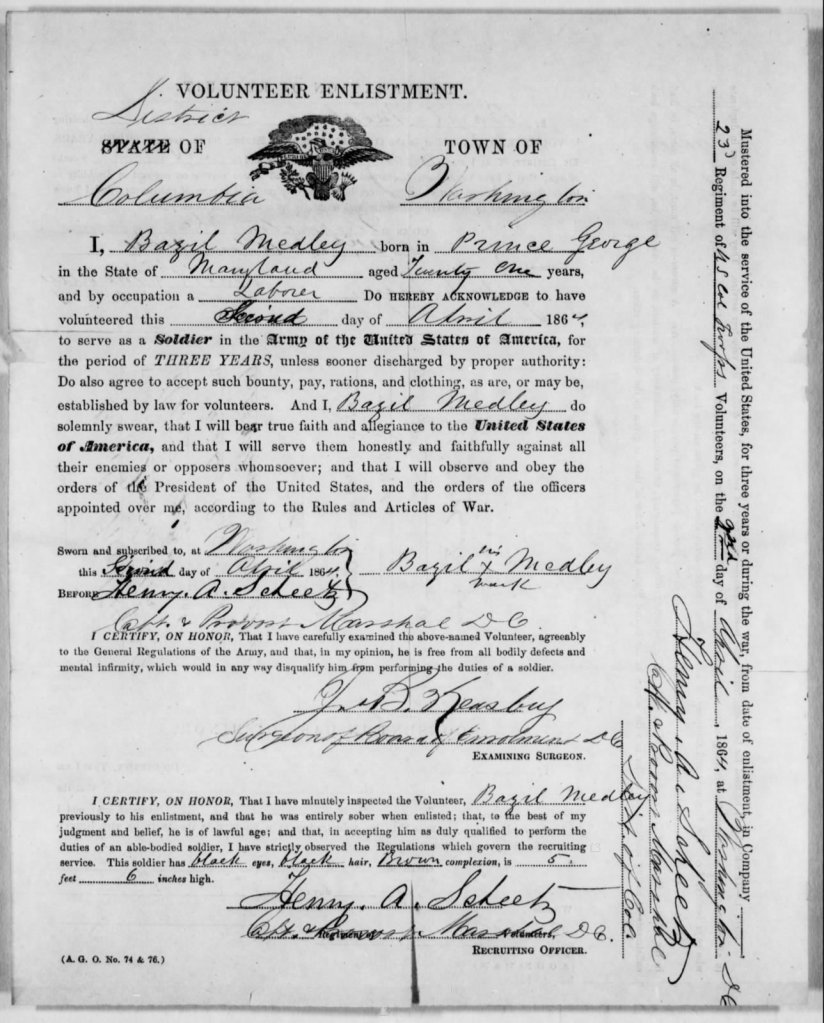
Basil Medley was one of the enslaved people named in the manumissions by the Dangerfield Heirs. USCT records have been located for him under the name “Bazil Medley” (fold3.com | ancestry.com)

Basil Medley was described as a 5 foot 6 inches man, 21 years old. He had brown skin with black eyes and hair. His birth (likely 1843) was listed as Prince George’s County, about ten years after Robert D Sewall inherited the St. Mary’s property and three years after Robert D Sewall sold the St. Mary’s property to George Forbes in 1840, consolidating his holdings in Prince George’s County.

Basil Medley enlisted into Company H of the 23rd Regiment in Washington DC in the spring of 1864. He signed his enlistment papers with his mark.


1853 Inventory

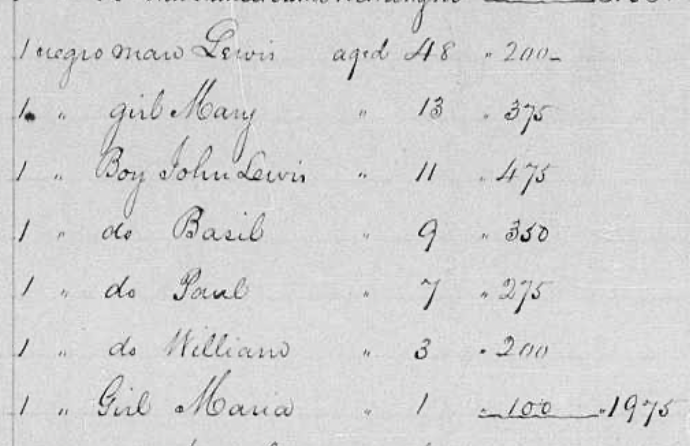
In the 1853 Robert D Sewall Inventory [JH 2:699], there is a family group that included the names Lewis and Basil.

It is in the portion of the inventory that lists the people “gifted” to William P Brinham and on the property in his possession. Brinham was a friend of both Robert D Sewall and Sewall’s brother, William HB. William HB Sewall had inherited the St. Mary’s property from his father in 1820 and upon his death in 1832 had devised it to Robert D Sewall. In the 1840s, Sewall had conveyed some of those who had previously been enslaved in St Mary’s county to Brinham [JBB 3:587]. Listed in the deed are “Louis and his wife Maria, and their children, to wit: Mary and John Louis.”

These names correspond with the first two children listed in the Lewis family group in the 1853 inventory.

From 1853 Inventory of Robert D Sewall, Image 380, first column

In the family group, Lewis is listed as the inferred father, at 48 years old. This places his estimated birth year as 1805, which is consistent with the 1822 St. Mary’s inventory which estimates his birth year as 1806. The two inventories alone however did not indicate a surname name for either family. This left it open as to whether or not Beck and her children were related to the Lewis Medley who escaped the Carrolls and his Medleys, or related to his wife, Beck, and therefore related to a different family surname.

The USCT records cite Basil’s last name as Medley, which suggests that Lewis (born 1805/6) was also a Medley.

The presence of Medley for Basil suggests that Beck’s children and grandchildren are related to Lewis Medley who left with the British in 1812. It is likely that Beck’s partner and Lewis’s father is the Medley.

Thomas Clarke (b. ca 1783) & Charity (b. ca 1790)

This post is one in a series in an attempt to identify members of the Clarke family groups among the people enslaved by Robert D Sewall at “Poplar Hill” in Prince George’s County


Thomas Clarke, age 70, is listed in the 1853 Robert D Sewall inventory with Charity, age 63. [JH 2:699]. Having lived at least two decades past forty, they have surpassed the usual lifespan of an enslaved person. They were listed without an appraised value. Berry, in the The Price for their Pound, discusses the life cycle of the enslaved and in the chapter on the elderly (any enslaved person over 40), she writes “As the enslaved aged, their monetary values decreased and they became worthless on the market. Despite low external values, their soul values [internal values placed on themselves and by their kin] excelled. They carried great wisdom and stability for the community and were respected by the younger enslaved family and friends.” (130-131)

Thomas Clarke and Charity lived at “Poplar Hill” surrounded by their nieces and nephews and their children. The Sewalls and Dangerfields likely no longer had them working in the fields or the house, and so they were more likely providing child care for the small children under 10 while their parents worked under the watchful eye of the overseers and managers.


Thomas Clarke and Charity are also listed in the 1821 Robert Sewall Inventory, though they are not listed together. [TT 4:352] Thomas is listed with other adult males (Tom, Sampson, Capt John and Capt George — “Capt” signifying carpenters). Charity is listed with other female headed family groups with three children: Bob, age 7, Nelly, age 2, and Henrietta, infant. Immediately following her family group was that of Easter and her two children.

The “Early Records of White Marsh Church” includes baptismal records from White Marsh. “White Marsh was the center of Catholic life in Prince George’s County.” (Maryland State Archives). It was a Jesuit plantation that used enslaved labor for the profit of the Catholic Church. The Sewalls were a Catholic family with a private chapel included in the dwelling plantation.

In 1828, among the baptismal records of White Marsh was an April 9th baptism for “Mary, daughter of Thos. & Charity, servts [ensalved people] of Robert Sewall. The sponsor was Esther of same.”

This suggests the possibility that Charity and Easter/Esther are sisters and that they sponsored each others children.


The 1828 baptismal record also helps to the clarify the 1853 Inventory. Thomas and Charity Clarke are listed on page 1 of the inventory and the page breaks after their names. Without a value, they are not included in the subtotals on the first page or the second page, making it ambiguous if they are considered part of the family group that continues on page two.

NameAgeValue
Lucy + boy27 & 6825
Mary23650
Lewis29950

Lucy [1826], Mary [1830], Lewis [1824] would have been born after the 1821 inventory and close to Charity’s child-bearing year range (1805-1825 +/- a few years).

The baptismal record however, shows an earlier birth year for Mary — 1828– which places her birth in closer proximity to Charity’s child-bearing year range.

Sources

Berry, Daina R. The Price for Their Pound of Flesh: The Value of the Enslaved, from Womb to Grave, in the Building of a Nation. United States: Random House Inc, 2018. Print.

Early Records of the White Marsh Church, Prince George’s County, Maryland. Bowie, MD: Prince Georges County Genealogical Society, 2005. Print.